

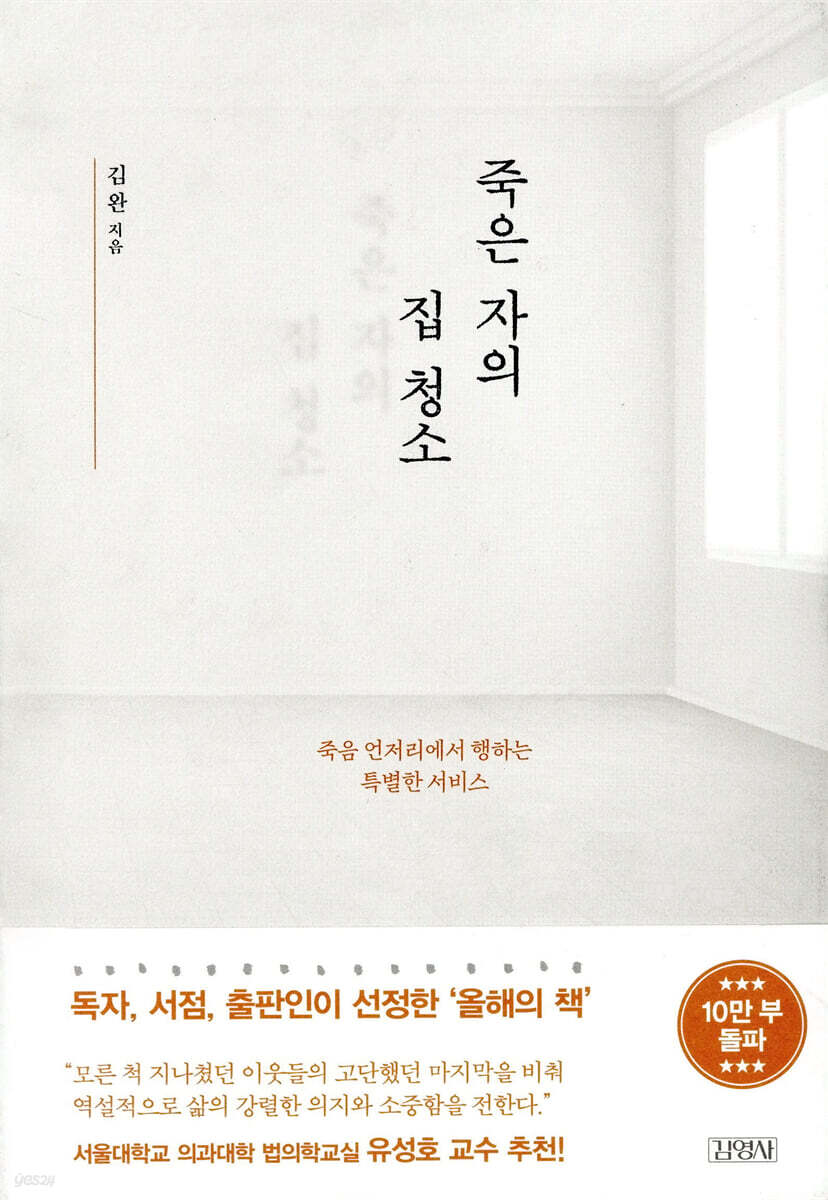
Cleaning the House of the Dead
 |
Description
Book Introduction
“When someone dies alone, my work begins.” About the special service performed at the edge of death An essay by a special cleaner that has been highlighted by numerous media outlets A house where someone died alone, a house with mountains of garbage, a house full of sewage or animal carcasses… . The special death story of Kim Wan, the CEO of 'Hardworks', a special cleaning company that cleans places that are difficult to see or clean. As the expression 'special' cleaning suggests, his workplace is full of unique stories. A person who separated their trash right before committing suicide, a person who asked about the 'cost' of cleaning their own home and then committed suicide, etc. Chapter 1, which mainly deals with on-site stories, unfolds a realistic story so unrealistic that it almost seems like fiction, while Chapter 2 vividly conveys his work through diverse episodes, from the hardships and rewards of being a special cleaner to occupational diseases and occult stories about ghosts. This book not only allows you to have a vicarious experience as if you were standing there, but also makes you think about 'how to live' and 'what kind of death to face.' Through the work of a special cleaner, you can create a valuable opportunity to reflect on your life. |
- You can preview some of the book's contents.
Preview
index
Open the prologue door and take the first step
Chapter 1.
Cleaning the place I left alone
Camping Life
Separate collection
Go somewhere with nice flowers, sis
Death of the Poor
Gold, one day you will be like a stone
Pee Festival
Lifting the cat
The Gates of Hell and Heaven
stack
The World Under the Blanket
Hidden things
Twin bars
To my dear Youngmin
Chapter 2.
I do something a little special
special occupation
The joy of leaving home
Perilla
The Birth of a Haunted House
Should I save you or should I save myself?
price
The mind that looks at the lid of a pot
cleaning the bathroom
With a face as blue as a banknote
Homo Faber
Dwarf Night Pianism
Epilogue
Chapter 1.
Cleaning the place I left alone
Camping Life
Separate collection
Go somewhere with nice flowers, sis
Death of the Poor
Gold, one day you will be like a stone
Pee Festival
Lifting the cat
The Gates of Hell and Heaven
stack
The World Under the Blanket
Hidden things
Twin bars
To my dear Youngmin
Chapter 2.
I do something a little special
special occupation
The joy of leaving home
Perilla
The Birth of a Haunted House
Should I save you or should I save myself?
price
The mind that looks at the lid of a pot
cleaning the bathroom
With a face as blue as a banknote
Homo Faber
Dwarf Night Pianism
Epilogue
Into the book
The building cleaner said she was such a kind person.
That good woman may not have been a good person to herself, and ended up killing herself.
Even though the resentment and sorrow piled up, he could not say a single word of displeasure to others, and instead, he might have turned the target and shot at himself.
Why couldn't she return that kind and upright heart, the one that ultimately abandoned even the very tools that would kill her, to herself? Why couldn't she be kind to herself? Couldn't that upright heart have become a sharp needle, an obsession, constantly stabbing her?
--- p.27
It may seem like I'm cleaning up his trash, but it actually feels like I'm cleaning up the invisible trash that's been piling up in my life.
Is my tireless, day-to-day life ultimately about clearing out trash? Questions arise one after another.
There is no answer and no one to answer.
Perhaps that's what a perfect question is all about.
A world where questions constantly invite more questions, a bustling festival where old and new questions meet, greet each other, and raise a toast.
--- p.65
Inside the cage, each compartment is filled with the fur of a different cat.
The gray fur is a cat breed called Russian Blue, the cream fur is Siamese, and the light brown with white stripes here and there is American Shorthair… .
As a person who has always loved cats, I am amazed that I can tell the species apart just by looking at their fur in this dire situation.
Didn't they say that when a tiger dies, it leaves its skin behind, and when a person dies, it leaves its name behind? I've always been displeased with the honor-first mentality and utterly anthropomorphic worldview that permeates that proverb.
What meaning does leaving behind a name and skin have in the face of death?
--- p.80
Clean up and empty the mess.
In that respect, what I do is no different from clearing the table.
It's just like moving what was on the table into the kitchen, gathering what's in the house and taking it outside.
Clearing tables, which happens every day in every home and restaurant on Earth, is essentially my job.
--- p.134
Wherever it is, whoever we are, I just hope we can meet often.
I hope we can meet and endure the lonely times of suffering from an incurable disease together.
I want to believe that just as the accumulated snow melts when sunlight touches it, loneliness will definitely disappear when we touch each other's hands.
The meeting place is so dazzlingly bright and warm that no ghost or haunted house will ever be able to set foot there again.
--- p.165
Please, I hope that someday you will forgive me for preventing your suicide.
I had to live in that moment, and it felt like I had to keep you alive to keep living.
I haven't gotten off the boat yet.
We're still in the boat together.
I will never forget that for a long time.
That good woman may not have been a good person to herself, and ended up killing herself.
Even though the resentment and sorrow piled up, he could not say a single word of displeasure to others, and instead, he might have turned the target and shot at himself.
Why couldn't she return that kind and upright heart, the one that ultimately abandoned even the very tools that would kill her, to herself? Why couldn't she be kind to herself? Couldn't that upright heart have become a sharp needle, an obsession, constantly stabbing her?
--- p.27
It may seem like I'm cleaning up his trash, but it actually feels like I'm cleaning up the invisible trash that's been piling up in my life.
Is my tireless, day-to-day life ultimately about clearing out trash? Questions arise one after another.
There is no answer and no one to answer.
Perhaps that's what a perfect question is all about.
A world where questions constantly invite more questions, a bustling festival where old and new questions meet, greet each other, and raise a toast.
--- p.65
Inside the cage, each compartment is filled with the fur of a different cat.
The gray fur is a cat breed called Russian Blue, the cream fur is Siamese, and the light brown with white stripes here and there is American Shorthair… .
As a person who has always loved cats, I am amazed that I can tell the species apart just by looking at their fur in this dire situation.
Didn't they say that when a tiger dies, it leaves its skin behind, and when a person dies, it leaves its name behind? I've always been displeased with the honor-first mentality and utterly anthropomorphic worldview that permeates that proverb.
What meaning does leaving behind a name and skin have in the face of death?
--- p.80
Clean up and empty the mess.
In that respect, what I do is no different from clearing the table.
It's just like moving what was on the table into the kitchen, gathering what's in the house and taking it outside.
Clearing tables, which happens every day in every home and restaurant on Earth, is essentially my job.
--- p.134
Wherever it is, whoever we are, I just hope we can meet often.
I hope we can meet and endure the lonely times of suffering from an incurable disease together.
I want to believe that just as the accumulated snow melts when sunlight touches it, loneliness will definitely disappear when we touch each other's hands.
The meeting place is so dazzlingly bright and warm that no ghost or haunted house will ever be able to set foot there again.
--- p.165
Please, I hope that someday you will forgive me for preventing your suicide.
I had to live in that moment, and it felt like I had to keep you alive to keep living.
I haven't gotten off the boat yet.
We're still in the boat together.
I will never forget that for a long time.
--- p.185
Publisher's Review
A person who separated trash just before committing suicide
A person who asked about the 'price' of clearing one's traces before dying
A person who was remembered as ‘a very kind person’…
The different faces of lonely deaths encountered by special cleaners
These days, the expression ‘death from loneliness’ is not unfamiliar.
However, the reality is that there are no official definitions or statistics related to this.
The government's 'Act on the Prevention and Management of Lonely Deaths,' which mainly includes an investigation into the actual state of loneliness and a plan for prevention, was not passed by the National Assembly plenary session until March 2020.
An issue that lingers around us as a vague social problem that is not unfamiliar but does not have a concrete meaning.
Perhaps that is why, when we think of 'death from loneliness', we only think of the image of an elderly person who lived alone and died only to be discovered late.
Nowadays, it is likely that people only think of it as a story distant from themselves, a sympathetic incident, as they do not live alone and are not old.
If you slowly follow the gaze of writer Kim Wan, who travels to various sites as a special cleaner, you will come face to face with the reality of lonely deaths and the bare face of lonely deaths.
A lonely death that strikes not only the elderly, but also the middle-aged and young.
As we come across stories of lonely deaths that transcend generations and genders, our stereotypes begin to break down.
Traces of struggling to survive on the edge of a cliff in life, right up until the point of giving up on life, remain everywhere in the scene.
The author reflects on life while clearing away blood, dirt, and various artifacts that provide clues to his daily life.
So, although this book deals with 'death', paradoxically it talks about 'life'.
Perhaps that's why the special cleaners' field stories don't come across as heavy and sad.
The author confesses, “I believe that this record, which reflects on someone’s death and asks for its meaning, will become a mechanism to make our lives more valuable and stronger.”
This is why this book was created.
The author cleaned his mind by writing down what he experienced and felt on site, clearing away and organizing his miscellaneous thoughts.
I was able to wash away the guilt that came from the professional irony of 'making a living off of someone's death' and find solace in writing.
I hope that readers of this book will also feel a variety of emotions.
I hope that we can face 'death', which is considered ominous and gloomy and we are reluctant to even mention it, and look at 'life' and find comfort in the process.
This sincerity is abundantly contained in the book.
I get caught up in my daily routine and each day passes by in a flash.
But what if we contemplated life and death, even for a moment? Thinking about "What kind of life will I live?" and "What kind of death will I face?" can be a valuable experience, making our own lives feel even more precious.
I believe that the act of reflecting on death and questioning its meaning, the in-depth statement about life and existence that becomes more vivid in the place where humans die, will act as an antiviral agent, even if it causes a fever for a moment, and ultimately become a valuable and powerful mechanism for making our lives more valuable and stronger.
In the professional irony of making a living off of someone's death, the belief that this record would serve that purpose, and the awareness that it was my social responsibility, encouraged me to continue writing.
_Pages 249-250, from "Epilogue"
Lonely death and poor death
“Is South Korea a healthy society?”
Reading the detailed field stories makes you think about not only 'personal health' but also 'social health'.
A nation with boundless advancements in science and technology, GDP, and a national power that is among the best in the world.
But through this book, we encounter lives that are unrelated to this.
A pile of reminders and unpaid bills stuck in the mailbox, water and electricity that have been cut off for a long time, etc.
The author said, “I have never seen a person die alone, surrounded by treasures, only to be discovered late,” and “It seems that it is mostly poor people who die alone.”
It is a bit sad and humorous to see that even though family and friends have long since stopped visiting, creditors still desperately care about the debtor's health.
It's not unusual for people in my line of work to see bereaved families refusing to collect the bodies.
It is rare for long-lost family members and distant relatives to readily step forward and say, “Yes, I will take responsibility for all the expenses related to the funeral and cleaning up the house” upon hearing the sudden news of death.
He writes a waiver of his assets at the speed of light, thinking, 'I might end up in debt.'
_Page 43, from “The Death of the Poor”
There are also houses filled with huge mountains of garbage, houses filled with thousands of plastic bottles filled with urine, houses strewn with dead cats…
Situations are unfolding around us that make it difficult to believe that we live in the same era and society.
They probably didn't live like this from the beginning.
If you think about it that way, you can't say that it has nothing to do with all of us who are living ordinary lives right now.
This is why we need to consider the structural issues that create social isolation and whether such situations could have been prevented.
A serious attitude toward one's job
The daily life of someone who makes a living in special cleaning…
“Because you’re doing something special.” “I don’t think it’s something that just anyone can do.” “It’s a noble thing.” Reporters, drama writers, doctors, administrative staff, etc.
Many people come to us to tell the stories of special cleaners in articles, dramas, papers, reports, etc.
And they ask a lot of questions about 'special cleaning'.
People often ask first, "What's difficult?" and then follow up with, "When do you feel rewarded?"
Occasionally, there are interviewees who seriously ask, "Have you ever seen a ghost?"
The latter part of this book contains many questions about the unique profession of 'special cleaner'.
Reading the answers to the countless questions I've received, presented as related episodes, also makes me think about 'professional spirit' and 'work philosophy'.
Furthermore, the writer's warm humanism can be felt in the writer's efforts to return to daily life after mentally arduous work, and in the incidents that arise due to his strong work ethic.
My work is special, just like yours.
It's about clearing the place where the one and only precious person in the world died.
Since a man cannot die twice, my service to Him, who is one and only, is also only once.
Isn't that truly special and noble?
_Page 139, from “Special Occupations”
The solid writing style is also a major attraction of this book.
The author's unique background, having graduated from the Department of Creative Writing, played a role in being able to capture the vivid scene without being too heavy or too light.
Insights into life and death, reflections on our society, and even our attitudes toward work.
Let's encounter things that we should think about at least once in our lives through this book.
As I read through the stories of special services performed on the brink of death,
A person who asked about the 'price' of clearing one's traces before dying
A person who was remembered as ‘a very kind person’…
The different faces of lonely deaths encountered by special cleaners
These days, the expression ‘death from loneliness’ is not unfamiliar.
However, the reality is that there are no official definitions or statistics related to this.
The government's 'Act on the Prevention and Management of Lonely Deaths,' which mainly includes an investigation into the actual state of loneliness and a plan for prevention, was not passed by the National Assembly plenary session until March 2020.
An issue that lingers around us as a vague social problem that is not unfamiliar but does not have a concrete meaning.
Perhaps that is why, when we think of 'death from loneliness', we only think of the image of an elderly person who lived alone and died only to be discovered late.
Nowadays, it is likely that people only think of it as a story distant from themselves, a sympathetic incident, as they do not live alone and are not old.
If you slowly follow the gaze of writer Kim Wan, who travels to various sites as a special cleaner, you will come face to face with the reality of lonely deaths and the bare face of lonely deaths.
A lonely death that strikes not only the elderly, but also the middle-aged and young.
As we come across stories of lonely deaths that transcend generations and genders, our stereotypes begin to break down.
Traces of struggling to survive on the edge of a cliff in life, right up until the point of giving up on life, remain everywhere in the scene.
The author reflects on life while clearing away blood, dirt, and various artifacts that provide clues to his daily life.
So, although this book deals with 'death', paradoxically it talks about 'life'.
Perhaps that's why the special cleaners' field stories don't come across as heavy and sad.
The author confesses, “I believe that this record, which reflects on someone’s death and asks for its meaning, will become a mechanism to make our lives more valuable and stronger.”
This is why this book was created.
The author cleaned his mind by writing down what he experienced and felt on site, clearing away and organizing his miscellaneous thoughts.
I was able to wash away the guilt that came from the professional irony of 'making a living off of someone's death' and find solace in writing.
I hope that readers of this book will also feel a variety of emotions.
I hope that we can face 'death', which is considered ominous and gloomy and we are reluctant to even mention it, and look at 'life' and find comfort in the process.
This sincerity is abundantly contained in the book.
I get caught up in my daily routine and each day passes by in a flash.
But what if we contemplated life and death, even for a moment? Thinking about "What kind of life will I live?" and "What kind of death will I face?" can be a valuable experience, making our own lives feel even more precious.
I believe that the act of reflecting on death and questioning its meaning, the in-depth statement about life and existence that becomes more vivid in the place where humans die, will act as an antiviral agent, even if it causes a fever for a moment, and ultimately become a valuable and powerful mechanism for making our lives more valuable and stronger.
In the professional irony of making a living off of someone's death, the belief that this record would serve that purpose, and the awareness that it was my social responsibility, encouraged me to continue writing.
_Pages 249-250, from "Epilogue"
Lonely death and poor death
“Is South Korea a healthy society?”
Reading the detailed field stories makes you think about not only 'personal health' but also 'social health'.
A nation with boundless advancements in science and technology, GDP, and a national power that is among the best in the world.
But through this book, we encounter lives that are unrelated to this.
A pile of reminders and unpaid bills stuck in the mailbox, water and electricity that have been cut off for a long time, etc.
The author said, “I have never seen a person die alone, surrounded by treasures, only to be discovered late,” and “It seems that it is mostly poor people who die alone.”
It is a bit sad and humorous to see that even though family and friends have long since stopped visiting, creditors still desperately care about the debtor's health.
It's not unusual for people in my line of work to see bereaved families refusing to collect the bodies.
It is rare for long-lost family members and distant relatives to readily step forward and say, “Yes, I will take responsibility for all the expenses related to the funeral and cleaning up the house” upon hearing the sudden news of death.
He writes a waiver of his assets at the speed of light, thinking, 'I might end up in debt.'
_Page 43, from “The Death of the Poor”
There are also houses filled with huge mountains of garbage, houses filled with thousands of plastic bottles filled with urine, houses strewn with dead cats…
Situations are unfolding around us that make it difficult to believe that we live in the same era and society.
They probably didn't live like this from the beginning.
If you think about it that way, you can't say that it has nothing to do with all of us who are living ordinary lives right now.
This is why we need to consider the structural issues that create social isolation and whether such situations could have been prevented.
A serious attitude toward one's job
The daily life of someone who makes a living in special cleaning…
“Because you’re doing something special.” “I don’t think it’s something that just anyone can do.” “It’s a noble thing.” Reporters, drama writers, doctors, administrative staff, etc.
Many people come to us to tell the stories of special cleaners in articles, dramas, papers, reports, etc.
And they ask a lot of questions about 'special cleaning'.
People often ask first, "What's difficult?" and then follow up with, "When do you feel rewarded?"
Occasionally, there are interviewees who seriously ask, "Have you ever seen a ghost?"
The latter part of this book contains many questions about the unique profession of 'special cleaner'.
Reading the answers to the countless questions I've received, presented as related episodes, also makes me think about 'professional spirit' and 'work philosophy'.
Furthermore, the writer's warm humanism can be felt in the writer's efforts to return to daily life after mentally arduous work, and in the incidents that arise due to his strong work ethic.
My work is special, just like yours.
It's about clearing the place where the one and only precious person in the world died.
Since a man cannot die twice, my service to Him, who is one and only, is also only once.
Isn't that truly special and noble?
_Page 139, from “Special Occupations”
The solid writing style is also a major attraction of this book.
The author's unique background, having graduated from the Department of Creative Writing, played a role in being able to capture the vivid scene without being too heavy or too light.
Insights into life and death, reflections on our society, and even our attitudes toward work.
Let's encounter things that we should think about at least once in our lives through this book.
As I read through the stories of special services performed on the brink of death,
GOODS SPECIFICS
- Date of issue: May 30, 2020
- Format: Hardcover book binding method guide
- Page count, weight, size: 252 pages | 348g | 130*190*20mm
- ISBN13: 9788934992493
- ISBN10: 8934992492
You may also like
카테고리
korean


korean

![GQ KOREA Mark (Monthly): December [2025]](http://librairie.coreenne.fr/cdn/shop/files/8ef265dbbfbf186523ed75ba7319009d.jpg?v=1765340328&width=3840)


