

Temperature of Language
 |
Description
Book Introduction
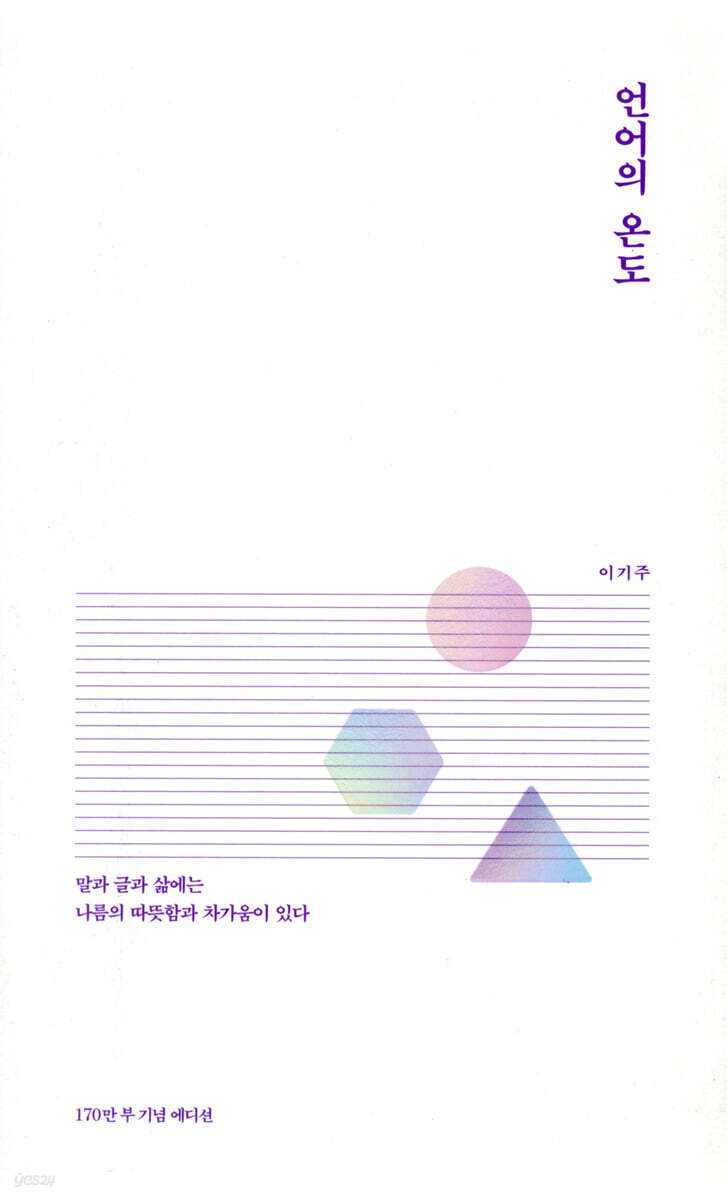
“Words and writing have their own temperature.”
Words and writing have their own temperature.
The degree of warmth and coldness varies from person to person.
Moderately warm language embraces sadness.
When people feel weary from life, some people talk to friends to vent their worries, while others read books and find solace in the words of the author.
So, what would be the temperature of our language as we pick up this book? If a loved one leaves us because of a single thoughtless word, wouldn't our "verbal temperature" be too hot?
If someone closes their heart because of a sentence or two, it may be because the 'temperature of the text' is too cold.
perhaps.
Author Lee Ki-joo is a person who enjoys eavesdropping and recording.
He confesses that his bad habit kicks in whenever he gets on a bus or subway.
Listen to the conversations of ordinary people with your ears perked up.
And when a meaningful sentence comes into my ears, I quietly note it down.
Because it seems like there might be a desperate story hidden in the words they exchange and the sentences they scribble out without thinking.
"The Temperature of Language" is a book that densely captures the author's discovery of meaningful words and phrases in everyday life, the etymology and origin of words, and the preciousness and urgency of such language.
If you breathe life into each sentence as you turn each page and read it carefully, savoring it as if you were eating a moderately hot meal, you might be able to reflect on your own 'language temperature.'
Words and writing have their own temperature.
The degree of warmth and coldness varies from person to person.
Moderately warm language embraces sadness.
When people feel weary from life, some people talk to friends to vent their worries, while others read books and find solace in the words of the author.
So, what would be the temperature of our language as we pick up this book? If a loved one leaves us because of a single thoughtless word, wouldn't our "verbal temperature" be too hot?
If someone closes their heart because of a sentence or two, it may be because the 'temperature of the text' is too cold.
perhaps.
Author Lee Ki-joo is a person who enjoys eavesdropping and recording.
He confesses that his bad habit kicks in whenever he gets on a bus or subway.
Listen to the conversations of ordinary people with your ears perked up.
And when a meaningful sentence comes into my ears, I quietly note it down.
Because it seems like there might be a desperate story hidden in the words they exchange and the sentences they scribble out without thinking.
"The Temperature of Language" is a book that densely captures the author's discovery of meaningful words and phrases in everyday life, the etymology and origin of words, and the preciousness and urgency of such language.
If you breathe life into each sentence as you turn each page and read it carefully, savoring it as if you were eating a moderately hot meal, you might be able to reflect on your own 'language temperature.'
- You can preview some of the book's contents.
Preview
index
Temperature of Language
Introduction: What is the temperature of your language?
Part 1: Words, Things to Remember
The sicker person
Can words be medicine?
Love makes no excuses
Gaps and sturdiness
The Grave of Words, Unchong
I just took a walk
I still care about you
You resemble May
A journey without a destination
The existence of absence
roadside flowers
A real apology hurts
How to tell the difference between fake and real
A story as big as the universe
People being pushed to the edge
A flower of comfort blooming above the calculations
Marriage for us, not me
signs of wear
A guy who makes a living by traveling
Violence that forces effort
Solo cold vulnerability theory
Branches of Busyness
Comedy and Tragedy
The path that suits you
What is and what isn't
The last day of the year
I'm sorry I can't give you more
The bond that connects parents and children
Aejiyok gisaeng (love desires her life)
Part 2, The Unsupported Flower
scratch, writing, longing
A person who is everything to someone
Where did the word love come from?
Planting my mother
fattening people
Tears aren't just for the eyes.
Irreplaceable
Irreplaceable sentence
Lighting is relighting
You are inside me
Happy Dictionary
Everyone returned to the forest
A goodnight kiss to my daughter
Treasure hunt for two
The difference between a professional and an amateur
Filling the gap in time
rainbow bridge
If you look closely, you can see something different
Hell is a place without hope
kneel before sorrow
The moment when only that person is visible
Why the man jumps into the sea
Bread-eating relationship
Lost People
typographic addiction
Why security guards keep notebooks
Erosion and sedimentation
Whenever I am struggling in front of a text, I
The ending is as important as the beginning
Part 3: The Proof of Being Alive
Why the hat went for a walk
Wind is also a nest material
Lee Sedol proves it
The day I found your memories
Love often walks behind
How to Deal with Anger
A triangle that wanted to become a circle
Jijihyang (Paper Land), the home of paper
Emotions are moving
Things Jeju Island taught me
Purpose of travel
Don't accept the dark night
Drawing a line
Why did she take the picture?
Different types of memories
Becoming an adult
Factors that determine age
A person who leads a trip
soft and hard
Calling names
Synonym for possibility
The time when the sky clears up
seasonal gap
A letter from the seasons
The body spoke
The fragrance of flowers is a hundred miles, and the fragrance of people is ten thousand miles
Observation is soon interest
Why You Should Forgive Me
Other people's misfortune
When you feel something beautiful as beautiful
Introduction: What is the temperature of your language?
Part 1: Words, Things to Remember
The sicker person
Can words be medicine?
Love makes no excuses
Gaps and sturdiness
The Grave of Words, Unchong
I just took a walk
I still care about you
You resemble May
A journey without a destination
The existence of absence
roadside flowers
A real apology hurts
How to tell the difference between fake and real
A story as big as the universe
People being pushed to the edge
A flower of comfort blooming above the calculations
Marriage for us, not me
signs of wear
A guy who makes a living by traveling
Violence that forces effort
Solo cold vulnerability theory
Branches of Busyness
Comedy and Tragedy
The path that suits you
What is and what isn't
The last day of the year
I'm sorry I can't give you more
The bond that connects parents and children
Aejiyok gisaeng (love desires her life)
Part 2, The Unsupported Flower
scratch, writing, longing
A person who is everything to someone
Where did the word love come from?
Planting my mother
fattening people
Tears aren't just for the eyes.
Irreplaceable
Irreplaceable sentence
Lighting is relighting
You are inside me
Happy Dictionary
Everyone returned to the forest
A goodnight kiss to my daughter
Treasure hunt for two
The difference between a professional and an amateur
Filling the gap in time
rainbow bridge
If you look closely, you can see something different
Hell is a place without hope
kneel before sorrow
The moment when only that person is visible
Why the man jumps into the sea
Bread-eating relationship
Lost People
typographic addiction
Why security guards keep notebooks
Erosion and sedimentation
Whenever I am struggling in front of a text, I
The ending is as important as the beginning
Part 3: The Proof of Being Alive
Why the hat went for a walk
Wind is also a nest material
Lee Sedol proves it
The day I found your memories
Love often walks behind
How to Deal with Anger
A triangle that wanted to become a circle
Jijihyang (Paper Land), the home of paper
Emotions are moving
Things Jeju Island taught me
Purpose of travel
Don't accept the dark night
Drawing a line
Why did she take the picture?
Different types of memories
Becoming an adult
Factors that determine age
A person who leads a trip
soft and hard
Calling names
Synonym for possibility
The time when the sky clears up
seasonal gap
A letter from the seasons
The body spoke
The fragrance of flowers is a hundred miles, and the fragrance of people is ten thousand miles
Observation is soon interest
Why You Should Forgive Me
Other people's misfortune
When you feel something beautiful as beautiful
Into the book
Temperature of Language
Yesterday I turned on my laptop and tried to type in 'people' but accidentally typed 'life'.
Come to think of it, if you secretly change the final consonant in 'person', it becomes 'love', and if you secretly remove the vowel from 'person', it becomes 'life'.
Is it because the three words are similar?
It seems that there is no one who lives without being entangled in love, and no life without love interfering with it.
---From "Where did the word love come from?"
As the food was about to run out, the topic shifted to love.
A friend of mine who works as an editor at a magazine emphasized that the moment you fall in love, you start having disturbing fantasies.
“When you like someone, you become obsessed with the desire to have not only their ‘day’ but also their ‘night’.
Sometimes we try to be confident criminals who trust each other's feelings and steal each other's nights.
“Yeah, that must be love.”
The president of a publishing company that primarily plans and publishes philosophy books added to this story.
“The so-called ‘some’ is a struggle between the ‘confidence’ and ‘doubt’ that you have feelings for someone.
Certainty and doubt alternate like the ebb and flow of the tide.
Then, when the level of doubt gradually fades and only certainty remains, isn’t that when love truly begins?”
---From "I Still Care About You"
Writing isn't just left on the margins.
It is also engraved on the head and chest.
A phrase that is deeply embedded in the heart is a flower that does not wither.
We find comfort in looking at those flowers.
Sometimes, a single, concise sentence can soothe a wound and ease the emptiness of life.
---From "Scratch, Writing, Longing"
The Inuit (Eskimos) manage their anger wisely.
No, let it go.
They say that when they get angry, they stop what they are doing and just walk away.
How long? Until the anger subsides.
And when you think you've come far enough, leave a long stick there.
It's about leaving behind a place filled with overly hot emotions that could burn someone, entangled with hatred, resentment, and sorrow.
---From "How to Deal with Anger"
I once thought about the similarity between travel and wandering.
They are similar in that they both involve ‘leaving.’
However, while the beginning of the two acts is similar, the ending is very different.
The English word 'tour', meaning travel, comes from the Latin word 'tornus', meaning 'to go around' or 'to go around'.
What flows has the property of flowing and returning to its place.
Anyone who sets out on a journey will eventually return to the starting point of their journey.
If there is no place to return to, then perhaps it is not a journey but a wandering.
---From "Purpose of Travel"
Being able to share a glance with someone you love is truly a precious thing.
The act of opening one's eyes wide and looking closely at another person has quite an important meaning in our lives.
So the equation ‘Observation = Interest’ holds true.
When people lack interest, they don't look at each other.
There is no reason to be curious, so I look away.
It is ignoring.
“I don’t want to see you” means “I’m not interested in you” or “My passionate feelings have cooled down at some point.
It is often used interchangeably with the phrase “No, it got cold.”
Maybe that's why.
Looking back, it seems that the moment I stopped being interested, I also stopped observing the other person.
Yesterday I turned on my laptop and tried to type in 'people' but accidentally typed 'life'.
Come to think of it, if you secretly change the final consonant in 'person', it becomes 'love', and if you secretly remove the vowel from 'person', it becomes 'life'.
Is it because the three words are similar?
It seems that there is no one who lives without being entangled in love, and no life without love interfering with it.
---From "Where did the word love come from?"
As the food was about to run out, the topic shifted to love.
A friend of mine who works as an editor at a magazine emphasized that the moment you fall in love, you start having disturbing fantasies.
“When you like someone, you become obsessed with the desire to have not only their ‘day’ but also their ‘night’.
Sometimes we try to be confident criminals who trust each other's feelings and steal each other's nights.
“Yeah, that must be love.”
The president of a publishing company that primarily plans and publishes philosophy books added to this story.
“The so-called ‘some’ is a struggle between the ‘confidence’ and ‘doubt’ that you have feelings for someone.
Certainty and doubt alternate like the ebb and flow of the tide.
Then, when the level of doubt gradually fades and only certainty remains, isn’t that when love truly begins?”
---From "I Still Care About You"
Writing isn't just left on the margins.
It is also engraved on the head and chest.
A phrase that is deeply embedded in the heart is a flower that does not wither.
We find comfort in looking at those flowers.
Sometimes, a single, concise sentence can soothe a wound and ease the emptiness of life.
---From "Scratch, Writing, Longing"
The Inuit (Eskimos) manage their anger wisely.
No, let it go.
They say that when they get angry, they stop what they are doing and just walk away.
How long? Until the anger subsides.
And when you think you've come far enough, leave a long stick there.
It's about leaving behind a place filled with overly hot emotions that could burn someone, entangled with hatred, resentment, and sorrow.
---From "How to Deal with Anger"
I once thought about the similarity between travel and wandering.
They are similar in that they both involve ‘leaving.’
However, while the beginning of the two acts is similar, the ending is very different.
The English word 'tour', meaning travel, comes from the Latin word 'tornus', meaning 'to go around' or 'to go around'.
What flows has the property of flowing and returning to its place.
Anyone who sets out on a journey will eventually return to the starting point of their journey.
If there is no place to return to, then perhaps it is not a journey but a wandering.
---From "Purpose of Travel"
Being able to share a glance with someone you love is truly a precious thing.
The act of opening one's eyes wide and looking closely at another person has quite an important meaning in our lives.
So the equation ‘Observation = Interest’ holds true.
When people lack interest, they don't look at each other.
There is no reason to be curious, so I look away.
It is ignoring.
“I don’t want to see you” means “I’m not interested in you” or “My passionate feelings have cooled down at some point.
It is often used interchangeably with the phrase “No, it got cold.”
Maybe that's why.
Looking back, it seems that the moment I stopped being interested, I also stopped observing the other person.
---From “Observation is Interest”
Publisher's Review
Temperature of Language
“Words and writing have their own temperature.”
Subtle things are usually beautiful.
And it's sensitive.
Our language is a representative example.
In Korean, the ending of a sentence can change with just one dot or one particle.
The moment you try to say to your friend, “You have a pretty face too,” but accidentally say, “You only have a pretty face,” you both end up blushing.
Words and writing have their own temperature.
The degree of warmth and coldness varies from person to person.
Moderately warm language embraces sadness.
When people feel weary from life, some people talk to friends to vent their worries, while others read books and find solace in the words of the author.
Language, as hot as a furnace, is bound to be full of emotions.
It may be refreshing for the speaker, but it can leave the listener emotionally burned.
Even an expression as cold as ice is dangerous.
Rather than changing the other person's mind, it freezes them completely.
So, what would be the temperature of our language as we pick up this book? If a loved one leaves us because of a single thoughtless word, wouldn't our "verbal temperature" be too hot?
If someone closes their heart because of a sentence or two, it may be because the 'temperature of the text' is too cold.
perhaps.
Author Lee Ki-joo is a person who enjoys eavesdropping and recording.
He confesses that his bad habit kicks in whenever he gets on a bus or subway.
Listen to the conversations of ordinary people with your ears perked up.
And when a meaningful sentence comes into my ears, I quietly note it down.
Because it seems like there might be a desperate story hidden in the words they exchange and the sentences they scribble out without thinking.
"The Temperature of Language" is a book that densely captures the author's discovery of meaningful words and phrases in everyday life, the etymology and origin of words, and the preciousness and urgency of such language.
If you breathe life into each sentence as you turn each page and read it carefully, savoring it as if you were eating a moderately hot meal, you might be able to reflect on your own 'language temperature.'
“Words and writing have their own temperature.”
Subtle things are usually beautiful.
And it's sensitive.
Our language is a representative example.
In Korean, the ending of a sentence can change with just one dot or one particle.
The moment you try to say to your friend, “You have a pretty face too,” but accidentally say, “You only have a pretty face,” you both end up blushing.
Words and writing have their own temperature.
The degree of warmth and coldness varies from person to person.
Moderately warm language embraces sadness.
When people feel weary from life, some people talk to friends to vent their worries, while others read books and find solace in the words of the author.
Language, as hot as a furnace, is bound to be full of emotions.
It may be refreshing for the speaker, but it can leave the listener emotionally burned.
Even an expression as cold as ice is dangerous.
Rather than changing the other person's mind, it freezes them completely.
So, what would be the temperature of our language as we pick up this book? If a loved one leaves us because of a single thoughtless word, wouldn't our "verbal temperature" be too hot?
If someone closes their heart because of a sentence or two, it may be because the 'temperature of the text' is too cold.
perhaps.
Author Lee Ki-joo is a person who enjoys eavesdropping and recording.
He confesses that his bad habit kicks in whenever he gets on a bus or subway.
Listen to the conversations of ordinary people with your ears perked up.
And when a meaningful sentence comes into my ears, I quietly note it down.
Because it seems like there might be a desperate story hidden in the words they exchange and the sentences they scribble out without thinking.
"The Temperature of Language" is a book that densely captures the author's discovery of meaningful words and phrases in everyday life, the etymology and origin of words, and the preciousness and urgency of such language.
If you breathe life into each sentence as you turn each page and read it carefully, savoring it as if you were eating a moderately hot meal, you might be able to reflect on your own 'language temperature.'
GOODS SPECIFICS
- Date of publication: August 19, 2016
- Page count, weight, size: 308 pages | 344g | 112*184*30mm
- ISBN13: 9791195522125
- ISBN10: 1195522126
You may also like
카테고리
korean


korean

![GQ KOREA Mark (Monthly): December [2025]](http://librairie.coreenne.fr/cdn/shop/files/8ef265dbbfbf186523ed75ba7319009d.jpg?v=1765340328&width=3840)


