

A measure of offbeat
 |
Description
Book Introduction
★ National Book Award Nominee
★ Finalist for the William Saroyan International Literary Award
★ Selected as one of NPR's 'Best Books of the Year'
Recommended by novelist Kim Yeon-su
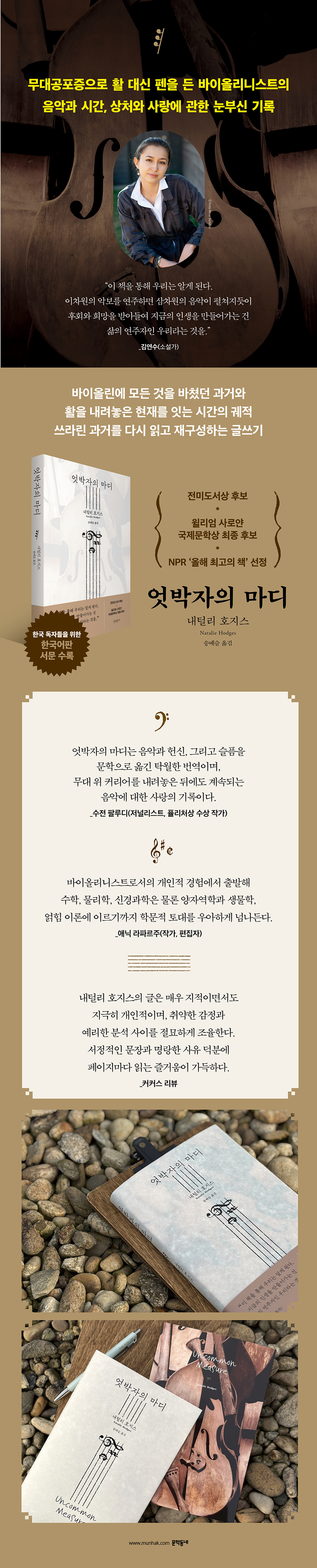
“Through this book we come to know:
Just as playing a two-dimensional score unfolds three-dimensional music,
Accepting regrets and hopes and creating the life you have now
“We are the performers of life.” _Kim Yeon-su (novelist)
A violinist who holds a pen instead of a bow due to stage fright
A dazzling record of music, time, hurt, and love.
Is there anything more closely linked to time than music? We perceive the length of time as we listen to music while driving, and we sense the passage of time as the beats of an orchestra stretch and contract like a rubber band.
Natalie Hodges, author of "The Beat of Time," knows this sense of time better than anyone.
Hodges, who had been playing the violin since the age of five, gave up music after nearly twenty years due to stage fright caused by the pressure of time.
But Hodges takes up his pen instead of his bow, confronts the past, and redefines its meaning.
"The Beat of the Outbeat" is a record of wounds, an exploration of time, and a confession of love for music.
To express his experiences, Hodges delves into physics and quantum mechanics, exploring the relationship between time and music.
He also calmly tells the story of his mother who led him into the world of music, the discrimination that follows Asians majoring in classical music, the joys and sorrows of being a Korean-American immigrant, and the heartbreaking family history of his father.
Despite the frustrations and personal pain of having to give up his dreams, his story is centered around his love for music and family.
In a special preface for Korean readers, he reveals his deep affection for his roots by sharing the story of his grandparents who immigrated to America.
Natalie Hodges's debut novel, "The Beatles," was nominated for the National Book Award and the William Saroyan International Literary Award, and was named a "Best Book of the Year" by NPR and Smithsonian Magazine.
Hailed as “a musician with a poet’s soul, a writer with a musician’s heart,” Hodges offers a heartwarming message that anything that happened in the past can have a different meaning, and that we can bounce back even when betrayed by those we love most.
★ Finalist for the William Saroyan International Literary Award
★ Selected as one of NPR's 'Best Books of the Year'
Recommended by novelist Kim Yeon-su
“Through this book we come to know:
Just as playing a two-dimensional score unfolds three-dimensional music,
Accepting regrets and hopes and creating the life you have now
“We are the performers of life.” _Kim Yeon-su (novelist)
A violinist who holds a pen instead of a bow due to stage fright
A dazzling record of music, time, hurt, and love.
Is there anything more closely linked to time than music? We perceive the length of time as we listen to music while driving, and we sense the passage of time as the beats of an orchestra stretch and contract like a rubber band.
Natalie Hodges, author of "The Beat of Time," knows this sense of time better than anyone.
Hodges, who had been playing the violin since the age of five, gave up music after nearly twenty years due to stage fright caused by the pressure of time.
But Hodges takes up his pen instead of his bow, confronts the past, and redefines its meaning.
"The Beat of the Outbeat" is a record of wounds, an exploration of time, and a confession of love for music.
To express his experiences, Hodges delves into physics and quantum mechanics, exploring the relationship between time and music.
He also calmly tells the story of his mother who led him into the world of music, the discrimination that follows Asians majoring in classical music, the joys and sorrows of being a Korean-American immigrant, and the heartbreaking family history of his father.
Despite the frustrations and personal pain of having to give up his dreams, his story is centered around his love for music and family.
In a special preface for Korean readers, he reveals his deep affection for his roots by sharing the story of his grandparents who immigrated to America.
Natalie Hodges's debut novel, "The Beatles," was nominated for the National Book Award and the William Saroyan International Literary Award, and was named a "Best Book of the Year" by NPR and Smithsonian Magazine.
Hailed as “a musician with a poet’s soul, a writer with a musician’s heart,” Hodges offers a heartwarming message that anything that happened in the past can have a different meaning, and that we can bounce back even when betrayed by those we love most.
- You can preview some of the book's contents.
Preview
index
Preface for Korean Readers - 9
Prelude - 15
Clear Training - 21
The Sixth Sense: Notes on Improvisation - 53
Symmetry Breaking - 87
Chaconne - 123
The Stop of a Rotating World - 157
Coda: Memory is a Hologram - 191
Acknowledgements - 199
Translator's Note - 205
Week - 209
Source - 215
References - 216
Prelude - 15
Clear Training - 21
The Sixth Sense: Notes on Improvisation - 53
Symmetry Breaking - 87
Chaconne - 123
The Stop of a Rotating World - 157
Coda: Memory is a Hologram - 191
Acknowledgements - 199
Translator's Note - 205
Week - 209
Source - 215
References - 216
Detailed image
Into the book
I feel that music inevitably connects me to my Koreanness.
I think back to the happiest moments when I was still playing an instrument.
Before my family split up, after violin lessons on Friday afternoons, all six of us would gather at Shilla, a Korean restaurant in south Denver, to eat galbi and mul naengmyeon.
(…) That time wasn’t always completely happy.
The day I failed the lesson, I swallowed my meal with tears in my eyes.
The discord between Mom and Dad weighed heavily on the already crowded table.
It was also in that restaurant that I observed my grandmother, who became more and more quiet as time passed and her heart grew quieter.
But if I could leave the present behind and go back to the past even for a moment, I would go back to the time when my family all ate together.
Now, looking back on those days, I wonder if stopping time really was possible.
--- From "Preface for Korean Readers" pp.11-12
Musical time exists within the ordinary flow of everyday time, but it is distinctly different.
What is certain, at least, is that musical time clearly demonstrates how much time varies according to our conscious perception, and how much the opposite is true as well.
Actually, I think the same thing applies to everyday time.
Time flies when you're having fun, but it slows down when you're waiting anxiously.
But music bends flexible time and shapes it into sound.
Musical time is not a simple flow of beats.
Just as our perception of the length of an hour is determined not by the actual passage of sixty minutes, but by what happens to us within it.
--- p.31 From "Erasing Training"
It takes constant effort to be considered a useful musician, but the moment he starts sounding like he's trying too hard during a performance, his music loses its way.
I never managed to reconcile this tension and contradiction while playing.
Even when you're trying to play every note as you've practiced, even when you're trying to improvise and failing.
--- p.65 From “The Sixth Sense: Notes on Improvisation”
Moving to the other side of the world to start a new life necessarily entails a massive shift in space, language, and time.
Change is essential, moving the continent from here to there, from past to present.
To do that, you have to change yourself, you have to break the symmetry that your past, your previous self, has created.
Perhaps in many cases it is precisely this desire for collapse that drives immigration.
But once I arrived in a new country and there was no turning back, I realized that no matter what I did, no matter how hard I worked or how successful I became, the way others viewed me didn't change much.
The more I try to change my appearance to fit in, the more obvious it becomes that I am an outsider, as always.
--- p.113 From "Symmetry Breakdown"
All this time I had forgotten how beautiful the D major section was, how everything sounded so present and vibrant.
This section is the only moment in the entire song where memories are suspended, and the sadness is momentarily relieved by something beautiful.
The beauty is the scenery of green hills after the rain, the little blue light in the stained glass window, the sound of the violin.
Maybe this is where I can start again, where I can find my way back.
--- p.155 From "Chaconne"
According to entanglement theory, particles have an equal chance of being polarized vertically or horizontally before they become polarized.
That is, until one of the two particles passes through the polarizer, the polarization of the remaining particle can be either vertical or horizontal.
It's like Schrödinger's cat being both dead and alive until the box is opened.
Then, when one of the two passes through the polarizer, its polarization changes, and the polarization of the remaining particles also changes accordingly.
As if he always knew which way his partner would vibrate.
Similarly, when dancing the tango, you have to think about every possible move in your head at every moment, but at the same time, you know exactly which step to take at every moment.
--- p.168 From “The Still Point of a Rotating World”
The act of looking back and recording past choices somehow changed those choices, or at least their impact.
I tell myself this in order to accept reality as it is and live on, but on the other hand, it really feels like this is the only ending to the story.
This is also why I secretly fear writing, because writing is what allows me to change the past so effortlessly and solidify that change into reality.
But I also say this to myself:
There must be wonder in life, both in the struggle to understand life as it is and in the struggle to weave it into narrative through memory.
In doing so, we may come closer to knowing the beginning and end of time.
I think back to the happiest moments when I was still playing an instrument.
Before my family split up, after violin lessons on Friday afternoons, all six of us would gather at Shilla, a Korean restaurant in south Denver, to eat galbi and mul naengmyeon.
(…) That time wasn’t always completely happy.
The day I failed the lesson, I swallowed my meal with tears in my eyes.
The discord between Mom and Dad weighed heavily on the already crowded table.
It was also in that restaurant that I observed my grandmother, who became more and more quiet as time passed and her heart grew quieter.
But if I could leave the present behind and go back to the past even for a moment, I would go back to the time when my family all ate together.
Now, looking back on those days, I wonder if stopping time really was possible.
--- From "Preface for Korean Readers" pp.11-12
Musical time exists within the ordinary flow of everyday time, but it is distinctly different.
What is certain, at least, is that musical time clearly demonstrates how much time varies according to our conscious perception, and how much the opposite is true as well.
Actually, I think the same thing applies to everyday time.
Time flies when you're having fun, but it slows down when you're waiting anxiously.
But music bends flexible time and shapes it into sound.
Musical time is not a simple flow of beats.
Just as our perception of the length of an hour is determined not by the actual passage of sixty minutes, but by what happens to us within it.
--- p.31 From "Erasing Training"
It takes constant effort to be considered a useful musician, but the moment he starts sounding like he's trying too hard during a performance, his music loses its way.
I never managed to reconcile this tension and contradiction while playing.
Even when you're trying to play every note as you've practiced, even when you're trying to improvise and failing.
--- p.65 From “The Sixth Sense: Notes on Improvisation”
Moving to the other side of the world to start a new life necessarily entails a massive shift in space, language, and time.
Change is essential, moving the continent from here to there, from past to present.
To do that, you have to change yourself, you have to break the symmetry that your past, your previous self, has created.
Perhaps in many cases it is precisely this desire for collapse that drives immigration.
But once I arrived in a new country and there was no turning back, I realized that no matter what I did, no matter how hard I worked or how successful I became, the way others viewed me didn't change much.
The more I try to change my appearance to fit in, the more obvious it becomes that I am an outsider, as always.
--- p.113 From "Symmetry Breakdown"
All this time I had forgotten how beautiful the D major section was, how everything sounded so present and vibrant.
This section is the only moment in the entire song where memories are suspended, and the sadness is momentarily relieved by something beautiful.
The beauty is the scenery of green hills after the rain, the little blue light in the stained glass window, the sound of the violin.
Maybe this is where I can start again, where I can find my way back.
--- p.155 From "Chaconne"
According to entanglement theory, particles have an equal chance of being polarized vertically or horizontally before they become polarized.
That is, until one of the two particles passes through the polarizer, the polarization of the remaining particle can be either vertical or horizontal.
It's like Schrödinger's cat being both dead and alive until the box is opened.
Then, when one of the two passes through the polarizer, its polarization changes, and the polarization of the remaining particles also changes accordingly.
As if he always knew which way his partner would vibrate.
Similarly, when dancing the tango, you have to think about every possible move in your head at every moment, but at the same time, you know exactly which step to take at every moment.
--- p.168 From “The Still Point of a Rotating World”
The act of looking back and recording past choices somehow changed those choices, or at least their impact.
I tell myself this in order to accept reality as it is and live on, but on the other hand, it really feels like this is the only ending to the story.
This is also why I secretly fear writing, because writing is what allows me to change the past so effortlessly and solidify that change into reality.
But I also say this to myself:
There must be wonder in life, both in the struggle to understand life as it is and in the struggle to weave it into narrative through memory.
In doing so, we may come closer to knowing the beginning and end of time.
--- p.197 From "Coda: Memory is a Hologram"
Publisher's Review
Just as there is rhythm and melody even in a beat,
Even a misaligned life has meaning
Hodges, who began playing the violin at his mother's suggestion, stood out by winning prizes in several local competitions, but faced a high wall for the first time at a music camp he attended at the age of sixteen.
The friends I met there attended Juilliard Preparatory School every weekend and went to competitions in Europe on weekdays and won awards.
Even one teacher at the camp gave him harsh criticism, saying, “You have little chance of becoming a soloist, so you’d better focus on your studies from now on.”
Hodges works tirelessly, practicing until dawn and performing with an orchestra, but at some point he realizes that it is time to give up music.
I felt that no matter how hard I tried my whole life, it would never be enough.
To my beloved violin, and to my father who abandoned his family.
Of course, there weren't only bitter memories while making music.
The solidarity with his orchestral colleagues, the tender dawn hours spent practicing with his mother, and the feeling of body and mind united with music gave him the strength to embrace the violin as a part of his life.
Hodges began writing to re-examine the unsettled past in his mind, and came to accept that “rather than feeling like I had lost the opportunity to be a musician or that I had given up on myself, my life as a musician was something absolutely necessary and wonderful at the time, but ultimately had to come to an end.”
It also adds credibility and universality to the text by talking about the temporality of music based on scientific evidence.
Some might say that Hodges's past journey was a departure from the established musical score.
But just as even a misstep has its own rhythm and melody, so too does a misaligned life have meaning.
Or, there are things that are only visible because they are out of alignment.
Once a dedicated violinist, now a celebrated author, Hodges demonstrates the lesson that when one door closes, another opens.
The power of writing to reconstruct and heal the past
A wondrous journey of embracing life as it is
If you write a book in chronological order, you will read the past differently.
The event itself may not change, but at least the meaning of it and the perception of how and why it happened will change.
The stories that make up a life are constantly mixed and combined.
Meanwhile, the latent consciousness within us rewrites time in the margins of memory, drawing narrative from the chronology and order from the chaos of time.
Through the acts of recording, writing, and remembering, we unravel stories along specific trajectories.
Perhaps that is how we perceive the infinite trajectories of the past that we did not choose from within our finite human perspective.
Writing distorts our sense of time, while at the same time orienting us in it and giving it meaning.
Prelude, pp. 16-17
Hodges says he discovered the wonders of life through writing, a process that helped him understand his past and see his present life as it really is.
It was all thanks to writing that I came to appreciate the value of my past with the violin, realized my mother's love, and discovered the world of science that I had never known about.
Events that occurred in the past do not change in themselves.
However, the meaning can change greatly depending on how we think about the event.
This changed perception of the past leads our present and future in entirely different directions.
Just like the first sentence of the book, “If you want to change the past, just write down what happened in the past.”
Even a misaligned life has meaning
Hodges, who began playing the violin at his mother's suggestion, stood out by winning prizes in several local competitions, but faced a high wall for the first time at a music camp he attended at the age of sixteen.
The friends I met there attended Juilliard Preparatory School every weekend and went to competitions in Europe on weekdays and won awards.
Even one teacher at the camp gave him harsh criticism, saying, “You have little chance of becoming a soloist, so you’d better focus on your studies from now on.”
Hodges works tirelessly, practicing until dawn and performing with an orchestra, but at some point he realizes that it is time to give up music.
I felt that no matter how hard I tried my whole life, it would never be enough.
To my beloved violin, and to my father who abandoned his family.
Of course, there weren't only bitter memories while making music.
The solidarity with his orchestral colleagues, the tender dawn hours spent practicing with his mother, and the feeling of body and mind united with music gave him the strength to embrace the violin as a part of his life.
Hodges began writing to re-examine the unsettled past in his mind, and came to accept that “rather than feeling like I had lost the opportunity to be a musician or that I had given up on myself, my life as a musician was something absolutely necessary and wonderful at the time, but ultimately had to come to an end.”
It also adds credibility and universality to the text by talking about the temporality of music based on scientific evidence.
Some might say that Hodges's past journey was a departure from the established musical score.
But just as even a misstep has its own rhythm and melody, so too does a misaligned life have meaning.
Or, there are things that are only visible because they are out of alignment.
Once a dedicated violinist, now a celebrated author, Hodges demonstrates the lesson that when one door closes, another opens.
The power of writing to reconstruct and heal the past
A wondrous journey of embracing life as it is
If you write a book in chronological order, you will read the past differently.
The event itself may not change, but at least the meaning of it and the perception of how and why it happened will change.
The stories that make up a life are constantly mixed and combined.
Meanwhile, the latent consciousness within us rewrites time in the margins of memory, drawing narrative from the chronology and order from the chaos of time.
Through the acts of recording, writing, and remembering, we unravel stories along specific trajectories.
Perhaps that is how we perceive the infinite trajectories of the past that we did not choose from within our finite human perspective.
Writing distorts our sense of time, while at the same time orienting us in it and giving it meaning.
Prelude, pp. 16-17
Hodges says he discovered the wonders of life through writing, a process that helped him understand his past and see his present life as it really is.
It was all thanks to writing that I came to appreciate the value of my past with the violin, realized my mother's love, and discovered the world of science that I had never known about.
Events that occurred in the past do not change in themselves.
However, the meaning can change greatly depending on how we think about the event.
This changed perception of the past leads our present and future in entirely different directions.
Just like the first sentence of the book, “If you want to change the past, just write down what happened in the past.”
GOODS SPECIFICS
- Date of issue: October 31, 2025
- Page count, weight, size: 252 pages | 130*200*20mm
- ISBN13: 9791141602536
- ISBN10: 1141602539
You may also like
카테고리
korean


korean

![GQ KOREA Mark (Monthly): December [2025]](http://librairie.coreenne.fr/cdn/shop/files/8ef265dbbfbf186523ed75ba7319009d.jpg?v=1765340328&width=3840)


