

Ida's City Observation Diary
 |
Description
Book Introduction
When you put on your shoes and go outside
A strange and lovely world awaits you.
- Illustrator Ida's city observations that captured the hearts of 100,000 followers
Every time I watch the news, I hate the world.
All kinds of hatred and selfishness are rampant, and the climate crisis seems to be destroying the planet.
What on earth can a country do?
When I feel this helpless, Ida puts on her shoes and goes outside.
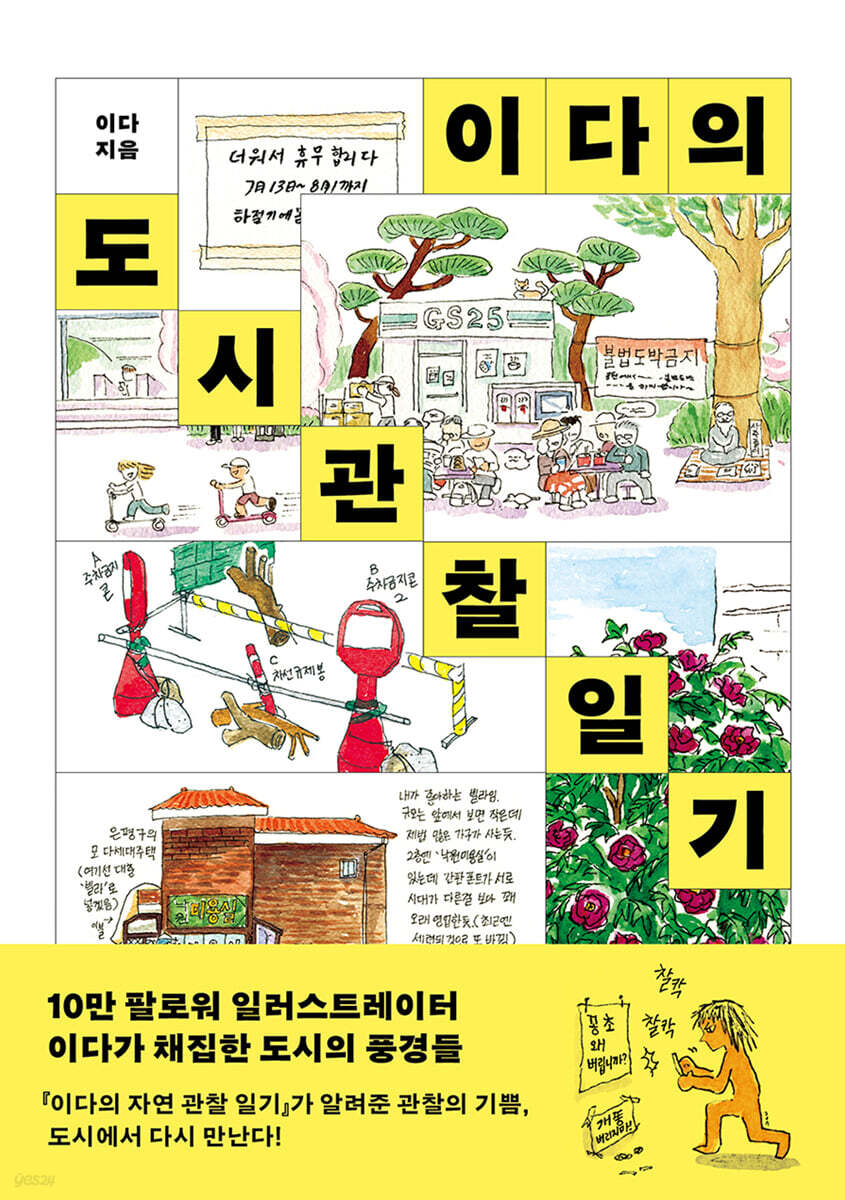
Ida, an illustrator who has received love from 100,000 followers, has published a new book titled "Ida's City Observation Diary," which expands the joy of observation discovered in "Ida's Nature Observation Diary" to the city.
In the previous work, the gaze that delicately followed the small movements of trees, grass, birds, and insects passing through the seasons now turns to the familiar yet new stage of streets, people, objects, and space.
The method of walking on two feet, seeing with the eyes, and recording with the hands remains the same, but in the city, which seems colder and more complex than nature, the sense of observation becomes sharper and more precise.
Even places we pass by without a second thought, such as flower beds in a villa village, inside a bus, narrow alleys, and old shops, are reborn as the stage for humorous, bizarre, and sometimes touching and funny stories through Ida's eyes.
A strange and lovely world awaits you.
- Illustrator Ida's city observations that captured the hearts of 100,000 followers
Every time I watch the news, I hate the world.
All kinds of hatred and selfishness are rampant, and the climate crisis seems to be destroying the planet.
What on earth can a country do?
When I feel this helpless, Ida puts on her shoes and goes outside.
Ida, an illustrator who has received love from 100,000 followers, has published a new book titled "Ida's City Observation Diary," which expands the joy of observation discovered in "Ida's Nature Observation Diary" to the city.
In the previous work, the gaze that delicately followed the small movements of trees, grass, birds, and insects passing through the seasons now turns to the familiar yet new stage of streets, people, objects, and space.
The method of walking on two feet, seeing with the eyes, and recording with the hands remains the same, but in the city, which seems colder and more complex than nature, the sense of observation becomes sharper and more precise.
Even places we pass by without a second thought, such as flower beds in a villa village, inside a bus, narrow alleys, and old shops, are reborn as the stage for humorous, bizarre, and sometimes touching and funny stories through Ida's eyes.
- You can preview some of the book's contents.
Preview
index
Main observation area map
Why I Write a City Observation Journal
City Observation Preparation
How to observe the city
Part 1 Put on your shoes and go outside
Eavesdropping on the warning sign in the alley
ㅁWarning message encyclopedia
People who cultivate altruistic flower beds in the city
Villa Guide
In the old store, I become an archaeologist.
Losing my bungeoppang to the blue duck in Bulkwangcheon
City River Map
Part 2: The neighborhood is still alive and kicking
Keys, Ive CDs, and a bag of Seongsimdang bread
Chair Encyclopedia
Observing watermelons and people at a greengrocer's store
What do I observe when I go to a restaurant for the first time?
ㅁSignboard Encyclopedia
Those who want to park, those who want to block parking
No-parking sign guide
Map of densely populated residential areas
3. Go a little further by bus and subway
Classic Knight, please enjoy today's performance as well.
ㅁNotice Encyclopedia
An eagle ID photo posted at Daerim Station
When others see flowers, I see a person who sees flowers.
Sometimes I observe other cities
Map of the M-Jukong Apartment Complex
Part 4 The city is large and has many people.
Small talk in Seoul, where people don't even care about other people's noses, let alone cutting them off.
Instead of observing the impeachment rally, jump in.
Same thing today in the same place
A world I don't know
Map of new apartments
City Observation Diary Epilogue
Things to observe in the city
Seasonal changes in the city
Colors I Met in the City
Why I Write a City Observation Journal
City Observation Preparation
How to observe the city
Part 1 Put on your shoes and go outside
Eavesdropping on the warning sign in the alley
ㅁWarning message encyclopedia
People who cultivate altruistic flower beds in the city
Villa Guide
In the old store, I become an archaeologist.
Losing my bungeoppang to the blue duck in Bulkwangcheon
City River Map
Part 2: The neighborhood is still alive and kicking
Keys, Ive CDs, and a bag of Seongsimdang bread
Chair Encyclopedia
Observing watermelons and people at a greengrocer's store
What do I observe when I go to a restaurant for the first time?
ㅁSignboard Encyclopedia
Those who want to park, those who want to block parking
No-parking sign guide
Map of densely populated residential areas
3. Go a little further by bus and subway
Classic Knight, please enjoy today's performance as well.
ㅁNotice Encyclopedia
An eagle ID photo posted at Daerim Station
When others see flowers, I see a person who sees flowers.
Sometimes I observe other cities
Map of the M-Jukong Apartment Complex
Part 4 The city is large and has many people.
Small talk in Seoul, where people don't even care about other people's noses, let alone cutting them off.
Instead of observing the impeachment rally, jump in.
Same thing today in the same place
A world I don't know
Map of new apartments
City Observation Diary Epilogue
Things to observe in the city
Seasonal changes in the city
Colors I Met in the City
Detailed image
.jpg)
Into the book
As I walked around the neighborhood observing, I soon became familiar with where the flower beds were.
In front of a church near Saejol Station, there is a rose bed made of arches.
In summer, balloon vine fruits, which look like gourds, also grow.
In front of a property named after a nearby king, rice is grown.
Between the recently repainted single-family apartment and the red brick villa is a one-pyeong garden filled with white zinnias.
Not all of these flower beds were created by government offices.
The people who live there cannot leave a piece of land that no one cares about alone, so they take care of it.
What should we call this? A private garden? A self-cultivated flower bed? A resident-run flower bed? The term "altruistic flower bed" suddenly comes to mind.
--- p.35
Daiso or other large marts that you can just walk into without thinking are different.
There is no 'shop owner' with an ego.
Of course, there is an owner, but he is not sitting in front of the cash register with a fan on and watching a trot program.
In the mart, anyone can see anything, as much as they want.
It's nice to just look around for thirty minutes, and no one will complain if you lift and put things down.
Of course, that kind of shopping is also fun.
But there's an unpredictable thrill and fun in old stores.
A thirty-year-old Hello Kitty notebook, a pot holder from the 80s, a faded fan with the 2002 World Cup logo on it.
You may encounter items that even the owner who brought them in has forgotten.
--- p.48
Why on earth? No matter how much I think about it, I just can't understand.
Bollards are already sufficient to prevent cars from parking.
Why did they even put a chief on top of that? My head suddenly feels spinning.
Let's have fun solving the mystery.
Your family keeps nagging you to throw away those useless stones, but you don't want to throw them away. Are you hoping to find a use for them? Or are you just showing off your precious collection of stones that don't deserve to be left in the corner of your room? Or are you burning a deep-seated artistic spirit? (Please, if you do this, please disclose the artist's intentions along with the title of the piece.)
--- p.115
“Why is that there?”
Sometimes you find things in train stations that shouldn't be there.
No, quite often.
I found it again today.
Sharp and clear pupils, sharp yellow beak with sharp, curved lines, and beautifully raised white feathers.
The face of an extremely handsome eagle (more precisely, a bald eagle) is attached to the top of the elevator at Daerim Station.
I see idol birthday ads on the subway all the time, but this is the first time I've seen one with such a ridiculously long eagle ID photo.
--- p.140
When I observe, I am not important.
That's the essence of observation.
But usually I am full of thoughts about myself.
I keep thinking back to my past mistakes and regrets.
'Why am I like that?' 'Why did I do that?' Everything starts with 'I', 'I'.
But when I observe, I can forget about myself for a moment.
I see not myself, but a transmission tower standing on a distant mountaintop, and a steel pipe laid down as a barrier at the entrance to an apartment building.
And I think about why they are there and who did this.
When you start observing, you start to see things you couldn't see before, and you start to think again about the meaning of things that are not you.
--- p.168
“I want to tell you, the sad times - I can only hear them after they have all scattered -” Girls’ Generation’s “Into the New World” rings out.
This is a famous song that became a folk song for young women after the 2016 sit-in protest at Ewha Womans University.
I sing along loudly, waving the small LED candle in my hand, but for some reason my throat feels choked up.
Because the lyrics seem to be about the current situation.
“In the midst of countless unknown paths - I chase after a faint light -” When I look back, my friends’ eyes are also moist.
It's sad and upsetting to go through this, but at the same time, it's heartbreaking.
It's inspiring to see so many people sharing the same vision.
In front of a church near Saejol Station, there is a rose bed made of arches.
In summer, balloon vine fruits, which look like gourds, also grow.
In front of a property named after a nearby king, rice is grown.
Between the recently repainted single-family apartment and the red brick villa is a one-pyeong garden filled with white zinnias.
Not all of these flower beds were created by government offices.
The people who live there cannot leave a piece of land that no one cares about alone, so they take care of it.
What should we call this? A private garden? A self-cultivated flower bed? A resident-run flower bed? The term "altruistic flower bed" suddenly comes to mind.
--- p.35
Daiso or other large marts that you can just walk into without thinking are different.
There is no 'shop owner' with an ego.
Of course, there is an owner, but he is not sitting in front of the cash register with a fan on and watching a trot program.
In the mart, anyone can see anything, as much as they want.
It's nice to just look around for thirty minutes, and no one will complain if you lift and put things down.
Of course, that kind of shopping is also fun.
But there's an unpredictable thrill and fun in old stores.
A thirty-year-old Hello Kitty notebook, a pot holder from the 80s, a faded fan with the 2002 World Cup logo on it.
You may encounter items that even the owner who brought them in has forgotten.
--- p.48
Why on earth? No matter how much I think about it, I just can't understand.
Bollards are already sufficient to prevent cars from parking.
Why did they even put a chief on top of that? My head suddenly feels spinning.
Let's have fun solving the mystery.
Your family keeps nagging you to throw away those useless stones, but you don't want to throw them away. Are you hoping to find a use for them? Or are you just showing off your precious collection of stones that don't deserve to be left in the corner of your room? Or are you burning a deep-seated artistic spirit? (Please, if you do this, please disclose the artist's intentions along with the title of the piece.)
--- p.115
“Why is that there?”
Sometimes you find things in train stations that shouldn't be there.
No, quite often.
I found it again today.
Sharp and clear pupils, sharp yellow beak with sharp, curved lines, and beautifully raised white feathers.
The face of an extremely handsome eagle (more precisely, a bald eagle) is attached to the top of the elevator at Daerim Station.
I see idol birthday ads on the subway all the time, but this is the first time I've seen one with such a ridiculously long eagle ID photo.
--- p.140
When I observe, I am not important.
That's the essence of observation.
But usually I am full of thoughts about myself.
I keep thinking back to my past mistakes and regrets.
'Why am I like that?' 'Why did I do that?' Everything starts with 'I', 'I'.
But when I observe, I can forget about myself for a moment.
I see not myself, but a transmission tower standing on a distant mountaintop, and a steel pipe laid down as a barrier at the entrance to an apartment building.
And I think about why they are there and who did this.
When you start observing, you start to see things you couldn't see before, and you start to think again about the meaning of things that are not you.
--- p.168
“I want to tell you, the sad times - I can only hear them after they have all scattered -” Girls’ Generation’s “Into the New World” rings out.
This is a famous song that became a folk song for young women after the 2016 sit-in protest at Ewha Womans University.
I sing along loudly, waving the small LED candle in my hand, but for some reason my throat feels choked up.
Because the lyrics seem to be about the current situation.
“In the midst of countless unknown paths - I chase after a faint light -” When I look back, my friends’ eyes are also moist.
It's sad and upsetting to go through this, but at the same time, it's heartbreaking.
It's inspiring to see so many people sharing the same vision.
--- pp.188-189
Publisher's Review
When a familiar landscape speaks to you with an unexpected story
- A thoughtful gaze that revives dulled senses
This book is a delightful and tender look at how observation can be the beginning of connection, leading to a deeper understanding and love of the world.
Ida doesn't just 'see', but imagines the story hidden behind each scene.
When you put on your shoes, go outside, and start observing, the landscapes that you didn't know about but were always alive and well begin to reveal themselves one by one.
A mysterious key hanging on a metasequoia branch in front of an elementary school, a no-parking installation that explodes with artistry as anger builds from not wanting to spend a single penny, a bus driver who instantly turns the inside of a bus into an opera house… … .
A city that is looked at closely speaks to us in a voice that is sometimes strange, sometimes comical, and often loving.
Gazing at those scenes becomes a small gesture toward understanding the world, and a special meaning is imbued into otherwise insignificant landscapes.
Even scenes that seem to exist but don't exist take on their own expressions and stories when viewed through his eyes.
Little by little, I begin to feel a strong connection with a world that seemed unrelated to me.
The vast and ruthless world we used to see through news and social media on the screen comes back to life in the form of vivid streets and people's faces.
Observation goes beyond simply ‘a way of seeing’ and becomes an attitude for surviving in an age of helplessness and disconnection.
The landscapes collected in this way are brought to life through the author's unique sentences and drawings.
The sentences, which flow smoothly and then suddenly spring up, resemble the rhythm of the city, and the liveliness and hardship of the streets, as well as fragments of emotion, unfold in humorous and sharp language.
The delicate illustrations, abundantly included, capture even the smallest details that are difficult to capture with text alone, and the author's original observation diary, included throughout, vividly conveys the atmosphere of the scene.
If you follow Ida's gaze expressed in this way, you, the reader, will eventually want to begin making your own observations.
What stories lie hidden in the neighborhood I live in, the alleys I walk every day, and the landscapes I frequently pass by? The artist's message, "It doesn't matter whether you draw well or poorly," provides unwavering encouragement to those who wish to begin documenting their work.
"Ida's City Observation Diary," which allows us to look at familiar places with a fresh perspective and new places with a loving gaze, is a warm invitation to all those who wish to rediscover a vivid sense of connection with the world.
I want to like this world, this place where I am now, more.
- A sense of connection that begins again in a familiar city
What 『Ida's City Observation Diary』 shows is not just the interesting scenery of the city.
This book contains an attitude toward the city and the world, a quiet but steady practice of connecting with the world.
The daily acts of walking, seeing, and recording allow us to discover seeds of friendship and solidarity in every corner of the street we pass by without noticing.
Ida's gaze, which gazes at those small connections for a long time without missing them, ultimately leads to her desire to like the world she lives in.
As the book progresses, the author's footsteps go further and deeper.
Among beings he does not know, among others who live with different rhythms, he still stands as an observer with a keen sense and a cheerful and affectionate imagination.
Instead of grandiose words about changing the world, cynicism and helplessness are gradually pushed away through the daily practice of slowly walking around and observing our surroundings.
What began as an observation of myself walking around my neighborhood soon led to a cold winter square, where countless lights illuminated the darkness and I, among my fellow citizens, thought, “I live in a society with these people.
The moment the realization that “that alone is enough hope” is conveyed, a deep emotion blooms.
In an age when the belief that we can understand and coexist with beings different from ourselves is wavering, this book asks what it means to begin observation here and now.
The author seems to be saying that observation is a strong bridge connecting existence and a practice of affection toward the world.
The sense of humanity and connection that I thought had disappeared is revived in the tips of my feet as I walk.
- A thoughtful gaze that revives dulled senses
This book is a delightful and tender look at how observation can be the beginning of connection, leading to a deeper understanding and love of the world.
Ida doesn't just 'see', but imagines the story hidden behind each scene.
When you put on your shoes, go outside, and start observing, the landscapes that you didn't know about but were always alive and well begin to reveal themselves one by one.
A mysterious key hanging on a metasequoia branch in front of an elementary school, a no-parking installation that explodes with artistry as anger builds from not wanting to spend a single penny, a bus driver who instantly turns the inside of a bus into an opera house… … .
A city that is looked at closely speaks to us in a voice that is sometimes strange, sometimes comical, and often loving.
Gazing at those scenes becomes a small gesture toward understanding the world, and a special meaning is imbued into otherwise insignificant landscapes.
Even scenes that seem to exist but don't exist take on their own expressions and stories when viewed through his eyes.
Little by little, I begin to feel a strong connection with a world that seemed unrelated to me.
The vast and ruthless world we used to see through news and social media on the screen comes back to life in the form of vivid streets and people's faces.
Observation goes beyond simply ‘a way of seeing’ and becomes an attitude for surviving in an age of helplessness and disconnection.
The landscapes collected in this way are brought to life through the author's unique sentences and drawings.
The sentences, which flow smoothly and then suddenly spring up, resemble the rhythm of the city, and the liveliness and hardship of the streets, as well as fragments of emotion, unfold in humorous and sharp language.
The delicate illustrations, abundantly included, capture even the smallest details that are difficult to capture with text alone, and the author's original observation diary, included throughout, vividly conveys the atmosphere of the scene.
If you follow Ida's gaze expressed in this way, you, the reader, will eventually want to begin making your own observations.
What stories lie hidden in the neighborhood I live in, the alleys I walk every day, and the landscapes I frequently pass by? The artist's message, "It doesn't matter whether you draw well or poorly," provides unwavering encouragement to those who wish to begin documenting their work.
"Ida's City Observation Diary," which allows us to look at familiar places with a fresh perspective and new places with a loving gaze, is a warm invitation to all those who wish to rediscover a vivid sense of connection with the world.
I want to like this world, this place where I am now, more.
- A sense of connection that begins again in a familiar city
What 『Ida's City Observation Diary』 shows is not just the interesting scenery of the city.
This book contains an attitude toward the city and the world, a quiet but steady practice of connecting with the world.
The daily acts of walking, seeing, and recording allow us to discover seeds of friendship and solidarity in every corner of the street we pass by without noticing.
Ida's gaze, which gazes at those small connections for a long time without missing them, ultimately leads to her desire to like the world she lives in.
As the book progresses, the author's footsteps go further and deeper.
Among beings he does not know, among others who live with different rhythms, he still stands as an observer with a keen sense and a cheerful and affectionate imagination.
Instead of grandiose words about changing the world, cynicism and helplessness are gradually pushed away through the daily practice of slowly walking around and observing our surroundings.
What began as an observation of myself walking around my neighborhood soon led to a cold winter square, where countless lights illuminated the darkness and I, among my fellow citizens, thought, “I live in a society with these people.
The moment the realization that “that alone is enough hope” is conveyed, a deep emotion blooms.
In an age when the belief that we can understand and coexist with beings different from ourselves is wavering, this book asks what it means to begin observation here and now.
The author seems to be saying that observation is a strong bridge connecting existence and a practice of affection toward the world.
The sense of humanity and connection that I thought had disappeared is revived in the tips of my feet as I walk.
GOODS SPECIFICS
- Date of issue: June 18, 2025
- Page count, weight, size: 232 pages | 394g | 148*210*20mm
- ISBN13: 9791194087885
- ISBN10: 1194087884
You may also like
카테고리
korean


korean

![GQ KOREA Mark (Monthly): December [2025]](http://librairie.coreenne.fr/cdn/shop/files/8ef265dbbfbf186523ed75ba7319009d.jpg?v=1765340328&width=3840)


