

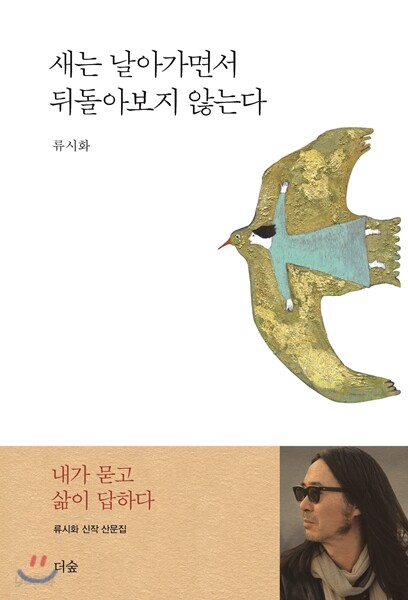
Birds don't look back as they fly.
 |
Description
Book Introduction
"A bird sitting on a tree is not afraid of the branch breaking.
Because a bird trusts its wings, not the tree."
- From “Birds don’t look back as they fly”
I ask and life answers
Poet Ryu Si-hwa's new prose collection
A new collection of essays by Ryu Si-hwa, following 『What Life Has Taught Me』 and 『A Journey to the Sky Lake』, containing her unique resonance and perspective.
A collection of 51 prose pieces that help us understand life and humanity.
Many of the articles included here, such as “The Road with the Heart,” “Querencia,” “A Fly in a Teacup,” “The Reason We Yell When We’re Angry,” “There’s No Road to Walk Alone,” “The Heart is a Storyteller,” and “Places Don’t Easily Show Their Insides,” resonated with tens of thousands of readers on Facebook.
Writings that are written plainly, without wasting language and without embellishment, actually come across as genuine.
Novelist Hwang Sun-won, who was my teacher in the Department of Korean Literature at Kyunghee University, said, “Poetry is written when you are young, and prose is written when you are old.
The author says that he has not forgotten the words, “Poetry contains agony, prose contains life,” but the title of the preface, “I ask, and life answers,” reveals what answers the search for the meaning of human existence and life, which began in his youth, has led to.
This new collection of essays, Birds Don't Look Back as They Fly, is Ryu Si-hwa's sincere response to readers' long-held expectations, and a story about loss and recovery that resonates with us all.
The poet's sensibility in leading us to 'fundamental questions and answers' with sentences that are easy to read yet delicate and weighty is truly poetic.
This book, which weaves a tapestry of 51 prose pieces to answer the ultimate questions in people's minds, feels even fresher than his first collection of prose published over 20 years ago to readers who have long awaited his new work.
It may not be unrelated to the fact that his writings always talk about 'being alive now.'
As he is not a prolific writer, I have a special interest in reading his new work.
Because a bird trusts its wings, not the tree."
- From “Birds don’t look back as they fly”
I ask and life answers
Poet Ryu Si-hwa's new prose collection
A new collection of essays by Ryu Si-hwa, following 『What Life Has Taught Me』 and 『A Journey to the Sky Lake』, containing her unique resonance and perspective.
A collection of 51 prose pieces that help us understand life and humanity.
Many of the articles included here, such as “The Road with the Heart,” “Querencia,” “A Fly in a Teacup,” “The Reason We Yell When We’re Angry,” “There’s No Road to Walk Alone,” “The Heart is a Storyteller,” and “Places Don’t Easily Show Their Insides,” resonated with tens of thousands of readers on Facebook.
Writings that are written plainly, without wasting language and without embellishment, actually come across as genuine.
Novelist Hwang Sun-won, who was my teacher in the Department of Korean Literature at Kyunghee University, said, “Poetry is written when you are young, and prose is written when you are old.
The author says that he has not forgotten the words, “Poetry contains agony, prose contains life,” but the title of the preface, “I ask, and life answers,” reveals what answers the search for the meaning of human existence and life, which began in his youth, has led to.
This new collection of essays, Birds Don't Look Back as They Fly, is Ryu Si-hwa's sincere response to readers' long-held expectations, and a story about loss and recovery that resonates with us all.
The poet's sensibility in leading us to 'fundamental questions and answers' with sentences that are easy to read yet delicate and weighty is truly poetic.
This book, which weaves a tapestry of 51 prose pieces to answer the ultimate questions in people's minds, feels even fresher than his first collection of prose published over 20 years ago to readers who have long awaited his new work.
It may not be unrelated to the fact that his writings always talk about 'being alive now.'
As he is not a prolific writer, I have a special interest in reading his new work.
- You can preview some of the book's contents.
Preview
index
Introduction: I Ask, Life Answers
Querencia _ In search of a place for self-recovery
A Fly in a Teacup: When the World Hurts, I Hurt Too
Why we yell when we're angry _ The distance between two hearts
If you can heal the wounds in someone's heart by making them smile at the end
Jim Corbett's Story - Did you enjoy the process?
Who am I? _The tiger's stripes are outside, and the human's stripes are inside.
The Road of the Heart _Wandering doesn't mean you're lost.
Blue Flower _What is your blue flower?
Now is the Time _ A Tale of Two Astrologers
Praise _ How to Color Reality
I wish you would come to me without a name _Yeokkwi
A person in love never passes by _ Proust's Rose
There is no path to walk alone _ with soulmates
The long road to you _God makes you lose your way to show you the way
Vision Quest: Life Begins the Moment You Leave Your Comfort Zone
What if you don't laugh? _Life is like a game
My song is _There is no life that has been lived wrongly
What is Beauty? _The Story of the Woman in the Cave
Places don't easily reveal their true colors - Things that come when you love
When was the last time you danced? _Dance Meditation
The mind is a storyteller _ Mindfulness
We are all the same _ Empathy and compassion
Face within a Face _Mother Meditation
Wounded Healer - From Wounded to Healer
Avoiding the Second Arrow: The Art of Dealing with Pain
Mother Whale _ Life Will Take Care of Itself
A life copied wrongly - living happily
In the face of death, everyday life neutralizes the sense of urgency.
The Tale of a Chief: The Abandonment of the Indians
Can you see the stars? Don't bring all the truth.
Hurt and Be Hurt - Be a Therapist, Not a Terrorist
The Monk and the Scorpion: Which Nature Will You Follow?
One joy banishes a thousand sorrows - Why we can't forget love
Pain passes, beauty remains _ Light enters through the wounds
The Source of Healing _ Wisdom of the Bambamba Tribe
Did something move you today? _See the world through a poet's eyes
Your Leaf _ A Gift from God
Birds don't look back as they fly - Freedom after letting go
What are you thinking about _Notice
The World's Most Delicious Food - Mindful Eating
In the name of anonymity _The fruit of obedience
There is no tomorrow _ A story from the Ramayana
The Octopus Talks _ The Beginning of Recovery
How many chickens are there? _ A life worth living
In the Dark, Eyes Begin to See - A Tale of the Kogi Tribe
Gold Jewel _ Broken open
The Critic Within Me _ Beyond Criticism to Existence
A Gift of Chance _ A Widening Circle
People who cannot be included in the numbers - Me and you
The Man Who Draws the Himalayas: Becoming Friends with Uncertainty
Ithaca - The path you walk will become your life
Querencia _ In search of a place for self-recovery
A Fly in a Teacup: When the World Hurts, I Hurt Too
Why we yell when we're angry _ The distance between two hearts
If you can heal the wounds in someone's heart by making them smile at the end
Jim Corbett's Story - Did you enjoy the process?
Who am I? _The tiger's stripes are outside, and the human's stripes are inside.
The Road of the Heart _Wandering doesn't mean you're lost.
Blue Flower _What is your blue flower?
Now is the Time _ A Tale of Two Astrologers
Praise _ How to Color Reality
I wish you would come to me without a name _Yeokkwi
A person in love never passes by _ Proust's Rose
There is no path to walk alone _ with soulmates
The long road to you _God makes you lose your way to show you the way
Vision Quest: Life Begins the Moment You Leave Your Comfort Zone
What if you don't laugh? _Life is like a game
My song is _There is no life that has been lived wrongly
What is Beauty? _The Story of the Woman in the Cave
Places don't easily reveal their true colors - Things that come when you love
When was the last time you danced? _Dance Meditation
The mind is a storyteller _ Mindfulness
We are all the same _ Empathy and compassion
Face within a Face _Mother Meditation
Wounded Healer - From Wounded to Healer
Avoiding the Second Arrow: The Art of Dealing with Pain
Mother Whale _ Life Will Take Care of Itself
A life copied wrongly - living happily
In the face of death, everyday life neutralizes the sense of urgency.
The Tale of a Chief: The Abandonment of the Indians
Can you see the stars? Don't bring all the truth.
Hurt and Be Hurt - Be a Therapist, Not a Terrorist
The Monk and the Scorpion: Which Nature Will You Follow?
One joy banishes a thousand sorrows - Why we can't forget love
Pain passes, beauty remains _ Light enters through the wounds
The Source of Healing _ Wisdom of the Bambamba Tribe
Did something move you today? _See the world through a poet's eyes
Your Leaf _ A Gift from God
Birds don't look back as they fly - Freedom after letting go
What are you thinking about _Notice
The World's Most Delicious Food - Mindful Eating
In the name of anonymity _The fruit of obedience
There is no tomorrow _ A story from the Ramayana
The Octopus Talks _ The Beginning of Recovery
How many chickens are there? _ A life worth living
In the Dark, Eyes Begin to See - A Tale of the Kogi Tribe
Gold Jewel _ Broken open
The Critic Within Me _ Beyond Criticism to Existence
A Gift of Chance _ A Widening Circle
People who cannot be included in the numbers - Me and you
The Man Who Draws the Himalayas: Becoming Friends with Uncertainty
Ithaca - The path you walk will become your life
Into the book
* We always have an instinct within us to be renewed and to be reborn.
The will to awaken within yourself the power to change your life.
We instinctively seek out places of self-recovery, and we have the will to heal and become whole, not just to be absorbed by life.
* A man who was always angry came to his spiritual master and said:
“I always get angry and can’t control my emotions even over trivial things.
“What could be the reason?”
The master said.
“You are suffering from old wounds from your childhood or youth.
“Because of that, I became very weak.”
“I don’t remember being seriously hurt, except for little things.
How can the wounds of the distant past weaken me in the present?”
The master gave the man a small bottle of water that was lying next to him and said,
“Reach out in front of you and hold this water bottle.
“Is it heavy?”
"no.
“It’s not heavy.”
Ten minutes later the teacher asked again.
“Is it heavy?”
“It’s a little heavy, but bearable.”
After a while, the teacher asked again.
“How is it now?”
“It’s very heavy.
“I can’t hold it in any longer.”
Then the teacher said:
“The issue isn’t the weight of the water bottle, but how long you hold it.
You have to let go of past wounds and memories.
The longer you hold them, the more they will add weight to them, like this water bottle.”
* I wish you would come to me without a name.
I too would like to abandon all those names and come to you.
I wish we could feel each other before we know each other's names.
Then the key that opens the door of mystery comes down to us.
There is no name in the present.
We, the ultimate mystery, are beyond names and classifications.
Only in that world can we become completely one.
The God within me and the God within you, the fire within me and the fire within you can meet.
Absolute silence within me and absolute silence within you.
* Remember that the etymology of the word ‘road’ is ‘to tame’, so you must tame yourself and create your own path.
My life is about breaking away from what is familiar and making the path I feel is right the right answer.
You won't be left behind if you deviate from the path chosen by the majority.
The standard of 'universal' does not exempt us from error.
To walk the path of the heart, you must be able to stand on the other side of prejudice.
Don't expect everyone to love you and understand your journey.
Because it is your way, not theirs.
Homo viator is someone who seeks his own answers, not those of others.
* Each of our lives is an Odyssey.
The completion of that epic depends on us.
Therefore, the path we walk must be our own Ithaca journey.
The process of falling down and getting back up on that path is our pilgrimage.
What is your Ithaca? Where are you on the way to it? Are you suffering in the cave of the one-eyed monster, sinking in the raging waves of the sea god? Or are you shopping for luxurious goods in the Phoenician market? Have you already understood that Ithaca is not the destination, but the path leading there? If so, you are on the right journey.
The will to awaken within yourself the power to change your life.
We instinctively seek out places of self-recovery, and we have the will to heal and become whole, not just to be absorbed by life.
* A man who was always angry came to his spiritual master and said:
“I always get angry and can’t control my emotions even over trivial things.
“What could be the reason?”
The master said.
“You are suffering from old wounds from your childhood or youth.
“Because of that, I became very weak.”
“I don’t remember being seriously hurt, except for little things.
How can the wounds of the distant past weaken me in the present?”
The master gave the man a small bottle of water that was lying next to him and said,
“Reach out in front of you and hold this water bottle.
“Is it heavy?”
"no.
“It’s not heavy.”
Ten minutes later the teacher asked again.
“Is it heavy?”
“It’s a little heavy, but bearable.”
After a while, the teacher asked again.
“How is it now?”
“It’s very heavy.
“I can’t hold it in any longer.”
Then the teacher said:
“The issue isn’t the weight of the water bottle, but how long you hold it.
You have to let go of past wounds and memories.
The longer you hold them, the more they will add weight to them, like this water bottle.”
* I wish you would come to me without a name.
I too would like to abandon all those names and come to you.
I wish we could feel each other before we know each other's names.
Then the key that opens the door of mystery comes down to us.
There is no name in the present.
We, the ultimate mystery, are beyond names and classifications.
Only in that world can we become completely one.
The God within me and the God within you, the fire within me and the fire within you can meet.
Absolute silence within me and absolute silence within you.
* Remember that the etymology of the word ‘road’ is ‘to tame’, so you must tame yourself and create your own path.
My life is about breaking away from what is familiar and making the path I feel is right the right answer.
You won't be left behind if you deviate from the path chosen by the majority.
The standard of 'universal' does not exempt us from error.
To walk the path of the heart, you must be able to stand on the other side of prejudice.
Don't expect everyone to love you and understand your journey.
Because it is your way, not theirs.
Homo viator is someone who seeks his own answers, not those of others.
* Each of our lives is an Odyssey.
The completion of that epic depends on us.
Therefore, the path we walk must be our own Ithaca journey.
The process of falling down and getting back up on that path is our pilgrimage.
What is your Ithaca? Where are you on the way to it? Are you suffering in the cave of the one-eyed monster, sinking in the raging waves of the sea god? Or are you shopping for luxurious goods in the Phoenician market? Have you already understood that Ithaca is not the destination, but the path leading there? If so, you are on the right journey.
--- From the text
Publisher's Review
"A bird sitting on a tree is not afraid of the branch breaking.
Because a bird trusts its wings, not the tree."
- From “Birds don’t look back as they fly”
I ask and life answers
Poet Ryu Si-hwa's new prose collection
A new collection of essays by Ryu Si-hwa, following 『What Life Has Taught Me』 and 『A Journey to the Sky Lake』, containing her unique resonance and perspective.
A collection of 51 prose pieces that help us understand life and humanity.
Many of the articles included here, such as “The Road with the Heart,” “Querencia,” “A Fly in a Teacup,” “The Reason We Yell When We’re Angry,” “There’s No Road to Walk Alone,” “The Heart is a Storyteller,” and “Places Don’t Easily Show Their Insides,” resonated with tens of thousands of readers on Facebook.
Writings that are written plainly, without wasting language and without embellishment, actually come across as genuine.
Novelist Hwang Sun-won, who was my teacher in the Department of Korean Literature at Kyunghee University, said, “Poetry is written when you are young, and prose is written when you are old.
The author says that he has not forgotten the words, “Poetry contains agony, prose contains life,” but the title of the preface, “I ask, and life answers,” reveals what answers the search for the meaning of human existence and life, which began in his youth, has led to.
This new collection of essays, Birds Don't Look Back as They Fly, is Ryu Si-hwa's sincere response to readers' long-held expectations, and a story about loss and recovery that resonates with us all.
The poet's sensibility in leading us to 'fundamental questions and answers' with sentences that are easy to read yet delicate and weighty is truly poetic.
Can we be free and authentic at any moment in our lives? Among the many prose pieces that speak of life, there are those that can only be written by Ryu Si-hwa.
His yearly journeys to India and the translation of meditation books not only reflect his will and perseverance in answering his own questions, but also lead his writings to a search for the "lost self" and a search for the "self."
"Querencia" tells us through the bull in the bullring that we always have an instinct to be renewed and rejuvenated; "A Fly in a Teacup" shows that although we often say "no problem" as if we have transcended the problems of life, if we do not shift the standard of that "no problem" from "me" to "others", it is in fact a "big problem"; "Why We Yell When We Get Angry" tells us that the loudness of our voices is proportional to the distance between our chests; "The Jim Corbett Story" reminds us that those who are not interested in the things in the process will not be happy even when they reach their destination; "Who Am I" tells us that a tiger's stripes are outside and a person's stripes are inside; "Now is the Time" tells us that we think we have missed many things in life, but what we have missed the most is the present moment; "Ode" tells us that the real world is not originally colored but achromatic, but it is our eyes that give color to that reality; "Yeokkwi" tells us that it would be nice if you came to me without a name.
And "Love Never Passes By," which says that those who live superficially without seeing the world in front of them suffer in their souls; "There Is No Road to Walk Alone," which says that no matter what we do or what journey we take now, we are mentally connected to all those who have walked that path in the past or are currently walking it; "The Long Road to You," which says that God sometimes makes us lose our way in order to show us the way; "Places Do Not Easily Show Their Insides," which says that there are things in the world that we cannot know unless we pour time into loving them; "Avoiding the Second Arrow," which shows that most pain is deepened by the emotional reaction to an event rather than the actual event itself; "The Wounded Healer," which says that all healers are wounded people and true healers are those who heal others by overcoming their own wounds... ...Even up to "Ithaca," which is included at the end of the book and says that the path we walk will soon become our lives, these famous prose pieces that cannot be left out deeply resonate with our souls.
This book, which weaves a tapestry of 51 prose pieces to answer the ultimate questions in people's minds, feels even fresher than his first collection of prose published over 20 years ago to readers who have long awaited his new work.
It may not be unrelated to the fact that his writings always talk about 'being alive now.'
As he is not a prolific writer, I have a special interest in reading his new work.
Author's Preface
When I was young, I asked myself some questions about life.
About truth and enlightenment, about happiness, about the meaning of life and the question, 'Who am I?'
Life answers those questions throughout our lives.
I didn't know at the time.
That the answers to life can only be found through life experiences.
I traveled the world and read books in search of a teacher, but it was life itself that gave me enlightenment.
This is consistent with the proposition that 'we think we travel, but in reality, travel makes us.'
A poet cannot represent another poet, and a writer cannot replace another writer.
All poetry was non-existent poetry, and all books were non-existent books.
Whether you are a writer or a reader, being alive now means writing your own story.
Not the expectations or correct answers of others, but your own answers.
When life speaks to you one day, what will you say? Even after experiencing loss and wading through the fires of pain, will you still be able to say yes to life? Even after repeated rejections, will you still be able to send a letter to life?
The prose collected here are the questions I asked and life answered.
The Indian poet Ghalib wrote, “I give myself with my poetry,” but no writing can fully express the true self.
I also hope that what I write doesn't surpass my true self.
I know my words won't offer you comfort or strength in these uncertain times, but I just want to share life with you on the road.
Because a bird trusts its wings, not the tree."
- From “Birds don’t look back as they fly”
I ask and life answers
Poet Ryu Si-hwa's new prose collection
A new collection of essays by Ryu Si-hwa, following 『What Life Has Taught Me』 and 『A Journey to the Sky Lake』, containing her unique resonance and perspective.
A collection of 51 prose pieces that help us understand life and humanity.
Many of the articles included here, such as “The Road with the Heart,” “Querencia,” “A Fly in a Teacup,” “The Reason We Yell When We’re Angry,” “There’s No Road to Walk Alone,” “The Heart is a Storyteller,” and “Places Don’t Easily Show Their Insides,” resonated with tens of thousands of readers on Facebook.
Writings that are written plainly, without wasting language and without embellishment, actually come across as genuine.
Novelist Hwang Sun-won, who was my teacher in the Department of Korean Literature at Kyunghee University, said, “Poetry is written when you are young, and prose is written when you are old.
The author says that he has not forgotten the words, “Poetry contains agony, prose contains life,” but the title of the preface, “I ask, and life answers,” reveals what answers the search for the meaning of human existence and life, which began in his youth, has led to.
This new collection of essays, Birds Don't Look Back as They Fly, is Ryu Si-hwa's sincere response to readers' long-held expectations, and a story about loss and recovery that resonates with us all.
The poet's sensibility in leading us to 'fundamental questions and answers' with sentences that are easy to read yet delicate and weighty is truly poetic.
Can we be free and authentic at any moment in our lives? Among the many prose pieces that speak of life, there are those that can only be written by Ryu Si-hwa.
His yearly journeys to India and the translation of meditation books not only reflect his will and perseverance in answering his own questions, but also lead his writings to a search for the "lost self" and a search for the "self."
"Querencia" tells us through the bull in the bullring that we always have an instinct to be renewed and rejuvenated; "A Fly in a Teacup" shows that although we often say "no problem" as if we have transcended the problems of life, if we do not shift the standard of that "no problem" from "me" to "others", it is in fact a "big problem"; "Why We Yell When We Get Angry" tells us that the loudness of our voices is proportional to the distance between our chests; "The Jim Corbett Story" reminds us that those who are not interested in the things in the process will not be happy even when they reach their destination; "Who Am I" tells us that a tiger's stripes are outside and a person's stripes are inside; "Now is the Time" tells us that we think we have missed many things in life, but what we have missed the most is the present moment; "Ode" tells us that the real world is not originally colored but achromatic, but it is our eyes that give color to that reality; "Yeokkwi" tells us that it would be nice if you came to me without a name.
And "Love Never Passes By," which says that those who live superficially without seeing the world in front of them suffer in their souls; "There Is No Road to Walk Alone," which says that no matter what we do or what journey we take now, we are mentally connected to all those who have walked that path in the past or are currently walking it; "The Long Road to You," which says that God sometimes makes us lose our way in order to show us the way; "Places Do Not Easily Show Their Insides," which says that there are things in the world that we cannot know unless we pour time into loving them; "Avoiding the Second Arrow," which shows that most pain is deepened by the emotional reaction to an event rather than the actual event itself; "The Wounded Healer," which says that all healers are wounded people and true healers are those who heal others by overcoming their own wounds... ...Even up to "Ithaca," which is included at the end of the book and says that the path we walk will soon become our lives, these famous prose pieces that cannot be left out deeply resonate with our souls.
This book, which weaves a tapestry of 51 prose pieces to answer the ultimate questions in people's minds, feels even fresher than his first collection of prose published over 20 years ago to readers who have long awaited his new work.
It may not be unrelated to the fact that his writings always talk about 'being alive now.'
As he is not a prolific writer, I have a special interest in reading his new work.
Author's Preface
When I was young, I asked myself some questions about life.
About truth and enlightenment, about happiness, about the meaning of life and the question, 'Who am I?'
Life answers those questions throughout our lives.
I didn't know at the time.
That the answers to life can only be found through life experiences.
I traveled the world and read books in search of a teacher, but it was life itself that gave me enlightenment.
This is consistent with the proposition that 'we think we travel, but in reality, travel makes us.'
A poet cannot represent another poet, and a writer cannot replace another writer.
All poetry was non-existent poetry, and all books were non-existent books.
Whether you are a writer or a reader, being alive now means writing your own story.
Not the expectations or correct answers of others, but your own answers.
When life speaks to you one day, what will you say? Even after experiencing loss and wading through the fires of pain, will you still be able to say yes to life? Even after repeated rejections, will you still be able to send a letter to life?
The prose collected here are the questions I asked and life answered.
The Indian poet Ghalib wrote, “I give myself with my poetry,” but no writing can fully express the true self.
I also hope that what I write doesn't surpass my true self.
I know my words won't offer you comfort or strength in these uncertain times, but I just want to share life with you on the road.
GOODS SPECIFICS
- Date of publication: February 15, 2017
- Page count, weight, size: 280 pages | 426g | 139*204*20mm
- ISBN13: 9791186900222
- ISBN10: 1186900229
You may also like
카테고리
korean


korean

![GQ KOREA Mark (Monthly): December [2025]](http://librairie.coreenne.fr/cdn/shop/files/8ef265dbbfbf186523ed75ba7319009d.jpg?v=1765340328&width=3840)


