

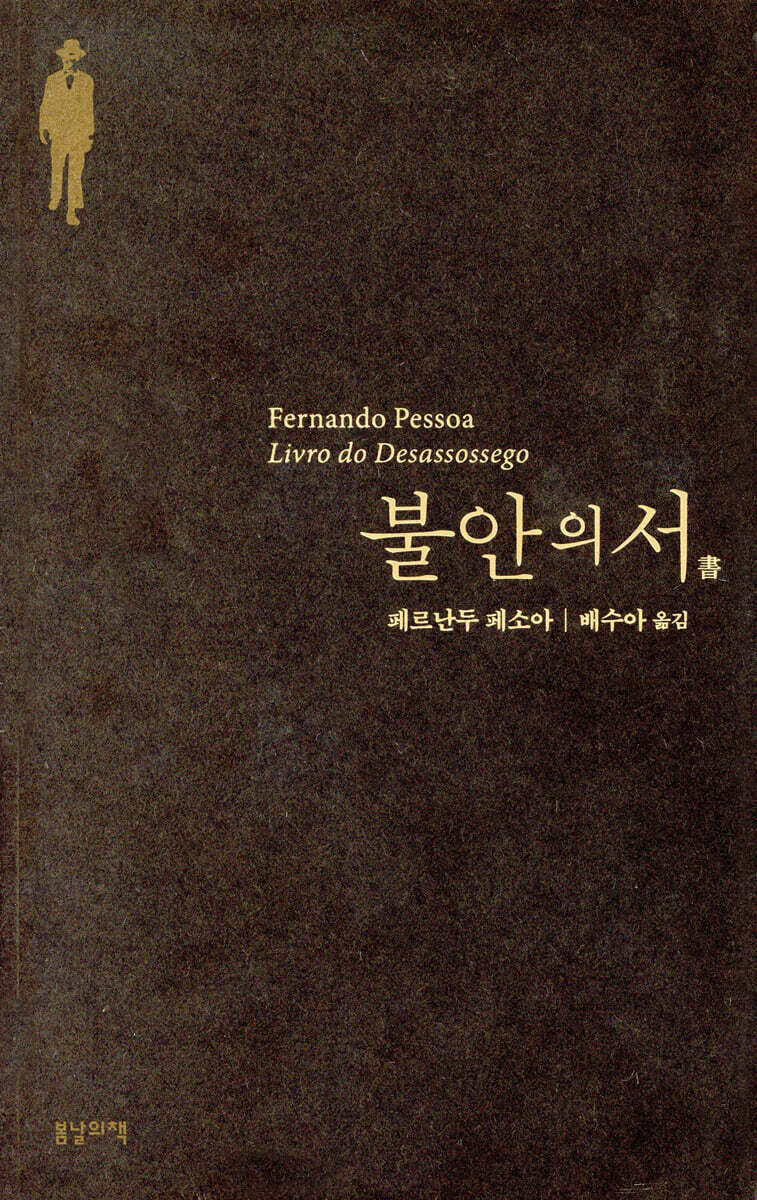
Book of Anxiety
 |
Description
Book Introduction
“Fernando Pessoa,
“No one who has read his writings once will ever forget his name.”
This book is a diary of Soares's external and internal aspects, observing and contemplating in detail the world that surrounds him but cannot penetrate his inner self, and his superficial daily life as an assistant accountant.
The language in which he records notes, recollections, impressions, reflections, meditations and fantasies, sometimes long and sometimes very short, is full of poetic metaphors.
The diary sounds like a song of sorrow, asking about the meaning of life, human destiny, and the secrets of the soul.
Places and landscapes of Lisbon are often the objects of his observation and contemplation.
Doradores, the representative street of goldsmiths, is where Soares lives and at the same time symbolizes the world and his entire life.
This book is a modern work of open form, consisting of numerous fragmented texts, sketches, and aphorisms, without any plot, but progressing solely by association of consciousness.
Soares-Pessoa's perspective on the world, his meditations, and his reflections reflect both the universality of humanity and the unique characteristics of an individual. The questions of what it means to be human, what is the meaning of life, and the secrets of the self form the main themes that run through the entire book.
Lisbon is a white city on the ocean, where dreams and longing meet.
No writer captured the melancholy and loneliness of Lisbon more brilliantly than Fernando Pessoa.
He always wears a new mask and wanders the narrow alleys of Lisbon.
To capture the play unfolding on the vast stage of the world with one's eyes at every moment.
The Book of Disquiet is the saddest book on earth, one that defies summary or categorization.
Complete translation by novelist Bae Su-ah.
“No one who has read his writings once will ever forget his name.”
This book is a diary of Soares's external and internal aspects, observing and contemplating in detail the world that surrounds him but cannot penetrate his inner self, and his superficial daily life as an assistant accountant.
The language in which he records notes, recollections, impressions, reflections, meditations and fantasies, sometimes long and sometimes very short, is full of poetic metaphors.
The diary sounds like a song of sorrow, asking about the meaning of life, human destiny, and the secrets of the soul.
Places and landscapes of Lisbon are often the objects of his observation and contemplation.
Doradores, the representative street of goldsmiths, is where Soares lives and at the same time symbolizes the world and his entire life.
This book is a modern work of open form, consisting of numerous fragmented texts, sketches, and aphorisms, without any plot, but progressing solely by association of consciousness.
Soares-Pessoa's perspective on the world, his meditations, and his reflections reflect both the universality of humanity and the unique characteristics of an individual. The questions of what it means to be human, what is the meaning of life, and the secrets of the self form the main themes that run through the entire book.
Lisbon is a white city on the ocean, where dreams and longing meet.
No writer captured the melancholy and loneliness of Lisbon more brilliantly than Fernando Pessoa.
He always wears a new mask and wanders the narrow alleys of Lisbon.
To capture the play unfolding on the vast stage of the world with one's eyes at every moment.
The Book of Disquiet is the saddest book on earth, one that defies summary or categorization.
Complete translation by novelist Bae Su-ah.
- You can preview some of the book's contents.
Preview
index
epilogue
The Ability to Want Nothing, by Kim So-yeon (poet) 5
Introduction 17
Text
1-481
Note 789
Translator's Note
A name is a sign. Bae Su-ah 793
The Ability to Want Nothing, by Kim So-yeon (poet) 5
Introduction 17
Text
1-481
Note 789
Translator's Note
A name is a sign. Bae Su-ah 793
Into the book
When, while I'm lost in my own conversation, I suddenly feel a strong desire to talk to someone else, as I am doing right now, I speak to the light pouring down like a waterfall on the rooftops.
I speak to the tall trees that stand in gentle curves on the slopes of the city, which seem closer and closer as if they are about to collapse in a silent landslide.
It speaks to the houses that are steeply sloping and stand in layers like placards.
Each window is like a letter on a placard.
---From "Text 152"
I want to run away.
I want to run away from what I know, from what is mine, from what I love.
I suddenly want to leave.
Not to an impossible India or a southern island where everything awaits, but somewhere unknown, a small town or a remote place, somewhere very different from here and now.
I don't want to see the faces here, the daily life and the days here anymore.
I want to become a stranger and rest, free from the hypocrisy that is mixed in my flesh and blood.
I want to feel sleep coming to me not as rest, but as life.
A small hut by the sea, or even a cave on a steep mountainside cliff, would suffice to fulfill this wish of mine.
But unfortunately, my will is not like that.
---From "Text 167"
The day passes by in the dying purple and fades away.
No one will tell me who I am.
No one will know who I was.
I came down to an unknown mountain and an unknown valley.
My footsteps led me into an open space in the forest as evening slowly approached.
Everyone I loved forgot me, leaving me in the shadows.
No one knew about the last ship.
No one at the post office knew about the letter that no one had written.
---From "Text 205"
Liking is always a superficial feeling to me.
But it's also honest.
I've always been an actor.
He was also a very good actor.
Every time I loved, I loved as if I were in love.
It was the same when I was the target.
---From "Text 261"
Today, the delivery man at the office left for his hometown forever.
He, who I have considered a part of this human community, and therefore a part of myself, a part of my world, has left us today.
I was so surprised to hear the news that I was about to say goodbye, when I happened to run into him in the hallway.
I hugged him.
Then he shyly hugged her.
My hot eyes felt like they were about to burst into tears at any moment, but I forced myself to hold them back.
Anything that once belonged to us, even if it came into our daily lives or into our sight by pure chance, remains a part of us because it was ours.
Today, the person who left for my hometown in Galicia, an unknown place, was not just a simple office deliveryman to me.
It was a part of the substance of my life, a visible part of my existence.
Today I am reduced.
I am no longer the person I used to be.
The delivery man from the office left.
… Yes.
Tomorrow, or some future day, when the bells of death and departure ring silently, I too will be someone who is no longer here, no longer in this place.
I speak to the tall trees that stand in gentle curves on the slopes of the city, which seem closer and closer as if they are about to collapse in a silent landslide.
It speaks to the houses that are steeply sloping and stand in layers like placards.
Each window is like a letter on a placard.
---From "Text 152"
I want to run away.
I want to run away from what I know, from what is mine, from what I love.
I suddenly want to leave.
Not to an impossible India or a southern island where everything awaits, but somewhere unknown, a small town or a remote place, somewhere very different from here and now.
I don't want to see the faces here, the daily life and the days here anymore.
I want to become a stranger and rest, free from the hypocrisy that is mixed in my flesh and blood.
I want to feel sleep coming to me not as rest, but as life.
A small hut by the sea, or even a cave on a steep mountainside cliff, would suffice to fulfill this wish of mine.
But unfortunately, my will is not like that.
---From "Text 167"
The day passes by in the dying purple and fades away.
No one will tell me who I am.
No one will know who I was.
I came down to an unknown mountain and an unknown valley.
My footsteps led me into an open space in the forest as evening slowly approached.
Everyone I loved forgot me, leaving me in the shadows.
No one knew about the last ship.
No one at the post office knew about the letter that no one had written.
---From "Text 205"
Liking is always a superficial feeling to me.
But it's also honest.
I've always been an actor.
He was also a very good actor.
Every time I loved, I loved as if I were in love.
It was the same when I was the target.
---From "Text 261"
Today, the delivery man at the office left for his hometown forever.
He, who I have considered a part of this human community, and therefore a part of myself, a part of my world, has left us today.
I was so surprised to hear the news that I was about to say goodbye, when I happened to run into him in the hallway.
I hugged him.
Then he shyly hugged her.
My hot eyes felt like they were about to burst into tears at any moment, but I forced myself to hold them back.
Anything that once belonged to us, even if it came into our daily lives or into our sight by pure chance, remains a part of us because it was ours.
Today, the person who left for my hometown in Galicia, an unknown place, was not just a simple office deliveryman to me.
It was a part of the substance of my life, a visible part of my existence.
Today I am reduced.
I am no longer the person I used to be.
The delivery man from the office left.
… Yes.
Tomorrow, or some future day, when the bells of death and departure ring silently, I too will be someone who is no longer here, no longer in this place.
---From "Text 279"
Publisher's Review
The saddest and most beautiful book about anxiety
“I created many personalities within myself.
I am constantly creating different personalities.
Every time I dream, each dream takes on a physical form and is born as a different person.
“The dreams born that way continue to dream on my behalf.”
Fernando Pessoa, revered as Portugal's national author, wrote "The Book of Disquiet," which contains approximately 480 essays ranging from two to three pages of manuscript paper to as long as 20 pages.
In the modern age, where fame, success, convenience, noise and bustle are often acknowledged, Pessoa sings of the opposite things - darkness, ambiguity, failure, hardship, silence, etc. - through his heteronym, Bernardo Soares.
Soares focuses on the Portuguese city of Lisbon, and particularly on a place called Doradores, and freely displays the people, the scenery, and the imagination sparked there, without being restricted by anything.
Each of the 480 or so articles contains independent content in principle.
However, they are closely related to each other, dealing with fundamental and diverse topics such as humanity, life and death, inner psychology and the external world.
Through Pessoa's writings, which are calm, delicate, meticulous, and yet intense, we can glimpse the true meaning of life pursued by a writer who, in his alone time, agonizes over the general themes he encounters in life.
This book is a diary of Soares's external and internal aspects, observing and contemplating in detail the world that surrounds him but cannot penetrate his inner self, and his superficial daily life as an assistant accountant.
The language in which he records notes, recollections, impressions, reflections, meditations and fantasies, sometimes long and sometimes very short, is full of poetic metaphors.
The diary sounds like a song of sorrow, asking about the meaning of life, human destiny, and the secrets of the soul.
Places and landscapes of Lisbon are often the objects of his observation and contemplation.
Doradores, the representative street of goldsmiths, is where Soares lives and at the same time symbolizes the world and his entire life.
We can treat this book as a lifelong sketchbook revealing an artist within his various heterim.
Or we can read it as a travelogue, a 'book of random impressions' that faithfully accompanied Pessoa throughout his literary wanderings, even though he never left Lisbon.
Or perhaps we might view this book as a 'false autobiography' of a man who devoted his life to not living, a man who cultivated 'an aversion to greenhouse-like behavior.'
This book is like a treasure chest of cut gems and gemstones that can be arranged and rearranged in infinite combinations precisely because there is no pre-established order.
The word 'anxiety' refers less to the existential problems of human beings than to the instability and uncertainty that exist everywhere and are now distilled into a rhetoric of everyday life.
But other forms of anxiety begin to invade the work, soon causing unexpected changes.
This book is a modern work of open form, consisting of numerous fragmented texts, sketches, and aphorisms, without any plot, but progressing solely by association of consciousness.
Soares-Pessoa's perspective on the world, his meditations, and his reflections reflect both the universality of humanity and the unique characteristics of an individual. The questions of what it means to be human, what is the meaning of life, and the secrets of the self form the main themes that run through the entire book.
Lisbon, the emotional backdrop of this piece, is a city where dreams and desires intersect.
Like Kafka's Prague, James Joyce's Dublin, and Robert Musil's Vienna, Pessoa wanders the alleys of Lisbon, capturing the melancholy and loneliness of the white seaside city with greater sensitivity than anyone else.
“I created many personalities within myself.
I am constantly creating different personalities.
Every time I dream, each dream takes on a physical form and is born as a different person.
“The dreams born that way continue to dream on my behalf.”
Fernando Pessoa, revered as Portugal's national author, wrote "The Book of Disquiet," which contains approximately 480 essays ranging from two to three pages of manuscript paper to as long as 20 pages.
In the modern age, where fame, success, convenience, noise and bustle are often acknowledged, Pessoa sings of the opposite things - darkness, ambiguity, failure, hardship, silence, etc. - through his heteronym, Bernardo Soares.
Soares focuses on the Portuguese city of Lisbon, and particularly on a place called Doradores, and freely displays the people, the scenery, and the imagination sparked there, without being restricted by anything.
Each of the 480 or so articles contains independent content in principle.
However, they are closely related to each other, dealing with fundamental and diverse topics such as humanity, life and death, inner psychology and the external world.
Through Pessoa's writings, which are calm, delicate, meticulous, and yet intense, we can glimpse the true meaning of life pursued by a writer who, in his alone time, agonizes over the general themes he encounters in life.
This book is a diary of Soares's external and internal aspects, observing and contemplating in detail the world that surrounds him but cannot penetrate his inner self, and his superficial daily life as an assistant accountant.
The language in which he records notes, recollections, impressions, reflections, meditations and fantasies, sometimes long and sometimes very short, is full of poetic metaphors.
The diary sounds like a song of sorrow, asking about the meaning of life, human destiny, and the secrets of the soul.
Places and landscapes of Lisbon are often the objects of his observation and contemplation.
Doradores, the representative street of goldsmiths, is where Soares lives and at the same time symbolizes the world and his entire life.
We can treat this book as a lifelong sketchbook revealing an artist within his various heterim.
Or we can read it as a travelogue, a 'book of random impressions' that faithfully accompanied Pessoa throughout his literary wanderings, even though he never left Lisbon.
Or perhaps we might view this book as a 'false autobiography' of a man who devoted his life to not living, a man who cultivated 'an aversion to greenhouse-like behavior.'
This book is like a treasure chest of cut gems and gemstones that can be arranged and rearranged in infinite combinations precisely because there is no pre-established order.
The word 'anxiety' refers less to the existential problems of human beings than to the instability and uncertainty that exist everywhere and are now distilled into a rhetoric of everyday life.
But other forms of anxiety begin to invade the work, soon causing unexpected changes.
This book is a modern work of open form, consisting of numerous fragmented texts, sketches, and aphorisms, without any plot, but progressing solely by association of consciousness.
Soares-Pessoa's perspective on the world, his meditations, and his reflections reflect both the universality of humanity and the unique characteristics of an individual. The questions of what it means to be human, what is the meaning of life, and the secrets of the self form the main themes that run through the entire book.
Lisbon, the emotional backdrop of this piece, is a city where dreams and desires intersect.
Like Kafka's Prague, James Joyce's Dublin, and Robert Musil's Vienna, Pessoa wanders the alleys of Lisbon, capturing the melancholy and loneliness of the white seaside city with greater sensitivity than anyone else.
GOODS SPECIFICS
- Date of publication: March 27, 2014
- Page count, weight, size: 807 pages | 811g | 140*220*40mm
- ISBN13: 9788996997962
- ISBN10: 899699796X
You may also like
카테고리
korean


korean

![GQ KOREA Mark (Monthly): December [2025]](http://librairie.coreenne.fr/cdn/shop/files/8ef265dbbfbf186523ed75ba7319009d.jpg?v=1765340328&width=3840)


