

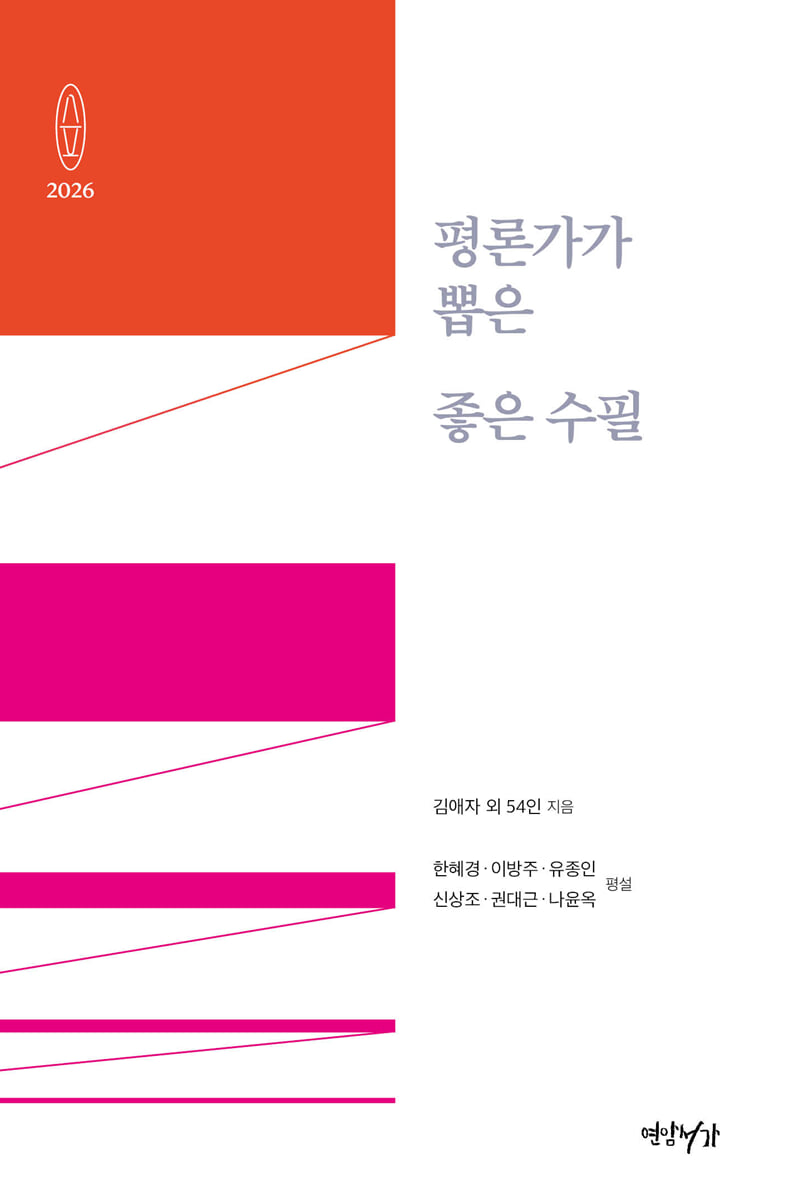
Critics' Picks for Best Essays of 2026
 |
Description
Book Introduction
Essays and Commentaries: A Beautiful Harmony
Even in the AI era, literary magazines are still published, but the reality is that we are looking at our smartphones more than we are reading paper books.
We live in an environment where recognition is measured by portal searches rather than by biographies in books, and the more often someone is mentioned, the more famous they are considered.
Now that I feel like publishing my writing in literary magazines is no longer the only option, I've decided to utilize the "portal site" as a space where I can quickly gauge readers' reactions.
The unique and advantageous feature of "Good Essays Selected by Critics" is that it is the first book in Korea to directly connect readers and the public through a portal site called Naver.
It became a great catalyst for spreading the author's name and work widely in cyberspace rather than on land.
For essays that are truly essays and are filled with emotion to be loved by readers, we must continue to produce "good essays" that can properly fit into this new space.
I hope this book will be that grain of wheat.
The keyword for the first book was 'future'.
The future of essays will shine brightly when they are freer and more diverse, and when they have no boundaries, they will naturally be passed on to the next generation.
─From the “Publisher’s Note”
Even in the AI era, literary magazines are still published, but the reality is that we are looking at our smartphones more than we are reading paper books.
We live in an environment where recognition is measured by portal searches rather than by biographies in books, and the more often someone is mentioned, the more famous they are considered.
Now that I feel like publishing my writing in literary magazines is no longer the only option, I've decided to utilize the "portal site" as a space where I can quickly gauge readers' reactions.
The unique and advantageous feature of "Good Essays Selected by Critics" is that it is the first book in Korea to directly connect readers and the public through a portal site called Naver.
It became a great catalyst for spreading the author's name and work widely in cyberspace rather than on land.
For essays that are truly essays and are filled with emotion to be loved by readers, we must continue to produce "good essays" that can properly fit into this new space.
I hope this book will be that grain of wheat.
The keyword for the first book was 'future'.
The future of essays will shine brightly when they are freer and more diverse, and when they have no boundaries, they will naturally be passed on to the next generation.
─From the “Publisher’s Note”
- You can preview some of the book's contents.
Preview
index
Publisher's Note: A Beautiful Harmony of Essays and Commentary
Part 1: Strict and Beautiful
Kim Ae-ja's "Under the Waning Moon" - Strict and Beautiful
Jeong Tae-heon's "Blue Secret Record" - Fate, a transparent and blue trace
Cho Heon, "Tears, That Precious Function" - Tears are the language of the soul.
Lee Kyung-eun's "Outside": A Subversive Perspective on the Outside
Hwang Jin-sook, "At the Port" - Shedding the shell and becoming a pure self
Lee Myung-ji's "On the Way to the Cathedral" - Such a delightful self-affirmation
Noh Hye-sook's "When Silence Becomes a Landscape" - The Day the Plaza Becomes First-Class
Song Myung-hwa's "Root Knot": A Solid Multilayered Structure and Compassionate Healing Poetics
Song Hye-young's "The Disappearing People" - Concerns About the Vanishing Rush of Love
Park Tae-seon's "Dumogachi" - The Book of Father
Go Gyeong-seo (Gyeong-suk) 『Reflecting Light』_The Illusion of Sorrow
Part 2: Unlocking the Lock and Moving Forward into Existence
Kang Hyun-ja's "Open the Gate" - Unlocking the Lock and Moving Forward into Existence
Baek Song-ja's "Burning Platform" - Burning Platform, a space symbolizing the archetype of death
Son Bong-ho's "Boiler Fool" - Clear and cheerful
Choi Yun-jeong's "Suddenly" - Love blossoms in "Suddenly"
Kim Baek-yoon's "The Sea of Wife" - A Writing Shaped by Life
Shin Geum-cheol's "Soban Da-rim-i" - Interpreted with strategic imagination and shaped by the mystery of sentences
Kim Jin-sook's "Regret of Addiction": On the Paradigm of Addiction
Lee Seung-ae's "Yobyeon": Embracing Change
Hong Jae-suk's "The Heart Meets the Eyes and Runs Out" - The expression of snow is dualistic.
Lee Myeong-jin's "The Beauty of the Land" - Etiquette for Sadness
Kwon Soon-yi's "Putting Your Soul in Your Fingertips" - Covering Yourself with Courtesy and Sincerity
Part 3: The 'Sai' Theory of Urban Scenery
Kim Cheol-hee's "The Time of the Soup" - A Tribute to the Unattractive
Jo Jae-hyung's "Strange Stories" - An Unexpected Scene, a Poetic Encounter with a Cat
Lee Hye-yeon's "Bubble Missing Report" - A New World Visible Through Convergence
Choi Yun-suk's "Carving a Stroke" - Forgiving by Living
Lee Jae-heon's "The Room Where the Lights Never Go Out": A Metaphor for Love
Kim Jeong-ae's "The Old Tree and the Butterfly": The Discovery of the "Aha Moment" and the Development of Transformational Poetics
Kwon Kyung-ja's "Broken Windows": Objects viewed intimately respond to the gaze.
Park So-yoon's "Between, That Between": A Study of the "Between" in Urban Landscape
Kang Pyo-seong, "Embracing Green" - Photosynthesis of the Soul through Green
Kim Eun-sook's "Geura" - Words are symbols containing the heart
Lim Yi-song's "Human Stain": The Mutual Birth of Stain and Pattern
Part 4: Boredom, the Modern Anxiety
Kim Gwi-seon's "Unable to Wait": Remembering Life in Front of a Closed Door
Lee Shin-ae's "Hanging Laundry" - A Memory That Cannot Be Reset
Yoon Seong-geun's "Boredom vs. Boredom" - Boredom, the Modern Anxiety
Kim Kyung-hye's "The Husband's Room" - The Relationship Between Roles and Existence
Lee Chun-hee (Bom-hee) 『Entering the Island』_Finding My Name
Kim Jong-hee's "Bottom, That Deep Language" - Language, the transformative energy that guides thought
Noh Sang-bi's "Blue Sorrow": A Blue Hymn to a Life Without Regret
Lee Ho-yoon's "The Water of Logos" - The Water of Logos, the Principle of Human and Cosmic Existence
Jeong Ok-sun's "Springtime Today" - From Raw to Mature
Jang Eun-kyung's "The Dark Side of the Moon" - The Light That Came to Me Without Even Ringing the Bell
Im Mi-ok's "That Snowy Day" - Longing for a Road Without Confession
A flower blooming at the end of episode 5
Kim Jeong-hwa's "The End" - A Remnant of Japanese Imperialism, a Flower Blooming in the End
Lim Byeong-mi's "Water Drops Splash" - Reflecting on the Being of "Mother"
Jeon Mi-ran's "Apgujeong Flyer" - Taking Care of a Subversive Life
Kim Jeong-tae's "Where the Persimmon Blossoms Bloom" - The Origin of Life Found in Nature
Chu Seon-hee's "Living in Yulwon" - Praising Uselessness
Kim Mi-kyung's "Van Gogh's Star, Spiral Galaxy M51a" - Stars, the Origin of Marvelous Art
Lee Nan-young's "Mother Embraced in the Museum" - A Love That Reflects and Reflects
Hwang Hye-ran's "Jinhon Gut" - A Place of Empathy Completed Through Crying
Kang Gil-su's "A Certain Kite" - Nature Seen Through Nature's Eyes
Park Jini's "A Glass of Makgeolli" - The Momentum of Ruminating Drinks
Lim Seung-ju's "Tight" - A Journey to Break the Frozen Sea
Editorial review
Part 1: Strict and Beautiful
Kim Ae-ja's "Under the Waning Moon" - Strict and Beautiful
Jeong Tae-heon's "Blue Secret Record" - Fate, a transparent and blue trace
Cho Heon, "Tears, That Precious Function" - Tears are the language of the soul.
Lee Kyung-eun's "Outside": A Subversive Perspective on the Outside
Hwang Jin-sook, "At the Port" - Shedding the shell and becoming a pure self
Lee Myung-ji's "On the Way to the Cathedral" - Such a delightful self-affirmation
Noh Hye-sook's "When Silence Becomes a Landscape" - The Day the Plaza Becomes First-Class
Song Myung-hwa's "Root Knot": A Solid Multilayered Structure and Compassionate Healing Poetics
Song Hye-young's "The Disappearing People" - Concerns About the Vanishing Rush of Love
Park Tae-seon's "Dumogachi" - The Book of Father
Go Gyeong-seo (Gyeong-suk) 『Reflecting Light』_The Illusion of Sorrow
Part 2: Unlocking the Lock and Moving Forward into Existence
Kang Hyun-ja's "Open the Gate" - Unlocking the Lock and Moving Forward into Existence
Baek Song-ja's "Burning Platform" - Burning Platform, a space symbolizing the archetype of death
Son Bong-ho's "Boiler Fool" - Clear and cheerful
Choi Yun-jeong's "Suddenly" - Love blossoms in "Suddenly"
Kim Baek-yoon's "The Sea of Wife" - A Writing Shaped by Life
Shin Geum-cheol's "Soban Da-rim-i" - Interpreted with strategic imagination and shaped by the mystery of sentences
Kim Jin-sook's "Regret of Addiction": On the Paradigm of Addiction
Lee Seung-ae's "Yobyeon": Embracing Change
Hong Jae-suk's "The Heart Meets the Eyes and Runs Out" - The expression of snow is dualistic.
Lee Myeong-jin's "The Beauty of the Land" - Etiquette for Sadness
Kwon Soon-yi's "Putting Your Soul in Your Fingertips" - Covering Yourself with Courtesy and Sincerity
Part 3: The 'Sai' Theory of Urban Scenery
Kim Cheol-hee's "The Time of the Soup" - A Tribute to the Unattractive
Jo Jae-hyung's "Strange Stories" - An Unexpected Scene, a Poetic Encounter with a Cat
Lee Hye-yeon's "Bubble Missing Report" - A New World Visible Through Convergence
Choi Yun-suk's "Carving a Stroke" - Forgiving by Living
Lee Jae-heon's "The Room Where the Lights Never Go Out": A Metaphor for Love
Kim Jeong-ae's "The Old Tree and the Butterfly": The Discovery of the "Aha Moment" and the Development of Transformational Poetics
Kwon Kyung-ja's "Broken Windows": Objects viewed intimately respond to the gaze.
Park So-yoon's "Between, That Between": A Study of the "Between" in Urban Landscape
Kang Pyo-seong, "Embracing Green" - Photosynthesis of the Soul through Green
Kim Eun-sook's "Geura" - Words are symbols containing the heart
Lim Yi-song's "Human Stain": The Mutual Birth of Stain and Pattern
Part 4: Boredom, the Modern Anxiety
Kim Gwi-seon's "Unable to Wait": Remembering Life in Front of a Closed Door
Lee Shin-ae's "Hanging Laundry" - A Memory That Cannot Be Reset
Yoon Seong-geun's "Boredom vs. Boredom" - Boredom, the Modern Anxiety
Kim Kyung-hye's "The Husband's Room" - The Relationship Between Roles and Existence
Lee Chun-hee (Bom-hee) 『Entering the Island』_Finding My Name
Kim Jong-hee's "Bottom, That Deep Language" - Language, the transformative energy that guides thought
Noh Sang-bi's "Blue Sorrow": A Blue Hymn to a Life Without Regret
Lee Ho-yoon's "The Water of Logos" - The Water of Logos, the Principle of Human and Cosmic Existence
Jeong Ok-sun's "Springtime Today" - From Raw to Mature
Jang Eun-kyung's "The Dark Side of the Moon" - The Light That Came to Me Without Even Ringing the Bell
Im Mi-ok's "That Snowy Day" - Longing for a Road Without Confession
A flower blooming at the end of episode 5
Kim Jeong-hwa's "The End" - A Remnant of Japanese Imperialism, a Flower Blooming in the End
Lim Byeong-mi's "Water Drops Splash" - Reflecting on the Being of "Mother"
Jeon Mi-ran's "Apgujeong Flyer" - Taking Care of a Subversive Life
Kim Jeong-tae's "Where the Persimmon Blossoms Bloom" - The Origin of Life Found in Nature
Chu Seon-hee's "Living in Yulwon" - Praising Uselessness
Kim Mi-kyung's "Van Gogh's Star, Spiral Galaxy M51a" - Stars, the Origin of Marvelous Art
Lee Nan-young's "Mother Embraced in the Museum" - A Love That Reflects and Reflects
Hwang Hye-ran's "Jinhon Gut" - A Place of Empathy Completed Through Crying
Kang Gil-su's "A Certain Kite" - Nature Seen Through Nature's Eyes
Park Jini's "A Glass of Makgeolli" - The Momentum of Ruminating Drinks
Lim Seung-ju's "Tight" - A Journey to Break the Frozen Sea
Editorial review
Into the book
As people's bodies age, they begin to long for the days gone by.
As time moves westward, it becomes increasingly faster. Trapped in a bleak, inactive routine, even the events that were marred by poverty and left us tormented by the border between betrayal and reconciliation are colored with longing.
Even the smallest, most insignificant things come to me as a murmur, cloaked in longing.
After finishing cleaning with my wife, we go to coffee time.
He drinks the coffee his wife made for him and his old wife looks at him with amazement.
My wife, who prepares three meals a day without fail, is the person I met among the 8 billion people who exist within the laws of gravity and gravitation, and she is the person I have lived with the longest.
The wife also thinks her husband is a dazzling Buddha.
What fun would it be to prepare three meals a day without him?
--- p.14
Kim Ae-ja's "Under the Waning Moon" transfers the time of old age into the beautiful spatial image of "under the waning moon," completing the landscape of old age that has reached enlightenment.
“He is descending the steps of life under the waning moon.” The first sentence paints a dreamy scene through the image of him descending the steps of life under the dim light of the waning moon.
As we enter the night of life, the intensity of the descent, which overlaps with the night and the 'waxing moon', 'below', and 'going down', is diminished as the moon is enveloped by the moonlight.
This feeling is solidified in the following sentence: “I am going down slowly and with light steps.”
Although it is going down, it is not sad, and it is free from resentment, regret, and greed.
As autumn deepens, the trees shed their fruits and leaves, becoming lighter and lighter.
--- p.16
“You can’t go.
“Traveling without a guardian….”
These are words you are destined to hear someday.
I just didn't realize that that time was right now.
I also thought it was a little fast.
I thought you came in a hurry because I wasn't mentally ready yet.
A feeling of shame and sadness passed through me.
It was something I had to accept, but it wasn't easy.
As I struggled to put on the mask, Gregor Samsa's struggling limbs came to mind.
The sound of the fluid in my chest draining out in all directions was unusually loud.
--- p.30
“You can’t go.
“Traveling without a guardian….”
It's something everyone will hear at some point.
But when you hear it out of the blue when you're not mentally prepared, and when you're prevented from entering a world you've taken for granted, it's hard for anyone to escape the feeling of bewilderment and shock.
Lee Kyung-eun's "Outside" arrives at a dazzling, subversive conclusion by gazing at and pondering this experience, which feels like facing a gigantic cliff.
--- p.34
As I think about what shape and angle my voice has, the fable of the butterfly caterpillar comes to mind.
A caterpillar crawling and stepping to climb the only pillar that reaches the sky.
The caterpillar, who finally reached the end of the pillar, found nothing, and there were other pillars in the world, but could not tell the truth.
A caterpillar that realizes too late that it must fly rather than crawl to reach the top of the pillar, but hesitates for fear of the time it will take to become a pupa.
The fable resembles our self-portrait, running towards only one goal.
Where do I stand now?
What kind of voice is he making?
Have we been living in the easy and lazy life of a common citizen, hiding behind habitual self-reflection, without ever raising our own voice?
--- p.52
Noh Hye-sook confesses the silence she experienced through “When Silence Becomes a Landscape.”
In the stillness of the original empty state, I discovered ‘traces of shade’ in ‘thoughts spread out like a landscape.’
He has a desire for the shade to flow into the clear waters.
Such thoughts, when they confirm the true existence of the self in absolute solitude, become the energy that breathes dynamism into life.
At this time, the silence is transformed into a landscape.
--- p.54
It is said that glaciers flow in everyone's heart.
The ice in the chest flows into the groundwater and finds a part where the cover is not solid and flows out.
Is it true that the cold inner temperature can only find relief when it feels the warmth of the outside world and softens? Is that what it means to have a wound in your heart?
These are strange root nodules.
How can I explain the craters I encountered at Cheonliposu Arboretum?
As I was walking along the path by the pond, I came across a group of larch trees.
The unfamiliar objects beneath the tree trunks, lined up solemnly like a detective, caught my eye.
Is this a miniature version of the virtual empire seen in fantasy movies?
The numerous protrusions that rose from the ground were reminiscent of a stone exhibition hall.
Strange things sticking out here and there like knees raised from sitting, not even roots, but stalactites that grow out of the ground.
Looking at the sign, it said that it was a root that was created to help the roots of plants breathe.
--- p.56
The writer surveys the forest with a telescopic perspective and caresses the trees with microscopic care.
The root knots of the larch tree, a symbol of its evolution and adaptation for survival, and the pain of the poet who lost his child to bullying, Van Gogh who read the connection between life and death through the larch tree outside the window in a mental hospital, and his own past hurt by bullying from a friend, were woven together to achieve literary achievement through observation, reflection, insight, and introspection.
The main and background characters are wounded people, and the goal is healing.
--- p.61
At sunset, when day and night intersect, all existence—light and darkness, life and death, creation and extinction, moment and eternity—reveals its duality and cycles or comes to an end.
The setting sun seems to be watching the joys and sorrows of the human world, and a warm pain sweeps through my heart.
The constantly living and writhing form is shaken by empathy.
The emotional range is different each time.
The burden of having to put down the weight of life that my body, aged by the ravages of time, has endured and endured, makes me feel uneasy.
In the end, even the most miserable memories that should have been forgotten come back vividly, forcing me to straighten my spine and warmly embrace the sunset.
The sunset that brings tears to one's eyes is regret and longing.
--- p.76
Go Gyeong-seo's essays are special.
This is because of his unique writing style, which allows him to write an essay while leading the material into descriptive sentences.
Go Gyeong-seo is an essayist who writes with a literary aesthetic and a detailed and profound perspective.
If anyone is looking for a work to transcribe for sentence training, I would like to recommend this author's essays.
As I have already mentioned (in my book, “Reading Narrative Essays with Small Eyes”), the essay “Rose is Poetry,” written by the author while standing in one place and looking at an apple, left a deep impression because of its uniqueness.
The piece is a 16-page essay written on a single, ripe ruby on a sunny autumn day against the backdrop of a blue sky.
It was an essay in which the thoughts contained in dense, detailed descriptive sentences were in tight harmony with the descriptions.
--- p.149
I went to the fields in Saebok and came back, and I saw a two-story house with a lot of free time in the middle of the night.
The man of that house commutes to and from work by bicycle or something, so it's different from that of a slacker.
No matter how hard you draw, if you look inside the gate, it's chaos.
There are more weeds on the outside of the lawn.
I need to use weed killer to pull out the weeds, but I have to find a way to deal with it.
The fruit in the fruit basket is a fruit that is grown on the ground.
You're just making me do naked things without taking any medicine?
I'll lend you a bottle of disinfectant, so take it with you. I don't want to order anything.
Even if you lend it to me, I can't use it.
Yeah, we want to step up and do it, but we're so busy with farm work, so where can we find the time?
When Demon Jeon Ji-du and Hijuya Ga-jaengi don't go outside the city, I don't know if it's because they don't care or because they don't know, but they're so frustrated that they're going to die.
Yeah, I told him to open the door and come out, but he just won't come out.
Kang Hyeon-ja's "Open the Door Now" on page 85 is a work that reveals the desperate desire for relationships and communication as an individual being.
In this work, two worlds exist, separated by a main gate.
The world inside the gate and the world outside the gate, with different cultures.
From the moment we are born, we are ingrained with the customs of the world we live in, and we grow up to be human beings who live in harmony with each other, wearing similar cultural clothing.
In such a culture, individuals grow into members of society by constantly interacting with the world, influencing each other and transforming through causal relationships.
--- p.89
These days, I wake up at dawn, and the boiler is always running at that time, unless it's a very warm day.
Every time I see it, my yellow instinct kicks in.
If we wait a little longer, the sunlight and electric heater will raise the temperature in the house to 18 degrees and the boiler will stop working, so it would be a waste to waste gas until then.
So I turn on the electric heater and turn it towards the regulator.
The regulator, heated by the stove, reads 18 degrees in less than 5 minutes and the gas does not burn any further.
The temperature in the house is still 17 degrees, but the boiler is being fooled.
However, the temperature inside the house does not drop back down to 17 degrees due to the increasingly strong sunlight and the electric heater that continues to emit heat.
Although it is for a short time, the boiler stops operating a little earlier, which saves gas.
I am a believer in 'many a little makes a mickle'.
--- p.97
'Cheating the boiler' means using a solar electric heater to raise the temperature of the thermostat.
I usually set the temperature to 18 degrees and supplement the lack of heat with sunlight and an electric heater, so it's a shame that the boiler starts running at dawn these days.
If we just wait a little longer, the sunlight and the heater will raise the temperature to 18 degrees, but it's a waste to waste gas until then.
Show your 'yellow spirit' and turn the stove towards the regulator.
Then, the temperature immediately reached 18 degrees and the boiler stopped.
However, the temperature inside the house is still 17 degrees, so the boiler has been fooled.
--- p.101
I have a strange addiction to certain things or actions for a certain period of time.
For three or four years, the can of beer I drank alone every evening became a sacred ritual to end the day.
After drinking the beer, I was laughing in a state of ecstasy, somewhere between reality and unreality.
Wanting to know 'Everything that gives you comfort!', I willingly continued to explore the history, types, and tastes of beer.
This was also the case with coffee, and Haruki's light and sophisticated writings were not much different from beer or coffee.
When I started raising cats, I was so obsessed with all the cats in the world that it felt like more than 80% of my right brain was filled with cats.
But looking back, the period when I was completely absorbed in a certain object or action, or so-called addicted, was a time when I was having a hard time getting through a corner of my life.
During difficult times, I would have diverted my attention elsewhere as a defense mechanism, and while I was voluntarily exhausting my mind and body in that way, the difficult times would have passed.
--- p.124
If the scope of addiction can be expanded to become a symptomatic treatment for a difficult life, it has the potential to become a realm of enjoyment and savoring rather than a place of withdrawal.
Kim Jin-suk's "Regret of Addiction" is not unaware of the extremes of our devastated reality, but rather, because of this, it has an essayistic perspective that opens up another side of addiction, or another way out.
Kim Jin-suk's 'baking bread' is not a professional calling.
Nevertheless, the effort, energy, and concentration required to complete one's own bakery must be maintained with a sense of tension.
It is not unreasonable to view it as a psychological activity that serves as a kind of alternative antithesis to relieve or soothe the pain that is strangling oneself or the real pain.
When the mind is alive, the body lives, and when the body lives, the mind also seeks vitality through stability and peace that correspond to it.
--- p.127
Who hasn't experienced something that touched their heart at least once or twice in their life?
Life is a repetition of things that make people suffer, pickle, and ache, and make them cry and weep.
In between, when you live your life by taking care of yourself, the sun shines.
Sometimes I feel sorry for his skinny body, as he goes out to work and cooks meals alone after thirty years.
I think all the regrets and the sticky things that were bothering me have disappeared, and only the podium remains.
Now, I pay off several million won in debt every month.
When he leads and I support, like a verse, our engraving will also have meaning.
The strength in our hands as we hold each other is increasing.
--- p.177
Despite the bright appearance of sculptor Kim Seong-su's kkotdu, its raw material is not the so-called 'happily grown tree.'
The author prefers trees that grow in the cold winter, especially in the mountains of the southern and northern regions.
Even in the mountains in the north, he chooses trees that have not been exposed to enough sunlight, trees that have grown twisted from lack of food, poor growth, and illness, from steeper places.
Because the beauty of a tree comes from its very twisting.
Isn't the paradox that these crippled trees, enduring the barren land and harsh cold, embody a comforting image? Isn't this the very reward that suffering offers us? Choi Un-suk's "Carving Stroke" conveys the same message through her experience in the workshop:
--- p.179
A white butterfly flies towards the yellow rapeseed flowers.
It is a stylish bird with gray feathers on the wing tips and two black spots placed side by side.
This little one is more interested in playing than in sucking honey, so he just flaps his wings quickly and flies over the flowers.
Even if you try to closely observe its appearance and focus your eyes to follow the melody of its wings, it rarely rests its legs or touches the flower with its long, long tail.
Then, they met a friend and were playing love games, even flying diagonally towards each other.
Could the splendid technique of Mozart's Piano Sonata No. 16, Allegretto, have been inspired by the brisk fluttering of these tiny butterflies' wings?
Hang a tune on a butterfly's wing and hum it.
The close-up gaze on the butterfly is released and a full shot is taken of a long field of rapeseed flowers.
Aren't there a group of white little ones playing on the flowers that look like yellow silk shawls draped over the Oncheoncheon Stream?
Just a few days ago, they were nowhere to be seen. Where did these children, now fully enjoying this season of eclectic, cartoon-like ecstasy, come from? What was their past like before they acquired these magnificent wings, like the heart of freedom?
--- p.189
Kim Jeong-ae's "The Old Tree and the Butterfly," which stands out for its multi-layered nature, blended with Dante's "Divine Comedy," is a work of transitional aesthetics, in which the author, who had been complacently trying to adapt to a lifestyle that suits her health after feeling a warning sign at the age of seventy, discovers new shoots on an old tree.
“How can such tender shoots cover the entire body of an old tree?” The author chooses the new shoots of an old tree as a subject matter to embody new enlightenment through the shocking emotion of encountering an old tree.
In the process of delving deeply into the subject, the author weaves the image of his own life and will into a multi-layered structure, and puts it into effect through the subject of 'Virgil'.
--- p.194
On the subway at sunset, the outside world is so distorted that you can't tell what it is like.
My hopes of seeing detailed scenery while running faded.
What can you see while running?
Can you see something while running?
What is between what and what?
A person who strives to see something, even at the moment of running, strives to know what is between what and what.
Sunset is the time to end the day.
Many things in life come rushing in like a sunset.
The subway runs fast, and the people inside can't see the sunset properly.
In fact, we forget that we never actually see the sun set.
What the eyes see, the heart does not see, and what the heart knows, the mind does not know.
The hottest part of the sun, which appears red, is blue, and just before the sun sets, it briefly appears green.
Between sunset and sunrise, only green and blue fill the space, neither sunset nor sunrise.
--- p.205
Park So-yoon's "Between, That Between" is particularly notable for its keen eye for capturing the nuances of light that act on urban space-time (visual space) with the concept of "distance" to clearly capture that moment of leisure.
When we talk about the melancholy and atmosphere of a gray city, we often primarily expose a feeling of stagnation.
However, the urban daily life scenery that the author captures and depicts provides a very dynamic and impressive screen through the time called 'in-between'.
Like a chef who carefully prepares raw fish, the dramatic images of our urban life are extracted and displayed through the scenes and customs seen outside the window on the moving subway.
The way to sharply and impressively cut objects and landscapes as if they were nothing is to observe the changes in the landscape as if perceiving them with the concept of 'between'.
The mind that develops the scenery of time, sharply and densely packed in the dull time, is like a self-consciousness about the newness of discovering that “a little while ago, another woman was standing in the place of the man who was reading a book.”
--- p.207
When I get lost among people, I wander around green.
When bitter water gathers in my mouth and my heart feels like a wasteland, I seek out a tree.
The more lush the better.
When I'm panting and struggling to control my breathing, they listen to my body's signals.
Without making a fuss or forcing a look of pity, I just watch silently.
The green waves silently caressing my shoulders, the scenery slowly creeping into me.
It is a forest of blue proverbs.
There, you don't have to worry about line spacing, underlining, or parenthesizing.
I stand before a picture drawn by time.
Let go of everything and become your own being.
When faced with silence, it becomes very still.
Just open each and every hair and receive the energy that permeates your entire body.
There is a letter of ultimate comfort, a warm prescription.
--- p.210
Kang Pyo-seong knows very well that humans and nature are destined to be thieves.
So, you can immerse yourself in green and embrace green.
In fact, the green may have embraced the writer.
This work strategically hides the process of thinking about becoming one with nature.
The thought progresses in the following order: “Awareness of green, benefits of green, and self permeated with green.”
First, empty your mind, then immerse yourself in the green and gain insight into nature and the universe.
When we grasp the essence of nature, our true nature awakens and we reach unity with nature through spiritual thinking.
At this point, the reader also becomes immersed in the author's thoughts.
--- p.214
A truly deep desire immediately recognizes opportunity.
The tentacles are sensitive.
One day, I stopped by a brunch cafe and really liked the interior.
It was cozy, neat and free.
In particular, the ceiling supported by a tangled mass of wood and the rounded corners of the bathroom entrance caught my eye.
It was light but sturdy, with no place to show off or lean on.
The sense of identity of the space was clear.
I got the architect's contact information and asked for a consultation.
The architect who came to the house looked at the old and stained wallpaper in the study and said, "It's nice."
I was amazed by the unexpected things in the bedroom, such as the floorboards and the old gas range.
In my opinion, everything beautiful is something that has been touched by the hand of time.
Beauty, whether in objects or people, is determined by time.
I decided to entrust the construction to that architect.
--- p.332
Chu Seon-hee's "Living in Yulwon" is reminiscent of Ha Ji-jin's "Homo Ludens," and at the same time, the title itself evokes a sense of foreboding, as if it were "Living in YOLO."
This is a misconception that stems from the fact that both 'Yulwon' and 'Yolo' have two syllables with many sonorities, but also from the overall atmosphere of the work that does not emphasize practicality.
The author said, “There are days when something in a certain corner catches the eye.
It could be furniture, a painting, a pencil holder, or even hand cream in front of the pencil holder.
“Things move and space changes according to the moving mind,” he writes.
Furthermore, he plans to decorate this space like “the interior of a brunch cafe you visit one day” for active enjoyment.
--- p.336
To me, my father was a transparent person.
Even though I couldn't understand everything my father said or did, I could guess the context.
After he got angry at me for some reason, he immediately came up to me and asked if I needed anything or if there was anywhere I wanted to go.
I hated seeing that look because it reminded me of a child who was doing something wrong and was being careful.
As the daughter of such a father, I was no different from a child and did not want to admit my mistakes.
As my father's health deteriorated, his glass of wine became half a bowl of makgeolli, and he had to abstain from alcohol for the last few months.
Even when he was healthy, my father said that Jeongjong was tasteless.
How about a glass of makgeolli for the ancestral rites table? What would your father say if you asked?
--- p.368
Park Jini's "A Glass of Makgeolli" is not about the story of a strong drink like absinthe, but rather the meeting between a father who drinks alcohol and his daughter who does not drink alcohol.
The meeting embraces both the coincidence of time and the discrepancy of time through alcohol.
While drinking can be a great way to distract yourself, it actually leaves you with the aftertaste of a harsh look at life.
Looking back, where did all the alcohol go, leaving only a hangover?
Park Jini's father gave her the gift of questioning.
“How are you feeling today?” This may seem trivial at first, but it seems to be asking everyone, “How is your existence organized and running well?”
Perhaps it was the simple elegance of my father's drinking that led me from simple questions to profound reflections.
As time moves westward, it becomes increasingly faster. Trapped in a bleak, inactive routine, even the events that were marred by poverty and left us tormented by the border between betrayal and reconciliation are colored with longing.
Even the smallest, most insignificant things come to me as a murmur, cloaked in longing.
After finishing cleaning with my wife, we go to coffee time.
He drinks the coffee his wife made for him and his old wife looks at him with amazement.
My wife, who prepares three meals a day without fail, is the person I met among the 8 billion people who exist within the laws of gravity and gravitation, and she is the person I have lived with the longest.
The wife also thinks her husband is a dazzling Buddha.
What fun would it be to prepare three meals a day without him?
--- p.14
Kim Ae-ja's "Under the Waning Moon" transfers the time of old age into the beautiful spatial image of "under the waning moon," completing the landscape of old age that has reached enlightenment.
“He is descending the steps of life under the waning moon.” The first sentence paints a dreamy scene through the image of him descending the steps of life under the dim light of the waning moon.
As we enter the night of life, the intensity of the descent, which overlaps with the night and the 'waxing moon', 'below', and 'going down', is diminished as the moon is enveloped by the moonlight.
This feeling is solidified in the following sentence: “I am going down slowly and with light steps.”
Although it is going down, it is not sad, and it is free from resentment, regret, and greed.
As autumn deepens, the trees shed their fruits and leaves, becoming lighter and lighter.
--- p.16
“You can’t go.
“Traveling without a guardian….”
These are words you are destined to hear someday.
I just didn't realize that that time was right now.
I also thought it was a little fast.
I thought you came in a hurry because I wasn't mentally ready yet.
A feeling of shame and sadness passed through me.
It was something I had to accept, but it wasn't easy.
As I struggled to put on the mask, Gregor Samsa's struggling limbs came to mind.
The sound of the fluid in my chest draining out in all directions was unusually loud.
--- p.30
“You can’t go.
“Traveling without a guardian….”
It's something everyone will hear at some point.
But when you hear it out of the blue when you're not mentally prepared, and when you're prevented from entering a world you've taken for granted, it's hard for anyone to escape the feeling of bewilderment and shock.
Lee Kyung-eun's "Outside" arrives at a dazzling, subversive conclusion by gazing at and pondering this experience, which feels like facing a gigantic cliff.
--- p.34
As I think about what shape and angle my voice has, the fable of the butterfly caterpillar comes to mind.
A caterpillar crawling and stepping to climb the only pillar that reaches the sky.
The caterpillar, who finally reached the end of the pillar, found nothing, and there were other pillars in the world, but could not tell the truth.
A caterpillar that realizes too late that it must fly rather than crawl to reach the top of the pillar, but hesitates for fear of the time it will take to become a pupa.
The fable resembles our self-portrait, running towards only one goal.
Where do I stand now?
What kind of voice is he making?
Have we been living in the easy and lazy life of a common citizen, hiding behind habitual self-reflection, without ever raising our own voice?
--- p.52
Noh Hye-sook confesses the silence she experienced through “When Silence Becomes a Landscape.”
In the stillness of the original empty state, I discovered ‘traces of shade’ in ‘thoughts spread out like a landscape.’
He has a desire for the shade to flow into the clear waters.
Such thoughts, when they confirm the true existence of the self in absolute solitude, become the energy that breathes dynamism into life.
At this time, the silence is transformed into a landscape.
--- p.54
It is said that glaciers flow in everyone's heart.
The ice in the chest flows into the groundwater and finds a part where the cover is not solid and flows out.
Is it true that the cold inner temperature can only find relief when it feels the warmth of the outside world and softens? Is that what it means to have a wound in your heart?
These are strange root nodules.
How can I explain the craters I encountered at Cheonliposu Arboretum?
As I was walking along the path by the pond, I came across a group of larch trees.
The unfamiliar objects beneath the tree trunks, lined up solemnly like a detective, caught my eye.
Is this a miniature version of the virtual empire seen in fantasy movies?
The numerous protrusions that rose from the ground were reminiscent of a stone exhibition hall.
Strange things sticking out here and there like knees raised from sitting, not even roots, but stalactites that grow out of the ground.
Looking at the sign, it said that it was a root that was created to help the roots of plants breathe.
--- p.56
The writer surveys the forest with a telescopic perspective and caresses the trees with microscopic care.
The root knots of the larch tree, a symbol of its evolution and adaptation for survival, and the pain of the poet who lost his child to bullying, Van Gogh who read the connection between life and death through the larch tree outside the window in a mental hospital, and his own past hurt by bullying from a friend, were woven together to achieve literary achievement through observation, reflection, insight, and introspection.
The main and background characters are wounded people, and the goal is healing.
--- p.61
At sunset, when day and night intersect, all existence—light and darkness, life and death, creation and extinction, moment and eternity—reveals its duality and cycles or comes to an end.
The setting sun seems to be watching the joys and sorrows of the human world, and a warm pain sweeps through my heart.
The constantly living and writhing form is shaken by empathy.
The emotional range is different each time.
The burden of having to put down the weight of life that my body, aged by the ravages of time, has endured and endured, makes me feel uneasy.
In the end, even the most miserable memories that should have been forgotten come back vividly, forcing me to straighten my spine and warmly embrace the sunset.
The sunset that brings tears to one's eyes is regret and longing.
--- p.76
Go Gyeong-seo's essays are special.
This is because of his unique writing style, which allows him to write an essay while leading the material into descriptive sentences.
Go Gyeong-seo is an essayist who writes with a literary aesthetic and a detailed and profound perspective.
If anyone is looking for a work to transcribe for sentence training, I would like to recommend this author's essays.
As I have already mentioned (in my book, “Reading Narrative Essays with Small Eyes”), the essay “Rose is Poetry,” written by the author while standing in one place and looking at an apple, left a deep impression because of its uniqueness.
The piece is a 16-page essay written on a single, ripe ruby on a sunny autumn day against the backdrop of a blue sky.
It was an essay in which the thoughts contained in dense, detailed descriptive sentences were in tight harmony with the descriptions.
--- p.149
I went to the fields in Saebok and came back, and I saw a two-story house with a lot of free time in the middle of the night.
The man of that house commutes to and from work by bicycle or something, so it's different from that of a slacker.
No matter how hard you draw, if you look inside the gate, it's chaos.
There are more weeds on the outside of the lawn.
I need to use weed killer to pull out the weeds, but I have to find a way to deal with it.
The fruit in the fruit basket is a fruit that is grown on the ground.
You're just making me do naked things without taking any medicine?
I'll lend you a bottle of disinfectant, so take it with you. I don't want to order anything.
Even if you lend it to me, I can't use it.
Yeah, we want to step up and do it, but we're so busy with farm work, so where can we find the time?
When Demon Jeon Ji-du and Hijuya Ga-jaengi don't go outside the city, I don't know if it's because they don't care or because they don't know, but they're so frustrated that they're going to die.
Yeah, I told him to open the door and come out, but he just won't come out.
Kang Hyeon-ja's "Open the Door Now" on page 85 is a work that reveals the desperate desire for relationships and communication as an individual being.
In this work, two worlds exist, separated by a main gate.
The world inside the gate and the world outside the gate, with different cultures.
From the moment we are born, we are ingrained with the customs of the world we live in, and we grow up to be human beings who live in harmony with each other, wearing similar cultural clothing.
In such a culture, individuals grow into members of society by constantly interacting with the world, influencing each other and transforming through causal relationships.
--- p.89
These days, I wake up at dawn, and the boiler is always running at that time, unless it's a very warm day.
Every time I see it, my yellow instinct kicks in.
If we wait a little longer, the sunlight and electric heater will raise the temperature in the house to 18 degrees and the boiler will stop working, so it would be a waste to waste gas until then.
So I turn on the electric heater and turn it towards the regulator.
The regulator, heated by the stove, reads 18 degrees in less than 5 minutes and the gas does not burn any further.
The temperature in the house is still 17 degrees, but the boiler is being fooled.
However, the temperature inside the house does not drop back down to 17 degrees due to the increasingly strong sunlight and the electric heater that continues to emit heat.
Although it is for a short time, the boiler stops operating a little earlier, which saves gas.
I am a believer in 'many a little makes a mickle'.
--- p.97
'Cheating the boiler' means using a solar electric heater to raise the temperature of the thermostat.
I usually set the temperature to 18 degrees and supplement the lack of heat with sunlight and an electric heater, so it's a shame that the boiler starts running at dawn these days.
If we just wait a little longer, the sunlight and the heater will raise the temperature to 18 degrees, but it's a waste to waste gas until then.
Show your 'yellow spirit' and turn the stove towards the regulator.
Then, the temperature immediately reached 18 degrees and the boiler stopped.
However, the temperature inside the house is still 17 degrees, so the boiler has been fooled.
--- p.101
I have a strange addiction to certain things or actions for a certain period of time.
For three or four years, the can of beer I drank alone every evening became a sacred ritual to end the day.
After drinking the beer, I was laughing in a state of ecstasy, somewhere between reality and unreality.
Wanting to know 'Everything that gives you comfort!', I willingly continued to explore the history, types, and tastes of beer.
This was also the case with coffee, and Haruki's light and sophisticated writings were not much different from beer or coffee.
When I started raising cats, I was so obsessed with all the cats in the world that it felt like more than 80% of my right brain was filled with cats.
But looking back, the period when I was completely absorbed in a certain object or action, or so-called addicted, was a time when I was having a hard time getting through a corner of my life.
During difficult times, I would have diverted my attention elsewhere as a defense mechanism, and while I was voluntarily exhausting my mind and body in that way, the difficult times would have passed.
--- p.124
If the scope of addiction can be expanded to become a symptomatic treatment for a difficult life, it has the potential to become a realm of enjoyment and savoring rather than a place of withdrawal.
Kim Jin-suk's "Regret of Addiction" is not unaware of the extremes of our devastated reality, but rather, because of this, it has an essayistic perspective that opens up another side of addiction, or another way out.
Kim Jin-suk's 'baking bread' is not a professional calling.
Nevertheless, the effort, energy, and concentration required to complete one's own bakery must be maintained with a sense of tension.
It is not unreasonable to view it as a psychological activity that serves as a kind of alternative antithesis to relieve or soothe the pain that is strangling oneself or the real pain.
When the mind is alive, the body lives, and when the body lives, the mind also seeks vitality through stability and peace that correspond to it.
--- p.127
Who hasn't experienced something that touched their heart at least once or twice in their life?
Life is a repetition of things that make people suffer, pickle, and ache, and make them cry and weep.
In between, when you live your life by taking care of yourself, the sun shines.
Sometimes I feel sorry for his skinny body, as he goes out to work and cooks meals alone after thirty years.
I think all the regrets and the sticky things that were bothering me have disappeared, and only the podium remains.
Now, I pay off several million won in debt every month.
When he leads and I support, like a verse, our engraving will also have meaning.
The strength in our hands as we hold each other is increasing.
--- p.177
Despite the bright appearance of sculptor Kim Seong-su's kkotdu, its raw material is not the so-called 'happily grown tree.'
The author prefers trees that grow in the cold winter, especially in the mountains of the southern and northern regions.
Even in the mountains in the north, he chooses trees that have not been exposed to enough sunlight, trees that have grown twisted from lack of food, poor growth, and illness, from steeper places.
Because the beauty of a tree comes from its very twisting.
Isn't the paradox that these crippled trees, enduring the barren land and harsh cold, embody a comforting image? Isn't this the very reward that suffering offers us? Choi Un-suk's "Carving Stroke" conveys the same message through her experience in the workshop:
--- p.179
A white butterfly flies towards the yellow rapeseed flowers.
It is a stylish bird with gray feathers on the wing tips and two black spots placed side by side.
This little one is more interested in playing than in sucking honey, so he just flaps his wings quickly and flies over the flowers.
Even if you try to closely observe its appearance and focus your eyes to follow the melody of its wings, it rarely rests its legs or touches the flower with its long, long tail.
Then, they met a friend and were playing love games, even flying diagonally towards each other.
Could the splendid technique of Mozart's Piano Sonata No. 16, Allegretto, have been inspired by the brisk fluttering of these tiny butterflies' wings?
Hang a tune on a butterfly's wing and hum it.
The close-up gaze on the butterfly is released and a full shot is taken of a long field of rapeseed flowers.
Aren't there a group of white little ones playing on the flowers that look like yellow silk shawls draped over the Oncheoncheon Stream?
Just a few days ago, they were nowhere to be seen. Where did these children, now fully enjoying this season of eclectic, cartoon-like ecstasy, come from? What was their past like before they acquired these magnificent wings, like the heart of freedom?
--- p.189
Kim Jeong-ae's "The Old Tree and the Butterfly," which stands out for its multi-layered nature, blended with Dante's "Divine Comedy," is a work of transitional aesthetics, in which the author, who had been complacently trying to adapt to a lifestyle that suits her health after feeling a warning sign at the age of seventy, discovers new shoots on an old tree.
“How can such tender shoots cover the entire body of an old tree?” The author chooses the new shoots of an old tree as a subject matter to embody new enlightenment through the shocking emotion of encountering an old tree.
In the process of delving deeply into the subject, the author weaves the image of his own life and will into a multi-layered structure, and puts it into effect through the subject of 'Virgil'.
--- p.194
On the subway at sunset, the outside world is so distorted that you can't tell what it is like.
My hopes of seeing detailed scenery while running faded.
What can you see while running?
Can you see something while running?
What is between what and what?
A person who strives to see something, even at the moment of running, strives to know what is between what and what.
Sunset is the time to end the day.
Many things in life come rushing in like a sunset.
The subway runs fast, and the people inside can't see the sunset properly.
In fact, we forget that we never actually see the sun set.
What the eyes see, the heart does not see, and what the heart knows, the mind does not know.
The hottest part of the sun, which appears red, is blue, and just before the sun sets, it briefly appears green.
Between sunset and sunrise, only green and blue fill the space, neither sunset nor sunrise.
--- p.205
Park So-yoon's "Between, That Between" is particularly notable for its keen eye for capturing the nuances of light that act on urban space-time (visual space) with the concept of "distance" to clearly capture that moment of leisure.
When we talk about the melancholy and atmosphere of a gray city, we often primarily expose a feeling of stagnation.
However, the urban daily life scenery that the author captures and depicts provides a very dynamic and impressive screen through the time called 'in-between'.
Like a chef who carefully prepares raw fish, the dramatic images of our urban life are extracted and displayed through the scenes and customs seen outside the window on the moving subway.
The way to sharply and impressively cut objects and landscapes as if they were nothing is to observe the changes in the landscape as if perceiving them with the concept of 'between'.
The mind that develops the scenery of time, sharply and densely packed in the dull time, is like a self-consciousness about the newness of discovering that “a little while ago, another woman was standing in the place of the man who was reading a book.”
--- p.207
When I get lost among people, I wander around green.
When bitter water gathers in my mouth and my heart feels like a wasteland, I seek out a tree.
The more lush the better.
When I'm panting and struggling to control my breathing, they listen to my body's signals.
Without making a fuss or forcing a look of pity, I just watch silently.
The green waves silently caressing my shoulders, the scenery slowly creeping into me.
It is a forest of blue proverbs.
There, you don't have to worry about line spacing, underlining, or parenthesizing.
I stand before a picture drawn by time.
Let go of everything and become your own being.
When faced with silence, it becomes very still.
Just open each and every hair and receive the energy that permeates your entire body.
There is a letter of ultimate comfort, a warm prescription.
--- p.210
Kang Pyo-seong knows very well that humans and nature are destined to be thieves.
So, you can immerse yourself in green and embrace green.
In fact, the green may have embraced the writer.
This work strategically hides the process of thinking about becoming one with nature.
The thought progresses in the following order: “Awareness of green, benefits of green, and self permeated with green.”
First, empty your mind, then immerse yourself in the green and gain insight into nature and the universe.
When we grasp the essence of nature, our true nature awakens and we reach unity with nature through spiritual thinking.
At this point, the reader also becomes immersed in the author's thoughts.
--- p.214
A truly deep desire immediately recognizes opportunity.
The tentacles are sensitive.
One day, I stopped by a brunch cafe and really liked the interior.
It was cozy, neat and free.
In particular, the ceiling supported by a tangled mass of wood and the rounded corners of the bathroom entrance caught my eye.
It was light but sturdy, with no place to show off or lean on.
The sense of identity of the space was clear.
I got the architect's contact information and asked for a consultation.
The architect who came to the house looked at the old and stained wallpaper in the study and said, "It's nice."
I was amazed by the unexpected things in the bedroom, such as the floorboards and the old gas range.
In my opinion, everything beautiful is something that has been touched by the hand of time.
Beauty, whether in objects or people, is determined by time.
I decided to entrust the construction to that architect.
--- p.332
Chu Seon-hee's "Living in Yulwon" is reminiscent of Ha Ji-jin's "Homo Ludens," and at the same time, the title itself evokes a sense of foreboding, as if it were "Living in YOLO."
This is a misconception that stems from the fact that both 'Yulwon' and 'Yolo' have two syllables with many sonorities, but also from the overall atmosphere of the work that does not emphasize practicality.
The author said, “There are days when something in a certain corner catches the eye.
It could be furniture, a painting, a pencil holder, or even hand cream in front of the pencil holder.
“Things move and space changes according to the moving mind,” he writes.
Furthermore, he plans to decorate this space like “the interior of a brunch cafe you visit one day” for active enjoyment.
--- p.336
To me, my father was a transparent person.
Even though I couldn't understand everything my father said or did, I could guess the context.
After he got angry at me for some reason, he immediately came up to me and asked if I needed anything or if there was anywhere I wanted to go.
I hated seeing that look because it reminded me of a child who was doing something wrong and was being careful.
As the daughter of such a father, I was no different from a child and did not want to admit my mistakes.
As my father's health deteriorated, his glass of wine became half a bowl of makgeolli, and he had to abstain from alcohol for the last few months.
Even when he was healthy, my father said that Jeongjong was tasteless.
How about a glass of makgeolli for the ancestral rites table? What would your father say if you asked?
--- p.368
Park Jini's "A Glass of Makgeolli" is not about the story of a strong drink like absinthe, but rather the meeting between a father who drinks alcohol and his daughter who does not drink alcohol.
The meeting embraces both the coincidence of time and the discrepancy of time through alcohol.
While drinking can be a great way to distract yourself, it actually leaves you with the aftertaste of a harsh look at life.
Looking back, where did all the alcohol go, leaving only a hangover?
Park Jini's father gave her the gift of questioning.
“How are you feeling today?” This may seem trivial at first, but it seems to be asking everyone, “How is your existence organized and running well?”
Perhaps it was the simple elegance of my father's drinking that led me from simple questions to profound reflections.
--- p.370
GOODS SPECIFICS
- Date of issue: November 20, 2025
- Page count, weight, size: 381 pages | 145*220*30mm
- ISBN13: 9791160871500
- ISBN10: 1160871507
You may also like
카테고리
korean


korean

![GQ KOREA Mark (Monthly): December [2025]](http://librairie.coreenne.fr/cdn/shop/files/8ef265dbbfbf186523ed75ba7319009d.jpg?v=1765340328&width=3840)


