

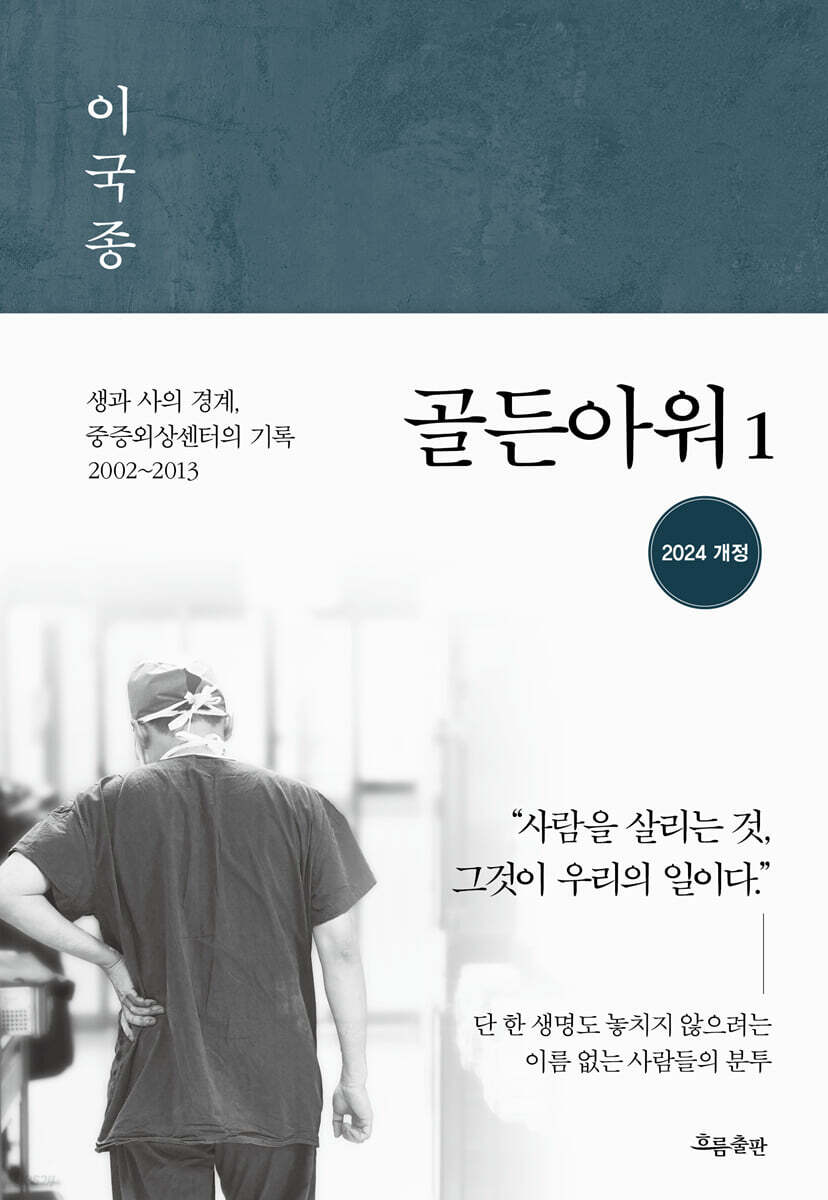
Golden Hour 1
 |
Description
Book Introduction
“Saving lives, that is our job.”
The struggle of nameless people who do not want to lose a single life
This is a record of life and death written by Professor Lee Guk-jong, a trauma surgeon.
The author has been documenting the harsh realities, anguish, reflections, and concerns about the medical system he has faced as a trauma surgeon for 17 years.
The writings, sometimes short and sometimes long, were known to some media outlets as the 'Igokjong Bimanrok'.
The record was polished and refined over a long period of time, published in two volumes (Volume 1, 2002-2013, Volume 2, 2013-2018), and has returned to readers in a revised edition in 2024.
In this 2024 revised edition, the biographies previously included in Volume 2 have been revised and relocated to the latter half of Volume 1.
Professor Lee Guk-jong's "Golden Hour" is a sobering report on the reality of severe trauma medical care in South Korea, and a historical record that captures the struggles of those who have struggled to save lives—medical staff, firefighters, soldiers, and others—even in a system that is not functioning.
Volume 1 depicts the process of setting foot in the trauma surgery department, despairing at the harsh medical reality he encounters, and finally establishing his own standards for what an international standard trauma center should be like while training at trauma centers in the US and UK.
The film depicts various aspects of our world, including the poignant feelings of medical staff, patients, and guardians in critical situations where life and death are at stake, the difficult lives of manual laborers constantly exposed to the risk of accidents, domestic violence, and organized crime.
Above all, it describes the whole story of the Captain Seok Project, which rescued and resuscitated Captain Seok, who was injured during Operation Dawn in the Gulf of Aden, as well as the reality of South Korea's medical system, which failed to make the most of this valuable opportunity despite creating a groundbreaking turning point in the severe trauma treatment system amidst national attention, in a calm tone that suppresses sadness.
In Volume 2, the author depicts the struggles of the university hospital he worked at after being designated as a regional trauma center, despite facing many twists and turns, in a medical reality that falls far short of international standards.
The struggle of nameless people who do not want to lose a single life
This is a record of life and death written by Professor Lee Guk-jong, a trauma surgeon.
The author has been documenting the harsh realities, anguish, reflections, and concerns about the medical system he has faced as a trauma surgeon for 17 years.
The writings, sometimes short and sometimes long, were known to some media outlets as the 'Igokjong Bimanrok'.
The record was polished and refined over a long period of time, published in two volumes (Volume 1, 2002-2013, Volume 2, 2013-2018), and has returned to readers in a revised edition in 2024.
In this 2024 revised edition, the biographies previously included in Volume 2 have been revised and relocated to the latter half of Volume 1.
Professor Lee Guk-jong's "Golden Hour" is a sobering report on the reality of severe trauma medical care in South Korea, and a historical record that captures the struggles of those who have struggled to save lives—medical staff, firefighters, soldiers, and others—even in a system that is not functioning.
Volume 1 depicts the process of setting foot in the trauma surgery department, despairing at the harsh medical reality he encounters, and finally establishing his own standards for what an international standard trauma center should be like while training at trauma centers in the US and UK.
The film depicts various aspects of our world, including the poignant feelings of medical staff, patients, and guardians in critical situations where life and death are at stake, the difficult lives of manual laborers constantly exposed to the risk of accidents, domestic violence, and organized crime.
Above all, it describes the whole story of the Captain Seok Project, which rescued and resuscitated Captain Seok, who was injured during Operation Dawn in the Gulf of Aden, as well as the reality of South Korea's medical system, which failed to make the most of this valuable opportunity despite creating a groundbreaking turning point in the severe trauma treatment system amidst national attention, in a calm tone that suppresses sadness.
In Volume 2, the author depicts the struggles of the university hospital he worked at after being designated as a regional trauma center, despite facing many twists and turns, in a medical reality that falls far short of international standards.
- You can preview some of the book's contents.
Preview
index
introduction
Teacher's Day 2013 | Surgeon | Regression | A shabby beginning | The culprit | A deep, red abyss | Changing room | Attitude to life | Transformation | The eve of darkness | Escape | HMS Belfast | The last surgery | Comfort | Transition | The butterfly effect | Yoon Han-deok | Sailors | Priority of policy | The meaning of karma | Man and woman | Dead end | The logic of the jungle | The tangled days | A broken ship | Operation Dawn in the Gulf of Aden | A precarious flag | The will to live | Light and shadow | Change | Seok Hae-gyun Project | An uneasy beginning | Positive change | Interruption | A calm body | The right to protect oneself | Christmas | Household affairs | Sailor | Night flight | Support and system | Edge | Dropout | The watchman | A thirsty person
Appendix | Biography
Teacher's Day 2013 | Surgeon | Regression | A shabby beginning | The culprit | A deep, red abyss | Changing room | Attitude to life | Transformation | The eve of darkness | Escape | HMS Belfast | The last surgery | Comfort | Transition | The butterfly effect | Yoon Han-deok | Sailors | Priority of policy | The meaning of karma | Man and woman | Dead end | The logic of the jungle | The tangled days | A broken ship | Operation Dawn in the Gulf of Aden | A precarious flag | The will to live | Light and shadow | Change | Seok Hae-gyun Project | An uneasy beginning | Positive change | Interruption | A calm body | The right to protect oneself | Christmas | Household affairs | Sailor | Night flight | Support and system | Edge | Dropout | The watchman | A thirsty person
Appendix | Biography
Detailed image

Into the book
There was no system, baseless rumors were endless, and amidst the absurdity and irrationality, only the shadows chasing the scent of money stood out.
In it, our team members have endured with great difficulty.
I wanted to somehow attract government support to establish the advanced-country-style system we had barely managed to create.
I found my way, groping for a thin thread of hope.
My team and I have been working tirelessly to make the seemingly impossible a reality.
But what I have confirmed upon arriving here is that the trauma center project is impossible with the current level of transparency in Korean society.
--- p.9
'You must stick to your principles, do your best to insist on what is right and do not bend, and do not worry if it does not work out. If it really does not work out, just go back on the boat and that's it.
If you are willing to accept a bad position, there is no need to compromise.
If you are forced to step away from your principles and are fired, it is better to quit.' That was simple logic.
The soldiers I met on the sea were like that, and most sailors were like that.
His words deeply colored my mind with a deep purple color.
--- p.43
The second surgery was completed to the extent of removing the necrotic tissue.
The abdominal wall that had been left open was closed, and a long drainage tube was inserted into one side of the wound where the knife had entered.
Fortunately, there was an empty bed in the intensive care unit, so the man was moved there.
The surgery was over, but the treatment had just begun again.
Reality is different from movies.
In reality, there is no such thing as a movie protagonist being stabbed, shot, bleeding, and then regaining consciousness the next day after surgery.
For patients with severe trauma, surgery is only the beginning of treatment, and patients cannot return to life with surgery alone.
In the intensive care unit, patients must receive intensive treatment using numerous artificial life support devices and drugs, and if they cannot endure this difficult process, they will die.
--- p.85
Blood was sprinkled and soaked onto the road.
No matter how quickly the rescue team rushed to the scene of the accident, the patient did not survive.
The criteria for judging a patient's condition were loose, and information on suitable hospitals was limited.
Because rescue teams would choose the nearest hospital from the scene, patients were sometimes left behind in places they should have gone and taken to places they shouldn't have, and were left waiting for unnecessary tests in places they shouldn't have been.
After that, he was transferred to another hospital and his life waned in a meaningless bed.
In this way, the average time it took for patients to be transferred from one hospital to another to arrive at a trauma center was 245 minutes, and in the meantime, patients who could have survived died.
--- p.147
The fatigue of Baek Suk-ja, who was standing on the left as the third assistant, was conveyed.
No matter how hard I tried, I couldn't handle it.
We had no choice but to apply pressure with gauze and send the patient to the intensive care unit.
The nurses transferred the patient onto a transport cart and left the operating room.
I stared blankly at the sight.
There was a grim reaper staring at the patient among the dedicated nurses.
As the cart disappeared from sight, I thought I saw death smiling.
It is not known how long the patient will last, but he will soon die.
--- pp.177~178
You don't catch a falling knife.
Captain Seok was a heavy-falling blade.
When a patient's condition is extremely poor, doctors do not rush to act.
Even if the patient survives, the credit does not go to him, and if the patient dies, the responsibility lies solely with the doctor who was with the patient until the end.
That's the old truth of this world.
There was little chance of Captain Seok surviving, and in the worst case scenario, the responsibility I would have to bear was beyond imagination.
--- p.221
But if things ended that way, I would feel sorry for Captain Seok, the Navy, and Samho Shipping.
The relevant ministries ultimately declined to comment, and the air ambulance flew to Africa.
All the air ambulances from Europe were busy, as if there was some kind of emergency in South America and Africa.
A bitterness rose deep in my stomach.
The dry air spreading under the skin was sucking away the moisture from my body.
We were desperate and desperate, but that desperateness was not reaching anywhere, so it was just miserable.
--- p.231
As the blood was collected, the young man's face was revealed.
His face, blackened by training, was lifeless.
Whose son will he be?
I thought of the parents waiting for the body on land.
Tears kept welling up in my eyes.
The vibrations from the diesel engine, a characteristic of old speedboats, were transmitted up the hull, through the buttocks, along the spine, and to the head.
The inside of my skull rattled and shook.
--- p.298
There was no way to recover the loss.
The cold blade of the hospital's 'ABC cost analysis' was aimed squarely at my neck.
Among the things that should be done in trauma surgery, few met the standards of the Health Insurance Review & Assessment Service.
The judging criteria haven't been adjusted and the nature of trauma surgery hasn't changed, so I've continued to be cut down.
The field of trauma surgery could not exist in Korea.
In it, our team members have endured with great difficulty.
I wanted to somehow attract government support to establish the advanced-country-style system we had barely managed to create.
I found my way, groping for a thin thread of hope.
My team and I have been working tirelessly to make the seemingly impossible a reality.
But what I have confirmed upon arriving here is that the trauma center project is impossible with the current level of transparency in Korean society.
--- p.9
'You must stick to your principles, do your best to insist on what is right and do not bend, and do not worry if it does not work out. If it really does not work out, just go back on the boat and that's it.
If you are willing to accept a bad position, there is no need to compromise.
If you are forced to step away from your principles and are fired, it is better to quit.' That was simple logic.
The soldiers I met on the sea were like that, and most sailors were like that.
His words deeply colored my mind with a deep purple color.
--- p.43
The second surgery was completed to the extent of removing the necrotic tissue.
The abdominal wall that had been left open was closed, and a long drainage tube was inserted into one side of the wound where the knife had entered.
Fortunately, there was an empty bed in the intensive care unit, so the man was moved there.
The surgery was over, but the treatment had just begun again.
Reality is different from movies.
In reality, there is no such thing as a movie protagonist being stabbed, shot, bleeding, and then regaining consciousness the next day after surgery.
For patients with severe trauma, surgery is only the beginning of treatment, and patients cannot return to life with surgery alone.
In the intensive care unit, patients must receive intensive treatment using numerous artificial life support devices and drugs, and if they cannot endure this difficult process, they will die.
--- p.85
Blood was sprinkled and soaked onto the road.
No matter how quickly the rescue team rushed to the scene of the accident, the patient did not survive.
The criteria for judging a patient's condition were loose, and information on suitable hospitals was limited.
Because rescue teams would choose the nearest hospital from the scene, patients were sometimes left behind in places they should have gone and taken to places they shouldn't have, and were left waiting for unnecessary tests in places they shouldn't have been.
After that, he was transferred to another hospital and his life waned in a meaningless bed.
In this way, the average time it took for patients to be transferred from one hospital to another to arrive at a trauma center was 245 minutes, and in the meantime, patients who could have survived died.
--- p.147
The fatigue of Baek Suk-ja, who was standing on the left as the third assistant, was conveyed.
No matter how hard I tried, I couldn't handle it.
We had no choice but to apply pressure with gauze and send the patient to the intensive care unit.
The nurses transferred the patient onto a transport cart and left the operating room.
I stared blankly at the sight.
There was a grim reaper staring at the patient among the dedicated nurses.
As the cart disappeared from sight, I thought I saw death smiling.
It is not known how long the patient will last, but he will soon die.
--- pp.177~178
You don't catch a falling knife.
Captain Seok was a heavy-falling blade.
When a patient's condition is extremely poor, doctors do not rush to act.
Even if the patient survives, the credit does not go to him, and if the patient dies, the responsibility lies solely with the doctor who was with the patient until the end.
That's the old truth of this world.
There was little chance of Captain Seok surviving, and in the worst case scenario, the responsibility I would have to bear was beyond imagination.
--- p.221
But if things ended that way, I would feel sorry for Captain Seok, the Navy, and Samho Shipping.
The relevant ministries ultimately declined to comment, and the air ambulance flew to Africa.
All the air ambulances from Europe were busy, as if there was some kind of emergency in South America and Africa.
A bitterness rose deep in my stomach.
The dry air spreading under the skin was sucking away the moisture from my body.
We were desperate and desperate, but that desperateness was not reaching anywhere, so it was just miserable.
--- p.231
As the blood was collected, the young man's face was revealed.
His face, blackened by training, was lifeless.
Whose son will he be?
I thought of the parents waiting for the body on land.
Tears kept welling up in my eyes.
The vibrations from the diesel engine, a characteristic of old speedboats, were transmitted up the hull, through the buttocks, along the spine, and to the head.
The inside of my skull rattled and shook.
--- p.298
There was no way to recover the loss.
The cold blade of the hospital's 'ABC cost analysis' was aimed squarely at my neck.
Among the things that should be done in trauma surgery, few met the standards of the Health Insurance Review & Assessment Service.
The judging criteria haven't been adjusted and the nature of trauma surgery hasn't changed, so I've continued to be cut down.
The field of trauma surgery could not exist in Korea.
--- p.337
Publisher's Review
The 17 Years of Life and Death Written by Surgeon Lee Guk-jong
Lives are at stake in the 60 minutes of 'Golden Hour'.
And the story of those who protect them
In 2002, Lee Guk-jong entered the Department of Trauma Surgery at the recommendation of his advisor, which marked a turning point in his life.
In principle, patients should arrive at a hospital capable of treating severe trauma within the golden hour of 60 minutes, and medical resources from various fields, including operating rooms, intensive care units, anesthesia departments, blood banks, and medical staff ready for immediate surgery, should be quickly deployed. However, the reality is far from this principle.
From this point on, his arduous struggle to establish an international standard severe trauma system in South Korea began.
This book is a compilation of the author's memories based on various medical and surgical records from 2002 to the first half of 2018, as the author states.
It is also a fierce narrative of the patients, the author, and their colleagues struggling on the front lines of life and death.
Above all, it is the first and last trace of foolish people who struggle to improve their positions in order to survive while maintaining the essence of karma in the harsh reality of Korean society, and who end up breaking down.
The sharp, sharp sentences that delve into the scene with the surgeon's unique perspective were not easily written.
As a doctor, his perfectionism, which does not allow for even a single mistake, is also evident in his writing.
I took painstaking efforts to accurately express the urgency that only someone who has experienced the accident scene and the medical field can understand, and poured my heart and soul into every single word and sentence.
Before publishing the book, there was a arduous process of revising and revising the manuscript, worrying about whether every word used was truly the most accurate expression.
Through this process, the lives and deaths of patients encountered at the trauma center, the arduous daily lives of medical staff, and even the rescue of Captain Seok Hae-gyun and the Sewol Ferry disaster, which have been well-known in the media, are told in a three-dimensional way that only those who have experienced them can understand.
Even after witnessing countless deaths that could have been prevented,
Why can't we change?
In Volume 2, the author depicts the process of struggling to establish a system that meets international standards in the still-poor reality after the university hospital where he worked was designated as the Gyeonggi Southern Regional Trauma Center after many twists and turns.
As the trauma center project deviated from its principles and essence over time, becoming swayed by complex vested interests, my colleagues, who had personally addressed the system's shortcomings, were pushed to the limit and succumbed to injuries.
The contradictions and absurdities that had been piling up were finally revealed through a great disaster that plunged the entire nation into sorrow.
The author, witnessing the Sewol ferry disaster and the treatment of severe trauma victims in South Korea, including defectors from North Korea, now reflects on the sacrifices, sweat, and tears of his colleagues.
I came this far without optimism and am moving forward without hope, but I stayed up all night writing down each word, like a comrade, to record those who have walked the same path.
Pilots and medical staff who board helicopters despite their injuries, firefighters who fight death at the scene of an accident, soldiers and police officers who risk their lives to protect the people…
This book is a tribute to all of those people.
Lives are at stake in the 60 minutes of 'Golden Hour'.
And the story of those who protect them
In 2002, Lee Guk-jong entered the Department of Trauma Surgery at the recommendation of his advisor, which marked a turning point in his life.
In principle, patients should arrive at a hospital capable of treating severe trauma within the golden hour of 60 minutes, and medical resources from various fields, including operating rooms, intensive care units, anesthesia departments, blood banks, and medical staff ready for immediate surgery, should be quickly deployed. However, the reality is far from this principle.
From this point on, his arduous struggle to establish an international standard severe trauma system in South Korea began.
This book is a compilation of the author's memories based on various medical and surgical records from 2002 to the first half of 2018, as the author states.
It is also a fierce narrative of the patients, the author, and their colleagues struggling on the front lines of life and death.
Above all, it is the first and last trace of foolish people who struggle to improve their positions in order to survive while maintaining the essence of karma in the harsh reality of Korean society, and who end up breaking down.
The sharp, sharp sentences that delve into the scene with the surgeon's unique perspective were not easily written.
As a doctor, his perfectionism, which does not allow for even a single mistake, is also evident in his writing.
I took painstaking efforts to accurately express the urgency that only someone who has experienced the accident scene and the medical field can understand, and poured my heart and soul into every single word and sentence.
Before publishing the book, there was a arduous process of revising and revising the manuscript, worrying about whether every word used was truly the most accurate expression.
Through this process, the lives and deaths of patients encountered at the trauma center, the arduous daily lives of medical staff, and even the rescue of Captain Seok Hae-gyun and the Sewol Ferry disaster, which have been well-known in the media, are told in a three-dimensional way that only those who have experienced them can understand.
Even after witnessing countless deaths that could have been prevented,
Why can't we change?
In Volume 2, the author depicts the process of struggling to establish a system that meets international standards in the still-poor reality after the university hospital where he worked was designated as the Gyeonggi Southern Regional Trauma Center after many twists and turns.
As the trauma center project deviated from its principles and essence over time, becoming swayed by complex vested interests, my colleagues, who had personally addressed the system's shortcomings, were pushed to the limit and succumbed to injuries.
The contradictions and absurdities that had been piling up were finally revealed through a great disaster that plunged the entire nation into sorrow.
The author, witnessing the Sewol ferry disaster and the treatment of severe trauma victims in South Korea, including defectors from North Korea, now reflects on the sacrifices, sweat, and tears of his colleagues.
I came this far without optimism and am moving forward without hope, but I stayed up all night writing down each word, like a comrade, to record those who have walked the same path.
Pilots and medical staff who board helicopters despite their injuries, firefighters who fight death at the scene of an accident, soldiers and police officers who risk their lives to protect the people…
This book is a tribute to all of those people.
GOODS SPECIFICS
- Date of issue: October 3, 2024
- Page count, weight, size: 448 pages | 145*210*30mm
- ISBN13: 9788965966524
- ISBN10: 8965966523
You may also like
카테고리
korean


korean

![GQ KOREA Mark (Monthly): December [2025]](http://librairie.coreenne.fr/cdn/shop/files/8ef265dbbfbf186523ed75ba7319009d.jpg?v=1765340328&width=3840)


