

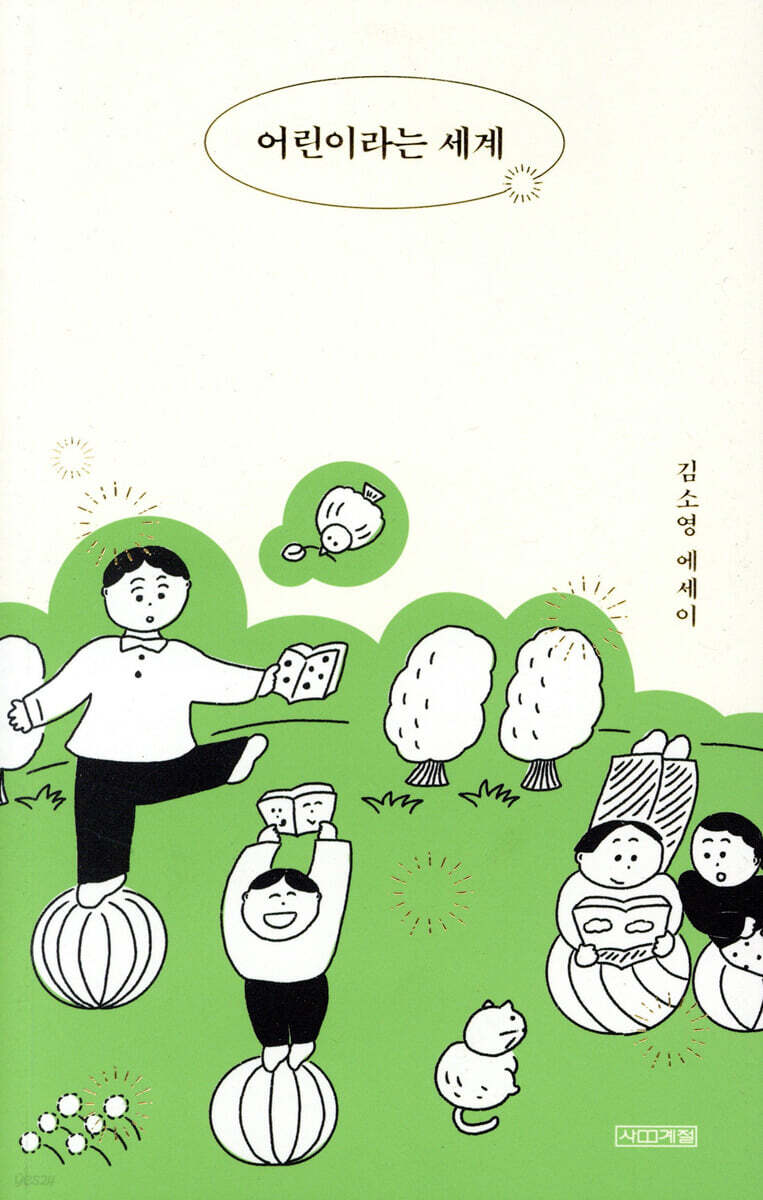
The world of children
 |
Description
Book Introduction
The more we think about children, the broader our world becomes. Children are not visible. It's because my body is small, and it's also because my voice is small. Unless we are responsible for raising, educating, or caring for children, it is easy to live without realizing that there are children around us. Kim So-young, who worked as a children's book editor for over ten years and now reads books with children in a reading classroom, has been diligently writing and speaking out to make children's presence more visible. "The World of Children" contains the world that Kim So-young discovered while meeting children, where small and weak beings busily learn, grow, and master themselves. The children of this world are the children who live next to us, the children we have all passed through, our fellow citizens, and the children who will form the next generation. Kim So-young's writing, which meticulously observes and records children's unique thoughts and behaviors both inside and outside of the reading classroom, gradually expands to encompass the role of adults in responding to and understanding children's world, as well as society's duty to provide a proper place for all its members. The effort to better understand children is no different from the desire to examine ourselves, our neighbors, and every nook and cranny of our society. Through this book, we will finally be able to begin to tell stories about children, something we all experience but no one has readily acknowledged as important. |
- You can preview some of the book's contents.
Preview
index
Entering
The child next to Part 1
It just takes time
Teacher, are you afraid of balls?
good child
Child dignity
Scary thing
It's not play, it's playing
Reading and writing
When I was young
In countless ways
Part 2: Children and Me
Based on the loneliest child
Friends living under the same roof
Teacher in my heart
Picky eating in children, picky eating in adults
Senior's words
It was comforting
Can you call this love?
Choosing life
Go find your socks
Adults in other people's houses
Part 3: Children in the World
Is it my birthday today?
Even if one is small, one person
Easy problem
There is a child
misunderstanding
Children are political beings
The Children's Day I Wish For
Guide
Recommendation
The child next to Part 1
It just takes time
Teacher, are you afraid of balls?
good child
Child dignity
Scary thing
It's not play, it's playing
Reading and writing
When I was young
In countless ways
Part 2: Children and Me
Based on the loneliest child
Friends living under the same roof
Teacher in my heart
Picky eating in children, picky eating in adults
Senior's words
It was comforting
Can you call this love?
Choosing life
Go find your socks
Adults in other people's houses
Part 3: Children in the World
Is it my birthday today?
Even if one is small, one person
Easy problem
There is a child
misunderstanding
Children are political beings
The Children's Day I Wish For
Guide
Recommendation
Into the book
The child's bravado is serious and optimistic.
Some children brag about their accomplishments through boasting.
The moment you assume the future, you become certain of it.
When Hayoon was eight years old, he said that if he were to become the richest man in the world, he would “buy half the land on Earth, farm it, raise five dogs, and raise seven cats.”
Then, thanks to the Harry Potter movie series, I became interested in England and began to dream of studying abroad there.
(…) The child’s bravado is serious and optimistic.
So cool.
Crucially, it is because of that bluff that Hayoon has a chance of going to Oxford (or Cambridge).
How could you go abroad to study if you didn't even think about it?
A child's 'inflation' is a declaration.
A declaration that says, 'I will grow to this level.'
--- p.27~28
How come I always learn from children?
It was time to explain 'surplus production' and 'barter'.
“As I continued farming like that, I finally started producing more than I needed.
"There's so much we could eat in our village and still have some left over! So, what should we do?"
Hayoon answered without any hesitation.
“Share it!”
It was a face that seemed certain that there could be no other answer.
Trying to explain economic logic to Hayoon, I suddenly felt like a dark-hearted adult.
(…) wrote on the blackboard, “Even if our bodies are different, we sleep together.”
I waited for Yeji's answer, secretly hoping that she would say, "Let's respect each other," but she couldn't answer right away.
“Yeji, in times like that, it would be good to think of the opposite of ‘ignoring.’”
“Ah! I got it!”
As if this were the only answer, Yeji wrote:
“Let’s play together even though we have different bodies.”
--- p.31~36
Child dignity
I believe that children must be treated well in order to continue to be treated well.
Of course, I don't want you to act like you don't care.
In my experience, children who are treated with respect behave well.
And if it's a child like that, they will be treated even more respectfully.
If children become accustomed to this, they will regard politeness and respect as the basic attitude and manners of relationships.
Behaving politely and treating others with respect.
So, when you are treated unfairly, I hope you feel 'strange'.
Actually, that's what I really want.
--- p.41
Based on the loneliest child
Children watch this show too.
Instead of a 'set', we see the real homes of famous celebrities and the other children who live there.
There may be children who ignore it and ignore it.
But to some children, the house will seem as big as a dream.
(…) Some children still learn about the world through TV.
This will mostly be the case for lonely children.
If it's a program that children can watch, I hope it's made with the loneliest children in mind.
I hope to show the triumph of honest and kind people, the joy of playing together, the natural appearance of diverse families, strong relationships even without family, dogs and cats, and the kindness of the world.
I wish I could reassure children that the world is a wonderful home.
--- p.101~102
A small favor from an unknown adult
“That woman, she might be seeing me for the first time.
Maybe not.
Anyway, I guess he thought I looked strange because I was carrying a bag.
He asks, 'Are you going to study?'
So I said, 'Yes,' and he said, 'It's Sunday, so you must be tired from studying.'
I felt uneasy for some reason.
I was wondering what to do if Joo-i thought it was strange or even unpleasant to hear such words from a stranger.
“How did you feel when you heard that?”
“What should I say? It was comforting.
“I think I’m a bit lucky on days like that.”
When she said, “I am comforted,” Joo-i put her right hand to her chest.
That scene comes to mind sometimes.
It was because she was different from her usual self, and also because I realized that day that adults are the environment and the world to children.
--- p.143~144
Children are guides to adults
I used to dislike the saying, 'Children are guides to adults.'
It was because it seemed to objectify children and even deify them.
Adults should think about teaching and guiding children well, and leave the responsibility of guiding them to the children.
And how does a child know the way? It's not like he has some mystical powers.
I thought so.
But as I chose what to say to the child and reflected on myself in those words, my misunderstanding about the 'guide' was resolved.
It is not that we know the way because children teach us, but rather that we decide the way as we consider what and how to teach children.
That is why teaching and raising children, that is, education, is the responsibility of all of us living in this world.
Home and school are only the starting point of education, but ultimately, society must take responsibility.
Even if we don't want to, it ends up becoming a burden to society.
Some children brag about their accomplishments through boasting.
The moment you assume the future, you become certain of it.
When Hayoon was eight years old, he said that if he were to become the richest man in the world, he would “buy half the land on Earth, farm it, raise five dogs, and raise seven cats.”
Then, thanks to the Harry Potter movie series, I became interested in England and began to dream of studying abroad there.
(…) The child’s bravado is serious and optimistic.
So cool.
Crucially, it is because of that bluff that Hayoon has a chance of going to Oxford (or Cambridge).
How could you go abroad to study if you didn't even think about it?
A child's 'inflation' is a declaration.
A declaration that says, 'I will grow to this level.'
--- p.27~28
How come I always learn from children?
It was time to explain 'surplus production' and 'barter'.
“As I continued farming like that, I finally started producing more than I needed.
"There's so much we could eat in our village and still have some left over! So, what should we do?"
Hayoon answered without any hesitation.
“Share it!”
It was a face that seemed certain that there could be no other answer.
Trying to explain economic logic to Hayoon, I suddenly felt like a dark-hearted adult.
(…) wrote on the blackboard, “Even if our bodies are different, we sleep together.”
I waited for Yeji's answer, secretly hoping that she would say, "Let's respect each other," but she couldn't answer right away.
“Yeji, in times like that, it would be good to think of the opposite of ‘ignoring.’”
“Ah! I got it!”
As if this were the only answer, Yeji wrote:
“Let’s play together even though we have different bodies.”
--- p.31~36
Child dignity
I believe that children must be treated well in order to continue to be treated well.
Of course, I don't want you to act like you don't care.
In my experience, children who are treated with respect behave well.
And if it's a child like that, they will be treated even more respectfully.
If children become accustomed to this, they will regard politeness and respect as the basic attitude and manners of relationships.
Behaving politely and treating others with respect.
So, when you are treated unfairly, I hope you feel 'strange'.
Actually, that's what I really want.
--- p.41
Based on the loneliest child
Children watch this show too.
Instead of a 'set', we see the real homes of famous celebrities and the other children who live there.
There may be children who ignore it and ignore it.
But to some children, the house will seem as big as a dream.
(…) Some children still learn about the world through TV.
This will mostly be the case for lonely children.
If it's a program that children can watch, I hope it's made with the loneliest children in mind.
I hope to show the triumph of honest and kind people, the joy of playing together, the natural appearance of diverse families, strong relationships even without family, dogs and cats, and the kindness of the world.
I wish I could reassure children that the world is a wonderful home.
--- p.101~102
A small favor from an unknown adult
“That woman, she might be seeing me for the first time.
Maybe not.
Anyway, I guess he thought I looked strange because I was carrying a bag.
He asks, 'Are you going to study?'
So I said, 'Yes,' and he said, 'It's Sunday, so you must be tired from studying.'
I felt uneasy for some reason.
I was wondering what to do if Joo-i thought it was strange or even unpleasant to hear such words from a stranger.
“How did you feel when you heard that?”
“What should I say? It was comforting.
“I think I’m a bit lucky on days like that.”
When she said, “I am comforted,” Joo-i put her right hand to her chest.
That scene comes to mind sometimes.
It was because she was different from her usual self, and also because I realized that day that adults are the environment and the world to children.
--- p.143~144
Children are guides to adults
I used to dislike the saying, 'Children are guides to adults.'
It was because it seemed to objectify children and even deify them.
Adults should think about teaching and guiding children well, and leave the responsibility of guiding them to the children.
And how does a child know the way? It's not like he has some mystical powers.
I thought so.
But as I chose what to say to the child and reflected on myself in those words, my misunderstanding about the 'guide' was resolved.
It is not that we know the way because children teach us, but rather that we decide the way as we consider what and how to teach children.
That is why teaching and raising children, that is, education, is the responsibility of all of us living in this world.
Home and school are only the starting point of education, but ultimately, society must take responsibility.
Even if we don't want to, it ends up becoming a burden to society.
--- p.253~254
Publisher's Review
Children around us, inside me, and in the world
A cheerful, affectionate, and thoughtful welcoming voice
This book contains the unique voices of children, each with their own unique colors.
Children who interpret the unfamiliar world with flexible and original thinking, children who respond politely when they meet adults who respect them, children who enjoy adventures and willingly take small risks, children who express kindness with the utmost affection, children who firmly point out adults' mistakes...
“You can still tie it now.
Adults can do it quickly, and children take their time, the only difference is that it takes time.” _ Page 18
“If there is sand underneath, it won’t hurt even if you fall.” _ Page 63
"You have this book, don't you? But even though they're all the same books, this book has my heart." _ Page 72
"If unification happens, the children of today will be grown adults by then. What if problems are discovered then? We can't just focus on the positive aspects and fail to prepare, then say, 'Oh, that's not it,' and pretend it never happened.
“We’ll have to figure it out then, so why don’t we ask the children for their opinions?” _ Page 231
It's not that special children just appear in front of Kim So-young.
Kim So-young carefully observed and meticulously recorded moments that most adults would pass by without a second thought.
The children in this book are not someone's daughter or son, or a student in a certain grade who has to learn something, but rather appear as individuals with their own thoughts and voices.
Rather than explaining children or suggesting beneficial things for them, Kim So-young reveals that each and every child is 'present' among us in their own way.
By capturing the small moments of struggling to tie your shoelaces, being unable to ride the elevator alone, or picking a carrot out of your plate, it shows that there are people who are doing their part in life, even if it is a little clumsy and slow.
Kim So-young's voice, welcoming the children and saying, "Let's get along well, no matter what we look like," naturally creates a place for children in the reader's world.
Stories from our childhood that we all have difficulty telling.
Even adults who are indifferent to children were all children once.
Childhood, spent in a limited environment of home, neighborhood, and school, is likely to be a somewhat comfortable and somewhat painful memory for everyone.
This is precisely what makes this book so compelling even to those who consider themselves independent of children.
The anecdotes about children introduced by Kim So-young bring out the 'child me' that was hidden deep in our memories.
The day my heart pounded at my homeroom teacher's single compliment, the night I woke from a nightmare, the disappointment of losing my beloved wallet, the closeness between sisters, brothers, and siblings, the embarrassment I felt in a friend's spacious and bright home. As I confront memories long forgotten, I realize that I have already passed, but someone else might still be harboring the same childish feelings at this very moment.
The house was so big I didn't know where to look.
Even so, I didn't want to show that I was looking around, so I followed him into the room, just watching his feet.
I was also surprised to find that the room had a bed and desk just for him.
I said nothing for fear of being found out.
Of course it would have been discovered.
And soon, Grandma came with a snack 'on a tray'.
Beautifully cut fruit, cookies, and juice in a glass. I'd seen it on TV, but it was something I'd never experienced in real life, let alone imagined.
_ Page 99
Those who have realized the existence of a child's heart can no longer treat children carelessly.
This is because we can guess that children today may have things they were unable to say as children because they were embarrassed or upset, because they were weak, or because they did not have enough vocabulary.
Instead of saying, "Let's respect each other" and "Let's not discriminate against the weak," this book encourages us to remember the heart of a child and try to become that person.
With that alone, we can do our part to change the world for the better.
I believe that being a laid-back adult to children is, in a broad sense, a way to change the world for the better.
There are small rewards and joys in the moments of waiting for a child.
Couldn't that also be considered growth? Children and adults can grow together.
_ Page 20
I pledge to listen more closely to what children say.
I will not only listen to what the child has expressed, but also think about what he or she has not been able to express.
I will become an adult who can figure out what emotions and feelings children cannot express in words.
_ Page 192
A world that is good for children is a world that is good for adults too.
The Role of "Other People's Adults" in Welcoming the Next Generation
Kim So-young is an expert who has worked with children for a long time, but she is not a parent who has raised children herself.
So, I've often heard things like, "You have to have children to be good at writing children's books," and "You don't know because you're not a mother."
However, just as parenting experience does not guarantee a complete understanding of children, being a non-custodial parent does not mean being ignorant or unqualified to speak about children.
Rather, because non-custodial parents encounter children outside the family, they can sometimes have a clearer understanding of the rights children deserve as members of society and the roles adults ought to play as fellow citizens and members of the older generation.
In addition to the love of family, if there is respectful treatment and hospitality from the 'adults of other people's homes,' children will find their place in the world more smoothly.
I liked the saying 'someone else's kid'.
Then, wouldn't I be able to become "someone else's mom," "someone else's dad," "someone else's aunt or uncle"? I could raise "someone else's child" together, observing closely, learning, enjoying, envying, feeling safe, and worrying.
One day, you may become a 'grandmother' to some child.
I can do my part by putting children's chocolates in ziplock bags and lending a shoulder to their mothers.
Anyone can be an 'adult in someone else's house' even if they are not the parent.
_ Page 181
Kim So-young, as an 'adult in another's house', strongly criticizes our society's attitude toward children.
They express anger at a society that expels children under the pretext of "No Kids Zone" or "No Bad Parents Zone," creates programs that deliberately make children cry while watching them, and gives light punishments for crimes against children.
This series of events stems from the idea that children can be treated as they please because they cannot resist.
A society that expels children naturally moves in the direction of expelling the weak and minorities who find it difficult to make their voices heard.
This means that a world that is good for children is also a world that is good for adults.
This is why even those who are not caregivers or who do not have any contact with children should observe the environment in which children live and learn to respect them.
This book will serve as a starting point for the world of children to become the world of us all.
Thinking about children makes me realize how ignorant and insensitive I have been to various minorities, including people with disabilities, sexual minorities, and immigrants.
I also thought that children are people in a transitional period rather than a minority, as they grow up to become adults.
But just as I don't consider myself a person in transition to becoming an old person, it's right to think of children in terms of the present, not the future.
Also, as children become teenagers and adults, new children always come.
In other words, there will always be children in the world.
Children's issues are not a passing issue.
Rather, it is something that everyone must put their heads together and think about, as it is a time that everyone goes through.
_ Pages 201-202
A cheerful, affectionate, and thoughtful welcoming voice
This book contains the unique voices of children, each with their own unique colors.
Children who interpret the unfamiliar world with flexible and original thinking, children who respond politely when they meet adults who respect them, children who enjoy adventures and willingly take small risks, children who express kindness with the utmost affection, children who firmly point out adults' mistakes...
“You can still tie it now.
Adults can do it quickly, and children take their time, the only difference is that it takes time.” _ Page 18
“If there is sand underneath, it won’t hurt even if you fall.” _ Page 63
"You have this book, don't you? But even though they're all the same books, this book has my heart." _ Page 72
"If unification happens, the children of today will be grown adults by then. What if problems are discovered then? We can't just focus on the positive aspects and fail to prepare, then say, 'Oh, that's not it,' and pretend it never happened.
“We’ll have to figure it out then, so why don’t we ask the children for their opinions?” _ Page 231
It's not that special children just appear in front of Kim So-young.
Kim So-young carefully observed and meticulously recorded moments that most adults would pass by without a second thought.
The children in this book are not someone's daughter or son, or a student in a certain grade who has to learn something, but rather appear as individuals with their own thoughts and voices.
Rather than explaining children or suggesting beneficial things for them, Kim So-young reveals that each and every child is 'present' among us in their own way.
By capturing the small moments of struggling to tie your shoelaces, being unable to ride the elevator alone, or picking a carrot out of your plate, it shows that there are people who are doing their part in life, even if it is a little clumsy and slow.
Kim So-young's voice, welcoming the children and saying, "Let's get along well, no matter what we look like," naturally creates a place for children in the reader's world.
Stories from our childhood that we all have difficulty telling.
Even adults who are indifferent to children were all children once.
Childhood, spent in a limited environment of home, neighborhood, and school, is likely to be a somewhat comfortable and somewhat painful memory for everyone.
This is precisely what makes this book so compelling even to those who consider themselves independent of children.
The anecdotes about children introduced by Kim So-young bring out the 'child me' that was hidden deep in our memories.
The day my heart pounded at my homeroom teacher's single compliment, the night I woke from a nightmare, the disappointment of losing my beloved wallet, the closeness between sisters, brothers, and siblings, the embarrassment I felt in a friend's spacious and bright home. As I confront memories long forgotten, I realize that I have already passed, but someone else might still be harboring the same childish feelings at this very moment.
The house was so big I didn't know where to look.
Even so, I didn't want to show that I was looking around, so I followed him into the room, just watching his feet.
I was also surprised to find that the room had a bed and desk just for him.
I said nothing for fear of being found out.
Of course it would have been discovered.
And soon, Grandma came with a snack 'on a tray'.
Beautifully cut fruit, cookies, and juice in a glass. I'd seen it on TV, but it was something I'd never experienced in real life, let alone imagined.
_ Page 99
Those who have realized the existence of a child's heart can no longer treat children carelessly.
This is because we can guess that children today may have things they were unable to say as children because they were embarrassed or upset, because they were weak, or because they did not have enough vocabulary.
Instead of saying, "Let's respect each other" and "Let's not discriminate against the weak," this book encourages us to remember the heart of a child and try to become that person.
With that alone, we can do our part to change the world for the better.
I believe that being a laid-back adult to children is, in a broad sense, a way to change the world for the better.
There are small rewards and joys in the moments of waiting for a child.
Couldn't that also be considered growth? Children and adults can grow together.
_ Page 20
I pledge to listen more closely to what children say.
I will not only listen to what the child has expressed, but also think about what he or she has not been able to express.
I will become an adult who can figure out what emotions and feelings children cannot express in words.
_ Page 192
A world that is good for children is a world that is good for adults too.
The Role of "Other People's Adults" in Welcoming the Next Generation
Kim So-young is an expert who has worked with children for a long time, but she is not a parent who has raised children herself.
So, I've often heard things like, "You have to have children to be good at writing children's books," and "You don't know because you're not a mother."
However, just as parenting experience does not guarantee a complete understanding of children, being a non-custodial parent does not mean being ignorant or unqualified to speak about children.
Rather, because non-custodial parents encounter children outside the family, they can sometimes have a clearer understanding of the rights children deserve as members of society and the roles adults ought to play as fellow citizens and members of the older generation.
In addition to the love of family, if there is respectful treatment and hospitality from the 'adults of other people's homes,' children will find their place in the world more smoothly.
I liked the saying 'someone else's kid'.
Then, wouldn't I be able to become "someone else's mom," "someone else's dad," "someone else's aunt or uncle"? I could raise "someone else's child" together, observing closely, learning, enjoying, envying, feeling safe, and worrying.
One day, you may become a 'grandmother' to some child.
I can do my part by putting children's chocolates in ziplock bags and lending a shoulder to their mothers.
Anyone can be an 'adult in someone else's house' even if they are not the parent.
_ Page 181
Kim So-young, as an 'adult in another's house', strongly criticizes our society's attitude toward children.
They express anger at a society that expels children under the pretext of "No Kids Zone" or "No Bad Parents Zone," creates programs that deliberately make children cry while watching them, and gives light punishments for crimes against children.
This series of events stems from the idea that children can be treated as they please because they cannot resist.
A society that expels children naturally moves in the direction of expelling the weak and minorities who find it difficult to make their voices heard.
This means that a world that is good for children is also a world that is good for adults.
This is why even those who are not caregivers or who do not have any contact with children should observe the environment in which children live and learn to respect them.
This book will serve as a starting point for the world of children to become the world of us all.
Thinking about children makes me realize how ignorant and insensitive I have been to various minorities, including people with disabilities, sexual minorities, and immigrants.
I also thought that children are people in a transitional period rather than a minority, as they grow up to become adults.
But just as I don't consider myself a person in transition to becoming an old person, it's right to think of children in terms of the present, not the future.
Also, as children become teenagers and adults, new children always come.
In other words, there will always be children in the world.
Children's issues are not a passing issue.
Rather, it is something that everyone must put their heads together and think about, as it is a time that everyone goes through.
_ Pages 201-202
GOODS SPECIFICS
- Publication date: November 16, 2020
- Page count, weight, size: 260 pages | 356g | 130*205*16mm
- ISBN13: 9791160946918
- ISBN10: 1160946914
You may also like
카테고리
korean


korean

![GQ KOREA Mark (Monthly): December [2025]](http://librairie.coreenne.fr/cdn/shop/files/8ef265dbbfbf186523ed75ba7319009d.jpg?v=1765340328&width=3840)


