

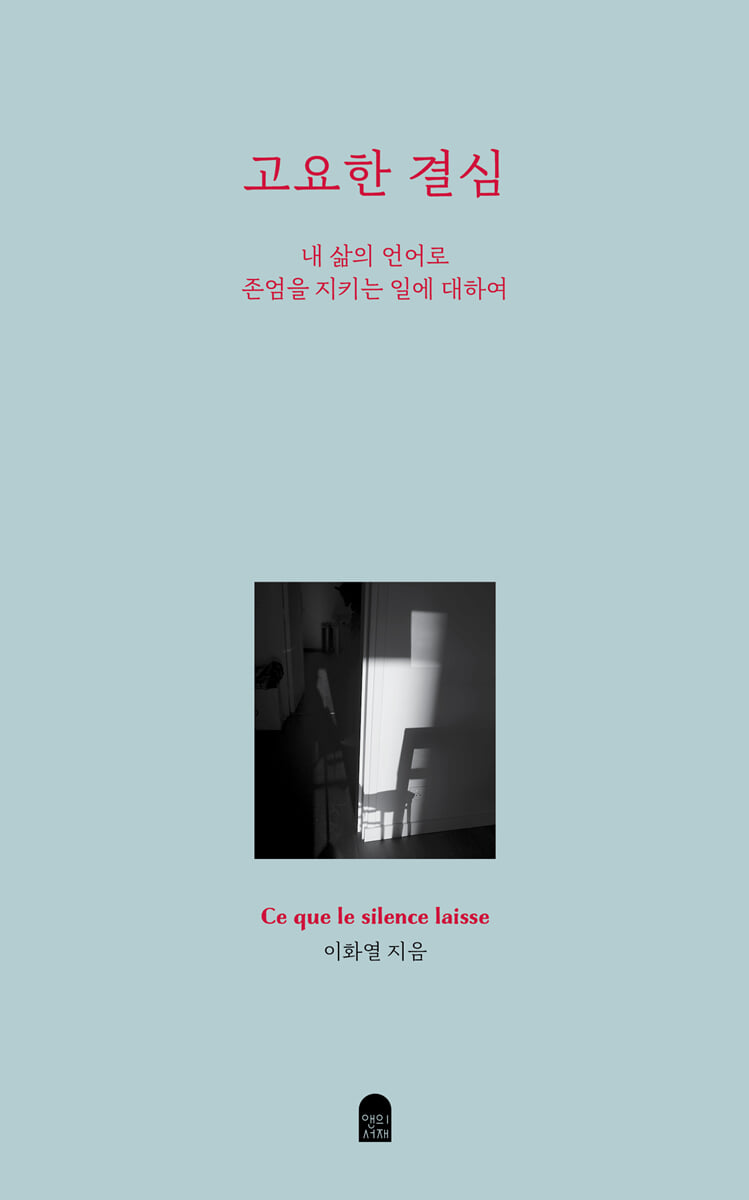
quiet resolution
 |
Description
Book Introduction
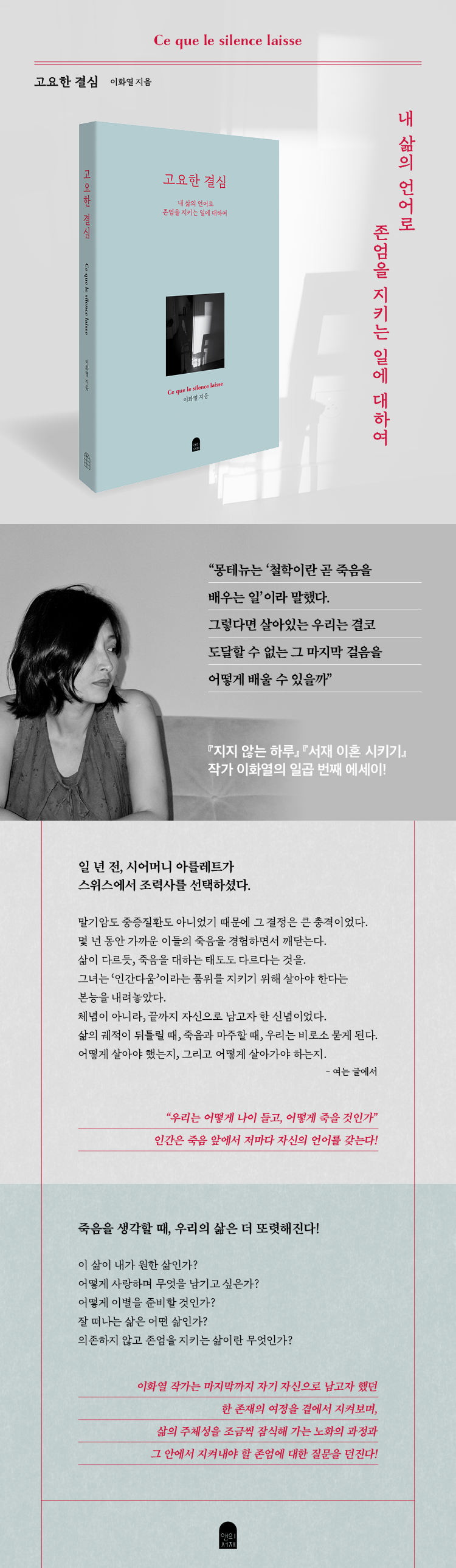
A new work by Lee Hwa-yeol, author of "A Day That Never Ends" and "Getting the Study Divorced"!
“On preserving dignity in the language of my life”
Montaigne said, 'Philosophy is learning to die.'
So how can we, the living, learn to take that last step that we can never reach?”
One day, author Lee Hwa-yeol hears that her mother-in-law, Arlette, has applied for assisted death at a Swiss assisted death agency.
"Quiet Resolution" is a book that records the three months spent preparing for farewell, from deciding to assist with dying to accompanying my mother-in-law on her final journey, and the sense of life awakened by death.
“A year ago, my mother-in-law chose assisted dying in Switzerland.
The decision was a huge shock, as it was neither terminal nor seriously ill.
(…) She put down her instinct to live in order to maintain the dignity of ‘humanity.’
“It was not resignation, but a conviction to remain true to oneself until the end.” _From the opening remarks
The author observes the journey of a being who wanted to remain himself until the end, and raises questions about the process of aging that gradually erodes the subjectivity of life and the dignity that must be preserved within it.
And he recorded in everyday language the aging and death that no human being can avoid.
Just as everyone's life is different, everyone's attitude toward death is also different.
For some, life is a 'desire not to die', but for others, death is 'the final sentence that completes life'.
When we are young, death seems like something that has nothing to do with us, so we are not interested in it, and as we get older, many people turn away from it out of fear.
But the author says that when we think about death, life becomes clearer.
It is also said that whether we prepare for death or not, we will eventually die the way we lived.
A foolish person should be foolish, a decisive person should be decisive.
We cannot know while we are alive whether death will be peaceful or painful, but that is why we must always think about death and prepare for it.
Author Lee Hwa-yeol, who expresses the 'philosophy embedded in life' in a simple and witty way, poses the questions 'How will we grow old and die?' and 'What is a life that maintains dignity without dependence?' in her seventh essay, 'Quiet Resolution.'
And through this, I ask the readers:
Is this the life I wanted?
How do you love and what do you want to leave behind?
How do I prepare for a breakup?
What kind of life is a life that leaves well?
“On preserving dignity in the language of my life”
Montaigne said, 'Philosophy is learning to die.'
So how can we, the living, learn to take that last step that we can never reach?”
One day, author Lee Hwa-yeol hears that her mother-in-law, Arlette, has applied for assisted death at a Swiss assisted death agency.
"Quiet Resolution" is a book that records the three months spent preparing for farewell, from deciding to assist with dying to accompanying my mother-in-law on her final journey, and the sense of life awakened by death.
“A year ago, my mother-in-law chose assisted dying in Switzerland.
The decision was a huge shock, as it was neither terminal nor seriously ill.
(…) She put down her instinct to live in order to maintain the dignity of ‘humanity.’
“It was not resignation, but a conviction to remain true to oneself until the end.” _From the opening remarks
The author observes the journey of a being who wanted to remain himself until the end, and raises questions about the process of aging that gradually erodes the subjectivity of life and the dignity that must be preserved within it.
And he recorded in everyday language the aging and death that no human being can avoid.
Just as everyone's life is different, everyone's attitude toward death is also different.
For some, life is a 'desire not to die', but for others, death is 'the final sentence that completes life'.
When we are young, death seems like something that has nothing to do with us, so we are not interested in it, and as we get older, many people turn away from it out of fear.
But the author says that when we think about death, life becomes clearer.
It is also said that whether we prepare for death or not, we will eventually die the way we lived.
A foolish person should be foolish, a decisive person should be decisive.
We cannot know while we are alive whether death will be peaceful or painful, but that is why we must always think about death and prepare for it.
Author Lee Hwa-yeol, who expresses the 'philosophy embedded in life' in a simple and witty way, poses the questions 'How will we grow old and die?' and 'What is a life that maintains dignity without dependence?' in her seventh essay, 'Quiet Resolution.'
And through this, I ask the readers:
Is this the life I wanted?
How do you love and what do you want to leave behind?
How do I prepare for a breakup?
What kind of life is a life that leaves well?
- You can preview some of the book's contents.
Preview
index
Opening remarks
Part 1.
Humans have their own language in the face of death.
Old man walking on the road
A product of conditions
Paid condolences
Decision to remain as myself
Cookie's Comfort
Champagne on Thursday I
Festival and Death
Friendly prison, uncomfortable freedom
On the elegance of existence
sediment of time
Time to feel with your fingertips
The Art of Refusal
The Silence of the Old Man
The Rules of a Perfect and Fair Life
Champagne on Thursday II
The moment you fall in love, mourning begins.
A love deeper than death
The weight of dignity
How to accept death
The paradox of waiting
Sorting out one's relationship with oneself
Spider Woman
Country house memories
Melancholy of Time
Belle Mer, Belle Pie
A taste that never goes away
The power of dependence
The Taste of Time
Beautiful Street
I'd rather not do that.
Life becomes clearer when we think about death.
bread dough
Father's death notice
Geppetto's Tomb
Thursday Champagne III
The date has been set.
Champagne on Thursday IV
quiet resolution
The Last Supper
Part 2.
Just as no two lives are the same, no two old ages are the same.
A journey from which there will be no return
As if there were nothing
Rewind time
Arlette's recipe
empty house
Absence and presence
The croaking of a tree frog
What's sad is not a lonely death.
Garden of Memories
A dream I can't escape from
Practice leaving
Father's phone number
Mother and I
wedding dish set
Thoughts on Jjajangmyeon
What We Talk About When We Talk About Death
From earth to heaven
Mother's will
piano lessons
105th birthday party
Organizing the remains
The scenery I love
Connecting with Evolving Humanity
Dear guests
Old age has its own doors.
Moving day
Part 1.
Humans have their own language in the face of death.
Old man walking on the road
A product of conditions
Paid condolences
Decision to remain as myself
Cookie's Comfort
Champagne on Thursday I
Festival and Death
Friendly prison, uncomfortable freedom
On the elegance of existence
sediment of time
Time to feel with your fingertips
The Art of Refusal
The Silence of the Old Man
The Rules of a Perfect and Fair Life
Champagne on Thursday II
The moment you fall in love, mourning begins.
A love deeper than death
The weight of dignity
How to accept death
The paradox of waiting
Sorting out one's relationship with oneself
Spider Woman
Country house memories
Melancholy of Time
Belle Mer, Belle Pie
A taste that never goes away
The power of dependence
The Taste of Time
Beautiful Street
I'd rather not do that.
Life becomes clearer when we think about death.
bread dough
Father's death notice
Geppetto's Tomb
Thursday Champagne III
The date has been set.
Champagne on Thursday IV
quiet resolution
The Last Supper
Part 2.
Just as no two lives are the same, no two old ages are the same.
A journey from which there will be no return
As if there were nothing
Rewind time
Arlette's recipe
empty house
Absence and presence
The croaking of a tree frog
What's sad is not a lonely death.
Garden of Memories
A dream I can't escape from
Practice leaving
Father's phone number
Mother and I
wedding dish set
Thoughts on Jjajangmyeon
What We Talk About When We Talk About Death
From earth to heaven
Mother's will
piano lessons
105th birthday party
Organizing the remains
The scenery I love
Connecting with Evolving Humanity
Dear guests
Old age has its own doors.
Moving day
Detailed image
Into the book
After that day, Arlette said.
“I’m never going to the hospital again.” At that time, I had no idea what she meant by her firm tone.
I just thought of it as the stubbornness of a picky old man.
But that meant that he would not entrust himself to medical care and forcibly prolong his life.
It was a declaration of refusal to wait for death while tied to a device, a determination to remain true to oneself until the end.
--- p.30
“I am useless now.” Her kitchen, no longer able to bake pies, has lost its warmth.
Now she can't survive without a caregiver and a housekeeper.
Perhaps what is more frightening than death is watching yourself die a little bit every day.
--- p.32
People don't want to stay in front of the uncomfortable mirror of old age for too long.
We also forget that it has its own life and story.
He takes care of me like a child, but doesn't talk to me.
It may seem like consideration, but it's actually avoidance.
The simplest way to bring an older person out of a silent room is to make eye contact and ask a question.
People don't ask questions.
Without even being able to tell your own story properly.
--- p.61
Aid in death, literally, is the act of assisting a loved one in their death.
The mind tells us that we must end the suffering, but we cannot be completely free from the guilt of complicity in death.
What if Arlette had chosen to end her life alone, without this painful process, keeping all her time hidden within herself and leaving her loved ones outside?
The guilt and fear may have lessened, but the loss of being denied time together would have been greater.
This farewell practice is a painful and painful time, but it is comforting to know that we will be together until the end.
At least we have time to see them off.
--- pp.72-73
How we face death is not a question of who makes the decision, but rather how we accept it with peace.
Death is not the opposite of life, but another shadow of life.
Just as we welcome guests who may come at any time, we must live our lives preparing for death.
To borrow Zygmunt Bauman's ideas, accepting death is like 'taking the poison from the thorn of death.'
The way you accept death ultimately resembles the attitude you have taken toward life.
--- p.83
The reason why humans become alienated even from themselves may be because they have lost the ability to stop and exist.
Some silences are not empty, but filled with answers.
It's better to relax than to win.
Knowing how to hear silence, even as you become less sensitive to sound as you age.
How often have we stayed in silence?
I look at the sea of clouds spread out beyond the window.
This life seems to be a journey that asks not what we leave behind, but how lightly we can leave it.
“I’m never going to the hospital again.” At that time, I had no idea what she meant by her firm tone.
I just thought of it as the stubbornness of a picky old man.
But that meant that he would not entrust himself to medical care and forcibly prolong his life.
It was a declaration of refusal to wait for death while tied to a device, a determination to remain true to oneself until the end.
--- p.30
“I am useless now.” Her kitchen, no longer able to bake pies, has lost its warmth.
Now she can't survive without a caregiver and a housekeeper.
Perhaps what is more frightening than death is watching yourself die a little bit every day.
--- p.32
People don't want to stay in front of the uncomfortable mirror of old age for too long.
We also forget that it has its own life and story.
He takes care of me like a child, but doesn't talk to me.
It may seem like consideration, but it's actually avoidance.
The simplest way to bring an older person out of a silent room is to make eye contact and ask a question.
People don't ask questions.
Without even being able to tell your own story properly.
--- p.61
Aid in death, literally, is the act of assisting a loved one in their death.
The mind tells us that we must end the suffering, but we cannot be completely free from the guilt of complicity in death.
What if Arlette had chosen to end her life alone, without this painful process, keeping all her time hidden within herself and leaving her loved ones outside?
The guilt and fear may have lessened, but the loss of being denied time together would have been greater.
This farewell practice is a painful and painful time, but it is comforting to know that we will be together until the end.
At least we have time to see them off.
--- pp.72-73
How we face death is not a question of who makes the decision, but rather how we accept it with peace.
Death is not the opposite of life, but another shadow of life.
Just as we welcome guests who may come at any time, we must live our lives preparing for death.
To borrow Zygmunt Bauman's ideas, accepting death is like 'taking the poison from the thorn of death.'
The way you accept death ultimately resembles the attitude you have taken toward life.
--- p.83
The reason why humans become alienated even from themselves may be because they have lost the ability to stop and exist.
Some silences are not empty, but filled with answers.
It's better to relax than to win.
Knowing how to hear silence, even as you become less sensitive to sound as you age.
How often have we stayed in silence?
I look at the sea of clouds spread out beyond the window.
This life seems to be a journey that asks not what we leave behind, but how lightly we can leave it.
--- p.192
Publisher's Review
Each person has his or her own language in the face of death.
As the author comes to understand her mother-in-law's suffering, she finally respects her own decision to have assisted dying in order to preserve her dignity.
Still, the sadness and fear of having to part with a loved one was immense.
Moreover, in France, where the author resides, just like in Korea, neither euthanasia (getting to death with the help of a doctor) nor assisted death (getting the help of a doctor but pressing the final button yourself) is permitted, so the author feels a strong sense of guilt as he prepares for both 'receiving approval for death' and 'crossing the border', wondering if he is assisting in death.
“Is there really nothing we can do?”
“This is not life.
You know that too.
“All I can do is end this suffering while I’m still lucid.”
During the three months of unfamiliar and endless waiting, my mother-in-law never wavered.
As she, who loved her life so much and never fare-free or ran a red light, decided to cross the border and travel to remain herself, even at the risk of breaking the law, the author realizes that the way she accepts death ultimately resembles her attitude toward life.
《Quiet Resolution》 is not a book that argues for or against assisted dying or euthanasia.
The question is not 'Which choice is right?' but 'Can you maintain your dignity and be the master of your own life until the end?'
Even without being philosophers, we can prepare for death through the language of our own lives.
How will we grow old and how will we die!
“Throughout our lives, we compare ourselves to our ‘past’ or our ‘youth.’
(…) The moment the omniscient illusion that physical problems can be fixed is shattered, we begin to understand aging.
“If we live based on ‘future’ and ‘old age,’ will we be able to better endure the feeling of decline little by little every day?” _ From the text
If, as I said before, we die as we have lived, how should we grow old?
The author observes the various attitudes toward life as people approach old age and says, "Old age has its own unique doors."
A door that gently adapts to life, a door that requires a password to enter, a door that is firmly locked.
We are preoccupied with how to stay young and what to do to live healthier, but we are not interested in aging, or what we call old age.
We often forget that just as no two lives are the same, no two old ages are the same.
However, everyone is faced with the question of how far they can maintain their 'dignity' and 'freedom' in old age.
We worry about dying alone, but what we really need is to ask ourselves how we can rely on others before old age comes.
Ultimately, this question comes back to 'How should I live now?' and 'How do I want to live in the future?'
As the author comes to understand her mother-in-law's suffering, she finally respects her own decision to have assisted dying in order to preserve her dignity.
Still, the sadness and fear of having to part with a loved one was immense.
Moreover, in France, where the author resides, just like in Korea, neither euthanasia (getting to death with the help of a doctor) nor assisted death (getting the help of a doctor but pressing the final button yourself) is permitted, so the author feels a strong sense of guilt as he prepares for both 'receiving approval for death' and 'crossing the border', wondering if he is assisting in death.
“Is there really nothing we can do?”
“This is not life.
You know that too.
“All I can do is end this suffering while I’m still lucid.”
During the three months of unfamiliar and endless waiting, my mother-in-law never wavered.
As she, who loved her life so much and never fare-free or ran a red light, decided to cross the border and travel to remain herself, even at the risk of breaking the law, the author realizes that the way she accepts death ultimately resembles her attitude toward life.
《Quiet Resolution》 is not a book that argues for or against assisted dying or euthanasia.
The question is not 'Which choice is right?' but 'Can you maintain your dignity and be the master of your own life until the end?'
Even without being philosophers, we can prepare for death through the language of our own lives.
How will we grow old and how will we die!
“Throughout our lives, we compare ourselves to our ‘past’ or our ‘youth.’
(…) The moment the omniscient illusion that physical problems can be fixed is shattered, we begin to understand aging.
“If we live based on ‘future’ and ‘old age,’ will we be able to better endure the feeling of decline little by little every day?” _ From the text
If, as I said before, we die as we have lived, how should we grow old?
The author observes the various attitudes toward life as people approach old age and says, "Old age has its own unique doors."
A door that gently adapts to life, a door that requires a password to enter, a door that is firmly locked.
We are preoccupied with how to stay young and what to do to live healthier, but we are not interested in aging, or what we call old age.
We often forget that just as no two lives are the same, no two old ages are the same.
However, everyone is faced with the question of how far they can maintain their 'dignity' and 'freedom' in old age.
We worry about dying alone, but what we really need is to ask ourselves how we can rely on others before old age comes.
Ultimately, this question comes back to 'How should I live now?' and 'How do I want to live in the future?'
GOODS SPECIFICS
- Date of issue: September 25, 2025
- Page count, weight, size: 248 pages | 292g | 125*200*16mm
- ISBN13: 9791194877080
- ISBN10: 1194877087
You may also like
카테고리
korean


korean

![GQ KOREA Mark (Monthly): December [2025]](http://librairie.coreenne.fr/cdn/shop/files/8ef265dbbfbf186523ed75ba7319009d.jpg?v=1765340328&width=3840)


