

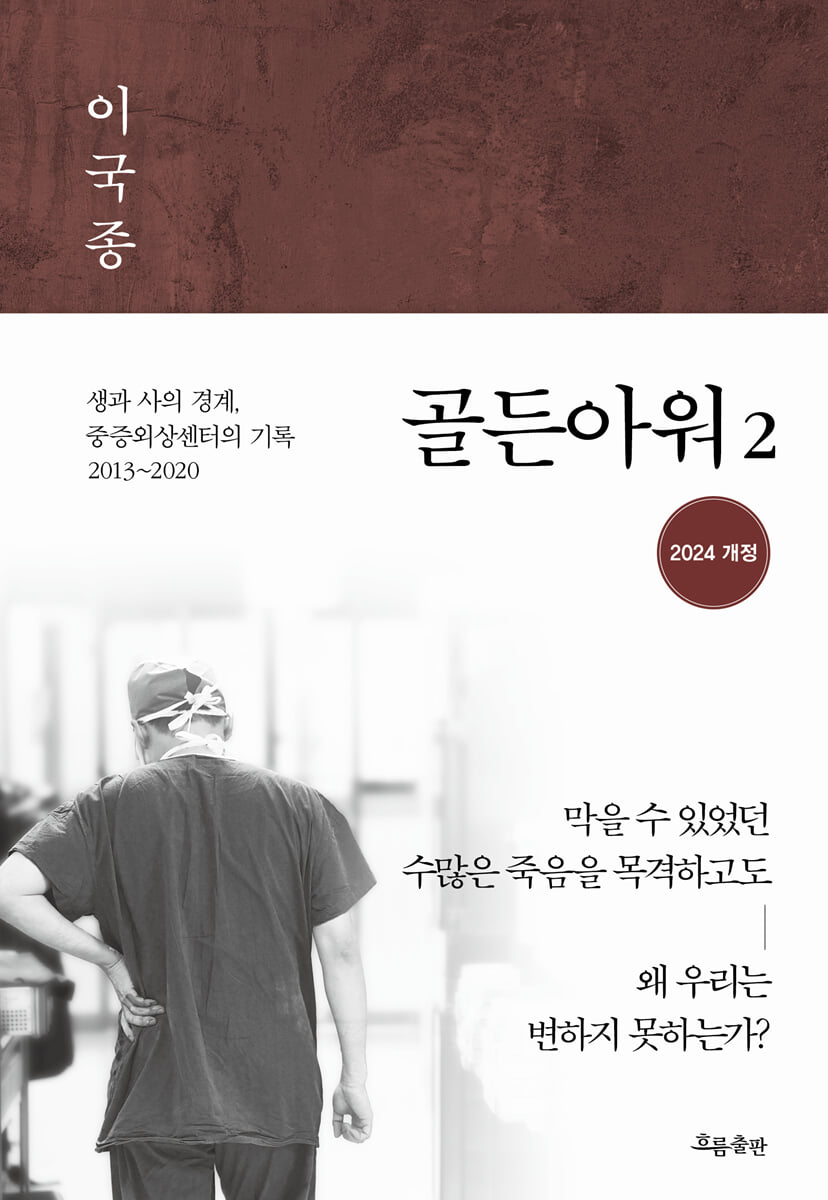
Golden Hour 2
 |
Description
Book Introduction
“Saving lives, that is our job.”
The struggle of nameless people who do not want to lose a single life
This is a record of life and death written by Professor Lee Guk-jong, a trauma surgeon.
The author has been documenting the harsh realities, anguish, reflections, and concerns about the medical system he has faced as a trauma surgeon for 17 years.
The writings, sometimes short and sometimes long, were known to some media outlets as the 'Igokjong Bimanrok'.
The record was polished and refined over a long period of time, published in two volumes (Volume 1, 2002-2013, Volume 2, 2013-2018), and has returned to readers in a revised edition in 2024.
In this 2024 revised edition, the biographies previously included in Volume 2 have been revised and relocated to the latter half of Volume 1.
Professor Lee Guk-jong's "Golden Hour" is a sobering report on the reality of severe trauma medical care in South Korea, and a historical record that captures the struggles of those who have struggled to save lives—medical staff, firefighters, soldiers, and others—even in a system that is not functioning.
Volume 1 depicts the process of setting foot in the trauma surgery department, despairing at the harsh medical reality he encountered, and finally establishing his own standards for what an international standard trauma center should be like while training at trauma centers in the United States and the United Kingdom.
The film depicts various aspects of our world, including the poignant feelings of medical staff, patients, and guardians in critical situations where life and death are at stake, the difficult lives of manual laborers constantly exposed to the risk of accidents, domestic violence, and organized crime.
Above all, it describes the whole story of the Captain Seok Project, which rescued and resuscitated Captain Seok, who was injured during Operation Dawn in the Gulf of Aden, as well as the reality of South Korea's medical system, which failed to make the most of this valuable opportunity despite creating a groundbreaking turning point in the severe trauma treatment system amidst national attention, in a calm tone that suppresses sadness.
In Volume 2, the author depicts the struggles of the university hospital he worked at after being designated as a regional trauma center, despite facing many twists and turns, in a medical reality that falls far short of international standards.
The struggle of nameless people who do not want to lose a single life
This is a record of life and death written by Professor Lee Guk-jong, a trauma surgeon.
The author has been documenting the harsh realities, anguish, reflections, and concerns about the medical system he has faced as a trauma surgeon for 17 years.
The writings, sometimes short and sometimes long, were known to some media outlets as the 'Igokjong Bimanrok'.
The record was polished and refined over a long period of time, published in two volumes (Volume 1, 2002-2013, Volume 2, 2013-2018), and has returned to readers in a revised edition in 2024.
In this 2024 revised edition, the biographies previously included in Volume 2 have been revised and relocated to the latter half of Volume 1.
Professor Lee Guk-jong's "Golden Hour" is a sobering report on the reality of severe trauma medical care in South Korea, and a historical record that captures the struggles of those who have struggled to save lives—medical staff, firefighters, soldiers, and others—even in a system that is not functioning.
Volume 1 depicts the process of setting foot in the trauma surgery department, despairing at the harsh medical reality he encountered, and finally establishing his own standards for what an international standard trauma center should be like while training at trauma centers in the United States and the United Kingdom.
The film depicts various aspects of our world, including the poignant feelings of medical staff, patients, and guardians in critical situations where life and death are at stake, the difficult lives of manual laborers constantly exposed to the risk of accidents, domestic violence, and organized crime.
Above all, it describes the whole story of the Captain Seok Project, which rescued and resuscitated Captain Seok, who was injured during Operation Dawn in the Gulf of Aden, as well as the reality of South Korea's medical system, which failed to make the most of this valuable opportunity despite creating a groundbreaking turning point in the severe trauma treatment system amidst national attention, in a calm tone that suppresses sadness.
In Volume 2, the author depicts the struggles of the university hospital he worked at after being designated as a regional trauma center, despite facing many twists and turns, in a medical reality that falls far short of international standards.
- You can preview some of the book's contents.
Preview
index
Giant dinosaur | Fight | Vain dependence | Corner | People on the same boat | Enemy within | Empty seat | Giant | Endless sacrifice | New patient | Reason for making a living | Life and death | 2013, records | Severe trauma center | Goodwill | Dolphin | Patient on the frontier | Volunteer | Injuries | Medical gap | Tilt ship | Letter | Crossroads | Pain | Edge of cliff | Fossil | Professor's work | Internal cracks | Drifting | No way forward | Commander | Bridgehead | Blindness | Fading days | Genetics | The man who said he was a Chinese fisherman | Broken landmark | Selfishness | Breaking point | House on top of a building | Sinking | Dim light | Blood Plunging | Fragments Left Behind | Obsession | Medicine and Politics | Endless Drifting | A Final Farewell | Meaningless Alternatives | Firefighters | 2016-2017, Records | Awful Reenactment | Debris | Weathering | Destination | Remaining Records | The Beginning of the End
Detailed image

Into the book
Patients with severe trauma were brought from semi-general hospitals to university hospitals, and those who could not be accepted by university hospitals were pushed out and sent back to semi-general hospitals.
Patients were always coming and going.
As patients who had been pushed out of the university hospital headed back to the general hospital, some died, and those who had lost their lives were taken to the morgue.
That was the final destination.
The fact that they no longer had to wander between hospitals in agony while still alive might have been a comfort to the deceased, but the cries of the survivors were heartbreakingly sad.
--- p.88
Among surgeons who were overly obsessed with trauma surgery or jumped into the field with high expectations from a young age, there were surprisingly many who dropped out.
This field is one that can only be sustained if you start without high expectations.
The miraculous saving of a patient with a single surgery and receiving praise from their guardians only exists in movies.
In reality, the job of a trauma surgeon is to examine patients with long, tedious breaths, and to endure the most miserable reality while doing so.
--- p.126
It's a resource.
That's a very plausible statement.
I was curious about the source of that saying.
As I chewed on that word, I pondered the meaning of resources as a member of an organization.
The orders to take on risky tasks from above sometimes disguised themselves as resources within the organization, and they even imposed their own will.
Strapping bombs to your body and running into enemy territory isn't something that only happens on the battlefield.
I couldn't tell if the five dead crew members had truly volunteered for the flight or not.
The cause of the crash remained unknown for several days.
--- p.177
In Korean society, you have to know how to step back at an appropriate point.
I didn't have the courage to give up halfway and I didn't know how.
The Gyeonggi Southern Regional Trauma Center was like a baby just learning to walk, like a thin glass that would shatter if touched.
Each and every rejected payment was so crucial to the operation of the center that we could not back down.
I was not a person fit for Korean society.
--- pp.186~187
The street was sunny.
The sunlight was nice even in the late afternoon, but the difference in brightness on the left and right made me dizzy.
I closed my left eye.
The sunlight was so bright that it blinded my right eye.
I closed my right eye.
It was dark.
Now I can clearly feel the difference in vision between my two eyes.
Yet, I never thought, 'What if I had gone to the ophthalmologist instead of taking off my goggles?'
It was something that was expected.
--- p.240
Blood was oozing throughout the abdominal cavity and the retroperitoneal cavity.
Bleeding also occurred in the right lobe of the liver.
Blood spurted out and swirled, covering the shattered liver lobe and rising up onto the Kent blade.
The bleeding area was large and the amount of bleeding was excessive.
The number of hemostatic agents we had was not enough.
The styptic that had barely been applied fell away like autumn leaves amidst the gushing blood.
Behind the ruptured liver, the hepatic vein suddenly widens and joins the abdominal vena cava.
From there, it will be impossible to completely repair the enlarged ruptured hepatic vein.
The place to dig was wide and deep, but there was almost no room to recover and come out alive after digging in.
--- p.297
During flight, when the wind was strong enough, it would whip around the AW-139 and the aircraft would roar.
It also seemed as if the AW-139 was trying to fly to the hospital as quickly as possible when the patient's condition worsened while being treated inside the cabin above the sky.
The sound the rotor made as it cut through the wind was sometimes loud enough to overcome the wind, and at other times it sounded like it was struggling with great exhaustion.
Medical staff and patients depended on helicopters for their lives, so for us, it was not just a means of transportation.
--- p.336
In stark contrast to this reality, the new government has set out to improve the 'quality of life.'
All kinds of policies were introduced.
The government's policy direction also influenced trauma centers.
The working hours of dedicated nurses, who fill the gap in the work of doctors who are absolutely insufficient, have also been limited to 52 hours per week.
An outrageous policy of limiting working hours without increasing the number of employees.
This was a huge blow to the center's operations.
I felt sick at the thought of my situation, barely able to survive by going against the grain of the world.
--- p.375
I looked closely at my father's name engraved on the stone monument.
I gently brushed the corner of the stone monument with my fingertips.
The sunlight that touched the roof was not hot.
How far and where should I go?
Father had no answer.
The place where he lay looked peaceful.
I was envious of my father's place in eternal rest.
But my end will not be far away.
It was a sad and vain thing, but since most of the days I lived were not perfect, that fact didn't seem so bad.
Patients were always coming and going.
As patients who had been pushed out of the university hospital headed back to the general hospital, some died, and those who had lost their lives were taken to the morgue.
That was the final destination.
The fact that they no longer had to wander between hospitals in agony while still alive might have been a comfort to the deceased, but the cries of the survivors were heartbreakingly sad.
--- p.88
Among surgeons who were overly obsessed with trauma surgery or jumped into the field with high expectations from a young age, there were surprisingly many who dropped out.
This field is one that can only be sustained if you start without high expectations.
The miraculous saving of a patient with a single surgery and receiving praise from their guardians only exists in movies.
In reality, the job of a trauma surgeon is to examine patients with long, tedious breaths, and to endure the most miserable reality while doing so.
--- p.126
It's a resource.
That's a very plausible statement.
I was curious about the source of that saying.
As I chewed on that word, I pondered the meaning of resources as a member of an organization.
The orders to take on risky tasks from above sometimes disguised themselves as resources within the organization, and they even imposed their own will.
Strapping bombs to your body and running into enemy territory isn't something that only happens on the battlefield.
I couldn't tell if the five dead crew members had truly volunteered for the flight or not.
The cause of the crash remained unknown for several days.
--- p.177
In Korean society, you have to know how to step back at an appropriate point.
I didn't have the courage to give up halfway and I didn't know how.
The Gyeonggi Southern Regional Trauma Center was like a baby just learning to walk, like a thin glass that would shatter if touched.
Each and every rejected payment was so crucial to the operation of the center that we could not back down.
I was not a person fit for Korean society.
--- pp.186~187
The street was sunny.
The sunlight was nice even in the late afternoon, but the difference in brightness on the left and right made me dizzy.
I closed my left eye.
The sunlight was so bright that it blinded my right eye.
I closed my right eye.
It was dark.
Now I can clearly feel the difference in vision between my two eyes.
Yet, I never thought, 'What if I had gone to the ophthalmologist instead of taking off my goggles?'
It was something that was expected.
--- p.240
Blood was oozing throughout the abdominal cavity and the retroperitoneal cavity.
Bleeding also occurred in the right lobe of the liver.
Blood spurted out and swirled, covering the shattered liver lobe and rising up onto the Kent blade.
The bleeding area was large and the amount of bleeding was excessive.
The number of hemostatic agents we had was not enough.
The styptic that had barely been applied fell away like autumn leaves amidst the gushing blood.
Behind the ruptured liver, the hepatic vein suddenly widens and joins the abdominal vena cava.
From there, it will be impossible to completely repair the enlarged ruptured hepatic vein.
The place to dig was wide and deep, but there was almost no room to recover and come out alive after digging in.
--- p.297
During flight, when the wind was strong enough, it would whip around the AW-139 and the aircraft would roar.
It also seemed as if the AW-139 was trying to fly to the hospital as quickly as possible when the patient's condition worsened while being treated inside the cabin above the sky.
The sound the rotor made as it cut through the wind was sometimes loud enough to overcome the wind, and at other times it sounded like it was struggling with great exhaustion.
Medical staff and patients depended on helicopters for their lives, so for us, it was not just a means of transportation.
--- p.336
In stark contrast to this reality, the new government has set out to improve the 'quality of life.'
All kinds of policies were introduced.
The government's policy direction also influenced trauma centers.
The working hours of dedicated nurses, who fill the gap in the work of doctors who are absolutely insufficient, have also been limited to 52 hours per week.
An outrageous policy of limiting working hours without increasing the number of employees.
This was a huge blow to the center's operations.
I felt sick at the thought of my situation, barely able to survive by going against the grain of the world.
--- p.375
I looked closely at my father's name engraved on the stone monument.
I gently brushed the corner of the stone monument with my fingertips.
The sunlight that touched the roof was not hot.
How far and where should I go?
Father had no answer.
The place where he lay looked peaceful.
I was envious of my father's place in eternal rest.
But my end will not be far away.
It was a sad and vain thing, but since most of the days I lived were not perfect, that fact didn't seem so bad.
--- p.385
Publisher's Review
The 17 Years of Life and Death Written by Surgeon Lee Guk-jong
Lives are at stake in the 60 minutes of 'Golden Hour'.
And the story of those who protect them
In 2002, Lee Guk-jong entered the Department of Trauma Surgery at the recommendation of his advisor, which marked a turning point in his life.
In principle, patients should arrive at a hospital capable of treating severe trauma within the golden hour of 60 minutes, and medical resources from various fields, including operating rooms, intensive care units, anesthesia departments, blood banks, and medical staff ready for immediate surgery, should be quickly deployed. However, the reality is far from this principle.
From this point on, his arduous struggle to establish an international standard severe trauma system in South Korea began.
This book is a compilation of the author's memories based on various medical and surgical records from 2002 to the first half of 2018, as the author states.
It is also a fierce narrative of the patients, the author, and their colleagues struggling on the front lines of life and death.
Above all, it is the first and last trace of foolish people who struggle to improve their positions in order to survive while maintaining the essence of karma in the harsh reality of Korean society, and who end up breaking down.
The sharp, sharp sentences that delve into the scene with the surgeon's unique perspective were not easily written.
As a doctor, his perfectionism, which does not allow for even a single mistake, is also evident in his writing.
I took painstaking efforts to accurately express the urgency that only someone who has experienced the accident scene and the medical field can understand, and poured my heart and soul into every single word and sentence.
Before publishing a book, there was a arduous process of revising and revising the manuscript, worrying about whether every word used was truly the most accurate expression.
Through this process, the lives and deaths of patients encountered at the trauma center, the arduous daily lives of medical staff, and even the rescue of Captain Seok Hae-gyun and the Sewol Ferry disaster, which have been well-known in the media, are told in a three-dimensional way that only those who have experienced them can understand.
Even after witnessing countless deaths that could have been prevented,
Why can't we change?
In Volume 2, the author depicts the process of struggling to establish a system that meets international standards in the still-poor reality after the university hospital where he worked was designated as the Gyeonggi Southern Regional Trauma Center after many twists and turns.
As the trauma center project deviated from its principles and essence over time, becoming swayed by complex vested interests, my colleagues, who had personally addressed the system's shortcomings, were pushed to the limit and succumbed to injuries.
The contradictions and absurdities that had been piling up were finally revealed through a great disaster that plunged the entire nation into sorrow.
The author, witnessing the Sewol ferry disaster and the treatment of severe trauma victims in South Korea, including defectors from North Korea, now reflects on the sacrifices, sweat, and tears of his colleagues.
I came this far without optimism and am moving forward without hope, but I stayed up all night writing down each word, like a comrade, to record those who have walked the same path.
Pilots and medical staff who board helicopters despite their injuries, firefighters who fight death at the scene of an accident, soldiers and police officers who risk their lives to protect the people…
This book is a tribute to all of those people.
Lives are at stake in the 60 minutes of 'Golden Hour'.
And the story of those who protect them
In 2002, Lee Guk-jong entered the Department of Trauma Surgery at the recommendation of his advisor, which marked a turning point in his life.
In principle, patients should arrive at a hospital capable of treating severe trauma within the golden hour of 60 minutes, and medical resources from various fields, including operating rooms, intensive care units, anesthesia departments, blood banks, and medical staff ready for immediate surgery, should be quickly deployed. However, the reality is far from this principle.
From this point on, his arduous struggle to establish an international standard severe trauma system in South Korea began.
This book is a compilation of the author's memories based on various medical and surgical records from 2002 to the first half of 2018, as the author states.
It is also a fierce narrative of the patients, the author, and their colleagues struggling on the front lines of life and death.
Above all, it is the first and last trace of foolish people who struggle to improve their positions in order to survive while maintaining the essence of karma in the harsh reality of Korean society, and who end up breaking down.
The sharp, sharp sentences that delve into the scene with the surgeon's unique perspective were not easily written.
As a doctor, his perfectionism, which does not allow for even a single mistake, is also evident in his writing.
I took painstaking efforts to accurately express the urgency that only someone who has experienced the accident scene and the medical field can understand, and poured my heart and soul into every single word and sentence.
Before publishing a book, there was a arduous process of revising and revising the manuscript, worrying about whether every word used was truly the most accurate expression.
Through this process, the lives and deaths of patients encountered at the trauma center, the arduous daily lives of medical staff, and even the rescue of Captain Seok Hae-gyun and the Sewol Ferry disaster, which have been well-known in the media, are told in a three-dimensional way that only those who have experienced them can understand.
Even after witnessing countless deaths that could have been prevented,
Why can't we change?
In Volume 2, the author depicts the process of struggling to establish a system that meets international standards in the still-poor reality after the university hospital where he worked was designated as the Gyeonggi Southern Regional Trauma Center after many twists and turns.
As the trauma center project deviated from its principles and essence over time, becoming swayed by complex vested interests, my colleagues, who had personally addressed the system's shortcomings, were pushed to the limit and succumbed to injuries.
The contradictions and absurdities that had been piling up were finally revealed through a great disaster that plunged the entire nation into sorrow.
The author, witnessing the Sewol ferry disaster and the treatment of severe trauma victims in South Korea, including defectors from North Korea, now reflects on the sacrifices, sweat, and tears of his colleagues.
I came this far without optimism and am moving forward without hope, but I stayed up all night writing down each word, like a comrade, to record those who have walked the same path.
Pilots and medical staff who board helicopters despite their injuries, firefighters who fight death at the scene of an accident, soldiers and police officers who risk their lives to protect the people…
This book is a tribute to all of those people.
GOODS SPECIFICS
- Date of issue: October 3, 2024
- Page count, weight, size: 412 pages | 145*210*30mm
- ISBN13: 9788965966531
- ISBN10: 8965966531
You may also like
카테고리
korean


korean

![GQ KOREA Mark (Monthly): December [2025]](http://librairie.coreenne.fr/cdn/shop/files/8ef265dbbfbf186523ed75ba7319009d.jpg?v=1765340328&width=3840)


