

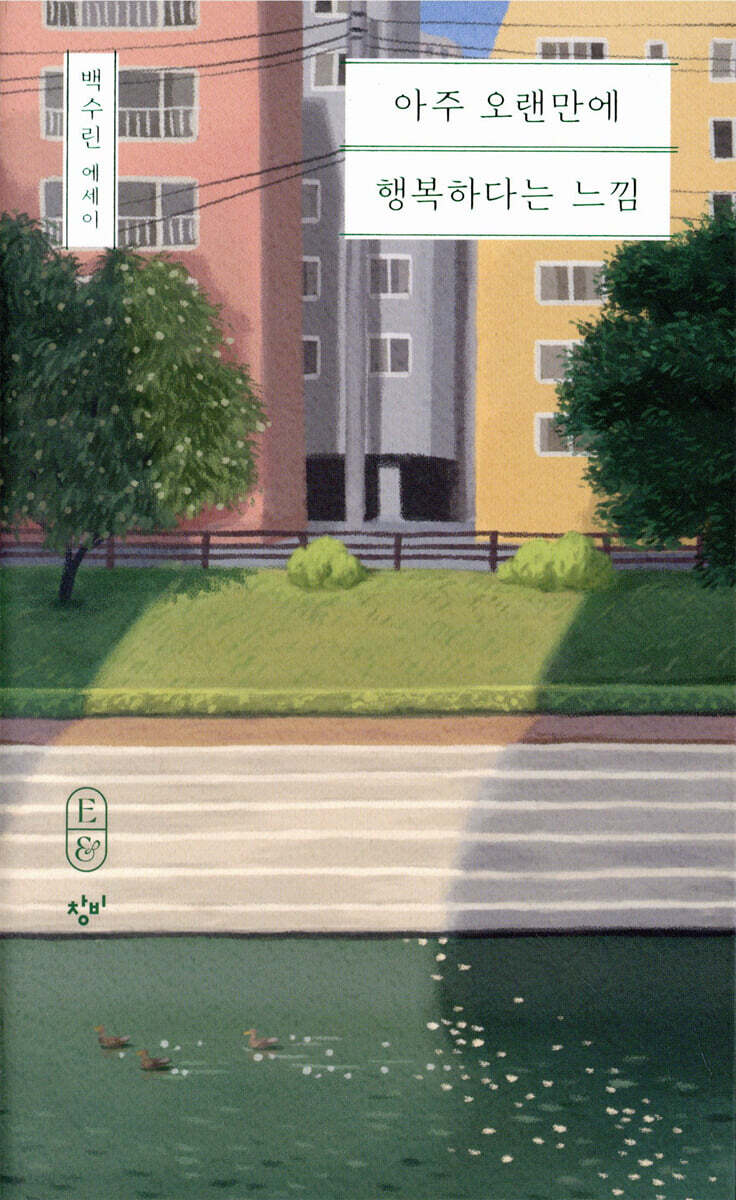
It's been a long time since I felt so happy
 |
Description
Book Introduction
- A word from MD
-
A path to walk together with happiness by your sideA story of love and people written by novelist Baek Su-rin while living in an old neighborhood.
The author records the new home, the beginnings with neighbors, and the meeting and parting with the companion dog, Bongbong, in neat and beautiful sentences.
The sparkling moments of life he would have seen from his house on the hill have arrived here for us.
October 14, 2022. Essay PD Park Hyung-wook
A single essay for those who dream of a happy life.
A record of all the beings who awakened love within me
Novelist Baek Su-rin, who has received praise from critics and readers for every work she publishes, including the Hankook Ilbo Literary Award, the Contemporary Literary Award, the Lee Hae-jo Novel Literary Award, the Munji Literary Award, and the Young Writer’s Award, meets readers with her new essay, “The Feeling of Being Happy for the First Time in a Long Time.”
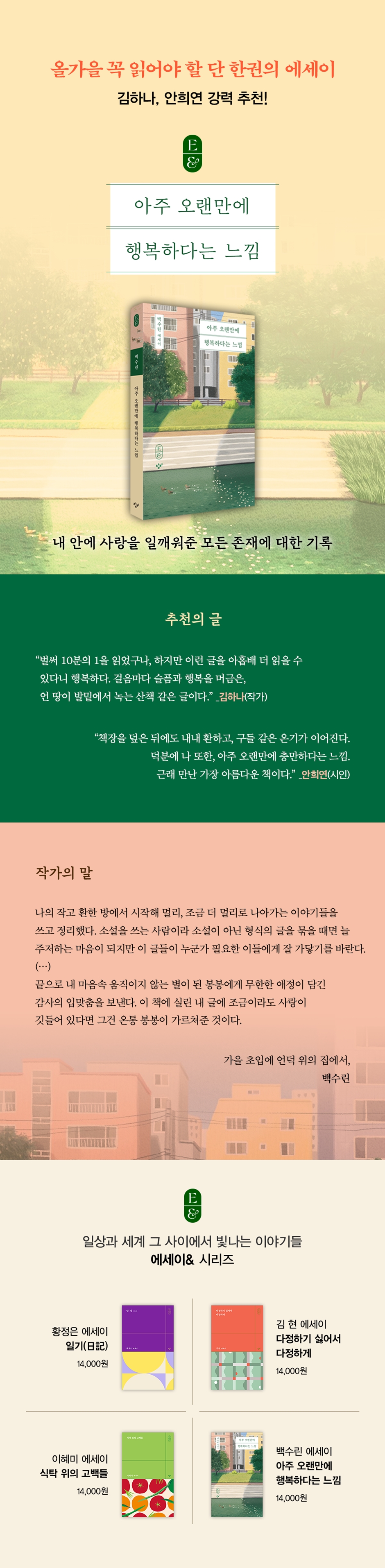
This is the fourth book in Changbi's 'Essay &' series, which presents 'stories that shine between everyday life and the world.'
This story, which received the love of countless readers and recorded over 1,000 views per month when it was serialized on Changbi's online platform 'Switch' for four months starting this spring, is a poignant and dazzling record set in an old neighborhood in Seoul where author Baek Su-rin settled several years ago.
It contains stories about the neighbors I met in the neighborhood I moved into for the first time in my life after leaving my apartment, the pets and loved ones I lost there, the sadness and insights into life I gained through parting, and the everyday life of a female writer.
This new essay, which highlights author Baek Su-rin's thoughtful reflections and beautiful prose, is organically connected, allowing readers to fully experience the narrative of a person's life and growth.
Following this story, you will glimpse the splendid secrets of life: what it means to love your own life and where true happiness comes from.
As the praises such as “A book like a walk where the frozen ground melts beneath your feet” (recommended by Kim Ha-na) and “The most beautiful book I’ve read in a while” (recommended by Ahn Hee-yeon) suggest, this book will give readers the will to live, the beauty of being alive, and “a feeling of being happy for the first time in a long time.”
A record of all the beings who awakened love within me
Novelist Baek Su-rin, who has received praise from critics and readers for every work she publishes, including the Hankook Ilbo Literary Award, the Contemporary Literary Award, the Lee Hae-jo Novel Literary Award, the Munji Literary Award, and the Young Writer’s Award, meets readers with her new essay, “The Feeling of Being Happy for the First Time in a Long Time.”
This is the fourth book in Changbi's 'Essay &' series, which presents 'stories that shine between everyday life and the world.'
This story, which received the love of countless readers and recorded over 1,000 views per month when it was serialized on Changbi's online platform 'Switch' for four months starting this spring, is a poignant and dazzling record set in an old neighborhood in Seoul where author Baek Su-rin settled several years ago.
It contains stories about the neighbors I met in the neighborhood I moved into for the first time in my life after leaving my apartment, the pets and loved ones I lost there, the sadness and insights into life I gained through parting, and the everyday life of a female writer.
This new essay, which highlights author Baek Su-rin's thoughtful reflections and beautiful prose, is organically connected, allowing readers to fully experience the narrative of a person's life and growth.
Following this story, you will glimpse the splendid secrets of life: what it means to love your own life and where true happiness comes from.
As the praises such as “A book like a walk where the frozen ground melts beneath your feet” (recommended by Kim Ha-na) and “The most beautiful book I’ve read in a while” (recommended by Ahn Hee-yeon) suggest, this book will give readers the will to live, the beauty of being alive, and “a feeling of being happy for the first time in a long time.”
- You can preview some of the book's contents.
Preview
index
Part 1 My Small, Bright Room
Memories of places, places of memories
My neighbors
Summer Table Setting
house without a yard
The beauty of uselessness
That winter's scenery
A heart that tries
Before night falls
Part 2: Feeling like taking a walk
Days of Love
Early Summer Walk 1
Diary 1
Diary 2
Diary 3
Diary 4
What sadness taught me
Put your sneakers back on
Early Summer Walk 2
May
Part 3 Far, a little further
Like a bird, like the wind
Writing about others
My window, my apricot
The hardships of being me
Spring Diary
Around forty
Author's Note
Memories of places, places of memories
My neighbors
Summer Table Setting
house without a yard
The beauty of uselessness
That winter's scenery
A heart that tries
Before night falls
Part 2: Feeling like taking a walk
Days of Love
Early Summer Walk 1
Diary 1
Diary 2
Diary 3
Diary 4
What sadness taught me
Put your sneakers back on
Early Summer Walk 2
May
Part 3 Far, a little further
Like a bird, like the wind
Writing about others
My window, my apricot
The hardships of being me
Spring Diary
Around forty
Author's Note
Detailed image
Into the book
“Living is like a journey to find your own home.”
My sister said that while we were eating cake.
“It’s a journey to find a state where I can be at peace with myself, without being swayed by the words or gaze of others.”
Those words touched my heart.
--- p.40
Why is it that everything I love seems so trivial and useless in the eyes of the world?
But now I try not to feel guilty about loving useless things.
I want to live remembering the feelings of happiness that are divided into fine details.
Because in the end, those things are what will keep us alive.
--- p.59
Any living being, no matter what, needs boundless love.
And a being that has grown up receiving infinite love knows how to give love.
Bongbong was the first person to show me that even though I thought I was cold and selfish, there was so much love hidden inside me.
--- p.102
On the way back from my walk, I whispered to Bongbong.
Bongbong, that's a crescent moon. Isn't it beautiful? Let's see more crescent moons together in the future.
As soon as Bongbong got home, he staggered but bravely walked to the bathroom alone.
Our separation was inevitable, but for now, it was as if to remind me that we were both alive.
Today, through that small body, I learn that instead of easily giving in to the sorrow that will come in the future, we must do our best to live in the present, to live together.
--- p.120
You become more sensitive to everything, your senses of touch, sight and hearing awaken.
People in grief acquire sharper tentacles than ever before.
Every being who has lost a loved one feels the change in the world that has become unfamiliar overnight due to a single absence.
--- pp.130~131
The person who was talking about my fate said with a very embarrassed look on his face that I was born with a horoscope that makes me unsettled like a bird or the wind, and that I might get married very late or become the head of the household instead of a man.
The person who did my fortune telling felt sorry, but I really liked my fortune telling.
Free as a bird, as the wind! Could there be a more wonderful destiny? I interpreted his words, "You may marry very late in life or become the head of the household instead of your husband," as meaning a life of financial independence and self-reliance. It wasn't much different from the life I dreamed of, and it was a truly wonderful life.
--- p.175
It was a happiness that I didn't know how long it would last, but it didn't matter anyway.
After all, I was old enough to know that happiness is not something that lasts, but rather a fleeting sensation that sparkles beautifully and then disappears like a thief's eye in the deep night.
Although it was different from my poor imagination of forty when I was twenty, I had a feeling that my forties would be full of fun and exciting adventures.
I don't love myself every day like I wished I did as a child, but that's not all bad.
As I live on, I will write about my love for more beings outside of myself on the blank pages I will fill.
--- pp.224~225
Some of the writings included here were serialized on Changbi's online platform 'Switch' this summer, but the rest are a collection of writings I've written sporadically over the years since I became a writer and became acquainted with House on the Hill.
When I look at the manuscripts I wrote over a long period of time, I can see how things have changed over time.
Many things have changed, but as I was working on the writings I had written in the past, the beings I had thought I had lost quietly came to my side and stayed with me. Even though time erases many things, I have writing, so I can be with the things I had lost again and again, and I cannot help but be grateful.
When I returned to my house on the hill a few days later to resume writing after submitting the final manuscript for this collection and leaving for a short time, what I saw was the sight of the plants I had painstakingly planted and nurtured withering and dying while I had neglected to care for them.
It's a scenery I see over and over again every time I come back from a trip, and every time, the same spot is filled with grass and flowers that I didn't plant.
In the old days, I would have focused on the dead.
No matter how hard we try, how easily precious things can be damaged and ruined the moment we stop caring for them.
On the other hand, what tenacity and tenacious vitality do those things have that need to be eliminated?
As if the mind is inclined towards pessimism or discouragement, hatred and misunderstanding, and a deep-seated inferiority complex.
But now I turn my gaze towards living things.
Those born outside my limited capacity to care and see the light of day.
The lives given to me like an unexpected gift at the moment I stopped.
I like a world where 'I' am not everything.
I want to live leaving behind a land where things I didn't plant can bloom.
With such things in mind, I wrote and organized the essays included in this collection of essays.
Stories that start from my small, bright room and go far, a little further.
As a novelist, I always hesitate when I write non-fiction pieces, but I hope these pieces will reach those who need them.
(…)
Finally, I send a kiss of gratitude filled with endless affection to Bongbong, who has become the unmoving star in my heart.
If there is even a little bit of love in my writings in this book, it is all because Bongbong taught me.
In the house on the hill in early autumn,
Baek Su-rin
My sister said that while we were eating cake.
“It’s a journey to find a state where I can be at peace with myself, without being swayed by the words or gaze of others.”
Those words touched my heart.
--- p.40
Why is it that everything I love seems so trivial and useless in the eyes of the world?
But now I try not to feel guilty about loving useless things.
I want to live remembering the feelings of happiness that are divided into fine details.
Because in the end, those things are what will keep us alive.
--- p.59
Any living being, no matter what, needs boundless love.
And a being that has grown up receiving infinite love knows how to give love.
Bongbong was the first person to show me that even though I thought I was cold and selfish, there was so much love hidden inside me.
--- p.102
On the way back from my walk, I whispered to Bongbong.
Bongbong, that's a crescent moon. Isn't it beautiful? Let's see more crescent moons together in the future.
As soon as Bongbong got home, he staggered but bravely walked to the bathroom alone.
Our separation was inevitable, but for now, it was as if to remind me that we were both alive.
Today, through that small body, I learn that instead of easily giving in to the sorrow that will come in the future, we must do our best to live in the present, to live together.
--- p.120
You become more sensitive to everything, your senses of touch, sight and hearing awaken.
People in grief acquire sharper tentacles than ever before.
Every being who has lost a loved one feels the change in the world that has become unfamiliar overnight due to a single absence.
--- pp.130~131
The person who was talking about my fate said with a very embarrassed look on his face that I was born with a horoscope that makes me unsettled like a bird or the wind, and that I might get married very late or become the head of the household instead of a man.
The person who did my fortune telling felt sorry, but I really liked my fortune telling.
Free as a bird, as the wind! Could there be a more wonderful destiny? I interpreted his words, "You may marry very late in life or become the head of the household instead of your husband," as meaning a life of financial independence and self-reliance. It wasn't much different from the life I dreamed of, and it was a truly wonderful life.
--- p.175
It was a happiness that I didn't know how long it would last, but it didn't matter anyway.
After all, I was old enough to know that happiness is not something that lasts, but rather a fleeting sensation that sparkles beautifully and then disappears like a thief's eye in the deep night.
Although it was different from my poor imagination of forty when I was twenty, I had a feeling that my forties would be full of fun and exciting adventures.
I don't love myself every day like I wished I did as a child, but that's not all bad.
As I live on, I will write about my love for more beings outside of myself on the blank pages I will fill.
--- pp.224~225
Some of the writings included here were serialized on Changbi's online platform 'Switch' this summer, but the rest are a collection of writings I've written sporadically over the years since I became a writer and became acquainted with House on the Hill.
When I look at the manuscripts I wrote over a long period of time, I can see how things have changed over time.
Many things have changed, but as I was working on the writings I had written in the past, the beings I had thought I had lost quietly came to my side and stayed with me. Even though time erases many things, I have writing, so I can be with the things I had lost again and again, and I cannot help but be grateful.
When I returned to my house on the hill a few days later to resume writing after submitting the final manuscript for this collection and leaving for a short time, what I saw was the sight of the plants I had painstakingly planted and nurtured withering and dying while I had neglected to care for them.
It's a scenery I see over and over again every time I come back from a trip, and every time, the same spot is filled with grass and flowers that I didn't plant.
In the old days, I would have focused on the dead.
No matter how hard we try, how easily precious things can be damaged and ruined the moment we stop caring for them.
On the other hand, what tenacity and tenacious vitality do those things have that need to be eliminated?
As if the mind is inclined towards pessimism or discouragement, hatred and misunderstanding, and a deep-seated inferiority complex.
But now I turn my gaze towards living things.
Those born outside my limited capacity to care and see the light of day.
The lives given to me like an unexpected gift at the moment I stopped.
I like a world where 'I' am not everything.
I want to live leaving behind a land where things I didn't plant can bloom.
With such things in mind, I wrote and organized the essays included in this collection of essays.
Stories that start from my small, bright room and go far, a little further.
As a novelist, I always hesitate when I write non-fiction pieces, but I hope these pieces will reach those who need them.
(…)
Finally, I send a kiss of gratitude filled with endless affection to Bongbong, who has become the unmoving star in my heart.
If there is even a little bit of love in my writings in this book, it is all because Bongbong taught me.
In the house on the hill in early autumn,
Baek Su-rin
---From the author's note
Publisher's Review
“Life is like a journey to find your own home.”
The joy of walking through life, as woven by the brilliant essayist Baek Su-rin.
Part 1, "My Small and Bright Room," details the story of how author Baek Su-rin came to live in a village on a hill, the neighbors she met there, the winter preparations and snow removal she never experienced when living in an apartment building, and her reflections on the reality of a neighborhood that may one day disappear due to redevelopment.
This story, in which the author, who liked to live in a closed world of his own, encounters an old neighborhood and dreams of our own world, as revealed in the episode where he liked to crawl under his desk as a child, rediscovers the meaning of living together.
In particular, the story of E, a woman in her 50s who returned to Korea after living in a monastery in France for 10 years and now lives by doing physical labor, seems to ask us what true happiness is.
The author is disturbed by the stories of people around him using their homes as a means of making money, but seeing E, who invites her friends over, treats them to hearty meals, and sends them small gifts every time they visit, allows her to firmly establish her own definition of wealth and poverty.
E's words, "Life is a journey of finding your own home," but also "a journey of finding a state where you can be at peace with yourself, without being swayed by the words or gaze of others," send a weighty message to us today, who constantly compare ourselves to others and live our lives always striving to have more.
Through the life she experienced here, writer Baek Su-rin came to fully accept the aspect of herself that has always loved the useless.
In the end, what keeps us alive are these “finely divided senses of happiness.”
Part 2, 'Feeling Like Taking a Walk', contains the author's story of love and death learned through his first encounter and separation with his dog, 'Bongbong', who has been with him for over 17 years.
Bongbong is the one who first made the author realize that he, who he thought was cold and selfish, had so much love hidden within him.
The author, who grew up learning responsibility for a small creature that trusted only him, also learned that when Bongbong became an old dog and was battling illness, “instead of easily giving in to the sadness that would come in the future, we must do our best to live ‘living together’ in the present.”
Still, parting is inevitable.
The author calmly tells the story of 'what grief teaches us' through the death and mourning of a pet.
The story of a man who lost a family member he had been with for over a decade, only to have his grief completely ignored because the person was an animal, not a human, and the clumsy consolation of those around him that only served to hurt him will resonate with many who have suffered from pet loss syndrome and unrecognized grief.
The author realizes that while “joy is a vivid and crude emotion,” sadness is “a narrow and long tunnel that only one person can pass through at a time,” and through this mourning, he learns once again how to love others.
Meanwhile, in the story "May," which tells the story of the death of a relative who knew how to love life to the fullest in a special way, a beautiful person appears who "definitely discovered the joy of growing fresh even in the darkness and lived life brilliantly until the last moment." The story of a person who knew how to love "being alive" itself even in the face of death is deeply moving.
Part 3, 'Far, Farther', contains the story of writer Baek Su-rin living as a 'woman' and a 'female writer'.
The author, who had not had her own voice throughout her growth as a 'girl', feels that she too has the power to create a new narrative while reading Rebecca Solnit's book, and when interacting with an old man who collects waste paper in the neighborhood, she coolly recalls that she had feelings of superiority toward him, and expresses her concerns about the limitations of writing novels that inevitably objectify others.
A beautiful book that fills you with a sense of happiness
This story of growth, in which a single woman learns to love while living alone and interacting with her neighbors, begins in "My Small, Bright Room" and brightly unfolds a bright future that goes "far, a little further."
At the end of this essay, the author shows a small but precious scene of happiness he experienced on his fortieth birthday, and tells the truth that “happiness is not something that lasts, but a fleeting sensation that sparkles beautifully and then disappears like a thief’s eye in the deep night.”
Although it may not be the glamorous forties I imagined when I was in my twenties, I have a feeling that my forties will be filled with fun and exciting adventures.
Although it may seem simple to some, the author's aspirations for life, expressed in a calm manner, have great implications for us who are always wandering in search of happiness.
Even if I can't love myself every day, I will continue to love more beings as I live.
While reading this book, a sense of happiness will settle down on us for the first time in a long time.
The joy of walking through life, as woven by the brilliant essayist Baek Su-rin.
Part 1, "My Small and Bright Room," details the story of how author Baek Su-rin came to live in a village on a hill, the neighbors she met there, the winter preparations and snow removal she never experienced when living in an apartment building, and her reflections on the reality of a neighborhood that may one day disappear due to redevelopment.
This story, in which the author, who liked to live in a closed world of his own, encounters an old neighborhood and dreams of our own world, as revealed in the episode where he liked to crawl under his desk as a child, rediscovers the meaning of living together.
In particular, the story of E, a woman in her 50s who returned to Korea after living in a monastery in France for 10 years and now lives by doing physical labor, seems to ask us what true happiness is.
The author is disturbed by the stories of people around him using their homes as a means of making money, but seeing E, who invites her friends over, treats them to hearty meals, and sends them small gifts every time they visit, allows her to firmly establish her own definition of wealth and poverty.
E's words, "Life is a journey of finding your own home," but also "a journey of finding a state where you can be at peace with yourself, without being swayed by the words or gaze of others," send a weighty message to us today, who constantly compare ourselves to others and live our lives always striving to have more.
Through the life she experienced here, writer Baek Su-rin came to fully accept the aspect of herself that has always loved the useless.
In the end, what keeps us alive are these “finely divided senses of happiness.”
Part 2, 'Feeling Like Taking a Walk', contains the author's story of love and death learned through his first encounter and separation with his dog, 'Bongbong', who has been with him for over 17 years.
Bongbong is the one who first made the author realize that he, who he thought was cold and selfish, had so much love hidden within him.
The author, who grew up learning responsibility for a small creature that trusted only him, also learned that when Bongbong became an old dog and was battling illness, “instead of easily giving in to the sadness that would come in the future, we must do our best to live ‘living together’ in the present.”
Still, parting is inevitable.
The author calmly tells the story of 'what grief teaches us' through the death and mourning of a pet.
The story of a man who lost a family member he had been with for over a decade, only to have his grief completely ignored because the person was an animal, not a human, and the clumsy consolation of those around him that only served to hurt him will resonate with many who have suffered from pet loss syndrome and unrecognized grief.
The author realizes that while “joy is a vivid and crude emotion,” sadness is “a narrow and long tunnel that only one person can pass through at a time,” and through this mourning, he learns once again how to love others.
Meanwhile, in the story "May," which tells the story of the death of a relative who knew how to love life to the fullest in a special way, a beautiful person appears who "definitely discovered the joy of growing fresh even in the darkness and lived life brilliantly until the last moment." The story of a person who knew how to love "being alive" itself even in the face of death is deeply moving.
Part 3, 'Far, Farther', contains the story of writer Baek Su-rin living as a 'woman' and a 'female writer'.
The author, who had not had her own voice throughout her growth as a 'girl', feels that she too has the power to create a new narrative while reading Rebecca Solnit's book, and when interacting with an old man who collects waste paper in the neighborhood, she coolly recalls that she had feelings of superiority toward him, and expresses her concerns about the limitations of writing novels that inevitably objectify others.
A beautiful book that fills you with a sense of happiness
This story of growth, in which a single woman learns to love while living alone and interacting with her neighbors, begins in "My Small, Bright Room" and brightly unfolds a bright future that goes "far, a little further."
At the end of this essay, the author shows a small but precious scene of happiness he experienced on his fortieth birthday, and tells the truth that “happiness is not something that lasts, but a fleeting sensation that sparkles beautifully and then disappears like a thief’s eye in the deep night.”
Although it may not be the glamorous forties I imagined when I was in my twenties, I have a feeling that my forties will be filled with fun and exciting adventures.
Although it may seem simple to some, the author's aspirations for life, expressed in a calm manner, have great implications for us who are always wandering in search of happiness.
Even if I can't love myself every day, I will continue to love more beings as I live.
While reading this book, a sense of happiness will settle down on us for the first time in a long time.
GOODS SPECIFICS
- Publication date: October 14, 2022
- Page count, weight, size: 232 pages | 242g | 115*188*15mm
- ISBN13: 9788936438869
- ISBN10: 8936438867
You may also like
카테고리
korean


korean

![GQ KOREA Mark (Monthly): December [2025]](http://librairie.coreenne.fr/cdn/shop/files/8ef265dbbfbf186523ed75ba7319009d.jpg?v=1765340328&width=3840)


