

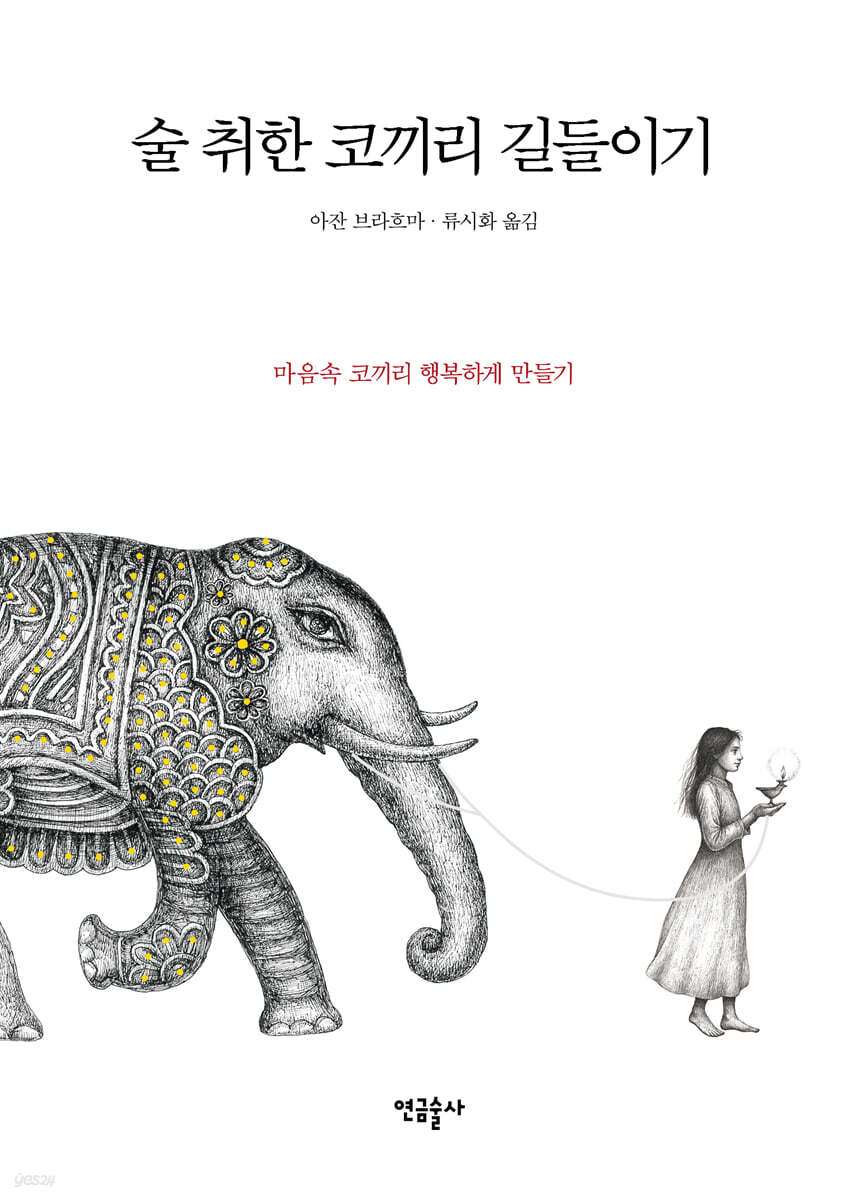
Taming a Drunken Elephant
 |
Description
Book Introduction
108 Stories to Tame the Drunken Elephant in Your Heart
Ajahn Brahma, a Cambridge University graduate and monk, made his masterpiece, [The Taming of the Drunken Elephant], famous in Korea, has been republished with new editing and design after two years out of print.
A traveler was sitting on the banks of the Ganges River, admiring the surrounding scenery, when he saw a large elephant coming up from its bath in the river.
At that time, he saw a man with a hooked stick controlling an elephant and had a great realization that wild animals can be tamed by humans.
On that path he went into the forest and began to concentrate his mind.
This book contains 108 stories of enlightenment gained while practicing under the legendary Thai monk Ajahn Chah, who converted to Buddhism at a time when interest in Buddhism was rare in the West.
This book is not written to unilaterally teach someone, but rather honestly contains the process of gaining one's own experiences and enlightenment.
Through the symbol of the elephant, it tells stories of overcoming fear, accepting pain, anger and forgiveness, and how to not lose heart even in the midst of numerous emotions such as happiness and unhappiness, sadness and joy.
[Taming the Drunken Elephant] is a good guide for those who want to control the elephant in their hearts that tries to destroy human relationships, makes them angry, jealous, hateful, and destroys the beautiful house they have built.
Ajahn Brahma, a Cambridge University graduate and monk, made his masterpiece, [The Taming of the Drunken Elephant], famous in Korea, has been republished with new editing and design after two years out of print.
A traveler was sitting on the banks of the Ganges River, admiring the surrounding scenery, when he saw a large elephant coming up from its bath in the river.
At that time, he saw a man with a hooked stick controlling an elephant and had a great realization that wild animals can be tamed by humans.
On that path he went into the forest and began to concentrate his mind.
This book contains 108 stories of enlightenment gained while practicing under the legendary Thai monk Ajahn Chah, who converted to Buddhism at a time when interest in Buddhism was rare in the West.
This book is not written to unilaterally teach someone, but rather honestly contains the process of gaining one's own experiences and enlightenment.
Through the symbol of the elephant, it tells stories of overcoming fear, accepting pain, anger and forgiveness, and how to not lose heart even in the midst of numerous emotions such as happiness and unhappiness, sadness and joy.
[Taming the Drunken Elephant] is a good guide for those who want to control the elephant in their hearts that tries to destroy human relationships, makes them angry, jealous, hateful, and destroys the beautiful house they have built.
- You can preview some of the book's contents.
Preview
index
The Heart That Can Give Up an Elephant _ Ryu Si-hwa
1 two bricks
2 Door of the Heart
3 Put it down
4 Taming the Drunken Elephant
5 truckloads of cow dung
6 Crying Cow
7 The biggest thing in the world
8 full jars
9 A Teacher Named Life
10 A Beautiful End to Life
About the Author
1 two bricks
2 Door of the Heart
3 Put it down
4 Taming the Drunken Elephant
5 truckloads of cow dung
6 Crying Cow
7 The biggest thing in the world
8 full jars
9 A Teacher Named Life
10 A Beautiful End to Life
About the Author
Into the book
Every human being has two misplaced bricks.
But within each of us there are far more perfectly laid bricks than there are faulty ones.
Once you know that, things aren't so bad.
Then we can not only live at peace with ourselves, but also live happily with others, despite our problems.
--- p.
29
We all deserve to get away from others for a while and enjoy some peace.
And others deserve their own peace by our disappearance! --- p.
37
It is better to light a candle than to complain about the darkness.
--- p.
40
True love is love without ego.
'The door of my heart is always open to you.
No matter what you do in life,' receiving that kind of love from someone is the most valuable gift in the world.
Then you cherish it and keep it deep in your heart so you don't lose it.
--- p.
52
There are countless possibilities for what will happen in the future.
When we focus on the unfortunate possibility, it is called fear.
On the other hand, when we remember that there are many other possibilities, it is called freedom from fear.
--- p.
73
Fear is the anticipation of things that will go wrong in the future.
But if we just keep in mind how uncertain our future is, we will never try to predict what might go wrong.
At that moment, fear ends.
--- p.
76
Fear is the greatest cause of suffering.
What makes pain more painful is fear.
When you let go of fear, all that remains is the feeling of pain.
What I put down was the fear of the pain of a toothache.
I accepted the pain, I embraced it, I didn't reject it.
Because I did that, it went away.
--- p.
84
When someone hurts us, we don't have to punish them ourselves.
If we're Christian, Muslim, or Jewish, don't we believe that God will punish them sufficiently? If we're Buddhist, Hindu, or Sikh, don't we believe that the law of karma will justly punish the perpetrator? And if you're a follower of psychotherapy, a modern-day new religion, you know that your perpetrator will suffer from guilt and undergo years of expensive psychotherapy.
So why must we be the ones to "slap them hard"? A little wisdom will reveal that we don't necessarily have to be the ones to punish them.
When we let go of our anger and cool our hearts with forgiveness, we are still fulfilling our duty.
--- p.
117
My dear crazy heart, no matter what you do to me, the door of my heart is open to you.
You may destroy me and bring me to ruin, but I bear no ill will toward you.
I love you no matter what you do.
--- p.
123
Despair is a prison we all must pass through.
'This too shall pass.' This is what helps us endure the situation.
It also helps us to let go of the attitude of taking happy times for granted, which is so often the greatest cause of despair --- p.
137
Practitioners who have lived relatively easy lives and have not had much dung to spread around could not become great teachers.
Those who became great teachers were those who endured great trials, silently shoveled dung, and cultivated a rich inner garden.
Almost all the practitioners I know have a mind of wisdom, inner calm, and compassion.
But those who had more dung had more to share with the world.
--- p.
143
Half of karma is the material we have.
The other half, the most important part, is what we do with that material in this life.
There is bound to be something we can do with the materials we have available to us on a daily basis.
Even if it's just sitting down and enjoying one last cup of tea.
--- p.
148
There are times when you come to a crossroads and are not sure which way to go.
At that time, you have to stop for a moment, stand on the side of the road, and wait for the bus to come.
The bus will arrive soon, at a time you weren't expecting.
There is a sign on the front window of the bus indicating the destination in large, bold letters.
If that destination suits you, you get on that bus.
Otherwise, wait.
Because there will always be another bus arriving soon after.
--- p.
163
It is not right to criticize the religion a religious fanatic believes in because his beliefs cause serious problems for those around him.
It's just that the beginner hasn't learned the religion well yet.
Each of us must become a master of love within our religion.
--- p.
212
We all need to allow ourselves the time and peace to climb the spiritual pyramid within ourselves at some point in our lives.
We must, even if only for a moment, ascend above this complex, tangled jungle called life.
Then we may be able to see our place in things and see far ahead on the journey of life.
And we may gaze upon the infinite world, undisturbed by anything, surrounding our existence in all directions.
--- p.
219
There are two kinds of freedom that we can find in the world we live in.
One is freedom of desire, and the other is freedom from desire.
--- p.
229
Any place, no matter how comfortable, is a prison to you if you don't want to be there.
This is what the word 'prison' means.
Any situation you don't want to be in is a prison.
If your job is not what you want, then you are in jail.
If you are in a relationship you don't want, you are also in prison.
If you are in a sick and painful body and do not want to be there, that too is a prison for you.
Any situation you don't want to be in is a prison.
--- p.
234
It's not the work itself that makes us tired, it's our thoughts about it.
I learned this priceless lesson early in my life as a monk in northeastern Thailand: 'What makes something in life difficult is the thought we have about it.'
--- p.
265
It is merely an illusion to think that you can be happy by becoming something else.
Becoming something else is merely exchanging one form of suffering for another.
But when you are satisfied with who you are now, whether you are married or single, rich or poor, new or veteran, then you can be free from suffering.
--- p.
270
Sadness is seeing only what is gone from you.
On the other hand, the celebration of life is about recognizing all that we have and feeling deep gratitude for it.
--- p.
287
Since I was a scientist before I became a monk, I decided to conduct an experiment.
The next time I hit my head, I decided to laugh like the Thai monks.
I wanted to know what would happen if I did that.
Do you know what I discovered? I discovered that if I laugh when I hit my head, it hurts a lot less.
But within each of us there are far more perfectly laid bricks than there are faulty ones.
Once you know that, things aren't so bad.
Then we can not only live at peace with ourselves, but also live happily with others, despite our problems.
--- p.
29
We all deserve to get away from others for a while and enjoy some peace.
And others deserve their own peace by our disappearance! --- p.
37
It is better to light a candle than to complain about the darkness.
--- p.
40
True love is love without ego.
'The door of my heart is always open to you.
No matter what you do in life,' receiving that kind of love from someone is the most valuable gift in the world.
Then you cherish it and keep it deep in your heart so you don't lose it.
--- p.
52
There are countless possibilities for what will happen in the future.
When we focus on the unfortunate possibility, it is called fear.
On the other hand, when we remember that there are many other possibilities, it is called freedom from fear.
--- p.
73
Fear is the anticipation of things that will go wrong in the future.
But if we just keep in mind how uncertain our future is, we will never try to predict what might go wrong.
At that moment, fear ends.
--- p.
76
Fear is the greatest cause of suffering.
What makes pain more painful is fear.
When you let go of fear, all that remains is the feeling of pain.
What I put down was the fear of the pain of a toothache.
I accepted the pain, I embraced it, I didn't reject it.
Because I did that, it went away.
--- p.
84
When someone hurts us, we don't have to punish them ourselves.
If we're Christian, Muslim, or Jewish, don't we believe that God will punish them sufficiently? If we're Buddhist, Hindu, or Sikh, don't we believe that the law of karma will justly punish the perpetrator? And if you're a follower of psychotherapy, a modern-day new religion, you know that your perpetrator will suffer from guilt and undergo years of expensive psychotherapy.
So why must we be the ones to "slap them hard"? A little wisdom will reveal that we don't necessarily have to be the ones to punish them.
When we let go of our anger and cool our hearts with forgiveness, we are still fulfilling our duty.
--- p.
117
My dear crazy heart, no matter what you do to me, the door of my heart is open to you.
You may destroy me and bring me to ruin, but I bear no ill will toward you.
I love you no matter what you do.
--- p.
123
Despair is a prison we all must pass through.
'This too shall pass.' This is what helps us endure the situation.
It also helps us to let go of the attitude of taking happy times for granted, which is so often the greatest cause of despair --- p.
137
Practitioners who have lived relatively easy lives and have not had much dung to spread around could not become great teachers.
Those who became great teachers were those who endured great trials, silently shoveled dung, and cultivated a rich inner garden.
Almost all the practitioners I know have a mind of wisdom, inner calm, and compassion.
But those who had more dung had more to share with the world.
--- p.
143
Half of karma is the material we have.
The other half, the most important part, is what we do with that material in this life.
There is bound to be something we can do with the materials we have available to us on a daily basis.
Even if it's just sitting down and enjoying one last cup of tea.
--- p.
148
There are times when you come to a crossroads and are not sure which way to go.
At that time, you have to stop for a moment, stand on the side of the road, and wait for the bus to come.
The bus will arrive soon, at a time you weren't expecting.
There is a sign on the front window of the bus indicating the destination in large, bold letters.
If that destination suits you, you get on that bus.
Otherwise, wait.
Because there will always be another bus arriving soon after.
--- p.
163
It is not right to criticize the religion a religious fanatic believes in because his beliefs cause serious problems for those around him.
It's just that the beginner hasn't learned the religion well yet.
Each of us must become a master of love within our religion.
--- p.
212
We all need to allow ourselves the time and peace to climb the spiritual pyramid within ourselves at some point in our lives.
We must, even if only for a moment, ascend above this complex, tangled jungle called life.
Then we may be able to see our place in things and see far ahead on the journey of life.
And we may gaze upon the infinite world, undisturbed by anything, surrounding our existence in all directions.
--- p.
219
There are two kinds of freedom that we can find in the world we live in.
One is freedom of desire, and the other is freedom from desire.
--- p.
229
Any place, no matter how comfortable, is a prison to you if you don't want to be there.
This is what the word 'prison' means.
Any situation you don't want to be in is a prison.
If your job is not what you want, then you are in jail.
If you are in a relationship you don't want, you are also in prison.
If you are in a sick and painful body and do not want to be there, that too is a prison for you.
Any situation you don't want to be in is a prison.
--- p.
234
It's not the work itself that makes us tired, it's our thoughts about it.
I learned this priceless lesson early in my life as a monk in northeastern Thailand: 'What makes something in life difficult is the thought we have about it.'
--- p.
265
It is merely an illusion to think that you can be happy by becoming something else.
Becoming something else is merely exchanging one form of suffering for another.
But when you are satisfied with who you are now, whether you are married or single, rich or poor, new or veteran, then you can be free from suffering.
--- p.
270
Sadness is seeing only what is gone from you.
On the other hand, the celebration of life is about recognizing all that we have and feeling deep gratitude for it.
--- p.
287
Since I was a scientist before I became a monk, I decided to conduct an experiment.
The next time I hit my head, I decided to laugh like the Thai monks.
I wanted to know what would happen if I did that.
Do you know what I discovered? I discovered that if I laugh when I hit my head, it hurts a lot less.
--- p.
296
296
Publisher's Review
108 Stories to Tame the Drunken Elephant in Your Heart
The reason we struggle in life is not because we can't achieve what we want, but because we can't let go of our desires.
To achieve peace of mind, we must seek freedom from desire, not freedom of desire.
If the path to happiness I have chosen never brings me happiness, I must make a bold decision about that path.
That is the real choice.
Ajahn Brahma, a Cambridge University graduate and monk, made his masterpiece, [The Taming of the Drunken Elephant], famous in Korea, has been republished with new editing and design after two years out of print.
This book contains 108 stories of enlightenment gained while practicing under the legendary Thai monk Ajahn Chah, who converted to Buddhism at a time when interest in Buddhism was rare in the West.
This book is not written to unilaterally teach someone, but rather honestly contains the process of gaining one's own experiences and enlightenment.
Through the symbol of the elephant, it tells stories of overcoming fear, accepting pain, anger and forgiveness, and how to not lose heart even in the midst of numerous emotions such as happiness and unhappiness, sadness and joy.
Don't be led by the elephant, be its master.
A traveler was sitting on the banks of the Ganges River, admiring the surrounding scenery, when he saw a large elephant coming up from its bath in the river.
At that time, he saw a man with a hooked stick controlling an elephant and had a great realization that wild animals can be tamed by humans.
On that path he went into the forest and began to concentrate his mind.
We love and hate, we are happy and we are dissatisfied according to the script our mind writes.
Taming an elephant is difficult, but taming a drunken elephant is even more difficult.
To that extent, controlling the human mind is a difficult subject in itself.
Until we master our minds, life will bring us pain, unhappiness, sadness, fear, and everything else.
Even though we know that elephant is ruining our lives, we cannot tame it.
Because our minds themselves are drunken elephants.
Ajahn Brahma's representative book, [Taming the Drunken Elephant], which has also visited Korea, is a good guide for those who want to control the elephant in our hearts that tries to destroy human relationships, makes us angry, jealous, and hateful, and destroys the beautiful house we have built.
This book has received many reviews from readers saying it is 'fun and touching.'
Overseas recommendations
The author says that there is only one master.
That teacher is none other than ‘life’.
Each of us is an expression of that life.
After studying theoretical physics at Cambridge University, Ajahn Brahma became a disciple of the spiritual master Ajahn Chah and lived as a Buddhist monk in the forests of northeastern Thailand for many years.
But his stories touch the heart and soul so deeply that even someone who has never spent a single day in a temple can understand them.
- New York Times Book Review
True happiness begins when you stop clinging to it.
Ajahn Brahma is a master storyteller and soul healer.
The 108 stories he tells are woven together like a beautiful fabric, giving peace and enlightenment to the heart.
- Shambhala Zen
Ajahn Brahma is certainly one of the most powerful and charismatic spiritual teachers alive today.
His weekly 'Friday Night Sermon' is now world-renowned.
This first book is filled with stories of spiritual growth, surprising events, delightful humor, and fascinating yet instructive stories from my 30 years as a practicing monk.
- John Roberts (Northwest Buddhist Association)
Ajahn Brahma is the one who gives proper names to the happiness and unhappiness, joy and sorrow that we feel.
Only a few people, including the Dalai Lama, can explain the true meaning of life and the value of happiness as easily and clearly as Ajahn Brahma.
- Eastern Horizon
The reason we struggle in life is not because we can't achieve what we want, but because we can't let go of our desires.
To achieve peace of mind, we must seek freedom from desire, not freedom of desire.
If the path to happiness I have chosen never brings me happiness, I must make a bold decision about that path.
That is the real choice.
Ajahn Brahma, a Cambridge University graduate and monk, made his masterpiece, [The Taming of the Drunken Elephant], famous in Korea, has been republished with new editing and design after two years out of print.
This book contains 108 stories of enlightenment gained while practicing under the legendary Thai monk Ajahn Chah, who converted to Buddhism at a time when interest in Buddhism was rare in the West.
This book is not written to unilaterally teach someone, but rather honestly contains the process of gaining one's own experiences and enlightenment.
Through the symbol of the elephant, it tells stories of overcoming fear, accepting pain, anger and forgiveness, and how to not lose heart even in the midst of numerous emotions such as happiness and unhappiness, sadness and joy.
Don't be led by the elephant, be its master.
A traveler was sitting on the banks of the Ganges River, admiring the surrounding scenery, when he saw a large elephant coming up from its bath in the river.
At that time, he saw a man with a hooked stick controlling an elephant and had a great realization that wild animals can be tamed by humans.
On that path he went into the forest and began to concentrate his mind.
We love and hate, we are happy and we are dissatisfied according to the script our mind writes.
Taming an elephant is difficult, but taming a drunken elephant is even more difficult.
To that extent, controlling the human mind is a difficult subject in itself.
Until we master our minds, life will bring us pain, unhappiness, sadness, fear, and everything else.
Even though we know that elephant is ruining our lives, we cannot tame it.
Because our minds themselves are drunken elephants.
Ajahn Brahma's representative book, [Taming the Drunken Elephant], which has also visited Korea, is a good guide for those who want to control the elephant in our hearts that tries to destroy human relationships, makes us angry, jealous, and hateful, and destroys the beautiful house we have built.
This book has received many reviews from readers saying it is 'fun and touching.'
Overseas recommendations
The author says that there is only one master.
That teacher is none other than ‘life’.
Each of us is an expression of that life.
After studying theoretical physics at Cambridge University, Ajahn Brahma became a disciple of the spiritual master Ajahn Chah and lived as a Buddhist monk in the forests of northeastern Thailand for many years.
But his stories touch the heart and soul so deeply that even someone who has never spent a single day in a temple can understand them.
- New York Times Book Review
True happiness begins when you stop clinging to it.
Ajahn Brahma is a master storyteller and soul healer.
The 108 stories he tells are woven together like a beautiful fabric, giving peace and enlightenment to the heart.
- Shambhala Zen
Ajahn Brahma is certainly one of the most powerful and charismatic spiritual teachers alive today.
His weekly 'Friday Night Sermon' is now world-renowned.
This first book is filled with stories of spiritual growth, surprising events, delightful humor, and fascinating yet instructive stories from my 30 years as a practicing monk.
- John Roberts (Northwest Buddhist Association)
Ajahn Brahma is the one who gives proper names to the happiness and unhappiness, joy and sorrow that we feel.
Only a few people, including the Dalai Lama, can explain the true meaning of life and the value of happiness as easily and clearly as Ajahn Brahma.
- Eastern Horizon
GOODS SPECIFICS
- Date of issue: December 5, 2013
- Page count, weight, size: 300 pages | 455g | 140*198*20mm
- ISBN13: 9791195026135
- ISBN10: 1195026137
You may also like
카테고리
korean


korean

![GQ KOREA Mark (Monthly): December [2025]](http://librairie.coreenne.fr/cdn/shop/files/8ef265dbbfbf186523ed75ba7319009d.jpg?v=1765340328&width=3840)


