

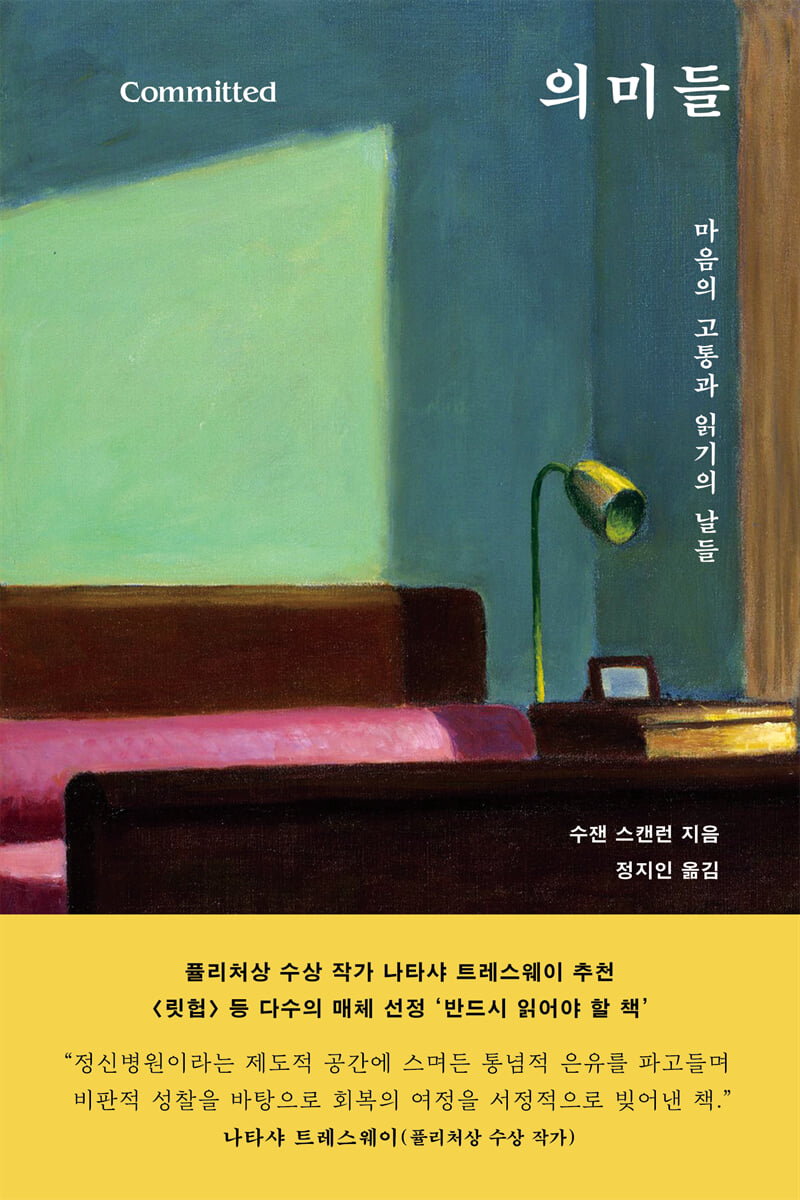
Meanings
 |
Description
Book Introduction
“Exploring the conventional metaphors that permeate the institutional space of a mental hospital
“A lyrical account of the journey of recovery, grounded in critical reflection.” - Natasha Tressway, Pulitzer Prize-winning author
★ Highly recommended by Pulitzer Prize-winning author Natasha Tresway
★ Selected as a "must-read" by numerous media outlets, including Lithub and The New Yorker.
How Reading Reawakened Me
Intersecting my recollections of my time in a mental hospital with my reading of literature
An excellent essay that reclaims the stigma of a 'crazy woman'
A significant achievement in women's literature of our time
Suzanne Scanlan, a writer who has been gaining attention in the United States for her profound reflections on women, psychiatry, reading and writing, and self-care, as well as her excellent literary portrayal of them, has published a new book, "Meanings: Days of Heartache and Reading."
This book is a dazzling essay that encompasses memoir and literary criticism, rewritten by the author by overlapping his own memories of long-term hospitalization in a psychiatric ward and the stigma he felt with his experiences reading literature.
By presenting a collage-like format of quotations, records, reflections, and critiques, it expanded the boundaries between memoir and literary criticism.
The author interweaves her own experiences with the writings of female writers who have delved into the pain of the heart, such as Sylvia Plath, Marguerite Duras, Virginia Woolf, Shulamith Firestone, and Janet Frame, thereby transforming the “language of pain” into the “language of meaning,” and reappropriates the existence of the stigma of being a “mad woman” as a subject of reflection.
Furthermore, based on his own experience, he testifies to “how reading becomes care,” and persuasively shows the process of recovering meaning in life from a place of loss.
“A lyrical account of the journey of recovery, grounded in critical reflection.” - Natasha Tressway, Pulitzer Prize-winning author
★ Highly recommended by Pulitzer Prize-winning author Natasha Tresway
★ Selected as a "must-read" by numerous media outlets, including Lithub and The New Yorker.
How Reading Reawakened Me
Intersecting my recollections of my time in a mental hospital with my reading of literature
An excellent essay that reclaims the stigma of a 'crazy woman'
A significant achievement in women's literature of our time
Suzanne Scanlan, a writer who has been gaining attention in the United States for her profound reflections on women, psychiatry, reading and writing, and self-care, as well as her excellent literary portrayal of them, has published a new book, "Meanings: Days of Heartache and Reading."
This book is a dazzling essay that encompasses memoir and literary criticism, rewritten by the author by overlapping his own memories of long-term hospitalization in a psychiatric ward and the stigma he felt with his experiences reading literature.
By presenting a collage-like format of quotations, records, reflections, and critiques, it expanded the boundaries between memoir and literary criticism.
The author interweaves her own experiences with the writings of female writers who have delved into the pain of the heart, such as Sylvia Plath, Marguerite Duras, Virginia Woolf, Shulamith Firestone, and Janet Frame, thereby transforming the “language of pain” into the “language of meaning,” and reappropriates the existence of the stigma of being a “mad woman” as a subject of reflection.
Furthermore, based on his own experience, he testifies to “how reading becomes care,” and persuasively shows the process of recovering meaning in life from a place of loss.
- You can preview some of the book's contents.
Preview
index
Part 1: Existence, a Moving Target
Go back again
My Insanity and Other Things
Vortex effect
A way of forming
With bags
Duras Space, or Book as Room (I)
At point zero
Escape from the trap
psychoanalyst
Reflections on Women
Sit still
Books as Rooms (II)
Attempts to Theorize About My Illness (I)
Without worries
Trapped in a story
Part 2 I saw the golden number 5
Psychiatric Hospital Architecture (I)
5th floor
Too much
Time passes
Nerve problems, or what can I do?
Psychiatric Hospital Architecture (II)
Tell me who I am
Septimus
Hank, Reflections (I)
Melting
Interlude, 2022
Elina
Hank, Reflections (II)
family therapy
Blossom
cobweb
Grace
Duras today
Then you will never be happy
Leave the couch
Part 3: Mirror City
Attempts to Develop a Theory About My Illness (II)
notebooks
The last days of the long-term hospital ward
We're all gone
Attempts to Develop a Theory About My Illness (III)
Our trustworthy Nadil
Shadow Story
angry women
About Recovery (I)
Homeless Self
incarceration
Q&A
Meetings and positivity
On Recovery (II)
You look very normal
Acknowledgements
References
Go back again
My Insanity and Other Things
Vortex effect
A way of forming
With bags
Duras Space, or Book as Room (I)
At point zero
Escape from the trap
psychoanalyst
Reflections on Women
Sit still
Books as Rooms (II)
Attempts to Theorize About My Illness (I)
Without worries
Trapped in a story
Part 2 I saw the golden number 5
Psychiatric Hospital Architecture (I)
5th floor
Too much
Time passes
Nerve problems, or what can I do?
Psychiatric Hospital Architecture (II)
Tell me who I am
Septimus
Hank, Reflections (I)
Melting
Interlude, 2022
Elina
Hank, Reflections (II)
family therapy
Blossom
cobweb
Grace
Duras today
Then you will never be happy
Leave the couch
Part 3: Mirror City
Attempts to Develop a Theory About My Illness (II)
notebooks
The last days of the long-term hospital ward
We're all gone
Attempts to Develop a Theory About My Illness (III)
Our trustworthy Nadil
Shadow Story
angry women
About Recovery (I)
Homeless Self
incarceration
Q&A
Meetings and positivity
On Recovery (II)
You look very normal
Acknowledgements
References
Detailed image

Into the book
The time I was in the hospital was when my belief in 'recovered memories' was at its peak.
In the early 1990s, a growing number of patients began to report memories of sexual abuse during their childhood.
Doctors encouraged patients to uncover these memories.
I know that many of the women who lived with me in the hospital were sexually abused, horribly bullied, or raped.
I also know that many people have not experienced such a thing.
I don't know who was telling the truth, who was lying, or who was creating memories out of imagination and expectation.
I'm sure we've all made these memories to some degree.
--- p.47
The analyst's indifference felt violent, another blow to his fragile ego.
/ Whatever hysteria meant to that doctor in that room, to that doctor with whom I spoke for twenty minutes, there was no hysteria to me.
I had loneliness.
There was sadness.
But if I had known that, or if I could have said it, if it were that simple, if that were enough, I wouldn't have spent years looking for someone to tell me.
--- p.109
I didn't know that books were about communication.
Even if I had known, it hadn't mattered to me until then.
A book is a way of speaking to someone across time and space.
This book was telling me something about how to live.
Different ways of living.
--- p.184
As a teacher, I am often reminded of how difficult it is to discern even the most obvious connections between literature and life.
No, rather, even though a good reader, a good student, can recognize that connection, feeling that connection is a completely different thing.
Finding that meaning and being able to apply that meaning to your life are two entirely different things.
It's closer to method acting than what we call literary analysis.
For me, it started with emotions.
As Hilton Alls put it, if I can't feel it, I can't write it.
--- p.206
In those days, art was a light.
It showed me that there is space for weeping and longing, and that there is something I can do about living on the edge or just beyond it.
--- p.256
Kristeva wrote about the inexpressible grief of bereavement - the abyss of grief.
That's not a mental illness.
It's not any disease.
If it was a disease, it was more than just a disease.
It was a disease that arose from going through the sorrow of bereavement.
(Omitted) For Kristeva, the grief of bereavement was not something to be overcome.
It was in itself the subject of great art and great literature.
Grief from bereavement is a fundamental and universal human experience.
The grief of bereavement is a word that does not stigmatize the person who is broken by that emotion.
--- p.310
Books showed me a different life, a bigger and more supportive framework, a life-affirming framework.
I wouldn't have expressed it this way at the time, but I know now.
I can know now.
(Omitted) That book was a bulwark that protected me from collapse, from meaninglessness, from the unspeakable sorrow of separation.
--- p.314
The perfect escape becomes a trap.
You will find out very soon.
After escaping, you start acting as if you were escaping.
And once you're playing that role, people will react to you in a way that fits the role you're playing.
That's how you get trapped.
That trap could be your life.
--- p.415
And the grief of bereavement, like madness, does not resolve or reach its peak and then subside.
It's just a matter of learning to live with it and getting used to it or not getting used to it.
What Didion meant by the whirlpool is that the sadness can come back at any time without warning and never be resolved.
It is a part of the existence of a country.
--- p.421
Reading saved me.
It may sound silly, and I feel embarrassed to say it.
You might be accused of being delusional, romantic, or worse.
But we all know that it could be true, and it was true for me.
What if I hadn't gone to that bookstore that night, if I hadn't heard Adrienne Rich read, if I hadn't read Angry Women, if I hadn't read Audre Lorde?
--- p.431
Outsiders.
People who are always or inevitably outside.
People who are shy, socially awkward, easily depressed, occasionally or chronically suicidal, or paralyzed by past events, trauma, loss, or just plain confused.
People who write and rewrite about the past because they want to be understood, and who try to correct it and understand it properly each time.
Writing itself becomes a way of trying to understand the meaning of failure in living, failure to become a normal person.
And you stop wanting to be a normal person.
--- p.448
On campus, I learned that madness has been a pervasive theme throughout literature.
Because there is truth in extinction.
In polite society, even among friends, we need a voice of madness to remind us of all that remains unspoken.
As Susan Sontag wrote about Simone Weil, we need her voice of unreason.
There is truth in madness.
No parent would want their child to be a Beyu, but Beyu was a truth-teller.
For Sontag, sanity could be a compromise, a lie.
--- p.474
In many cases, we find that for many people, a diagnosis can help capture and treat the experience of real suffering.
But there are many ways for us to find solace even within the given state of our existence as human beings.
This is always a bit incomprehensible at some level.
This is why we read books.
This is why I needed other women's stories.
That's also why I want this doctor to know them.
In the early 1990s, a growing number of patients began to report memories of sexual abuse during their childhood.
Doctors encouraged patients to uncover these memories.
I know that many of the women who lived with me in the hospital were sexually abused, horribly bullied, or raped.
I also know that many people have not experienced such a thing.
I don't know who was telling the truth, who was lying, or who was creating memories out of imagination and expectation.
I'm sure we've all made these memories to some degree.
--- p.47
The analyst's indifference felt violent, another blow to his fragile ego.
/ Whatever hysteria meant to that doctor in that room, to that doctor with whom I spoke for twenty minutes, there was no hysteria to me.
I had loneliness.
There was sadness.
But if I had known that, or if I could have said it, if it were that simple, if that were enough, I wouldn't have spent years looking for someone to tell me.
--- p.109
I didn't know that books were about communication.
Even if I had known, it hadn't mattered to me until then.
A book is a way of speaking to someone across time and space.
This book was telling me something about how to live.
Different ways of living.
--- p.184
As a teacher, I am often reminded of how difficult it is to discern even the most obvious connections between literature and life.
No, rather, even though a good reader, a good student, can recognize that connection, feeling that connection is a completely different thing.
Finding that meaning and being able to apply that meaning to your life are two entirely different things.
It's closer to method acting than what we call literary analysis.
For me, it started with emotions.
As Hilton Alls put it, if I can't feel it, I can't write it.
--- p.206
In those days, art was a light.
It showed me that there is space for weeping and longing, and that there is something I can do about living on the edge or just beyond it.
--- p.256
Kristeva wrote about the inexpressible grief of bereavement - the abyss of grief.
That's not a mental illness.
It's not any disease.
If it was a disease, it was more than just a disease.
It was a disease that arose from going through the sorrow of bereavement.
(Omitted) For Kristeva, the grief of bereavement was not something to be overcome.
It was in itself the subject of great art and great literature.
Grief from bereavement is a fundamental and universal human experience.
The grief of bereavement is a word that does not stigmatize the person who is broken by that emotion.
--- p.310
Books showed me a different life, a bigger and more supportive framework, a life-affirming framework.
I wouldn't have expressed it this way at the time, but I know now.
I can know now.
(Omitted) That book was a bulwark that protected me from collapse, from meaninglessness, from the unspeakable sorrow of separation.
--- p.314
The perfect escape becomes a trap.
You will find out very soon.
After escaping, you start acting as if you were escaping.
And once you're playing that role, people will react to you in a way that fits the role you're playing.
That's how you get trapped.
That trap could be your life.
--- p.415
And the grief of bereavement, like madness, does not resolve or reach its peak and then subside.
It's just a matter of learning to live with it and getting used to it or not getting used to it.
What Didion meant by the whirlpool is that the sadness can come back at any time without warning and never be resolved.
It is a part of the existence of a country.
--- p.421
Reading saved me.
It may sound silly, and I feel embarrassed to say it.
You might be accused of being delusional, romantic, or worse.
But we all know that it could be true, and it was true for me.
What if I hadn't gone to that bookstore that night, if I hadn't heard Adrienne Rich read, if I hadn't read Angry Women, if I hadn't read Audre Lorde?
--- p.431
Outsiders.
People who are always or inevitably outside.
People who are shy, socially awkward, easily depressed, occasionally or chronically suicidal, or paralyzed by past events, trauma, loss, or just plain confused.
People who write and rewrite about the past because they want to be understood, and who try to correct it and understand it properly each time.
Writing itself becomes a way of trying to understand the meaning of failure in living, failure to become a normal person.
And you stop wanting to be a normal person.
--- p.448
On campus, I learned that madness has been a pervasive theme throughout literature.
Because there is truth in extinction.
In polite society, even among friends, we need a voice of madness to remind us of all that remains unspoken.
As Susan Sontag wrote about Simone Weil, we need her voice of unreason.
There is truth in madness.
No parent would want their child to be a Beyu, but Beyu was a truth-teller.
For Sontag, sanity could be a compromise, a lie.
--- p.474
In many cases, we find that for many people, a diagnosis can help capture and treat the experience of real suffering.
But there are many ways for us to find solace even within the given state of our existence as human beings.
This is always a bit incomprehensible at some level.
This is why we read books.
This is why I needed other women's stories.
That's also why I want this doctor to know them.
--- pp.501-502
Publisher's Review
“Exploring the conventional metaphors that permeate the institutional space of a mental hospital
“A book that lyrically depicts the journey of recovery based on critical reflection.”
- Natasha Tressway (Pulitzer Prize-winning author)
★ Highly recommended by Pulitzer Prize-winning author Natasha Tresway
★ Selected as a "must-read" by numerous media outlets, including Lithub and The New Yorker.
How Reading Reawakened Me
Intersecting my recollections of my time in a mental hospital with my reading of literature
An excellent essay that reclaims the stigma of a 'crazy woman'
A significant achievement in women's literature of our time
Suzanne Scanlan, a writer who has been gaining attention in the United States for her profound reflections on women, psychiatry, reading and writing, and self-care, as well as her excellent literary portrayal of them, has published a new book, "Meanings: Days of Heartache and Reading."
This book is a dazzling essay that encompasses memoir and literary criticism, rewritten by the author by overlapping his own memories of long-term hospitalization in a psychiatric ward and the stigma he felt with his experiences reading literature.
By presenting a collage-like format of quotations, records, reflections, and critiques, it expanded the boundaries between memoir and literary criticism.
The author interweaves her own experiences with the writings of female writers who have delved into the pain of the heart, such as Sylvia Plath, Marguerite Duras, Virginia Woolf, Shulamith Firestone, and Janet Frame, thereby transforming the “language of pain” into the “language of meaning,” and reappropriates the existence of the stigma of being a “mad woman” as a subject of reflection.
Furthermore, based on his own experience, he testifies to “how reading becomes care,” and persuasively shows the process of recovering meaning in life from a place of loss.
Life entangled with literature, literature entangled with life
Literature was there on the journey to recover from emotional pain.
Literature and madness have intersected and connected in various ways.
Especially in feminist literary criticism, ‘madness’ as a metaphor has already become established as a genre.
There have been countless critiques that have attempted to interpret the sociocultural context that drove mad women to madness in literary works featuring them, or to connect the writings of female writers suffering from nervous breakdowns (or 'hysteria') to their own lives, or to illuminate the existence of 'mad women' as a literary tradition.
"Meanings: Days of Pain and Reading" attempts to reach the place of literature that sustains life by adding a meaningful axis to this chain: "a reader who delves into madness in literature."
The author keenly explores the emotions that made him vulnerable—anxiety, depression, loss, alienation—and shows how these emotions, through the prism of literature, return to our lives, and how the light that returns then functions as a force that empowers us to once again dedicate ourselves to life.
This book is a text with many layers and textures.
It is a literary critique that aims to re-appropriate the "crazy women" in literary history, a reportage exposing the problems of the mental health system from the perspective of a long-term hospitalized patient, and an intimate memoir in which the author records her "crazy days."
However, the layered intentions do not scatter into fragments, but ultimately form one large forest, firmly establishing the relationship between life and literature.
While reading this book, we experience the entire mental health system while empathizing with the patient's situation. This process becomes a journey of self-discovery in the most literary way, and the process of recovery from deep depression becomes the most powerful motivation for reading.
As we approach the sadness that clings to life more clearly through literature, we also have the mystical experience of literature once again becoming a mirror reflecting art and our lives.
At the end of this journey, the author's story is revealed in a warm light: it is a lament and consolation for the loss we all inevitably face at some point, and that this is the essence of literature.
Three Years in a Mental Hospital: Reflections on Those Sick Years
Recording the narrative of a life that cannot be reduced to a diagnosis
Born to Irish immigrant parents, a devout Catholic, and raised in a white suburb 80 kilometers from Chicago, the author moved to New York City at the age of twenty to attend college.
I couldn't eat anything other than microwaved potatoes, and going days and weeks without speaking to anyone became routine.
The author, who was struggling at the bottom of his heart, eventually climbed the stone stairs of an old building called the New York State Psychiatric Institute and was admitted to the ward on the fifth floor.
The period when the author was hospitalized in a psychiatric ward was when the concept of 'recovered memory' was gaining attention as a methodology in psychiatry.
The author repeatedly received requests from doctors asking, "What else happened? Think about it slowly."
The author and the patients diligently participated in 'memory making' to meet the expectations of such doctors.
And at the end of that consultation, I was prescribed medications that were said to be aimed at correcting the 'chemical imbalance'.
However, the secrets that patients confide in their doctors cannot be the key to unlocking all the suffering they experience.
Just as mental health cannot be solved by treating it as an isolated phenomenon, a problem of 'chemical imbalance',
The author was diagnosed with dysthymia, chronic depression, and bipolar disorder in a psychiatric ward and was prescribed medication related to these conditions, but did not see any effect.
Over the course of three years, the author became more accustomed to his morbid state and “became increasingly adept at living as a psychiatric patient.” He left the hospital because the reduction in welfare services for the mentally ill made it difficult to run a long-term inpatient ward.
In the literary space created by 'crazy women'
Finding my story that will become a stepping stone to recovery
The days spent in the somewhat oppressive or ineffective psychiatric ward were, however, also a time for the author to look into and study his own madness.
The stories patients tell, the stories doctors want patients to tell, the doctor's consultations held in silence so quiet it feels like white noise, women who don't smile, women who smile too much, self-destructive behaviors that involve all sorts of creative methods, patients who commonly respond to the word "emptiness."
The author stubbornly resists attempts to reduce his suffering to 'memories of an abusive childhood', and the fact that his existence could be reduced to the diagnosis of 'depressed patient'.
The author spent three years in a psychiatric ward, and lived with the scars of it for several more years.
In those days, it was literature that filled the author's emptiness.
Above all, these were literary works written by 'crazy women' who had lived messy lives.
Literature as a space for lamentation and longing created on the edge of collapse.
In that space, madness was not something to be resolved, but a passage to “the truth about everything that baffles and pains me.”
And as she builds a spiritual solidarity with the "mad women" of literary history, the author finally gains a clue to understanding her own suffering in a larger context.
The loss that the author describes as “formless sadness” or, to borrow John Didion’s phrase, “a whirlpool of grief” is reduced in medical narratives to the official diagnosis of “depression” or something similar.
However, these feelings, which cannot be named and therefore seem to have no way of being resolved, create an explosive resonance when they meet literature.
The author describes it as a process of “reading with hunger, searching for something, for the bottom.”
It was a process that did not allow even the slightest distance, so much so that it could be described as “a swallowing.”
In this way, the author “devoured” Marguerite Duras, Sylvia Plath, Virginia Woolf, Audre Lorde, Julia Kristeva, and Janet Frame.
“If you don’t tell your story, they’ll win.”
The miracle that occurs when a fragile ego begins to create its own narrative through literature.
The characters of Marguerite Duras, who yearn for desire without fear, sometimes even at the risk of death; the self-destructive ego of Sylvia Plath; the madwoman of Charlotte Perkins Gilman who resists learned helplessness with madness; Audre Lorde, who said, “Your silence will not protect you,” and other works by female writers who lived with madness and achieved achievements that cannot be reduced to its symptoms, become the materials that weave her language across the author’s life.
It is “a narrative framework to contain my grief over losing my mother,” a way to transform madness into something else, “something you can change its form,” and ultimately a process of finding my own way through the trappings of seemingly certain diagnoses.
"Meanings" is the desperate record of an explorer determined to discover the "meanings" he will live with among the countless stories we encounter.
As the author nears discharge, a nurse advises him, “You should tell your own story.”
Between the desperate sentences that sound like, “If you don’t, they’ll tell your story,” and “If I don’t tell this story, they’ll win,” readers are drawn into the subversive narrative of a vulnerable self.
Getting used to, or not getting used to, the sadness or madness that “comes back at any time, without warning, and never goes away,” rather than victory or salvation.
Embracing it as a part of our existence.
There are such struggles throughout 『Meanings』.
Any reader will long for the intense reading experience that the author of this book has created, the “blurred boundary between self and text.”
And 『Meanings』, as part of the work of making literature read in this way into reality again, presents literature to us as something “much more real than any diagnosis.”
“A book that lyrically depicts the journey of recovery based on critical reflection.”
- Natasha Tressway (Pulitzer Prize-winning author)
★ Highly recommended by Pulitzer Prize-winning author Natasha Tresway
★ Selected as a "must-read" by numerous media outlets, including Lithub and The New Yorker.
How Reading Reawakened Me
Intersecting my recollections of my time in a mental hospital with my reading of literature
An excellent essay that reclaims the stigma of a 'crazy woman'
A significant achievement in women's literature of our time
Suzanne Scanlan, a writer who has been gaining attention in the United States for her profound reflections on women, psychiatry, reading and writing, and self-care, as well as her excellent literary portrayal of them, has published a new book, "Meanings: Days of Heartache and Reading."
This book is a dazzling essay that encompasses memoir and literary criticism, rewritten by the author by overlapping his own memories of long-term hospitalization in a psychiatric ward and the stigma he felt with his experiences reading literature.
By presenting a collage-like format of quotations, records, reflections, and critiques, it expanded the boundaries between memoir and literary criticism.
The author interweaves her own experiences with the writings of female writers who have delved into the pain of the heart, such as Sylvia Plath, Marguerite Duras, Virginia Woolf, Shulamith Firestone, and Janet Frame, thereby transforming the “language of pain” into the “language of meaning,” and reappropriates the existence of the stigma of being a “mad woman” as a subject of reflection.
Furthermore, based on his own experience, he testifies to “how reading becomes care,” and persuasively shows the process of recovering meaning in life from a place of loss.
Life entangled with literature, literature entangled with life
Literature was there on the journey to recover from emotional pain.
Literature and madness have intersected and connected in various ways.
Especially in feminist literary criticism, ‘madness’ as a metaphor has already become established as a genre.
There have been countless critiques that have attempted to interpret the sociocultural context that drove mad women to madness in literary works featuring them, or to connect the writings of female writers suffering from nervous breakdowns (or 'hysteria') to their own lives, or to illuminate the existence of 'mad women' as a literary tradition.
"Meanings: Days of Pain and Reading" attempts to reach the place of literature that sustains life by adding a meaningful axis to this chain: "a reader who delves into madness in literature."
The author keenly explores the emotions that made him vulnerable—anxiety, depression, loss, alienation—and shows how these emotions, through the prism of literature, return to our lives, and how the light that returns then functions as a force that empowers us to once again dedicate ourselves to life.
This book is a text with many layers and textures.
It is a literary critique that aims to re-appropriate the "crazy women" in literary history, a reportage exposing the problems of the mental health system from the perspective of a long-term hospitalized patient, and an intimate memoir in which the author records her "crazy days."
However, the layered intentions do not scatter into fragments, but ultimately form one large forest, firmly establishing the relationship between life and literature.
While reading this book, we experience the entire mental health system while empathizing with the patient's situation. This process becomes a journey of self-discovery in the most literary way, and the process of recovery from deep depression becomes the most powerful motivation for reading.
As we approach the sadness that clings to life more clearly through literature, we also have the mystical experience of literature once again becoming a mirror reflecting art and our lives.
At the end of this journey, the author's story is revealed in a warm light: it is a lament and consolation for the loss we all inevitably face at some point, and that this is the essence of literature.
Three Years in a Mental Hospital: Reflections on Those Sick Years
Recording the narrative of a life that cannot be reduced to a diagnosis
Born to Irish immigrant parents, a devout Catholic, and raised in a white suburb 80 kilometers from Chicago, the author moved to New York City at the age of twenty to attend college.
I couldn't eat anything other than microwaved potatoes, and going days and weeks without speaking to anyone became routine.
The author, who was struggling at the bottom of his heart, eventually climbed the stone stairs of an old building called the New York State Psychiatric Institute and was admitted to the ward on the fifth floor.
The period when the author was hospitalized in a psychiatric ward was when the concept of 'recovered memory' was gaining attention as a methodology in psychiatry.
The author repeatedly received requests from doctors asking, "What else happened? Think about it slowly."
The author and the patients diligently participated in 'memory making' to meet the expectations of such doctors.
And at the end of that consultation, I was prescribed medications that were said to be aimed at correcting the 'chemical imbalance'.
However, the secrets that patients confide in their doctors cannot be the key to unlocking all the suffering they experience.
Just as mental health cannot be solved by treating it as an isolated phenomenon, a problem of 'chemical imbalance',
The author was diagnosed with dysthymia, chronic depression, and bipolar disorder in a psychiatric ward and was prescribed medication related to these conditions, but did not see any effect.
Over the course of three years, the author became more accustomed to his morbid state and “became increasingly adept at living as a psychiatric patient.” He left the hospital because the reduction in welfare services for the mentally ill made it difficult to run a long-term inpatient ward.
In the literary space created by 'crazy women'
Finding my story that will become a stepping stone to recovery
The days spent in the somewhat oppressive or ineffective psychiatric ward were, however, also a time for the author to look into and study his own madness.
The stories patients tell, the stories doctors want patients to tell, the doctor's consultations held in silence so quiet it feels like white noise, women who don't smile, women who smile too much, self-destructive behaviors that involve all sorts of creative methods, patients who commonly respond to the word "emptiness."
The author stubbornly resists attempts to reduce his suffering to 'memories of an abusive childhood', and the fact that his existence could be reduced to the diagnosis of 'depressed patient'.
The author spent three years in a psychiatric ward, and lived with the scars of it for several more years.
In those days, it was literature that filled the author's emptiness.
Above all, these were literary works written by 'crazy women' who had lived messy lives.
Literature as a space for lamentation and longing created on the edge of collapse.
In that space, madness was not something to be resolved, but a passage to “the truth about everything that baffles and pains me.”
And as she builds a spiritual solidarity with the "mad women" of literary history, the author finally gains a clue to understanding her own suffering in a larger context.
The loss that the author describes as “formless sadness” or, to borrow John Didion’s phrase, “a whirlpool of grief” is reduced in medical narratives to the official diagnosis of “depression” or something similar.
However, these feelings, which cannot be named and therefore seem to have no way of being resolved, create an explosive resonance when they meet literature.
The author describes it as a process of “reading with hunger, searching for something, for the bottom.”
It was a process that did not allow even the slightest distance, so much so that it could be described as “a swallowing.”
In this way, the author “devoured” Marguerite Duras, Sylvia Plath, Virginia Woolf, Audre Lorde, Julia Kristeva, and Janet Frame.
“If you don’t tell your story, they’ll win.”
The miracle that occurs when a fragile ego begins to create its own narrative through literature.
The characters of Marguerite Duras, who yearn for desire without fear, sometimes even at the risk of death; the self-destructive ego of Sylvia Plath; the madwoman of Charlotte Perkins Gilman who resists learned helplessness with madness; Audre Lorde, who said, “Your silence will not protect you,” and other works by female writers who lived with madness and achieved achievements that cannot be reduced to its symptoms, become the materials that weave her language across the author’s life.
It is “a narrative framework to contain my grief over losing my mother,” a way to transform madness into something else, “something you can change its form,” and ultimately a process of finding my own way through the trappings of seemingly certain diagnoses.
"Meanings" is the desperate record of an explorer determined to discover the "meanings" he will live with among the countless stories we encounter.
As the author nears discharge, a nurse advises him, “You should tell your own story.”
Between the desperate sentences that sound like, “If you don’t, they’ll tell your story,” and “If I don’t tell this story, they’ll win,” readers are drawn into the subversive narrative of a vulnerable self.
Getting used to, or not getting used to, the sadness or madness that “comes back at any time, without warning, and never goes away,” rather than victory or salvation.
Embracing it as a part of our existence.
There are such struggles throughout 『Meanings』.
Any reader will long for the intense reading experience that the author of this book has created, the “blurred boundary between self and text.”
And 『Meanings』, as part of the work of making literature read in this way into reality again, presents literature to us as something “much more real than any diagnosis.”
GOODS SPECIFICS
- Date of issue: October 27, 2025
- Page count, weight, size: 512 pages | 634g | 140*210*24mm
- ISBN13: 9791191247589
You may also like
카테고리
korean


korean

![GQ KOREA Mark (Monthly): December [2025]](http://librairie.coreenne.fr/cdn/shop/files/8ef265dbbfbf186523ed75ba7319009d.jpg?v=1765340328&width=3840)


