

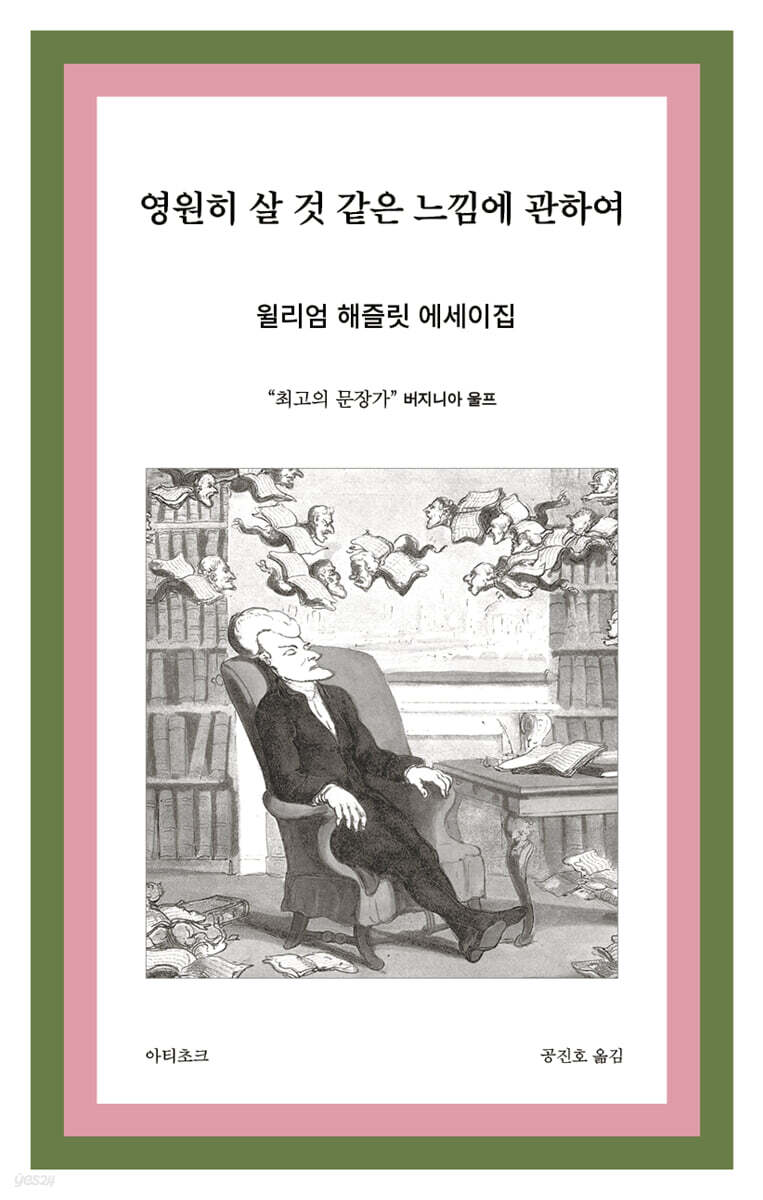
About feeling like you'll live forever
 |
Description
Book Introduction
"On the Feeling of Living Forever" is William Hazlitt's third collection of essays, following "On the Pleasure of Disgust" and "Why Distant Things Look Good," both of which were first published in Korea by Artichoke.
Hazlitt is considered one of the most influential essayists in English literature.
Behind his direct and high-sounding prose, he breathes the strong political convictions of a radical republican, his intellectual vitality, and his unhesitating critique of human nature.
For Hazlitt, the essay was not simply a tool for reflection, but also a weapon of resistance, influencing later political essayists such as George Orwell and Christopher Hitchens.
This anthology, subtitled “The Essence of Hazlitt’s Essays: A Man of Resistance,” contains eight works that showcase Hazlitt’s true colors.
From the title piece, "The Cliche Critic," to "The Sickbed," his essays are unpretentious, muscular, and at times, tinged with a lonely sentiment.
Hazlitt does not write to please his readers, but to shake them and awaken them.
These eight essays, “vivid, refreshing, and powerful,” hold a stark mirror to our lives today, prompting readers to think deeply and embrace the complexities of human nature.
Hazlitt is considered one of the most influential essayists in English literature.
Behind his direct and high-sounding prose, he breathes the strong political convictions of a radical republican, his intellectual vitality, and his unhesitating critique of human nature.
For Hazlitt, the essay was not simply a tool for reflection, but also a weapon of resistance, influencing later political essayists such as George Orwell and Christopher Hitchens.
This anthology, subtitled “The Essence of Hazlitt’s Essays: A Man of Resistance,” contains eight works that showcase Hazlitt’s true colors.
From the title piece, "The Cliche Critic," to "The Sickbed," his essays are unpretentious, muscular, and at times, tinged with a lonely sentiment.
Hazlitt does not write to please his readers, but to shake them and awaken them.
These eight essays, “vivid, refreshing, and powerful,” hold a stark mirror to our lives today, prompting readers to think deeply and embrace the complexities of human nature.
- You can preview some of the book's contents.
Preview
index
Love as if it will last forever, dream as if it will last forever
On the Trite Critic
The Two Faces of a Gentle Man
The Mask of Religion
Knowing personality means
Living without money is
Indian acrobats
About feeling like you'll live forever
Bedside scenery
annual report
On the Trite Critic
The Two Faces of a Gentle Man
The Mask of Religion
Knowing personality means
Living without money is
Indian acrobats
About feeling like you'll live forever
Bedside scenery
annual report
Into the book
Trying to convince him to give up his current fad is like trying to wear clothes backwards.
The 'best people' he always talks about are actually people who live on their own property and live according to the thoughts of others.
The 'worldly opinion' he speaks of is actually just the words exchanged and heard within the small groups he frequents.
--- From "On the Trite Critic"
Gentleness, or temper as it is commonly regarded, is the most selfish of all virtues.
Nine times out of ten, it's just a lazy nature.
[Omitted] Gentleness is nothing but humanitarianism that costs nothing.
A gentle person has never sacrificed himself for any cause, whether religious or political.
--- From "The Two Faces of a Gentle Man"
First impressions are often the most truthful.
We often forget our first impressions because of plausible words or actions, and only realize it after paying the price.
A person's face is the product of many years, and his entire life is engraved in his expression.
No, it is a trace directly created by nature and is not easily erased.
--- From "Knowing Personality"
Poverty is the touchstone of truth and the test of character.
[Omitted] A poet once said that the greatest inconvenience poverty brings is that it makes people look ridiculous, and that is an accurate observation.
Poverty not only brings humiliation, but also reveals the true colors of those around us.
What hurts more than poverty itself is how you are treated when you become poor.
--- From "Living Without Money"
If an Indian acrobat were to playfully perform a trick where he throws three knives into the air and makes them float like crocus petals, he would cut his fingers.
On the other hand, I don't get cut on my fingers even if I write poor sentences.
The sense of writing and style is much more ambiguous than a sharp tool.
Even if you make a mistake, there is no blood.
--- From "The Indian Acrobat"
But they don't know.
That one day we will fall behind in the competition, grow old, and eventually be thrown into the grave.
Youth does not imagine the future.
No, I can't imagine.
Youth lives in the anticipation of eternity, and this anticipation is the spark that keeps them alive.
Youth is immortal.
At least we believe so.
And in those times, that belief determines the very way we live.
The 'best people' he always talks about are actually people who live on their own property and live according to the thoughts of others.
The 'worldly opinion' he speaks of is actually just the words exchanged and heard within the small groups he frequents.
--- From "On the Trite Critic"
Gentleness, or temper as it is commonly regarded, is the most selfish of all virtues.
Nine times out of ten, it's just a lazy nature.
[Omitted] Gentleness is nothing but humanitarianism that costs nothing.
A gentle person has never sacrificed himself for any cause, whether religious or political.
--- From "The Two Faces of a Gentle Man"
First impressions are often the most truthful.
We often forget our first impressions because of plausible words or actions, and only realize it after paying the price.
A person's face is the product of many years, and his entire life is engraved in his expression.
No, it is a trace directly created by nature and is not easily erased.
--- From "Knowing Personality"
Poverty is the touchstone of truth and the test of character.
[Omitted] A poet once said that the greatest inconvenience poverty brings is that it makes people look ridiculous, and that is an accurate observation.
Poverty not only brings humiliation, but also reveals the true colors of those around us.
What hurts more than poverty itself is how you are treated when you become poor.
--- From "Living Without Money"
If an Indian acrobat were to playfully perform a trick where he throws three knives into the air and makes them float like crocus petals, he would cut his fingers.
On the other hand, I don't get cut on my fingers even if I write poor sentences.
The sense of writing and style is much more ambiguous than a sharp tool.
Even if you make a mistake, there is no blood.
--- From "The Indian Acrobat"
But they don't know.
That one day we will fall behind in the competition, grow old, and eventually be thrown into the grave.
Youth does not imagine the future.
No, I can't imagine.
Youth lives in the anticipation of eternity, and this anticipation is the spark that keeps them alive.
Youth is immortal.
At least we believe so.
And in those times, that belief determines the very way we live.
--- From "On the Feeling of Living Forever"
Publisher's Review
The Essence of William Hazlitt's Essays, Following "On the Pleasure of Disgust"
Hazlitt does not write to please his readers, but to shake them and awaken them.
The first Korean translation of "On the Feeling of Living Forever" is William Hazlitt's third collection of essays, following "On the Pleasure of Disgust" and "Why Distant Things Look Good."
Hazlitt is considered one of the most influential essayists in English literature.
He created his own artistic world in the form of 'essays' rather than poetry or novels.
Beneath Hazlitt's direct and dignified prose, a radical republican's strong political convictions, intellectual vitality, and unhesitating critique of human nature live.
For him, the essay was not simply a tool for reflection, but also a weapon of resistance.
Hazlitt, who valued the role of intellectuals and writing against power, still delivers a powerful message even today, in a world rife with authoritarianism and hatred.
“Hazlitt was not the kind of writer whose attitude was vague, who lingered in the fog and met his death in his own insignificance.
His essays are undeniably Hazlitt himself.” - Virginia Woolf
This anthology contains eight works that showcase the true face of essayist Hazlitt.
His sentences are not pretentious, but are solid like muscles, yet sometimes have a lonely tone.
Hazlitt does not write to please his readers, but to shake them and awaken them.
The title piece, "On the Feeling of Living Forever," shows the brilliance of youth and the illusions behind it, while "Knowing Character" shows how easily we misjudge others.
"Living Without Money" points out the wounds that poverty leaves on human dignity, and "The Mask of Religion" sharply criticizes the falsehoods and self-deception hidden behind the name of faith.
In "On the Cliche Critic," he dissects the landscape of superficial language that spreads in the name of criticism; in "The Indian Acrobat," he reflects on the limits of human ability and expression; and in "The Sickbed," a quiet elegy for pain and loneliness, he captures the quiet insight that comes when body and mind break down.
Unlike the Romantic writers of his time who preferred flowery language, Hazlitt used a direct yet elegant style.
Hazlitt weaves personal reflections and philosophical explorations in a conversational tone, employs literary devices not as mere decoration but as tools to reinforce logic, and harmoniously combines anecdote, argument, and analysis to create a writing style that is both intellectual and emotional.
In this respect, Hazlitt's influence can be found in the writings of political essayists such as George Orwell and Christopher Hitchens, as well as Virginia Woolf.
Hazlitt's essays challenge readers to think deeply and embrace the complexities of human nature.
Hazlitt's essay is a mirror that pierces our lives today.
A master of English essays who captured human nature and the pulse of society more accurately than anyone else.
Hazlitt's writing was a bridge between the reason of the Enlightenment and the emotion of Romanticism, and his prose was sometimes as beautiful as poetry and at other times as sharp as philosophy.
He was also emotional yet cool-headed, morally minded yet wary of hypocrisy, and a solitary thinker yet able to sense the pulse of society more accurately than anyone else.
Hazlitt's writings are not old philosophy, but a mirror that pierces our lives today.
"On the Feeling of Living Forever" challenges conventional wisdom, exposes hypocrisy, and confronts human contradictions, fully demonstrating Hazlitt's rejection of simplistic interpretations.
For readers new to Hazlitt, this anthology will serve as an introduction to his captivating voice, while for those already familiar with him, it will remind them why Hazlitt remains a must-read.
Hazlitt does not write to please his readers, but to shake them and awaken them.
The first Korean translation of "On the Feeling of Living Forever" is William Hazlitt's third collection of essays, following "On the Pleasure of Disgust" and "Why Distant Things Look Good."
Hazlitt is considered one of the most influential essayists in English literature.
He created his own artistic world in the form of 'essays' rather than poetry or novels.
Beneath Hazlitt's direct and dignified prose, a radical republican's strong political convictions, intellectual vitality, and unhesitating critique of human nature live.
For him, the essay was not simply a tool for reflection, but also a weapon of resistance.
Hazlitt, who valued the role of intellectuals and writing against power, still delivers a powerful message even today, in a world rife with authoritarianism and hatred.
“Hazlitt was not the kind of writer whose attitude was vague, who lingered in the fog and met his death in his own insignificance.
His essays are undeniably Hazlitt himself.” - Virginia Woolf
This anthology contains eight works that showcase the true face of essayist Hazlitt.
His sentences are not pretentious, but are solid like muscles, yet sometimes have a lonely tone.
Hazlitt does not write to please his readers, but to shake them and awaken them.
The title piece, "On the Feeling of Living Forever," shows the brilliance of youth and the illusions behind it, while "Knowing Character" shows how easily we misjudge others.
"Living Without Money" points out the wounds that poverty leaves on human dignity, and "The Mask of Religion" sharply criticizes the falsehoods and self-deception hidden behind the name of faith.
In "On the Cliche Critic," he dissects the landscape of superficial language that spreads in the name of criticism; in "The Indian Acrobat," he reflects on the limits of human ability and expression; and in "The Sickbed," a quiet elegy for pain and loneliness, he captures the quiet insight that comes when body and mind break down.
Unlike the Romantic writers of his time who preferred flowery language, Hazlitt used a direct yet elegant style.
Hazlitt weaves personal reflections and philosophical explorations in a conversational tone, employs literary devices not as mere decoration but as tools to reinforce logic, and harmoniously combines anecdote, argument, and analysis to create a writing style that is both intellectual and emotional.
In this respect, Hazlitt's influence can be found in the writings of political essayists such as George Orwell and Christopher Hitchens, as well as Virginia Woolf.
Hazlitt's essays challenge readers to think deeply and embrace the complexities of human nature.
Hazlitt's essay is a mirror that pierces our lives today.
A master of English essays who captured human nature and the pulse of society more accurately than anyone else.
Hazlitt's writing was a bridge between the reason of the Enlightenment and the emotion of Romanticism, and his prose was sometimes as beautiful as poetry and at other times as sharp as philosophy.
He was also emotional yet cool-headed, morally minded yet wary of hypocrisy, and a solitary thinker yet able to sense the pulse of society more accurately than anyone else.
Hazlitt's writings are not old philosophy, but a mirror that pierces our lives today.
"On the Feeling of Living Forever" challenges conventional wisdom, exposes hypocrisy, and confronts human contradictions, fully demonstrating Hazlitt's rejection of simplistic interpretations.
For readers new to Hazlitt, this anthology will serve as an introduction to his captivating voice, while for those already familiar with him, it will remind them why Hazlitt remains a must-read.
GOODS SPECIFICS
- Date of issue: October 20, 2025
- Page count, weight, size: 216 pages | 140*220*15mm
- ISBN13: 9791186643235
- ISBN10: 1186643234
You may also like
카테고리
korean


korean

![GQ KOREA Mark (Monthly): December [2025]](http://librairie.coreenne.fr/cdn/shop/files/8ef265dbbfbf186523ed75ba7319009d.jpg?v=1765340328&width=3840)


