

On the Pleasure of Disgust
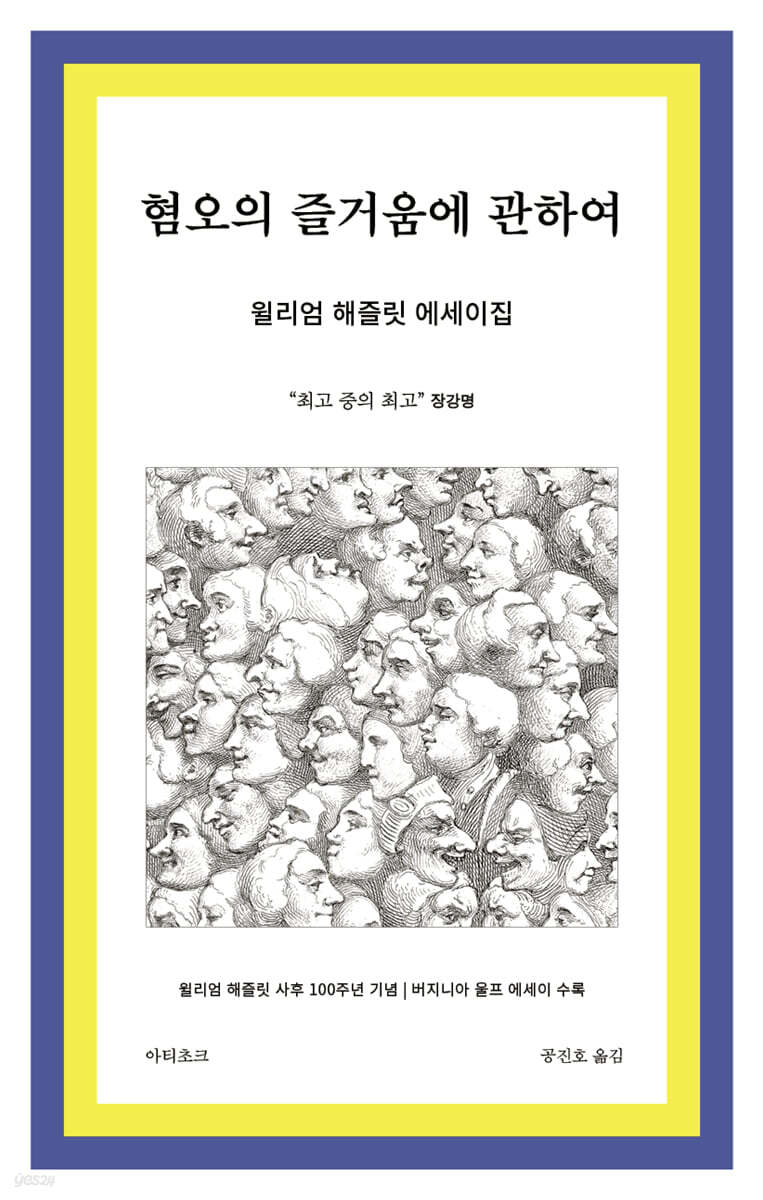 |
Description
Book Introduction
“We cannot write like Hazlitt today.” On the Pleasure of Disgust is the first collection of William Hazlitt’s essays to be introduced in Korea.
Hazlitt, a leading figure in Romanticism, is one of the greatest essayists in the English-speaking world, alongside George Orwell.
He was also the one who brought Shakespeare to the top ranks as a literary critic and was also renowned as a journalist.
Hazlitt, who dreamed of a republic, was a politically radical idealist, but he remained in the minority his entire life, criticizing conservatism and championing the creeds of liberty, brotherhood, and revolution, to the point that his only flaw was that he “did not become an instrument of government.”
The tombstone of the "radical" writer Hazlitt, who died in 1830, was destroyed 40 years later in 1870 for fear of causing social conflict, and in 1930 Virginia Woolf published a lengthy essay called "On Hazlitt" in which she sought to restore Hazlitt's status as a "first-rate intellectual" and "the greatest prose writer of his time."
Introducing Woolf's Hazlitt theory, "On the Pleasure of Disgust" contains a selection of Hazlitt's major essays on human nature and behavior, including the title work, from the twenty-volume Hazlitt collection.
Hazlitt was arguably the first modern man.
Hazlitt, who observed, analyzed, and described Romanticism, that is, the beginning of modern times, delved into the unchanging nature and behavior of human beings and revealed its true nature to us who live in the very extension of modern times.
"On the Pleasures of Disgust" is a book with surprising timeliness and universal appeal, and its penmanship and sharp wit will quench the thirst of even the most parched readers with its "vivid, refreshing, and powerful" writing style.
Hazlitt, a leading figure in Romanticism, is one of the greatest essayists in the English-speaking world, alongside George Orwell.
He was also the one who brought Shakespeare to the top ranks as a literary critic and was also renowned as a journalist.
Hazlitt, who dreamed of a republic, was a politically radical idealist, but he remained in the minority his entire life, criticizing conservatism and championing the creeds of liberty, brotherhood, and revolution, to the point that his only flaw was that he “did not become an instrument of government.”
The tombstone of the "radical" writer Hazlitt, who died in 1830, was destroyed 40 years later in 1870 for fear of causing social conflict, and in 1930 Virginia Woolf published a lengthy essay called "On Hazlitt" in which she sought to restore Hazlitt's status as a "first-rate intellectual" and "the greatest prose writer of his time."
Introducing Woolf's Hazlitt theory, "On the Pleasure of Disgust" contains a selection of Hazlitt's major essays on human nature and behavior, including the title work, from the twenty-volume Hazlitt collection.
Hazlitt was arguably the first modern man.
Hazlitt, who observed, analyzed, and described Romanticism, that is, the beginning of modern times, delved into the unchanging nature and behavior of human beings and revealed its true nature to us who live in the very extension of modern times.
"On the Pleasures of Disgust" is a book with surprising timeliness and universal appeal, and its penmanship and sharp wit will quench the thirst of even the most parched readers with its "vivid, refreshing, and powerful" writing style.
- You can preview some of the book's contents.
Preview
index
Recommendation: Why I'm Passionate About Hazlitt | Jang Kang-myeong
Preface by William Hazlitt | Virginia Woolf
On the Pleasure of Disgust
On the fear of death
About jealousy
About people who are annoying
On the ignorance of scholars
bare-knuckle boxing
Translator's Note What more needs to be said about reading Hazlitt?
Chronology of William Hazlitt
Preface by William Hazlitt | Virginia Woolf
On the Pleasure of Disgust
On the fear of death
About jealousy
About people who are annoying
On the ignorance of scholars
bare-knuckle boxing
Translator's Note What more needs to be said about reading Hazlitt?
Chronology of William Hazlitt
Into the book
If there were nothing to hate, it would seem that even the source of thought and action would be lost.
If we don't continue to stir up trouble with our squeaky interests and unruly passions, life will become stagnant.
Everyone finds newspaper articles about accidents and crimes to be the best gossip.
When a fire breaks out, the whole village rushes to the scene to watch.
[Omitted] Emotions are more about passion and understanding than about one another.
As Burke says, if a public execution were to take place on a side street, even the theaters performing would be empty.
When a strange dog, a fool, or a crazy woman is seen, the whole village attacks and harasses them.
Social problems are essentially public interests.
--- From "On the Pleasure of Disgust"
We refuse to be robbed of the present in any way and to have the room where it once was left empty.
We resist death vehemently and “suffer the misfortune of living long” because of the pain of separation, the pain of letting go of something we held dear, the pain of breaking a strong bond, and the pain of not being able to achieve our heart’s desires. [Omitted] The most reasonable way to eliminate the excessive fear of death is to give life appropriate value.
If we are merely trying to stay on the stage of life to satisfy our uncontrollable feelings and unbearable passions, we had better leave immediately.
--- From "On the Fear of Death"
If so, jealousy has something to do with a sense of justice.
Jealousy is a defense against deception and falsehood.
We don't readily surrender our hidden self-worth to those who make pretentious and unreasonable demands, but when someone worthy of a legitimate reputation appears, we pay tribute and even take pride in recognizing someone of such value and qualifications ourselves.
This is one of the reasons why we are not jealous of dead people.
--- From "On Jealousy"
A simple scholar who only knows books will inevitably be ignorant of books as well.
"A book doesn't teach you how to use it." How can you know a book if you don't know its subject? A knowledgeable scholar is only knowledgeable about a book if it builds on another book (which in turn builds on another book).
He parrots the books of those who have already parroted them.
[Omitted] We must not forget that the least brilliant of modern politicians was the brightest student at Eton.
If we don't continue to stir up trouble with our squeaky interests and unruly passions, life will become stagnant.
Everyone finds newspaper articles about accidents and crimes to be the best gossip.
When a fire breaks out, the whole village rushes to the scene to watch.
[Omitted] Emotions are more about passion and understanding than about one another.
As Burke says, if a public execution were to take place on a side street, even the theaters performing would be empty.
When a strange dog, a fool, or a crazy woman is seen, the whole village attacks and harasses them.
Social problems are essentially public interests.
--- From "On the Pleasure of Disgust"
We refuse to be robbed of the present in any way and to have the room where it once was left empty.
We resist death vehemently and “suffer the misfortune of living long” because of the pain of separation, the pain of letting go of something we held dear, the pain of breaking a strong bond, and the pain of not being able to achieve our heart’s desires. [Omitted] The most reasonable way to eliminate the excessive fear of death is to give life appropriate value.
If we are merely trying to stay on the stage of life to satisfy our uncontrollable feelings and unbearable passions, we had better leave immediately.
--- From "On the Fear of Death"
If so, jealousy has something to do with a sense of justice.
Jealousy is a defense against deception and falsehood.
We don't readily surrender our hidden self-worth to those who make pretentious and unreasonable demands, but when someone worthy of a legitimate reputation appears, we pay tribute and even take pride in recognizing someone of such value and qualifications ourselves.
This is one of the reasons why we are not jealous of dead people.
--- From "On Jealousy"
A simple scholar who only knows books will inevitably be ignorant of books as well.
"A book doesn't teach you how to use it." How can you know a book if you don't know its subject? A knowledgeable scholar is only knowledgeable about a book if it builds on another book (which in turn builds on another book).
He parrots the books of those who have already parroted them.
[Omitted] We must not forget that the least brilliant of modern politicians was the brightest student at Eton.
--- From "On the Ignorance of Scholars"
Publisher's Review
★ Jang Gang-myeong: "Recommended for those who need high-intensity wisdom and wit."
★ Virginia Woolf: "The strongest and most fearless writer of her time."
★ Terry Eagleton: "The Radical Power of the Friction Between Moral Indictment and Biting Irony"
He was there before George Orwell!
William Hazlitt, the English-speaking world's greatest essayist, first published in Korea
On the Pleasure of Disgust is a collection of William Hazlitt's essays being introduced for the first time in Korea.
Hazlitt, a leading figure in Romanticism, is one of the greatest essayists in the English-speaking world, alongside George Orwell.
He was the one who brought Shakespeare to the forefront of theatre criticism and was also renowned as a journalist.
Modern art, theater, and literary criticism, like political journalism, have their roots in Hazlitt.
Hazlitt was a politically radical idealist, a lifelong critic of conservatism as a minority group whose only flaw was that he “did not become an instrument of government,” and he never gave up his fervent desire for a republic of popular sovereignty until his death.
For this reason, the tombstone of the 'radical' writer Hazlitt, who died in 1830, was vandalized in 1870, 40 years later, for fear that it might cause social conflict.
In 1930, Virginia Woolf published a lengthy essay titled "On Hazlitt," attempting to restore Hazlitt's status as a "first-rate intellectual" and "the greatest prose writer of his time."
“It’s painful but fun.
“How strange are human beings!”
The power of sharp and incisive sentences that delve into human nature and behavior.
Virginia Woolf's "On the Pleasure of Disgust," introduced as "Hazlitt's Theory," contains a selection of "poignant, searching, and penetrating" major essays on human nature and behavior, including the title work, from the twenty-volume Hazlitt collection.
As an essayist, Hazlitt's influence on his own time and later generations was greater than that of Thomas de Quincey and George Orwell.
Robert Louis Stevenson paid tribute to Hazlitt, saying, “We cannot write like him today,” and Stendhal studied Hazlitt’s essays, showing how exceptional he was.
As the renowned biographer Duncan Wu has said, Hazlitt was arguably the first modern man.
The Romantic era was the gateway to modern times.
The modern era was a new world, and people wanted someone to analyze and explain the "newness," and Hazlitt was the perfect man with the talent and temperament to do so.
Hazlitt, who observed, analyzed, and described the beginning of the modern era, delved into the unchanging nature and behavior of human beings and revealed its true nature to us who live in the very extension of that modern era.
Strongly recommended by author Jang Kang-myeong: "The best of the best."
Amazing timeliness and universal appeal, sharp writing, and sharp wit.
Meanwhile, the most notable thing about the era in which Hazlitt was active was the flourishing of the media as we know it today.
(Hazlitt had a decisive influence on the format of 'columns,' 'feature articles,' and 'sports commentary' that we see in newspapers today.) This very media became the perfect ammunition to slander, defame, and attack Hazlitt, who championed the creeds of freedom and revolution.
In the aftermath, Hazlitt's work was revived a hundred years after his death through Woolf's essay, but it makes us realize how difficult it is for the greatest writer of his time to escape the systematic slander and personal attacks of the press, even after his death.
In “Why I’m Passionate About Hazlitt,” author Jang Gang-myeong asks, “Should we say that our era is more civilized than Hazlitt’s era, or that we have lost wisdom?” and recommends this book “to those who need high-intensity wisdom and wit, to those who enjoy cynical conversations, and to those who believe that darkness is worth exploring.”
"On the Pleasures of Disgust" is a book with surprising timeliness and universal appeal, and its penmanship is sharp and sharp, and its "vivid, refreshing, and powerful" writing will quench the thirst of even the most parched readers.
★ Virginia Woolf: "The strongest and most fearless writer of her time."
★ Terry Eagleton: "The Radical Power of the Friction Between Moral Indictment and Biting Irony"
He was there before George Orwell!
William Hazlitt, the English-speaking world's greatest essayist, first published in Korea
On the Pleasure of Disgust is a collection of William Hazlitt's essays being introduced for the first time in Korea.
Hazlitt, a leading figure in Romanticism, is one of the greatest essayists in the English-speaking world, alongside George Orwell.
He was the one who brought Shakespeare to the forefront of theatre criticism and was also renowned as a journalist.
Modern art, theater, and literary criticism, like political journalism, have their roots in Hazlitt.
Hazlitt was a politically radical idealist, a lifelong critic of conservatism as a minority group whose only flaw was that he “did not become an instrument of government,” and he never gave up his fervent desire for a republic of popular sovereignty until his death.
For this reason, the tombstone of the 'radical' writer Hazlitt, who died in 1830, was vandalized in 1870, 40 years later, for fear that it might cause social conflict.
In 1930, Virginia Woolf published a lengthy essay titled "On Hazlitt," attempting to restore Hazlitt's status as a "first-rate intellectual" and "the greatest prose writer of his time."
“It’s painful but fun.
“How strange are human beings!”
The power of sharp and incisive sentences that delve into human nature and behavior.
Virginia Woolf's "On the Pleasure of Disgust," introduced as "Hazlitt's Theory," contains a selection of "poignant, searching, and penetrating" major essays on human nature and behavior, including the title work, from the twenty-volume Hazlitt collection.
As an essayist, Hazlitt's influence on his own time and later generations was greater than that of Thomas de Quincey and George Orwell.
Robert Louis Stevenson paid tribute to Hazlitt, saying, “We cannot write like him today,” and Stendhal studied Hazlitt’s essays, showing how exceptional he was.
As the renowned biographer Duncan Wu has said, Hazlitt was arguably the first modern man.
The Romantic era was the gateway to modern times.
The modern era was a new world, and people wanted someone to analyze and explain the "newness," and Hazlitt was the perfect man with the talent and temperament to do so.
Hazlitt, who observed, analyzed, and described the beginning of the modern era, delved into the unchanging nature and behavior of human beings and revealed its true nature to us who live in the very extension of that modern era.
Strongly recommended by author Jang Kang-myeong: "The best of the best."
Amazing timeliness and universal appeal, sharp writing, and sharp wit.
Meanwhile, the most notable thing about the era in which Hazlitt was active was the flourishing of the media as we know it today.
(Hazlitt had a decisive influence on the format of 'columns,' 'feature articles,' and 'sports commentary' that we see in newspapers today.) This very media became the perfect ammunition to slander, defame, and attack Hazlitt, who championed the creeds of freedom and revolution.
In the aftermath, Hazlitt's work was revived a hundred years after his death through Woolf's essay, but it makes us realize how difficult it is for the greatest writer of his time to escape the systematic slander and personal attacks of the press, even after his death.
In “Why I’m Passionate About Hazlitt,” author Jang Gang-myeong asks, “Should we say that our era is more civilized than Hazlitt’s era, or that we have lost wisdom?” and recommends this book “to those who need high-intensity wisdom and wit, to those who enjoy cynical conversations, and to those who believe that darkness is worth exploring.”
"On the Pleasures of Disgust" is a book with surprising timeliness and universal appeal, and its penmanship is sharp and sharp, and its "vivid, refreshing, and powerful" writing will quench the thirst of even the most parched readers.
GOODS SPECIFICS
- Date of issue: August 30, 2024
- Page count, weight, size: 200 pages | 140*220*14mm
- ISBN13: 9791186643204
- ISBN10: 118664320X
You may also like
카테고리
korean


korean

![GQ KOREA Mark (Monthly): December [2025]](http://librairie.coreenne.fr/cdn/shop/files/8ef265dbbfbf186523ed75ba7319009d.jpg?v=1765340328&width=3840)


