

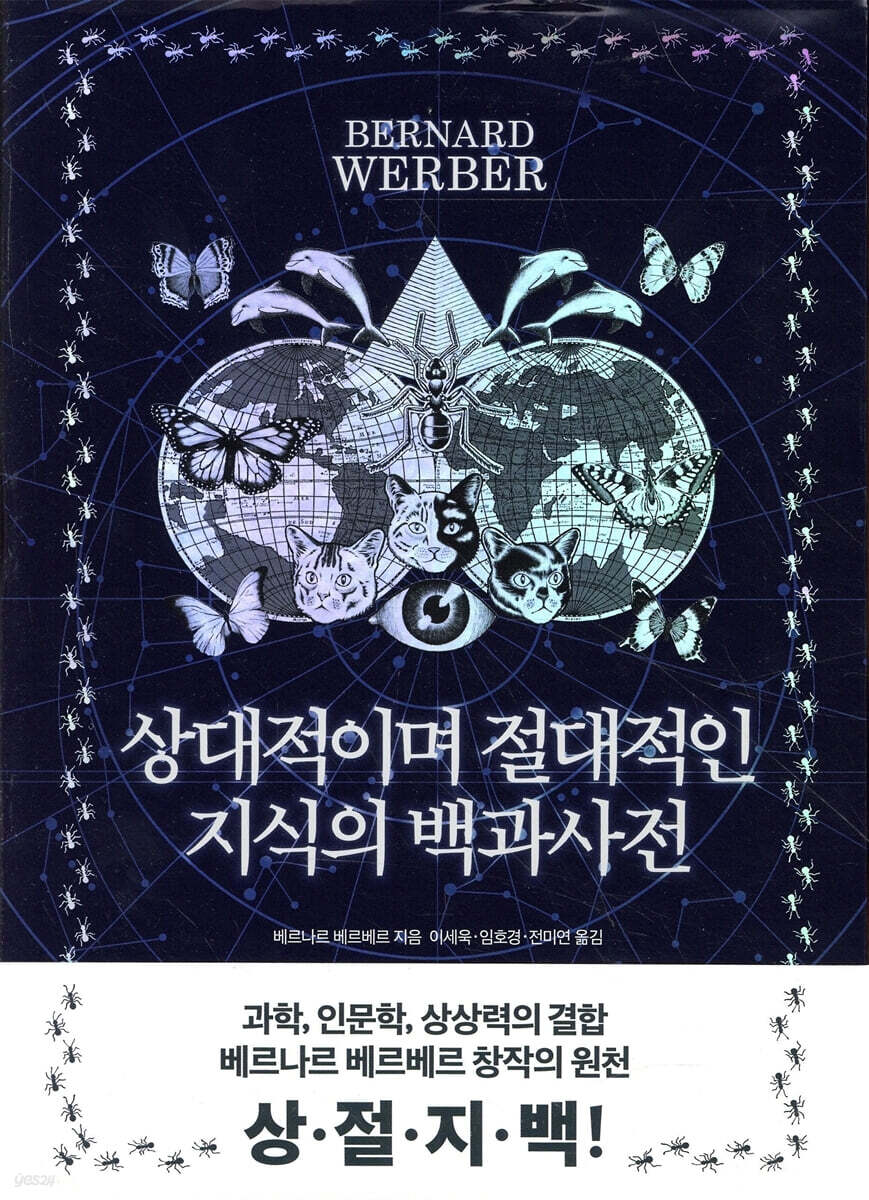
Encyclopedia of Relative and Absolute Knowledge
 |
Description
Book Introduction
If you need imagination, this is the book for you! Bernard Werber's Source of Creation [Volume, Section, Chapter, and Page] The "Encyclopedia of Relative and Absolute Knowledge," containing 542 items of knowledge, anecdotes, proverbs, and short stories that stimulate the reader's imagination, has been published by Open Books. Bernard Werber, a master of imagination who has written countless bestsellers, including 『Ants』, 『Brain』, 『Trees』, 『God』, and 『Civilization』. Since his debut with "Ants" in 1991, he has consistently captivated readers with his unique and captivating stories for 30 years. Where on earth does this inexhaustible source of creativity lie? "The Encyclopedia of Relative and Absolute Knowledge" offers a glimpse into that secret. Berber has been keeping a secret notebook of his own since he was thirteen. In those notebooks, which he had written for decades, were piled up with his own inspirations, stories that sparked his imagination, events that overturned his ideas and perspectives, intriguing riddles and mysteries, and his own unique interpretations of humanity and the world. Adding to this my experience as a science journalist, my contacts with prominent scientists, and my years of exploration into spiritual and biological evolution, the notebook grew into a unique [encyclopedia]. Some of these encyclopedias were first introduced in Korea in 1996 under the name “Encyclopedia of Relative and Absolute Knowledge.” It is often mentioned in Berber's novels and is much loved by readers, nicknamed [Sangjeoljibaek]. In 2011, the content was supplemented and published as 『Bernard Werber's Dictionary of Imagination』, and it was also published as 『Bernard Werber's Dictionary of Imagination in Comics』 with illustrations by Kim Soo-bak. The recently published 『Encyclopedia of Relative and Absolute Knowledge』 has a significantly increased content of 542 articles compared to the 383 articles in the 『Dictionary of Imagination』, and reflects the contents of 『The Third Humanity』 and 『Death』. With over 300 antique illustrations, it feels like you've discovered and read an encyclopedia that's been hidden away in your study for a long time. |
- You can preview some of the book's contents.
Preview
index
prolog
Chapter 1 Death
Chapter 2: Earthquakes
Chapter 3: Micro-Humans
Chapter 4 The Third Humanity
Chapter 5: The Mystery of the Gods
Chapter 6: Breath of the Gods
Chapter 7 We are God
Chapter 8: The Empire of Angels
Chapter 9: The Ant Revolution
Chapter 10: Ant Day
Chapter 11 Ants
Chapter 12 Others
Source of the illustration
Browse Items
Chapter 1 Death
Chapter 2: Earthquakes
Chapter 3: Micro-Humans
Chapter 4 The Third Humanity
Chapter 5: The Mystery of the Gods
Chapter 6: Breath of the Gods
Chapter 7 We are God
Chapter 8: The Empire of Angels
Chapter 9: The Ant Revolution
Chapter 10: Ant Day
Chapter 11 Ants
Chapter 12 Others
Source of the illustration
Browse Items
Into the book
Most of these unusual stories were heard from people outside the traditional channels of knowledge acquisition (school studies, newspapers, television, everyday conversation).
When people around me told me stories that were “surprising,” I would ask someone else or read some information to confirm, and then write them down one by one.
For me, it was a kind of “parallel knowledge.”
As I collected stories, I developed an obsession that I might forget them.
I'm not a person with a very good memory.
So I decided to approach it with a thorough collector's attitude.
I thought I should properly collect these stories, just as I memorize clever jokes and magic tricks to use later.
To make reading more enjoyable, we added photos and cartoons, drew our own pictures, and even pasted in shocking images, and the number of strange stories that were not widely known to the public increased.
(……)
When I was writing "Ants," I didn't plan on including an encyclopedia at first, but I decided to do so at the end. After that, my desire to collect grew even stronger.
I also thought it would be great if readers could take out a passage from the encyclopedia and share it with their friends or acquaintances over a meal.
(……)
Even now, when I read them again, they are still exciting and surprising stories to me, but I don't know how you will feel about them.
I hope you find it as interesting as I did.
Dear readers, please choose and read for fun.
When people around me told me stories that were “surprising,” I would ask someone else or read some information to confirm, and then write them down one by one.
For me, it was a kind of “parallel knowledge.”
As I collected stories, I developed an obsession that I might forget them.
I'm not a person with a very good memory.
So I decided to approach it with a thorough collector's attitude.
I thought I should properly collect these stories, just as I memorize clever jokes and magic tricks to use later.
To make reading more enjoyable, we added photos and cartoons, drew our own pictures, and even pasted in shocking images, and the number of strange stories that were not widely known to the public increased.
(……)
When I was writing "Ants," I didn't plan on including an encyclopedia at first, but I decided to do so at the end. After that, my desire to collect grew even stronger.
I also thought it would be great if readers could take out a passage from the encyclopedia and share it with their friends or acquaintances over a meal.
(……)
Even now, when I read them again, they are still exciting and surprising stories to me, but I don't know how you will feel about them.
I hope you find it as interesting as I did.
Dear readers, please choose and read for fun.
--- pp.5~7, from “Prologue”
Publisher's Review
A "new" encyclopedia of richer, deeper, relative and absolute knowledge
These fascinating stories, which cover a wide range of fields, including science, history, literature, mythology, alchemy, worldly affairs, and even games, sometimes lead readers to deep thought, sometimes to insightful insights, and sometimes to unexpected laughter.
The pure joy of acquiring new knowledge is also considerable.
It is full of topics that are hard to find elsewhere, such as the mysterious jellyfish that become younger again over time ("The Small Tower Jellyfish"), why people feel more affection for the people they helped than for the people who helped them ("Mr. Perichon's Complex"), cases of starting a second career after death ("The Mummified Robber"), why gladiators were usually fat rather than agile ("The Gladiator"), and how dolphins sleep and dream underwater ("The Dolphin's Dream").
It also broadens our perspective on the world by introducing us to the surprising customs and ancient wisdom of Native Americans, Africans, and Polynesian tribes that are somewhat unfamiliar to us.
Events from Greco-Roman mythology also appear frequently, and Berber adds his own interpretation to the myths, reviving them into stories that are slightly different from the original, but more vivid and interesting.
Among readers who seek knowledge and fun even in their busy daily lives, “Jidaebangyeopyat” and “Alseulsinjab” gained great popularity.
And here is the encyclopedia of relative and absolute knowledge, the Sangjeoljibaek.
Now all the reader has to do is open the dictionary.
No matter which page you turn to, you'll find an exciting story.
These fascinating stories, which cover a wide range of fields, including science, history, literature, mythology, alchemy, worldly affairs, and even games, sometimes lead readers to deep thought, sometimes to insightful insights, and sometimes to unexpected laughter.
The pure joy of acquiring new knowledge is also considerable.
It is full of topics that are hard to find elsewhere, such as the mysterious jellyfish that become younger again over time ("The Small Tower Jellyfish"), why people feel more affection for the people they helped than for the people who helped them ("Mr. Perichon's Complex"), cases of starting a second career after death ("The Mummified Robber"), why gladiators were usually fat rather than agile ("The Gladiator"), and how dolphins sleep and dream underwater ("The Dolphin's Dream").
It also broadens our perspective on the world by introducing us to the surprising customs and ancient wisdom of Native Americans, Africans, and Polynesian tribes that are somewhat unfamiliar to us.
Events from Greco-Roman mythology also appear frequently, and Berber adds his own interpretation to the myths, reviving them into stories that are slightly different from the original, but more vivid and interesting.
Among readers who seek knowledge and fun even in their busy daily lives, “Jidaebangyeopyat” and “Alseulsinjab” gained great popularity.
And here is the encyclopedia of relative and absolute knowledge, the Sangjeoljibaek.
Now all the reader has to do is open the dictionary.
No matter which page you turn to, you'll find an exciting story.
GOODS SPECIFICS
- Publication date: November 10, 2021
- Format: Hardcover book binding method guide
- Page count, weight, size: 752 pages | 1,030g | 160*218*42mm
- ISBN13: 9788932921365
- ISBN10: 8932921369
You may also like
카테고리
korean


korean

![GQ KOREA Mark (Monthly): December [2025]](http://librairie.coreenne.fr/cdn/shop/files/8ef265dbbfbf186523ed75ba7319009d.jpg?v=1765340328&width=3840)


