

tree
 |
Description
Book Introduction
Reporter Da-hye Lee [Cine21] recommends botanical artist So-young Lee!
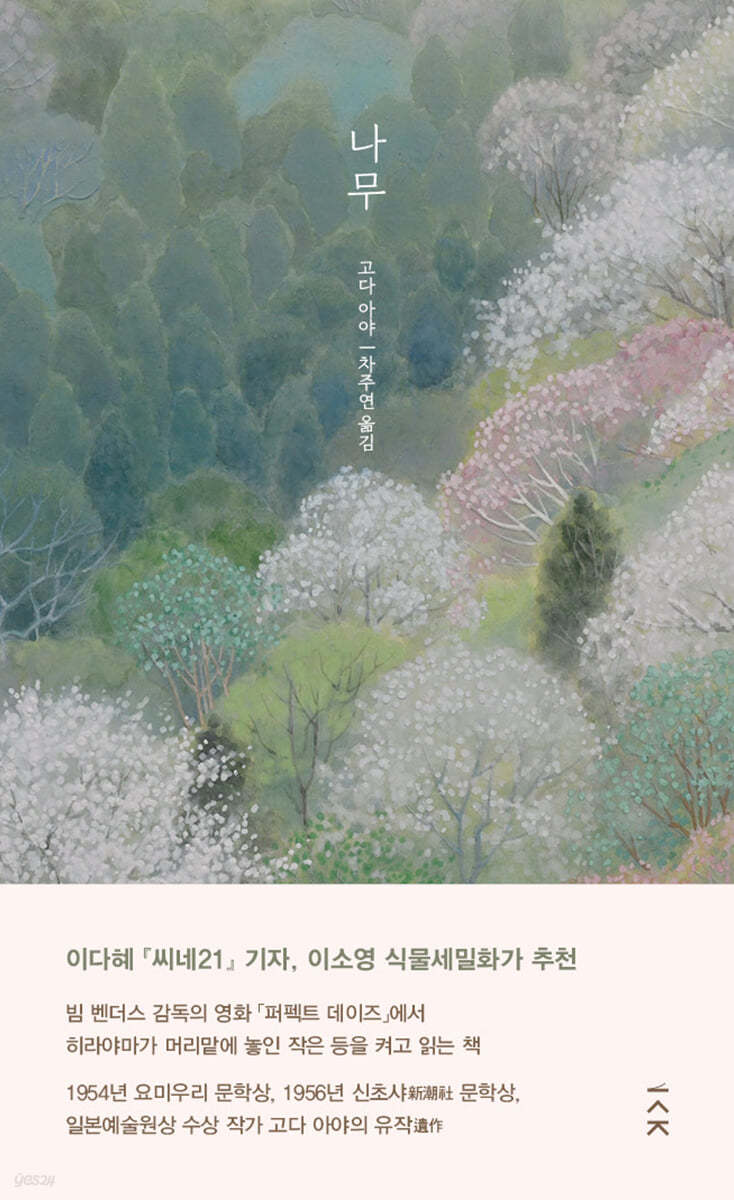
In the film [Perfect Days] directed by Wim Wenders, the main character Hirayama
A book to read with a small lamp on the bedside table
The posthumous work of author Aya Goda, winner of the 1954 Yomiuri Literary Prize, the 1956 Shinchosha Literary Prize, and the Japan Academy of Arts Award
The author in his later years conveys the emotions he felt as he painstakingly recorded and carved trees from Hokkaido in the north to Yakushima in the south.
It took 13 years and 6 months from the first essay, 'Renewal of the Spruce Tree', to the writing of the last work, 'Poplar'.
『Tree』 sometimes learns about plants and trees in earnest, and sometimes appreciates them deeply.
Pine trees nestled in temples, zelkova trees in the countryside, flowers in spring and forests in winter… .
The record of the time spent with a life is always sensitive and mysterious.
In each tree's story, a simple story of life is hidden.
In the film [Perfect Days] directed by Wim Wenders, the main character Hirayama
A book to read with a small lamp on the bedside table
The posthumous work of author Aya Goda, winner of the 1954 Yomiuri Literary Prize, the 1956 Shinchosha Literary Prize, and the Japan Academy of Arts Award
The author in his later years conveys the emotions he felt as he painstakingly recorded and carved trees from Hokkaido in the north to Yakushima in the south.
It took 13 years and 6 months from the first essay, 'Renewal of the Spruce Tree', to the writing of the last work, 'Poplar'.
『Tree』 sometimes learns about plants and trees in earnest, and sometimes appreciates them deeply.
Pine trees nestled in temples, zelkova trees in the countryside, flowers in spring and forests in winter… .
The record of the time spent with a life is always sensitive and mysterious.
In each tree's story, a simple story of life is hidden.
- You can preview some of the book's contents.
Preview
index
Recommendation
Spruce renewal
Lantern flower
cypress
Yaku cedar
Kimono of the tree
At Abe Pass
standing tree, lying tree
The Tree's Suspicion
cedar
re
The life of wood
Cherry blossoms and willows
Flowers of this spring
Pine, camphor, and cedar
poplar
commentary
Translator's Note
Spruce renewal
Lantern flower
cypress
Yaku cedar
Kimono of the tree
At Abe Pass
standing tree, lying tree
The Tree's Suspicion
cedar
re
The life of wood
Cherry blossoms and willows
Flowers of this spring
Pine, camphor, and cedar
poplar
commentary
Translator's Note
Detailed image

Into the book
I was more surprised to see the roots of the wisteria than the flowers.
The 'old wisteria', which has lived for a thousand years, has a root circumference of more than 3 meters, and its fearsome form is overwhelming to the eye.
Looking at the roots, twisting and entangled, sometimes rising above the ground and sometimes stretching out, I felt a great strength, but at the same time, I felt something very twisted, stubborn, complex, ugly, and strange.
The flower is infinitely soft and beautiful, but the roots are scary to look at, so when you look at the flower after seeing the roots, you are at a loss as to what to do with the beauty of the flower.
But he didn't leave my side.
I stood still until the group urged me on, overwhelmed by the crushing force of the terrifying being.
I still don't know what to think.
It seemed like he had just finished reminiscing and apologizing to the flower.
In the case of the roots, I had a strong impression that I was meeting them for the first time this time.
Anyway, I had a feeling that it would be difficult to meet that root again next time.
This time, I intend to show you the flowers and roots of old and young wisteria trees growing in nature in the mountains and valleys.
The reason I think this way may be because I am bound by the strong strength of the ash tree, which is so tough that it is used to build bridges.
---From "Backflower"
If you are in the forest, you will come across one or two fallen dead trees.
Some trees fall to their deaths when their trunks are twisted in a storm, while others fall to their deaths after their lifespan has ended.
The reasons may vary, but all trees that stand still, untouched by human hands, look peaceful, leisurely, and beautifully asleep.
Whenever I look at such a tree, I often think of the number of trees in the country.
What would he say if he saw a tree lying peacefully in the forest, clothed in moss? A tree that had been rooted in the ground until it was cut down, and even a fallen, dead tree was once rooted and standing.
But a dead tree that falls in the forest is not wood.
I would like to ask him which expression he would choose.
I was deeply aware of the need for a term to describe a dead tree that had fallen in the forest, but I couldn't think of an appropriate expression.
The expression 'a fallen tree' is direct and good, but I feel like it needs a little more comfort.
The 'old wisteria', which has lived for a thousand years, has a root circumference of more than 3 meters, and its fearsome form is overwhelming to the eye.
Looking at the roots, twisting and entangled, sometimes rising above the ground and sometimes stretching out, I felt a great strength, but at the same time, I felt something very twisted, stubborn, complex, ugly, and strange.
The flower is infinitely soft and beautiful, but the roots are scary to look at, so when you look at the flower after seeing the roots, you are at a loss as to what to do with the beauty of the flower.
But he didn't leave my side.
I stood still until the group urged me on, overwhelmed by the crushing force of the terrifying being.
I still don't know what to think.
It seemed like he had just finished reminiscing and apologizing to the flower.
In the case of the roots, I had a strong impression that I was meeting them for the first time this time.
Anyway, I had a feeling that it would be difficult to meet that root again next time.
This time, I intend to show you the flowers and roots of old and young wisteria trees growing in nature in the mountains and valleys.
The reason I think this way may be because I am bound by the strong strength of the ash tree, which is so tough that it is used to build bridges.
---From "Backflower"
If you are in the forest, you will come across one or two fallen dead trees.
Some trees fall to their deaths when their trunks are twisted in a storm, while others fall to their deaths after their lifespan has ended.
The reasons may vary, but all trees that stand still, untouched by human hands, look peaceful, leisurely, and beautifully asleep.
Whenever I look at such a tree, I often think of the number of trees in the country.
What would he say if he saw a tree lying peacefully in the forest, clothed in moss? A tree that had been rooted in the ground until it was cut down, and even a fallen, dead tree was once rooted and standing.
But a dead tree that falls in the forest is not wood.
I would like to ask him which expression he would choose.
I was deeply aware of the need for a term to describe a dead tree that had fallen in the forest, but I couldn't think of an appropriate expression.
The expression 'a fallen tree' is direct and good, but I feel like it needs a little more comfort.
---From "Standing Tree, Lying Tree"
Publisher's Review
From Hokkaido in the north to Yakushima in the south
A story of trees recorded over 13 years and 6 months
The author in his later years conveys the emotions he felt as he painstakingly recorded and carved trees from Hokkaido in the north to Yakushima in the south.
It took 13 years and 6 months from the first essay, 'Renewal of the Spruce Tree', to the writing of the last work, 'Poplar'.
As the author says, “You have to experience it for a year to know for sure,” and “You have to see it at least once every season to be able to say anything,” these must have been days of persistent effort to organize in his mind the trees he encountered.
A sensitive and mysterious time spent with a life,
Birth and death react violently, and the joys and sorrows of life quietly shine.
『Tree』 sometimes learns about plants and trees in earnest, and sometimes appreciates them deeply.
Pine trees nestled in temples, zelkova trees in the countryside, flowers in spring and forests in winter… .
The record of the time spent with a life is always sensitive and mysterious.
Birth and death react violently, and the joys and sorrows of life shine quietly.
And within each tree's story, a simple story of life is hidden.
A book that is still loved even 30 years after its publication
"Tree" is a posthumous work published after Aya Goda's death and is still greatly loved by readers.
His works are being republished with new covers by leading Japanese literary publishers such as Kodansha, Shinchosha, and Heibonsha.
This book, which describes nature and people's daily lives in a warm yet bold tone, is still loved even 30 years after its publication.
A story of trees recorded over 13 years and 6 months
The author in his later years conveys the emotions he felt as he painstakingly recorded and carved trees from Hokkaido in the north to Yakushima in the south.
It took 13 years and 6 months from the first essay, 'Renewal of the Spruce Tree', to the writing of the last work, 'Poplar'.
As the author says, “You have to experience it for a year to know for sure,” and “You have to see it at least once every season to be able to say anything,” these must have been days of persistent effort to organize in his mind the trees he encountered.
A sensitive and mysterious time spent with a life,
Birth and death react violently, and the joys and sorrows of life quietly shine.
『Tree』 sometimes learns about plants and trees in earnest, and sometimes appreciates them deeply.
Pine trees nestled in temples, zelkova trees in the countryside, flowers in spring and forests in winter… .
The record of the time spent with a life is always sensitive and mysterious.
Birth and death react violently, and the joys and sorrows of life shine quietly.
And within each tree's story, a simple story of life is hidden.
A book that is still loved even 30 years after its publication
"Tree" is a posthumous work published after Aya Goda's death and is still greatly loved by readers.
His works are being republished with new covers by leading Japanese literary publishers such as Kodansha, Shinchosha, and Heibonsha.
This book, which describes nature and people's daily lives in a warm yet bold tone, is still loved even 30 years after its publication.
GOODS SPECIFICS
- Date of issue: December 20, 2024
- Page count, weight, size: 232 pages | 246g | 111*182*16mm
- ISBN13: 9791194140030
- ISBN10: 1194140033
You may also like
카테고리
korean


korean

![GQ KOREA Mark (Monthly): December [2025]](http://librairie.coreenne.fr/cdn/shop/files/8ef265dbbfbf186523ed75ba7319009d.jpg?v=1765340328&width=3840)


