

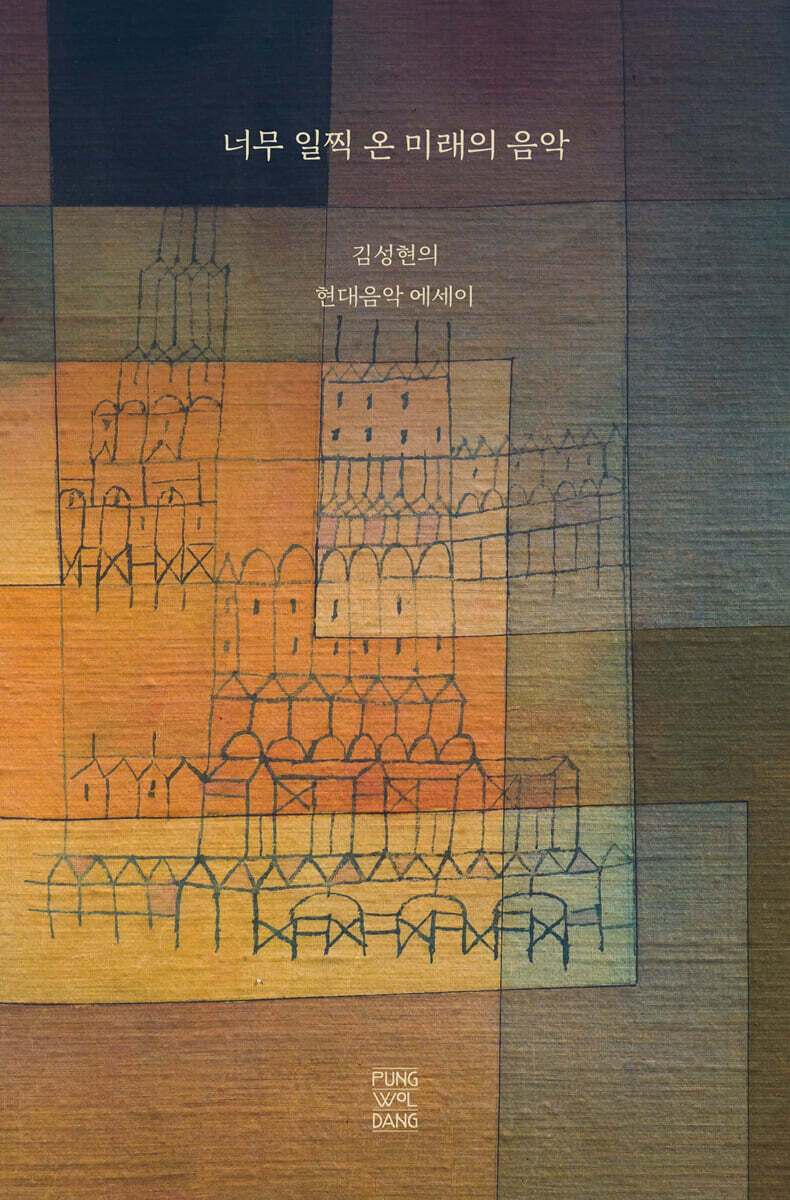
The music of the future that came too soon
 |
Description
Book Introduction
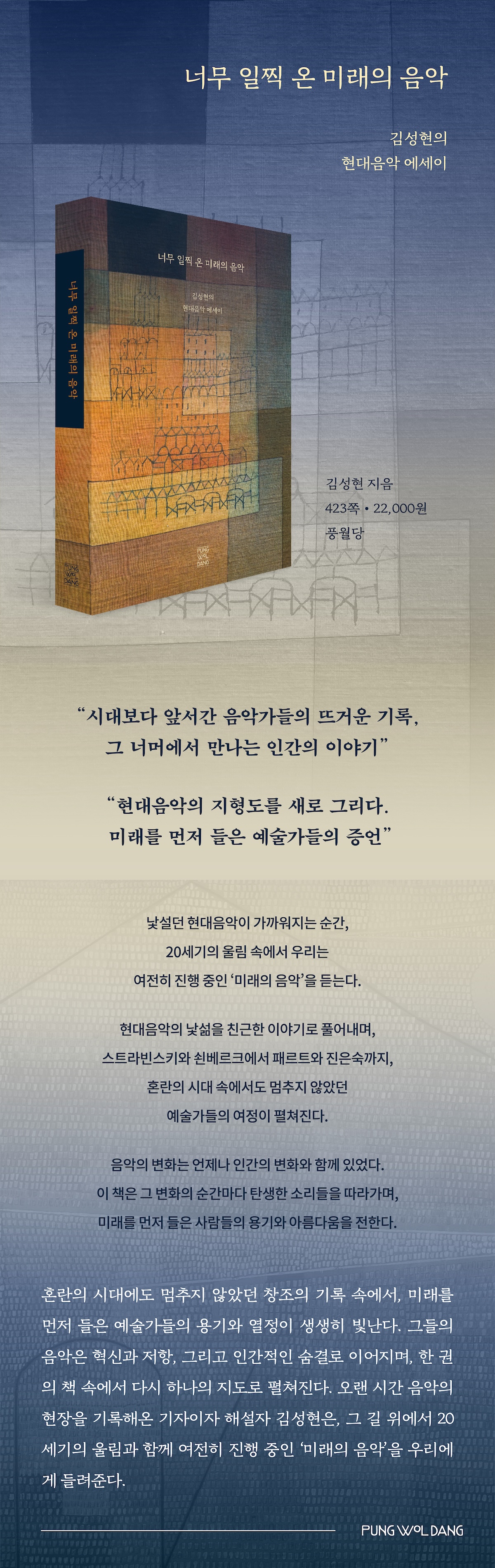
“A passionate record of musicians ahead of their time,
“A human story we encounter beyond that.”
Changes in music have always accompanied changes in humanity.
This book follows the sounds born at each moment of change, conveying the courage and beauty of those who heard the future first.
The unfamiliarity of contemporary music is unraveled in a familiar narrative, and the journey of artists who did not stop even in times of turmoil, from Stravinsky and Schoenberg to Pärt and Jin Eun-sook, unfolds.
As unfamiliar contemporary music becomes closer, we hear the 'music of the future' still in progress amidst the echoes of the 20th century.
“Redrawing the topography of contemporary music.
“Testimony from artists who heard the future first”
As unfamiliar contemporary music becomes more accessible, we follow the journey of sounds that changed the times.
In the records of creation that never ceased even in times of chaos, the courage and passion of artists who heard the future first shine vividly.
Their music is a journey of innovation, resistance, and human breath, unfolding as a map in a book.
Kim Seong-hyeon, a journalist and commentator who has been documenting the music scene for a long time, tells us about the 'music of the future' that is still ongoing along with the resonance of the 20th century.
“A human story we encounter beyond that.”
Changes in music have always accompanied changes in humanity.
This book follows the sounds born at each moment of change, conveying the courage and beauty of those who heard the future first.
The unfamiliarity of contemporary music is unraveled in a familiar narrative, and the journey of artists who did not stop even in times of turmoil, from Stravinsky and Schoenberg to Pärt and Jin Eun-sook, unfolds.
As unfamiliar contemporary music becomes closer, we hear the 'music of the future' still in progress amidst the echoes of the 20th century.
“Redrawing the topography of contemporary music.
“Testimony from artists who heard the future first”
As unfamiliar contemporary music becomes more accessible, we follow the journey of sounds that changed the times.
In the records of creation that never ceased even in times of chaos, the courage and passion of artists who heard the future first shine vividly.
Their music is a journey of innovation, resistance, and human breath, unfolding as a map in a book.
Kim Seong-hyeon, a journalist and commentator who has been documenting the music scene for a long time, tells us about the 'music of the future' that is still ongoing along with the resonance of the 20th century.
- You can preview some of the book's contents.
Preview
index
introduction
Topography of Contemporary Music
Two meanings of contemporary music
Seven Ways to Enjoy The Rite of Spring - Igor Stravinsky's The Rite of Spring
Was it his wife or his music that he lost? - Arnold Schoenberg's Pierrot Lunaire
Submission to Stalin or Covert Resistance? - Dmitri Shostakovich's Symphony No. 5
The meeting of two geniuses - Sergei Prokofiev's "Alexander Nevsky"
The Subversive Opera Hated by Both Hitler and Stalin - Alban Berg's "Wozzeck"
At the Twilight of Life, at the End of Romanticism - Richard Strauss's "Four Last Songs"
Artistic Double Front Against Impressionism - Claude Debussy's "The Sea"
A riddle all the more fascinating because its answer is unknown - Edward Elgar's "Enigma Variations"
The Declaration of Independence for 20th-Century American Music: Charles Ives' "Concord Sonata"
A Great Exception in Czech Music - Leos Janáček's "Glagolitic Mass"
Is there a "total soccer" version of classical music? - Béla Bartók's "Concerto for Orchestra"
Mozart of Finca Vienna - Erich Wolfgang Korngold's Violin Concerto
Weill in Berlin and Weill on Broadway - Kurt Weill's The Threepenny Opera
Joining Hands Through Cold War Music - Benjamin Britten's "War Requiem"
The dazzling fireworks display from the film "The Great Gatsby" - George Gershwin's "Rhapsody in Blue"
A melody that resonated even at the U.S. presidential inauguration - Aaron Copland's "Appalachian Spring"
Olivier Messiaen, a saint of modern music who sang of the joys of love, "Turangalila Symphony"
A postwar revolutionary who surpassed his master - Pierre Boulez's "The Hammer Without a Master"
Contemporary music, painted with an Eastern brush instead of a Western pen - Yun Isang's "Yeak"
In a Cloud of Thick Sound - György Ligeti, "Atmospher"
“In my dreams, I am always Alice” - Jin Eun-sook, Alice in Wonderland
Soviet Postmodernist - Alfred Schnittke Concerto No. 1
A Song of Sorrow and Comfort Born from Silence - Arvo Pärt's "Tabula Rasa"
"The composer's path is not a flowerbed covered with roses." - Sofia Gubaidulina, Violin Concerto No. 1
The sonic imagination that captivated horror films and rock stars - Krzysztof Penderecki's "Elegy for the Victims of Hiroshima"
A Modern Retelling of Romeo and Juliet - Leonard Bernstein's "West Side Story"
All music begins and ends with silence - John Cage, 4'33"
The Birth of CNN Opera - John Adams' "Nixon in China"
From New York cab driver to contemporary music star - Philip Glass's "Einstein on the Beach"
Percussion, the protagonist of minimalism - Steve Reich, "Drumming"
Contemporary Music Timeline
References
Find a person's name
Plate information
Topography of Contemporary Music
Two meanings of contemporary music
Seven Ways to Enjoy The Rite of Spring - Igor Stravinsky's The Rite of Spring
Was it his wife or his music that he lost? - Arnold Schoenberg's Pierrot Lunaire
Submission to Stalin or Covert Resistance? - Dmitri Shostakovich's Symphony No. 5
The meeting of two geniuses - Sergei Prokofiev's "Alexander Nevsky"
The Subversive Opera Hated by Both Hitler and Stalin - Alban Berg's "Wozzeck"
At the Twilight of Life, at the End of Romanticism - Richard Strauss's "Four Last Songs"
Artistic Double Front Against Impressionism - Claude Debussy's "The Sea"
A riddle all the more fascinating because its answer is unknown - Edward Elgar's "Enigma Variations"
The Declaration of Independence for 20th-Century American Music: Charles Ives' "Concord Sonata"
A Great Exception in Czech Music - Leos Janáček's "Glagolitic Mass"
Is there a "total soccer" version of classical music? - Béla Bartók's "Concerto for Orchestra"
Mozart of Finca Vienna - Erich Wolfgang Korngold's Violin Concerto
Weill in Berlin and Weill on Broadway - Kurt Weill's The Threepenny Opera
Joining Hands Through Cold War Music - Benjamin Britten's "War Requiem"
The dazzling fireworks display from the film "The Great Gatsby" - George Gershwin's "Rhapsody in Blue"
A melody that resonated even at the U.S. presidential inauguration - Aaron Copland's "Appalachian Spring"
Olivier Messiaen, a saint of modern music who sang of the joys of love, "Turangalila Symphony"
A postwar revolutionary who surpassed his master - Pierre Boulez's "The Hammer Without a Master"
Contemporary music, painted with an Eastern brush instead of a Western pen - Yun Isang's "Yeak"
In a Cloud of Thick Sound - György Ligeti, "Atmospher"
“In my dreams, I am always Alice” - Jin Eun-sook, Alice in Wonderland
Soviet Postmodernist - Alfred Schnittke Concerto No. 1
A Song of Sorrow and Comfort Born from Silence - Arvo Pärt's "Tabula Rasa"
"The composer's path is not a flowerbed covered with roses." - Sofia Gubaidulina, Violin Concerto No. 1
The sonic imagination that captivated horror films and rock stars - Krzysztof Penderecki's "Elegy for the Victims of Hiroshima"
A Modern Retelling of Romeo and Juliet - Leonard Bernstein's "West Side Story"
All music begins and ends with silence - John Cage, 4'33"
The Birth of CNN Opera - John Adams' "Nixon in China"
From New York cab driver to contemporary music star - Philip Glass's "Einstein on the Beach"
Percussion, the protagonist of minimalism - Steve Reich, "Drumming"
Contemporary Music Timeline
References
Find a person's name
Plate information
Detailed image
Into the book
Creating a blueprint for navigating the vast sea of contemporary music
Writing a review of a work that no one had ever seen or heard of before was a strange and unfamiliar experience.
Since then, it has become my personal task and wish to create a blueprint that will allow me to safely navigate the vast sea of contemporary music of the 20th and 21st centuries.
--- p.10
Artistic events of our time
Even the works of Stravinsky and Schoenberg, which are considered the starting point of modern music, are only 100 years old.
In fact, it means that these are artistic events of the same time as us.
Just as studying history doesn't necessarily have to begin with prehistoric times and Gojoseon, classical music can also be viewed by turning the timeline upside down.
Even in the history of music, attempts like the 'Egg of Columbus' are possible.
I sincerely hope that this book will become one of those works.
--- p.11
All these stories are the stories of us living now.
By the late 20th century, diversity in gender, region, and race had become a hot topic in contemporary music.
There has been a growing movement away from studies of European white male-centered composers and towards a reevaluation of female and people of color composers and performers.
Regionally, interest in 'regional balanced development' has grown not only in Europe and the United States, but also in South America, Asia, and Africa.
The history of modern music is not much different from modern history in general.
That is why all these stories are also the stories of us who are living now.
--- p.20
From a radical work of fiction to a modern classic
Sometimes myths create paradoxes that hinder a full understanding of the work.
The evaluation of any work is not completed on the day of its premiere, but rather, like life, it gradually goes through the process of birth, aging, illness, and death.
"The Rite of Spring" is also a case in point, having endured the test of time for a century, transforming from a radical work of controversy into a modern classic.
--- p.30
At the twilight of life, at the end of romanticism
"Four Last Songs" became a final farewell to the fading tradition of late German Romanticism.
At the same time, it remains a contradictory masterpiece that fully preserves its retro sentiment even amidst the turbulent waves of modern music that goes beyond atonality and twelve-tone techniques and rushes toward serialism.
--- p.124
Shaking up the old, outdated aesthetics and bringing about a change in new tastes
In the 21st century, we no longer consider the Impressionist art of the Musée d'Orsay to be groundbreaking or radical.
Likewise, no one complains that the sea is not seen or heard in Debussy's works.
A century has passed since the work's premiere, and our aesthetic standards themselves have changed.
Perhaps Debussy's greatest achievement is that he shook up the old, outdated aesthetics and brought about a change in new tastes.
--- p.137
Elgar.
A true British composer after Purcell
There is a very ironic aspect to Elgar's life.
Although he may seem like Britain's national composer now, he was actually more of an outsider during his lifetime.
In England, where the Church of England was central, he was a minority Catholic and was from the suburbs of Worcester, not London.
He was also born the son of a music books and musical instrument dealer, and was virtually self-taught in music.
It seems that there was nothing that fit the mainstream conditions in terms of religion, region, or class.
--- p.143
American music's "Declaration of Independence"
As the introduction shows, Ives is easily understood as a musical outsider, as radical as Schoenberg.
This sonata, which Ives devoted four years to composing, is also considered a difficult piece full of technical difficulties due to the continuous flow of notes and the rapid tempo.
However, with the release of numerous albums featuring this song in the latter half of the 20th century, these harsh criticisms have been ably refuted.
(...)
After his death in 1954, Ives was called "a pioneer of American modern music."
In that sense, Ives's sonata was like a 'declaration of independence' for 20th-century American music.
--- p.156
The Great Exception, Janáček
The Glagolitic Mass is one of Janáček's later masterpieces, premiered in 1927.
Although the composer was already in his seventies, Janáček displayed his experience as he continued to produce operas, orchestral works, and chamber music in his later years.
(...)
We live in constant fear of falling behind the times, but 'great exceptions' like Janáček subtly point us in the right direction.
In life and art, what is more important than momentary evaluation is your own originality.
--- p.163
Zemlinsky, teacher of Korngold and Schoenberg
It seems that both Korngold, Vienna's greatest musical prodigy, and Schönberg, a late bloomer, were Zemlinsky's students.
Korngold later made a significant contribution to the development of Hollywood film music.
Schoenberg left a significant mark on the history of 20th-century modern music by nurturing students such as Alban Berg and Webern.
As a result, Zemlinsky indirectly influenced both film music and modern music through his students.
It seems that both Korngold, Vienna's greatest musical prodigy, and Schönberg, a late bloomer, were Zemlinsky's students.
Korngold later made a significant contribution to the development of Hollywood film music.
Schoenberg left a significant mark on the history of 20th-century modern music by nurturing students such as Alban Berg and Webern.
As a result, Zemlinsky indirectly influenced both film music and modern music through his students.
--- p.193
Appalachian Spring, a work that captures the turbulent times and their meaning.
"Appalachian Spring" contained a triple meaning: the utopia of the Old Testament's Book of Genesis, the pioneering spirit of the early days of the United States, and the optimism of wartime America.
“Appalachian Spring” is, in fact, a product of the fusion of artists with disparate and contradictory backgrounds.
Yuriko Kikuchi, a Japanese-American dancer who participated in the work's premiere, was detained in an Arizona immigration center for two years immediately after the attack on Pearl Harbor.
Isamu Noguchi (1904-1988), who was in charge of stage design, was also investigated by the FBI on suspicion of espionage.
Even in an era when the mere fact of having Japanese ancestry made them objects of suspicion and surveillance, Graham accepted them into his dance troupe without hesitation.
If you think about it, Copland was also a composer with a non-mainstream identity: he was a Lithuanian Jew, a political leftist, and a homosexual.
However, in 1945, the year after its premiere, Copland won the Pulitzer Prize for this work, solidifying his position as the 'Dean' of American modern music.
--- p.236
Ligeti, a musician who expanded boundaries beyond the narrow-mindedness of his time
The self-consciousness of the uprooted tormented the composer throughout his life, but conversely, it was also the driving force that enabled him to be free from the laws and trends of modern music.
Even after his exile in the West, Ligeti tried to keep a certain distance from the narrow-minded and dogmatic atmosphere of the contemporary music world.
He first became known in 1957 through the Darmstadt Music Festival, the cradle of modern music.
However, when looking at composers fighting and strife for hegemony within the narrow world of contemporary music, some have compared it to the power struggles of the Nazi or Stalinist regimes.
Later he said, “I am not a guru (spiritual leader).
I have no desire to preach or improve the world.
“All these utopias are so strange to me,” he confessed.
For this reason, Ligeti not only never created his own musical school throughout his life, but also constantly sought to break away from his already established style.
In 1993, Ligeti confessed:
“I have no definite vision of the future, no overarching plan.
I just feel like a blind person in a maze, groping my way through various paths.
“The moment you succeed in taking a step forward, it immediately becomes the past, and there are many forks in the road for the next step.” Perhaps, discontinuity and continuity were keywords that ran through his life and music.
--- p.266-267
A self-image filled with maturity, development, dreams, and the unconscious: Jin Eun-sook's "Alice in Wonderland"
As Alice sings, “Who in the world am I?”, the opera continually poses questions about identity.
Like the lyrics of Alice's Aria, it is a question of "Am I still the same person when I wake up this morning?"
This question is, of course, the original author Carol's, but it is also the question Jin Eun-sook poses to us.
At a 2011 conversation with the composer at London's Barbican Centre, the audience peppered Jin Eun-sook with questions about her composing habits and even her process for preparing for the opera's premiere.
To the final question, “Do you sometimes identify with Alice, the main character of the original Carol?” Jin Eun-sook answered as follows.
“In my dreams, I am always Alice.” As a result, “Alice in Wonderland” became a work that fully embodies the composer Jin Eun-sook’s maturity and development, as well as her dreams and unconsciousness.
--- p.276-277
A Journey of Resistance and Endurance
Whenever his health recovered and he rose again like a rock, he would always pick up his pen.
In the late 1980s, concerts highlighting his works were held in London, Berlin, Stockholm, and other cities, and he also served as resident composer at the Salzburg and Old Lover Festivals.
The powers that be in the Soviet music world, who had oppressed and harassed him throughout his life, lost their power after the dissolution of the Soviet Union in 1991.
Meanwhile, in 1994, a music festival highlighting Schnittke's work was held around the world.
One of those cities was Moscow.
It was the moment when the city where Schnittke had studied, taught, and composed music all his life finally 'officially recognized' his music.
--- p.294-295
Minimalism and the spiritual world born through silence
When he returned in 1976 after a long silence, Part was a completely different composer.
Since the mid-1970s, Part has called his musical style 'tintinnabuli'.
The Latin word 'tintinnabulum', meaning 'little bell', refers to the bells or bell sounds used in events such as church services or papal processions.
In fact, Part enjoyed using chime-like sounds in his works, but more importantly, there was a change in the musical language itself.
“Tintinabulli is an area I encountered during a time when I was searching for answers in my life, music and work,” the composer said. “When I was going through dark times, I felt that anything outside of that one answer was meaningless.”
The conclusion reached after a long period of searching in the dark was that it was Tin Tinabuli.
As a result, the initial difficult dissonances disappeared, and the main melody and the tonic triad stood out in a quiet and meditative atmosphere.
--- p.303-304
Escape from the cage
Although Cage was a lifelong self-proclaimed "anarchist," he was largely indifferent to real-world politics.
(...) But it is also true that pop and rock musicians, including John Lennon and Yoko Ono, guitarist Frank Zappa, and rock band Sonic Youth, also embraced topics such as noise, silence, and chance through Cage.
In that sense, Cage's words, "Escape from the bird cage that is imprisoning you," still sound meaningful.
Where will contemporary music fly to after breaking free from its cage?
Writing a review of a work that no one had ever seen or heard of before was a strange and unfamiliar experience.
Since then, it has become my personal task and wish to create a blueprint that will allow me to safely navigate the vast sea of contemporary music of the 20th and 21st centuries.
--- p.10
Artistic events of our time
Even the works of Stravinsky and Schoenberg, which are considered the starting point of modern music, are only 100 years old.
In fact, it means that these are artistic events of the same time as us.
Just as studying history doesn't necessarily have to begin with prehistoric times and Gojoseon, classical music can also be viewed by turning the timeline upside down.
Even in the history of music, attempts like the 'Egg of Columbus' are possible.
I sincerely hope that this book will become one of those works.
--- p.11
All these stories are the stories of us living now.
By the late 20th century, diversity in gender, region, and race had become a hot topic in contemporary music.
There has been a growing movement away from studies of European white male-centered composers and towards a reevaluation of female and people of color composers and performers.
Regionally, interest in 'regional balanced development' has grown not only in Europe and the United States, but also in South America, Asia, and Africa.
The history of modern music is not much different from modern history in general.
That is why all these stories are also the stories of us who are living now.
--- p.20
From a radical work of fiction to a modern classic
Sometimes myths create paradoxes that hinder a full understanding of the work.
The evaluation of any work is not completed on the day of its premiere, but rather, like life, it gradually goes through the process of birth, aging, illness, and death.
"The Rite of Spring" is also a case in point, having endured the test of time for a century, transforming from a radical work of controversy into a modern classic.
--- p.30
At the twilight of life, at the end of romanticism
"Four Last Songs" became a final farewell to the fading tradition of late German Romanticism.
At the same time, it remains a contradictory masterpiece that fully preserves its retro sentiment even amidst the turbulent waves of modern music that goes beyond atonality and twelve-tone techniques and rushes toward serialism.
--- p.124
Shaking up the old, outdated aesthetics and bringing about a change in new tastes
In the 21st century, we no longer consider the Impressionist art of the Musée d'Orsay to be groundbreaking or radical.
Likewise, no one complains that the sea is not seen or heard in Debussy's works.
A century has passed since the work's premiere, and our aesthetic standards themselves have changed.
Perhaps Debussy's greatest achievement is that he shook up the old, outdated aesthetics and brought about a change in new tastes.
--- p.137
Elgar.
A true British composer after Purcell
There is a very ironic aspect to Elgar's life.
Although he may seem like Britain's national composer now, he was actually more of an outsider during his lifetime.
In England, where the Church of England was central, he was a minority Catholic and was from the suburbs of Worcester, not London.
He was also born the son of a music books and musical instrument dealer, and was virtually self-taught in music.
It seems that there was nothing that fit the mainstream conditions in terms of religion, region, or class.
--- p.143
American music's "Declaration of Independence"
As the introduction shows, Ives is easily understood as a musical outsider, as radical as Schoenberg.
This sonata, which Ives devoted four years to composing, is also considered a difficult piece full of technical difficulties due to the continuous flow of notes and the rapid tempo.
However, with the release of numerous albums featuring this song in the latter half of the 20th century, these harsh criticisms have been ably refuted.
(...)
After his death in 1954, Ives was called "a pioneer of American modern music."
In that sense, Ives's sonata was like a 'declaration of independence' for 20th-century American music.
--- p.156
The Great Exception, Janáček
The Glagolitic Mass is one of Janáček's later masterpieces, premiered in 1927.
Although the composer was already in his seventies, Janáček displayed his experience as he continued to produce operas, orchestral works, and chamber music in his later years.
(...)
We live in constant fear of falling behind the times, but 'great exceptions' like Janáček subtly point us in the right direction.
In life and art, what is more important than momentary evaluation is your own originality.
--- p.163
Zemlinsky, teacher of Korngold and Schoenberg
It seems that both Korngold, Vienna's greatest musical prodigy, and Schönberg, a late bloomer, were Zemlinsky's students.
Korngold later made a significant contribution to the development of Hollywood film music.
Schoenberg left a significant mark on the history of 20th-century modern music by nurturing students such as Alban Berg and Webern.
As a result, Zemlinsky indirectly influenced both film music and modern music through his students.
It seems that both Korngold, Vienna's greatest musical prodigy, and Schönberg, a late bloomer, were Zemlinsky's students.
Korngold later made a significant contribution to the development of Hollywood film music.
Schoenberg left a significant mark on the history of 20th-century modern music by nurturing students such as Alban Berg and Webern.
As a result, Zemlinsky indirectly influenced both film music and modern music through his students.
--- p.193
Appalachian Spring, a work that captures the turbulent times and their meaning.
"Appalachian Spring" contained a triple meaning: the utopia of the Old Testament's Book of Genesis, the pioneering spirit of the early days of the United States, and the optimism of wartime America.
“Appalachian Spring” is, in fact, a product of the fusion of artists with disparate and contradictory backgrounds.
Yuriko Kikuchi, a Japanese-American dancer who participated in the work's premiere, was detained in an Arizona immigration center for two years immediately after the attack on Pearl Harbor.
Isamu Noguchi (1904-1988), who was in charge of stage design, was also investigated by the FBI on suspicion of espionage.
Even in an era when the mere fact of having Japanese ancestry made them objects of suspicion and surveillance, Graham accepted them into his dance troupe without hesitation.
If you think about it, Copland was also a composer with a non-mainstream identity: he was a Lithuanian Jew, a political leftist, and a homosexual.
However, in 1945, the year after its premiere, Copland won the Pulitzer Prize for this work, solidifying his position as the 'Dean' of American modern music.
--- p.236
Ligeti, a musician who expanded boundaries beyond the narrow-mindedness of his time
The self-consciousness of the uprooted tormented the composer throughout his life, but conversely, it was also the driving force that enabled him to be free from the laws and trends of modern music.
Even after his exile in the West, Ligeti tried to keep a certain distance from the narrow-minded and dogmatic atmosphere of the contemporary music world.
He first became known in 1957 through the Darmstadt Music Festival, the cradle of modern music.
However, when looking at composers fighting and strife for hegemony within the narrow world of contemporary music, some have compared it to the power struggles of the Nazi or Stalinist regimes.
Later he said, “I am not a guru (spiritual leader).
I have no desire to preach or improve the world.
“All these utopias are so strange to me,” he confessed.
For this reason, Ligeti not only never created his own musical school throughout his life, but also constantly sought to break away from his already established style.
In 1993, Ligeti confessed:
“I have no definite vision of the future, no overarching plan.
I just feel like a blind person in a maze, groping my way through various paths.
“The moment you succeed in taking a step forward, it immediately becomes the past, and there are many forks in the road for the next step.” Perhaps, discontinuity and continuity were keywords that ran through his life and music.
--- p.266-267
A self-image filled with maturity, development, dreams, and the unconscious: Jin Eun-sook's "Alice in Wonderland"
As Alice sings, “Who in the world am I?”, the opera continually poses questions about identity.
Like the lyrics of Alice's Aria, it is a question of "Am I still the same person when I wake up this morning?"
This question is, of course, the original author Carol's, but it is also the question Jin Eun-sook poses to us.
At a 2011 conversation with the composer at London's Barbican Centre, the audience peppered Jin Eun-sook with questions about her composing habits and even her process for preparing for the opera's premiere.
To the final question, “Do you sometimes identify with Alice, the main character of the original Carol?” Jin Eun-sook answered as follows.
“In my dreams, I am always Alice.” As a result, “Alice in Wonderland” became a work that fully embodies the composer Jin Eun-sook’s maturity and development, as well as her dreams and unconsciousness.
--- p.276-277
A Journey of Resistance and Endurance
Whenever his health recovered and he rose again like a rock, he would always pick up his pen.
In the late 1980s, concerts highlighting his works were held in London, Berlin, Stockholm, and other cities, and he also served as resident composer at the Salzburg and Old Lover Festivals.
The powers that be in the Soviet music world, who had oppressed and harassed him throughout his life, lost their power after the dissolution of the Soviet Union in 1991.
Meanwhile, in 1994, a music festival highlighting Schnittke's work was held around the world.
One of those cities was Moscow.
It was the moment when the city where Schnittke had studied, taught, and composed music all his life finally 'officially recognized' his music.
--- p.294-295
Minimalism and the spiritual world born through silence
When he returned in 1976 after a long silence, Part was a completely different composer.
Since the mid-1970s, Part has called his musical style 'tintinnabuli'.
The Latin word 'tintinnabulum', meaning 'little bell', refers to the bells or bell sounds used in events such as church services or papal processions.
In fact, Part enjoyed using chime-like sounds in his works, but more importantly, there was a change in the musical language itself.
“Tintinabulli is an area I encountered during a time when I was searching for answers in my life, music and work,” the composer said. “When I was going through dark times, I felt that anything outside of that one answer was meaningless.”
The conclusion reached after a long period of searching in the dark was that it was Tin Tinabuli.
As a result, the initial difficult dissonances disappeared, and the main melody and the tonic triad stood out in a quiet and meditative atmosphere.
--- p.303-304
Escape from the cage
Although Cage was a lifelong self-proclaimed "anarchist," he was largely indifferent to real-world politics.
(...) But it is also true that pop and rock musicians, including John Lennon and Yoko Ono, guitarist Frank Zappa, and rock band Sonic Youth, also embraced topics such as noise, silence, and chance through Cage.
In that sense, Cage's words, "Escape from the bird cage that is imprisoning you," still sound meaningful.
Where will contemporary music fly to after breaking free from its cage?
--- p.359
Publisher's Review
"Do I have to listen to contemporary music?"
This is the question most frequently asked by authors covering classical music.
He says, 'I went to contemporary music concerts, listened to records, and as if that wasn't enough, I even published a book.'
This is connected to his 'main job'.
As a reporter for the culture department of the Chosun Ilbo and a concert commentator, the author has introduced music through the blog 'Classic Neverland' and YouTube 'Classic Talk', and due to the nature of his job, he is one of the people who has been exposed to the most classical performances in Korea.
Even for him, encountering contemporary music was by no means easy.
Unlike art or literature, classical music is still confined to the framework of 'Western classical music', and contemporary music in particular remains the most difficult area among them.
Until the 19th century, music shared a common grammar called tonality, but with the emergence of methodologies such as Schoenberg's atonality, twelve-tone technique, and later serialism, that grammar itself collapsed.
Familiar structures, like those of Classical and Romantic music, are lost, forms are dismantled by erasing repetition, fragmenting time and sound, and even making silence part of the work.
However, even contemporary music, which may seem difficult and complex, can be surprisingly interesting and fascinating when viewed within the context of the relationship between the era and the musicians.
So, introducing contemporary music to the author is ultimately like 'handing over a map so that he can safely cross the vast ocean.'
A map of contemporary music in digest format
The author says, 'Just as there is no need to start from prehistoric times and Gojoseon when studying history, classical music can also be viewed by turning the chronology upside down.
He says that even in music history, attempts like 'Columbus's Egg' are possible (page 11).
This means that you don't have to learn everything sequentially.
Exploring music history in a digest format, first highlighting interesting and vivid points, is the very method that transforms the unfamiliarity of contemporary music into a familiar story.
In this process, the 'map of contemporary music' is revealed in three dimensions by weaving together scattered points into a single map.
Seven coordinates on four topographic maps
This book unfolds contemporary music around four topographical maps.
These are ‘Stravinsky and Schoenberg’, ‘Hitler and Stalin’, ‘The Third Zone of Modern Music’, and ‘Old Continent Europe and New Continent America’.
Here, the terrain was expanded to a total of seven coordinates by adding 'Between the 19th and 20th Centuries', 'Avant-garde in Russia and Eastern Europe', and 'Voices of America'.
In the process of expanding this, boundaries overlap and flow, but it is precisely this that reveals the dynamism and hybridity of contemporary music.
The book's preface includes a map of contemporary music in text and images, providing readers with a three-dimensional guide.
Characters, events, and historical backgrounds are connected like dots, and the relationships and episodes of the musicians unfold in small story units.
Thanks to this, the book is a light read, but it can also be a reading experience that weaves together a map of the topography of modern music by following the coordinates.
Stravinsky and Schoenberg
The birth of modern music began with two shocks.
Stravinsky's "The Rite of Spring," premiered in Paris in 1913, caused such a stir that the police were called out, and the concert held in Vienna by Schoenberg and his students in the same year was called the "Scandal Concert" and caused another explosion in the history of music.
The parallels and gaps between 'Stravinsky, who reigned as a brilliant star' and 'Schoenberg, the lonely prophet' opened up new horizons for 20th-century modern music, and over the course of a century, their music transformed from a radical problematic work to a modern classic.
Hitler and Stalin
In the 1930s and 1940s, Hitler and Stalin subordinated art to ideology.
Shostakovich and Prokofiev struggled painfully within it, and countless artists went into exile and exile.
Schoenberg also went into exile in France and the United States after the Nazis came to power, and Kurt Weill also went into exile in the United States via France due to Nazi persecution.
In this way, the violence of political power changed the course of art history, and World War II became a decisive turning point for modern music.
The Third Zone of Contemporary Music
The Wagner craze that swept across Europe in the late 19th century was a huge issue in the history of music.
This succession and severance soon emerged as a key issue dividing the 19th and 20th centuries.
While the two great masters, Stravinsky and Schoenberg, faced each other, Debussy and later French composers dug into the gap between them and opened up new possibilities.
The path they opened up over what at first glance seemed impossible was captured in the ‘third zone of contemporary music.’
At the same time, this flow also coincides with the coordinates of 'between the 19th and 20th centuries' and intersects with the trajectories of composers such as Elgar, Ives, and Janáček.
Old World Europe and New World America
In post-war Europe, the Darmstadt generation expanded on Schoenberg's methodology and experimented with new music.
In contrast, in the United States, the popular currents of Copland and Bernstein and the experimental currents of Cage and Carter coexisted, creating a completely different landscape.
This conflict ultimately expands to the coordinates of the 'Voice of America'.
Furthermore, minimalism in the 1960s shook popular music through Glass and Reich, and later, it expanded to encompass diversity in gender, race, and region, and even included the 'Russian and Eastern European avant-garde', filling the map of contemporary music in three dimensions.
A story of contemporary music, told through thirty texts and twenty-seven essays.
What's interesting about this book is that it includes twenty-seven essays, including "Gulda the Terrorist Pianist," "The Bakery and the Arrows," "The Beatles and Stockhausen," "Between Prime Minister Hwang Hui of the Soviet Union and Salieri," "The Goldberg Variations of Our Time," and "Movie Theaters and Wedding Part-Timers."
These essays, brimming with wit and curiosity even just by looking at their titles, serve as a small bridge that leads the unfamiliar world of contemporary music into a friendly and warm story.
In the main text, the characters, events, and flow of time flow naturally, and the relationships and episodes between the musicians flow in an interesting way.
Through these stories, the author transformed contemporary music from a 'distant and difficult world' to 'music of this era, right next to us.'
So, as you turn the pages of the book, unfamiliar names will soon turn into familiar faces, and you will realize that sounds that once seemed complicated are connected to our daily lives.
An intimate and vivid sense beyond the unfamiliar
The history of modern music is a history of pioneering.
Stravinsky's "The Rite of Spring" and Schoenberg's controversial works have become "modern classics" over the past century, and Jin Eun-sook expanded her own musical world with the opera "Alice in Wonderland", overcoming her identity crisis in Europe.
Schnittke used the 60 or so film scores he wrote to avoid censorship as the basis for his symphonies and concertos, while Pärt, after a period of silence, opened up a unique sound world called 'Tintinabuli'.
Their journey is a record of creation and resistance that did not stop even under the pressure of the times.
In this way, musicians bear witness to their times through a history of resistance and pioneering, while simultaneously unfolding the diverse spectrum of contemporary music through their diverse cultures and musical imaginations.
"The Music of the Future That Came Too Soon" is a guidebook that allows readers to explore the entire spectrum in a friendly manner, and a vivid record of the testimonies of artists who stood against the times.
It is composed of short chapters that can be read lightly, making it easy to approach, but after reading it all, you will realize just how deep and long the author's years of effort and dedication were.
This is the question most frequently asked by authors covering classical music.
He says, 'I went to contemporary music concerts, listened to records, and as if that wasn't enough, I even published a book.'
This is connected to his 'main job'.
As a reporter for the culture department of the Chosun Ilbo and a concert commentator, the author has introduced music through the blog 'Classic Neverland' and YouTube 'Classic Talk', and due to the nature of his job, he is one of the people who has been exposed to the most classical performances in Korea.
Even for him, encountering contemporary music was by no means easy.
Unlike art or literature, classical music is still confined to the framework of 'Western classical music', and contemporary music in particular remains the most difficult area among them.
Until the 19th century, music shared a common grammar called tonality, but with the emergence of methodologies such as Schoenberg's atonality, twelve-tone technique, and later serialism, that grammar itself collapsed.
Familiar structures, like those of Classical and Romantic music, are lost, forms are dismantled by erasing repetition, fragmenting time and sound, and even making silence part of the work.
However, even contemporary music, which may seem difficult and complex, can be surprisingly interesting and fascinating when viewed within the context of the relationship between the era and the musicians.
So, introducing contemporary music to the author is ultimately like 'handing over a map so that he can safely cross the vast ocean.'
A map of contemporary music in digest format
The author says, 'Just as there is no need to start from prehistoric times and Gojoseon when studying history, classical music can also be viewed by turning the chronology upside down.
He says that even in music history, attempts like 'Columbus's Egg' are possible (page 11).
This means that you don't have to learn everything sequentially.
Exploring music history in a digest format, first highlighting interesting and vivid points, is the very method that transforms the unfamiliarity of contemporary music into a familiar story.
In this process, the 'map of contemporary music' is revealed in three dimensions by weaving together scattered points into a single map.
Seven coordinates on four topographic maps
This book unfolds contemporary music around four topographical maps.
These are ‘Stravinsky and Schoenberg’, ‘Hitler and Stalin’, ‘The Third Zone of Modern Music’, and ‘Old Continent Europe and New Continent America’.
Here, the terrain was expanded to a total of seven coordinates by adding 'Between the 19th and 20th Centuries', 'Avant-garde in Russia and Eastern Europe', and 'Voices of America'.
In the process of expanding this, boundaries overlap and flow, but it is precisely this that reveals the dynamism and hybridity of contemporary music.
The book's preface includes a map of contemporary music in text and images, providing readers with a three-dimensional guide.
Characters, events, and historical backgrounds are connected like dots, and the relationships and episodes of the musicians unfold in small story units.
Thanks to this, the book is a light read, but it can also be a reading experience that weaves together a map of the topography of modern music by following the coordinates.
Stravinsky and Schoenberg
The birth of modern music began with two shocks.
Stravinsky's "The Rite of Spring," premiered in Paris in 1913, caused such a stir that the police were called out, and the concert held in Vienna by Schoenberg and his students in the same year was called the "Scandal Concert" and caused another explosion in the history of music.
The parallels and gaps between 'Stravinsky, who reigned as a brilliant star' and 'Schoenberg, the lonely prophet' opened up new horizons for 20th-century modern music, and over the course of a century, their music transformed from a radical problematic work to a modern classic.
Hitler and Stalin
In the 1930s and 1940s, Hitler and Stalin subordinated art to ideology.
Shostakovich and Prokofiev struggled painfully within it, and countless artists went into exile and exile.
Schoenberg also went into exile in France and the United States after the Nazis came to power, and Kurt Weill also went into exile in the United States via France due to Nazi persecution.
In this way, the violence of political power changed the course of art history, and World War II became a decisive turning point for modern music.
The Third Zone of Contemporary Music
The Wagner craze that swept across Europe in the late 19th century was a huge issue in the history of music.
This succession and severance soon emerged as a key issue dividing the 19th and 20th centuries.
While the two great masters, Stravinsky and Schoenberg, faced each other, Debussy and later French composers dug into the gap between them and opened up new possibilities.
The path they opened up over what at first glance seemed impossible was captured in the ‘third zone of contemporary music.’
At the same time, this flow also coincides with the coordinates of 'between the 19th and 20th centuries' and intersects with the trajectories of composers such as Elgar, Ives, and Janáček.
Old World Europe and New World America
In post-war Europe, the Darmstadt generation expanded on Schoenberg's methodology and experimented with new music.
In contrast, in the United States, the popular currents of Copland and Bernstein and the experimental currents of Cage and Carter coexisted, creating a completely different landscape.
This conflict ultimately expands to the coordinates of the 'Voice of America'.
Furthermore, minimalism in the 1960s shook popular music through Glass and Reich, and later, it expanded to encompass diversity in gender, race, and region, and even included the 'Russian and Eastern European avant-garde', filling the map of contemporary music in three dimensions.
A story of contemporary music, told through thirty texts and twenty-seven essays.
What's interesting about this book is that it includes twenty-seven essays, including "Gulda the Terrorist Pianist," "The Bakery and the Arrows," "The Beatles and Stockhausen," "Between Prime Minister Hwang Hui of the Soviet Union and Salieri," "The Goldberg Variations of Our Time," and "Movie Theaters and Wedding Part-Timers."
These essays, brimming with wit and curiosity even just by looking at their titles, serve as a small bridge that leads the unfamiliar world of contemporary music into a friendly and warm story.
In the main text, the characters, events, and flow of time flow naturally, and the relationships and episodes between the musicians flow in an interesting way.
Through these stories, the author transformed contemporary music from a 'distant and difficult world' to 'music of this era, right next to us.'
So, as you turn the pages of the book, unfamiliar names will soon turn into familiar faces, and you will realize that sounds that once seemed complicated are connected to our daily lives.
An intimate and vivid sense beyond the unfamiliar
The history of modern music is a history of pioneering.
Stravinsky's "The Rite of Spring" and Schoenberg's controversial works have become "modern classics" over the past century, and Jin Eun-sook expanded her own musical world with the opera "Alice in Wonderland", overcoming her identity crisis in Europe.
Schnittke used the 60 or so film scores he wrote to avoid censorship as the basis for his symphonies and concertos, while Pärt, after a period of silence, opened up a unique sound world called 'Tintinabuli'.
Their journey is a record of creation and resistance that did not stop even under the pressure of the times.
In this way, musicians bear witness to their times through a history of resistance and pioneering, while simultaneously unfolding the diverse spectrum of contemporary music through their diverse cultures and musical imaginations.
"The Music of the Future That Came Too Soon" is a guidebook that allows readers to explore the entire spectrum in a friendly manner, and a vivid record of the testimonies of artists who stood against the times.
It is composed of short chapters that can be read lightly, making it easy to approach, but after reading it all, you will realize just how deep and long the author's years of effort and dedication were.
GOODS SPECIFICS
- Date of issue: October 29, 2025
- Page count, weight, size: 420 pages | 135*205*30mm
- ISBN13: 9791189346812
- ISBN10: 1189346818
You may also like
카테고리
korean


korean

![GQ KOREA Mark (Monthly): December [2025]](http://librairie.coreenne.fr/cdn/shop/files/8ef265dbbfbf186523ed75ba7319009d.jpg?v=1765340328&width=3840)


