

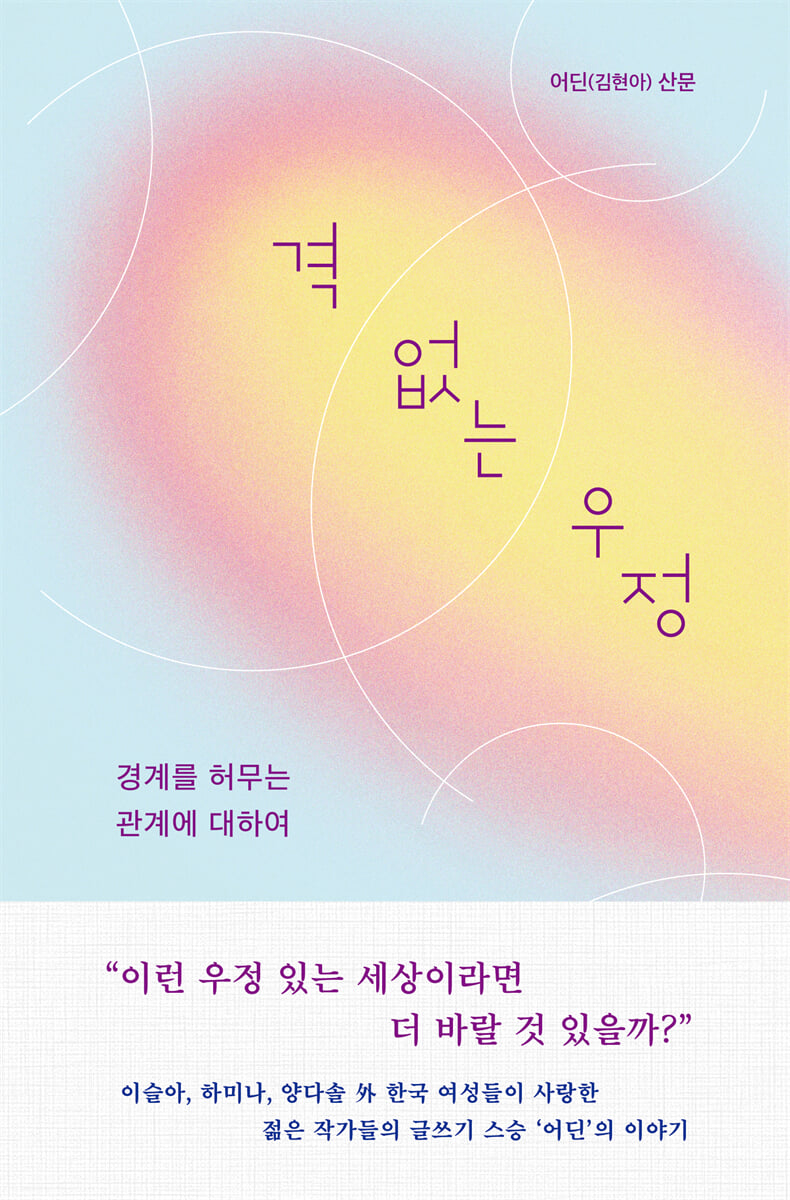
Friendship without formality
 |
Description
Book Introduction
“He is the one I can call my teacher,
“He is my only teacher.” - Lee Gil-bo-ra (film director)
who was someone's teacher,
Or was everyone's friend,
Records of a strange and ecstatic friendship
Author, operator of a children's library, founding member of the civic group Nawauri, and writing mentor to the next generation of female writers, including Isul-ah, Hamina, and Yang Da-sol.
These are all words that describe the writer (Kim Hyun-ah).
He, who has always lived his life silently listening to those in need, either from the side or behind the scenes, has now published a collection of essays titled “Friendship Without Borders,” which contains the story of the life and times of “human Kim Hyun-ah.”
Women and men, children and old people, living and dead, Vietnamese and Burmese, Korean and Japanese, human and non-human.
This book, which ultimately leads us to imagine the future of 'us' no matter what we communicate with, is full of episodes that vividly show that true friendship is created regardless of acquired traits or unchangeable conditions such as gender, age, and origin.
This book is a preview of the 'chance connection' that will come to you too.
After reading this, everything around you will look new.
“He is my only teacher.” - Lee Gil-bo-ra (film director)
who was someone's teacher,
Or was everyone's friend,
Records of a strange and ecstatic friendship
Author, operator of a children's library, founding member of the civic group Nawauri, and writing mentor to the next generation of female writers, including Isul-ah, Hamina, and Yang Da-sol.
These are all words that describe the writer (Kim Hyun-ah).
He, who has always lived his life silently listening to those in need, either from the side or behind the scenes, has now published a collection of essays titled “Friendship Without Borders,” which contains the story of the life and times of “human Kim Hyun-ah.”
Women and men, children and old people, living and dead, Vietnamese and Burmese, Korean and Japanese, human and non-human.
This book, which ultimately leads us to imagine the future of 'us' no matter what we communicate with, is full of episodes that vividly show that true friendship is created regardless of acquired traits or unchangeable conditions such as gender, age, and origin.
This book is a preview of the 'chance connection' that will come to you too.
After reading this, everything around you will look new.
- You can preview some of the book's contents.
Preview
index
Entering… In this era, everyone was a star, a planet, and a satellite to everyone.
Chapter 1… I am living in a writing room.
Who told me to go this way?
Courageous children and women who know the way of the martial arts
I Want to Live Too _Children's Book Room
Can We Die Naturally? _Youth Writing Room
The Genetic Revolution: Secret and Great _Working Women's Writing Room
Chapter 2…Holding Hands with a Handsome Man
A boy grows up to become a young man
Voluntary Extinctionist
Jeje, a well-off young man
To the Pa Army
Holding hands with a cool guy
Chapter 3…Working with a Great Woman
No, I can't do that.
These brave, lively, and fierce young comrades
belated letter
Wandering Restaurant
Noble things do not disappear, they are passed down.
Women of the Sewing Machine Factory Literature Class
Chapter 4… Interacting with Wonderful Foreign Friends
Me and Uri
Where is my friend's house
Minu, the exiled person
Goodbye Van Le
Chapter 5 … Friends of the Earth
The face of life
The Tale of the Octopus Princess
I decided to witness the death of a sheep.
The Age of Great Stories
Chapter 1… I am living in a writing room.
Who told me to go this way?
Courageous children and women who know the way of the martial arts
I Want to Live Too _Children's Book Room
Can We Die Naturally? _Youth Writing Room
The Genetic Revolution: Secret and Great _Working Women's Writing Room
Chapter 2…Holding Hands with a Handsome Man
A boy grows up to become a young man
Voluntary Extinctionist
Jeje, a well-off young man
To the Pa Army
Holding hands with a cool guy
Chapter 3…Working with a Great Woman
No, I can't do that.
These brave, lively, and fierce young comrades
belated letter
Wandering Restaurant
Noble things do not disappear, they are passed down.
Women of the Sewing Machine Factory Literature Class
Chapter 4… Interacting with Wonderful Foreign Friends
Me and Uri
Where is my friend's house
Minu, the exiled person
Goodbye Van Le
Chapter 5 … Friends of the Earth
The face of life
The Tale of the Octopus Princess
I decided to witness the death of a sheep.
The Age of Great Stories
Detailed image

Into the book
At the age of twenty-four, I was a young man and had something I wanted to do in my native language.
The stories of those who sought to overthrow dictatorship, uncover the truth about the Gwangju Massacre, and achieve national unification, the stories of those who became arrows that would never return, the faint but urgent sound of drums heard from the borders—as a young man, I wanted to write such stories.
A story of being too shy to raise one's head, a story swallowed up in shame, a story scattered into the air because no one listened.
So, it was shameful to use my native language in advertising, the flower of capitalism, I thought, oh my, at the age of twenty-four in 1990.
--- p.18 From “Who told me to go this way”
Sometimes it's heartwarming to hear what children write about their teachers.
It is important to meet them and deeply engrave in your mind that a single word or small action from a teacher can often create a huge ripple and resonance in the lives of children.
Children are always, always, always ready to study with teachers who are passionate about their classes, listen to their concerns attentively, and above all, are fair and generous.
It is a place where the heritage of mankind is passed down.
--- p.38 From “I Want to Live Too _ Children’s Book Room”
In the study room, I meet all the mothers in the world.
My mother, who left me at my grandmother's house saying she would come back after seven nights, but still hasn't come back even though she's in her mid-thirties; my alcoholic mother; my mother with hair like a lion's mane; my mother who died young after giving birth to me because she couldn't properly take care of herself after giving birth; my mother who serves the patriarchal system; my mother who resists the patriarchal system—all of these mothers get vivid expressions in my daughter's writing.
--- p.56 From “The Genetic Revolution, Secretly and Greatly _Working Women’s Writing Room”
“Well, can you explain the situation?”
“Even though we shouted ‘We are teenagers, we are teenagers,’ they arrested us indiscriminately.
“Those damn cops.”
“Okay, who’s on site right now?”
“It’s all there.
All of us.”
“Okay, listen to me carefully.
Let's go home for today.
Everyone is a little excited right now, so let’s go home today…”
Before he could even finish speaking, Kyeol answered.
“That can’t be.”
So, that tone of voice was something I had never heard before.
The words that the floating stars used to express their rejection were mainly things like “I don’t like it” or “I can’t do it.”
That can't be happening, Rani.
It was the first time I had heard such a clear and determined tone from a young person.
--- p.121 From “No, I can’t do that”
This is all I can do, Gowoon, so if you ever feel heartbroken or start to doubt yourself, please come to me.
I will testify to you how courageous, beautiful, and intelligent you are.
If it's that story, I could probably do it in a day and a half.
--- p.135 From “A Belated Letter”
I don't think comrades are made by chance.
When we plan, cooperate, and stand in solidarity, spending time together in adventure and struggle, when we endure endless toil and unseen humiliation, when we can witness and bear witness to each other's trials and wounds for a long time, there is my comrade, my friend who embodies both misery and greatness, nobility and foolishness, the weakest and at the same time the most desperate and strong in the world.
--- p.152 From “Noble things do not disappear but are passed down”
Oxygen, it's time to reveal your secret.
I feel the time has finally come to tell you this long-kept secret, and your responsibility now is to tell it to someone when the time comes.
We have never lost.
Since we first stood on our own two feet in the savannah forest, humanity has evolved to ensure that genes that save us, our neighbors, and all life win, and that will continue to do so.
Noble things do not disappear, but are passed down, barely barely.
--- p.154 From “Noble things do not disappear, but are passed down”
When someone asked why they came to Korea instead of going to a more advanced country like the UK, France, the US or Switzerland, one of the NLD members said:
“There is Gwangju in Korea.
“It’s a country where democracy was created through the power of the citizens.”
I thought to myself.
'Damn, this is going to be a long-term relationship.'
--- p.187 From “Where is my friend’s house?”
Ban Le is not his real name.
It's the name of a dead friend who wanted to become a poet.
When Ban Re became a poet, he abandoned his own name, 'Re Ji Tui', and took his friend's name.
Ban Re, who decided to become Ban Re, thought that his friend would live forever in the name, and that he was writing poetry only to fulfill his friend's wish.
--- p.208 From "Goodbye Van Re"
They were the masters and I was the guest.
The feeling was clear and vivid.
It filled my heart to know that there was a world they could only briefly float in, a world they could never master or own.
(…) ‘Humans are beautiful in places where humans are not the masters.’ I wrote this in my diving log on the day I went down to 24 meters under the sea.
The stories of those who sought to overthrow dictatorship, uncover the truth about the Gwangju Massacre, and achieve national unification, the stories of those who became arrows that would never return, the faint but urgent sound of drums heard from the borders—as a young man, I wanted to write such stories.
A story of being too shy to raise one's head, a story swallowed up in shame, a story scattered into the air because no one listened.
So, it was shameful to use my native language in advertising, the flower of capitalism, I thought, oh my, at the age of twenty-four in 1990.
--- p.18 From “Who told me to go this way”
Sometimes it's heartwarming to hear what children write about their teachers.
It is important to meet them and deeply engrave in your mind that a single word or small action from a teacher can often create a huge ripple and resonance in the lives of children.
Children are always, always, always ready to study with teachers who are passionate about their classes, listen to their concerns attentively, and above all, are fair and generous.
It is a place where the heritage of mankind is passed down.
--- p.38 From “I Want to Live Too _ Children’s Book Room”
In the study room, I meet all the mothers in the world.
My mother, who left me at my grandmother's house saying she would come back after seven nights, but still hasn't come back even though she's in her mid-thirties; my alcoholic mother; my mother with hair like a lion's mane; my mother who died young after giving birth to me because she couldn't properly take care of herself after giving birth; my mother who serves the patriarchal system; my mother who resists the patriarchal system—all of these mothers get vivid expressions in my daughter's writing.
--- p.56 From “The Genetic Revolution, Secretly and Greatly _Working Women’s Writing Room”
“Well, can you explain the situation?”
“Even though we shouted ‘We are teenagers, we are teenagers,’ they arrested us indiscriminately.
“Those damn cops.”
“Okay, who’s on site right now?”
“It’s all there.
All of us.”
“Okay, listen to me carefully.
Let's go home for today.
Everyone is a little excited right now, so let’s go home today…”
Before he could even finish speaking, Kyeol answered.
“That can’t be.”
So, that tone of voice was something I had never heard before.
The words that the floating stars used to express their rejection were mainly things like “I don’t like it” or “I can’t do it.”
That can't be happening, Rani.
It was the first time I had heard such a clear and determined tone from a young person.
--- p.121 From “No, I can’t do that”
This is all I can do, Gowoon, so if you ever feel heartbroken or start to doubt yourself, please come to me.
I will testify to you how courageous, beautiful, and intelligent you are.
If it's that story, I could probably do it in a day and a half.
--- p.135 From “A Belated Letter”
I don't think comrades are made by chance.
When we plan, cooperate, and stand in solidarity, spending time together in adventure and struggle, when we endure endless toil and unseen humiliation, when we can witness and bear witness to each other's trials and wounds for a long time, there is my comrade, my friend who embodies both misery and greatness, nobility and foolishness, the weakest and at the same time the most desperate and strong in the world.
--- p.152 From “Noble things do not disappear but are passed down”
Oxygen, it's time to reveal your secret.
I feel the time has finally come to tell you this long-kept secret, and your responsibility now is to tell it to someone when the time comes.
We have never lost.
Since we first stood on our own two feet in the savannah forest, humanity has evolved to ensure that genes that save us, our neighbors, and all life win, and that will continue to do so.
Noble things do not disappear, but are passed down, barely barely.
--- p.154 From “Noble things do not disappear, but are passed down”
When someone asked why they came to Korea instead of going to a more advanced country like the UK, France, the US or Switzerland, one of the NLD members said:
“There is Gwangju in Korea.
“It’s a country where democracy was created through the power of the citizens.”
I thought to myself.
'Damn, this is going to be a long-term relationship.'
--- p.187 From “Where is my friend’s house?”
Ban Le is not his real name.
It's the name of a dead friend who wanted to become a poet.
When Ban Re became a poet, he abandoned his own name, 'Re Ji Tui', and took his friend's name.
Ban Re, who decided to become Ban Re, thought that his friend would live forever in the name, and that he was writing poetry only to fulfill his friend's wish.
--- p.208 From "Goodbye Van Re"
They were the masters and I was the guest.
The feeling was clear and vivid.
It filled my heart to know that there was a world they could only briefly float in, a world they could never master or own.
(…) ‘Humans are beautiful in places where humans are not the masters.’ I wrote this in my diving log on the day I went down to 24 meters under the sea.
--- p.223 From “The Face of Life”
Publisher's Review
Dear 'Future Colleagues'!
"It's impossible to even fathom how many beings are alive and connected." - Hamina (author)
《Friendship Without Class》 is a collection of essays that contains serialized parts from the email delivery service 'A Chance Connection Somewhere', which is strongly recommended by writers Lee Seul-ah, Yang Da-sol, and Lee Ji-an (formerly Lee Da-ul), as well as unpublished additional manuscripts. It is a book that vividly depicts his life from his twenties to the present in his fifties.
He wanted to be a poet, but after surviving the military dictatorship when writing poetry was considered shameful, he founded a civic group and continued to advocate day and night for the socially disadvantaged, while also opening a writing room where people who wanted to write could gather, maintaining his identity as a "writer."
His life was full of life and excitement, filled with countless relationships that cared for each other at every turn.
Although he is a teacher, the author is also called 'Somewhere' by elementary school boys and young men in their twenties and thirties.
Ten-year-old Sinbad, who read The Adventures of Tom Sawyer in a children's library, said, "I want to live like Tom."
I sympathize and am surprised by his announcement that he wants to go on an adventure to find treasure, but on the other hand, as a teacher, I teach him that the American continent, discovered through an 'adventure', is only a 'discovery' for white people, but for the natives, it may be an 'invasion'.
He sympathizes with the feelings of boys who feel wronged by their school teacher's discrimination against girls and boys, and together they seek role models and solutions that they would not find awkward. He writes a letter to a colleague who he had spent time with, saying, "If the day comes that I doubt you in life, I will testify to how courageous and intelligent you are."
What all these stories have in common is that they are both 'teachers' who show us the direction we should take, and at the same time, they are also affectionate 'colleagues'.
So his face becomes most alive when he is called 'somewhere' rather than by any other honorific.
Because I ran away from the advertising company in my twenties and started writing with children, or because I couldn't forget the young people who carried the darkness of the times, like Park Jong-cheol, Lee Han-yeol, Lee Nae-chang, Park Seung-hee, and Kim Gwi-jeong, or because I shared friendships with all beings in the world, I choose to live a life of 'togetherness' in some ways.
Rather than distinguishing between the realm of 'you' and 'me', I am naturally inclined to expand the world of 'me and us', and rather than being afraid of a new era, I am filled with excitement.
In this kind of person's world, age, gender, and nationality do not matter.
Therefore, there are many colorful comrades.
Ultimately, "Friendship Without Borders" is a bold letter that unfolds the various aspects of relationships that break down boundaries in an age of hatred and discrimination, and proposes that you create a new era together.
This is because the author knows very clearly that the young people reading this article are the future of the coming era.
About gravity, listening to the lowest place
"What more could one ask for in a world filled with such friendship?" - Yang Da-sol (author)
Somewhere was once the operator of the civic group 'Me and Us'.
The sentence, “The 80s were my gravity,” gives an idea of how intense his twenties were.
Friends from Myanmar (Burma) who came to Korea after witnessing the Gwangju Democratization Movement; Minu, a Nepalese worker who lived in Korea for 18 years but was forcibly deported; and Van Le, a Vietnamese poet who writes poetry in the name of a friend who died in the war so as not to forget him.
'Nawauri' never stops working, even with worn-out wrists, to hear about their lives and spread the word.
I fly to Vietnam, turn on the recorder, ask questions, and imagine the pain of this human being sitting in front of me, and I cry.
Even a complex event like war can become a living, breathing narrative through the hands of someone.
This is because he is always equipped with a 'gravity' that makes him lean towards personal narratives beyond political and national contexts.
After the story of friendship shared with humans, the final chapter unfolds with stories of respect and awe toward non-humans.
Deep under the sea at a depth of 20 meters, in a documentary, and in a small village in Mongolia, we share moments of encountering different species, and feel how friendships that transcend species are possible and function.
It speaks with unwavering courage and determination that even anchovies have expressions, that we can shake hands with octopuses, and that even sheep have beating hearts; that once we look into the faces of non-human life, we cannot go back to the time before we knew it; that these beings, like us, once suffered, despaired, loved, and cheered, living their lives.
“They were the hosts and I was the guest.
The feeling was clear and vivid.
(...) 'Humans were beautiful where humans were not the masters.' I wrote this in my diving log on the day I went down to 24 meters under the sea." - From page 223
“Everyone who has looked closely and long at any living thing tries to tell how excellent and wonderful its abilities are.
“I try to convey that ‘deep’ communication is possible even with non-humans.” - From p. 229
“In the Mongolian steppes, people and animals have lived interdependently, caring for and respecting each other until the end of their lives.
They gave each other inspiration and comfort, and protected each other with unconditional love.
It won't be difficult to restore the sensitivity of life's solidarity.
The time I lived like that was much longer than the time I didn't live like that.
“Calling each other’s names.” - From page 237
Funny children and youth, caring men who understand and empathize with diversity, courageous women who reveal their suffering and take the lead in social issues, friends from other countries who cheerfully share stories despite their tragic lives of war and exile, and even non-human beings of other species.
This book is filled with the records of a 40-year-long, ecstatic friendship that has no boundaries or standards.
To modern people who have lost their sense of connection, we promise a dazzling belief that 'we can still be connected.'
"It's impossible to even fathom how many beings are alive and connected." - Hamina (author)
《Friendship Without Class》 is a collection of essays that contains serialized parts from the email delivery service 'A Chance Connection Somewhere', which is strongly recommended by writers Lee Seul-ah, Yang Da-sol, and Lee Ji-an (formerly Lee Da-ul), as well as unpublished additional manuscripts. It is a book that vividly depicts his life from his twenties to the present in his fifties.
He wanted to be a poet, but after surviving the military dictatorship when writing poetry was considered shameful, he founded a civic group and continued to advocate day and night for the socially disadvantaged, while also opening a writing room where people who wanted to write could gather, maintaining his identity as a "writer."
His life was full of life and excitement, filled with countless relationships that cared for each other at every turn.
Although he is a teacher, the author is also called 'Somewhere' by elementary school boys and young men in their twenties and thirties.
Ten-year-old Sinbad, who read The Adventures of Tom Sawyer in a children's library, said, "I want to live like Tom."
I sympathize and am surprised by his announcement that he wants to go on an adventure to find treasure, but on the other hand, as a teacher, I teach him that the American continent, discovered through an 'adventure', is only a 'discovery' for white people, but for the natives, it may be an 'invasion'.
He sympathizes with the feelings of boys who feel wronged by their school teacher's discrimination against girls and boys, and together they seek role models and solutions that they would not find awkward. He writes a letter to a colleague who he had spent time with, saying, "If the day comes that I doubt you in life, I will testify to how courageous and intelligent you are."
What all these stories have in common is that they are both 'teachers' who show us the direction we should take, and at the same time, they are also affectionate 'colleagues'.
So his face becomes most alive when he is called 'somewhere' rather than by any other honorific.
Because I ran away from the advertising company in my twenties and started writing with children, or because I couldn't forget the young people who carried the darkness of the times, like Park Jong-cheol, Lee Han-yeol, Lee Nae-chang, Park Seung-hee, and Kim Gwi-jeong, or because I shared friendships with all beings in the world, I choose to live a life of 'togetherness' in some ways.
Rather than distinguishing between the realm of 'you' and 'me', I am naturally inclined to expand the world of 'me and us', and rather than being afraid of a new era, I am filled with excitement.
In this kind of person's world, age, gender, and nationality do not matter.
Therefore, there are many colorful comrades.
Ultimately, "Friendship Without Borders" is a bold letter that unfolds the various aspects of relationships that break down boundaries in an age of hatred and discrimination, and proposes that you create a new era together.
This is because the author knows very clearly that the young people reading this article are the future of the coming era.
About gravity, listening to the lowest place
"What more could one ask for in a world filled with such friendship?" - Yang Da-sol (author)
Somewhere was once the operator of the civic group 'Me and Us'.
The sentence, “The 80s were my gravity,” gives an idea of how intense his twenties were.
Friends from Myanmar (Burma) who came to Korea after witnessing the Gwangju Democratization Movement; Minu, a Nepalese worker who lived in Korea for 18 years but was forcibly deported; and Van Le, a Vietnamese poet who writes poetry in the name of a friend who died in the war so as not to forget him.
'Nawauri' never stops working, even with worn-out wrists, to hear about their lives and spread the word.
I fly to Vietnam, turn on the recorder, ask questions, and imagine the pain of this human being sitting in front of me, and I cry.
Even a complex event like war can become a living, breathing narrative through the hands of someone.
This is because he is always equipped with a 'gravity' that makes him lean towards personal narratives beyond political and national contexts.
After the story of friendship shared with humans, the final chapter unfolds with stories of respect and awe toward non-humans.
Deep under the sea at a depth of 20 meters, in a documentary, and in a small village in Mongolia, we share moments of encountering different species, and feel how friendships that transcend species are possible and function.
It speaks with unwavering courage and determination that even anchovies have expressions, that we can shake hands with octopuses, and that even sheep have beating hearts; that once we look into the faces of non-human life, we cannot go back to the time before we knew it; that these beings, like us, once suffered, despaired, loved, and cheered, living their lives.
“They were the hosts and I was the guest.
The feeling was clear and vivid.
(...) 'Humans were beautiful where humans were not the masters.' I wrote this in my diving log on the day I went down to 24 meters under the sea." - From page 223
“Everyone who has looked closely and long at any living thing tries to tell how excellent and wonderful its abilities are.
“I try to convey that ‘deep’ communication is possible even with non-humans.” - From p. 229
“In the Mongolian steppes, people and animals have lived interdependently, caring for and respecting each other until the end of their lives.
They gave each other inspiration and comfort, and protected each other with unconditional love.
It won't be difficult to restore the sensitivity of life's solidarity.
The time I lived like that was much longer than the time I didn't live like that.
“Calling each other’s names.” - From page 237
Funny children and youth, caring men who understand and empathize with diversity, courageous women who reveal their suffering and take the lead in social issues, friends from other countries who cheerfully share stories despite their tragic lives of war and exile, and even non-human beings of other species.
This book is filled with the records of a 40-year-long, ecstatic friendship that has no boundaries or standards.
To modern people who have lost their sense of connection, we promise a dazzling belief that 'we can still be connected.'
GOODS SPECIFICS
- Date of issue: November 19, 2025
- Page count, weight, size: 244 pages | 310g | 135*205*15mm
- ISBN13: 9791193941546
You may also like
카테고리
korean


korean

![GQ KOREA Mark (Monthly): December [2025]](http://librairie.coreenne.fr/cdn/shop/files/8ef265dbbfbf186523ed75ba7319009d.jpg?v=1765340328&width=3840)


