

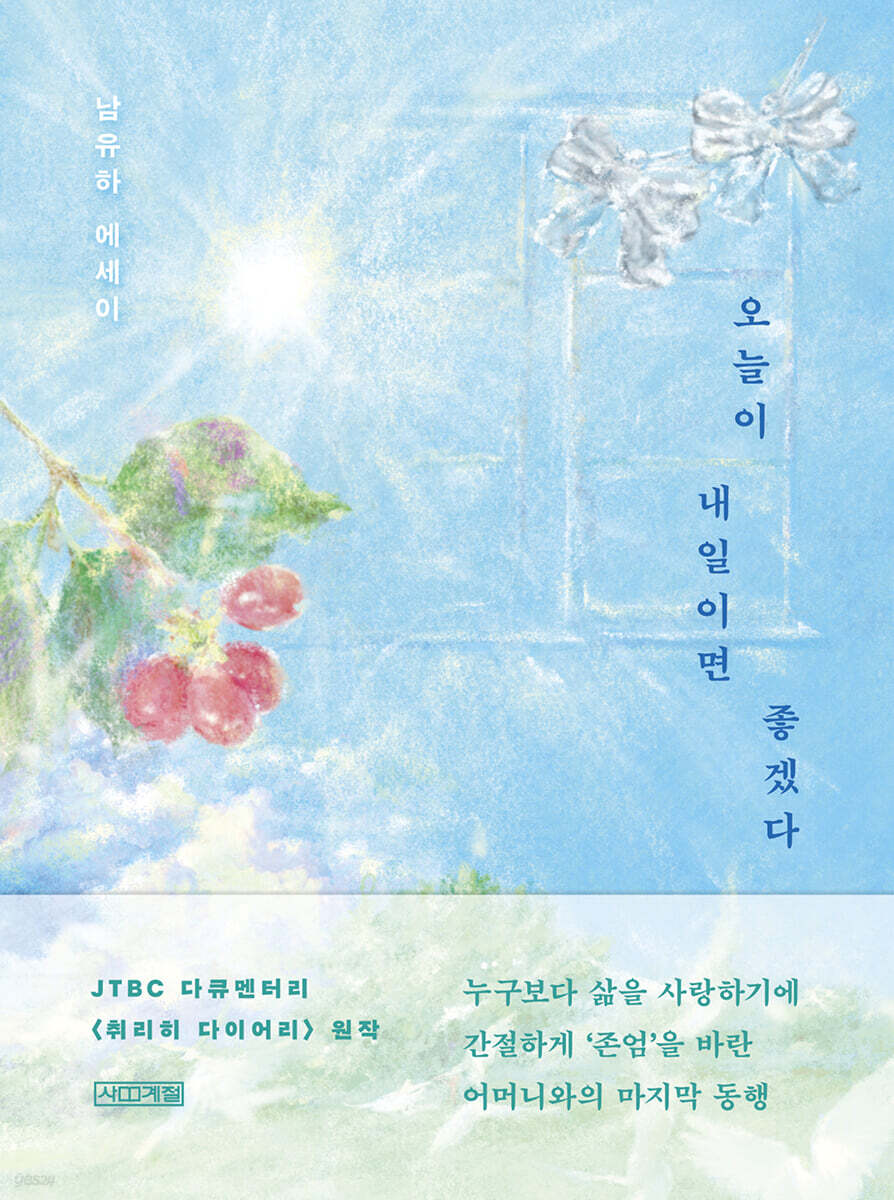
I wish today were tomorrow
 |
Description
Book Introduction
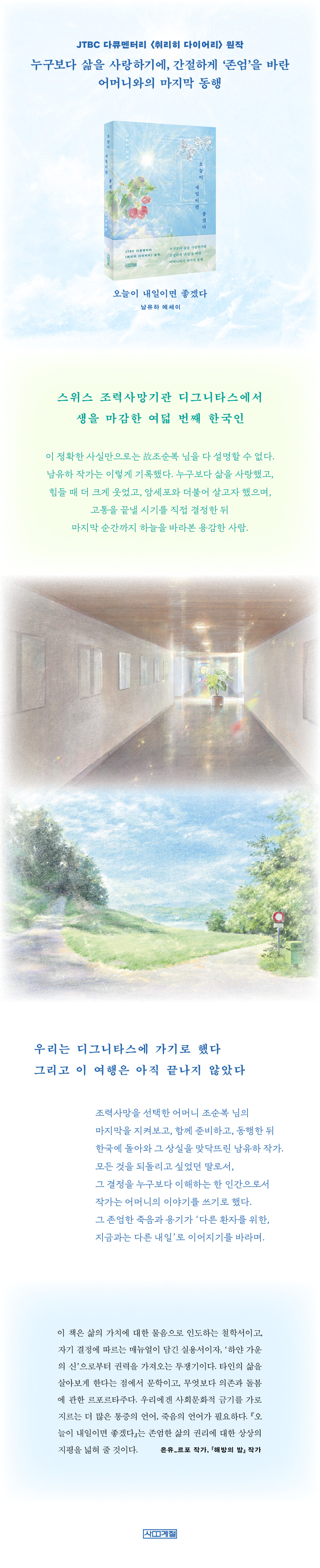
JTBC documentary [Zurich Diary] original
Because he loved life more than anyone else, he fiercely desired 'dignity' until the very end.
The final journey of a terminally ill mother and daughter
The eighth Korean to end his life at Dignitas, a Swiss assisted death organization.
This precise and brief fact alone cannot fully explain the late Jo Sun-bok.
Author Nam Yu-ha wrote:
A brave man who loved life more than anyone else, laughed louder when times were tough, wanted to live with cancer cells, and looked up to the sky until the very end after deciding for himself when to end his suffering.
"I wish today were tomorrow" is a record of the late Cho Sun-bok, who flew 8,770 km to Switzerland with an ailing body to exercise his final right to self-determination after a long battle with illness.
At the same time, it is also the story of novelist Nam Yu-ha, who watched over that choice as a daughter and a fellow human being, accompanied it, and returned to Korea to face the aftermath of that dignified death.
The times they spent together, or perhaps could have spent together, remind us of the profound connection between the preciousness of life and a dignified death.
At the same time, it calmly informs us of the existence of suffering people, whose suffering can be ended, and whose hope sustains their lives.
Therefore, this book is completed as a story about a dignified life, not about death.
A mother who filmed a documentary until her death, hoping that patients like her would one day die in Korea.
To remember his mother and pass on her courage, the author wrote about this entire process.
To find the meaning left by my mother's death in creating 'a tomorrow different from the past, for others.'
This book is a special record of love between a mother and daughter, a dazzling account of one person's struggle to preserve a dignified life, and a weighty question to our contemporaries about a "dignified life."
This book is a philosophical treatise that leads to questions about the value of life, a practical guide to self-determination, and a story of struggle to gain power from the "God in White."
It is literature in that it allows us to experience the lives of others, and above all, it is a reportage on dependence and care.
We need more languages of pain, languages of death, that cut across sociocultural taboos.
"I Wish Today Were Tomorrow" will broaden our horizons of imagination regarding the right to a dignified life.
- Eunyu (reporter, author of "Night of Liberation")
Because he loved life more than anyone else, he fiercely desired 'dignity' until the very end.
The final journey of a terminally ill mother and daughter
The eighth Korean to end his life at Dignitas, a Swiss assisted death organization.
This precise and brief fact alone cannot fully explain the late Jo Sun-bok.
Author Nam Yu-ha wrote:
A brave man who loved life more than anyone else, laughed louder when times were tough, wanted to live with cancer cells, and looked up to the sky until the very end after deciding for himself when to end his suffering.
"I wish today were tomorrow" is a record of the late Cho Sun-bok, who flew 8,770 km to Switzerland with an ailing body to exercise his final right to self-determination after a long battle with illness.
At the same time, it is also the story of novelist Nam Yu-ha, who watched over that choice as a daughter and a fellow human being, accompanied it, and returned to Korea to face the aftermath of that dignified death.
The times they spent together, or perhaps could have spent together, remind us of the profound connection between the preciousness of life and a dignified death.
At the same time, it calmly informs us of the existence of suffering people, whose suffering can be ended, and whose hope sustains their lives.
Therefore, this book is completed as a story about a dignified life, not about death.
A mother who filmed a documentary until her death, hoping that patients like her would one day die in Korea.
To remember his mother and pass on her courage, the author wrote about this entire process.
To find the meaning left by my mother's death in creating 'a tomorrow different from the past, for others.'
This book is a special record of love between a mother and daughter, a dazzling account of one person's struggle to preserve a dignified life, and a weighty question to our contemporaries about a "dignified life."
This book is a philosophical treatise that leads to questions about the value of life, a practical guide to self-determination, and a story of struggle to gain power from the "God in White."
It is literature in that it allows us to experience the lives of others, and above all, it is a reportage on dependence and care.
We need more languages of pain, languages of death, that cut across sociocultural taboos.
"I Wish Today Were Tomorrow" will broaden our horizons of imagination regarding the right to a dignified life.
- Eunyu (reporter, author of "Night of Liberation")
- You can preview some of the book's contents.
Preview
index
Prologue / Eight photos / It's raining in Santiago / Our code: It's raining in Santiago / Graceful death / Reserving death / Mom, I got the green light / D-Day, the time cut off / That day, the day our fate was decided / The remaining time, a week / People who don't come / Mom who left and Mom who will leave / Interview before departure / The day before departure / Sending Mom off in Switzerland / Departure day, August 1st / I wish today were tomorrow / Mom, goodbye / Three go, two come / Mom's house without Mom / Mourning diary / Mourning diary / Good bye, my dear / Writing Mom's story / The speed of the soul / Inconvenient people / Collecting fingernails / The times we could have had / Unspeakable death / The meaning of a funeral / Reincarnation / Looking at Mom's CT results / Mom's rock, Grandfather Pine, Squirrel / Memorial earrings / Wearing black clothes / The last week on earth / Mom's 49th day memorial service / Mom's dreams / Deciding to believe in the afterlife / Death report / Walking through sorrow / The moon, Moon / Right to Die Day / Mom and the Parallel Universe / Protest in front of the National Assembly / The Right to Die with Dignity / My Uncle's Death / Memorial Service / National Assembly Debate / People Who Share the Same Grief / What Is a Dignified Death? / Back to Switzerland / Epilogue / Author's Note
Detailed image
Into the book
You may not suffer from pain that you don't know when it will end.
You can decide for yourself when to end that suffering.
Just the possibility of that made Mom brighten up a little.
My mother said that in her final days, when she could not walk, if she could go back to a time when she was not sick, she would want to help sick people, especially those in wheelchairs.
These days, I can't just pass by people who are sick.
Once again, I cannot help but reflect on our early separation and the time we lost.
If only my mother could have closed her eyes at home, not in a strange and distant country.
I decided to write my mother's story truthfully.
Throughout this process, I imagined what kind of miracle would have to happen for my mother to not leave.
But we have come too far.
(…) For me, the miracle was that my mother arrived safely on the plane to Switzerland, and that she would fulfill her last wish safely tomorrow.
A Korean person dying comfortably in Korea, at home, surrounded by loving family and friends.
That was my mother's will and now it is my duty to continue it.
A mother who loved life even in the pain of cancer cells spreading throughout her body.
And my mother who loved me.
thank you.
i love you.
Even now, I regret the times we could have had.
I'm chewing over whether something went wrong.
At times like that, it feels like my mom is talking to me.
Don't look back on the past.
Do what you can from now on.
You can decide for yourself when to end that suffering.
Just the possibility of that made Mom brighten up a little.
My mother said that in her final days, when she could not walk, if she could go back to a time when she was not sick, she would want to help sick people, especially those in wheelchairs.
These days, I can't just pass by people who are sick.
Once again, I cannot help but reflect on our early separation and the time we lost.
If only my mother could have closed her eyes at home, not in a strange and distant country.
I decided to write my mother's story truthfully.
Throughout this process, I imagined what kind of miracle would have to happen for my mother to not leave.
But we have come too far.
(…) For me, the miracle was that my mother arrived safely on the plane to Switzerland, and that she would fulfill her last wish safely tomorrow.
A Korean person dying comfortably in Korea, at home, surrounded by loving family and friends.
That was my mother's will and now it is my duty to continue it.
A mother who loved life even in the pain of cancer cells spreading throughout her body.
And my mother who loved me.
thank you.
i love you.
Even now, I regret the times we could have had.
I'm chewing over whether something went wrong.
At times like that, it feels like my mom is talking to me.
Don't look back on the past.
Do what you can from now on.
--- From the text
Publisher's Review
"My mother, who loved life more than anyone else, made a choice that was more painful than death."
This book is a record of the late Cho Soon-bok, who passed away in 2023 at Dignitas, a Swiss assisted death organization, becoming the eighth Korean to pass away.
The recorder is the daughter who witnessed the death most closely, and is the author Nam Yu-ha, who is recognized for her unique world of works in the Korean science fiction literature world.
His mother was declared cured 10 years after breast cancer surgery, but just a few months later, she was given a terminal diagnosis: "The cancer that remained in her tissues had metastasized to her bones, and she was already in stage 4."
My mother, who was stronger and more cheerful than anyone else, went through repeated chemotherapy and surgeries.
I wanted to live with cancer cells.
But the cancer spread wildly throughout the body, into the bones, skin, stomach, and lungs.
My mother, whose physical and mental functions had almost completely disappeared, began to think of ways to take her own life.
The author was convinced that his mother was only 'imagining' death to momentarily forget her extreme pain.
But the moment he discovered the bandage in his mother's drawer, still wrapped in plastic, the author was terrified.
I'm afraid my mother will leave alone and lonely.
The author made his mother promise not to commit suicide, and instead began to think together about a good way to end her life.
And after a while, my mother remembered 'assisted death' that she had seen in a documentary.
After serious research and discussion, the two decided to go to Switzerland, which allows foreigners to die with assistance.
The process by which they decide to die through assisted dying is neither impulsive nor emotional.
Extremely careful and serious.
The conversation between a mother and daughter about death while eating together or lying in bed is so natural that it is all the more poignant.
For terminally ill cancer patients and their families, death is deeply embedded in their daily lives.
Days when we explode in pointless anger over why this happened, but also days when we ponder what we can truly do for each other.
This record honestly and calmly shows the daily lives of patients and their families, something that only those involved could imagine.
The scene tells the reader how desperate a choice this was for them.
And ask:
Can others really evaluate this choice?
“You can avoid suffering from pain that you don’t know when it will end.
You can decide for yourself when to end that suffering.
Just the possibility of that made Mom brighten up a little.
The fact that she could die whenever she wanted, paradoxically, gave her mother hope.
It's not that I absolutely want to die.
“Because the only way to end the pain that came without warning like a natural disaster and was as severe as torture was death.” (p. 52)
The weight of deciding, scheduling, and executing death
Dignitas is an organization of doctors and nurses who support assisted dying to ensure the right to self-determination of terminally ill and dying patients.
It was established to guarantee the right to self-determination of death to terminally ill patients and those in the final stages of life who are experiencing extreme physical and mental pain.
In order to respect his mother's wishes, the author communicated directly with Dignitas and set a 'date of separation'.
Numerous documents to inform the patient of his or her condition, records of his or her life, and documents to prove that assisted dying was the patient's choice.
The process of becoming a Dignitas member, and of course, obtaining permission for assisted dying, was rigorous and strict.
During that long process, the writer was in endless conflict.
As a daughter who wants to turn everything back, my heart and my heart as a fellow human being who sympathizes with my mother's decision clashed countless times.
Meanwhile, whenever the mother hesitated, the writer felt relieved.
Although I wanted to be free from the burden of scheduling my mother's death, I also fell into the fear that she might make an extreme choice.
Meanwhile, my mother's health deteriorated.
The excruciating pain of cancer that had spread from the femur to the stomach, the diagnosis that future treatment would be even more difficult for an elderly patient, and the response from the hospice that hospitalization was only possible for a maximum of two weeks…
Mother never gave in.
The separation from his mother was brought forward several times as his condition worsened.
The mother writhe in pain and worry that she might not even be able to fulfill her last wish: “to die the way I want to die.”
I had my fourth back surgery to get back on my feet before going to Switzerland, and I was on IV drips to get my energy up for going there.
Because terminally ill patients were not allowed on airplanes, they had to hide their pain and board the plane, and they had to be anxious about dying on the plane.
The author felt resentful and sad for his mother, who was using all her life's energy to prepare for 'death', and thought of only one thing.
Let's do the only thing we can do for our mother right now.
For a tomorrow different from yesterday
This book is divided into three major parts.
Part 1 covers the process of deciding on assisted dying and preparing to go to Dignitas, Part 2 covers the last three days spent with his mother in Switzerland, and Part 3 is Nam Yu-ha's "Mourning Diary" upon his return to Korea.
After returning to Korea, the author was faced with an unexpected reality.
In Korea, it was illegal to publicly announce my mother's death, and even reporting the death was not easy.
Could he allow the immense loss of his mother to remain a "death without words"? Could he have been robbed of the process of "mourning," of announcing someone's death and sharing sorrow and memories?
Although I was very happy that my mother was finally free from her suffering, I also felt a great regret that I could not have been with her a little longer.
"Diary of Mourning" delicately captures the sadness, regret, wandering, and longing.
The author prepares a memorial service for his mother with his father, announces her death, meets with those preparing for euthanasia and those who have lost their loved ones to it, talks with his father, and silently "walks" through his grief, observing the traces of love his mother left behind. He grieves deeply and at the same time, he is freeing himself from that grief.
And as he reflected on the lost times, the writer thought.
“If only my mother could have closed her eyes at home, not in a strange and distant land.”
The author is a member of the Korean Association for Dignified Death, has joined the Dignified Death Study Group, and has spoken out at rallies calling for the enactment of the Assisted Death Dignity Act.
For those who dismiss assisted dying as a disregard for life, the purpose was to inform the patient's family that the process is by no means 'comfortable' and to remind them of the weight and necessity of that choice.
In the process, the author discovered a bond of solidarity.
People who have experienced the same grief, people who continue to fight against the pain in various ways, and even people who have no connection to the decision but try to understand it and reach out.
This is a great legacy left by my mother.
For a tomorrow different from the past for countless people
A documentary film crew accompanied the mother and writer Nam Yu-ha on their trip to Switzerland.
My mother readily accepted the offer from the JTBC production team, who had made the connection through an interview with the Korea Dignitas Association.
I decided to appear without mosaic.
It is my hope that after me, terminally ill patients will be able to spend their final moments with their loved ones and face death in Korea.
The reporting team covered the entire process of author Nam Yu-ha's preparations in Korea, her journey in Switzerland, and her return to Korea, where she mourned and remembered her mother's death.
As his mother stood alone in front of the camera, author Nam Yu-ha wrote about the last times he spent with her.
Writing was scary and painful, the author confesses.
However, my mother's last wish, "I wish today were tomorrow," in hopes of ending the suffering as soon as possible, gave me the strength to endure that time.
The author speaks to the readers through this book.
All life and death is dignified.
Shouldn't society collectively consider ways to preserve the dignity of patients whose suffering can only be ended with life-prolonging treatment? No one deserves to suffer, right?
The mother's choice and the writer's decision may not be met with everyone's agreement.
Nevertheless, the author decided to find the meaning left by his mother's death in 'a tomorrow different from the past, for others.'
That determination makes this book more than just a deeply personal record; it has meaning for everyone living in this era.
While modern medicine has extended our lives and a social consensus is forming on how to die well, the bill on assisted dying continues to be pending, forcing us to confront the contradictions of our society today.
This book is a record of the late Cho Soon-bok, who passed away in 2023 at Dignitas, a Swiss assisted death organization, becoming the eighth Korean to pass away.
The recorder is the daughter who witnessed the death most closely, and is the author Nam Yu-ha, who is recognized for her unique world of works in the Korean science fiction literature world.
His mother was declared cured 10 years after breast cancer surgery, but just a few months later, she was given a terminal diagnosis: "The cancer that remained in her tissues had metastasized to her bones, and she was already in stage 4."
My mother, who was stronger and more cheerful than anyone else, went through repeated chemotherapy and surgeries.
I wanted to live with cancer cells.
But the cancer spread wildly throughout the body, into the bones, skin, stomach, and lungs.
My mother, whose physical and mental functions had almost completely disappeared, began to think of ways to take her own life.
The author was convinced that his mother was only 'imagining' death to momentarily forget her extreme pain.
But the moment he discovered the bandage in his mother's drawer, still wrapped in plastic, the author was terrified.
I'm afraid my mother will leave alone and lonely.
The author made his mother promise not to commit suicide, and instead began to think together about a good way to end her life.
And after a while, my mother remembered 'assisted death' that she had seen in a documentary.
After serious research and discussion, the two decided to go to Switzerland, which allows foreigners to die with assistance.
The process by which they decide to die through assisted dying is neither impulsive nor emotional.
Extremely careful and serious.
The conversation between a mother and daughter about death while eating together or lying in bed is so natural that it is all the more poignant.
For terminally ill cancer patients and their families, death is deeply embedded in their daily lives.
Days when we explode in pointless anger over why this happened, but also days when we ponder what we can truly do for each other.
This record honestly and calmly shows the daily lives of patients and their families, something that only those involved could imagine.
The scene tells the reader how desperate a choice this was for them.
And ask:
Can others really evaluate this choice?
“You can avoid suffering from pain that you don’t know when it will end.
You can decide for yourself when to end that suffering.
Just the possibility of that made Mom brighten up a little.
The fact that she could die whenever she wanted, paradoxically, gave her mother hope.
It's not that I absolutely want to die.
“Because the only way to end the pain that came without warning like a natural disaster and was as severe as torture was death.” (p. 52)
The weight of deciding, scheduling, and executing death
Dignitas is an organization of doctors and nurses who support assisted dying to ensure the right to self-determination of terminally ill and dying patients.
It was established to guarantee the right to self-determination of death to terminally ill patients and those in the final stages of life who are experiencing extreme physical and mental pain.
In order to respect his mother's wishes, the author communicated directly with Dignitas and set a 'date of separation'.
Numerous documents to inform the patient of his or her condition, records of his or her life, and documents to prove that assisted dying was the patient's choice.
The process of becoming a Dignitas member, and of course, obtaining permission for assisted dying, was rigorous and strict.
During that long process, the writer was in endless conflict.
As a daughter who wants to turn everything back, my heart and my heart as a fellow human being who sympathizes with my mother's decision clashed countless times.
Meanwhile, whenever the mother hesitated, the writer felt relieved.
Although I wanted to be free from the burden of scheduling my mother's death, I also fell into the fear that she might make an extreme choice.
Meanwhile, my mother's health deteriorated.
The excruciating pain of cancer that had spread from the femur to the stomach, the diagnosis that future treatment would be even more difficult for an elderly patient, and the response from the hospice that hospitalization was only possible for a maximum of two weeks…
Mother never gave in.
The separation from his mother was brought forward several times as his condition worsened.
The mother writhe in pain and worry that she might not even be able to fulfill her last wish: “to die the way I want to die.”
I had my fourth back surgery to get back on my feet before going to Switzerland, and I was on IV drips to get my energy up for going there.
Because terminally ill patients were not allowed on airplanes, they had to hide their pain and board the plane, and they had to be anxious about dying on the plane.
The author felt resentful and sad for his mother, who was using all her life's energy to prepare for 'death', and thought of only one thing.
Let's do the only thing we can do for our mother right now.
For a tomorrow different from yesterday
This book is divided into three major parts.
Part 1 covers the process of deciding on assisted dying and preparing to go to Dignitas, Part 2 covers the last three days spent with his mother in Switzerland, and Part 3 is Nam Yu-ha's "Mourning Diary" upon his return to Korea.
After returning to Korea, the author was faced with an unexpected reality.
In Korea, it was illegal to publicly announce my mother's death, and even reporting the death was not easy.
Could he allow the immense loss of his mother to remain a "death without words"? Could he have been robbed of the process of "mourning," of announcing someone's death and sharing sorrow and memories?
Although I was very happy that my mother was finally free from her suffering, I also felt a great regret that I could not have been with her a little longer.
"Diary of Mourning" delicately captures the sadness, regret, wandering, and longing.
The author prepares a memorial service for his mother with his father, announces her death, meets with those preparing for euthanasia and those who have lost their loved ones to it, talks with his father, and silently "walks" through his grief, observing the traces of love his mother left behind. He grieves deeply and at the same time, he is freeing himself from that grief.
And as he reflected on the lost times, the writer thought.
“If only my mother could have closed her eyes at home, not in a strange and distant land.”
The author is a member of the Korean Association for Dignified Death, has joined the Dignified Death Study Group, and has spoken out at rallies calling for the enactment of the Assisted Death Dignity Act.
For those who dismiss assisted dying as a disregard for life, the purpose was to inform the patient's family that the process is by no means 'comfortable' and to remind them of the weight and necessity of that choice.
In the process, the author discovered a bond of solidarity.
People who have experienced the same grief, people who continue to fight against the pain in various ways, and even people who have no connection to the decision but try to understand it and reach out.
This is a great legacy left by my mother.
For a tomorrow different from the past for countless people
A documentary film crew accompanied the mother and writer Nam Yu-ha on their trip to Switzerland.
My mother readily accepted the offer from the JTBC production team, who had made the connection through an interview with the Korea Dignitas Association.
I decided to appear without mosaic.
It is my hope that after me, terminally ill patients will be able to spend their final moments with their loved ones and face death in Korea.
The reporting team covered the entire process of author Nam Yu-ha's preparations in Korea, her journey in Switzerland, and her return to Korea, where she mourned and remembered her mother's death.
As his mother stood alone in front of the camera, author Nam Yu-ha wrote about the last times he spent with her.
Writing was scary and painful, the author confesses.
However, my mother's last wish, "I wish today were tomorrow," in hopes of ending the suffering as soon as possible, gave me the strength to endure that time.
The author speaks to the readers through this book.
All life and death is dignified.
Shouldn't society collectively consider ways to preserve the dignity of patients whose suffering can only be ended with life-prolonging treatment? No one deserves to suffer, right?
The mother's choice and the writer's decision may not be met with everyone's agreement.
Nevertheless, the author decided to find the meaning left by his mother's death in 'a tomorrow different from the past, for others.'
That determination makes this book more than just a deeply personal record; it has meaning for everyone living in this era.
While modern medicine has extended our lives and a social consensus is forming on how to die well, the bill on assisted dying continues to be pending, forcing us to confront the contradictions of our society today.
GOODS SPECIFICS
- Date of issue: January 3, 2025
- Page count, weight, size: 312 pages | 444g | 140*188*20mm
- ISBN13: 9791169813488
- ISBN10: 1169813488
You may also like
카테고리
korean


korean

![GQ KOREA Mark (Monthly): December [2025]](http://librairie.coreenne.fr/cdn/shop/files/8ef265dbbfbf186523ed75ba7319009d.jpg?v=1765340328&width=3840)


