

Na Tae-joo's Happiness Class
 |
Description
Book Introduction
Kim Ji-soo, the author of ‘Lee Eo-ryeong’s Last Lesson’
Spring Happiness Lessons from "Wildflower Poet" Na Tae-ju
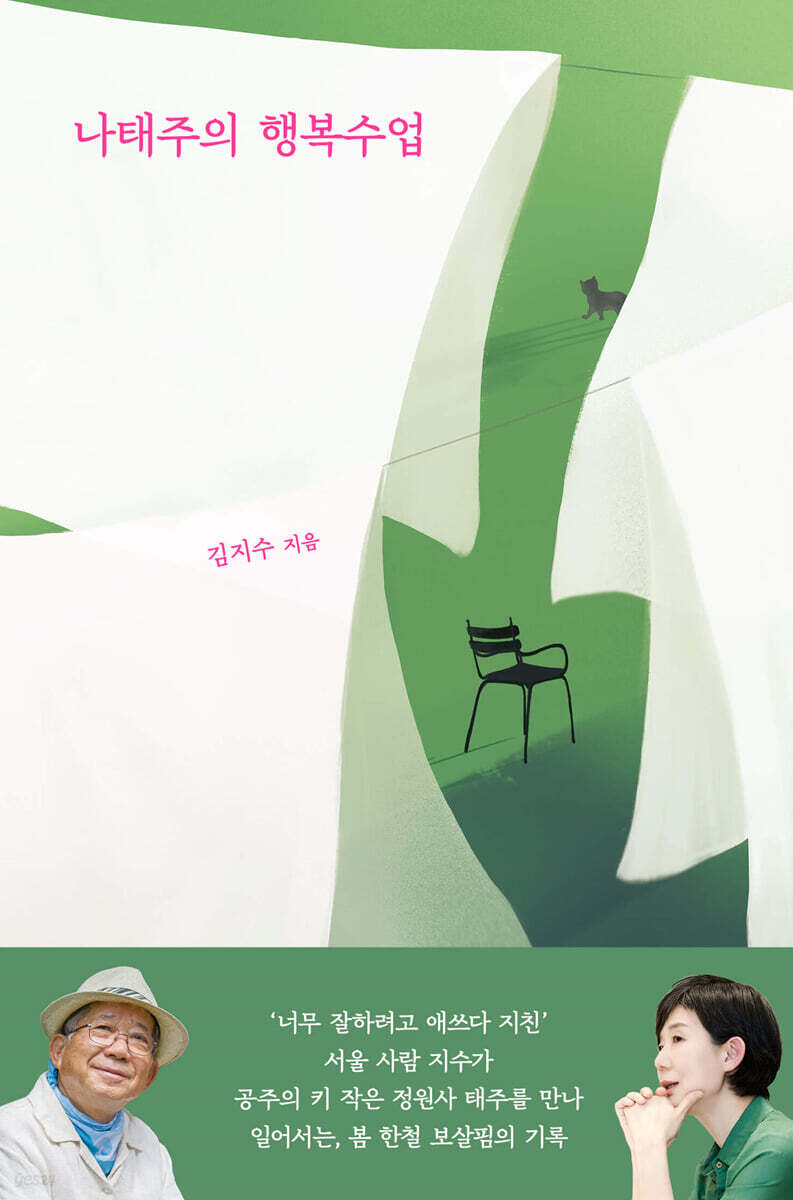
“Seoul native Jisoo, who is ‘tired of trying too hard to do well’
The princess meets the short gardener Taeju and stands up.
“A Record of Spring Care”
“You are pretty even if you are not pretty.”
Life is about being cheerful in the midst of misery.
It's okay to just live.
I was like a withered blade of grass
“I received Na Tae-joo’s cheering song and slowly blossomed.”
The interview essay "Na Tae-ju's Happiness Class" by Kim Ji-su, author of "Interstellar" and "Wildflower Poet" Na Tae-ju, author of "Lee Eo-ryeong's Last Class," has been published.
This book is a travelogue of a spring season written by Seoul native Kim Ji-su at the Wildflower Literature Museum in Gongju every Monday from February to May 2023, and is the result of a happy class.
Additionally, it is a record of the friendship between 'flower poets' Na Tae-joo and Kim Ji-soo that transcends generations and 'saved each other', and it is also the most touching and affectionate cheering song dedicated to all adults who are 'tired from trying too hard'.
The moment you open the book, you will meet Tae-ju, the 'short gardener' in the princess's small village, and witness the magic of flowers blooming again, like Yun-seul, receiving hope like the flowers he carefully tends at the Wildflower Literature Museum.
This book is a follow-up to the last interview collection with Professor Lee Eo-ryeong, 『Lee Eo-ryeong's Last Class』. “If 『Lee Eo-ryeong's Last Class』 is the 'spoils of the night' given by a dying teacher at the dark crossroads, then 『Na Tae-ju's Happiness Class』 is a 'letter of the morning' given to those who must stand at the starting line again every day while looking at the rising sun.”
Spring Happiness Lessons from "Wildflower Poet" Na Tae-ju
“Seoul native Jisoo, who is ‘tired of trying too hard to do well’
The princess meets the short gardener Taeju and stands up.
“A Record of Spring Care”
“You are pretty even if you are not pretty.”
Life is about being cheerful in the midst of misery.
It's okay to just live.
I was like a withered blade of grass
“I received Na Tae-joo’s cheering song and slowly blossomed.”
The interview essay "Na Tae-ju's Happiness Class" by Kim Ji-su, author of "Interstellar" and "Wildflower Poet" Na Tae-ju, author of "Lee Eo-ryeong's Last Class," has been published.
This book is a travelogue of a spring season written by Seoul native Kim Ji-su at the Wildflower Literature Museum in Gongju every Monday from February to May 2023, and is the result of a happy class.
Additionally, it is a record of the friendship between 'flower poets' Na Tae-joo and Kim Ji-soo that transcends generations and 'saved each other', and it is also the most touching and affectionate cheering song dedicated to all adults who are 'tired from trying too hard'.
The moment you open the book, you will meet Tae-ju, the 'short gardener' in the princess's small village, and witness the magic of flowers blooming again, like Yun-seul, receiving hope like the flowers he carefully tends at the Wildflower Literature Museum.
This book is a follow-up to the last interview collection with Professor Lee Eo-ryeong, 『Lee Eo-ryeong's Last Class』. “If 『Lee Eo-ryeong's Last Class』 is the 'spoils of the night' given by a dying teacher at the dark crossroads, then 『Na Tae-ju's Happiness Class』 is a 'letter of the morning' given to those who must stand at the starting line again every day while looking at the rising sun.”
- You can preview some of the book's contents.
Preview
index
Introduction_ It's okay to just live
Part 1_ Knowing Misery and Still Being Cheerful
The most beautiful spring is coming / Quietly and clumsily / The gentle stream of poetry / Each and every one of you / Where can there be a smile without pain / If I shake, I won't fall apart / At least I have to spend the evening comfortably / Being good to others, that's all that remains / The end of beauty is always 'you', not 'me'
Part 2: Why am I so small?
It's okay to regret / To see that green, you have to keep your distance / The fate that we jumped into together / Draw 'the world I left'? / Teacher, what is friendship? / That was enough love / It's autumn, please don't be sick... / Even if we're not pretty, we have to become pretty people
Part 3: What Face Does Adult Love Take?
All of you want consideration / Just like a streetlight goes out, isn't death the same? / Good poetry has moisture and sparkle / Eighty-year-old love is... ... a diligent love / Poetry and life also require moisture / Jisoo has experienced countless wars in her life / It's because there were no flowers in her heart / Don't hate me, because you'll see me again
Part 4: Faces of Deficiency
It will bloom beautifully like its name / But let's put the sadness aside for a while / Creation is like stabbing rice with a knife / It's important to sense lack and joy / Like grains piling up in a casserole / Teacher, what is your heart? / If hardships challenge you, do the opposite unconditionally
Part 5_ Come again, come often, come whenever you have the chance!
I cried, I laughed, and then it ended / If you give up on everything, you'll be old even if you're young / Why did you refuse even though I gave you money? / Your life is ruined here, so stop / They tell you not to go, but there's a path I want to take / I'm weak, I don't know, but that's okay / Tae-ju, who is an old person, continues to wear new clothes and is reborn / Today, I died well and lived well.
Part 6_ Just live
Bokseokcho, kkaengkaengipul, I'll be back / Walking the 'Ieo-ryeong-gil' with Taeju / Don't be discouraged and live, bloom, it's so good / The beginning of recovery is acknowledging that you're weak / Don't be lonely, it's okay to be wrong / I live cherishing my loving heart / Don't go too far, love / For whom do you give birth to children? / I used that hunger to good use / Just, live.
Part 7_ Inviting small adversities into life
Because all living things are trembling / Trembling is life / Like a spring flower / You have to avoid things to love / Ask, my heart.
Do you still need me? / We are still clumsy beings / Cry for good things, cry for flowers, cry for clouds / Tae-ju who told me not to try hard and Tae-ju who told me to force myself
Part 8: The one thing I must do when I come into this world is to be happy, even if it means forcing myself to be happy.
The short gardener / Today is the last day to meet Tae-ju / Today is the last time, have you found the answer? / I'm a junk dealer / When money becomes pretty / What kind of life did you long for? / If not poetry, then rice, if not rice, then money / Don't try too hard to do well when you go to Seoul
Flow and reach the sea_Na Tae-joo
Part 1_ Knowing Misery and Still Being Cheerful
The most beautiful spring is coming / Quietly and clumsily / The gentle stream of poetry / Each and every one of you / Where can there be a smile without pain / If I shake, I won't fall apart / At least I have to spend the evening comfortably / Being good to others, that's all that remains / The end of beauty is always 'you', not 'me'
Part 2: Why am I so small?
It's okay to regret / To see that green, you have to keep your distance / The fate that we jumped into together / Draw 'the world I left'? / Teacher, what is friendship? / That was enough love / It's autumn, please don't be sick... / Even if we're not pretty, we have to become pretty people
Part 3: What Face Does Adult Love Take?
All of you want consideration / Just like a streetlight goes out, isn't death the same? / Good poetry has moisture and sparkle / Eighty-year-old love is... ... a diligent love / Poetry and life also require moisture / Jisoo has experienced countless wars in her life / It's because there were no flowers in her heart / Don't hate me, because you'll see me again
Part 4: Faces of Deficiency
It will bloom beautifully like its name / But let's put the sadness aside for a while / Creation is like stabbing rice with a knife / It's important to sense lack and joy / Like grains piling up in a casserole / Teacher, what is your heart? / If hardships challenge you, do the opposite unconditionally
Part 5_ Come again, come often, come whenever you have the chance!
I cried, I laughed, and then it ended / If you give up on everything, you'll be old even if you're young / Why did you refuse even though I gave you money? / Your life is ruined here, so stop / They tell you not to go, but there's a path I want to take / I'm weak, I don't know, but that's okay / Tae-ju, who is an old person, continues to wear new clothes and is reborn / Today, I died well and lived well.
Part 6_ Just live
Bokseokcho, kkaengkaengipul, I'll be back / Walking the 'Ieo-ryeong-gil' with Taeju / Don't be discouraged and live, bloom, it's so good / The beginning of recovery is acknowledging that you're weak / Don't be lonely, it's okay to be wrong / I live cherishing my loving heart / Don't go too far, love / For whom do you give birth to children? / I used that hunger to good use / Just, live.
Part 7_ Inviting small adversities into life
Because all living things are trembling / Trembling is life / Like a spring flower / You have to avoid things to love / Ask, my heart.
Do you still need me? / We are still clumsy beings / Cry for good things, cry for flowers, cry for clouds / Tae-ju who told me not to try hard and Tae-ju who told me to force myself
Part 8: The one thing I must do when I come into this world is to be happy, even if it means forcing myself to be happy.
The short gardener / Today is the last day to meet Tae-ju / Today is the last time, have you found the answer? / I'm a junk dealer / When money becomes pretty / What kind of life did you long for? / If not poetry, then rice, if not rice, then money / Don't try too hard to do well when you go to Seoul
Flow and reach the sea_Na Tae-joo
Detailed image

Into the book
“I know why people like Laziness’s poetry.
You don't reign.
I don't think you're being rude.
I feel sorry for everyone.
When a nosy person comes near me, my skin starts to tremble.
“The strong emotions seeped out like wet paper.”
They said that there is hope for pretty people even if they are not pretty.
There is hope not for the successful people who want to hang out in high places, but for the ugly people who live tangled up like roots at the bottom.
--- p.91
‘Can you see the midnight crow? Can you hear the midnight crow? … .’ I was now having the same conversation I had with Professor Lee Eo-ryeong about ‘The Touch of Fate’ with Professor Na Tae-ju.
The seasons come but we don't notice them, the birds sing but we don't hear them... ... We live without seeing all the things that nature has put in place, like bookmarks of time.
I can't even catch the countless frequencies that pass by me.
How much do we live unaware of?
The realization that we cannot know everything about this world, that we do not know, gave me a refreshing thrill.
Taeju said with a smile.
“You can just feel it and go.
It is important to feel that you don't know what you know... that is the poet's ability.
With a jujube in front of him, poet Jang Seok-ju sees both the lightning and the crescent moon trapped within it.
Hehe.
“Just put one fruit in your mouth and that’s it… … You feel it, you feel a story you don’t know.”
--- p.101
“There is something called moisture.
“In good times, there is moisture and sparkle.”
“It’s moisturizing.
“Is it like a water glow?”
"yes.
It's moisture.
“There is moisture and water in both Kihyungdo’s “Jealousy is My Strength” and Yun Dongju’s “Starry Night.”
“When do moisture and water occur?”
“It happens when you are honest.”
Jisoo always admired Taejoo's honesty whenever she saw him.
“I want to be honest too, but I always worry if you can handle my honesty.”
“Honestly, it comes from giving up even that.”
--- p.102
Perhaps because he chose to give up rather than practice self-denial at every turn of life, Taeju became a poet, not a monk, a professor, or a 'loser'.
A poet who sees and speaks beautifully of insignificant things.
A poet who does not look down on even a single blade of grass that lowers its head.
--- p.105
“……What does the love of eighty years, obtained through countless sacrifices, look like?”
A smile spread across his large, concentric face.
“Love at eighty is… diligent love.”
“Diligent love…….”
“When my wife tells me to sit down and pee, I sit down and pee quietly.
“If you’re told to take a bath, take a bath and put on clean clothes.”
“It’s the love of a gentle child!”
"sure.
It's the pinnacle of giving up, love at eighty.
And don't even take your socks off inside out.
Without throwing it under the table or under the blanket.
That's the beginning of love.
“That’s the right attitude for a poet.”
--- pp.109~110
Although we couldn't savor the sunset or look at the stars together, it was enough to enjoy the moon rising in the distance and the stars twinkling on the river.
Taeju was a morning man, so he went to the house where Seongye was waiting in the evening.
But during the day, Taeju's friendship was always accompanied by excitement, and Taeju himself kept the love saturated with blushing shyly or laughing nervously.
Taeju was the princess's pride, and the princess was Taeju's pride.
The city became more lush, brighter, and closer because the 'beautiful seed' named Taeju flew into the arms of the polite princess who 'did not treat anyone carelessly.'
--- p.126
“We all want to be heard.
The true heart wants to be discovered purely.
Both lonely and melancholic hearts.
This is our task.
To bring out one's own mind as it is, without changing or distorting it.
But you can't just take it out.
You have to dress it up in language and take it out.
The mind keeps moving like an amoeba.
You have to feel it by keeping your mind still.
“We have to smell it, hear it, feel it… … and then we have to dress it in the clothes of language and take out the evil.”
--- pp.155~156
As they walked along the 'Ieo-ryeong Road' with Tae-ju, the two were caught up in their own thoughts.
To Jisoo, Lee Eo-ryeong was a teacher with big and clear thoughts, and Na Tae-ju was a father with a funny and affectionate feel.
Lee Eo-ryeong had large movements like an orchestra conductor, and Na Tae-joo had facial expressions that changed constantly like a comedian.
Lee Eo-ryeong's eyes sparkled with foresight, and Na Tae-ju's eyes were moist with tears.
Lee Eo-ryeong was a generous egoist who spent his entire life exploring death, himself, and the universe, while Na Tae-ju was a romantic who devoted his entire life to you, flowers, and love.
Lee Eo-ryeong used the lofty language of truth, goodness, and beauty, while Na Tae-ju used the language of daily life, consciousness, and thought, but both were masters of metaphor that passed through spirituality.
Between the intellectual with an infinite vocabulary and the poet with an infinite memory, Jisoo felt a strange difference in their polarity.
Both of them were from Chungcheong Province, had a great sense of humor, and were short.
Above all, he loved the future generations that would be left behind.
--- pp.201~202
“The beginning of recovery is acknowledging that you are weak.
Don't be ashamed of your weakness.
A person who has suffered from illness and regained his strength after eating porridge can help others when they are sick.
That's the logic.
I don't avoid getting sick because I have a disease.
“It’s okay to be weak, and it’s not bad to live humbly.”
You don't reign.
I don't think you're being rude.
I feel sorry for everyone.
When a nosy person comes near me, my skin starts to tremble.
“The strong emotions seeped out like wet paper.”
They said that there is hope for pretty people even if they are not pretty.
There is hope not for the successful people who want to hang out in high places, but for the ugly people who live tangled up like roots at the bottom.
--- p.91
‘Can you see the midnight crow? Can you hear the midnight crow? … .’ I was now having the same conversation I had with Professor Lee Eo-ryeong about ‘The Touch of Fate’ with Professor Na Tae-ju.
The seasons come but we don't notice them, the birds sing but we don't hear them... ... We live without seeing all the things that nature has put in place, like bookmarks of time.
I can't even catch the countless frequencies that pass by me.
How much do we live unaware of?
The realization that we cannot know everything about this world, that we do not know, gave me a refreshing thrill.
Taeju said with a smile.
“You can just feel it and go.
It is important to feel that you don't know what you know... that is the poet's ability.
With a jujube in front of him, poet Jang Seok-ju sees both the lightning and the crescent moon trapped within it.
Hehe.
“Just put one fruit in your mouth and that’s it… … You feel it, you feel a story you don’t know.”
--- p.101
“There is something called moisture.
“In good times, there is moisture and sparkle.”
“It’s moisturizing.
“Is it like a water glow?”
"yes.
It's moisture.
“There is moisture and water in both Kihyungdo’s “Jealousy is My Strength” and Yun Dongju’s “Starry Night.”
“When do moisture and water occur?”
“It happens when you are honest.”
Jisoo always admired Taejoo's honesty whenever she saw him.
“I want to be honest too, but I always worry if you can handle my honesty.”
“Honestly, it comes from giving up even that.”
--- p.102
Perhaps because he chose to give up rather than practice self-denial at every turn of life, Taeju became a poet, not a monk, a professor, or a 'loser'.
A poet who sees and speaks beautifully of insignificant things.
A poet who does not look down on even a single blade of grass that lowers its head.
--- p.105
“……What does the love of eighty years, obtained through countless sacrifices, look like?”
A smile spread across his large, concentric face.
“Love at eighty is… diligent love.”
“Diligent love…….”
“When my wife tells me to sit down and pee, I sit down and pee quietly.
“If you’re told to take a bath, take a bath and put on clean clothes.”
“It’s the love of a gentle child!”
"sure.
It's the pinnacle of giving up, love at eighty.
And don't even take your socks off inside out.
Without throwing it under the table or under the blanket.
That's the beginning of love.
“That’s the right attitude for a poet.”
--- pp.109~110
Although we couldn't savor the sunset or look at the stars together, it was enough to enjoy the moon rising in the distance and the stars twinkling on the river.
Taeju was a morning man, so he went to the house where Seongye was waiting in the evening.
But during the day, Taeju's friendship was always accompanied by excitement, and Taeju himself kept the love saturated with blushing shyly or laughing nervously.
Taeju was the princess's pride, and the princess was Taeju's pride.
The city became more lush, brighter, and closer because the 'beautiful seed' named Taeju flew into the arms of the polite princess who 'did not treat anyone carelessly.'
--- p.126
“We all want to be heard.
The true heart wants to be discovered purely.
Both lonely and melancholic hearts.
This is our task.
To bring out one's own mind as it is, without changing or distorting it.
But you can't just take it out.
You have to dress it up in language and take it out.
The mind keeps moving like an amoeba.
You have to feel it by keeping your mind still.
“We have to smell it, hear it, feel it… … and then we have to dress it in the clothes of language and take out the evil.”
--- pp.155~156
As they walked along the 'Ieo-ryeong Road' with Tae-ju, the two were caught up in their own thoughts.
To Jisoo, Lee Eo-ryeong was a teacher with big and clear thoughts, and Na Tae-ju was a father with a funny and affectionate feel.
Lee Eo-ryeong had large movements like an orchestra conductor, and Na Tae-joo had facial expressions that changed constantly like a comedian.
Lee Eo-ryeong's eyes sparkled with foresight, and Na Tae-ju's eyes were moist with tears.
Lee Eo-ryeong was a generous egoist who spent his entire life exploring death, himself, and the universe, while Na Tae-ju was a romantic who devoted his entire life to you, flowers, and love.
Lee Eo-ryeong used the lofty language of truth, goodness, and beauty, while Na Tae-ju used the language of daily life, consciousness, and thought, but both were masters of metaphor that passed through spirituality.
Between the intellectual with an infinite vocabulary and the poet with an infinite memory, Jisoo felt a strange difference in their polarity.
Both of them were from Chungcheong Province, had a great sense of humor, and were short.
Above all, he loved the future generations that would be left behind.
--- pp.201~202
“The beginning of recovery is acknowledging that you are weak.
Don't be ashamed of your weakness.
A person who has suffered from illness and regained his strength after eating porridge can help others when they are sick.
That's the logic.
I don't avoid getting sick because I have a disease.
“It’s okay to be weak, and it’s not bad to live humbly.”
--- p.213
Publisher's Review
Kim Ji-soo, the author of ‘Lee Eo-ryeong’s Last Lesson’
Spring Happiness Lessons from "Wildflower Poet" Na Tae-ju
“Taeju, for a moment, lets Jisoo escape from the ‘umbrella of thoughts called Lee Eo-ryeong’
I wanted to be drenched in the pouring rain of emotions.
Swim like a fish in the stream of feelings, not in the stream of thoughts.
Become more open, more relaxed, more free
I hope it flows more smoothly.
“I’ll be back after playing.” With a cheerful greeting. - From the introduction
The interview essay "Na Tae-ju's Happiness Class" by Kim Ji-su, author of "Interstellar" and "Wildflower Poet" Na Tae-ju, author of "Lee Eo-ryeong's Last Class," has been published.
This book is a travelogue of a spring season written by Seoul native Kim Ji-su at the Wildflower Literature Museum in Gongju every Monday from February to May 2023, and is the result of a happy class.
Additionally, it is a record of the friendship between 'flower poets' Na Tae-joo and Kim Ji-soo that transcends generations and 'saved each other', and it is also the most touching and affectionate cheering song dedicated to all adults who are 'tired from trying too hard'.
The moment you open the book, you will meet Tae-ju, the 'short gardener' in the princess's small village, and witness the magic of flowers blooming again, like Yun-seul, receiving hope like the flowers he carefully tends at the Wildflower Literature Museum.
This book is a follow-up to the last interview collection with Professor Lee Eo-ryeong, 『Lee Eo-ryeong's Last Class』. “If 『Lee Eo-ryeong's Last Class』 is the 'spoils of the night' given by a dying teacher at the dark crossroads, then 『Na Tae-ju's Happiness Class』 is a 'letter of the morning' given to those who must stand at the starting line again every day while looking at the rising sun.”
In pursuit of the 'essence of happiness'
A life's journey to the prettiest outskirts
“Living is… you know.
“It’s a cheerful thing in the midst of great misery.”
A poet who sees and speaks beautifully of insignificant things.
As a poet who does not look down on even a single blade of grass with its head bowed, I sing eight songs of encouragement until my throat is hoarse for “you” who is closest to me and all the ordinary people who exist in low places, “for you and me who live day after day, the most moist adult of our time.”
Because 'the low posture is a truly crazy mind that makes no one feel lonely', Na Tae-joo puts himself down in the lowest and most remote place and takes care of his own wildflowers.
In the 'prettiest outskirts' where there is a friendly couple who make pottery, a yard where stray cats roam, and a neatly prepared table, the cheering song of Na Tae-ju, who "dispels persistent 'self-deprecation' with unwavering affection" in Gongju, helps us find the 'essence of happiness' hidden in every corner of life.
Embracing the most beautiful spring we'll ever meet
Poet Na Tae-joo's happiness class is coming.
“It looks pretty even when you see it for the first time.
Last spring is already a spring that has passed
Next spring hasn't come yet,
It has nothing to do with me.
The spring that is coming now is my spring.
This is the first spring I've welcomed with you.
“Of all the springs I have ever seen, the most beautiful spring is coming.”
Na Tae-ju's poetry collection, "Don't Try Too Hard to Do Well," goes further and delivers the message that "You shouldn't try too hard to do well, but you should be happy, even if you have to force yourself to be."
“This free and safe adult who goes where he wants to go even when he is told not to, does what he wants to do even when he is told not to, runs towards the person he wants to meet, and always keeps his head turned towards ‘you’ while keeping his boundaries.”
Just as Tae-ju Na ‘forcedly’ and ‘definitely’ pursued his hopes, “Tae-ju who said ‘don’t try too hard to do well’ and Tae-ju who said ‘force yourself to do it’ were actually in cahoots.” Even the gaze that adores someone ultimately depends on one’s mindset.
“The essence of beauty is not in ‘your beauty.’
A beggar in 'my will'.
Me trying to make you look pretty.
So, I force myself to try hard.
That's the way it is.
“Because if you say ‘you’re pretty,’ you become pretty.” “Even on days when I get drenched in the rain and nothing works out, that day is my day.
Wouldn't the next day be better if we cherish that day? ... .” Na Tae-joo's affectionate and moist gaze on 'you' and 'life' not only disarmed Seoul native Kim Ji-soo, but will also reach other readers, drenching their hearts and releasing them.
Spring Happiness Lessons from "Wildflower Poet" Na Tae-ju
“Taeju, for a moment, lets Jisoo escape from the ‘umbrella of thoughts called Lee Eo-ryeong’
I wanted to be drenched in the pouring rain of emotions.
Swim like a fish in the stream of feelings, not in the stream of thoughts.
Become more open, more relaxed, more free
I hope it flows more smoothly.
“I’ll be back after playing.” With a cheerful greeting. - From the introduction
The interview essay "Na Tae-ju's Happiness Class" by Kim Ji-su, author of "Interstellar" and "Wildflower Poet" Na Tae-ju, author of "Lee Eo-ryeong's Last Class," has been published.
This book is a travelogue of a spring season written by Seoul native Kim Ji-su at the Wildflower Literature Museum in Gongju every Monday from February to May 2023, and is the result of a happy class.
Additionally, it is a record of the friendship between 'flower poets' Na Tae-joo and Kim Ji-soo that transcends generations and 'saved each other', and it is also the most touching and affectionate cheering song dedicated to all adults who are 'tired from trying too hard'.
The moment you open the book, you will meet Tae-ju, the 'short gardener' in the princess's small village, and witness the magic of flowers blooming again, like Yun-seul, receiving hope like the flowers he carefully tends at the Wildflower Literature Museum.
This book is a follow-up to the last interview collection with Professor Lee Eo-ryeong, 『Lee Eo-ryeong's Last Class』. “If 『Lee Eo-ryeong's Last Class』 is the 'spoils of the night' given by a dying teacher at the dark crossroads, then 『Na Tae-ju's Happiness Class』 is a 'letter of the morning' given to those who must stand at the starting line again every day while looking at the rising sun.”
In pursuit of the 'essence of happiness'
A life's journey to the prettiest outskirts
“Living is… you know.
“It’s a cheerful thing in the midst of great misery.”
A poet who sees and speaks beautifully of insignificant things.
As a poet who does not look down on even a single blade of grass with its head bowed, I sing eight songs of encouragement until my throat is hoarse for “you” who is closest to me and all the ordinary people who exist in low places, “for you and me who live day after day, the most moist adult of our time.”
Because 'the low posture is a truly crazy mind that makes no one feel lonely', Na Tae-joo puts himself down in the lowest and most remote place and takes care of his own wildflowers.
In the 'prettiest outskirts' where there is a friendly couple who make pottery, a yard where stray cats roam, and a neatly prepared table, the cheering song of Na Tae-ju, who "dispels persistent 'self-deprecation' with unwavering affection" in Gongju, helps us find the 'essence of happiness' hidden in every corner of life.
Embracing the most beautiful spring we'll ever meet
Poet Na Tae-joo's happiness class is coming.
“It looks pretty even when you see it for the first time.
Last spring is already a spring that has passed
Next spring hasn't come yet,
It has nothing to do with me.
The spring that is coming now is my spring.
This is the first spring I've welcomed with you.
“Of all the springs I have ever seen, the most beautiful spring is coming.”
Na Tae-ju's poetry collection, "Don't Try Too Hard to Do Well," goes further and delivers the message that "You shouldn't try too hard to do well, but you should be happy, even if you have to force yourself to be."
“This free and safe adult who goes where he wants to go even when he is told not to, does what he wants to do even when he is told not to, runs towards the person he wants to meet, and always keeps his head turned towards ‘you’ while keeping his boundaries.”
Just as Tae-ju Na ‘forcedly’ and ‘definitely’ pursued his hopes, “Tae-ju who said ‘don’t try too hard to do well’ and Tae-ju who said ‘force yourself to do it’ were actually in cahoots.” Even the gaze that adores someone ultimately depends on one’s mindset.
“The essence of beauty is not in ‘your beauty.’
A beggar in 'my will'.
Me trying to make you look pretty.
So, I force myself to try hard.
That's the way it is.
“Because if you say ‘you’re pretty,’ you become pretty.” “Even on days when I get drenched in the rain and nothing works out, that day is my day.
Wouldn't the next day be better if we cherish that day? ... .” Na Tae-joo's affectionate and moist gaze on 'you' and 'life' not only disarmed Seoul native Kim Ji-soo, but will also reach other readers, drenching their hearts and releasing them.
GOODS SPECIFICS
- Date of issue: April 22, 2024
- Page count, weight, size: 324 pages | 388g | 125*189*20mm
- ISBN13: 9791170402602
- ISBN10: 1170402607
You may also like
카테고리
korean


korean

![GQ KOREA Mark (Monthly): December [2025]](http://librairie.coreenne.fr/cdn/shop/files/8ef265dbbfbf186523ed75ba7319009d.jpg?v=1765340328&width=3840)


