

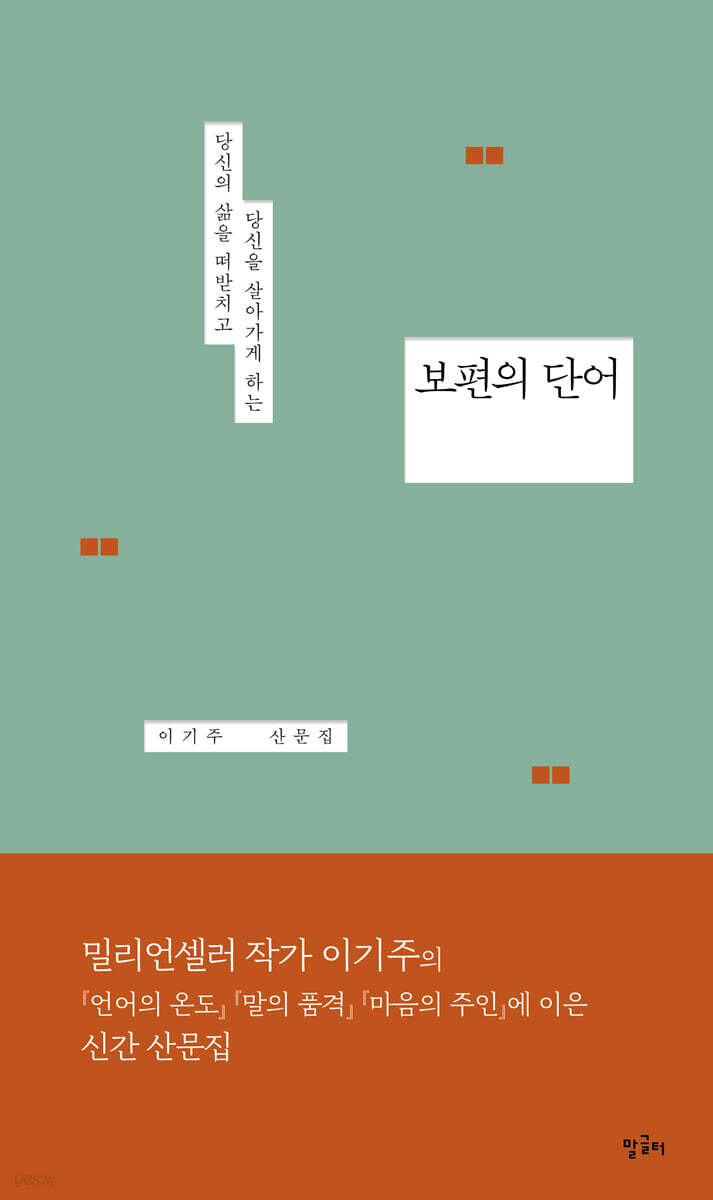
universal word
 |
Description
Book Introduction
“Is there a word that has been a pillar of support in your life?”
New essay collection by best-selling author Lee Ki-ju
Everyone needs a place to rest their mind.
Even the most inner strength, when faced with hardships too difficult to bear alone, tends to lean on someone close to them or something familiar.
Indeed, that is true.
When life shakes, what sustains our hearts are not the unfamiliar and flashy things, but the familiar and ordinary things around us.
For example, the universal words that we frequently read, write, speak, and think about in our daily lives may become the strong supports that support our lives.
Author Lee Ki-joo, who secured a wide readership with the word-of-mouth bestseller 『The Temperature of Language』 and the steady seller 『The Dignity of Words』, returns to us with a new collection of essays, 『Universal Words』.
Author Lee Ki-joo, who has previously explored the essence of life hidden in everyday life with a delicate gaze, now persistently delves into the ordinary words we use thoughtlessly, asking fundamental questions about love and hate, happiness and unhappiness, hope and regret, life and death, and more.
As we walk the path of the book, guided by the weighty questions the author has planted between the lines, we will be able to reflect anew on what words support our own lives and what kind of landscape of life they embody.
New essay collection by best-selling author Lee Ki-ju
Everyone needs a place to rest their mind.
Even the most inner strength, when faced with hardships too difficult to bear alone, tends to lean on someone close to them or something familiar.
Indeed, that is true.
When life shakes, what sustains our hearts are not the unfamiliar and flashy things, but the familiar and ordinary things around us.
For example, the universal words that we frequently read, write, speak, and think about in our daily lives may become the strong supports that support our lives.
Author Lee Ki-joo, who secured a wide readership with the word-of-mouth bestseller 『The Temperature of Language』 and the steady seller 『The Dignity of Words』, returns to us with a new collection of essays, 『Universal Words』.
Author Lee Ki-joo, who has previously explored the essence of life hidden in everyday life with a delicate gaze, now persistently delves into the ordinary words we use thoughtlessly, asking fundamental questions about love and hate, happiness and unhappiness, hope and regret, life and death, and more.
As we walk the path of the book, guided by the weighty questions the author has planted between the lines, we will be able to reflect anew on what words support our own lives and what kind of landscape of life they embody.
- You can preview some of the book's contents.
Preview
index
Handing over the book
_ Maybe we are made up of the words we use so often
1.
The most ordinary things are the most noble
Daily Life _ The Opposite of Unhappiness
Ordinary _ The desire to live like others
Love and hate - the most complex emotions
Principle _ Grounds for Rejection and Acceptance
Pain _ Life is a journey through pain
Mood - something that is easy to tear like thin paper
Anxiety _ Because we don't know the future
Escape - Perhaps the most powerful force in life
Play _ Time to calm your wavering mind
Implementation _ Examining and cultivating one's own life
2.
Nothing is made of just one side
Time _ The Wind of Time
Complex _ Intricately intertwined things
Limit _ Unclimbable Tree
Thoughts - Growing in the Field of the Mind
Crying _ flood of emotions
Support _ The value of the familiar
Contrast - Things that are clearer because they are different
Evaluation _ The author put the fish on the cutting board
Friends _ There is no need to unconditionally expand your network
Powerlessness - closer to frustration than laziness
Margin _ If there is no room, it is bound to shake
3.
The one who is less sick hugs the one who is more sick
Comfort _ the act of relieving suffering
Intimacy _ The closest and therefore the easiest
Concern _ Synonym for love
Rest _ Time to gather life energy
Exchange _ Things given and received between parents and children
Wounds _ Elements that Constitute Personal Identity
Balance _ Maybe love is a seesaw
Delicacy _ tentacles of emotion toward the other person
Studying _ Digging deep and thinking
Reunion _ Meeting with a different heart than before
4.
If you know a little, you brag; if you know a lot, you ask questions.
Know _ About true knowledge
Jealousy - I pretend not to be jealous in front of others
Hello _ Sometimes I want to hide behind the words "It's okay"
Imagination _ A world beyond the visible
Extinction _ Things that scatter into time
Beginning _ Only a small part
Cynical _ an infinitely sad gaze
Show-off _ a product of deficiency
Fashion _ The flow of the world
Prejudice - A guess that is always terribly wrong
5.
A knife without a handle is dangerous.
Emotions _ Water or Fire
Anger _ People living in an age of fury
Intellectuals - People who strive to destroy the lives of others
Advice _ People who say they know when they don't
Desperate _ Engine that only works uphill
Regret _ A Byproduct of Choice
A windfall - When you suddenly come into possession of a large sum of money
Greed - What to Let Go of and What Not to
Possession _ A journey that has a beginning but no end
Golden _ Iron axe or golden axe
6.
We each carry different burdens on our shoulders.
Change _ What Comes and What Goes Away
Best _ Because there are things that can't be done no matter how hard you try
Luck - Why We're Obsessed with Luck
Waves _ The ceaseless flowing river of time
Alone _ Some processes must be experienced alone
Hope _ Mostly bright, but sometimes dark
Deceived _ Sometimes people even deceive themselves
Self-care - taking care of yourself
Gateway _ From this side of life to that side
Death _ A being trapped in finite time
_ Maybe we are made up of the words we use so often
1.
The most ordinary things are the most noble
Daily Life _ The Opposite of Unhappiness
Ordinary _ The desire to live like others
Love and hate - the most complex emotions
Principle _ Grounds for Rejection and Acceptance
Pain _ Life is a journey through pain
Mood - something that is easy to tear like thin paper
Anxiety _ Because we don't know the future
Escape - Perhaps the most powerful force in life
Play _ Time to calm your wavering mind
Implementation _ Examining and cultivating one's own life
2.
Nothing is made of just one side
Time _ The Wind of Time
Complex _ Intricately intertwined things
Limit _ Unclimbable Tree
Thoughts - Growing in the Field of the Mind
Crying _ flood of emotions
Support _ The value of the familiar
Contrast - Things that are clearer because they are different
Evaluation _ The author put the fish on the cutting board
Friends _ There is no need to unconditionally expand your network
Powerlessness - closer to frustration than laziness
Margin _ If there is no room, it is bound to shake
3.
The one who is less sick hugs the one who is more sick
Comfort _ the act of relieving suffering
Intimacy _ The closest and therefore the easiest
Concern _ Synonym for love
Rest _ Time to gather life energy
Exchange _ Things given and received between parents and children
Wounds _ Elements that Constitute Personal Identity
Balance _ Maybe love is a seesaw
Delicacy _ tentacles of emotion toward the other person
Studying _ Digging deep and thinking
Reunion _ Meeting with a different heart than before
4.
If you know a little, you brag; if you know a lot, you ask questions.
Know _ About true knowledge
Jealousy - I pretend not to be jealous in front of others
Hello _ Sometimes I want to hide behind the words "It's okay"
Imagination _ A world beyond the visible
Extinction _ Things that scatter into time
Beginning _ Only a small part
Cynical _ an infinitely sad gaze
Show-off _ a product of deficiency
Fashion _ The flow of the world
Prejudice - A guess that is always terribly wrong
5.
A knife without a handle is dangerous.
Emotions _ Water or Fire
Anger _ People living in an age of fury
Intellectuals - People who strive to destroy the lives of others
Advice _ People who say they know when they don't
Desperate _ Engine that only works uphill
Regret _ A Byproduct of Choice
A windfall - When you suddenly come into possession of a large sum of money
Greed - What to Let Go of and What Not to
Possession _ A journey that has a beginning but no end
Golden _ Iron axe or golden axe
6.
We each carry different burdens on our shoulders.
Change _ What Comes and What Goes Away
Best _ Because there are things that can't be done no matter how hard you try
Luck - Why We're Obsessed with Luck
Waves _ The ceaseless flowing river of time
Alone _ Some processes must be experienced alone
Hope _ Mostly bright, but sometimes dark
Deceived _ Sometimes people even deceive themselves
Self-care - taking care of yourself
Gateway _ From this side of life to that side
Death _ A being trapped in finite time
Into the book
“If a person loses his heart, he may lose everything in life.
Therefore, when you feel like you're thrown into misery alone or when cluttered thoughts keep running through your head, you may need to focus on filling the cracks in your heart and organizing your daily life rather than trying to be happy like others.
“The opposite of unhappiness is not happiness, but something closer to routine.”
---From "Everyday Life, the Opposite of Misfortune"
“What does it mean to be ordinary?
Is it simply not special?
The dictionary definition of 'ordinary' is that it is ordinary, without anything outstanding or different.
It is generally used as a synonym for words like 'middle' and 'ordinary', but the moment 'life' is added to it, it transforms into a word with a social context.
“It is because the clue ‘as much as others’ follows.”
---From "The desire to live an ordinary life, like everyone else"
“As we grow up and learn about the world, we naturally encounter some important facts.
“In reality, it is not easy to live like your parents, and it is just as important to protect your foundation as it is to move on to a wider world.”
---From "Love and Hate, the Most Complex Emotions"
“Every moment we live with a different feeling.
Human moods, which change from moment to moment, are like thin window paper.
When others stab you with dirty words and actions, you are torn apart without any strength.
To recover, you need to use alone time or the affection of someone other than yourself as glue to spread it evenly over your heart, then let it dry slowly in the wind of time.”
---From "Feelings, Like Thin Paper, Easily Tearable"
“We spend our entire lives thinking about places we never reached, goals we never fully achieved.
Work is like that, dreams are like that, and even love is like that.
“It is not something that is completely realized, but something that is not yet realized that becomes the ‘skeleton of memory.’”
---From "The Limit, the Tree You Can't Climb"
“As I got older, my values about interpersonal relationships changed.
This is because I often feel stressed because of unnecessary relationships or expend unnecessary emotions trying to maintain relationships.
It was from this time that the idea that there was no need to unconditionally expand my network began to sprout.
Around this time, I often thought:
“I think the most important thing in forming and maintaining relationships with others is ‘self-respect.’”
---From "Friend, there is no need to expand your network unconditionally"
“Powerlessness may seem like lethargy or laziness at first glance, but it is actually closer to frustration or defeat.
To escape the swamp of helplessness, we must first awaken our sense of self-efficacy, which is the belief that we have the ability to perform certain tasks.”
---From "Not powerlessness or laziness, but closer to frustration"
“Love is more like a constant ups and downs caused by the subtle weight of emotions.
“It’s like riding a seesaw.”
---From "Balance, Maybe Love Is a Seesaw"
“The expression “it’s okay” that we use every time we say hello has various hidden meanings.
People often say they are okay when they are not.
Even though it is a situation that would be worrisome to anyone, they just keep saying that it is okay.
By saying that you can grit your teeth and endure even when it's hard, you push your emotions out of your consciousness.
“Perhaps they hide their true feelings because they don’t want to burden the other person.”
---From "Sometimes I Want to Hide Behind the Words 'It's Okay'"
"So when does jealousy surface? Most people are more likely to feel jealous of someone occupying a similar but slightly larger chair than they are of someone sitting in a chair that is absurdly larger than their own.
Moreover, arrows of jealousy are often aimed at people we were once close to, rather than people we have no relationship with.
The longer you know someone, the sharper the arrowhead becomes.
“That is the nature of jealousy.”
---From "Jealousy, I pretend not to be jealous in front of others"
“A person who habitually points out the other person’s faults the moment they discover them is neither a good speaker nor a person who doesn’t have any lingering feelings.
They are people who are not good at speaking and who lack self-understanding.
In short, he is a person who does not know himself well.”
---From "People who strive to destroy the lives of others"
“Sometimes the people and events that cause us the greatest pain end up giving us the greatest insight and discernment.
Of course, you only realize this after a long time has passed.”
---From "Waves, the ceaselessly flowing river of time"
“We are living in an era where uncertainty is more prevalent than ever before.
In times like these, when we don't know what the future holds, enduring the present with the belief that things will get better means more than just waiting.
In a way, enduring the present means building up your body and mind while preparing for the future.”
---From "Building, the work of caring for and looking after oneself"
“Humans are still helpless in the face of death.
Not only that, but they are also ignorant.
Death is vaguely accepted as a process in which everything disappears or the soul and body are separated.
We don't know what lies beyond death.
If you don't know, you're afraid.
Fear blossoms from ignorance.
Perhaps we exchange love with someone other than ourselves in order to shake off even a little of the loneliness and fear that comes with death.”
Therefore, when you feel like you're thrown into misery alone or when cluttered thoughts keep running through your head, you may need to focus on filling the cracks in your heart and organizing your daily life rather than trying to be happy like others.
“The opposite of unhappiness is not happiness, but something closer to routine.”
---From "Everyday Life, the Opposite of Misfortune"
“What does it mean to be ordinary?
Is it simply not special?
The dictionary definition of 'ordinary' is that it is ordinary, without anything outstanding or different.
It is generally used as a synonym for words like 'middle' and 'ordinary', but the moment 'life' is added to it, it transforms into a word with a social context.
“It is because the clue ‘as much as others’ follows.”
---From "The desire to live an ordinary life, like everyone else"
“As we grow up and learn about the world, we naturally encounter some important facts.
“In reality, it is not easy to live like your parents, and it is just as important to protect your foundation as it is to move on to a wider world.”
---From "Love and Hate, the Most Complex Emotions"
“Every moment we live with a different feeling.
Human moods, which change from moment to moment, are like thin window paper.
When others stab you with dirty words and actions, you are torn apart without any strength.
To recover, you need to use alone time or the affection of someone other than yourself as glue to spread it evenly over your heart, then let it dry slowly in the wind of time.”
---From "Feelings, Like Thin Paper, Easily Tearable"
“We spend our entire lives thinking about places we never reached, goals we never fully achieved.
Work is like that, dreams are like that, and even love is like that.
“It is not something that is completely realized, but something that is not yet realized that becomes the ‘skeleton of memory.’”
---From "The Limit, the Tree You Can't Climb"
“As I got older, my values about interpersonal relationships changed.
This is because I often feel stressed because of unnecessary relationships or expend unnecessary emotions trying to maintain relationships.
It was from this time that the idea that there was no need to unconditionally expand my network began to sprout.
Around this time, I often thought:
“I think the most important thing in forming and maintaining relationships with others is ‘self-respect.’”
---From "Friend, there is no need to expand your network unconditionally"
“Powerlessness may seem like lethargy or laziness at first glance, but it is actually closer to frustration or defeat.
To escape the swamp of helplessness, we must first awaken our sense of self-efficacy, which is the belief that we have the ability to perform certain tasks.”
---From "Not powerlessness or laziness, but closer to frustration"
“Love is more like a constant ups and downs caused by the subtle weight of emotions.
“It’s like riding a seesaw.”
---From "Balance, Maybe Love Is a Seesaw"
“The expression “it’s okay” that we use every time we say hello has various hidden meanings.
People often say they are okay when they are not.
Even though it is a situation that would be worrisome to anyone, they just keep saying that it is okay.
By saying that you can grit your teeth and endure even when it's hard, you push your emotions out of your consciousness.
“Perhaps they hide their true feelings because they don’t want to burden the other person.”
---From "Sometimes I Want to Hide Behind the Words 'It's Okay'"
"So when does jealousy surface? Most people are more likely to feel jealous of someone occupying a similar but slightly larger chair than they are of someone sitting in a chair that is absurdly larger than their own.
Moreover, arrows of jealousy are often aimed at people we were once close to, rather than people we have no relationship with.
The longer you know someone, the sharper the arrowhead becomes.
“That is the nature of jealousy.”
---From "Jealousy, I pretend not to be jealous in front of others"
“A person who habitually points out the other person’s faults the moment they discover them is neither a good speaker nor a person who doesn’t have any lingering feelings.
They are people who are not good at speaking and who lack self-understanding.
In short, he is a person who does not know himself well.”
---From "People who strive to destroy the lives of others"
“Sometimes the people and events that cause us the greatest pain end up giving us the greatest insight and discernment.
Of course, you only realize this after a long time has passed.”
---From "Waves, the ceaselessly flowing river of time"
“We are living in an era where uncertainty is more prevalent than ever before.
In times like these, when we don't know what the future holds, enduring the present with the belief that things will get better means more than just waiting.
In a way, enduring the present means building up your body and mind while preparing for the future.”
---From "Building, the work of caring for and looking after oneself"
“Humans are still helpless in the face of death.
Not only that, but they are also ignorant.
Death is vaguely accepted as a process in which everything disappears or the soul and body are separated.
We don't know what lies beyond death.
If you don't know, you're afraid.
Fear blossoms from ignorance.
Perhaps we exchange love with someone other than ourselves in order to shake off even a little of the loneliness and fear that comes with death.”
---From "Death, a Being Trapped in Finite Time"
Publisher's Review
“What word do you live by?”
Diligently hovering around the edges of our lives
Supporting us so we don't fall
About the word 'supporting'!
“Before she passed away, my grandmother would often call me and say, ‘Giju, if you have time this weekend, come over for a meal.
He said, 'I'll make you your favorite food.'
“The warm voice of my grandmother from the other end of the phone still lingers in my ears, leaving a long aftertaste like an echo.”
_ From 'Handing Over a Book'
When we desperately miss someone who is beyond our reach, we trace the words and writings they left behind.
Because every word that comes out of his lips and every letter that springs from his fingertips is imbued with his thoughts, emotions, and even the breath of life.
A person's identity and the words he or she frequently uses are not unrelated.
Perhaps our emotional and thought systems are made up of the words we use most frequently.
That's understandable, because sometimes a single word spoken without embellishment in front of someone close to you can most honestly reveal your state of mind.
Sometimes, the joys and sorrows of life are captured in short messages posted on social media.
Sometimes, unfamiliar words scribbled in the corner of a diary can serve as a guide in life.
There are no meaningless words.
Every word we read, write, speak, and think of often reflects our own lives.
The countless words that spread out into the world through our mouths and hands do not disappear without a trace over time.
Since they were born within us from the beginning, some of them accumulate in our hearts and are imprinted in our minds, becoming intertwined with our lives until one day they magically come back to life and become a protective shield protecting us from the noisy world.
『The Temperature of Language』 and 『The Dignity of Words』, etc.
A new work by author Lee Ki-joo, whose cumulative sales have exceeded 2.5 million copies!
As you walk the path in the book with the author's guidance,
I'm realizing anew what sustains my life.
As we live, there are days when something new and unfamiliar overwhelms our daily lives and piles up like dirt, and there are also days when the familiar is mercilessly worn away by the winds of time.
Both the new and the familiar can add to life, but I think it's the latter that sustains our daily lives.
The unfamiliar excites us, but we cannot feel comfortable leaning into it because it is not familiar or familiar.
On days when we crumble under the weight of life and then rise again, what sustains our hearts are the familiar things around us.
For example, the common words we use in our daily lives without thinking may become the strong supports that support our lives.
Author Lee Ki-joo, who has sold over 2.5 million copies of his best-selling books, “The Temperature of Language,” and the humanities bestseller “The Dignity of Words,” which were all created through word-of-mouth, attempts to explore life using ordinary words as material in this book.
The author brings out the various implications and questions embedded in common words we use without thinking, and unfolds them before the reader in delicate and elegant sentences.
Author Lee Ki-joo says:
“A book may be a forest made up of hundreds of thousands of letters.
Rather than rushing through the forest of "Universal Words," I'd like to take a leisurely stroll, like taking a stroll through a quiet park in the early morning.
I hope that the moment you close this book, you will be able to look back on the words that keep you alive, and the meaning and value imbued within them.
So I hope you can ask meaningful questions about the people and the world around you.
I hope that question gives you the fuel to live.
“I dedicate this book to you, who struggles every day to protect your inner happiness and daily life.”
Diligently hovering around the edges of our lives
Supporting us so we don't fall
About the word 'supporting'!
“Before she passed away, my grandmother would often call me and say, ‘Giju, if you have time this weekend, come over for a meal.
He said, 'I'll make you your favorite food.'
“The warm voice of my grandmother from the other end of the phone still lingers in my ears, leaving a long aftertaste like an echo.”
_ From 'Handing Over a Book'
When we desperately miss someone who is beyond our reach, we trace the words and writings they left behind.
Because every word that comes out of his lips and every letter that springs from his fingertips is imbued with his thoughts, emotions, and even the breath of life.
A person's identity and the words he or she frequently uses are not unrelated.
Perhaps our emotional and thought systems are made up of the words we use most frequently.
That's understandable, because sometimes a single word spoken without embellishment in front of someone close to you can most honestly reveal your state of mind.
Sometimes, the joys and sorrows of life are captured in short messages posted on social media.
Sometimes, unfamiliar words scribbled in the corner of a diary can serve as a guide in life.
There are no meaningless words.
Every word we read, write, speak, and think of often reflects our own lives.
The countless words that spread out into the world through our mouths and hands do not disappear without a trace over time.
Since they were born within us from the beginning, some of them accumulate in our hearts and are imprinted in our minds, becoming intertwined with our lives until one day they magically come back to life and become a protective shield protecting us from the noisy world.
『The Temperature of Language』 and 『The Dignity of Words』, etc.
A new work by author Lee Ki-joo, whose cumulative sales have exceeded 2.5 million copies!
As you walk the path in the book with the author's guidance,
I'm realizing anew what sustains my life.
As we live, there are days when something new and unfamiliar overwhelms our daily lives and piles up like dirt, and there are also days when the familiar is mercilessly worn away by the winds of time.
Both the new and the familiar can add to life, but I think it's the latter that sustains our daily lives.
The unfamiliar excites us, but we cannot feel comfortable leaning into it because it is not familiar or familiar.
On days when we crumble under the weight of life and then rise again, what sustains our hearts are the familiar things around us.
For example, the common words we use in our daily lives without thinking may become the strong supports that support our lives.
Author Lee Ki-joo, who has sold over 2.5 million copies of his best-selling books, “The Temperature of Language,” and the humanities bestseller “The Dignity of Words,” which were all created through word-of-mouth, attempts to explore life using ordinary words as material in this book.
The author brings out the various implications and questions embedded in common words we use without thinking, and unfolds them before the reader in delicate and elegant sentences.
Author Lee Ki-joo says:
“A book may be a forest made up of hundreds of thousands of letters.
Rather than rushing through the forest of "Universal Words," I'd like to take a leisurely stroll, like taking a stroll through a quiet park in the early morning.
I hope that the moment you close this book, you will be able to look back on the words that keep you alive, and the meaning and value imbued within them.
So I hope you can ask meaningful questions about the people and the world around you.
I hope that question gives you the fuel to live.
“I dedicate this book to you, who struggles every day to protect your inner happiness and daily life.”
GOODS SPECIFICS
- Date of issue: January 11, 2024
- Page count, weight, size: 288 pages | 113*190*20mm
- ISBN13: 9791195522170
- ISBN10: 1195522177
You may also like
카테고리
korean


korean

![GQ KOREA Mark (Monthly): December [2025]](http://librairie.coreenne.fr/cdn/shop/files/8ef265dbbfbf186523ed75ba7319009d.jpg?v=1765340328&width=3840)


