

Nothing will change even if you cry
 |
Description
Book Introduction
Poet Park Jun, author of "I Made Up Your Name and Ate It for Several Days," his first collection of prose!
"Nothing will change even if you cry."
“We are all becoming orphans or already are.
Nothing will change if you cry
But if we cry together, it will be less embarrassing and we will feel a little stronger.”
Just a book next to me.
A book that just stays by your side.
Is life hard sometimes? Does it feel strange?
Even though he pretends to know and comfort me,
As if indifferent, without saying anything
Let's eat some dodari mugwort soup.
A book that speaks with a calm tone.
"Nothing will change even if you cry."
“We are all becoming orphans or already are.
Nothing will change if you cry
But if we cry together, it will be less embarrassing and we will feel a little stronger.”
Just a book next to me.
A book that just stays by your side.
Is life hard sometimes? Does it feel strange?
Even though he pretends to know and comfort me,
As if indifferent, without saying anything
Let's eat some dodari mugwort soup.
A book that speaks with a calm tone.
- You can preview some of the book's contents.
Preview
index
Entering - Shade
Part 1
Incheon that year
Gyeongju that year
Two faces
Some words never die
A phone call in the wee hours of the morning - Poet Lee Moon-jae
Waiting, remembering
letter
Yeosu that year
breakfast
Seasonal change
rain
That year's cooperation
White and dry light
Wall-mounted
Crying and breathing
Dream room
Body and illness
Now again
Solitude and loneliness
Travel and Life
Part 2
The time when I get better
Hwaam that year
That year's silence
Daytime drinking
ruins of the mind
Field of Memories
A letter from Haenam
weeping
stairs to the rooftop
Novelist Mr. Kim
Hyehwa-dong that year
sounds
relationship
Reply
The Age of Love
Part 3
Welcome spring
Small things and big things
Flowers leaving again
Haengsin that year
The right time
Everyday space, travel time
Once upon a time in the square
Extreme poison and venom
first love
Umbrella and rain
I
The birth of taste
Samcheok that year
Part 4
Work and poverty
Unfriendly labor
Becoming an adult
orphanage
soy sauce
Stop crying, Father
Waving hands
Congratulations! Park Joo-heon's first birthday!
Central Assembly
Sundae and Revolution
Death and Will
The age of my heart
sun
Moving forward - Yeonhwa-ri that year
Part 1
Incheon that year
Gyeongju that year
Two faces
Some words never die
A phone call in the wee hours of the morning - Poet Lee Moon-jae
Waiting, remembering
letter
Yeosu that year
breakfast
Seasonal change
rain
That year's cooperation
White and dry light
Wall-mounted
Crying and breathing
Dream room
Body and illness
Now again
Solitude and loneliness
Travel and Life
Part 2
The time when I get better
Hwaam that year
That year's silence
Daytime drinking
ruins of the mind
Field of Memories
A letter from Haenam
weeping
stairs to the rooftop
Novelist Mr. Kim
Hyehwa-dong that year
sounds
relationship
Reply
The Age of Love
Part 3
Welcome spring
Small things and big things
Flowers leaving again
Haengsin that year
The right time
Everyday space, travel time
Once upon a time in the square
Extreme poison and venom
first love
Umbrella and rain
I
The birth of taste
Samcheok that year
Part 4
Work and poverty
Unfriendly labor
Becoming an adult
orphanage
soy sauce
Stop crying, Father
Waving hands
Congratulations! Park Joo-heon's first birthday!
Central Assembly
Sundae and Revolution
Death and Will
The age of my heart
sun
Moving forward - Yeonhwa-ri that year
Into the book
The more I looked at the two scenes of sunrise and sunset, the more similar they seemed.
Just as your face that year, which was so clear without being visible on purpose, resembled my face that year, which bloomed freely without trying to hide it.
Or like the hello in the first greeting and the hello in the last greeting.
--- p.17 From "Two Faces"
The salty wind can even change the faded sign of a restaurant.
Long ago, 'Aunt's Restaurant' became 'Monet's Restaurant'.
Although the taste of Gomchiguk has become a little darker, it is still full of famous plants like lotus, and when you think about the fact that annual plants are growing where annual plants died, and that today's light is shining on the place where yesterday was, this is not such a big deal.
--- p.133 From "That Year in Samcheok"
I believe that the words I say to others without thinking can become the last words I leave them.
So, even if it's the same word, I try to make it a little warmer and prettier.
Words are born in the mouth and die in the ear.
But some words do not die, but survive in people's hearts.
--- p.19 From “Some Words Never Die”
There are so many different definitions of love that they are all either wrong or right.
It will always be true that there are countless people in the world who are in countless loves.
If there is still love left in this world for me and for you, it is for this very reason.
--- p.95 From "The Age of Love"
As I was writing this, I looked through my diary from that time, and the day I went to the crematorium was April 5, 2000.
There was a sentence that said, “If I ever go to the wall again, I hope it will be in the very distant future,” and another that said, “It is fortunate that a person’s end is with a large, thick wooden coffin.”
But contrary to my hopes at the time, I had to go to Byeokje in the not-too-distant future.
It's sad, but I'll have to go a few more times.
Still, it is fortunate that our end lies in the sorrow of those who shared a time with a well-grown tree in a deep forest.
--- p.38 From “Wall Walk”
Symptoms and pain now tell us that the minor illness has ended and that the disease has begun in our body.
Most organs and systems make their presence known through pain.
It is only after the stomachache begins that you realize that your stomach was here, and when the pain is in your lower back but your hands and feet start to feel numb first, you realize that the nerves in your entire body are connected.
This fact makes me think again about human relationships.
When a relationship is going well, I don't really care how much I think about that person or how much they think about me.
Because I think that if one person is lacking, the remaining one can fill in the gap.
But after a relationship ends, you start to gauge the size and warmth of the feelings you shared with each other.
At this time, we suffer from emotions such as regret and sadness.
Especially when a relationship ends against our will, we experience such great emotional pain that we regret being born as humans.
Just as your face that year, which was so clear without being visible on purpose, resembled my face that year, which bloomed freely without trying to hide it.
Or like the hello in the first greeting and the hello in the last greeting.
--- p.17 From "Two Faces"
The salty wind can even change the faded sign of a restaurant.
Long ago, 'Aunt's Restaurant' became 'Monet's Restaurant'.
Although the taste of Gomchiguk has become a little darker, it is still full of famous plants like lotus, and when you think about the fact that annual plants are growing where annual plants died, and that today's light is shining on the place where yesterday was, this is not such a big deal.
--- p.133 From "That Year in Samcheok"
I believe that the words I say to others without thinking can become the last words I leave them.
So, even if it's the same word, I try to make it a little warmer and prettier.
Words are born in the mouth and die in the ear.
But some words do not die, but survive in people's hearts.
--- p.19 From “Some Words Never Die”
There are so many different definitions of love that they are all either wrong or right.
It will always be true that there are countless people in the world who are in countless loves.
If there is still love left in this world for me and for you, it is for this very reason.
--- p.95 From "The Age of Love"
As I was writing this, I looked through my diary from that time, and the day I went to the crematorium was April 5, 2000.
There was a sentence that said, “If I ever go to the wall again, I hope it will be in the very distant future,” and another that said, “It is fortunate that a person’s end is with a large, thick wooden coffin.”
But contrary to my hopes at the time, I had to go to Byeokje in the not-too-distant future.
It's sad, but I'll have to go a few more times.
Still, it is fortunate that our end lies in the sorrow of those who shared a time with a well-grown tree in a deep forest.
--- p.38 From “Wall Walk”
Symptoms and pain now tell us that the minor illness has ended and that the disease has begun in our body.
Most organs and systems make their presence known through pain.
It is only after the stomachache begins that you realize that your stomach was here, and when the pain is in your lower back but your hands and feet start to feel numb first, you realize that the nerves in your entire body are connected.
This fact makes me think again about human relationships.
When a relationship is going well, I don't really care how much I think about that person or how much they think about me.
Because I think that if one person is lacking, the remaining one can fill in the gap.
But after a relationship ends, you start to gauge the size and warmth of the feelings you shared with each other.
At this time, we suffer from emotions such as regret and sadness.
Especially when a relationship ends against our will, we experience such great emotional pain that we regret being born as humans.
--- p.44~45 From “Body and Illness”
Publisher's Review
Poet Park Jun, author of "I Made Up Your Name and Ate It for Several Days," his first collection of prose!
"Nothing will change even if you cry."
“We are all becoming orphans or already are.
Nothing will change if you cry
But if we cry together, it will be less embarrassing and we will feel a little stronger.”
*
Just a book next to me.
A book that just stays by your side.
Is life hard sometimes? Does it feel strange?
Even though he pretends to know and comfort me,
As if indifferent, without saying anything
Let's eat some dodari mugwort soup.
A book that speaks with a calm tone.
1.
I know a poet named Park Jun.
The poet, who debuted in 2008 through 『Practical Literature』, published his first poetry collection in 2012.
Even if it's not the exact title, you may have vaguely heard of the title of the poetry collection. It's a chocolate-colored poetry collection called "I Made Up Your Name and Ate It for Several Days."
This is the very poetry book that had a woman's back engraved on the back in a pose that seemed nonchalant but hinted at some story.
This poetry collection, which has been published to great interest, is still enjoying your continued love even now, as it approaches its fifth anniversary.
How grateful I am, how precious it is. Poet Park Jun is a person who never forgets anything, so whenever he confirms those feelings, he folds them up and hides them inside him, and when a strange wind blows over him, he sits alone and secretly takes them out to look at them.
“Because I think receiving a letter is an act of being loved and writing a letter is an act of love.”
2.
After a long period of preparation, he came to us with his first collection of essays.
The title of my first poetry collection was sixteen characters, but I added one more character to make it seventeen characters long.
"Nothing will change even if you cry"... ... Wait, the title is a bit long, isn't it? Yes, you might say it's a bit long, but I was confident you wouldn't find it too difficult, because I'm sure we've all said or heard something with this nuance at least once.
How often have we been in situations where I was the one who said, “Crying won’t change anything, so don’t cry anymore” or you were the one who said, “Crying won’t change anything, so cry some more”?
3.
I briefly mentioned the word 'letter' earlier, and I think that this collection of poet Park Jun's prose truly resembles the inexplicable significance of letters.
Why is the letter like that?
If you force yourself to write, you'll end up mechanically repeating the same dull, boring words. But if you write voluntarily, it's true that the person holding the pen in their hand will burst out with unpredictable, boundless energy, letting out all the stories within them.
I have no idea why I'm writing like this, mixing in phrases like this here and there like exclamations.
But it is a letter that is born with truth, but it is a letter that is born with sincerity.
In that sense, I think this book is a reply and a love letter from poet Park Jun to all of you who have read, felt, and reflected on my poetry together.
I actually knew a little that the letters between these two were destined to be long, so I felt less burdened in handing you this book. Since letters are closer to affection and consideration than anger or hatred, and because I knew that the poet's wish to receive many letters while living was in fact the same pledge as his wish to write many letters while living, I think the poet was able to finish writing this book while slightly suppressing his innate shame with a stone.
I've said everything I can, there's nothing left! As I was finishing the manuscript, I pinned the poet's words to the last page with a thumbtack.
*
Their faces are covered in tears, so they might be poor siblings.
Their faces are covered in tears, so they might be a couple about to break up.
Their faces are covered in tears, so they might be a couple who shared death.
4.
"Nothing will change even if you cry" is a piece that truly penetrates the "person" called "poet Park Jun."
Although I divided it into four parts according to my breathing, regardless of the division, it is a piece of writing that allows you to confirm that the fragments of the story are organically connected like the blood vessels in our body, no matter if you gently turn any page or read any section.
We are busy holding the young hands of the story that was revealed without any intention of revealing it, and as we read the words that those young hands that we suddenly grabbed open our palms and wrote with their fingers, there was poverty in those names, separation, and death.
So, the life of poverty, the circumstances of separation, and the futility of death—these three are inseparable challenges that we all face, so there wasn't a single story that sounded in vain.
Our true face, which we tried to avoid if possible, that poverty is difficult and difficult again, separation is painful and painful again, and death is sad and sad again.
Still, it's good to face the hardships of life head-on, as if we're going to fight them off. This will help us develop a tolerance in our bodies, allowing us to push through life and move beyond it. This will be the driving force that will allow us to roll more confidently on the treadmill of life and death.
I was able to gain confidence and conviction that the question of why we should read books could be answered by the question of why we should live, thanks to this book.
5.
Moreover, the book proves to be a flexible combination of poetry and prose.
One day, it reads like a book of poetry, and another day, it reads like a book of prose.
Since not a single sentence is written carelessly, I often stumble over the lines I draw.
It's strange.
It is a simple piece of writing that has completely removed any forced words or hesitant sentiments, but it is often a mixture of the two, either laughter after crying or crying after laughter.
In particular, in this collection of essays, the scenes of memories brought to mind by his meticulous and persistent observation often brought us to tears. I had to repeatedly reflect on his special memory that composed this collection, wondering if I had caught anything or missed anything.
Poet Park Jun, who may look like a toy, but in reality seems to have a high-performance radar installed inside him.
Poet Park Jun, who speaks like a child but sees like an adult.
Perhaps it is because the poet was exposed to the storms of the world from a young age, which may seem a little early, quite familiar, or absurdly sudden, but despite this, the poet is courageous with an attitude toward life that does not blame anyone, does not hate anyone, and does not distrust anyone.
As if to say, what good would it do? They even hand us a message like a note written on a gum wrapper, saying that while it is true that we are all alone, we are not always alone.
He says that living while being deceived is also life, and that crying and laughing, laughing and crying again is also life, and he silently pats our tired backs and then disappears.
Poet Park Jun is someone who, unlike us, has one extra eye, so he might be considered a curse as an ordinary person, but a blessing as a poet.
6.
This book keeps pace with us throughout our reading.
It is not a book that goes ahead with its black back of its head sticking out, nor is it a book that goes behind with its white face fading away.
It's just a book next to me.
It's a book that just stays by your side.
Is life sometimes hard? Does it feel unfamiliar? This book pretends to comfort and understand, but then it also casually suggests, as if indifferent, that you eat mugwort soup with your lover.
“One day, we went to a group viewing of Ben-Hur at school.
I couldn't go.
“I couldn’t go on the school trip either,” said the father, who said, “because I don’t have money.”
Because I don't have money.
But fortunately, it was right during the IMF crisis, so there were a lot of friends who couldn't go.
That's fortunate.
“Even poverty can be buried,” is a book that makes you have a conversation with your proud father.
This book is about a person who lost his older sister in an accident a few years ago and, while organizing her letters, reads a line from her high school days, “I couldn’t eat lunch today because the school lunch ran out quickly.” It makes you feel the hunger of a lunch that someone who is no longer in this world felt 10 years ago, and it also makes you hold onto the thread of the spiderweb-like world.
Anyway, this is a book that lets people live as they please, with those who want to cry crying and those who don't want to cry not crying.
A book that gives a sweet message that whether you cry or not, the point where you stand is always the starting line, so you are always free.
A book that gives such hope.
7.
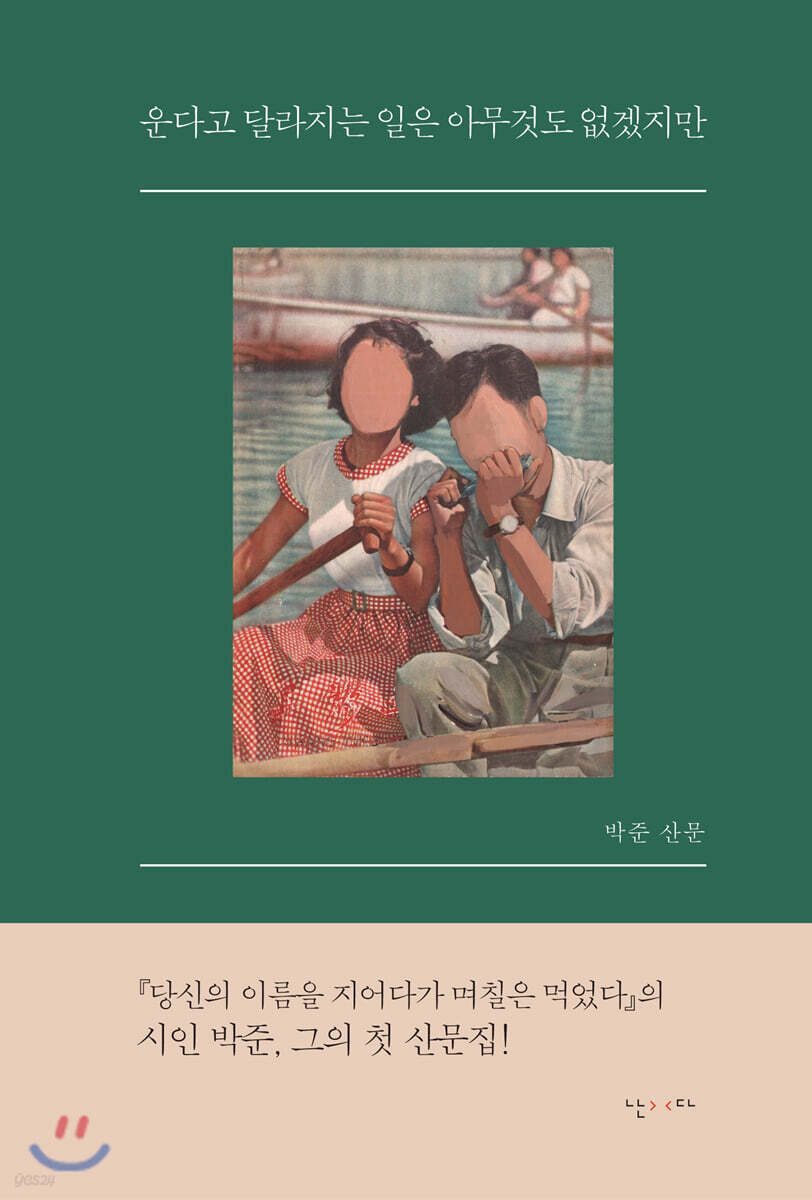
Lastly, I would like to ask you to look closely at the picture on the cover of “Nothing will change even if you cry.”
It's a bit strange.
On a boat floating on a river, a woman rows and a man plays the harmonica, and the facial features of both of them are completely erased.
Why did you erase the eyes, why did you erase the nose, why did you erase the mouth?
Yet, why do tears well up in my eyes, why does my nose run, and why does a song seem to flow out of my mouth?
Their faces are covered in tears, so they might be poor siblings.
Their faces are covered in tears, so they might be a couple about to break up.
Their faces are covered in tears, so they might be a couple who shared death.
However, as I try to infer various stories from the painting, I am convinced that the underlying sadness that flows through the eyes, nose, and mouth, even without facial features, truly represents our lives afloat on the river.
So, as you flip through the pages, take a moment to glance at the cover. I'm giving you this somewhat arrogant tip.
For your information, the painting on the cover is the work of Gideon Rubin, an Israeli artist working in the UK, and is titled Untitled.
They say there will be a large-scale first exhibition in Korea in September 2018, so I hope you familiarize yourself with it in advance and then go see it in person next year.
"Nothing will change even if you cry."
“We are all becoming orphans or already are.
Nothing will change if you cry
But if we cry together, it will be less embarrassing and we will feel a little stronger.”
*
Just a book next to me.
A book that just stays by your side.
Is life hard sometimes? Does it feel strange?
Even though he pretends to know and comfort me,
As if indifferent, without saying anything
Let's eat some dodari mugwort soup.
A book that speaks with a calm tone.
1.
I know a poet named Park Jun.
The poet, who debuted in 2008 through 『Practical Literature』, published his first poetry collection in 2012.
Even if it's not the exact title, you may have vaguely heard of the title of the poetry collection. It's a chocolate-colored poetry collection called "I Made Up Your Name and Ate It for Several Days."
This is the very poetry book that had a woman's back engraved on the back in a pose that seemed nonchalant but hinted at some story.
This poetry collection, which has been published to great interest, is still enjoying your continued love even now, as it approaches its fifth anniversary.
How grateful I am, how precious it is. Poet Park Jun is a person who never forgets anything, so whenever he confirms those feelings, he folds them up and hides them inside him, and when a strange wind blows over him, he sits alone and secretly takes them out to look at them.
“Because I think receiving a letter is an act of being loved and writing a letter is an act of love.”
2.
After a long period of preparation, he came to us with his first collection of essays.
The title of my first poetry collection was sixteen characters, but I added one more character to make it seventeen characters long.
"Nothing will change even if you cry"... ... Wait, the title is a bit long, isn't it? Yes, you might say it's a bit long, but I was confident you wouldn't find it too difficult, because I'm sure we've all said or heard something with this nuance at least once.
How often have we been in situations where I was the one who said, “Crying won’t change anything, so don’t cry anymore” or you were the one who said, “Crying won’t change anything, so cry some more”?
3.
I briefly mentioned the word 'letter' earlier, and I think that this collection of poet Park Jun's prose truly resembles the inexplicable significance of letters.
Why is the letter like that?
If you force yourself to write, you'll end up mechanically repeating the same dull, boring words. But if you write voluntarily, it's true that the person holding the pen in their hand will burst out with unpredictable, boundless energy, letting out all the stories within them.
I have no idea why I'm writing like this, mixing in phrases like this here and there like exclamations.
But it is a letter that is born with truth, but it is a letter that is born with sincerity.
In that sense, I think this book is a reply and a love letter from poet Park Jun to all of you who have read, felt, and reflected on my poetry together.
I actually knew a little that the letters between these two were destined to be long, so I felt less burdened in handing you this book. Since letters are closer to affection and consideration than anger or hatred, and because I knew that the poet's wish to receive many letters while living was in fact the same pledge as his wish to write many letters while living, I think the poet was able to finish writing this book while slightly suppressing his innate shame with a stone.
I've said everything I can, there's nothing left! As I was finishing the manuscript, I pinned the poet's words to the last page with a thumbtack.
*
Their faces are covered in tears, so they might be poor siblings.
Their faces are covered in tears, so they might be a couple about to break up.
Their faces are covered in tears, so they might be a couple who shared death.
4.
"Nothing will change even if you cry" is a piece that truly penetrates the "person" called "poet Park Jun."
Although I divided it into four parts according to my breathing, regardless of the division, it is a piece of writing that allows you to confirm that the fragments of the story are organically connected like the blood vessels in our body, no matter if you gently turn any page or read any section.
We are busy holding the young hands of the story that was revealed without any intention of revealing it, and as we read the words that those young hands that we suddenly grabbed open our palms and wrote with their fingers, there was poverty in those names, separation, and death.
So, the life of poverty, the circumstances of separation, and the futility of death—these three are inseparable challenges that we all face, so there wasn't a single story that sounded in vain.
Our true face, which we tried to avoid if possible, that poverty is difficult and difficult again, separation is painful and painful again, and death is sad and sad again.
Still, it's good to face the hardships of life head-on, as if we're going to fight them off. This will help us develop a tolerance in our bodies, allowing us to push through life and move beyond it. This will be the driving force that will allow us to roll more confidently on the treadmill of life and death.
I was able to gain confidence and conviction that the question of why we should read books could be answered by the question of why we should live, thanks to this book.
5.
Moreover, the book proves to be a flexible combination of poetry and prose.
One day, it reads like a book of poetry, and another day, it reads like a book of prose.
Since not a single sentence is written carelessly, I often stumble over the lines I draw.
It's strange.
It is a simple piece of writing that has completely removed any forced words or hesitant sentiments, but it is often a mixture of the two, either laughter after crying or crying after laughter.
In particular, in this collection of essays, the scenes of memories brought to mind by his meticulous and persistent observation often brought us to tears. I had to repeatedly reflect on his special memory that composed this collection, wondering if I had caught anything or missed anything.
Poet Park Jun, who may look like a toy, but in reality seems to have a high-performance radar installed inside him.
Poet Park Jun, who speaks like a child but sees like an adult.
Perhaps it is because the poet was exposed to the storms of the world from a young age, which may seem a little early, quite familiar, or absurdly sudden, but despite this, the poet is courageous with an attitude toward life that does not blame anyone, does not hate anyone, and does not distrust anyone.
As if to say, what good would it do? They even hand us a message like a note written on a gum wrapper, saying that while it is true that we are all alone, we are not always alone.
He says that living while being deceived is also life, and that crying and laughing, laughing and crying again is also life, and he silently pats our tired backs and then disappears.
Poet Park Jun is someone who, unlike us, has one extra eye, so he might be considered a curse as an ordinary person, but a blessing as a poet.
6.
This book keeps pace with us throughout our reading.
It is not a book that goes ahead with its black back of its head sticking out, nor is it a book that goes behind with its white face fading away.
It's just a book next to me.
It's a book that just stays by your side.
Is life sometimes hard? Does it feel unfamiliar? This book pretends to comfort and understand, but then it also casually suggests, as if indifferent, that you eat mugwort soup with your lover.
“One day, we went to a group viewing of Ben-Hur at school.
I couldn't go.
“I couldn’t go on the school trip either,” said the father, who said, “because I don’t have money.”
Because I don't have money.
But fortunately, it was right during the IMF crisis, so there were a lot of friends who couldn't go.
That's fortunate.
“Even poverty can be buried,” is a book that makes you have a conversation with your proud father.
This book is about a person who lost his older sister in an accident a few years ago and, while organizing her letters, reads a line from her high school days, “I couldn’t eat lunch today because the school lunch ran out quickly.” It makes you feel the hunger of a lunch that someone who is no longer in this world felt 10 years ago, and it also makes you hold onto the thread of the spiderweb-like world.
Anyway, this is a book that lets people live as they please, with those who want to cry crying and those who don't want to cry not crying.
A book that gives a sweet message that whether you cry or not, the point where you stand is always the starting line, so you are always free.
A book that gives such hope.
7.
Lastly, I would like to ask you to look closely at the picture on the cover of “Nothing will change even if you cry.”
It's a bit strange.
On a boat floating on a river, a woman rows and a man plays the harmonica, and the facial features of both of them are completely erased.
Why did you erase the eyes, why did you erase the nose, why did you erase the mouth?
Yet, why do tears well up in my eyes, why does my nose run, and why does a song seem to flow out of my mouth?
Their faces are covered in tears, so they might be poor siblings.
Their faces are covered in tears, so they might be a couple about to break up.
Their faces are covered in tears, so they might be a couple who shared death.
However, as I try to infer various stories from the painting, I am convinced that the underlying sadness that flows through the eyes, nose, and mouth, even without facial features, truly represents our lives afloat on the river.
So, as you flip through the pages, take a moment to glance at the cover. I'm giving you this somewhat arrogant tip.
For your information, the painting on the cover is the work of Gideon Rubin, an Israeli artist working in the UK, and is titled Untitled.
They say there will be a large-scale first exhibition in Korea in September 2018, so I hope you familiarize yourself with it in advance and then go see it in person next year.
[Author's Note]
Most of the thoughts that come to mind late at night are
He was preparing to leave me soon.
[Author's Note]
Most of the thoughts that come to mind late at night are
He was preparing to leave me soon.
Most of the thoughts that come to mind late at night are
He was preparing to leave me soon.
[Author's Note]
Most of the thoughts that come to mind late at night are
He was preparing to leave me soon.
GOODS SPECIFICS
- Date of issue: July 1, 2017
- Format: Hardcover book binding method guide
- Page count, weight, size: 192 pages | 292g | 124*188*20mm
- ISBN13: 9791196075170
- ISBN10: 1196075174
You may also like
카테고리
korean


korean

![GQ KOREA Mark (Monthly): December [2025]](http://librairie.coreenne.fr/cdn/shop/files/8ef265dbbfbf186523ed75ba7319009d.jpg?v=1765340328&width=3840)


