

The night is the teacher
 |
Description
Book Introduction
There is a name called Hwang Hyeon-san.
You might say I'm being too pretentious from the beginning, but I dare say that the name alone is enough to give you a sense of relief.
Even the modern French poetry, known for its difficulty, was different when he read it.
I don't know how many of our poets, unaware of their genius, languished in their closets with their poetry, and he dragged them out to dry in the sun.
Poet Hwang Byeong-seung was like that, poet Kim I-deum was like that, and there are other poets who were brought back to light through his commentary and became new to the Korean poetry world. It would be too much to list them all here.
You might say I'm being too pretentious from the beginning, but I dare say that the name alone is enough to give you a sense of relief.
Even the modern French poetry, known for its difficulty, was different when he read it.
I don't know how many of our poets, unaware of their genius, languished in their closets with their poetry, and he dragged them out to dry in the sun.
Poet Hwang Byeong-seung was like that, poet Kim I-deum was like that, and there are other poets who were brought back to light through his commentary and became new to the Korean poetry world. It would be too much to list them all here.
- You can preview some of the book's contents.
Preview
index
In publishing the book
Part 1
The past is also exploited
Who is the person wearing the hat?
Imagination or cowardice
Salt and Death
Military issues
Dream Journey to the Peach Blossom Land Tour
Remembering Mr. Kim Ji-ha
What is the name of that world?
English classes are also a social problem.
A person who lives on 300,000 won
If Kim Yuna wants to become a college student
What do you do in the French Literature department?
I am afraid of war
Where there are strawberries, there are snakes.
A duty that must weigh heavily on one's heart
The tragedy of Samhakdo
Memory and Place
Taebaek Coal Museum
Method and sincerity
Military problem again
epic of victory
Classroom without corporal punishment
Two national history teachers
Dead Poets Society
In front of [Spring in my hometown]
Spring days are passing by
Director Kim Ki-duk's one
The Legend of Swiss Banking
Context and Violence
banned songs
History flows like music
The legitimacy of the Republic of Korea that I believe in
The word that came before democracy
Covering and Baeksa Village
Interest in violence
Devil of Paradise
gold and stone
The meanness of the times
English classes and language control
Part 2
Country Diary
The power of Gangwon-do
Dog of Winter
frowning faces
empty house
Part 3
Your little circumstances
The happiness of embracing my neighbors
What's the use of poetry?
Jang Ok-i's Song of the Bride
Fashion and the sensibility of things
Anonymity and truthfulness
Bottom Truth's Last Words
Ethics is memory
The sentiment of the dialect
Sincerity in eating, sincerity in making
Free politics, solemn culture
There was a used bookstore
What is lost during the day is recovered at night.
Flipping through the essay test answer sheet
Father's life and child's life
Hong Sang-soo and the professors
Violence of the Stone
Korean and Chinese characters
The knight flies away and the rice ripens.
Praise of November
There are people everywhere
Mr. Lee Su-yeol
Ghost stories
There are mountain birds in the mountains and water birds in the water.
Public scenarios of gun incidents and
Private scenario
Time on the floor
Spring in Chuncheon
The sound of drums in the jungle
Difficult text, easy text
complicated things
Secret time
Two Lunar New Years
literary things
The yardstick of hometown
Allegory of Forbidden Time
I humbly read the will of former President Roh.
Part 1
The past is also exploited
Who is the person wearing the hat?
Imagination or cowardice
Salt and Death
Military issues
Dream Journey to the Peach Blossom Land Tour
Remembering Mr. Kim Ji-ha
What is the name of that world?
English classes are also a social problem.
A person who lives on 300,000 won
If Kim Yuna wants to become a college student
What do you do in the French Literature department?
I am afraid of war
Where there are strawberries, there are snakes.
A duty that must weigh heavily on one's heart
The tragedy of Samhakdo
Memory and Place
Taebaek Coal Museum
Method and sincerity
Military problem again
epic of victory
Classroom without corporal punishment
Two national history teachers
Dead Poets Society
In front of [Spring in my hometown]
Spring days are passing by
Director Kim Ki-duk's one
The Legend of Swiss Banking
Context and Violence
banned songs
History flows like music
The legitimacy of the Republic of Korea that I believe in
The word that came before democracy
Covering and Baeksa Village
Interest in violence
Devil of Paradise
gold and stone
The meanness of the times
English classes and language control
Part 2
Country Diary
The power of Gangwon-do
Dog of Winter
frowning faces
empty house
Part 3
Your little circumstances
The happiness of embracing my neighbors
What's the use of poetry?
Jang Ok-i's Song of the Bride
Fashion and the sensibility of things
Anonymity and truthfulness
Bottom Truth's Last Words
Ethics is memory
The sentiment of the dialect
Sincerity in eating, sincerity in making
Free politics, solemn culture
There was a used bookstore
What is lost during the day is recovered at night.
Flipping through the essay test answer sheet
Father's life and child's life
Hong Sang-soo and the professors
Violence of the Stone
Korean and Chinese characters
The knight flies away and the rice ripens.
Praise of November
There are people everywhere
Mr. Lee Su-yeol
Ghost stories
There are mountain birds in the mountains and water birds in the water.
Public scenarios of gun incidents and
Private scenario
Time on the floor
Spring in Chuncheon
The sound of drums in the jungle
Difficult text, easy text
complicated things
Secret time
Two Lunar New Years
literary things
The yardstick of hometown
Allegory of Forbidden Time
I humbly read the will of former President Roh.
Into the book
For some people, the present is the time before their eyes, but for others, the suffering suffered by slaves during the Joseon Dynasty is also the present.
The quality of a person's sensibility, whether aesthetic or political, seems to be determined by the depth of their present.
---From "The Past is Exploited Too"
If we change reality into unreality and cover up historical facts with false facts, it is not because we have a brilliant imagination, but because we are cowardly.
---From "Imagination or Cowardice"
Freedom is a good thing.
However, although the word democracy has never suppressed freedom in this land, the words that came before democracy have suppressed both democracy and freedom.
For example, ‘Korean democracy’ is like that.
---From "Words that came before democracy"
Telling someone to believe something they don't believe is violence, and living as if nothing is wrong in the world is also violence.
The lasting prescription for school violence is to realize and make people realize that violence is violence, no matter the cost.
---From "Interest in Violence"
Even if a knight flies with lightness, rice grows slowly and ripens slowly.
They say that an old farmer can hear the sound of rice growing, and if you think about it, the farmer is a true warrior of the martial world who cannot be compared to a blind warrior.
The quality of a person's sensibility, whether aesthetic or political, seems to be determined by the depth of their present.
---From "The Past is Exploited Too"
If we change reality into unreality and cover up historical facts with false facts, it is not because we have a brilliant imagination, but because we are cowardly.
---From "Imagination or Cowardice"
Freedom is a good thing.
However, although the word democracy has never suppressed freedom in this land, the words that came before democracy have suppressed both democracy and freedom.
For example, ‘Korean democracy’ is like that.
---From "Words that came before democracy"
Telling someone to believe something they don't believe is violence, and living as if nothing is wrong in the world is also violence.
The lasting prescription for school violence is to realize and make people realize that violence is violence, no matter the cost.
---From "Interest in Violence"
Even if a knight flies with lightness, rice grows slowly and ripens slowly.
They say that an old farmer can hear the sound of rice growing, and if you think about it, the farmer is a true warrior of the martial world who cannot be compared to a blind warrior.
---From "The Swordsman Flies Away and the Rice Ripens"
Publisher's Review
What our literature and our society believe in
That is the strength and depth of our future!
The first collection of prose by literary critic and French literature scholar Hwang Hyeon-san
There is a name called Hwang Hyeon-san.
You might say I'm being too pretentious from the beginning, but I dare say that the name alone is enough to give you a sense of relief.
Even the modern French poetry, known for its difficulty, was different when he read it.
I don't know how many of our poets, unaware of their genius, languished in their closets with their poetry, and he dragged them out to dry in the sun.
Poet Hwang Byeong-seung was like that, poet Kim I-deum was like that, and there are other poets who were brought back to light through his commentary and became new to the Korean poetry world. It would be too much to list them all here.
And that's not all.
He witnessed moments in our twisted modern history when we could not stand up for justice, and each time, with eyes that were wide open, he wrote about his regret and anger.
The words he wrote every night with tears in his eyes, however, returned to our bodies as blood in the morning.
Because he was born with a destiny that made it impossible for him to love people.
Because of that destiny, I have lived until now as a true 'adult' who guides everyone to love the world and embrace the world with hope.
That's how I published "The Night is My Teacher."
As the title suggests, the teacher is known for working at night.
As the saying goes, “getting fire from the darkness” in literature, it is about using darkness as fire. I think it will be more valid if we look at the teacher’s inner thoughts revealed in an interview with a magazine, so I will briefly translate it.
“The reason I analyze when I criticize is to reach what cannot be analyzed.
To say there is depth is to say I don't know.
If there is a soul in the rock, it means there is a ghost inside, or in other words, there is something inside it that I do not know about.
That means it has depth.
The possibilities in the light are possibilities we all know, and the path in the darkness is the path that has opened up before us, the path that will open up.
Sometimes the possibility itself is literature.”
-From an interview with GQ
This book is the teacher's first collection of prose, not a thesis or literary criticism on literature.
From the writings published in various media over the past thirty years, from the 1980s to the present day in 2013, I have selected these and divided them into Part 1 and Part 3. Part 2 contains a few shots from the photos of Kang Woon-goo and Koo Bohnchang, two of Korea's representative photographers, that can serve as a metaphor for the book, along with the writings.
“As we grow older, darkness increases.
There are very rare moments when something shines brightly enough to pierce the sky.
“The good thing is that as we get older, we become accustomed to the darkness and learn to forgive it.”
When you read the teacher's prose, it's surprising how old he is.
It's really strong because it's written in short sentences without any help from any other person.
Rather than saying that the teacher's prose is a 'word' that presses down on you from above, it would be more accurate to say that it is an 'action' that walks shoulder to shoulder and matches your pace.
It wakes us up on its own.
That's what makes you move from your seat to the street.
For example, let's look at what we should do after each of us hits our knees in response to these sentences.
“City people miss nature.
But there is nothing I fear more than nature.
City dwellers always look for 'wild' vegetables, but they don't reach for worm-eaten vegetables.
In nature, death exists alongside life.
The city dwellers cannot bear that death.
People try to thoroughly block the shadow of death from their dwellings.
However, since there is no life that does not embrace death, if you try to prevent death, you end up blocking life as well.
“Where death cannot be endured, only death remains.”
-p21 From “Salt and Death”
But it's strange.
When you look at the strangely remaining 'sadness' behind the teacher's 'sting' that is sharper than an awl and harder than a hammer,
Sometimes in a voice that couldn't hide his anger, sometimes in a voice that couldn't hide his affection, the emotion was so desperate that I couldn't ask him, a critic, why he didn't stand in the middle of the lever... I started to think that maybe in our time, all the teachers who speak the truth with all their heart have gone into hiding, so the teacher is left to bear that burden alone.
Even if you don't have eyes or ears, life will still be lived.
But when we prefix it with the word "present," can we truly say we live in this "today" without eyes or ears? Your prose speaks precisely of that "justice."
When we focus our gaze purely on what is right, the various lifestyles we encounter at the end of that path, those gaps, are perhaps the only examples of our lives, which follow trends, bow before money, and hide behind authority, not knowing how to live.
A total of eighty essays are included in 『Night is the Teacher』.
As the teacher said, “even though it was written over thirty years, the tone and style haven’t changed much, and I still think in the same way now and then,” which is surprising, and I couldn’t help but underline this part.
The phrase was, “It seems like I’ve been wrestling with a prospect I can’t give up all this time.” This made me reflect on what kind of fight I’ve been having in front of that ‘prospect’ that the teacher has been fighting for his entire life, that ‘prospect’ that can certainly be expressed in many different words.
Ah, what great cause could there be that you could fight for your entire life to maintain such a youthful and flexible mind? Suddenly, I felt envious of that 'sense' that never seemed to age.
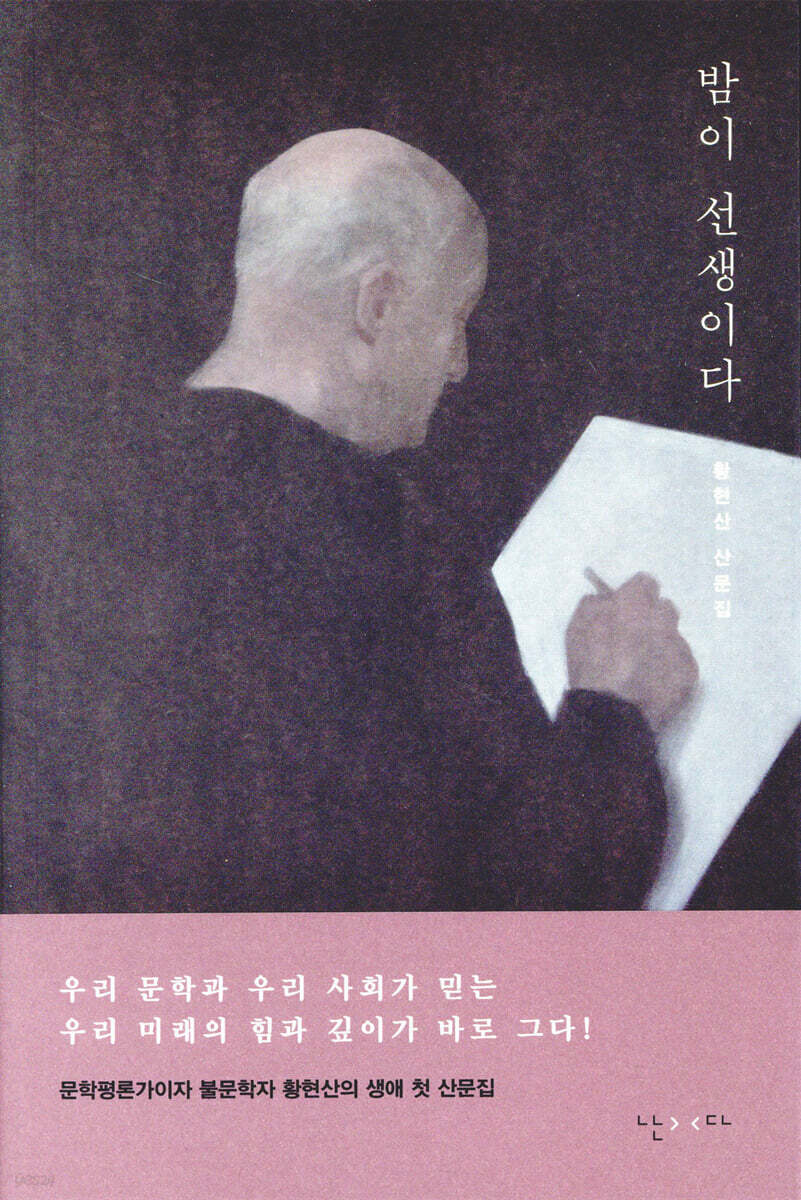
The book cover features a painting by Tim Eitel, a leading figure in German contemporary painting.
Having majored in painting, German, and philosophy, and having a keen interest in both art and literature, he probably had no idea that the characters he portrayed could be so similar to his teacher.
Are the expressions and backs of those who work at night this sublime?
This was the editor's private conversation.
Author's Note
This is my first book that is not a thesis or literary criticism on literature.
It mainly consists of columns written in the Hankyoreh newspaper over the past four years and in the Kookmin Ilbo in the early 2000s, but it also includes several articles written in the 1980s and 1990s of the last century.
As a result, I find it surprising that, although it was written over a period of over thirty years, the tone and style have not changed much, and that I still think in the same way now and then.
It may seem like there has been no progress, or it may seem like I have been wrestling with a prospect that I cannot give up.
I wanted to grope through the sometimes vague and sometimes concrete thoughts I had been harboring, and express them, if possible, beautifully, with appropriate language and honest rhetoric.
Those thoughts are nothing special.
Like my friends who deserved to be respected and loved, I also longed for a world where people lived freely and equally.
In this longing, I loved these mountains and rivers that raised me.
I loved cities and villages, I loved the night sky and the alleyways, and I dreamed of all living things living in harmony, healthy and happy.
Even thousands of years ago, even tens of thousands of years ago, people would have dreamed this dream every dark night, and we are still sadly dreaming this dream.
I wasn't in a position to put any great experience or profound philosophy into my writing, but I can say that I contributed my small talents in the hope that the dream would not be forgotten or sound like a mere platitude.
I would like to thank the editorial staff of Munhakdongne and poet Kim Min-jeong.
If it weren't for these amazing talents, this book would never have been published, or would have been published only half-heartedly.
June 2013
Hwang Hyeon-san
That is the strength and depth of our future!
The first collection of prose by literary critic and French literature scholar Hwang Hyeon-san
There is a name called Hwang Hyeon-san.
You might say I'm being too pretentious from the beginning, but I dare say that the name alone is enough to give you a sense of relief.
Even the modern French poetry, known for its difficulty, was different when he read it.
I don't know how many of our poets, unaware of their genius, languished in their closets with their poetry, and he dragged them out to dry in the sun.
Poet Hwang Byeong-seung was like that, poet Kim I-deum was like that, and there are other poets who were brought back to light through his commentary and became new to the Korean poetry world. It would be too much to list them all here.
And that's not all.
He witnessed moments in our twisted modern history when we could not stand up for justice, and each time, with eyes that were wide open, he wrote about his regret and anger.
The words he wrote every night with tears in his eyes, however, returned to our bodies as blood in the morning.
Because he was born with a destiny that made it impossible for him to love people.
Because of that destiny, I have lived until now as a true 'adult' who guides everyone to love the world and embrace the world with hope.
That's how I published "The Night is My Teacher."
As the title suggests, the teacher is known for working at night.
As the saying goes, “getting fire from the darkness” in literature, it is about using darkness as fire. I think it will be more valid if we look at the teacher’s inner thoughts revealed in an interview with a magazine, so I will briefly translate it.
“The reason I analyze when I criticize is to reach what cannot be analyzed.
To say there is depth is to say I don't know.
If there is a soul in the rock, it means there is a ghost inside, or in other words, there is something inside it that I do not know about.
That means it has depth.
The possibilities in the light are possibilities we all know, and the path in the darkness is the path that has opened up before us, the path that will open up.
Sometimes the possibility itself is literature.”
-From an interview with GQ
This book is the teacher's first collection of prose, not a thesis or literary criticism on literature.
From the writings published in various media over the past thirty years, from the 1980s to the present day in 2013, I have selected these and divided them into Part 1 and Part 3. Part 2 contains a few shots from the photos of Kang Woon-goo and Koo Bohnchang, two of Korea's representative photographers, that can serve as a metaphor for the book, along with the writings.
“As we grow older, darkness increases.
There are very rare moments when something shines brightly enough to pierce the sky.
“The good thing is that as we get older, we become accustomed to the darkness and learn to forgive it.”
When you read the teacher's prose, it's surprising how old he is.
It's really strong because it's written in short sentences without any help from any other person.
Rather than saying that the teacher's prose is a 'word' that presses down on you from above, it would be more accurate to say that it is an 'action' that walks shoulder to shoulder and matches your pace.
It wakes us up on its own.
That's what makes you move from your seat to the street.
For example, let's look at what we should do after each of us hits our knees in response to these sentences.
“City people miss nature.
But there is nothing I fear more than nature.
City dwellers always look for 'wild' vegetables, but they don't reach for worm-eaten vegetables.
In nature, death exists alongside life.
The city dwellers cannot bear that death.
People try to thoroughly block the shadow of death from their dwellings.
However, since there is no life that does not embrace death, if you try to prevent death, you end up blocking life as well.
“Where death cannot be endured, only death remains.”
-p21 From “Salt and Death”
But it's strange.
When you look at the strangely remaining 'sadness' behind the teacher's 'sting' that is sharper than an awl and harder than a hammer,
Sometimes in a voice that couldn't hide his anger, sometimes in a voice that couldn't hide his affection, the emotion was so desperate that I couldn't ask him, a critic, why he didn't stand in the middle of the lever... I started to think that maybe in our time, all the teachers who speak the truth with all their heart have gone into hiding, so the teacher is left to bear that burden alone.
Even if you don't have eyes or ears, life will still be lived.
But when we prefix it with the word "present," can we truly say we live in this "today" without eyes or ears? Your prose speaks precisely of that "justice."
When we focus our gaze purely on what is right, the various lifestyles we encounter at the end of that path, those gaps, are perhaps the only examples of our lives, which follow trends, bow before money, and hide behind authority, not knowing how to live.
A total of eighty essays are included in 『Night is the Teacher』.
As the teacher said, “even though it was written over thirty years, the tone and style haven’t changed much, and I still think in the same way now and then,” which is surprising, and I couldn’t help but underline this part.
The phrase was, “It seems like I’ve been wrestling with a prospect I can’t give up all this time.” This made me reflect on what kind of fight I’ve been having in front of that ‘prospect’ that the teacher has been fighting for his entire life, that ‘prospect’ that can certainly be expressed in many different words.
Ah, what great cause could there be that you could fight for your entire life to maintain such a youthful and flexible mind? Suddenly, I felt envious of that 'sense' that never seemed to age.
The book cover features a painting by Tim Eitel, a leading figure in German contemporary painting.
Having majored in painting, German, and philosophy, and having a keen interest in both art and literature, he probably had no idea that the characters he portrayed could be so similar to his teacher.
Are the expressions and backs of those who work at night this sublime?
This was the editor's private conversation.
Author's Note
This is my first book that is not a thesis or literary criticism on literature.
It mainly consists of columns written in the Hankyoreh newspaper over the past four years and in the Kookmin Ilbo in the early 2000s, but it also includes several articles written in the 1980s and 1990s of the last century.
As a result, I find it surprising that, although it was written over a period of over thirty years, the tone and style have not changed much, and that I still think in the same way now and then.
It may seem like there has been no progress, or it may seem like I have been wrestling with a prospect that I cannot give up.
I wanted to grope through the sometimes vague and sometimes concrete thoughts I had been harboring, and express them, if possible, beautifully, with appropriate language and honest rhetoric.
Those thoughts are nothing special.
Like my friends who deserved to be respected and loved, I also longed for a world where people lived freely and equally.
In this longing, I loved these mountains and rivers that raised me.
I loved cities and villages, I loved the night sky and the alleyways, and I dreamed of all living things living in harmony, healthy and happy.
Even thousands of years ago, even tens of thousands of years ago, people would have dreamed this dream every dark night, and we are still sadly dreaming this dream.
I wasn't in a position to put any great experience or profound philosophy into my writing, but I can say that I contributed my small talents in the hope that the dream would not be forgotten or sound like a mere platitude.
I would like to thank the editorial staff of Munhakdongne and poet Kim Min-jeong.
If it weren't for these amazing talents, this book would never have been published, or would have been published only half-heartedly.
June 2013
Hwang Hyeon-san
GOODS SPECIFICS
- Date of publication: June 25, 2013
- Page count, weight, size: 304 pages | 440g | 135*205*30mm
- ISBN13: 9788954621496
- ISBN10: 895462149X
You may also like
카테고리
korean


korean

![GQ KOREA Mark (Monthly): December [2025]](http://librairie.coreenne.fr/cdn/shop/files/8ef265dbbfbf186523ed75ba7319009d.jpg?v=1765340328&width=3840)


