

Haruki Murakami's essays
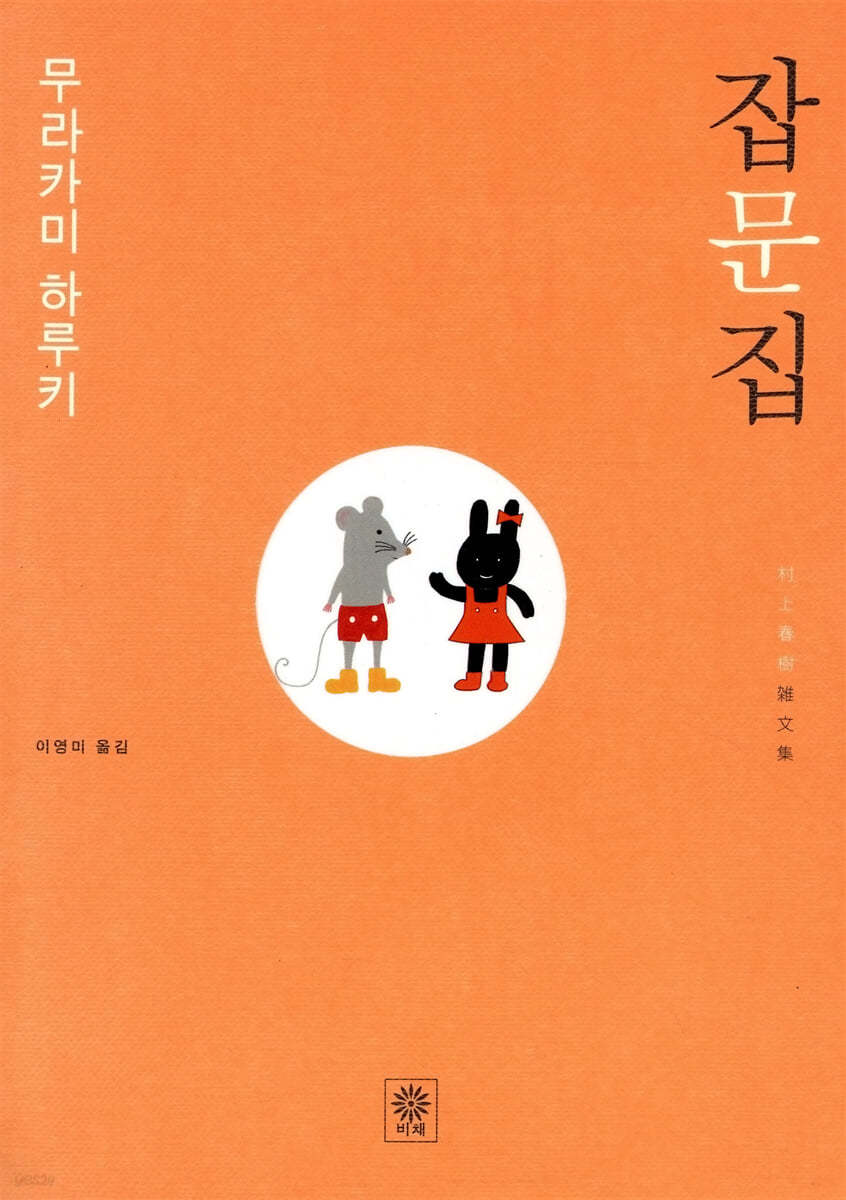 |
Description
Book Introduction
Everything You Need to Know About Haruki Murakami, Your Favorite Author
A culmination of 30 years of Haruki Murakami's literature
"The author hopes that you will read this book as if you were opening a 'lucky bag' on Lunar New Year's Day.
There are all kinds of things in the lucky bag.
There may be some things you like, and some you may not like so much.
Well, there's nothing we can do about it.
Because it's a lucky bag."
_Haruki Murakami
1979-2010, a culmination of Haruki Murakami's literature, containing both the innocent youthful innocence of a young writer and the seasoned sophistication of a writer in his sixties.
This is a collection of 69 previously unpublished essays carefully selected by Haruki Murakami, the contemporary writer.
From the serious literary theory told by author Haruki, to the sensuous translation theory of translator Murakami, the profound jazz theory of music lover Haruki Murakami, the clear reading theory advised by bookworm Haruki, the warm philosophy of life told by life senior Uncle Murakami, and even my close friend Jigi Jiwoo's explanation of my friend Haruki-kun.
Everything about Haruki Murakami, the author you love, is included.
Haruki usually insists on his ordinariness.
He goes to bed early and wakes up early, writes a certain amount of writing a day, runs, listens to music, enjoys watching baseball, translates as a hobby, enjoys reading Chandler and Jack London, likes beer and doesn't eat clams... ... He's just an average guy.
But as much as many people want to be like him, Haruki Murakami is, to put it mildly, the owner of an extraordinary ordinariness.
What he thinks about when he has fried oysters in front of him, what it was like to live on a Greek island, what conversations he had with Raymond Carver, why he likes the Beach Boys, what kind of translator he has, what kind of mission he has for his writing profession… … .
The book will answer all your questions.
It contains the time the author has accumulated layer by layer over the past thirty years or so.
From the serious literary theory of author Haruki Murakami, to the sensuous translation theory of translator Murakami, to the profound jazz theory of music lover Haruki Murakami, to the cheerful reading theory of bookworm Haruki, to the warm philosophy of life of life senior uncle Murakami, and even to the story of my friend Haruki-kun as told by his close friend Jigi-jiu, readers will find themselves nodding their heads without realizing it, thinking, "So even 'miscellaneous writing' is this different when written by Haruki."
A culmination of 30 years of Haruki Murakami's literature
"The author hopes that you will read this book as if you were opening a 'lucky bag' on Lunar New Year's Day.
There are all kinds of things in the lucky bag.
There may be some things you like, and some you may not like so much.
Well, there's nothing we can do about it.
Because it's a lucky bag."
_Haruki Murakami
1979-2010, a culmination of Haruki Murakami's literature, containing both the innocent youthful innocence of a young writer and the seasoned sophistication of a writer in his sixties.
This is a collection of 69 previously unpublished essays carefully selected by Haruki Murakami, the contemporary writer.
From the serious literary theory told by author Haruki, to the sensuous translation theory of translator Murakami, the profound jazz theory of music lover Haruki Murakami, the clear reading theory advised by bookworm Haruki, the warm philosophy of life told by life senior Uncle Murakami, and even my close friend Jigi Jiwoo's explanation of my friend Haruki-kun.
Everything about Haruki Murakami, the author you love, is included.
Haruki usually insists on his ordinariness.
He goes to bed early and wakes up early, writes a certain amount of writing a day, runs, listens to music, enjoys watching baseball, translates as a hobby, enjoys reading Chandler and Jack London, likes beer and doesn't eat clams... ... He's just an average guy.
But as much as many people want to be like him, Haruki Murakami is, to put it mildly, the owner of an extraordinary ordinariness.
What he thinks about when he has fried oysters in front of him, what it was like to live on a Greek island, what conversations he had with Raymond Carver, why he likes the Beach Boys, what kind of translator he has, what kind of mission he has for his writing profession… … .
The book will answer all your questions.
It contains the time the author has accumulated layer by layer over the past thirty years or so.
From the serious literary theory of author Haruki Murakami, to the sensuous translation theory of translator Murakami, to the profound jazz theory of music lover Haruki Murakami, to the cheerful reading theory of bookworm Haruki, to the warm philosophy of life of life senior uncle Murakami, and even to the story of my friend Haruki-kun as told by his close friend Jigi-jiu, readers will find themselves nodding their heads without realizing it, thinking, "So even 'miscellaneous writing' is this different when written by Haruki."
- You can preview some of the book's contents.
Preview
index
preface
Just a mixed feeling
Introduction, commentary, etc.
What is a magnet or how to eat delicious fried oysters
We breathe the same air, that's what it means.
The difficult world we live in
Anzai Mizumaru is watching you
Greeting messages, etc.
When I Turn Forty / Gunjo New Writer's Award Acceptance Speech
There's still a long way to go / Noma Literary New Writer Award acceptance speech
It's Okay to Forget It All / When I Received the Tanizaki Award
Amazing yet not so amazing / Asahi Prize acceptance speech
Is it a new thing to say now? / Waseda University Tsubouchi Soyo Award Recipient Speech
There are probably still many around / Mainichi Publishing Culture Award acceptance speech
No matter how violently the branches sway / Reception speech for the bride
I was able to explore unknown places within myself.
Eating a donut
When it's good, it's very good
The Wall and the Al / Jerusalem Prize Recipients' Greetings
About music
Music with space never gets boring
Jim Morrison's Soul Kitchen
You can see the trees in Norway but not the forest
Can Japanese people understand jazz?
A Conversation with Bill Crow
Autumn in New York
If everyone could have the sea
Smoke gets into your eyes
A consistent pianist
I can't bring myself to say it
Nowhere Man, the one who can't go anywhere
The Billie Holiday Story
About "Underground"
The Dark Magic of Tokyo's Underground
People who want coexistence, people who don't
In search of words with flesh and blood
Translating, being translated
Translating and being translated
The Watchman Within Me
The Long Goodbye as a quasi-classic novel
Chasing a moose
Stephen King's Despair and Love: A Quality Expression of Horror
The day Tim O'Brien visited Princeton University
The utility of Bach and Oster
Grace Paley's Addictive 'Chew'
The World of Raymond Carver
Scott Fitzgerald, the standard-bearer of the Jazz Age
More interesting than a novel?
What a single encounter leaves behind
A talented novel
The fact that there are contemporary writers like Kazuo Ishiguro
God of Translation
About the character
Anzai Mizumaru deserves nothing but praise.
Zootong
The history of the world of Kyoichi Tsuzuki
Collecting eyes and persuasive words
Chip Kidd's Work
Kawaii Teacher and Kawaii Hayao
What I saw with my eyes, what I thought with my heart
Dave Hilton's Season
How to iron correctly
The Herring Story
Jack London's dentures
Let's think about the wind
Comments for Tony Takitani
Finding a different sound
Questions and Answers
It's hard to age gracefully
Questions from the Postcommunist World
Outtakes from the short fiction "The Spider Monkey of the Night"
A world without love
Kojin Karatani
field mouse in the bush
Writing a novel
flexible soul
A room that travels far
My story and my writing style
A novel that brings warmth
Frozen Sea and Axe
Virtuous cycle of stories
commentary
Bold Anzai Mizumaru x Wada Makoto
The Gray Mouse and the Black Rabbit
Just a mixed feeling
Introduction, commentary, etc.
What is a magnet or how to eat delicious fried oysters
We breathe the same air, that's what it means.
The difficult world we live in
Anzai Mizumaru is watching you
Greeting messages, etc.
When I Turn Forty / Gunjo New Writer's Award Acceptance Speech
There's still a long way to go / Noma Literary New Writer Award acceptance speech
It's Okay to Forget It All / When I Received the Tanizaki Award
Amazing yet not so amazing / Asahi Prize acceptance speech
Is it a new thing to say now? / Waseda University Tsubouchi Soyo Award Recipient Speech
There are probably still many around / Mainichi Publishing Culture Award acceptance speech
No matter how violently the branches sway / Reception speech for the bride
I was able to explore unknown places within myself.
Eating a donut
When it's good, it's very good
The Wall and the Al / Jerusalem Prize Recipients' Greetings
About music
Music with space never gets boring
Jim Morrison's Soul Kitchen
You can see the trees in Norway but not the forest
Can Japanese people understand jazz?
A Conversation with Bill Crow
Autumn in New York
If everyone could have the sea
Smoke gets into your eyes
A consistent pianist
I can't bring myself to say it
Nowhere Man, the one who can't go anywhere
The Billie Holiday Story
About "Underground"
The Dark Magic of Tokyo's Underground
People who want coexistence, people who don't
In search of words with flesh and blood
Translating, being translated
Translating and being translated
The Watchman Within Me
The Long Goodbye as a quasi-classic novel
Chasing a moose
Stephen King's Despair and Love: A Quality Expression of Horror
The day Tim O'Brien visited Princeton University
The utility of Bach and Oster
Grace Paley's Addictive 'Chew'
The World of Raymond Carver
Scott Fitzgerald, the standard-bearer of the Jazz Age
More interesting than a novel?
What a single encounter leaves behind
A talented novel
The fact that there are contemporary writers like Kazuo Ishiguro
God of Translation
About the character
Anzai Mizumaru deserves nothing but praise.
Zootong
The history of the world of Kyoichi Tsuzuki
Collecting eyes and persuasive words
Chip Kidd's Work
Kawaii Teacher and Kawaii Hayao
What I saw with my eyes, what I thought with my heart
Dave Hilton's Season
How to iron correctly
The Herring Story
Jack London's dentures
Let's think about the wind
Comments for Tony Takitani
Finding a different sound
Questions and Answers
It's hard to age gracefully
Questions from the Postcommunist World
Outtakes from the short fiction "The Spider Monkey of the Night"
A world without love
Kojin Karatani
field mouse in the bush
Writing a novel
flexible soul
A room that travels far
My story and my writing style
A novel that brings warmth
Frozen Sea and Axe
Virtuous cycle of stories
commentary
Bold Anzai Mizumaru x Wada Makoto
The Gray Mouse and the Black Rabbit
Into the book
* It has been over thirty years since I debuted as a writer, and I have written for various purposes and in various publications. I have collected here the writings that have not yet been published as books.
It is composed in a way that can only be described as 'miscellaneous', including essays, introductions and commentaries to various books, answers to questions, various greetings, and even short fiction pieces.
There are quite a few unpublished works.
A more ordinary title would have been better, but since I kept calling it a "collection of essays" during discussions with the editor, the conversation flowed towards "Well, I guess it's okay to leave it as is," and so the title "Murakami Haruki's Collection of Essays" was chosen.
Since these are miscellaneous writings, I think it's okay to be thorough and miscellaneous. --- Preface: These are just miscellaneous thoughts.
* If there were a high, solid wall here, and an egg that would break when it hit it, I would always stand on the side of that egg.
---The Wall and the Egg - Jerusalem Prize Recipient's Greetings
* You know, Mom, what's this "post-war democracy" thing? They say humans have been having sex without love since then. Is that true? --- A world without love.
* Jack London and I have the same birthday, and although that's not necessarily the case, I read his novels often.
It is composed in a way that can only be described as 'miscellaneous', including essays, introductions and commentaries to various books, answers to questions, various greetings, and even short fiction pieces.
There are quite a few unpublished works.
A more ordinary title would have been better, but since I kept calling it a "collection of essays" during discussions with the editor, the conversation flowed towards "Well, I guess it's okay to leave it as is," and so the title "Murakami Haruki's Collection of Essays" was chosen.
Since these are miscellaneous writings, I think it's okay to be thorough and miscellaneous. --- Preface: These are just miscellaneous thoughts.
* If there were a high, solid wall here, and an egg that would break when it hit it, I would always stand on the side of that egg.
---The Wall and the Egg - Jerusalem Prize Recipient's Greetings
* You know, Mom, what's this "post-war democracy" thing? They say humans have been having sex without love since then. Is that true? --- A world without love.
* Jack London and I have the same birthday, and although that's not necessarily the case, I read his novels often.
---Jack London's dentures
Publisher's Review
Everything You Need to Know About Haruki Murakami, Your Favorite Author
A culmination of 30 years of Haruki Murakami's literature
"The author hopes that you will read this book as if you were opening a 'lucky bag' on Lunar New Year's Day.
There are all kinds of things in the lucky bag.
There may be some things you like, and some you may not like so much.
Well, there's nothing we can do about it.
Because it's a lucky bag."
_Haruki Murakami
Haruki Murakami, who is loved by readers around the world and is mentioned as a strong candidate for the Nobel Prize in Literature every year.
He, who made the hearts of countless "youths of yesterday" flutter with "Norwegian Wood," which left a mark on the history of Japanese literature, has now passed the age of 60 and captivated the "youths of today" with "1Q84."
And now he is meeting readers again with 『Murakami Haruki's Miscellaneous Essays』.
『Haruki Murakami's Collected Essays』, containing 69 unpublished and unpublished "beautiful writings" carefully selected by him.
It would not be an exaggeration to say that this is the culmination of 30 years of Haruki Murakami's literature, and everything about the author we love.
Haruki Murakami, the contemporary writer who captivated readers around the world
1979-2010, from unpublished essays to uncollected short stories
There is a writer who has been running silently and consistently for thirty years like a long-distance runner.
And, like walking down a street where each house and each stone has meaning, there are some writings that never lose their interest no matter how many times you visit them.
Author Haruki Murakami looked back on his life and compiled 69 beautiful pieces of writing into a single book, including unpublished essays, unpublished short stories, and acceptance speeches from various awards.
The title was simply ‘Murakami Haruki’s Miscellaneous Essays’.
Although it is said to be a collection of 'miscellaneous writings', it is extremely neatly organized.
As art critic Noi Sawaragi said, it is like 'a piece of refined furniture that is simple and functional.'
He also did not forget to be kind enough to add a short explanation similar to liner notes to each article.
We also added a commentary in the form of a bold statement.
This is a conversation between Mizumaru Anzai and Makoto Wada, who were in charge of the illustrations for the cover and various parts of the book. It is unprecedented for a Haruki Murakami book to have an explanation attached.
In that way, 『Murakami Haruki's Essays』 captures the essence of Haruki's existing style while also guiding readers into a new world of Haruki.
So, some people express their trust and satisfaction with 『Murakami Haruki's Collected Essays』, saying, "This book is full of Haruki's voice (Non-fiction writer, Hidemine Takahashi)", while others cannot help but marvel at its freshness, saying, "This is the first time I've seen a Haruki like this! (Shinchosha editor, T)."
As expected, it's Haruki Murakami!
What kind of person is Haruki Murakami?
Haruki usually insists on his ordinariness.
He goes to bed early and wakes up early, writes a certain amount of writing a day, runs, listens to music, enjoys watching baseball, translates as a hobby, enjoys reading Chandler and Jack London, likes beer and doesn't eat clams... ... He's just an average guy.
But as much as many people want to be like him, Haruki Murakami is, to put it mildly, the owner of an extraordinary ordinariness.
What he thinks about when he has fried oysters in front of him, what it was like to live on a Greek island, what conversations he had with Raymond Carver, why he likes the Beach Boys, what kind of translator he has, what kind of mission he has for his writing profession… … .
Here, 『Murakami Haruki's Miscellaneous Essays』 will answer all your questions.
It contains the time the author has accumulated layer by layer over the past thirty years or so.
From the serious literary theory of author Haruki Murakami, to the sensuous translation theory of translator Murakami, to the profound jazz theory of music lover Haruki Murakami, to the cheerful reading theory of bookworm Haruki, to the warm philosophy of life of life senior uncle Murakami, and even to the story of my friend Haruki-kun as told by his close friend Jigi-jiu, readers will find themselves nodding their heads without realizing it, thinking, "So even 'miscellaneous writing' is this different when written by Haruki."
A culmination of 30 years of Haruki Murakami's literature
"The author hopes that you will read this book as if you were opening a 'lucky bag' on Lunar New Year's Day.
There are all kinds of things in the lucky bag.
There may be some things you like, and some you may not like so much.
Well, there's nothing we can do about it.
Because it's a lucky bag."
_Haruki Murakami
Haruki Murakami, who is loved by readers around the world and is mentioned as a strong candidate for the Nobel Prize in Literature every year.
He, who made the hearts of countless "youths of yesterday" flutter with "Norwegian Wood," which left a mark on the history of Japanese literature, has now passed the age of 60 and captivated the "youths of today" with "1Q84."
And now he is meeting readers again with 『Murakami Haruki's Miscellaneous Essays』.
『Haruki Murakami's Collected Essays』, containing 69 unpublished and unpublished "beautiful writings" carefully selected by him.
It would not be an exaggeration to say that this is the culmination of 30 years of Haruki Murakami's literature, and everything about the author we love.
Haruki Murakami, the contemporary writer who captivated readers around the world
1979-2010, from unpublished essays to uncollected short stories
There is a writer who has been running silently and consistently for thirty years like a long-distance runner.
And, like walking down a street where each house and each stone has meaning, there are some writings that never lose their interest no matter how many times you visit them.
Author Haruki Murakami looked back on his life and compiled 69 beautiful pieces of writing into a single book, including unpublished essays, unpublished short stories, and acceptance speeches from various awards.
The title was simply ‘Murakami Haruki’s Miscellaneous Essays’.
Although it is said to be a collection of 'miscellaneous writings', it is extremely neatly organized.
As art critic Noi Sawaragi said, it is like 'a piece of refined furniture that is simple and functional.'
He also did not forget to be kind enough to add a short explanation similar to liner notes to each article.
We also added a commentary in the form of a bold statement.
This is a conversation between Mizumaru Anzai and Makoto Wada, who were in charge of the illustrations for the cover and various parts of the book. It is unprecedented for a Haruki Murakami book to have an explanation attached.
In that way, 『Murakami Haruki's Essays』 captures the essence of Haruki's existing style while also guiding readers into a new world of Haruki.
So, some people express their trust and satisfaction with 『Murakami Haruki's Collected Essays』, saying, "This book is full of Haruki's voice (Non-fiction writer, Hidemine Takahashi)", while others cannot help but marvel at its freshness, saying, "This is the first time I've seen a Haruki like this! (Shinchosha editor, T)."
As expected, it's Haruki Murakami!
What kind of person is Haruki Murakami?
Haruki usually insists on his ordinariness.
He goes to bed early and wakes up early, writes a certain amount of writing a day, runs, listens to music, enjoys watching baseball, translates as a hobby, enjoys reading Chandler and Jack London, likes beer and doesn't eat clams... ... He's just an average guy.
But as much as many people want to be like him, Haruki Murakami is, to put it mildly, the owner of an extraordinary ordinariness.
What he thinks about when he has fried oysters in front of him, what it was like to live on a Greek island, what conversations he had with Raymond Carver, why he likes the Beach Boys, what kind of translator he has, what kind of mission he has for his writing profession… … .
Here, 『Murakami Haruki's Miscellaneous Essays』 will answer all your questions.
It contains the time the author has accumulated layer by layer over the past thirty years or so.
From the serious literary theory of author Haruki Murakami, to the sensuous translation theory of translator Murakami, to the profound jazz theory of music lover Haruki Murakami, to the cheerful reading theory of bookworm Haruki, to the warm philosophy of life of life senior uncle Murakami, and even to the story of my friend Haruki-kun as told by his close friend Jigi-jiu, readers will find themselves nodding their heads without realizing it, thinking, "So even 'miscellaneous writing' is this different when written by Haruki."
GOODS SPECIFICS
- Date of issue: November 17, 2011
- Page count, weight, size: 504 pages | 542g | 137*195*35mm
- ISBN13: 9788994343501
- ISBN10: 8994343504
You may also like
카테고리
korean


korean

![GQ KOREA Mark (Monthly): December [2025]](http://librairie.coreenne.fr/cdn/shop/files/8ef265dbbfbf186523ed75ba7319009d.jpg?v=1765340328&width=3840)


