

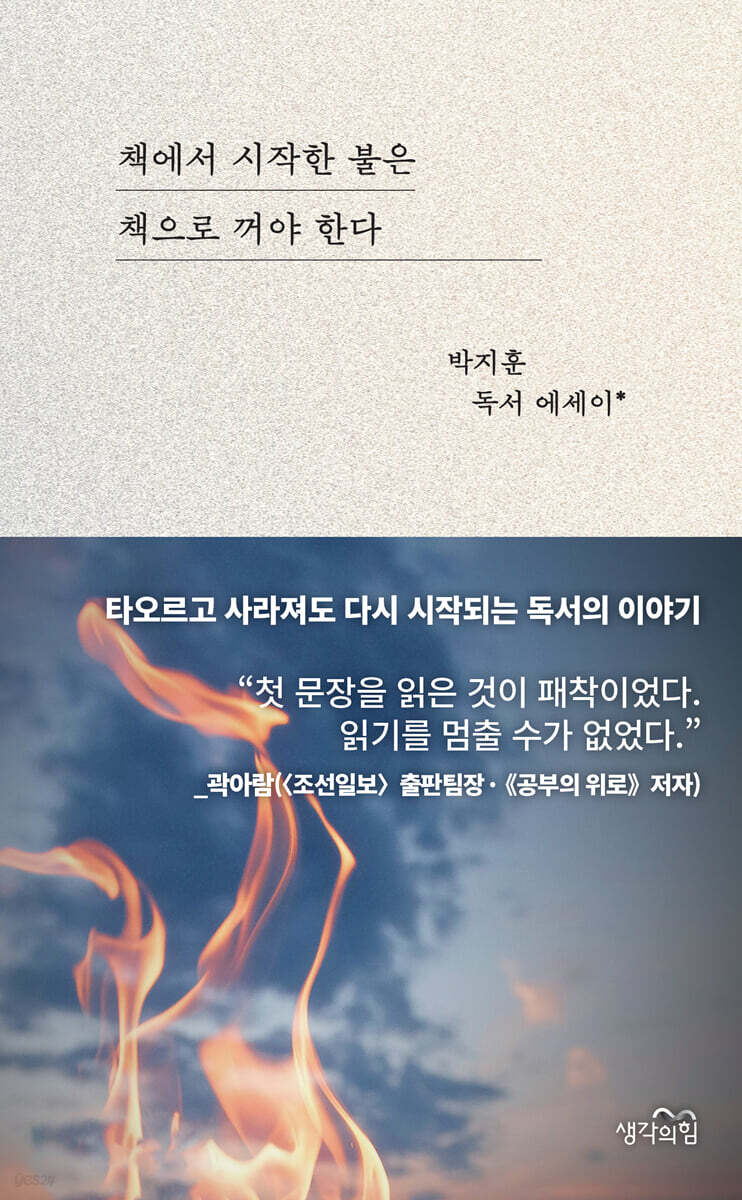
A fire started by a book must be put out by a book.
 |
Description
Book Introduction
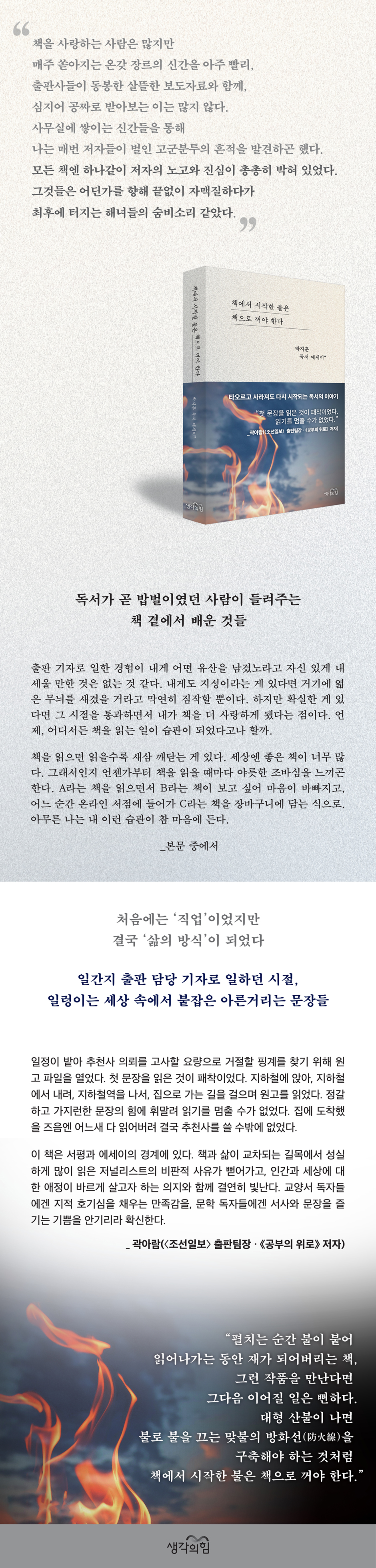
A story told by someone who made a living by reading
Things I learned from books
★Recommended by Kwak A-ram (Publishing Team Leader, Chosun Ilbo, Author of "The Comfort of Studying")
Author Park Ji-hoon, for whom reading books was his livelihood, presents a reading essay titled “A Fire Started by a Book Must Be Put Out with a Book,” in which he reminisces about the times when he was “surrounded by books, and sometimes even imprisoned.”
It vividly portrays the daily life of a daily newspaper reporter, which may seem somewhat unfamiliar, and also conveys sentences that catch the eye of the reader.
A total of 34 chapters cover a wide range of topics, from literature to social sciences, economics and management, philosophy, history, and science, and present a colorful and diverse range of book stories.
This book is the first essay of a publishing reporter who encounters hundreds of books every week, and is also a reading record of books and life reflecting each other, as well as a passionate love song for all the books in the world.
The author shares with readers the comfort and sparks of thought gleaned from the book, and poses various questions surrounding the book.
The story of a reader who lived by putting out the fire that started with books unfolds.
Things I learned from books
★Recommended by Kwak A-ram (Publishing Team Leader, Chosun Ilbo, Author of "The Comfort of Studying")
Author Park Ji-hoon, for whom reading books was his livelihood, presents a reading essay titled “A Fire Started by a Book Must Be Put Out with a Book,” in which he reminisces about the times when he was “surrounded by books, and sometimes even imprisoned.”
It vividly portrays the daily life of a daily newspaper reporter, which may seem somewhat unfamiliar, and also conveys sentences that catch the eye of the reader.
A total of 34 chapters cover a wide range of topics, from literature to social sciences, economics and management, philosophy, history, and science, and present a colorful and diverse range of book stories.
This book is the first essay of a publishing reporter who encounters hundreds of books every week, and is also a reading record of books and life reflecting each other, as well as a passionate love song for all the books in the world.
The author shares with readers the comfort and sparks of thought gleaned from the book, and poses various questions surrounding the book.
The story of a reader who lived by putting out the fire that started with books unfolds.
- You can preview some of the book's contents.
Preview
index
At the beginning of the book
Part 1
If there is a path to reading
- Lee Dong-jin's "Lee Dong-jin's Reading Method: Just Do What You Can, Just Do What You Can"
Where did that light go then?
- Trinh Juan Tuan's "A Night on Mauna Kea"
In the time swallowed by the whale, we
- Susan Orlean's "Library Life, Books' Fate"
Youth passes by quickly like a wild cat
- Kim Yeon-su's "National Route 7 Revisited"
I don't think I'll ever say goodbye
- Frans de Waal's 'Thoughts on Animal Thought'
A book toward the light
- Hope Jahren's "Rap Girl"
Even if it's not perfect, if I can put a period
- Metaphor's 『Metaphor's Writing Counseling Center』
I can't love you, but I have to love you
- Lee Seung-woo's "A Life of Love"
I'm sorry I can't be a cat
- Jingoroho's "Mother Gave Birth to a Fish"
Good night, everybody
- Matthew Walker's "Why We Sleep"
It's work, it's still work
- Kim Ho's "From Office Worker to Professional"
Where music flows, it never dries up.
- John Powell's "Why We Love Music"
How easy is it to earn money from others?
- Han Seung-tae's "Queening"
Could he have become a seagull?
- Ahn Do-hyun's 『Biography of Baekseok』
Good questions have no answers.
- Arisa H.
Oh Yi's "Why Those Children Had to Leave Korea"
The table of my mother who raised me, the food of the world
- Yoon Dae-nyeong's "Sword and Lips"
The root of love called name
- Jhumpa Lahiri's "Love Behind Names"
Part 2
Towards a circle community
- Anu Partanen's "We Arrived a Little Early in the Future"
Don't talk about us without us
- About Us by Peter Cattapano and Rosemary Garland-Thompson
If we meet again after 25 million years
- Lee Nak-won's "We Are Not Eternal"
In the mirror of Homo sapiens, there is always the face of war.
- Kim Dong-chun's "War and Society"
Towards a dignified and rational disagreement
Good Economics for Hard Times by Abhijit Banerjee and Esther Duflo
To parents who cannot become Oh Eun-young
- Judith Rich Harris's "The Parenting Hypothesis"
Impure language, exalt the individual
- Go Jong-seok's "Infected Language"
Is there a new society within me?
- Kim Gyu-hang's "Capitalism Seminar"
The Beginning of Korea's Real Estate Fantasy
- Han Jong-su and Kang Hee-yong's "The Birth of Gangnam"
The imagination of plucking the flower of democracy
- Todd Rose's "Collective Delusion"
Can cold warmth change the world?
- William MacAskill's The Cold Altruist
Marriage is not the only way to complete love.
- Ok Hye-sook and Lee Sang-heon's "We Met at Eleven"
Even as night falls and the bells ring, time passes and I remain.
- Masashi Matsuie's "Summer Remains There for a Long Time"
So that even if you can't see it, you can hear it, you can feel it
- Kim Seung-seop's "Studying Responding to Others' Pain"
So we have to hold hands so we don't fall into the sea.
- Moon Mi-sun's "The Way We Got Through Winter"
If eternal separation disappears
- Michio Kaku's "The Future of Humanity"
Everyone starts from ashes
- Lee Mun-yeol's 'Portrait of Youth'
main
Part 1
If there is a path to reading
- Lee Dong-jin's "Lee Dong-jin's Reading Method: Just Do What You Can, Just Do What You Can"
Where did that light go then?
- Trinh Juan Tuan's "A Night on Mauna Kea"
In the time swallowed by the whale, we
- Susan Orlean's "Library Life, Books' Fate"
Youth passes by quickly like a wild cat
- Kim Yeon-su's "National Route 7 Revisited"
I don't think I'll ever say goodbye
- Frans de Waal's 'Thoughts on Animal Thought'
A book toward the light
- Hope Jahren's "Rap Girl"
Even if it's not perfect, if I can put a period
- Metaphor's 『Metaphor's Writing Counseling Center』
I can't love you, but I have to love you
- Lee Seung-woo's "A Life of Love"
I'm sorry I can't be a cat
- Jingoroho's "Mother Gave Birth to a Fish"
Good night, everybody
- Matthew Walker's "Why We Sleep"
It's work, it's still work
- Kim Ho's "From Office Worker to Professional"
Where music flows, it never dries up.
- John Powell's "Why We Love Music"
How easy is it to earn money from others?
- Han Seung-tae's "Queening"
Could he have become a seagull?
- Ahn Do-hyun's 『Biography of Baekseok』
Good questions have no answers.
- Arisa H.
Oh Yi's "Why Those Children Had to Leave Korea"
The table of my mother who raised me, the food of the world
- Yoon Dae-nyeong's "Sword and Lips"
The root of love called name
- Jhumpa Lahiri's "Love Behind Names"
Part 2
Towards a circle community
- Anu Partanen's "We Arrived a Little Early in the Future"
Don't talk about us without us
- About Us by Peter Cattapano and Rosemary Garland-Thompson
If we meet again after 25 million years
- Lee Nak-won's "We Are Not Eternal"
In the mirror of Homo sapiens, there is always the face of war.
- Kim Dong-chun's "War and Society"
Towards a dignified and rational disagreement
Good Economics for Hard Times by Abhijit Banerjee and Esther Duflo
To parents who cannot become Oh Eun-young
- Judith Rich Harris's "The Parenting Hypothesis"
Impure language, exalt the individual
- Go Jong-seok's "Infected Language"
Is there a new society within me?
- Kim Gyu-hang's "Capitalism Seminar"
The Beginning of Korea's Real Estate Fantasy
- Han Jong-su and Kang Hee-yong's "The Birth of Gangnam"
The imagination of plucking the flower of democracy
- Todd Rose's "Collective Delusion"
Can cold warmth change the world?
- William MacAskill's The Cold Altruist
Marriage is not the only way to complete love.
- Ok Hye-sook and Lee Sang-heon's "We Met at Eleven"
Even as night falls and the bells ring, time passes and I remain.
- Masashi Matsuie's "Summer Remains There for a Long Time"
So that even if you can't see it, you can hear it, you can feel it
- Kim Seung-seop's "Studying Responding to Others' Pain"
So we have to hold hands so we don't fall into the sea.
- Moon Mi-sun's "The Way We Got Through Winter"
If eternal separation disappears
- Michio Kaku's "The Future of Humanity"
Everyone starts from ashes
- Lee Mun-yeol's 'Portrait of Youth'
main
Detailed image
Into the book
I worked as a publishing reporter from January 2017 to June 2020.
The job of a publishing reporter is to select a book from among the new releases each week and introduce it to readers as a "book of the week," but the first few months were a real struggle.
No matter how carefully I read it, summarizing its contents was a daunting task, and adding pointed comments was often a challenge.
If you read the book reviews I wrote back then, you will be able to feel the strong scent of imagination permeating every sentence.
It was a time when I had to check the bottom of my abilities every day, but those days gave me tremendous joy.
To borrow someone's expression, I experienced the nirvana of work life itself.
The satisfaction of having the rare experience of reading becoming a source of income was also great.
--- p.15
When I entered college, I had nowhere to put my mind, so the place I spent day and night was the school library.
To me, who came to Seoul from a rural area without a single proper library, that place was a vast new world.
I read books slowly in a corner of the library, like an animal licking its own wounds.
As I wandered through the cave of books, feeling like Pinocchio, who entered the whale's belly in search of his grandfather Geppetto, I found something that I could not help but long for.
In those days, the library was my most cozy fortress in the world.
As written in the non-fiction book 『Library Life, Books' Fate』 by Susan Orlean, a staff writer for the New Yorker:
--- pp.34~35
The tremendous resonance that the ordinary sentence “I must love” brings is a feeling that only readers who read this work to the end can experience.
The sentence “You must love” has no object.
This sentence seems to have appeared a bit out of the blue, feels a bit distant from the previous sentence, but thanks to this gap, it evokes a distant feeling, and at the same time, emphasizes the importance of love itself.
But what exactly is love?
How does the life, aging, illness, and death of love progress?
This is precisely the point that Lee Seung-woo's novel, "A Life of Love," focuses on.
In “Life Before Us,” the love that Momo says “must love” is a very broad love, but the love dealt with in this work means the love that burns passionately between lovers and then crumbles coldly.
The author defines this work in the beginning as follows:
“An exploratory report on love through a literary microscope” (4).
--- pp.82~83
My mother would have been the same.
In my hometown where I am not, I would look at the birds sitting on the high branches, the flowers blooming on the roadside, and the tree branches swaying in the wind, and think of my son who became a fish and went to the sea.
My mother, who is now approaching her seventies, is still full of energy.
I work as a social worker looking after the elderly in the neighborhood, I started farming late in life, I sometimes go to the beach to dig for clams, and I often give lectures at various lectures held in the countryside, although I don't know the content.
They say the prime of life starts at age sixty, but I wonder if I can be like that in my sixties.
As time goes by and my mother's life becomes less like that of a 'mother', I often imagine what will happen to me if she passes away.
When the time comes to ponder the meaning of Feng Shui Jitan, I think I will often recall Deleuze's words that life is not confined to a specific space and time, but rather that life exists in every moment and space.
For example, in the book “The History of Philosophy by Deleuze,” there is an explanation that says, “Life exists everywhere.”
--- pp.97~98
If you ask, “What is a good book?” you will get many answers.
A good book is one that stirs emotions, stimulates thoughts, or provides insight.
A great book might be defined as one that contains good questions, good answers, or both.
So what are good questions and what are good answers?
Although this isn't always the case, the better the question, the more difficult it is to find an answer.
Even if there are no answers, sometimes a good book is one that throws out a bunch of things to think about.
When readers read books like this, they find themselves asking all sorts of questions after reading, which becomes a source of thought.
"Why Those Children Had to Leave Korea" was introduced in Korea in 2019, and at the time, I thought it was one of the "Books of the Year" that would represent that year, and this was precisely why.
--- p.157
Hyunju was a child I met while preparing a feature article about the lives of disabled people who were cornered.
After reviewing the materials containing the difficult life of Hyun-ju's family, I interviewed Hyun-ju's mother, Hee-kyung (pseudonym). (Hee-kyung is also a person with a level 4 visual impairment and was raising Hyun-ju alone.)
He said he knew about the child's 'condition' from the time he was pregnant, and the moment I heard this, this question immediately popped into my mouth.
“Have you ever thought about having an abortion?”
Only after a deep silence did Hee-kyung give a short answer.
I've never thought about that.
It was only a few days later that I realized my question was seriously flawed.
He secretly considered Hyun-ju's life to be worthless and hopeless.
Why did I make such a mistake?
How did I end up asking such a bad question?
--- pp.191~192
There is something I often imagine when I look at the political scene of Baeknyeonhacheong, which is a country with a bumper crop of nonsense.
Since elections are always behind the turmoil that occurs there, why not just get rid of the election system?
Shouldn't members of the National Assembly, provincial governors, and even the president be chosen by lottery?
It may sound crazy, but the idea of reviving our broken democracy through an election system with a lottery system is something that has been put forward here and there by renowned thinkers and scholars.
For example, Japanese philosopher Kojin Karatani, in his book “The Origin of the Japanese Spirit,” proposed selecting multiple candidates and then holding a drawing to select a representative.
He believed that representative democracy was not the only system we could choose, and that electing representatives solely through elections was a double-edged sword for bourgeois dictatorship.
--- p.271
There is also a novel that deals with a similar story.
This is Jeong Jin-yeong's work, "To My Mother Who Was Younger Than Me," which features a person who tries to revive his mother, who took her own life, using AI.
The book says:
"mom.
“It is a word that I can write and read, but cannot sing.”
--- p.
94 Among "I"
The inability to touch, see, or even call that person's name is gone.
Because that is death, we always feel a sense of helplessness in the face of death.
The reason novels like “To My Mother Who Was Younger Than Me” came out is probably because people wanted to find a way to overcome this endless sadness.
But the heavy meaning of the word death may change in the future.
Immortality and eternal life are no longer words reserved for legends, myths, or novels.
If you're even remotely interested in science, the existence of dadbots might seem trivial.
The pace of development in the world is dizzying, and some even say this.
The first human to celebrate his 1,000th birthday is already living in the world.
The magic wand of science is drastically changing the future of humanity, so in the distant future, even the human life cycle, which can be summarized in the four characters of birth, aging, illness, and death, may be completely transformed.
The job of a publishing reporter is to select a book from among the new releases each week and introduce it to readers as a "book of the week," but the first few months were a real struggle.
No matter how carefully I read it, summarizing its contents was a daunting task, and adding pointed comments was often a challenge.
If you read the book reviews I wrote back then, you will be able to feel the strong scent of imagination permeating every sentence.
It was a time when I had to check the bottom of my abilities every day, but those days gave me tremendous joy.
To borrow someone's expression, I experienced the nirvana of work life itself.
The satisfaction of having the rare experience of reading becoming a source of income was also great.
--- p.15
When I entered college, I had nowhere to put my mind, so the place I spent day and night was the school library.
To me, who came to Seoul from a rural area without a single proper library, that place was a vast new world.
I read books slowly in a corner of the library, like an animal licking its own wounds.
As I wandered through the cave of books, feeling like Pinocchio, who entered the whale's belly in search of his grandfather Geppetto, I found something that I could not help but long for.
In those days, the library was my most cozy fortress in the world.
As written in the non-fiction book 『Library Life, Books' Fate』 by Susan Orlean, a staff writer for the New Yorker:
--- pp.34~35
The tremendous resonance that the ordinary sentence “I must love” brings is a feeling that only readers who read this work to the end can experience.
The sentence “You must love” has no object.
This sentence seems to have appeared a bit out of the blue, feels a bit distant from the previous sentence, but thanks to this gap, it evokes a distant feeling, and at the same time, emphasizes the importance of love itself.
But what exactly is love?
How does the life, aging, illness, and death of love progress?
This is precisely the point that Lee Seung-woo's novel, "A Life of Love," focuses on.
In “Life Before Us,” the love that Momo says “must love” is a very broad love, but the love dealt with in this work means the love that burns passionately between lovers and then crumbles coldly.
The author defines this work in the beginning as follows:
“An exploratory report on love through a literary microscope” (4).
--- pp.82~83
My mother would have been the same.
In my hometown where I am not, I would look at the birds sitting on the high branches, the flowers blooming on the roadside, and the tree branches swaying in the wind, and think of my son who became a fish and went to the sea.
My mother, who is now approaching her seventies, is still full of energy.
I work as a social worker looking after the elderly in the neighborhood, I started farming late in life, I sometimes go to the beach to dig for clams, and I often give lectures at various lectures held in the countryside, although I don't know the content.
They say the prime of life starts at age sixty, but I wonder if I can be like that in my sixties.
As time goes by and my mother's life becomes less like that of a 'mother', I often imagine what will happen to me if she passes away.
When the time comes to ponder the meaning of Feng Shui Jitan, I think I will often recall Deleuze's words that life is not confined to a specific space and time, but rather that life exists in every moment and space.
For example, in the book “The History of Philosophy by Deleuze,” there is an explanation that says, “Life exists everywhere.”
--- pp.97~98
If you ask, “What is a good book?” you will get many answers.
A good book is one that stirs emotions, stimulates thoughts, or provides insight.
A great book might be defined as one that contains good questions, good answers, or both.
So what are good questions and what are good answers?
Although this isn't always the case, the better the question, the more difficult it is to find an answer.
Even if there are no answers, sometimes a good book is one that throws out a bunch of things to think about.
When readers read books like this, they find themselves asking all sorts of questions after reading, which becomes a source of thought.
"Why Those Children Had to Leave Korea" was introduced in Korea in 2019, and at the time, I thought it was one of the "Books of the Year" that would represent that year, and this was precisely why.
--- p.157
Hyunju was a child I met while preparing a feature article about the lives of disabled people who were cornered.
After reviewing the materials containing the difficult life of Hyun-ju's family, I interviewed Hyun-ju's mother, Hee-kyung (pseudonym). (Hee-kyung is also a person with a level 4 visual impairment and was raising Hyun-ju alone.)
He said he knew about the child's 'condition' from the time he was pregnant, and the moment I heard this, this question immediately popped into my mouth.
“Have you ever thought about having an abortion?”
Only after a deep silence did Hee-kyung give a short answer.
I've never thought about that.
It was only a few days later that I realized my question was seriously flawed.
He secretly considered Hyun-ju's life to be worthless and hopeless.
Why did I make such a mistake?
How did I end up asking such a bad question?
--- pp.191~192
There is something I often imagine when I look at the political scene of Baeknyeonhacheong, which is a country with a bumper crop of nonsense.
Since elections are always behind the turmoil that occurs there, why not just get rid of the election system?
Shouldn't members of the National Assembly, provincial governors, and even the president be chosen by lottery?
It may sound crazy, but the idea of reviving our broken democracy through an election system with a lottery system is something that has been put forward here and there by renowned thinkers and scholars.
For example, Japanese philosopher Kojin Karatani, in his book “The Origin of the Japanese Spirit,” proposed selecting multiple candidates and then holding a drawing to select a representative.
He believed that representative democracy was not the only system we could choose, and that electing representatives solely through elections was a double-edged sword for bourgeois dictatorship.
--- p.271
There is also a novel that deals with a similar story.
This is Jeong Jin-yeong's work, "To My Mother Who Was Younger Than Me," which features a person who tries to revive his mother, who took her own life, using AI.
The book says:
"mom.
“It is a word that I can write and read, but cannot sing.”
--- p.
94 Among "I"
The inability to touch, see, or even call that person's name is gone.
Because that is death, we always feel a sense of helplessness in the face of death.
The reason novels like “To My Mother Who Was Younger Than Me” came out is probably because people wanted to find a way to overcome this endless sadness.
But the heavy meaning of the word death may change in the future.
Immortality and eternal life are no longer words reserved for legends, myths, or novels.
If you're even remotely interested in science, the existence of dadbots might seem trivial.
The pace of development in the world is dizzying, and some even say this.
The first human to celebrate his 1,000th birthday is already living in the world.
The magic wand of science is drastically changing the future of humanity, so in the distant future, even the human life cycle, which can be summarized in the four characters of birth, aging, illness, and death, may be completely transformed.
--- pp.328~329
GOODS SPECIFICS
- Date of issue: November 11, 2025
- Page count, weight, size: 348 pages | 418g | 130*210*20mm
- ISBN13: 9791194880288
- ISBN10: 1194880282
You may also like
카테고리
korean


korean

![GQ KOREA Mark (Monthly): December [2025]](http://librairie.coreenne.fr/cdn/shop/files/8ef265dbbfbf186523ed75ba7319009d.jpg?v=1765340328&width=3840)


