

Morning Piano
 |
Description
Book Introduction
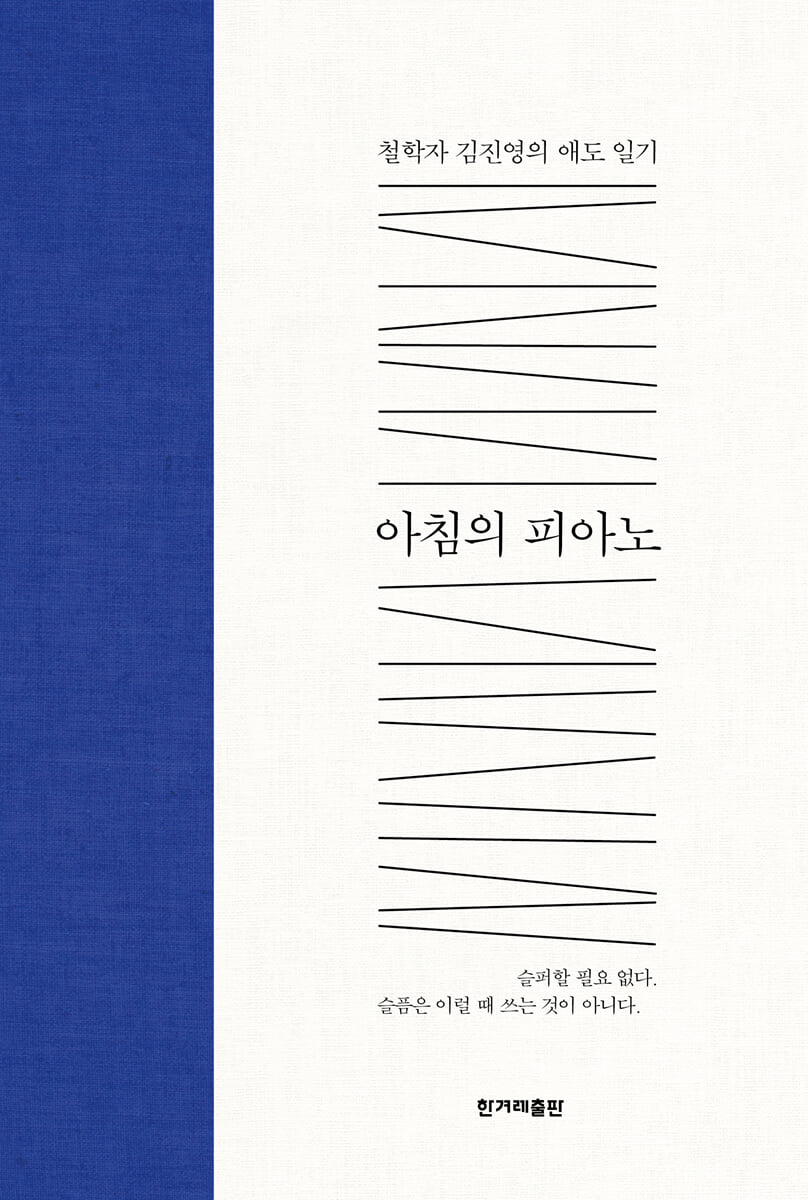
“There is no need to be sad.
“Sadness is not something to be used in these situations.”
The only collection of essays and posthumous works left behind by Kim Jin-yeong, the philosopher of mourning.
《Morning Piano》 is the first collection of prose and posthumous works by Kim Jin-yeong, an aesthetician, philosopher, and former head of the Academy of Philosophy.
It contains 234 diary entries from July 2017 to August 2018, written in a notebook while sitting in bed until just before delirium set in three days before his death.
However, “Morning Piano” is not simply a diary of a struggle with illness.
This book is a notebook of the teacher's achievements in literature, aesthetics, and philosophy, and an honest record that focuses on the small events that passed through his body, mind, and spirit after being diagnosed with cancer.
It cannot be denied that this is a personal writing of a patient who witnessed “all daily life come to a halt as if the shutter was pulled down,” but it is a heartwarming prose written with the dignity that only a scholar can portray “the patient’s life, its independence and authority, memories and reflections on the love and gratitude that he had finally encountered and discovered, and a life that opened his eyes to the world and others.”
Just as the teacher always encouraged students to value studying for the reasoning that comes from within themselves, rather than studying for the sake of learning about difficult thinkers and philosophies, the book is filled with sentences that the teacher meticulously read while thinking about himself, the world, and others.
These writings may seem like short notes to some, but the teacher's entire life is written within these aphorisms.
“Sadness is not something to be used in these situations.”
The only collection of essays and posthumous works left behind by Kim Jin-yeong, the philosopher of mourning.
《Morning Piano》 is the first collection of prose and posthumous works by Kim Jin-yeong, an aesthetician, philosopher, and former head of the Academy of Philosophy.
It contains 234 diary entries from July 2017 to August 2018, written in a notebook while sitting in bed until just before delirium set in three days before his death.
However, “Morning Piano” is not simply a diary of a struggle with illness.
This book is a notebook of the teacher's achievements in literature, aesthetics, and philosophy, and an honest record that focuses on the small events that passed through his body, mind, and spirit after being diagnosed with cancer.
It cannot be denied that this is a personal writing of a patient who witnessed “all daily life come to a halt as if the shutter was pulled down,” but it is a heartwarming prose written with the dignity that only a scholar can portray “the patient’s life, its independence and authority, memories and reflections on the love and gratitude that he had finally encountered and discovered, and a life that opened his eyes to the world and others.”
Just as the teacher always encouraged students to value studying for the reasoning that comes from within themselves, rather than studying for the sake of learning about difficult thinkers and philosophies, the book is filled with sentences that the teacher meticulously read while thinking about himself, the world, and others.
These writings may seem like short notes to some, but the teacher's entire life is written within these aphorisms.
index
2017
July
August
September
october
december
2018
january
february
March
april
May
June
July
August
Author's Note
July
August
September
october
december
2018
january
february
March
april
May
June
July
August
Author's Note
Into the book
Jooyoung wipes her eyes with a hot towel.
As you get older, you get eye boogers, so you have to check them often.
I have always tried to maintain a sense of neatness throughout my life.
There may have been a lot of false consciousness in it, but the pride in trying to protect oneself was also true.
There is nothing more powerful than self-affirmation.
That was my pride and purity.
That is my spirit and truth that I must still protect.
--- p.39
(…) Now that I think about it, there are no pests here.
Even if you sleep with the door open, you won't be bothered by mosquitoes.
Sitting by the water in the morning, I understand why.
That's because this is a place where water flows without stopping.
To flow is to vanish fleetingly, but only that which flows is alive.
The time of 'while' passing by.
That is the sum total of life.
To drift along with the flow with peace of mind - was that the freedom I had been searching for?
(…)
--- pp.50-51
I go for a morning walk with a violet umbrella.
Yesterday I went to bed late, waiting for the rain.
The rain seems to have passed me by and fallen overnight.
The morning after the rain is cloudy, quiet and damp.
Could it be a memory of the rain that fell yesterday?
Could this be news of coming rain?
In the wet atmosphere, Seu is sprinkled like powder.
Suddenly, I feel like I can understand Roland Barthes in his later years.
Why did he want to write 'a book just for myself', following Paul Valéry, why did he want to write a long piece that spoke about everyone's life and truth through himself, the smallest individual in the lower reaches of life... ... I, too, arrived at my lower reaches.
It was so sudden, like encountering a rapid current, that it was surprising, but if you think about it, you'll get there anyway.
At least for now, my downstream is as calm and safe as the morning after Bambi has passed.
I miss my father.
Before my father passed away, he wanted to build me a large study when I returned from studying.
Could this be the study?
I guess I should write a book here.
Shouldn't I write a book that only I can write about everything I've ever loved, about myself and my loved ones, about the world I hated yet deeply loved?
Isn't that why I've arrived at the lower library now?
--- pp.74-75
The reason you feel tired of a situation is because you haven't yet accurately recognized the situation.
Long ago, when I was learning kendo, my teacher told me as I was staggering.
You have to cut the right place at the right time.
Then the sword becomes a dance.
Establishing the patient's identity is most important.
Only then can you fight the disease as if you were dancing.
Great swordsmanship isn't just about winning.
It is also a matter of making the details into beautiful patterns.
I had no interest or desire in anything that wasn't my lot.
There was no such thing as jealousy or envy.
However, when something that was my share was unfairly not given to me or was taken away from me, I was determined to get it back.
Even after becoming a patient, I tried to remain faithful to this principle.
I felt like I had become a complete independent being of my own body, completely unrelated to the lives of others.
I believed it was a way to preserve my pride.
Now I know that thinking was wrong.
My life is not only my own, but also that of others.
My body cannot be separated or isolated from that of others.
My body is only mine within relationships.
That is the reason, the basis, the 'patient identity' that I have ownership of my life and must find my share.
--- pp.79-80
Now is the best time.
Now is the safest time.
Because now is 'not the time yet'.
What has not yet come has no power.
What is not here now has no power.
There are infinite nows between now and then.
I don't know now what they will bring and make.
As you get older, you get eye boogers, so you have to check them often.
I have always tried to maintain a sense of neatness throughout my life.
There may have been a lot of false consciousness in it, but the pride in trying to protect oneself was also true.
There is nothing more powerful than self-affirmation.
That was my pride and purity.
That is my spirit and truth that I must still protect.
--- p.39
(…) Now that I think about it, there are no pests here.
Even if you sleep with the door open, you won't be bothered by mosquitoes.
Sitting by the water in the morning, I understand why.
That's because this is a place where water flows without stopping.
To flow is to vanish fleetingly, but only that which flows is alive.
The time of 'while' passing by.
That is the sum total of life.
To drift along with the flow with peace of mind - was that the freedom I had been searching for?
(…)
--- pp.50-51
I go for a morning walk with a violet umbrella.
Yesterday I went to bed late, waiting for the rain.
The rain seems to have passed me by and fallen overnight.
The morning after the rain is cloudy, quiet and damp.
Could it be a memory of the rain that fell yesterday?
Could this be news of coming rain?
In the wet atmosphere, Seu is sprinkled like powder.
Suddenly, I feel like I can understand Roland Barthes in his later years.
Why did he want to write 'a book just for myself', following Paul Valéry, why did he want to write a long piece that spoke about everyone's life and truth through himself, the smallest individual in the lower reaches of life... ... I, too, arrived at my lower reaches.
It was so sudden, like encountering a rapid current, that it was surprising, but if you think about it, you'll get there anyway.
At least for now, my downstream is as calm and safe as the morning after Bambi has passed.
I miss my father.
Before my father passed away, he wanted to build me a large study when I returned from studying.
Could this be the study?
I guess I should write a book here.
Shouldn't I write a book that only I can write about everything I've ever loved, about myself and my loved ones, about the world I hated yet deeply loved?
Isn't that why I've arrived at the lower library now?
--- pp.74-75
The reason you feel tired of a situation is because you haven't yet accurately recognized the situation.
Long ago, when I was learning kendo, my teacher told me as I was staggering.
You have to cut the right place at the right time.
Then the sword becomes a dance.
Establishing the patient's identity is most important.
Only then can you fight the disease as if you were dancing.
Great swordsmanship isn't just about winning.
It is also a matter of making the details into beautiful patterns.
I had no interest or desire in anything that wasn't my lot.
There was no such thing as jealousy or envy.
However, when something that was my share was unfairly not given to me or was taken away from me, I was determined to get it back.
Even after becoming a patient, I tried to remain faithful to this principle.
I felt like I had become a complete independent being of my own body, completely unrelated to the lives of others.
I believed it was a way to preserve my pride.
Now I know that thinking was wrong.
My life is not only my own, but also that of others.
My body cannot be separated or isolated from that of others.
My body is only mine within relationships.
That is the reason, the basis, the 'patient identity' that I have ownership of my life and must find my share.
--- pp.79-80
Now is the best time.
Now is the safest time.
Because now is 'not the time yet'.
What has not yet come has no power.
What is not here now has no power.
There are infinite nows between now and then.
I don't know now what they will bring and make.
--- p.252
Publisher's Review
A book like a gift created by the combined efforts of many minds.
《Morning Piano》 is a book like a gift, created by the will of the teacher in his final days, who had no other works except the translated 《Diary of Mourning》 and the co-authored 《Reading Modern French Philosophy for the First Time》, and the hearts of his students who eagerly awaited the publication of the book.
In fact, "The Morning Piano" could not have been published as a book.
While contributing to various newspapers and magazines, lecturing at philosophy academies, libraries, and universities, and receiving offers from various publishers to publish his work, the old scholar always maintained a somewhat stubborn and rigid approach to his own writings.
He always said later.
After being diagnosed with cancer in July 2017, he stopped teaching at the Philosophy Academy and went into seclusion, cutting off contact with the outside world. This life lasted for about six months.
The publication of this book, which seemed impossible, was possible thanks to ten meetings with students (who had taken the professor's class at the Academy of Philosophy) called "When Proust and Benjamin Met" that took place from March 29, 2018, to early July 2018.
The meetings, which consisted mainly of mini-lectures and casual conversations, always started at 1 p.m., but they continued on until 5 or 6 p.m., and sometimes even 9 p.m., without any end in sight. The words that were exchanged and scattered within the meetings helped the teacher solidify his determination to “write my own text, not someone else’s.”
Another unexpected encounter with an editor, and a few weeks later, everything happened as if it were a lie, until the moment when we finally signed the contract with the working title 'Morning Piano'.
But before we could even discuss the book in detail, the first thing we heard was the news of the teacher's passing.
Author Eun-yu, who was also the teacher's disciple, says this in his recommendation.
“Once I started taking notes in class, I couldn’t stop.
“It was like listening to beautiful music and not being able to press the pause button,” the teacher said, adding that the words were “sheet music in sentences.”
Those who remained gathered around the large sheet of music the teacher had left behind, each holding a musical note.
With all my heart, I finally completed the beautiful music called “Morning Piano.”
A shining aphorism caught while transparently disappearing
《Morning Piano》 is full of brilliant aphorisms that only the teacher could catch.
Speaking of Proust's later years, "His later years, spent in his bedroom, were not lonely and quiet.
It was a busier life than ever.
In his bedroom, Proust was not lying comfortably.
He must have been running around everywhere because every second was precious.
(…) the reader can see.
The part where he says, “His last book is full of the writing and sentences of a 100-meter dasher,” is a brilliant discovery that breaks the fixed gaze on the existence in the room.
In “Flowing means fleeting and disappearing, but only that which flows is alive,” you can feel the teacher’s deep gaze on life and death.
“The world is beautiful, life is deep, there have been good and bad things in life, so blow, wind…” The sentences written while talking about the column in the Hankyoreh about poet Cheon Sang-byeong are full of positivity about life.
And above all, I said, “Writing is not for me, it is for the typist.”
The same goes for records from while sick.
These records are not for me, but for those who will be left behind when I am gone.
When I try to protect only myself, I become weaker day by day.
The teacher's confident tone, "When I try to protect the typist, I become more certain day by day," allows us to gauge what kind of life it is and what kind of life it should be, one that never stops talking about love, beauty, and gratitude.
“Piano in the morning.
From the first sentence, “I look into the distance from the veranda and listen to the sound of the piano,” to the last sentence, “My heart is at ease,” I feel as if I have lived a life with the teacher.
And, at the end of that book, we finally discover ourselves as “humans of music, humans of thought, and humans of pride.”
Author's Note
I was diagnosed with cancer in July 2017.
All the daily life that had been going on until then was halted as if the shutters were closed.
Hospital life began and I began living the life of a patient.
Exactly 13 months passed like that.
This article is a record of the small events that have passed through my body, mind, and spirit in the meantime.
The contents of the record are memories and reflections on the patient's life, the independence and authority of that life, the love and gratitude that were discovered and met for the first time, thoughts that opened one's eyes to the world and others, or just meaningless moments that come and go, approach and leave without a trace before one's eyes and by one's heart.
Like some kind of book that Paul Valéry and Roland Barthes wanted to write, these records are personal writings written just for me.
This article does not qualify as a book because of this.
But doesn't the inner self of an individual, especially when that individuality is in crisis, inevitably overlap with the realm of objectivity?
It might be an excuse to want to bind the most private records into a public medium, a book.
But if this book can be a source of reflection and comfort for those who, similar to me or in another way, are facing an existential crisis, then it is not necessarily an excuse.
《Morning Piano》 is a book like a gift, created by the will of the teacher in his final days, who had no other works except the translated 《Diary of Mourning》 and the co-authored 《Reading Modern French Philosophy for the First Time》, and the hearts of his students who eagerly awaited the publication of the book.
In fact, "The Morning Piano" could not have been published as a book.
While contributing to various newspapers and magazines, lecturing at philosophy academies, libraries, and universities, and receiving offers from various publishers to publish his work, the old scholar always maintained a somewhat stubborn and rigid approach to his own writings.
He always said later.
After being diagnosed with cancer in July 2017, he stopped teaching at the Philosophy Academy and went into seclusion, cutting off contact with the outside world. This life lasted for about six months.
The publication of this book, which seemed impossible, was possible thanks to ten meetings with students (who had taken the professor's class at the Academy of Philosophy) called "When Proust and Benjamin Met" that took place from March 29, 2018, to early July 2018.
The meetings, which consisted mainly of mini-lectures and casual conversations, always started at 1 p.m., but they continued on until 5 or 6 p.m., and sometimes even 9 p.m., without any end in sight. The words that were exchanged and scattered within the meetings helped the teacher solidify his determination to “write my own text, not someone else’s.”
Another unexpected encounter with an editor, and a few weeks later, everything happened as if it were a lie, until the moment when we finally signed the contract with the working title 'Morning Piano'.
But before we could even discuss the book in detail, the first thing we heard was the news of the teacher's passing.
Author Eun-yu, who was also the teacher's disciple, says this in his recommendation.
“Once I started taking notes in class, I couldn’t stop.
“It was like listening to beautiful music and not being able to press the pause button,” the teacher said, adding that the words were “sheet music in sentences.”
Those who remained gathered around the large sheet of music the teacher had left behind, each holding a musical note.
With all my heart, I finally completed the beautiful music called “Morning Piano.”
A shining aphorism caught while transparently disappearing
《Morning Piano》 is full of brilliant aphorisms that only the teacher could catch.
Speaking of Proust's later years, "His later years, spent in his bedroom, were not lonely and quiet.
It was a busier life than ever.
In his bedroom, Proust was not lying comfortably.
He must have been running around everywhere because every second was precious.
(…) the reader can see.
The part where he says, “His last book is full of the writing and sentences of a 100-meter dasher,” is a brilliant discovery that breaks the fixed gaze on the existence in the room.
In “Flowing means fleeting and disappearing, but only that which flows is alive,” you can feel the teacher’s deep gaze on life and death.
“The world is beautiful, life is deep, there have been good and bad things in life, so blow, wind…” The sentences written while talking about the column in the Hankyoreh about poet Cheon Sang-byeong are full of positivity about life.
And above all, I said, “Writing is not for me, it is for the typist.”
The same goes for records from while sick.
These records are not for me, but for those who will be left behind when I am gone.
When I try to protect only myself, I become weaker day by day.
The teacher's confident tone, "When I try to protect the typist, I become more certain day by day," allows us to gauge what kind of life it is and what kind of life it should be, one that never stops talking about love, beauty, and gratitude.
“Piano in the morning.
From the first sentence, “I look into the distance from the veranda and listen to the sound of the piano,” to the last sentence, “My heart is at ease,” I feel as if I have lived a life with the teacher.
And, at the end of that book, we finally discover ourselves as “humans of music, humans of thought, and humans of pride.”
Author's Note
I was diagnosed with cancer in July 2017.
All the daily life that had been going on until then was halted as if the shutters were closed.
Hospital life began and I began living the life of a patient.
Exactly 13 months passed like that.
This article is a record of the small events that have passed through my body, mind, and spirit in the meantime.
The contents of the record are memories and reflections on the patient's life, the independence and authority of that life, the love and gratitude that were discovered and met for the first time, thoughts that opened one's eyes to the world and others, or just meaningless moments that come and go, approach and leave without a trace before one's eyes and by one's heart.
Like some kind of book that Paul Valéry and Roland Barthes wanted to write, these records are personal writings written just for me.
This article does not qualify as a book because of this.
But doesn't the inner self of an individual, especially when that individuality is in crisis, inevitably overlap with the realm of objectivity?
It might be an excuse to want to bind the most private records into a public medium, a book.
But if this book can be a source of reflection and comfort for those who, similar to me or in another way, are facing an existential crisis, then it is not necessarily an excuse.
GOODS SPECIFICS
- Date of issue: May 20, 2025
- Format: Hardcover book binding method guide
- Page count, weight, size: 284 pages | 128*188*20mm
- ISBN13: 9791172132606
- ISBN10: 1172132607
You may also like
카테고리
korean


korean

![GQ KOREA Mark (Monthly): December [2025]](http://librairie.coreenne.fr/cdn/shop/files/8ef265dbbfbf186523ed75ba7319009d.jpg?v=1765340328&width=3840)


