

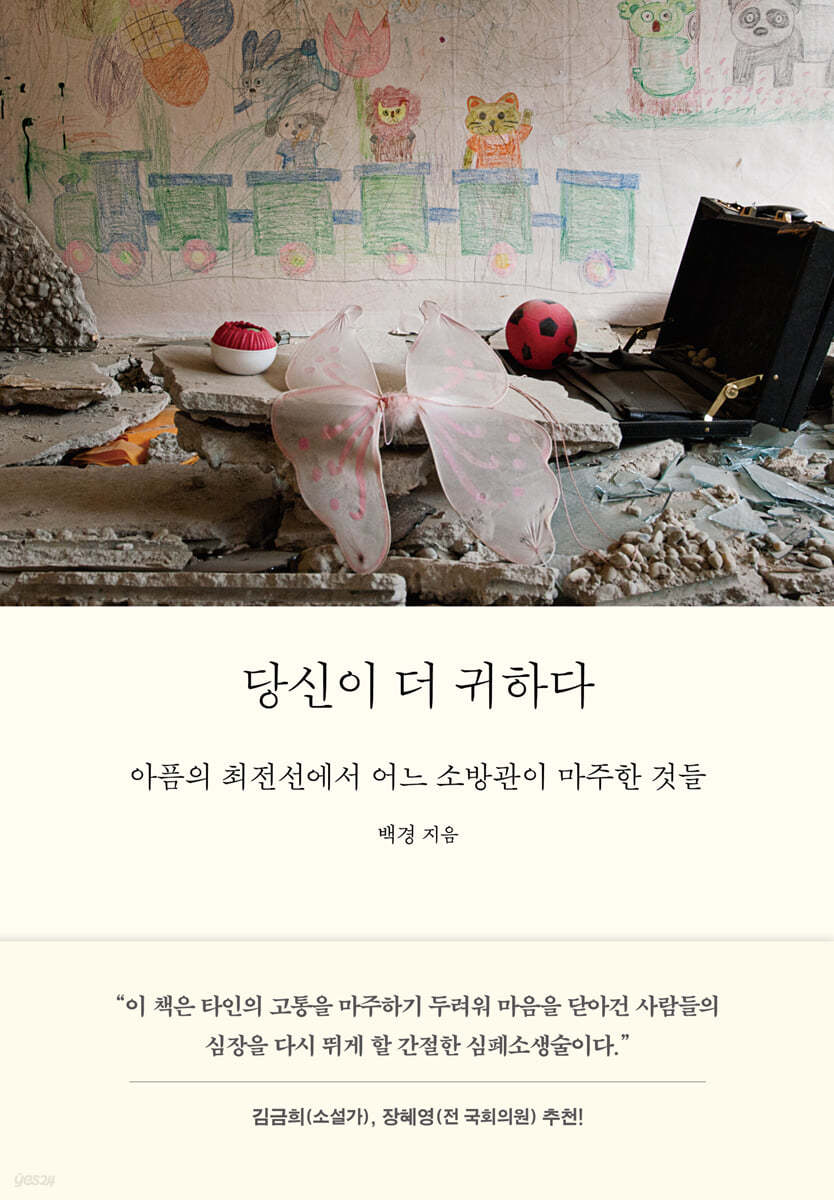
You are more precious
 |
Description
Book Introduction
** Recommended by former President Moon Jae-in! **
“It’s not a pretty story.
“It is a story that you read sometimes with a heavy heart, and sometimes with a sorrowful heart.”
The painful faces a firefighter encounters on the street…
A story written to fully understand the suffering of others
Children committing suicide, a man living with dog feces, an old man who died alone and rotted away all winter before being found in the spring, a house dirtier than a garbage dump…
The people who witness the world's suffering more closely than anyone else at the scene of an accident, 119 paramedics.
Author Baek Kyung, a firefighter with eight years of experience, tells the story of the pain and death he encountered while riding in an ambulance, as well as the passionate lives of those who live in it, through his first essay, “You Are More Precious.”
This book is a complete reflection of his efforts to fully understand the pain of society and the suffering of others as “part of the world,” not as “a special tragedy.”
After reading these honest and heartbreaking writings, both as a firefighter and as a human being, we will be able to look a little more courageously into the painful faces of the world that we have been afraid to face and have turned away from.
“This book is a paramedic’s desperate CPR that will bring back the hearts of those who have closed their hearts out of fear of facing the suffering of others.” _Jang Hye-young (former member of the National Assembly, film director)
“These writings, filled with self-destruction, anger, sadness, and sometimes even ridicule, are, therefore, hopeful.” _Kim Geum-hee (novelist)
“It’s not a pretty story.
“It is a story that you read sometimes with a heavy heart, and sometimes with a sorrowful heart.”
The painful faces a firefighter encounters on the street…
A story written to fully understand the suffering of others
Children committing suicide, a man living with dog feces, an old man who died alone and rotted away all winter before being found in the spring, a house dirtier than a garbage dump…
The people who witness the world's suffering more closely than anyone else at the scene of an accident, 119 paramedics.
Author Baek Kyung, a firefighter with eight years of experience, tells the story of the pain and death he encountered while riding in an ambulance, as well as the passionate lives of those who live in it, through his first essay, “You Are More Precious.”
This book is a complete reflection of his efforts to fully understand the pain of society and the suffering of others as “part of the world,” not as “a special tragedy.”
After reading these honest and heartbreaking writings, both as a firefighter and as a human being, we will be able to look a little more courageously into the painful faces of the world that we have been afraid to face and have turned away from.
“This book is a paramedic’s desperate CPR that will bring back the hearts of those who have closed their hearts out of fear of facing the suffering of others.” _Jang Hye-young (former member of the National Assembly, film director)
“These writings, filled with self-destruction, anger, sadness, and sometimes even ridicule, are, therefore, hopeful.” _Kim Geum-hee (novelist)
- You can preview some of the book's contents.
Preview
index
Prologue: Writing because I don't know when I'll die
Chapter 1 - When I Press Your Heart
When I press your heart
About what was lost
I should have gone and had coffee with her.
Let me tell you a funny story
People live there
The day I got scolded by a patient
Dog and man
Police cars, ambulances, poop, and me
My son died
When I press your heart
Hang on a pine tree and die
Addition, subtraction, multiplication, division
Hunger
What level of civil servant is a firefighter?
Children's temperature difference
I was smart when I was young
Please fix the door.
Christmas Wishes (Potty) Log
Cheongok-dong
Chapter 2 - You Are More Precious
You are more precious
Flower rain
Ramen is not rice
A Train Named Mom
My house is in Hokkaido
That's my world
Running to the end of the universe
What are you sorry about, Grandma?
The wall is life
You are more precious
Is love an indulgence?
To you who committed suicide today
Human attitude toward human death
My mom, can you take me with you?
No one died for love.
The river water is cold
I want to live
The ship is going
After the play ended
For the Epilogue Faucet
Chapter 1 - When I Press Your Heart
When I press your heart
About what was lost
I should have gone and had coffee with her.
Let me tell you a funny story
People live there
The day I got scolded by a patient
Dog and man
Police cars, ambulances, poop, and me
My son died
When I press your heart
Hang on a pine tree and die
Addition, subtraction, multiplication, division
Hunger
What level of civil servant is a firefighter?
Children's temperature difference
I was smart when I was young
Please fix the door.
Christmas Wishes (Potty) Log
Cheongok-dong
Chapter 2 - You Are More Precious
You are more precious
Flower rain
Ramen is not rice
A Train Named Mom
My house is in Hokkaido
That's my world
Running to the end of the universe
What are you sorry about, Grandma?
The wall is life
You are more precious
Is love an indulgence?
To you who committed suicide today
Human attitude toward human death
My mom, can you take me with you?
No one died for love.
The river water is cold
I want to live
The ship is going
After the play ended
For the Epilogue Faucet
Detailed image
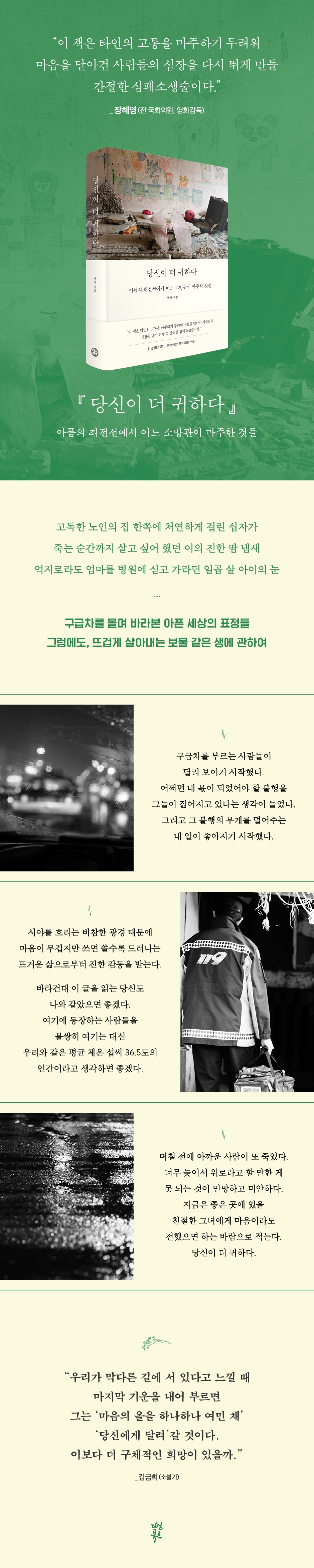
Into the book
Before long, I was drenched in rainwater, and the rain clouds were coming into the house.
I imagined my children, who were growing up well, dying or getting seriously injured in an accident, and when my wife was in a bad mood, I was anxious, thinking it was a sign of suicide.
While I was working, I pictured myself facing death in a thousand different ways.
They get hit by a car while providing emergency services on the highway, get stabbed by a mentally ill person, or take their own life due to a trauma they can't handle.
So, whenever I had time, I wrote a will.
The beginning of my writing was when I first reached out to death, which seemed so far away that it was almost impossible to catch.
---p.6
If I ever get tired and stop writing, the things that a person should naturally feel when faced with someone's death or wounds may disappear from within me.
The man who was on the verge of death, the bus accident that could have easily led to a major accident, could be brushed away like dry sand.
I'm afraid of that.
---p.18
Most of the people who frequently use ambulances are poor people.
People who are poor not only economically but also mentally.
They walk out to the front of their house to call an ambulance because they don't want to waste money on taxi fare, and they call 119 like they would to an ex-lover every drunken morning.
A foreign worker who left her country to escape poverty and got married is beaten daily by her husband, who is old enough to be her uncle, and a depressed mother hangs herself with a shower hose in front of her young daughter.
A man with bedsores all over his back, like a crater on the far side of the moon, unable to move, calls 911 with the only arm he can use and asks them to turn on a fan.
When I first started working, I was sick and tired of that poverty.
On the way back from a mission, I was busy cursing shameless and inconsiderate people.
But what I realized after riding in ambulances for years was that this poverty was not unusual.
Poverty permeates our society more widely than expected, and its roots are also deeper.
It was simply luck that I wasn't a part of it.
---pp.88-89
Just as you become accustomed to eating only ramen, and mistakenly believe that it is a complete meal, when you become accustomed to poverty of the mind, you forget that it is poverty.
I wanted to end the article by saying that I hope my children will grow up to be adults who don't take poverty for granted, but honestly, I don't think that will be easy.
Because ramen is delicious, convenient, and still cheap.
Because I think it would be okay to live like that.
But ramen is not rice.
Life is like that too.
---p.144
People say that old people have no more stories left.
They say that both their heads and hearts are old and they just wait for the day to die, searching for worn-out memories.
And that seems clear.
Because the world doesn't pay attention to old people.
The streets are filled with fresh youth, dramas feature only people with taut skin, and even books don't contain stories of old people.
No one comes looking for them, except for those who occasionally stop by their house to shake hands and tell them to vote for number 1 or 2.
So it seems like there's nothing left there.
But just because you don't see it doesn't mean it disappears, and just because you don't believe in it doesn't mean it doesn't exist.
Even for old people, there are stories that certainly do not get old.
---pp.156-157
Even now, when my mind is complicated, I still run sometimes.
Run until your lungs scream and your heart pounding in your throat.
When the pores all over my body are open and I can't tell if I'm sweating or the sweat is coming from me, I naturally think like that.
Life is just a race.
Whether naked or well-dressed, there is meaning in moving forward.
---p.164
The lie that you have to reach the top faster than others and without making mistakes.
So the lie is that you have to prove yourself by getting a shiny house, high heels, and a first-class seat.
A child who grows up believing such lies at face value may despair day after day at the gap between life and lies, and may end up holding onto a lifeline that can be cut by an eyebrow razor.
On the other hand, if you repeat the process of climbing and falling down a wall countless times by yourself, you will come to realize an important fact.
The point is that there is no point in measuring one's worth by comparing oneself to others.
Instead, the wall speaks.
People climbing their own walls with their broken palms are beautiful in themselves.
Every human being is precious as long as he or she survives.
---p.180
“Do you know what will happen when Dad goes back?”
Second, these days, people ask that question a lot.
What happens when you go back?
Ask what happens when you die.
It is unclear whether the child realizes that his father is doing something dangerous, or whether the child sees in his eyes the spirits of life and death that adults cannot see.
I think it might be instinct.
An instinct that is forgotten as we get older and busy living day to day.
It is the instinct to ask the void or God why people are born and die, and what awaits them after death.
“I don’t know, Dad.” I gave the same answer that day.
“I know.”
"okay?"
“My dad is going back, and I’m going to become a grandmother.”
"huh."
“When I go back, another baby will be born.”
"huh."
“That’s how it is.”
---pp.227-228
I remember the first time I did CPR, the feeling of the old man's sternum shattering under my palm.
I remembered the strong smell of sweat from a man who had wanted to live until the very moment of death, as he was dragged to the floor, hanging himself with a nylon rope.
I also remembered the eyes of a child trying to capture even a wisp of light from the world within its vast pupils.
The cold air that wet my fingertips the moment I opened and closed my child's tiny eyelids was still vivid.
Only then did I realize why I couldn't cry over my grandmother's death.
That was because I was trying to keep the faucet turned off.
That was because only then could I get on an ambulance.
In front of the broken faucet, I cried for a long time.
---p.246
The dispatch bell rings.
The upbeat music stops and the voices of the security guards, like the employees of the food section of a large supermarket, take over, without much interest.
Someone said they were sick.
They say he got hurt.
They say he's dead.
My fluttering heart calms down at the sound of a deep voice that seems to be paraphrasing the words "I'm hungry."
Wear sky blue nitrile gloves and a KF-94 mask.
These will help me not to fully sense the warmth and smell of people.
Get in the ambulance and call the caller.
“I am a paramedic on the way.
it's okay.
“Calm down and speak.” With words like that, I don’t know if I’m talking to the other person or to myself, and I open up each and every thread of my troubled heart.
After turning off the faucet like that, I am now running to you.
I imagined my children, who were growing up well, dying or getting seriously injured in an accident, and when my wife was in a bad mood, I was anxious, thinking it was a sign of suicide.
While I was working, I pictured myself facing death in a thousand different ways.
They get hit by a car while providing emergency services on the highway, get stabbed by a mentally ill person, or take their own life due to a trauma they can't handle.
So, whenever I had time, I wrote a will.
The beginning of my writing was when I first reached out to death, which seemed so far away that it was almost impossible to catch.
---p.6
If I ever get tired and stop writing, the things that a person should naturally feel when faced with someone's death or wounds may disappear from within me.
The man who was on the verge of death, the bus accident that could have easily led to a major accident, could be brushed away like dry sand.
I'm afraid of that.
---p.18
Most of the people who frequently use ambulances are poor people.
People who are poor not only economically but also mentally.
They walk out to the front of their house to call an ambulance because they don't want to waste money on taxi fare, and they call 119 like they would to an ex-lover every drunken morning.
A foreign worker who left her country to escape poverty and got married is beaten daily by her husband, who is old enough to be her uncle, and a depressed mother hangs herself with a shower hose in front of her young daughter.
A man with bedsores all over his back, like a crater on the far side of the moon, unable to move, calls 911 with the only arm he can use and asks them to turn on a fan.
When I first started working, I was sick and tired of that poverty.
On the way back from a mission, I was busy cursing shameless and inconsiderate people.
But what I realized after riding in ambulances for years was that this poverty was not unusual.
Poverty permeates our society more widely than expected, and its roots are also deeper.
It was simply luck that I wasn't a part of it.
---pp.88-89
Just as you become accustomed to eating only ramen, and mistakenly believe that it is a complete meal, when you become accustomed to poverty of the mind, you forget that it is poverty.
I wanted to end the article by saying that I hope my children will grow up to be adults who don't take poverty for granted, but honestly, I don't think that will be easy.
Because ramen is delicious, convenient, and still cheap.
Because I think it would be okay to live like that.
But ramen is not rice.
Life is like that too.
---p.144
People say that old people have no more stories left.
They say that both their heads and hearts are old and they just wait for the day to die, searching for worn-out memories.
And that seems clear.
Because the world doesn't pay attention to old people.
The streets are filled with fresh youth, dramas feature only people with taut skin, and even books don't contain stories of old people.
No one comes looking for them, except for those who occasionally stop by their house to shake hands and tell them to vote for number 1 or 2.
So it seems like there's nothing left there.
But just because you don't see it doesn't mean it disappears, and just because you don't believe in it doesn't mean it doesn't exist.
Even for old people, there are stories that certainly do not get old.
---pp.156-157
Even now, when my mind is complicated, I still run sometimes.
Run until your lungs scream and your heart pounding in your throat.
When the pores all over my body are open and I can't tell if I'm sweating or the sweat is coming from me, I naturally think like that.
Life is just a race.
Whether naked or well-dressed, there is meaning in moving forward.
---p.164
The lie that you have to reach the top faster than others and without making mistakes.
So the lie is that you have to prove yourself by getting a shiny house, high heels, and a first-class seat.
A child who grows up believing such lies at face value may despair day after day at the gap between life and lies, and may end up holding onto a lifeline that can be cut by an eyebrow razor.
On the other hand, if you repeat the process of climbing and falling down a wall countless times by yourself, you will come to realize an important fact.
The point is that there is no point in measuring one's worth by comparing oneself to others.
Instead, the wall speaks.
People climbing their own walls with their broken palms are beautiful in themselves.
Every human being is precious as long as he or she survives.
---p.180
“Do you know what will happen when Dad goes back?”
Second, these days, people ask that question a lot.
What happens when you go back?
Ask what happens when you die.
It is unclear whether the child realizes that his father is doing something dangerous, or whether the child sees in his eyes the spirits of life and death that adults cannot see.
I think it might be instinct.
An instinct that is forgotten as we get older and busy living day to day.
It is the instinct to ask the void or God why people are born and die, and what awaits them after death.
“I don’t know, Dad.” I gave the same answer that day.
“I know.”
"okay?"
“My dad is going back, and I’m going to become a grandmother.”
"huh."
“When I go back, another baby will be born.”
"huh."
“That’s how it is.”
---pp.227-228
I remember the first time I did CPR, the feeling of the old man's sternum shattering under my palm.
I remembered the strong smell of sweat from a man who had wanted to live until the very moment of death, as he was dragged to the floor, hanging himself with a nylon rope.
I also remembered the eyes of a child trying to capture even a wisp of light from the world within its vast pupils.
The cold air that wet my fingertips the moment I opened and closed my child's tiny eyelids was still vivid.
Only then did I realize why I couldn't cry over my grandmother's death.
That was because I was trying to keep the faucet turned off.
That was because only then could I get on an ambulance.
In front of the broken faucet, I cried for a long time.
---p.246
The dispatch bell rings.
The upbeat music stops and the voices of the security guards, like the employees of the food section of a large supermarket, take over, without much interest.
Someone said they were sick.
They say he got hurt.
They say he's dead.
My fluttering heart calms down at the sound of a deep voice that seems to be paraphrasing the words "I'm hungry."
Wear sky blue nitrile gloves and a KF-94 mask.
These will help me not to fully sense the warmth and smell of people.
Get in the ambulance and call the caller.
“I am a paramedic on the way.
it's okay.
“Calm down and speak.” With words like that, I don’t know if I’m talking to the other person or to myself, and I open up each and every thread of my troubled heart.
After turning off the faucet like that, I am now running to you.
---p.247
Publisher's Review
Poverty, accidents, death… a firefighter's closest friends and enemies.
A story hidden in the shadows of the world, never revealed until now.
“After I started riding in an ambulance, my belief that the world was worth living in crumbled.” (p. 122)
How much pain and suffering exists in the world that we cannot fathom?
People who are crushed by poverty and are about to make extreme choices, people who cannot raise their heads due to deep depression, people who are thrown into the middle of misfortune without even knowing the reason…
They were waiting for him at the scene of the operation, looking like something out of a novel.
Before becoming a firefighter, the writer thought there were few such people in the world.
Because I didn't see it.
After riding in the ambulance, I realized that this painful life was not just a story in a novel, but an extremely everyday reality.
Only then did they realize that they were hiding in the cold, dark shadows because they were too embarrassed, too sad, too sick.
What the author realized after working as a firefighter for many years is that poverty is not unusual.
Poverty was deeply rooted and widespread throughout society, though it did not reveal itself.
I felt that the current society, which turns its back on that reality and only pursues its own comfort, was even more miserable.
Through this book, I wanted to talk about how we should recognize the reality of poverty and death, rather than labeling them as "tragedies" and treating them as something special.
In this book, Baek Kyung, a firefighter with eight years of experience, reveals for the first time stories hidden in the shadows of the world that he encountered while riding in an ambulance, stories that had never been revealed before.
The story he tells is neither a heroic tale of firefighters nor a story about a world worth living in, such as the fact that more people die in warm spring than in cold winter, and that people who frequently use ambulances are usually poor.
The reason why the author insists on bringing up painful aspects that we would rather ignore than telling a beautiful story that everyone would cheer for is because of the author's belief that we should not turn our backs on the pain of the world.
Through "You Are More Precious," we convey the message that the world can only move in a more positive direction after we clearly realize that there are wounds right next to us that need to be reached out and embraced.
About the pain that I will never get used to…
This article was written as an ordinary human being before becoming a firefighter.
A timid and uncool firefighter.
This is how author Baek Kyung introduces himself.
A firefighter who calms down a drunk high school student and sends him home, performs meaningless CPR on a corpse out of concern for the bereaved family, and is terrified that his family will make an extreme choice too, unable to overcome the trauma of a suicide scene.
A person who, because he cannot bear to lose his mind if he is blinded by all the deaths he encounters, from the moment he leaves for duty to the moment he returns, he keeps repeating the mantra, “They are not my family, they are not my friends,” but he inevitably ends up reading the images of his family and friends in them.
I am an ordinary person who is gradually becoming accustomed to my work as a paramedic, but I can never get used to the pain and death right before my eyes.
Born in a city with many ginkgo trees in the mid-1980s, the writer majored in film in college and worked as a part-time instructor at a prep school until he was thirty, while occasionally making independent films.
Then, the year my first child started walking, I hurriedly prepared for the firefighter exam and passed with flying colors.
Life as a firefighter hasn't always been smooth sailing.
From the beginning of my career, I suffered from severe anxiety disorder due to trauma, and I started writing to overcome it.
The writing that I wrote out of anxiety about not knowing when I would die initially became a will to be left to the world, but at some point it transformed into a story to the world.
I have written down the stories of life and death that I encountered while riding in an ambulance, and of those who live passionately even in a world filled with pain, and have left them online.
His writing, based on the writing techniques he learned while majoring in film, attracted attention with its solid writing skills that were no less than those of any other writer.
Among them, he became a hot topic through X (formerly Twitter), and tens of thousands of people came to read his writing on an account that had been open for less than a year.
Those who enjoy Baek Kyung's writing leave comments of sympathy and support, saying things like, "Thank you for showing me a side of society I didn't know about," and "My heart is filled with emotion at the calmly written writing." However, some also voice concerns.
Yet, the author says, he continues to write about the world's suffering because "no one tells the stories of the poor."
It was to make known that while the world is abuzz with stories about delicious restaurants, luxury goods, and real estate, the stories of the poor also exist.
I wanted to tell real stories of poverty that permeate our lives, not the exaggerated images seen on television or in movies.
If you don't want to see it, you can close your eyes, but that doesn't mean the world's pain will disappear.
“So that we can continue to mourn the sad things”
Why a paramedic runs through the rain and sits at a desk every day
Some people say that the profession of firefighter is noble and deserves to be received.
However, writer Baek Kyung says that firefighters are not people who do special work, but rather people who do work that anyone can do, or perhaps people who are closer to 'people who do necessary work.'
Becoming a 'shovel' that scoops up misfortune that grows like a snowball if left alone is an ordinary task that anyone with a handful of heart can do, and that ordinary role has breathed life into the land we live on.
Ultimately, what the author wants to convey through this book is the importance of “seeing others as human beings like ourselves, and thus filling the world with ordinary warmth.”
Even a life that appears miserable at first glance is, upon closer inspection, a passionate life lived by humans with a body temperature of 36.5 degrees, just like us. The effort to face such a life from a level that is neither above nor below has been written down and compiled into a book.
Running through the rain is like writing down the stories of people who are going through hard times.
At first, the heart is heavy because of the miserable sight that clouds the vision, but as I write, I am deeply moved by the passionate life that is revealed.
I hope that those of you reading this are like me.
Instead of feeling sorry for the people who appear here, it would be better to think of them as humans with an average body temperature of 36.5 degrees Celsius, just like us.
That's why I never stop running on rainy days.
And that's why I never stop writing.
_From 'Prologue'
What the writer fears most right now is neither the difficult whistleblower nor the horrific scene.
It is something that an ordinary person should have, something that disappears from within.
It is the ordinary heart that empathizes with the pain of others, mourns death, and rejoices in happy events without cynicism.
As I was riding in the ambulance, I suddenly realized that I was becoming numb to those things without even realizing it.
To avoid becoming numb to the suffering of others, to preserve the humanity within himself, and to continue to grieve over sad events, firefighter Baek-kyung wakes up early in the morning again today, dragging his heavy body to sit down at his desk again.
A story hidden in the shadows of the world, never revealed until now.
“After I started riding in an ambulance, my belief that the world was worth living in crumbled.” (p. 122)
How much pain and suffering exists in the world that we cannot fathom?
People who are crushed by poverty and are about to make extreme choices, people who cannot raise their heads due to deep depression, people who are thrown into the middle of misfortune without even knowing the reason…
They were waiting for him at the scene of the operation, looking like something out of a novel.
Before becoming a firefighter, the writer thought there were few such people in the world.
Because I didn't see it.
After riding in the ambulance, I realized that this painful life was not just a story in a novel, but an extremely everyday reality.
Only then did they realize that they were hiding in the cold, dark shadows because they were too embarrassed, too sad, too sick.
What the author realized after working as a firefighter for many years is that poverty is not unusual.
Poverty was deeply rooted and widespread throughout society, though it did not reveal itself.
I felt that the current society, which turns its back on that reality and only pursues its own comfort, was even more miserable.
Through this book, I wanted to talk about how we should recognize the reality of poverty and death, rather than labeling them as "tragedies" and treating them as something special.
In this book, Baek Kyung, a firefighter with eight years of experience, reveals for the first time stories hidden in the shadows of the world that he encountered while riding in an ambulance, stories that had never been revealed before.
The story he tells is neither a heroic tale of firefighters nor a story about a world worth living in, such as the fact that more people die in warm spring than in cold winter, and that people who frequently use ambulances are usually poor.
The reason why the author insists on bringing up painful aspects that we would rather ignore than telling a beautiful story that everyone would cheer for is because of the author's belief that we should not turn our backs on the pain of the world.
Through "You Are More Precious," we convey the message that the world can only move in a more positive direction after we clearly realize that there are wounds right next to us that need to be reached out and embraced.
About the pain that I will never get used to…
This article was written as an ordinary human being before becoming a firefighter.
A timid and uncool firefighter.
This is how author Baek Kyung introduces himself.
A firefighter who calms down a drunk high school student and sends him home, performs meaningless CPR on a corpse out of concern for the bereaved family, and is terrified that his family will make an extreme choice too, unable to overcome the trauma of a suicide scene.
A person who, because he cannot bear to lose his mind if he is blinded by all the deaths he encounters, from the moment he leaves for duty to the moment he returns, he keeps repeating the mantra, “They are not my family, they are not my friends,” but he inevitably ends up reading the images of his family and friends in them.
I am an ordinary person who is gradually becoming accustomed to my work as a paramedic, but I can never get used to the pain and death right before my eyes.
Born in a city with many ginkgo trees in the mid-1980s, the writer majored in film in college and worked as a part-time instructor at a prep school until he was thirty, while occasionally making independent films.
Then, the year my first child started walking, I hurriedly prepared for the firefighter exam and passed with flying colors.
Life as a firefighter hasn't always been smooth sailing.
From the beginning of my career, I suffered from severe anxiety disorder due to trauma, and I started writing to overcome it.
The writing that I wrote out of anxiety about not knowing when I would die initially became a will to be left to the world, but at some point it transformed into a story to the world.
I have written down the stories of life and death that I encountered while riding in an ambulance, and of those who live passionately even in a world filled with pain, and have left them online.
His writing, based on the writing techniques he learned while majoring in film, attracted attention with its solid writing skills that were no less than those of any other writer.
Among them, he became a hot topic through X (formerly Twitter), and tens of thousands of people came to read his writing on an account that had been open for less than a year.
Those who enjoy Baek Kyung's writing leave comments of sympathy and support, saying things like, "Thank you for showing me a side of society I didn't know about," and "My heart is filled with emotion at the calmly written writing." However, some also voice concerns.
Yet, the author says, he continues to write about the world's suffering because "no one tells the stories of the poor."
It was to make known that while the world is abuzz with stories about delicious restaurants, luxury goods, and real estate, the stories of the poor also exist.
I wanted to tell real stories of poverty that permeate our lives, not the exaggerated images seen on television or in movies.
If you don't want to see it, you can close your eyes, but that doesn't mean the world's pain will disappear.
“So that we can continue to mourn the sad things”
Why a paramedic runs through the rain and sits at a desk every day
Some people say that the profession of firefighter is noble and deserves to be received.
However, writer Baek Kyung says that firefighters are not people who do special work, but rather people who do work that anyone can do, or perhaps people who are closer to 'people who do necessary work.'
Becoming a 'shovel' that scoops up misfortune that grows like a snowball if left alone is an ordinary task that anyone with a handful of heart can do, and that ordinary role has breathed life into the land we live on.
Ultimately, what the author wants to convey through this book is the importance of “seeing others as human beings like ourselves, and thus filling the world with ordinary warmth.”
Even a life that appears miserable at first glance is, upon closer inspection, a passionate life lived by humans with a body temperature of 36.5 degrees, just like us. The effort to face such a life from a level that is neither above nor below has been written down and compiled into a book.
Running through the rain is like writing down the stories of people who are going through hard times.
At first, the heart is heavy because of the miserable sight that clouds the vision, but as I write, I am deeply moved by the passionate life that is revealed.
I hope that those of you reading this are like me.
Instead of feeling sorry for the people who appear here, it would be better to think of them as humans with an average body temperature of 36.5 degrees Celsius, just like us.
That's why I never stop running on rainy days.
And that's why I never stop writing.
_From 'Prologue'
What the writer fears most right now is neither the difficult whistleblower nor the horrific scene.
It is something that an ordinary person should have, something that disappears from within.
It is the ordinary heart that empathizes with the pain of others, mourns death, and rejoices in happy events without cynicism.
As I was riding in the ambulance, I suddenly realized that I was becoming numb to those things without even realizing it.
To avoid becoming numb to the suffering of others, to preserve the humanity within himself, and to continue to grieve over sad events, firefighter Baek-kyung wakes up early in the morning again today, dragging his heavy body to sit down at his desk again.
GOODS SPECIFICS
- Date of issue: January 6, 2025
- Format: Hardcover book binding method guide
- Page count, weight, size: 248 pages | 388g | 130*188*18mm
- ISBN13: 9791130660882
- ISBN10: 1130660885
You may also like
카테고리
korean


korean

![GQ KOREA Mark (Monthly): December [2025]](http://librairie.coreenne.fr/cdn/shop/files/8ef265dbbfbf186523ed75ba7319009d.jpg?v=1765340328&width=3840)


