

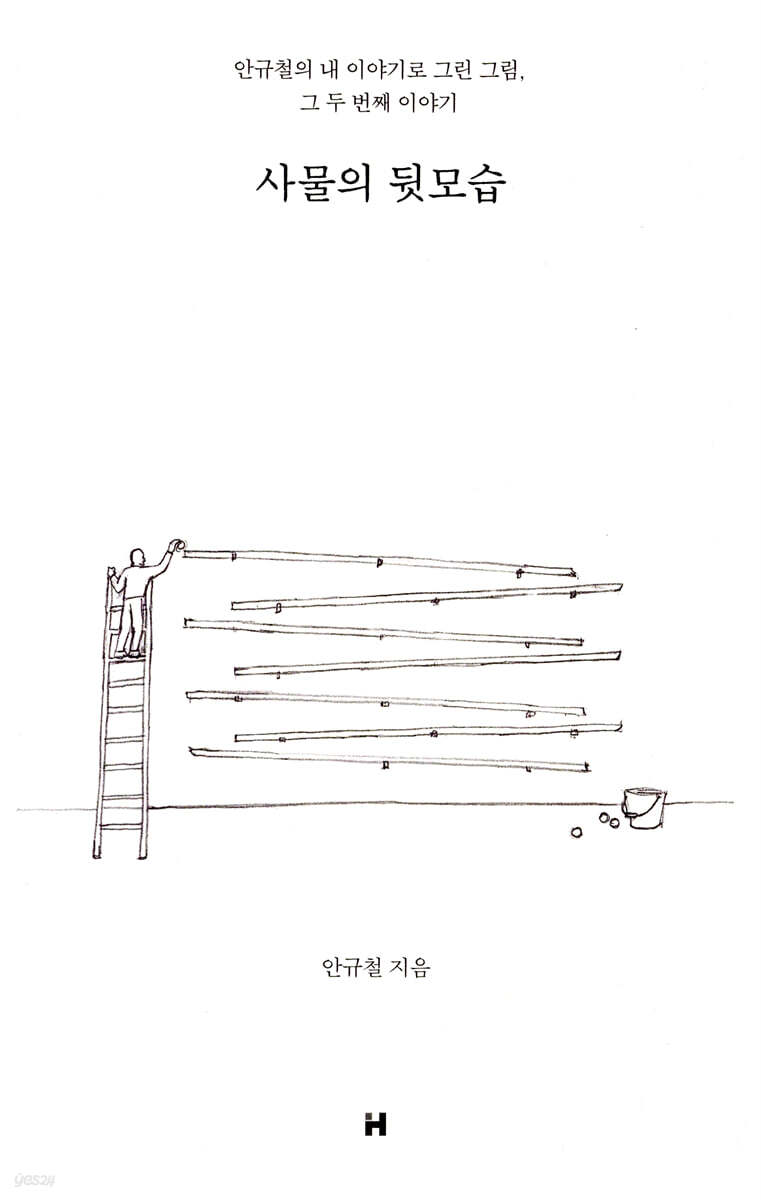
The back of things
 |
Description
Book Introduction
『The Back of Things』 was published by [Modern Literature].
This is a collection of essays by Ahn Kyu-chul, who transcends the genres of sculptor and artist, and simply and purely expresses objects and shapes, as well as his own attitude toward life and thoughts.
He has been serializing his work under the title ‘A Picture Drawn with My Story’ in the monthly magazine [Modern Literature] for 11 years since 2010.
The sequel to the first book, Nine Goldfish and the Distant Waters, published in 2013, “The Back View of Things” is a compilation of 67 articles and illustrations serialized since the January 2014 issue.
This is a collection of essays by Ahn Kyu-chul, who transcends the genres of sculptor and artist, and simply and purely expresses objects and shapes, as well as his own attitude toward life and thoughts.
He has been serializing his work under the title ‘A Picture Drawn with My Story’ in the monthly magazine [Modern Literature] for 11 years since 2010.
The sequel to the first book, Nine Goldfish and the Distant Waters, published in 2013, “The Back View of Things” is a compilation of 67 articles and illustrations serialized since the January 2014 issue.
- You can preview some of the book's contents.
Preview
index
At the beginning of the book
1 Plant Time
Form and formlessness · Ball · Vessels · How to become the wind · Artificial tears · Dull saw · Rust · Objects · Tears Electricity · Inside and outside · Glass · Screws · Inertia · The problem of balance · Sketch of a flower tree · Signals · Sounds · What we can learn from trees · Becoming alive · Seeds · The time of plants
2 Twenty words
A world without subjects · About names · About noise · In the ruins of words · The problem of A and B · Presumptive subjects · Crickets do not chirp · Weeds · A hair's breadth · Twenty words · The shelf life of words · The problem of right angles
3 Grace to the artists
How Artists Disappear · Two Walls · A Mug · The Unfinished Circle · The Wings of a Tit · Tinnitus · Warp and Weft · Writing in a Sketchbook · Pencils and Erasers · How Not to Fail · Voyager 2 · The Pyramids · The Age of 100 · A Favor for Artists · Everything and Nothing ·
4 House with a yard
Gravity · Until Thursday · Fine dust · What we didn't learn · A good carpenter · A house with a yard · A workshop · In a lonely house · Yesterday's rain · Greetings · A son older than his father · Old photographs · Things that don't stay · When nothing happened · Dad doesn't live with us · Message · A race against time · Home · Postcard
Recommendation_Dong-gu Yoon and So-yeon Ahn
1 Plant Time
Form and formlessness · Ball · Vessels · How to become the wind · Artificial tears · Dull saw · Rust · Objects · Tears Electricity · Inside and outside · Glass · Screws · Inertia · The problem of balance · Sketch of a flower tree · Signals · Sounds · What we can learn from trees · Becoming alive · Seeds · The time of plants
2 Twenty words
A world without subjects · About names · About noise · In the ruins of words · The problem of A and B · Presumptive subjects · Crickets do not chirp · Weeds · A hair's breadth · Twenty words · The shelf life of words · The problem of right angles
3 Grace to the artists
How Artists Disappear · Two Walls · A Mug · The Unfinished Circle · The Wings of a Tit · Tinnitus · Warp and Weft · Writing in a Sketchbook · Pencils and Erasers · How Not to Fail · Voyager 2 · The Pyramids · The Age of 100 · A Favor for Artists · Everything and Nothing ·
4 House with a yard
Gravity · Until Thursday · Fine dust · What we didn't learn · A good carpenter · A house with a yard · A workshop · In a lonely house · Yesterday's rain · Greetings · A son older than his father · Old photographs · Things that don't stay · When nothing happened · Dad doesn't live with us · Message · A race against time · Home · Postcard
Recommendation_Dong-gu Yoon and So-yeon Ahn
Detailed image

Into the book
A sculptor is someone who frees the shapes trapped in stone.
I have no intention of disparaging his insight that penetrates the surface of things, nor the numerous masterpieces he left behind, but I sometimes wonder about the fragments and dust he broke with his hammer and chisel for his own work.
(……) Here, the world is divided into form and formless, what remains and what is discarded.
Creating art was about distinguishing between what would be remembered and what would be forgotten, and making clear the boundaries between them.
Now that Michelangelo and his successors have drawn out the forms hidden in all the marble of the world, we are ultimately searching for the forms hidden in the rubble, in the discarded fragments and dust.
--- p.11~12, from “Form and Formlessness”
If it disappears, live as if it doesn't exist.
We must learn to let go of things that keep running away.
Instead of making more boxes and drawers and confining them in them, we should try, if possible, to imitate the sober life of the monks.
Just as flowers bloom without being called when the time comes, things that have disappeared will reappear someday. Now is the time to clean up my messy desk and throw away the clutter that I may never use. It is time for me to run away from them first.
--- p.39~41, from “Things”
Long ago, when someone said, "It came alive," to me it sounded like "It disappeared."
It may have sounded that way because the person had actually disappeared from my memory for a while.
It must have meant that even though it was a difficult life, I was still able to survive.
(……) Saying that it’s okay, saying that there’s nothing you can do but that it’s fate, saying that it’s something you have to handle entirely yourself and that you won’t listen to any pathetic consolation.
A life that is not about 'living', 'coming to live', 'surviving', 'surviving', or 'surviving', but about 'living off', 'getting rid of', and 'living away', and thus ultimately disappearing from life.
--- p.83~84, from “Coming Alive”
Whether I'm writing or drawing, I can't leave my sketchbook and pencil behind.
I love the feel of Kent paper and the sound of it squeaking through the pencil tip.
I love the freedom that is allowed there, the freedom to move slowly like a snail, to stand still, and to always be able to go back to where I was before.
There is a freedom there that is unimaginable in writing like an official document, written with a ballpoint pen on stiff A4 paper.
--- p.177~179, from “Writing in a Sketchbook”
In a world where the saying, "If you don't change, you die" has become the zeitgeist, we are being driven out onto the streets, completely unprepared for the long lifespan of the "100-year era," as we bite each other and are whipped by the premonitions of impending unemployment, impending bankruptcy, impending disaster, and impending catastrophe.
(……) In these days when no one talks about eternity or immortality, we need a carpenter who will build a house for the soul that will last 100 years, not an interior design that will last three months.
I have no intention of disparaging his insight that penetrates the surface of things, nor the numerous masterpieces he left behind, but I sometimes wonder about the fragments and dust he broke with his hammer and chisel for his own work.
(……) Here, the world is divided into form and formless, what remains and what is discarded.
Creating art was about distinguishing between what would be remembered and what would be forgotten, and making clear the boundaries between them.
Now that Michelangelo and his successors have drawn out the forms hidden in all the marble of the world, we are ultimately searching for the forms hidden in the rubble, in the discarded fragments and dust.
--- p.11~12, from “Form and Formlessness”
If it disappears, live as if it doesn't exist.
We must learn to let go of things that keep running away.
Instead of making more boxes and drawers and confining them in them, we should try, if possible, to imitate the sober life of the monks.
Just as flowers bloom without being called when the time comes, things that have disappeared will reappear someday. Now is the time to clean up my messy desk and throw away the clutter that I may never use. It is time for me to run away from them first.
--- p.39~41, from “Things”
Long ago, when someone said, "It came alive," to me it sounded like "It disappeared."
It may have sounded that way because the person had actually disappeared from my memory for a while.
It must have meant that even though it was a difficult life, I was still able to survive.
(……) Saying that it’s okay, saying that there’s nothing you can do but that it’s fate, saying that it’s something you have to handle entirely yourself and that you won’t listen to any pathetic consolation.
A life that is not about 'living', 'coming to live', 'surviving', 'surviving', or 'surviving', but about 'living off', 'getting rid of', and 'living away', and thus ultimately disappearing from life.
--- p.83~84, from “Coming Alive”
Whether I'm writing or drawing, I can't leave my sketchbook and pencil behind.
I love the feel of Kent paper and the sound of it squeaking through the pencil tip.
I love the freedom that is allowed there, the freedom to move slowly like a snail, to stand still, and to always be able to go back to where I was before.
There is a freedom there that is unimaginable in writing like an official document, written with a ballpoint pen on stiff A4 paper.
--- p.177~179, from “Writing in a Sketchbook”
In a world where the saying, "If you don't change, you die" has become the zeitgeist, we are being driven out onto the streets, completely unprepared for the long lifespan of the "100-year era," as we bite each other and are whipped by the premonitions of impending unemployment, impending bankruptcy, impending disaster, and impending catastrophe.
(……) In these days when no one talks about eternity or immortality, we need a carpenter who will build a house for the soul that will last 100 years, not an interior design that will last three months.
--- p.200, from “The 100-Year-Old Era”
Publisher's Review
There is more to things than you might guess.
There is a much deeper and wider world.
It consists of four chapters: 'The Time of Plants', which contains thoughts about objects; 'Twenty Words', which is a collection of thoughts about words and language; 'Grace to Artists', which collects the search for methods for the work of art and writing; and 'A House with a Yard', which looks into life through episodes containing life experiences.
This book deeply resonates with everyone, revealing a new world discovered by the author through a moment of pause in the leisurely space created by the time and thought he gained as a bonus in life.
While his previous work, "Nine Goldfish and the Distant Water," contained deep reflections on art and the life of an artist, "The Back Side of Things" is more focused on the story of an ordinary person living today.
In particular, the word 'back' in the title has two meanings: looking back at one's own back as one passes middle age and looking at the back of what is visible in objects or phenomena.
As he stated in the preface, the effort to “meet the grass, bugs, and trees we have passed by without a second thought, and to see the hidden side of things we have not yet noticed” meets a warm gaze and opens up another world.
In “Outside and Inside,” he is curious about the inside of things, but “even if we take apart the machine with great effort, we are helpless in front of the complex circuit board like a code.”
And he expands his perspective on recognizing things to the human world, saying, “This kind of relationship governs our entire lives (page 48).”
In "The Problem of Right Angles," he laments the world's lack of meticulousness in work through "the story of a carpenter who couldn't find right angles," but he also abandons his image as a "timid principled person" and his attachment to the way of life he had maintained, saying he can no longer waste his life like that.
In "Mug," he honestly confesses that his life as an artist is lonely and not easy.
Furthermore, we should reflect on the metaphors of the laws of nature that only humans cannot obey.
The confession in “Warp and Weft” that “I continue this work, which will ultimately end in incompleteness, every moment, with a thread that I don’t know when it will end, but which will surely end someday (p. 174)” allows us to glimpse the artist’s spirit that never ages and the author’s utmost devotion and sorrow to dedicate everything to the work he loves until the moment of his death.
“This book is another type of work in which the story becomes the main character.
“As we share the life and art of an author whose aspirations and hesitations, hopes and sighs we had only guessed at, we discover a world of thought far deeper and broader than we could have imagined.”
_An So-yeon (Artistic Director, Atelier Hermès)
There is a much deeper and wider world.
It consists of four chapters: 'The Time of Plants', which contains thoughts about objects; 'Twenty Words', which is a collection of thoughts about words and language; 'Grace to Artists', which collects the search for methods for the work of art and writing; and 'A House with a Yard', which looks into life through episodes containing life experiences.
This book deeply resonates with everyone, revealing a new world discovered by the author through a moment of pause in the leisurely space created by the time and thought he gained as a bonus in life.
While his previous work, "Nine Goldfish and the Distant Water," contained deep reflections on art and the life of an artist, "The Back Side of Things" is more focused on the story of an ordinary person living today.
In particular, the word 'back' in the title has two meanings: looking back at one's own back as one passes middle age and looking at the back of what is visible in objects or phenomena.
As he stated in the preface, the effort to “meet the grass, bugs, and trees we have passed by without a second thought, and to see the hidden side of things we have not yet noticed” meets a warm gaze and opens up another world.
In “Outside and Inside,” he is curious about the inside of things, but “even if we take apart the machine with great effort, we are helpless in front of the complex circuit board like a code.”
And he expands his perspective on recognizing things to the human world, saying, “This kind of relationship governs our entire lives (page 48).”
In "The Problem of Right Angles," he laments the world's lack of meticulousness in work through "the story of a carpenter who couldn't find right angles," but he also abandons his image as a "timid principled person" and his attachment to the way of life he had maintained, saying he can no longer waste his life like that.
In "Mug," he honestly confesses that his life as an artist is lonely and not easy.
Furthermore, we should reflect on the metaphors of the laws of nature that only humans cannot obey.
The confession in “Warp and Weft” that “I continue this work, which will ultimately end in incompleteness, every moment, with a thread that I don’t know when it will end, but which will surely end someday (p. 174)” allows us to glimpse the artist’s spirit that never ages and the author’s utmost devotion and sorrow to dedicate everything to the work he loves until the moment of his death.
“This book is another type of work in which the story becomes the main character.
“As we share the life and art of an author whose aspirations and hesitations, hopes and sighs we had only guessed at, we discover a world of thought far deeper and broader than we could have imagined.”
_An So-yeon (Artistic Director, Atelier Hermès)
GOODS SPECIFICS
- Publication date: March 22, 2021
- Page count, weight, size: 292 pages | 360g | 128*188*17mm
- ISBN13: 9791190885669
- ISBN10: 1190885662
You may also like
카테고리
korean


korean

![GQ KOREA Mark (Monthly): December [2025]](http://librairie.coreenne.fr/cdn/shop/files/8ef265dbbfbf186523ed75ba7319009d.jpg?v=1765340328&width=3840)


