

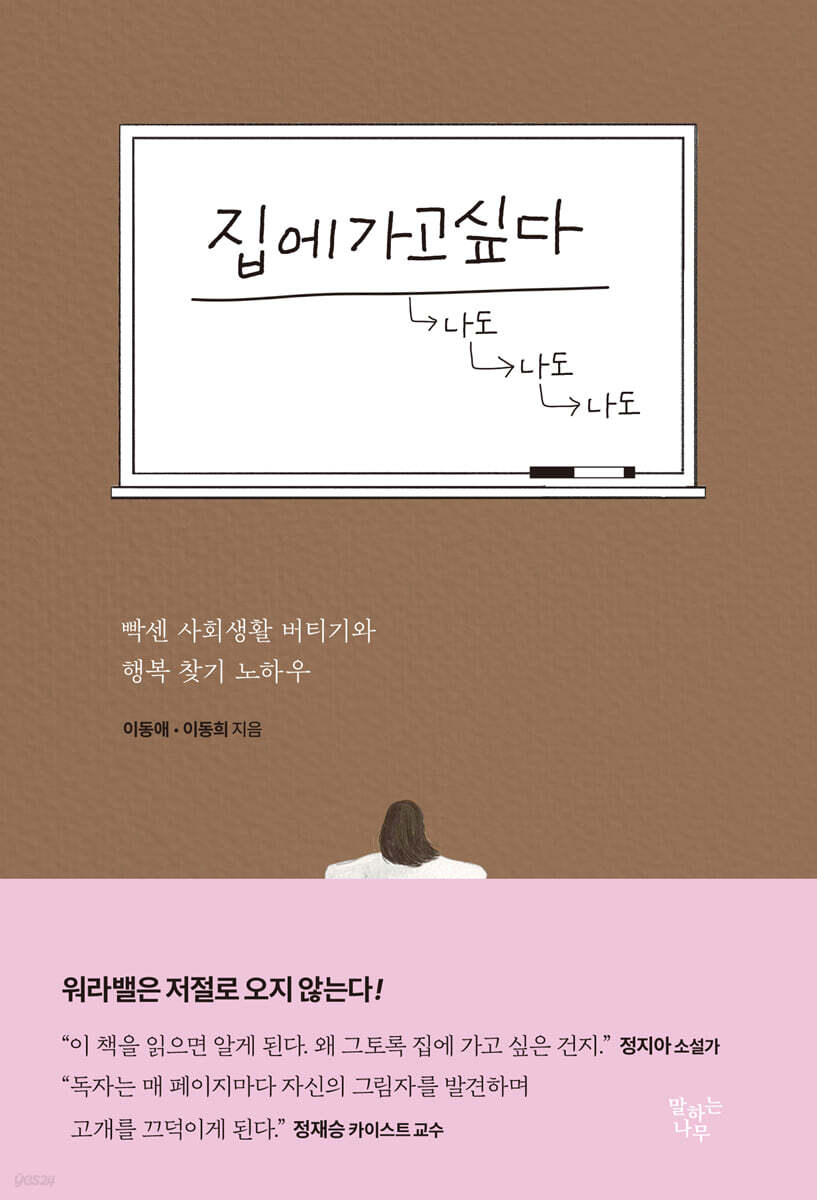
I want to go home
 |
Description
Book Introduction
How to Survive the Toughness of Social Life and Find Happiness
Honest, unvarnished stories from successful professionals
Work-life balance doesn't come naturally.
A humanistic self-help book that teaches you how to live well, not just hard.
Protecting myself from the hardships of work and life and showing me the way to happiness
“You will know when you read this book.
“Why do I want to go home so badly?”
_Jeong Ji-ah, novelist
“Their confessions go beyond trivial emotions and extend into sociological and neuroscientific contexts.”
_Professor Jaeseung Jeong of KAIST
A story that started with a single line of scribble on a whiteboard
The authors are twin sisters, reporters and producers, who have worked at the same company (MBC) for 30 years.
It was a Monday morning when reporter Lee Dong-ae was the head of the digital department.
When I got to work, I saw the phrase “I want to go home” written on a large whiteboard in the editorial office.
It appeared to have been written by a broadcast editor who worked on the weekend, but I sympathized with the earnest feeling and did not bother to ask those around me who had written it, and I did not delete it.
But within a few days, seven people joined in, writing “Me too” underneath.
The authors noted that episode.
The two people, who worked harder than anyone else while sharing their worries, big and small, received praise for their hard work, but also slipped in promotions and experienced burnout and brain fog.
These are the people who understand better than anyone the feelings of those who confidently confess, "I want to go home."
“I want to go home” is a phrase that many people use on a daily basis, but the authors’ analysis shows that it is not simply a complaint.
It was even less a statement of personal weakness.
It was a shared feeling among our generation, constantly being asked to be on, draining our batteries, and living in low-power mode.
It was a real voice of our time, encountered by the authors, who are reporters and producers, while working with their colleagues in the content field.
The authors expressed the true meaning of this saying as follows:
“The desire to go home is a secret resistance to protect oneself and to seek a better life, a desperate signal to return to oneself.” Alice Dalton Brown, a popular painter in her 80s who paints many houses, said, “Home is a metaphor for oneself.”
That is, people say, “I want to go home,” and they want to find themselves.
Honest, unvarnished stories from successful professionals
Work-life balance doesn't come naturally.
A humanistic self-help book that teaches you how to live well, not just hard.
Protecting myself from the hardships of work and life and showing me the way to happiness
“You will know when you read this book.
“Why do I want to go home so badly?”
_Jeong Ji-ah, novelist
“Their confessions go beyond trivial emotions and extend into sociological and neuroscientific contexts.”
_Professor Jaeseung Jeong of KAIST
A story that started with a single line of scribble on a whiteboard
The authors are twin sisters, reporters and producers, who have worked at the same company (MBC) for 30 years.
It was a Monday morning when reporter Lee Dong-ae was the head of the digital department.
When I got to work, I saw the phrase “I want to go home” written on a large whiteboard in the editorial office.
It appeared to have been written by a broadcast editor who worked on the weekend, but I sympathized with the earnest feeling and did not bother to ask those around me who had written it, and I did not delete it.
But within a few days, seven people joined in, writing “Me too” underneath.
The authors noted that episode.
The two people, who worked harder than anyone else while sharing their worries, big and small, received praise for their hard work, but also slipped in promotions and experienced burnout and brain fog.
These are the people who understand better than anyone the feelings of those who confidently confess, "I want to go home."
“I want to go home” is a phrase that many people use on a daily basis, but the authors’ analysis shows that it is not simply a complaint.
It was even less a statement of personal weakness.
It was a shared feeling among our generation, constantly being asked to be on, draining our batteries, and living in low-power mode.
It was a real voice of our time, encountered by the authors, who are reporters and producers, while working with their colleagues in the content field.
The authors expressed the true meaning of this saying as follows:
“The desire to go home is a secret resistance to protect oneself and to seek a better life, a desperate signal to return to oneself.” Alice Dalton Brown, a popular painter in her 80s who paints many houses, said, “Home is a metaphor for oneself.”
That is, people say, “I want to go home,” and they want to find themselves.
- You can preview some of the book's contents.
Preview
index
prolog
-1.
The event that changed my life
-2.
A Moment Together, 'Pizza Morning'
-3.
Why We Wrote a Book Together
Part 1: The Truth About Wanting to Go Home
-Episode 1.
Why do we want to leave work as soon as we get there?
-Episode 2.
The true meaning of wanting to go home
-Episode 3.
Even though I'm at home, I want to go home
-Episode 4.
Emotions on the way to work
-Episode 5.
Emotions on the way to work 2
-Episode 6.
Things to learn at work
-Episode 7.
People who desert from battle
-Episode 8.
Questions to Ask When Quitting a Job
-Episode 9.
Going to work doesn't give you a real job.
Part 2: Rediscovery and Transformation of Everyday Life
-Episode 1.
brain fog
-Episode 2.
One hour a day is enough
-Episode 3.
How to find new time
-Episode 4.
Sleeping is more important than waking up - Episode 5.
Am I living with my breath?
-Episode 6.
The charm of gravel fields
-Episode 7.
Anxiety and worry have no present.
-Episode 8.
Habits don't evoke emotions.
-Episode 9.
Being good at something you really hate
-Episode 10.
200g of levator scapulae, on how to take care of myself
-Episode 11.
Things you only know after losing them
-Episode 12.
How to do something consistently without willpower
Part 3: Relationships and Growth
- Episode 1.
It's the villain who changes the protagonist's path.
- Episode 2.
If bluffing becomes useful
- Episode 3.
Luxury goods have a transparent presence.
- Episode 4.
The difference between the 3rd and 4th hitters
- Episode 5.
Eating tteokbokki often doesn't build a reputation.
- Episode 6.
A polite person succeeds.
- Episode 7.
Find the switch that moves you
- Episode 8.
Sometimes it takes courage to quit
- Episode 9.
New relationships always come.
- Episode 10.
What we really need to manage is humility.
- # PD Note - 40 Days in the Gobi Desert
- # Reporter's Note - Three Years in Tokyo
Part 4: Life Wisdom from Role Models
- Episode 1.
Living like Balzac
- Episode 2.
Living for 100 years
- Episode 3.
Living like Emiko Inagaki
- Episode 4.
How does prime time come?
- Episode 5.
How to Find Your True Work, Even if It's Small
- Episode 6.
Create your own sentences
- Episode 7.
If you don't stop doing other things, opportunities will come.
- Episode 8.
What the Apple Tree Taught Me
Part 5 To my heart that needs a place to rest
- Episode 1.
Breaking out of the office worker persona
- Episode 2.
How to Cross the Desert
- Episode 3.
How to avoid being swept away by waves of frustration
- Episode 4.
How to build your own cabin
-1.
The event that changed my life
-2.
A Moment Together, 'Pizza Morning'
-3.
Why We Wrote a Book Together
Part 1: The Truth About Wanting to Go Home
-Episode 1.
Why do we want to leave work as soon as we get there?
-Episode 2.
The true meaning of wanting to go home
-Episode 3.
Even though I'm at home, I want to go home
-Episode 4.
Emotions on the way to work
-Episode 5.
Emotions on the way to work 2
-Episode 6.
Things to learn at work
-Episode 7.
People who desert from battle
-Episode 8.
Questions to Ask When Quitting a Job
-Episode 9.
Going to work doesn't give you a real job.
Part 2: Rediscovery and Transformation of Everyday Life
-Episode 1.
brain fog
-Episode 2.
One hour a day is enough
-Episode 3.
How to find new time
-Episode 4.
Sleeping is more important than waking up - Episode 5.
Am I living with my breath?
-Episode 6.
The charm of gravel fields
-Episode 7.
Anxiety and worry have no present.
-Episode 8.
Habits don't evoke emotions.
-Episode 9.
Being good at something you really hate
-Episode 10.
200g of levator scapulae, on how to take care of myself
-Episode 11.
Things you only know after losing them
-Episode 12.
How to do something consistently without willpower
Part 3: Relationships and Growth
- Episode 1.
It's the villain who changes the protagonist's path.
- Episode 2.
If bluffing becomes useful
- Episode 3.
Luxury goods have a transparent presence.
- Episode 4.
The difference between the 3rd and 4th hitters
- Episode 5.
Eating tteokbokki often doesn't build a reputation.
- Episode 6.
A polite person succeeds.
- Episode 7.
Find the switch that moves you
- Episode 8.
Sometimes it takes courage to quit
- Episode 9.
New relationships always come.
- Episode 10.
What we really need to manage is humility.
- # PD Note - 40 Days in the Gobi Desert
- # Reporter's Note - Three Years in Tokyo
Part 4: Life Wisdom from Role Models
- Episode 1.
Living like Balzac
- Episode 2.
Living for 100 years
- Episode 3.
Living like Emiko Inagaki
- Episode 4.
How does prime time come?
- Episode 5.
How to Find Your True Work, Even if It's Small
- Episode 6.
Create your own sentences
- Episode 7.
If you don't stop doing other things, opportunities will come.
- Episode 8.
What the Apple Tree Taught Me
Part 5 To my heart that needs a place to rest
- Episode 1.
Breaking out of the office worker persona
- Episode 2.
How to Cross the Desert
- Episode 3.
How to avoid being swept away by waves of frustration
- Episode 4.
How to build your own cabin
Detailed image

Into the book
As office workers, what we really want is not to 'get off work', but rather a space where we can exist as 'ourselves' comfortably and naturally as at 'home' when we go to work.
--- p.36
The desire to go home is not a sign of weakness or an escapist urge, but rather a wise desire to protect myself from the company's control over my day.
--- p.40
The thought of 'I want to go home' that comes to mind from time to time in an office where nostalgia has dried up is a cry for freedom from the constraints of work.
--- p.41
It is better not to show your true feelings within the company.
Wearing a mask is like equipping yourself with an important skill: separating your personal life from your work life.
--- p.48
So, the goal you should aim for in your corporate life is not success.
There are countless attempts.
--- p.53
To make your work life fun, interesting, and meaningful, you need your own story.
I need to know what my role is here, what motivates me, and what variables frustrate me.
--- p.66
If you take a closer look at the daily lives of celebrities, you will see that they strictly adhere to Miracle Sleep before the Miracle Morning.
I pour a lot of energy into managing my evenings to wake up early.
--- p.88
“The flower path is a path that everyone wants, so the competition is fierce, but on the gravel road, most people lack motivation, so with just a little motivation, you can shine.
“Can’t we talk about it?”
--- p.97
Even those who have left such a distinct mark in a field took a long time to find their true nature and purpose in life.
To find your own sentence, you must know yourself well.
You need to focus on what makes you happy and what makes your heart race.
--- p.230
I can't just give up the life I've enjoyed so far and move into a cabin in the mountains, but I need a cabin where I can take one hour a day, one day a week, to turn my gaze away from the outside world, look inside my heart, and examine myself.
--- p.36
The desire to go home is not a sign of weakness or an escapist urge, but rather a wise desire to protect myself from the company's control over my day.
--- p.40
The thought of 'I want to go home' that comes to mind from time to time in an office where nostalgia has dried up is a cry for freedom from the constraints of work.
--- p.41
It is better not to show your true feelings within the company.
Wearing a mask is like equipping yourself with an important skill: separating your personal life from your work life.
--- p.48
So, the goal you should aim for in your corporate life is not success.
There are countless attempts.
--- p.53
To make your work life fun, interesting, and meaningful, you need your own story.
I need to know what my role is here, what motivates me, and what variables frustrate me.
--- p.66
If you take a closer look at the daily lives of celebrities, you will see that they strictly adhere to Miracle Sleep before the Miracle Morning.
I pour a lot of energy into managing my evenings to wake up early.
--- p.88
“The flower path is a path that everyone wants, so the competition is fierce, but on the gravel road, most people lack motivation, so with just a little motivation, you can shine.
“Can’t we talk about it?”
--- p.97
Even those who have left such a distinct mark in a field took a long time to find their true nature and purpose in life.
To find your own sentence, you must know yourself well.
You need to focus on what makes you happy and what makes your heart race.
--- p.230
I can't just give up the life I've enjoyed so far and move into a cabin in the mountains, but I need a cabin where I can take one hour a day, one day a week, to turn my gaze away from the outside world, look inside my heart, and examine myself.
--- p.259
Publisher's Review
Change begins with a desire to go home.
How can I make the words "I want to go home" a positive action that protects me and brings me happiness in the midst of the battles of work and life?
The authors advise that we first use the 'desire to go home' as the starting point for change.
And they present solutions based on their experiences and learnings in a literary tone.
The content is structured so that the solutions can be naturally embodied as you read the book.
Through selective immersion, guilt-free rest, and the courage to disconnect from unwanted connections, it offers warm empathy and support, not unconditional comfort or harsh reprimand, but the message, "Yes, we all do."
In this book, which consists of five parts, the authors first delve into the truth about wanting to go home (Part 1).
The authors say that the reason we feel like leaving work as soon as we get there is because of the system that evaluates our actions and work every day.
It conveys a positive message that we should use the wise thought that wants to protect us from open offices, constant monitoring, and constant communication demands as a starting point for change.
Part 2 presents ways to look back on your daily life, discover your own breathing, and develop a positive mindset.
Part 3, 'Relationships and Growth,' looks at the other side of human relationships and teaches us how to create the driving force for growth there.
Part 4, “Life Wisdom from Role Models,” and Part 5, “To My Heart in Need of a Rest,” provide ways to escape frustration, find your true self, and achieve happiness.
Professor Jaeseung Jeong of KAIST evaluated this book as follows:
“The two authors unflinchingly document how work life both cultivates and exhausts human beings.
Moreover, their confessions do not remain in trivial emotions but expand into sociological and neuroscientific contexts.
From burnout and brain fog to commute anxiety and life skills learned at work to the delicate balance of humility and bravado, readers will find themselves nodding along as they recognize their own reflections on every page.”
How can I make the words "I want to go home" a positive action that protects me and brings me happiness in the midst of the battles of work and life?
The authors advise that we first use the 'desire to go home' as the starting point for change.
And they present solutions based on their experiences and learnings in a literary tone.
The content is structured so that the solutions can be naturally embodied as you read the book.
Through selective immersion, guilt-free rest, and the courage to disconnect from unwanted connections, it offers warm empathy and support, not unconditional comfort or harsh reprimand, but the message, "Yes, we all do."
In this book, which consists of five parts, the authors first delve into the truth about wanting to go home (Part 1).
The authors say that the reason we feel like leaving work as soon as we get there is because of the system that evaluates our actions and work every day.
It conveys a positive message that we should use the wise thought that wants to protect us from open offices, constant monitoring, and constant communication demands as a starting point for change.
Part 2 presents ways to look back on your daily life, discover your own breathing, and develop a positive mindset.
Part 3, 'Relationships and Growth,' looks at the other side of human relationships and teaches us how to create the driving force for growth there.
Part 4, “Life Wisdom from Role Models,” and Part 5, “To My Heart in Need of a Rest,” provide ways to escape frustration, find your true self, and achieve happiness.
Professor Jaeseung Jeong of KAIST evaluated this book as follows:
“The two authors unflinchingly document how work life both cultivates and exhausts human beings.
Moreover, their confessions do not remain in trivial emotions but expand into sociological and neuroscientific contexts.
From burnout and brain fog to commute anxiety and life skills learned at work to the delicate balance of humility and bravado, readers will find themselves nodding along as they recognize their own reflections on every page.”
A book that will revolutionize your stagnant life
A prescription for analyzing and treating the "I Want to Go Home" syndrome
A story about the only space and time where I can truly be myself.
Twin sister reporters and producers offer sympathy and comfort to those in need of a place to rest.
This book is a humanistic self-help book written by sisters Lee Dong-ae and Lee Dong-hee, who are director-level reporters and producers at the same broadcasting station (MBC) and are identical twins, and suggest ways to protect oneself and achieve happiness in the midst of the battles of work and life.
This book is especially dedicated to the MZ generation, who habitually say the earnest words, "I want to go home," and to those preparing for a life transition.
It has the advantage of providing an opportunity for self-awareness to those who are insecure about their position, and providing easy, actionable tips in a relatable style.
It is interesting what prompted the authors to write this book.
It was one Monday morning when reporter Lee Dong-ae was the head of the digital department at a broadcasting station.
After a breathless commute to work, I entered the company office and noticed some new writing on the whiteboard right in front of me.
Just one sentence written in black magic pen.
“I want to go home.”
It appeared to have been written by a broadcast editor who worked over the weekend, and it was such an honest and intense confession of emotion that I couldn't bring myself to delete the phrase and just leave it there.
But within a few days, seven people joined in, writing “Me too” under the post.
At that time, PD Lee Dong-hee was in charge of production at the company and was on a roll, but one afternoon in the office, he was overcome by an inexplicable sense of fatigue and anxiety.
He was obsessed with the thought, “I want to go home if I can.”
In the end, on the way home from work, he sent an SOS to his younger sister, reporter Lee Dong-ae, and the two had dinner at a spicy hot pot restaurant near the company and talked.
They were born into this world 30 minutes apart on the same day, attended the same elementary, high, and university, and even worked at the same company, sharing similar thoughts and experiences.
Even if we wanted to live differently, we often felt a fundamental homogeneity because our tastes, hobbies, and objects of empathy were so similar.
That was the feeling I had that day when I was confronted with the sentence, “I want to go home.”
During this period, the two people were actually struggling with various problems, despite their outward appearances.
At work, I was struggling to achieve results, and at home, I was emotionally struggling due to health issues and conflicts with my family.
So they felt the words, 'I want to go home,' resonate deep within their hearts.
Moreover, I learned that the phrase "I want to go home" is not simply a complaint from office workers or students who do not want to go to work, do overtime, handle difficult work, or hate stress, but rather a social psychological phenomenon.
In particular, the MZ generation says, “I find myself saying ‘I want to go home’ without even realizing it,” and “I blurt out ‘I want to go home’ as if I’m sighing.”
That means their generation is in a psychologically difficult situation.
So the two thought that recording and exploring that feeling little by little would be meaningful not only for themselves but also for society.
The covenant at the mala-tang restaurant was the beginning of the book.
Commonly suggested symptoms and coping strategies for 'I want to go home syndrome' include yoga, meditation, exercise, relaxation, and hobbies.
That might be a temporary solution.
But the authors felt it was necessary to delve deeper.
As a result, the authors realized that while the phrase "I want to go home" may seem weak on the surface, its underlying meaning is a cry for freedom from the constraints of work and a secret resistance to protect the self.
Alice Dalton Brown, a popular painter in her 80s who paints many houses, said, “A house is a metaphor for yourself, a reflection of yourself.”
People say, “I want to go home,” and they want to find themselves.
The authors' thoughts are as follows:
[As office workers, what we really want is not 'getting off work,' but a space where we can be comfortable and natural 'me' when we get to work, just like at 'home.']
[The desire to go home is not a sign of weakness or an escapist urge, but rather a wise desire to protect myself from the company's control over my day.]
[The thought of 'I want to go home' that comes to mind from time to time in an office where nostalgia has dried up is a cry for freedom from the constraints of work.]
[Perhaps we are all on our own journey to find 'home' in our own way.
Some people eagerly await the end of work, others dream of a quick lunchtime escape, or struggle to find time for themselves deep in the night under the covers.
All these moments are not just an escape from reality, but a secret resistance to protect the self.]
How can the words and thoughts of “I want to go home” become active actions that protect me and lead me to happiness in my battle-like work and life?
The authors advise that we first use the 'desire to go home' as the starting point for change.
And they present solutions based on their experiences and learnings in a literary tone.
The content is structured so that the solutions can be naturally embodied as you read the book.
In this book, which consists of five parts, the author first explores ‘the truth behind wanting to go home’ (Part 1).
"I want to go home" is the inner feeling of people who are disappointed in an organization that lacks values such as empathy and sympathy for others.
The reason we feel like leaving work as soon as we get to work is because of the system that evaluates our actions and work every day, and because of the wise mind that wants to protect us from open offices, constant monitoring, and constant demands for communication.
However, that doesn't mean you should look down on the company.
There are more things to learn from a company than you might think.
You need to explore the company and use it appropriately.
However, the reality is that corporate life does not always end happily.
Experiences and know-how of success and failure gained through commuting to and from work and participating in daily battles, big and small, within the workplace.
These are the things that really stick with me.
So, what you should aim for in your corporate life is not success, but countless attempts.
Part 2, “Rediscovering and Transforming Everyday Life,” presents ways to create a positive mindset by looking back on your daily life and discovering your own breathing.
PD Lee Dong-hee found himself in a state of burnout, experiencing brain fog, a feeling of hazy fog in his head, and felt a sense of crisis, thinking, 'If I keep living like this, I'll die!'
To escape from that situation, I looked back on my daily life and started remodeling my life.
When allocating my time each day, I first created an hour each day to immerse myself in.
And I found a way to immerse myself in writing books, which was what I wanted to do most outside of work, and changed my habits.
I realized that habits and time management are paramount to a sustainable life, and by putting them into practice, I was able to create meaningful changes in my daily life.
Part 3, “Relationships and Growth,” looks at the other side of human relationships and suggests ways to create a driving force for growth there.
It turns out that what changes the path in life and helps the protagonist grow is, unexpectedly, the villain (a character who stands in the way of the protagonist's goal).
The authors argue that the anger evoked by villains is a powerful source of motivation and provides powerful fuel to combat derailment.
As you rise through the ranks and the breadth and depth of your responsibilities change, you may need to strategically express yourself, and he emphasizes the need for appropriate self-promotion and bravado.
Like Richard Branson of Virgin Group, he offers a fresh perspective on accepting bluff as a persuasive technique with an ultra-positive attitude of “Fake it till you make it.”
But for it to become a useful bluff, it must be accompanied by courage, persistent effort, and the ability to execute.
You'll also discover wisdom from experience on topics like reputation management, positioning yourself in an organization, finding the switch that lights your inner fire, having the courage to quit, and the relationship between humility and success.
Part 4, “Life Wisdom from Role Models,” presents ways to escape frustration and find your true self.
Like the great writer Balzac, I seek to learn how to live in the present from people who created their own time and space, pursued a challenging lifestyle that transcended the limitations they had set for themselves, and maintained inner peace by writing and drawing even after they were over 100.
Rather than struggling to maintain your current status and possessions, some recommend setting up a Plan B of living a life of freedom through letting go and reducing.
For those who have not yet reached their prime, I advise them to repeat the long process of accumulation and anticipate a time when a qualitative change may occur, and that if we cherish every moment of our lives, one day we will experience the moment of prime that will explode like fireworks.
I sympathize with the value of 'pursuit' of those who boldly leave their current positions to find their true calling, even if it is small.
Part 5, "To My Heart That Needs a Rest," says that having the courage to take off your mask and immerse yourself in what you truly love, where you love, and what you truly value ultimately leads to true growth.
The episode where two sisters travel with their mother to Studio Ghibli, the birthplace of the Ghibli films they have loved since childhood, and try to break free from their office worker personas and find their true personas is very relatable.
Two sisters go for a drive to Yangyang Beach and, watching surfers balancing on the rough waves, encounter difficulties and ponder how to avoid being swept away by the waves of frustration.
When the old ways no longer work, we must find our own innovative ways to overcome them.
Horst Coenen advised that in such cases, one should have one's own consciousness in a space where one can have one's own time.
Such a space could be a room of one's own, as Virginia Woolf said in A Room of One's Own that a woman needed to write, or it could be the cabin of Henry David Thoreau, who, after graduating from Harvard, moved to Walden Pond and pursued a life of oneness with nature.
The authors ask, “Where is your cabin or home today, your personal base camp and a space for self-recovery?”
The Netsilik Eskimos of Northern Canada say "Qanoq sila?" (How is the universe (home)?) as a greeting meaning hello.
Peruvians greet each other with “Esta en su casa.” (You are in your house) and the people of the island village of Mexcaltitan greet each other with “My house is your house.” (Mi casa es su casa).
This is a greeting that reminds us of the importance of a home, a space where we always want to go, both physically and mentally.
I hope that through this book, readers can overcome the desire to go home even when they are at home and reach a state where they can declare, "Wherever I am, my home is mine."
A book that will revolutionize your stagnant life
A prescription for analyzing and treating the "I Want to Go Home" syndrome
A story about the only space and time where I can truly be myself.
Twin sister reporters and producers offer sympathy and comfort to those in need of a place to rest.
This book is a humanistic self-help book written by sisters Lee Dong-ae and Lee Dong-hee, who are director-level reporters and producers at the same broadcasting station (MBC) and are identical twins, and suggest ways to protect oneself and achieve happiness in the midst of the battles of work and life.
This book is especially dedicated to the MZ generation, who habitually say the earnest words, "I want to go home," and to those preparing for a life transition.
It has the advantage of providing an opportunity for self-awareness to those who are insecure about their position, and providing easy, actionable tips in a relatable style.
It is interesting what prompted the authors to write this book.
It was one Monday morning when reporter Lee Dong-ae was the head of the digital department at a broadcasting station.
After a breathless commute to work, I entered the company office and noticed some new writing on the whiteboard right in front of me.
Just one sentence written in black magic pen.
“I want to go home.”
It appeared to have been written by a broadcast editor who worked over the weekend, and it was such an honest and intense expression of emotion that I couldn't bring myself to delete the phrase and just leave it there.
But within a few days, seven people joined in, writing “Me too” under the post.
At that time, PD Lee Dong-hee was in charge of production at the company and was on a roll, but one afternoon in the office, he was overcome by an inexplicable sense of fatigue and anxiety.
He was obsessed with the thought, “I want to go home if I can.”
In the end, on the way home from work, he sent an SOS to his younger sister, reporter Lee Dong-ae, and the two had dinner at a spicy stew restaurant near the company and talked.
They were born into this world 30 minutes apart on the same day, attended the same elementary, high, and university, and even worked at the same company, sharing similar thoughts and experiences.
Even if we wanted to live differently, we often felt a fundamental homogeneity because our tastes, hobbies, and objects of empathy were so similar.
That was the feeling I had that day when I was confronted with the sentence, “I want to go home.”
During this period, the two people were actually struggling with various problems, despite their outward appearances.
At work, I was struggling to achieve results, and at home, I was emotionally struggling due to health issues and conflicts with my family.
So they felt the words, 'I want to go home,' resonate deep within their hearts.
Moreover, I learned that the phrase "I want to go home" is not simply a complaint from office workers or students who do not want to go to work, do overtime, handle difficult work, or hate stress, but rather a social psychological phenomenon.
In particular, the MZ generation says, “I find myself saying ‘I want to go home’ without even realizing it,” and “I blurt out ‘I want to go home’ as if I’m sighing.”
That means their generation is in a psychologically difficult situation.
So the two thought that recording and exploring that feeling little by little would be meaningful not only for themselves but also for society.
The covenant at the mala-tang restaurant was the beginning of the book.
Commonly suggested symptoms and coping strategies for 'I want to go home syndrome' include yoga, meditation, exercise, relaxation, and hobbies.
That might be a temporary solution.
But the authors felt it was necessary to delve deeper.
As a result, the authors realized that while the phrase "I want to go home" may seem weak on the surface, its underlying meaning is a cry for freedom from the constraints of work and a secret resistance to protect the self.
Alice Dalton Brown, a popular painter in her 80s who paints many houses, said, “A house is a metaphor for yourself, a reflection of yourself.”
People say, “I want to go home,” and they want to find themselves.
The authors' thoughts are as follows:
[As office workers, what we really want is not 'getting off work,' but a space where we can be comfortable and natural 'me' when we get to work, just like at 'home.']
[The desire to go home is not a sign of weakness or an escapist conscious, but rather a wise desire to protect myself from the company's control over my day.]
[The thought of 'I want to go home' that comes to mind from time to time in an office where nostalgia has dried up is a cry for freedom from the constraints of work.]
[Perhaps we are all on our own journey to find 'home' in our own way.
Some people eagerly await the end of work, others dream of a quick lunchtime escape, or struggle to find time for themselves deep in the night under the covers.
All these moments are not just an escape from reality, but a secret resistance to protect the self.]
How can the words and thoughts of “I want to go home” become active actions that protect me and lead me to happiness in my battle-like work and life?
The authors advise that we first use the 'desire to go home' as the starting point for change.
And they present solutions based on their experiences and learnings in a literary tone.
The content is structured so that the solutions can be naturally embodied as you read the book.
In this book, which consists of five parts, the author first explores ‘the truth behind wanting to go home’ (Part 1).
"I want to go home" is the inner feeling of people who are disappointed in an organization that lacks values such as empathy and sympathy for others.
The reason we feel like leaving work as soon as we get to work is because of the system that evaluates our actions and work every day, and because of the wise mind that wants to protect us from open offices, constant monitoring, and constant demands for communication.
However, that doesn't mean you should look down on the company.
There are more things to learn from a company than you might think.
You need to explore the company and use it appropriately.
However, the reality is that corporate life does not always end happily.
Experiences and know-how of success and failure gained through commuting to and from work and participating in daily battles, big and small, within the workplace.
These are the things that really stick with me.
So, what you should aim for in your corporate life is not success, but countless attempts.
Part 2, “Rediscovering and Transforming Everyday Life,” presents ways to create a positive mindset by looking back on your daily life and discovering your own breathing.
PD Lee Dong-hee found himself in a state of burnout, experiencing brain fog, a feeling of hazy fog in his head, and felt a sense of crisis, thinking, 'If I keep living like this, I'll die!'
To escape from that situation, I looked back on my daily life and started remodeling my life.
When allocating my time each day, I first created an hour each day to immerse myself in.
And I found a way to immerse myself in writing books, which was what I wanted to do most outside of work, and changed my habits.
I realized that habits and time management are paramount to a sustainable life, and by putting them into practice, I was able to make meaningful changes in my daily life.
Part 3, “Relationships and Growth,” looks at the other side of human relationships and suggests ways to create a driving force for growth there.
It turns out that what changes the protagonist's path and helps them grow in life is, unexpectedly, the villain (a character who stands in the way of the protagonist's goals).
The authors argue that the anger evoked by villains is a powerful source of motivation and provides powerful fuel to combat derailment.
As you rise through the ranks and the breadth and depth of your responsibilities change, you may need to strategically express yourself, and he emphasizes the need for appropriate self-promotion and bravado.
Like Richard Branson of Virgin Group, he offers a fresh perspective on accepting bluff as a persuasive technique with an ultra-positive attitude of “Fake it till you make it.”
But for it to become a useful bluff, it must be accompanied by courage, persistent effort, and the ability to execute.
You'll also discover wisdom from experience on topics like reputation management, positioning yourself in an organization, finding the switch that lights your inner fire, having the courage to quit, and the relationship between humility and success.
Part 4, “Life Wisdom from Role Models,” presents ways to escape frustration and find your true self.
Like the great writer Balzac, I seek to learn how to live in the present from people who created their own time and space, pursued a challenging lifestyle that transcended the limitations they had set for themselves, and maintained inner peace by writing and drawing even after they were over 100.
Rather than struggling to maintain your current status and possessions, some recommend setting up a Plan B of living a life of freedom through letting go and reducing.
For those who have not yet reached their prime, I advise them to repeat the long process of accumulation and anticipate a time when a qualitative change may occur, and that if we cherish every moment of our lives, one day we will experience the moment of prime that will explode like fireworks.
I sympathize with the value of 'pursuit' of those who boldly leave their current positions to find their true calling, even if it is small.
Part 5, "To My Heart That Needs a Rest," tells us that having the courage to take off your mask and immerse yourself in what you truly love, where you love, and what you truly value ultimately leads to true growth.
The episode where two sisters travel with their mother to Studio Ghibli, the birthplace of the Ghibli films they have loved since childhood, and try to break free from their office worker personas and find their true personas is very relatable.
Two sisters go for a drive to Yangyang Beach and, watching surfers balancing on the rough waves, encounter difficulties and ponder how to avoid being swept away by the waves of frustration.
When the old ways no longer work, we must find our own innovative ways to overcome them.
Horst Coenen advised that in such cases, one should have one's own consciousness in a space where one can have one's own time.
Such a space could be a room of one's own, as Virginia Woolf said in A Room of One's Own that a woman needed to write, or it could be the cabin of Henry David Thoreau, who, after graduating from Harvard, moved to Walden Pond and pursued a life of oneness with nature.
The authors ask, “Where is your cabin or home today, your personal base camp and a space for self-recovery?”
The Netsilik Eskimos of Northern Canada say "Qanoq sila?" (How is the universe (home)?) as a greeting meaning hello.
Peruvians greet each other with “Esta en su casa.” (You are in your house) and the people of the island village of Mexcaltitan greet each other with “My house is your house.” (Mi casa es su casa).
This is a greeting that reminds us of the importance of a home, a space where we always want to go, both physically and mentally.
I hope that through this book, readers can overcome the desire to go home even when they are at home and reach a state where they can declare, "Wherever I am, my home is mine."
A prescription for analyzing and treating the "I Want to Go Home" syndrome
A story about the only space and time where I can truly be myself.
Twin sister reporters and producers offer sympathy and comfort to those in need of a place to rest.
This book is a humanistic self-help book written by sisters Lee Dong-ae and Lee Dong-hee, who are director-level reporters and producers at the same broadcasting station (MBC) and are identical twins, and suggest ways to protect oneself and achieve happiness in the midst of the battles of work and life.
This book is especially dedicated to the MZ generation, who habitually say the earnest words, "I want to go home," and to those preparing for a life transition.
It has the advantage of providing an opportunity for self-awareness to those who are insecure about their position, and providing easy, actionable tips in a relatable style.
It is interesting what prompted the authors to write this book.
It was one Monday morning when reporter Lee Dong-ae was the head of the digital department at a broadcasting station.
After a breathless commute to work, I entered the company office and noticed some new writing on the whiteboard right in front of me.
Just one sentence written in black magic pen.
“I want to go home.”
It appeared to have been written by a broadcast editor who worked over the weekend, and it was such an honest and intense confession of emotion that I couldn't bring myself to delete the phrase and just leave it there.
But within a few days, seven people joined in, writing “Me too” under the post.
At that time, PD Lee Dong-hee was in charge of production at the company and was on a roll, but one afternoon in the office, he was overcome by an inexplicable sense of fatigue and anxiety.
He was obsessed with the thought, “I want to go home if I can.”
In the end, on the way home from work, he sent an SOS to his younger sister, reporter Lee Dong-ae, and the two had dinner at a spicy hot pot restaurant near the company and talked.
They were born into this world 30 minutes apart on the same day, attended the same elementary, high, and university, and even worked at the same company, sharing similar thoughts and experiences.
Even if we wanted to live differently, we often felt a fundamental homogeneity because our tastes, hobbies, and objects of empathy were so similar.
That was the feeling I had that day when I was confronted with the sentence, “I want to go home.”
During this period, the two people were actually struggling with various problems, despite their outward appearances.
At work, I was struggling to achieve results, and at home, I was emotionally struggling due to health issues and conflicts with my family.
So they felt the words, 'I want to go home,' resonate deep within their hearts.
Moreover, I learned that the phrase "I want to go home" is not simply a complaint from office workers or students who do not want to go to work, do overtime, handle difficult work, or hate stress, but rather a social psychological phenomenon.
In particular, the MZ generation says, “I find myself saying ‘I want to go home’ without even realizing it,” and “I blurt out ‘I want to go home’ as if I’m sighing.”
That means their generation is in a psychologically difficult situation.
So the two thought that recording and exploring that feeling little by little would be meaningful not only for themselves but also for society.
The covenant at the mala-tang restaurant was the beginning of the book.
Commonly suggested symptoms and coping strategies for 'I want to go home syndrome' include yoga, meditation, exercise, relaxation, and hobbies.
That might be a temporary solution.
But the authors felt it was necessary to delve deeper.
As a result, the authors realized that while the phrase "I want to go home" may seem weak on the surface, its underlying meaning is a cry for freedom from the constraints of work and a secret resistance to protect the self.
Alice Dalton Brown, a popular painter in her 80s who paints many houses, said, “A house is a metaphor for yourself, a reflection of yourself.”
People say, “I want to go home,” and they want to find themselves.
The authors' thoughts are as follows:
[As office workers, what we really want is not 'getting off work,' but a space where we can be comfortable and natural 'me' when we get to work, just like at 'home.']
[The desire to go home is not a sign of weakness or an escapist urge, but rather a wise desire to protect myself from the company's control over my day.]
[The thought of 'I want to go home' that comes to mind from time to time in an office where nostalgia has dried up is a cry for freedom from the constraints of work.]
[Perhaps we are all on our own journey to find 'home' in our own way.
Some people eagerly await the end of work, others dream of a quick lunchtime escape, or struggle to find time for themselves deep in the night under the covers.
All these moments are not just an escape from reality, but a secret resistance to protect the self.]
How can the words and thoughts of “I want to go home” become active actions that protect me and lead me to happiness in my battle-like work and life?
The authors advise that we first use the 'desire to go home' as the starting point for change.
And they present solutions based on their experiences and learnings in a literary tone.
The content is structured so that the solutions can be naturally embodied as you read the book.
In this book, which consists of five parts, the author first explores ‘the truth behind wanting to go home’ (Part 1).
"I want to go home" is the inner feeling of people who are disappointed in an organization that lacks values such as empathy and sympathy for others.
The reason we feel like leaving work as soon as we get to work is because of the system that evaluates our actions and work every day, and because of the wise mind that wants to protect us from open offices, constant monitoring, and constant demands for communication.
However, that doesn't mean you should look down on the company.
There are more things to learn from a company than you might think.
You need to explore the company and use it appropriately.
However, the reality is that corporate life does not always end happily.
Experiences and know-how of success and failure gained through commuting to and from work and participating in daily battles, big and small, within the workplace.
These are the things that really stick with me.
So, what you should aim for in your corporate life is not success, but countless attempts.
Part 2, “Rediscovering and Transforming Everyday Life,” presents ways to create a positive mindset by looking back on your daily life and discovering your own breathing.
PD Lee Dong-hee found himself in a state of burnout, experiencing brain fog, a feeling of hazy fog in his head, and felt a sense of crisis, thinking, 'If I keep living like this, I'll die!'
To escape from that situation, I looked back on my daily life and started remodeling my life.
When allocating my time each day, I first created an hour each day to immerse myself in.
And I found a way to immerse myself in writing books, which was what I wanted to do most outside of work, and changed my habits.
I realized that habits and time management are paramount to a sustainable life, and by putting them into practice, I was able to create meaningful changes in my daily life.
Part 3, “Relationships and Growth,” looks at the other side of human relationships and suggests ways to create a driving force for growth there.
It turns out that what changes the path in life and helps the protagonist grow is, unexpectedly, the villain (a character who stands in the way of the protagonist's goal).
The authors argue that the anger evoked by villains is a powerful source of motivation and provides powerful fuel to combat derailment.
As you rise through the ranks and the breadth and depth of your responsibilities change, you may need to strategically express yourself, and he emphasizes the need for appropriate self-promotion and bravado.
Like Richard Branson of Virgin Group, he offers a fresh perspective on accepting bluff as a persuasive technique with an ultra-positive attitude of “Fake it till you make it.”
But for it to become a useful bluff, it must be accompanied by courage, persistent effort, and the ability to execute.
You'll also discover wisdom from experience on topics like reputation management, positioning yourself in an organization, finding the switch that lights your inner fire, having the courage to quit, and the relationship between humility and success.
Part 4, “Life Wisdom from Role Models,” presents ways to escape frustration and find your true self.
Like the great writer Balzac, I seek to learn how to live in the present from people who created their own time and space, pursued a challenging lifestyle that transcended the limitations they had set for themselves, and maintained inner peace by writing and drawing even after they were over 100.
Rather than struggling to maintain your current status and possessions, some recommend setting up a Plan B of living a life of freedom through letting go and reducing.
For those who have not yet reached their prime, I advise them to repeat the long process of accumulation and anticipate a time when a qualitative change may occur, and that if we cherish every moment of our lives, one day we will experience the moment of prime that will explode like fireworks.
I sympathize with the value of 'pursuit' of those who boldly leave their current positions to find their true calling, even if it is small.
Part 5, "To My Heart That Needs a Rest," says that having the courage to take off your mask and immerse yourself in what you truly love, where you love, and what you truly value ultimately leads to true growth.
The episode where two sisters travel with their mother to Studio Ghibli, the birthplace of the Ghibli films they have loved since childhood, and try to break free from their office worker personas and find their true personas is very relatable.
Two sisters go for a drive to Yangyang Beach and, watching surfers balancing on the rough waves, encounter difficulties and ponder how to avoid being swept away by the waves of frustration.
When the old ways no longer work, we must find our own innovative ways to overcome them.
Horst Coenen advised that in such cases, one should have one's own consciousness in a space where one can have one's own time.
Such a space could be a room of one's own, as Virginia Woolf said in A Room of One's Own that a woman needed to write, or it could be the cabin of Henry David Thoreau, who, after graduating from Harvard, moved to Walden Pond and pursued a life of oneness with nature.
The authors ask, “Where is your cabin or home today, your personal base camp and a space for self-recovery?”
The Netsilik Eskimos of Northern Canada say "Qanoq sila?" (How is the universe (home)?) as a greeting meaning hello.
Peruvians greet each other with “Esta en su casa.” (You are in your house) and the people of the island village of Mexcaltitan greet each other with “My house is your house.” (Mi casa es su casa).
This is a greeting that reminds us of the importance of a home, a space where we always want to go, both physically and mentally.
I hope that through this book, readers can overcome the desire to go home even when they are at home and reach a state where they can declare, "Wherever I am, my home is mine."
A book that will revolutionize your stagnant life
A prescription for analyzing and treating the "I Want to Go Home" syndrome
A story about the only space and time where I can truly be myself.
Twin sister reporters and producers offer sympathy and comfort to those in need of a place to rest.
This book is a humanistic self-help book written by sisters Lee Dong-ae and Lee Dong-hee, who are director-level reporters and producers at the same broadcasting station (MBC) and are identical twins, and suggest ways to protect oneself and achieve happiness in the midst of the battles of work and life.
This book is especially dedicated to the MZ generation, who habitually say the earnest words, "I want to go home," and to those preparing for a life transition.
It has the advantage of providing an opportunity for self-awareness to those who are insecure about their position, and providing easy, actionable tips in a relatable style.
It is interesting what prompted the authors to write this book.
It was one Monday morning when reporter Lee Dong-ae was the head of the digital department at a broadcasting station.
After a breathless commute to work, I entered the company office and noticed some new writing on the whiteboard right in front of me.
Just one sentence written in black magic pen.
“I want to go home.”
It appeared to have been written by a broadcast editor who worked over the weekend, and it was such an honest and intense expression of emotion that I couldn't bring myself to delete the phrase and just leave it there.
But within a few days, seven people joined in, writing “Me too” under the post.
At that time, PD Lee Dong-hee was in charge of production at the company and was on a roll, but one afternoon in the office, he was overcome by an inexplicable sense of fatigue and anxiety.
He was obsessed with the thought, “I want to go home if I can.”
In the end, on the way home from work, he sent an SOS to his younger sister, reporter Lee Dong-ae, and the two had dinner at a spicy stew restaurant near the company and talked.
They were born into this world 30 minutes apart on the same day, attended the same elementary, high, and university, and even worked at the same company, sharing similar thoughts and experiences.
Even if we wanted to live differently, we often felt a fundamental homogeneity because our tastes, hobbies, and objects of empathy were so similar.
That was the feeling I had that day when I was confronted with the sentence, “I want to go home.”
During this period, the two people were actually struggling with various problems, despite their outward appearances.
At work, I was struggling to achieve results, and at home, I was emotionally struggling due to health issues and conflicts with my family.
So they felt the words, 'I want to go home,' resonate deep within their hearts.
Moreover, I learned that the phrase "I want to go home" is not simply a complaint from office workers or students who do not want to go to work, do overtime, handle difficult work, or hate stress, but rather a social psychological phenomenon.
In particular, the MZ generation says, “I find myself saying ‘I want to go home’ without even realizing it,” and “I blurt out ‘I want to go home’ as if I’m sighing.”
That means their generation is in a psychologically difficult situation.
So the two thought that recording and exploring that feeling little by little would be meaningful not only for themselves but also for society.
The covenant at the mala-tang restaurant was the beginning of the book.
Commonly suggested symptoms and coping strategies for 'I want to go home syndrome' include yoga, meditation, exercise, relaxation, and hobbies.
That might be a temporary solution.
But the authors felt it was necessary to delve deeper.
As a result, the authors realized that while the phrase "I want to go home" may seem weak on the surface, its underlying meaning is a cry for freedom from the constraints of work and a secret resistance to protect the self.
Alice Dalton Brown, a popular painter in her 80s who paints many houses, said, “A house is a metaphor for yourself, a reflection of yourself.”
People say, “I want to go home,” and they want to find themselves.
The authors' thoughts are as follows:
[As office workers, what we really want is not 'getting off work,' but a space where we can be comfortable and natural 'me' when we get to work, just like at 'home.']
[The desire to go home is not a sign of weakness or an escapist conscious, but rather a wise desire to protect myself from the company's control over my day.]
[The thought of 'I want to go home' that comes to mind from time to time in an office where nostalgia has dried up is a cry for freedom from the constraints of work.]
[Perhaps we are all on our own journey to find 'home' in our own way.
Some people eagerly await the end of work, others dream of a quick lunchtime escape, or struggle to find time for themselves deep in the night under the covers.
All these moments are not just an escape from reality, but a secret resistance to protect the self.]
How can the words and thoughts of “I want to go home” become active actions that protect me and lead me to happiness in my battle-like work and life?
The authors advise that we first use the 'desire to go home' as the starting point for change.
And they present solutions based on their experiences and learnings in a literary tone.
The content is structured so that the solutions can be naturally embodied as you read the book.
In this book, which consists of five parts, the author first explores ‘the truth behind wanting to go home’ (Part 1).
"I want to go home" is the inner feeling of people who are disappointed in an organization that lacks values such as empathy and sympathy for others.
The reason we feel like leaving work as soon as we get to work is because of the system that evaluates our actions and work every day, and because of the wise mind that wants to protect us from open offices, constant monitoring, and constant demands for communication.
However, that doesn't mean you should look down on the company.
There are more things to learn from a company than you might think.
You need to explore the company and use it appropriately.
However, the reality is that corporate life does not always end happily.
Experiences and know-how of success and failure gained through commuting to and from work and participating in daily battles, big and small, within the workplace.
These are the things that really stick with me.
So, what you should aim for in your corporate life is not success, but countless attempts.
Part 2, “Rediscovering and Transforming Everyday Life,” presents ways to create a positive mindset by looking back on your daily life and discovering your own breathing.
PD Lee Dong-hee found himself in a state of burnout, experiencing brain fog, a feeling of hazy fog in his head, and felt a sense of crisis, thinking, 'If I keep living like this, I'll die!'
To escape from that situation, I looked back on my daily life and started remodeling my life.
When allocating my time each day, I first created an hour each day to immerse myself in.
And I found a way to immerse myself in writing books, which was what I wanted to do most outside of work, and changed my habits.
I realized that habits and time management are paramount to a sustainable life, and by putting them into practice, I was able to make meaningful changes in my daily life.
Part 3, “Relationships and Growth,” looks at the other side of human relationships and suggests ways to create a driving force for growth there.
It turns out that what changes the protagonist's path and helps them grow in life is, unexpectedly, the villain (a character who stands in the way of the protagonist's goals).
The authors argue that the anger evoked by villains is a powerful source of motivation and provides powerful fuel to combat derailment.
As you rise through the ranks and the breadth and depth of your responsibilities change, you may need to strategically express yourself, and he emphasizes the need for appropriate self-promotion and bravado.
Like Richard Branson of Virgin Group, he offers a fresh perspective on accepting bluff as a persuasive technique with an ultra-positive attitude of “Fake it till you make it.”
But for it to become a useful bluff, it must be accompanied by courage, persistent effort, and the ability to execute.
You'll also discover wisdom from experience on topics like reputation management, positioning yourself in an organization, finding the switch that lights your inner fire, having the courage to quit, and the relationship between humility and success.
Part 4, “Life Wisdom from Role Models,” presents ways to escape frustration and find your true self.
Like the great writer Balzac, I seek to learn how to live in the present from people who created their own time and space, pursued a challenging lifestyle that transcended the limitations they had set for themselves, and maintained inner peace by writing and drawing even after they were over 100.
Rather than struggling to maintain your current status and possessions, some recommend setting up a Plan B of living a life of freedom through letting go and reducing.
For those who have not yet reached their prime, I advise them to repeat the long process of accumulation and anticipate a time when a qualitative change may occur, and that if we cherish every moment of our lives, one day we will experience the moment of prime that will explode like fireworks.
I sympathize with the value of 'pursuit' of those who boldly leave their current positions to find their true calling, even if it is small.
Part 5, "To My Heart That Needs a Rest," tells us that having the courage to take off your mask and immerse yourself in what you truly love, where you love, and what you truly value ultimately leads to true growth.
The episode where two sisters travel with their mother to Studio Ghibli, the birthplace of the Ghibli films they have loved since childhood, and try to break free from their office worker personas and find their true personas is very relatable.
Two sisters go for a drive to Yangyang Beach and, watching surfers balancing on the rough waves, encounter difficulties and ponder how to avoid being swept away by the waves of frustration.
When the old ways no longer work, we must find our own innovative ways to overcome them.
Horst Coenen advised that in such cases, one should have one's own consciousness in a space where one can have one's own time.
Such a space could be a room of one's own, as Virginia Woolf said in A Room of One's Own that a woman needed to write, or it could be the cabin of Henry David Thoreau, who, after graduating from Harvard, moved to Walden Pond and pursued a life of oneness with nature.
The authors ask, “Where is your cabin or home today, your personal base camp and a space for self-recovery?”
The Netsilik Eskimos of Northern Canada say "Qanoq sila?" (How is the universe (home)?) as a greeting meaning hello.
Peruvians greet each other with “Esta en su casa.” (You are in your house) and the people of the island village of Mexcaltitan greet each other with “My house is your house.” (Mi casa es su casa).
This is a greeting that reminds us of the importance of a home, a space where we always want to go, both physically and mentally.
I hope that through this book, readers can overcome the desire to go home even when they are at home and reach a state where they can declare, "Wherever I am, my home is mine."
GOODS SPECIFICS
- Date of issue: November 17, 2025
- Page count, weight, size: 264 pages | 340g | 128*188*15mm
- ISBN13: 9791198966438
- ISBN10: 1198966432
You may also like
카테고리
korean


korean

![GQ KOREA Mark (Monthly): December [2025]](http://librairie.coreenne.fr/cdn/shop/files/8ef265dbbfbf186523ed75ba7319009d.jpg?v=1765340328&width=3840)


