

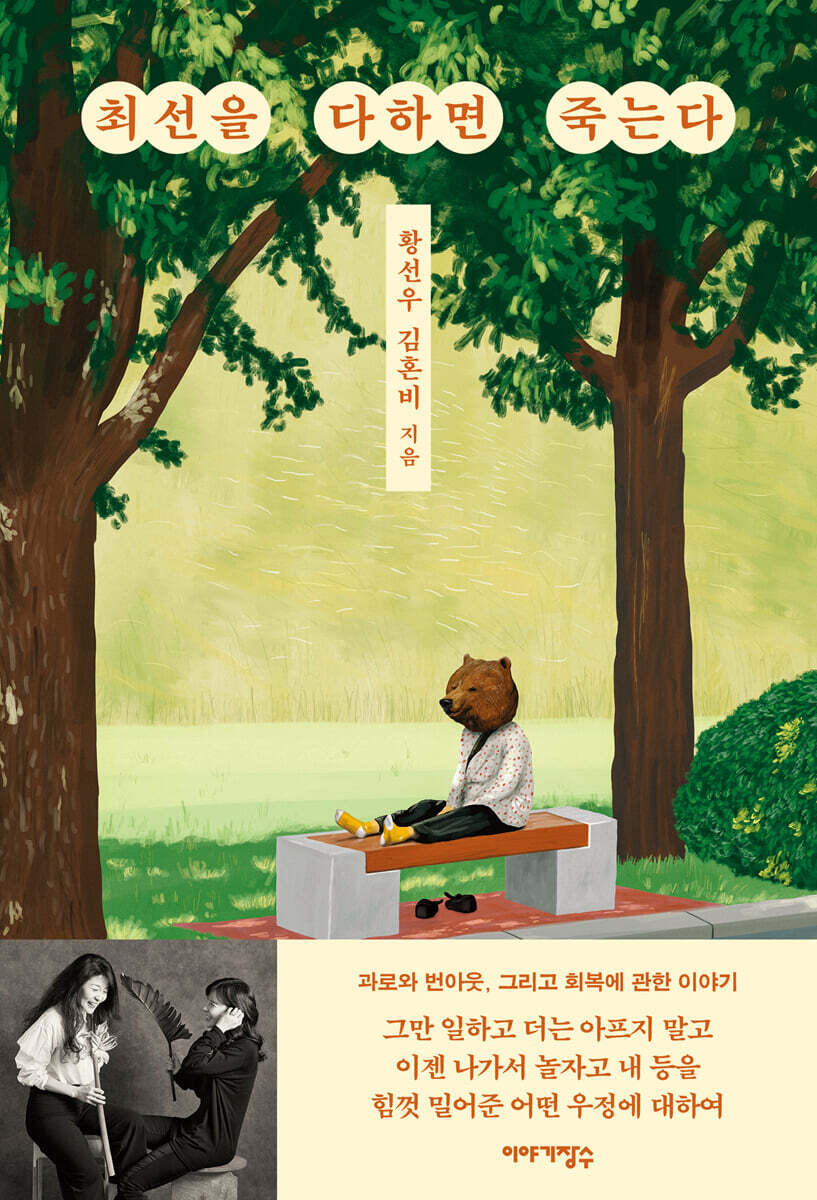
If you do your best, you die
 |
Description
Book Introduction
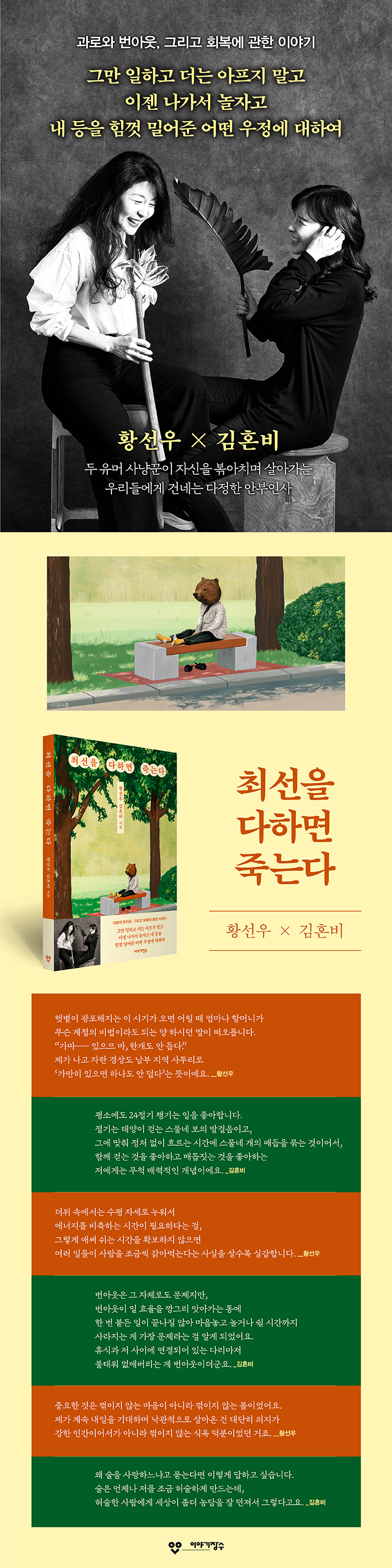
Hwang Seon-woo x Kim Hon-bi
A Story of Overwork, Burnout, and Recovery
Stop working and don't get sick anymore
Let's go out and play now
About a friendship that pushed me hard on my back
Hwang Seon-woo and Kim Hon-bi, two essayists who have recently received overwhelming support from female readers, are publishing a renewed edition of a book with an unusual title.
The title is 'If you do your best, you die'.
Writer Hwang Seon-woo, who is receiving attention as a "cool older sister" who works and speaks clearly while hosting the podcast [Two Women Are Talking], which provides new topics and courage to women of our time, and writer Kim Hon-bi, who has boldly kicked away the boundaries of things that were considered outside the realm of women, such as soccer and alcohol, with unique essays such as "Elegant and Refreshing Women's Soccer" and "Anyway, Alcohol" - how did these two writers come to exchange letters? And why did these two people, who seem like they would support and encourage each other as they "work hard" while living their so-called "newbie" lives, resolve to never "do our best to the point of death"?
Hwang Seon-woo and Kim Hon-bi's "If You Do Your Best, You'll Die" is a story about burnout and overwork that everyone has experienced at least once.
This is a record of one difficult night when I couldn't even sleep because I was so tired despite being tired and rude all day, and it is a story of some days when I kept losing everyday words and suspected I had amnesia, and I searched my mind in a daze.
It is a memory of a 'depressed' day when I suddenly suffered from enteritis and my body felt like an appendage to my internal organs, and it is also a story of a time when I became a 'wet seaweed' and had no choice but to stand under the shower like a ghost and shake off the water.
But more than anything, this book is a story about the humor and friendship of women who make each other laugh and lift each other up while going through these frustrating and daunting times that everyone experiences.
This book shows the path to recovery from burnout by showing how a heart that has been tormented and broken by people can be restored through human affection and friendship.
So, although this book contains a rather heavy theme of 'things we should not do' in order to avoid killing ourselves in a rude world and repetitive daily life, the voices of the two authors exchanging letters like ping-pong are filled with a soft and refreshing laughter.
“Making people laugh is probably one of the best gifts one person can give another.”
The humor and affection collected by the two humor hunters, Hwang Seon-woo and Kim Hon-bi, will eventually bring laughter to the hearts and expressionless faces that have become hardened in the midst of a busy day that passes by and fades away.
While we were exchanging letters, the wind blew, snow fell, and flowers bloomed and fell in the background where Mr. Honbi was sitting on the other side of the letter.
What time does to people has happened to us without fail.
It is about constantly letting the fatigue of everyday life, unresolved problems, old age and death, and thoughts about the dead flow through the landscape.
_Author's Note: From Hwang Seon-woo's words
Of course, I will do my best, but there are many ways to achieve 'not doing my best to the point of death', and among them, there is 'doing it together', and I will try not to forget that even if it is not necessarily sharing the physical share, there is also the constant sharing of daily life, laughter, and hearts.
_Author's Note: From Kim Hon-bi's words
A Story of Overwork, Burnout, and Recovery
Stop working and don't get sick anymore
Let's go out and play now
About a friendship that pushed me hard on my back
Hwang Seon-woo and Kim Hon-bi, two essayists who have recently received overwhelming support from female readers, are publishing a renewed edition of a book with an unusual title.
The title is 'If you do your best, you die'.
Writer Hwang Seon-woo, who is receiving attention as a "cool older sister" who works and speaks clearly while hosting the podcast [Two Women Are Talking], which provides new topics and courage to women of our time, and writer Kim Hon-bi, who has boldly kicked away the boundaries of things that were considered outside the realm of women, such as soccer and alcohol, with unique essays such as "Elegant and Refreshing Women's Soccer" and "Anyway, Alcohol" - how did these two writers come to exchange letters? And why did these two people, who seem like they would support and encourage each other as they "work hard" while living their so-called "newbie" lives, resolve to never "do our best to the point of death"?
Hwang Seon-woo and Kim Hon-bi's "If You Do Your Best, You'll Die" is a story about burnout and overwork that everyone has experienced at least once.
This is a record of one difficult night when I couldn't even sleep because I was so tired despite being tired and rude all day, and it is a story of some days when I kept losing everyday words and suspected I had amnesia, and I searched my mind in a daze.
It is a memory of a 'depressed' day when I suddenly suffered from enteritis and my body felt like an appendage to my internal organs, and it is also a story of a time when I became a 'wet seaweed' and had no choice but to stand under the shower like a ghost and shake off the water.
But more than anything, this book is a story about the humor and friendship of women who make each other laugh and lift each other up while going through these frustrating and daunting times that everyone experiences.
This book shows the path to recovery from burnout by showing how a heart that has been tormented and broken by people can be restored through human affection and friendship.
So, although this book contains a rather heavy theme of 'things we should not do' in order to avoid killing ourselves in a rude world and repetitive daily life, the voices of the two authors exchanging letters like ping-pong are filled with a soft and refreshing laughter.
“Making people laugh is probably one of the best gifts one person can give another.”
The humor and affection collected by the two humor hunters, Hwang Seon-woo and Kim Hon-bi, will eventually bring laughter to the hearts and expressionless faces that have become hardened in the midst of a busy day that passes by and fades away.
While we were exchanging letters, the wind blew, snow fell, and flowers bloomed and fell in the background where Mr. Honbi was sitting on the other side of the letter.
What time does to people has happened to us without fail.
It is about constantly letting the fatigue of everyday life, unresolved problems, old age and death, and thoughts about the dead flow through the landscape.
_Author's Note: From Hwang Seon-woo's words
Of course, I will do my best, but there are many ways to achieve 'not doing my best to the point of death', and among them, there is 'doing it together', and I will try not to forget that even if it is not necessarily sharing the physical share, there is also the constant sharing of daily life, laughter, and hearts.
_Author's Note: From Kim Hon-bi's words
- You can preview some of the book's contents.
Preview
index
Hug and Punch _Hwang Seon-woo_6
Lyrical Clubs _Kim Hon-bi_14
The World Seen from a Horizontal Position _Hwang Seon-woo_28
What's in My Bag _Kim Hon-bi_38
"Is it fun? It's fun, right?" _Hwang Seon-woo_50
Days that burn out repeatedly _Kim Hon-bi_58
How to Survive the Wet Seaweed Season _Hwang Seon-woo_68
The Dialectic of Tobacco and Health _Kim Hon-bi_78
First Letter Since October 29th _Hwang Seon-woo_88
“Even the trees know someone has passed away” _Kim Hon-bi_96
In a language we will never be fluent in, we _Hwang Seon-woo_106
I'm in charge of the 'that guy' in 'Don't mess with him' _Kim Hon-bi_116
The Joy of a Table Tennis Player Who's Not Excellent _Hwang Seon-woo_128
Should we do 1011? _Kim Hon-bi_136
Is Seonwoo benevolent? Then can Honbi be considered benevolent? _Hwang Seonwoo_148
The place that gives me the most courage these days _Kim Hon-bi_158
My First Battle with Enteritis _Hwang Seon-woo_170
The Jokes the World Throws at Us _Kim Hon-bi_178
Two Roots of the Alps' Grandmother Flower _Hwang Seon-woo_190
It's Summer, Let's Go Out and Play _Kim Hon-bi_198
Author's Note_208
Lyrical Clubs _Kim Hon-bi_14
The World Seen from a Horizontal Position _Hwang Seon-woo_28
What's in My Bag _Kim Hon-bi_38
"Is it fun? It's fun, right?" _Hwang Seon-woo_50
Days that burn out repeatedly _Kim Hon-bi_58
How to Survive the Wet Seaweed Season _Hwang Seon-woo_68
The Dialectic of Tobacco and Health _Kim Hon-bi_78
First Letter Since October 29th _Hwang Seon-woo_88
“Even the trees know someone has passed away” _Kim Hon-bi_96
In a language we will never be fluent in, we _Hwang Seon-woo_106
I'm in charge of the 'that guy' in 'Don't mess with him' _Kim Hon-bi_116
The Joy of a Table Tennis Player Who's Not Excellent _Hwang Seon-woo_128
Should we do 1011? _Kim Hon-bi_136
Is Seonwoo benevolent? Then can Honbi be considered benevolent? _Hwang Seonwoo_148
The place that gives me the most courage these days _Kim Hon-bi_158
My First Battle with Enteritis _Hwang Seon-woo_170
The Jokes the World Throws at Us _Kim Hon-bi_178
Two Roots of the Alps' Grandmother Flower _Hwang Seon-woo_190
It's Summer, Let's Go Out and Play _Kim Hon-bi_198
Author's Note_208
Detailed image
Publisher's Review
Mr. Seonwoo and Mr. Honbi - Two humor hunters
A warm greeting to those of us who live our lives torn apart by our own suffering.
"If you do your best, you die" is a work that continues the tradition of the Munhakdongne epistolary essay series "Chongchong" that began with "There is a misunderstanding between us" by Lee Seul-ah and Namgung In.
It was serialized in the webzine [Weekly Literature Village] from February 2023 and became a hot topic.
But the beginning was never easy.
Author Hwang Seon-woo left for Busan to start a letter, but returned only playing the recorder, and author Kim Hon-bi also went on a writing trip to Daebudo Island to finish a letter, but returned only playing the moktak.
Because although they supported each other as writers and had deep interest and affection for each other, they were not actually close enough to exchange letters regularly.
The two artists' signatures - the difference between the recorder and the moktak, and the distance between Busan and Daebudo Island - seemed as distant as the possibility that these two writers would meet in one place and engage in a natural conversation.
However, this distance was broken down in an instant when they promised to call each other 'Mr. Honbi' and 'Mr. Seonwoo'.
The title 'Mr.' is used regardless of age, occupation, or gender.
Author Kim Hon-bi writes this reply to 'Mr. Seonwoo', who called him 'Mr. Honbi'.
A long time ago, at a company I worked for, there was a boss who proudly said that his specialty was 'job hunting' and called himself a sergeant without anyone asking him to do so. He usually called people "Hey!" or "Hey OO!" but right before he was going to 'job hunt' someone, he would always use an honorific.
After his soft “Mr. OO,” the venomous words that were no different from curses continued without mercy, except that the curses were not included.
Whenever he would call me “Honbi-ssi,” it would feel like an arrow was stabbing my spine, and I left the company around the time I started to wonder if “Honbi-ssi” was actually an abbreviation for “Honbi, hey, Mr. Honbi!”, but that chill still remains.
So, I was very happy and special to hear Seonwoo sing “Honbi-ssi.”
I thought that if I were to be affectionately called “Mr. Honbi” by someone like Seonwoo, I would be able to wipe away all the dirty fingerprints of my old boss that were on that title.
_Kim Hon-bi, from 'Lyrical Clubs'
Author Kim Hon-bi is known as a popular essayist who still maintains a full-time job.
Until now, most of those who called him 'Mr.' were his former superiors armed with 'toxic language and nonsense'.
To him, 'Mr. Seonwoo' appears, asks about 'Mr. Honbi's' well-being, jokes with him, and makes him laugh.
While swimming, playing table tennis, and eating delicious and enjoyable meals on time, I ask them how their day was and what funny things happened today.
Mr. Honbi and Mr. Seonwoo become friends and share their daily lives and worries through letters.
Just as everyone carries a storm in their hearts and lives calmly, I tried to convey cheerful news while embracing them all, but it seems that I sometimes failed.
Yet, what made me censor myself less and rush myself less was the presence of a recipient waiting on the other side of the monitor.
It was because there was Mr. Honbi who would read whatever I wrote thoughtfully.
A person who writes letters is a person who can live better if he thinks of the person waiting for the letter.
And then I realized the obvious again.
But asking about this person's well-being and safety is the beginning, the end, and the whole of the letter.
_Author's Note: From Hwang Seon-woo's words
Days that burn out time after time…
How to spend the wet seaweed season
Caught between two jobs, office worker and writer, 'Honbi-ssi' is constantly having to complete tasks and meet deadlines, so he can't help but be overworked.
Mr. Seonwoo hopes that Mr. Honbi will put his body and mind first among his many busy and important tasks, and that he will rest well and sleep deeply.
Although they do not call or meet each other often, their letters, in which they ask about each other's well-being and confide in each other twice a month, feel like letters that, as writer Hwang Seon-woo puts it, "fit the now-disappeared tradition of classic pen pals."
Then one day, Honbi confesses to Seonwoo.
People always ask author Kim Hon-bi how she manages to balance her life as a writer and an office worker so wisely, but the truth is, she doesn't.
I've been suffering from burnout for a long time.
My friends had been warning me of signs of burnout since last winter, but I didn't notice and kept getting burned out until I finally accepted it this summer when I was "out" and had fallen out.
It's burnout.
It was like that from the time when a task that could have been completed in three days took ten days.
What could be so hard to accept about this?
(…) Burnout is a problem in itself, but I realized that the biggest problem is that burnout completely robs you of work efficiency, so once you start working, you can’t finish it and you lose the time to play or rest.
Burnout is like burning the bridge between rest and me.
_Kim Hon-bi, from 'Days that Burn Again and Again'
Mr. Seonwoo also suffered from burnout during his career, so he deeply sympathizes with Mr. Honbi's burnout.
As a person living in Korea, is there anyone who has not been burned to ashes?
There were times when I didn't have the strength to stand for a while while showering, so I just sat still in the bathtub while showering.
When I feel even more drained, I just lie down and get splashed with water.
After lying around like wet seaweed for a while, I came to my senses and found some energy to get out of the bathtub and dry myself.
It wasn't until a month or two later that I realized it when I found myself standing there, completely unfazed, from the beginning to the end of the shower.
Oh, I was a bit weird back then.
It wasn't a person, it was seaweed.
Whether it was physical strength, social skills, or concentration, it was all exhausted and I was just continuing to struggle.
People like me just keep going because they don't know how to stop.
_Hwang Seon-woo, from 'How to spend the days of wet seaweed'
In the midst of the time and deadlines that rush by and push me away, the two decide to become each other's 'joint of time' and 'season'.
The letters they exchange with each other twice a month become their own calendars, 'Seonwoo-ryeok' and 'Honbi-ryeok', which help them take care of their bodies and minds that were previously devoted to others and the world, and fill their daily lives with affection and laughter.
Perhaps affection is giving more than necessary to a person.
It's like the scene where Mr. Honbi checks the complexion of a person standing in front of the subway, and that person shouts to wake Mr. Honbi up.
(…) I believe that even during the time when we do not send letters to each other, Mr. Honbi is staying in such a place.
_Hwang Seon-woo, from 'Two Roots of the Alps'
I'm about halfway through recovery.
(…) The power of the letters that always contained the strength of Seonwoo, who pushed me hard every month to go out and play, and the image of Seonwoo taking care of life leisurely in any situation, was very strong.
(…)
Thank you for being my strong support during that time.
_Kim Hon-bi, from 'It's Summer, Let's Go Out and Play'
These two female writers, who never missed a hint of humor, puns, and refreshing moments in their daily lives, made readers laugh and passed the time while making each other laugh.
The humor and jokes that the two writers diligently hunted for just one person, as this piece was serialized and published, began to become not just for one recipient, but 'a comfort to all of us who are always overworked.'
It is said that when the 'time when the sunlight becomes wild' comes, author Hwang Seon-woo's mother or grandmother used to say this.
“If you stay still, you won’t get hot at all.”
This book is a good book to read while lying down in a horizontal position, not caring about anything, being chased, or worrying about the future, and looking into my tired and weary mind.
We all lived too hard.
Now is the time to take care of our bodies and minds with the spirit of 'do your best and you'll die', to ask about each other's well-being, and to smile at each other.
Remember, you 'roasting artists' of the world who have been roasting yourself and others, telling yourself that you are still lacking and that you can do more quickly.
“If you do your best, you die.”
A warm greeting to those of us who live our lives torn apart by our own suffering.
"If you do your best, you die" is a work that continues the tradition of the Munhakdongne epistolary essay series "Chongchong" that began with "There is a misunderstanding between us" by Lee Seul-ah and Namgung In.
It was serialized in the webzine [Weekly Literature Village] from February 2023 and became a hot topic.
But the beginning was never easy.
Author Hwang Seon-woo left for Busan to start a letter, but returned only playing the recorder, and author Kim Hon-bi also went on a writing trip to Daebudo Island to finish a letter, but returned only playing the moktak.
Because although they supported each other as writers and had deep interest and affection for each other, they were not actually close enough to exchange letters regularly.
The two artists' signatures - the difference between the recorder and the moktak, and the distance between Busan and Daebudo Island - seemed as distant as the possibility that these two writers would meet in one place and engage in a natural conversation.
However, this distance was broken down in an instant when they promised to call each other 'Mr. Honbi' and 'Mr. Seonwoo'.
The title 'Mr.' is used regardless of age, occupation, or gender.
Author Kim Hon-bi writes this reply to 'Mr. Seonwoo', who called him 'Mr. Honbi'.
A long time ago, at a company I worked for, there was a boss who proudly said that his specialty was 'job hunting' and called himself a sergeant without anyone asking him to do so. He usually called people "Hey!" or "Hey OO!" but right before he was going to 'job hunt' someone, he would always use an honorific.
After his soft “Mr. OO,” the venomous words that were no different from curses continued without mercy, except that the curses were not included.
Whenever he would call me “Honbi-ssi,” it would feel like an arrow was stabbing my spine, and I left the company around the time I started to wonder if “Honbi-ssi” was actually an abbreviation for “Honbi, hey, Mr. Honbi!”, but that chill still remains.
So, I was very happy and special to hear Seonwoo sing “Honbi-ssi.”
I thought that if I were to be affectionately called “Mr. Honbi” by someone like Seonwoo, I would be able to wipe away all the dirty fingerprints of my old boss that were on that title.
_Kim Hon-bi, from 'Lyrical Clubs'
Author Kim Hon-bi is known as a popular essayist who still maintains a full-time job.
Until now, most of those who called him 'Mr.' were his former superiors armed with 'toxic language and nonsense'.
To him, 'Mr. Seonwoo' appears, asks about 'Mr. Honbi's' well-being, jokes with him, and makes him laugh.
While swimming, playing table tennis, and eating delicious and enjoyable meals on time, I ask them how their day was and what funny things happened today.
Mr. Honbi and Mr. Seonwoo become friends and share their daily lives and worries through letters.
Just as everyone carries a storm in their hearts and lives calmly, I tried to convey cheerful news while embracing them all, but it seems that I sometimes failed.
Yet, what made me censor myself less and rush myself less was the presence of a recipient waiting on the other side of the monitor.
It was because there was Mr. Honbi who would read whatever I wrote thoughtfully.
A person who writes letters is a person who can live better if he thinks of the person waiting for the letter.
And then I realized the obvious again.
But asking about this person's well-being and safety is the beginning, the end, and the whole of the letter.
_Author's Note: From Hwang Seon-woo's words
Days that burn out time after time…
How to spend the wet seaweed season
Caught between two jobs, office worker and writer, 'Honbi-ssi' is constantly having to complete tasks and meet deadlines, so he can't help but be overworked.
Mr. Seonwoo hopes that Mr. Honbi will put his body and mind first among his many busy and important tasks, and that he will rest well and sleep deeply.
Although they do not call or meet each other often, their letters, in which they ask about each other's well-being and confide in each other twice a month, feel like letters that, as writer Hwang Seon-woo puts it, "fit the now-disappeared tradition of classic pen pals."
Then one day, Honbi confesses to Seonwoo.
People always ask author Kim Hon-bi how she manages to balance her life as a writer and an office worker so wisely, but the truth is, she doesn't.
I've been suffering from burnout for a long time.
My friends had been warning me of signs of burnout since last winter, but I didn't notice and kept getting burned out until I finally accepted it this summer when I was "out" and had fallen out.
It's burnout.
It was like that from the time when a task that could have been completed in three days took ten days.
What could be so hard to accept about this?
(…) Burnout is a problem in itself, but I realized that the biggest problem is that burnout completely robs you of work efficiency, so once you start working, you can’t finish it and you lose the time to play or rest.
Burnout is like burning the bridge between rest and me.
_Kim Hon-bi, from 'Days that Burn Again and Again'
Mr. Seonwoo also suffered from burnout during his career, so he deeply sympathizes with Mr. Honbi's burnout.
As a person living in Korea, is there anyone who has not been burned to ashes?
There were times when I didn't have the strength to stand for a while while showering, so I just sat still in the bathtub while showering.
When I feel even more drained, I just lie down and get splashed with water.
After lying around like wet seaweed for a while, I came to my senses and found some energy to get out of the bathtub and dry myself.
It wasn't until a month or two later that I realized it when I found myself standing there, completely unfazed, from the beginning to the end of the shower.
Oh, I was a bit weird back then.
It wasn't a person, it was seaweed.
Whether it was physical strength, social skills, or concentration, it was all exhausted and I was just continuing to struggle.
People like me just keep going because they don't know how to stop.
_Hwang Seon-woo, from 'How to spend the days of wet seaweed'
In the midst of the time and deadlines that rush by and push me away, the two decide to become each other's 'joint of time' and 'season'.
The letters they exchange with each other twice a month become their own calendars, 'Seonwoo-ryeok' and 'Honbi-ryeok', which help them take care of their bodies and minds that were previously devoted to others and the world, and fill their daily lives with affection and laughter.
Perhaps affection is giving more than necessary to a person.
It's like the scene where Mr. Honbi checks the complexion of a person standing in front of the subway, and that person shouts to wake Mr. Honbi up.
(…) I believe that even during the time when we do not send letters to each other, Mr. Honbi is staying in such a place.
_Hwang Seon-woo, from 'Two Roots of the Alps'
I'm about halfway through recovery.
(…) The power of the letters that always contained the strength of Seonwoo, who pushed me hard every month to go out and play, and the image of Seonwoo taking care of life leisurely in any situation, was very strong.
(…)
Thank you for being my strong support during that time.
_Kim Hon-bi, from 'It's Summer, Let's Go Out and Play'
These two female writers, who never missed a hint of humor, puns, and refreshing moments in their daily lives, made readers laugh and passed the time while making each other laugh.
The humor and jokes that the two writers diligently hunted for just one person, as this piece was serialized and published, began to become not just for one recipient, but 'a comfort to all of us who are always overworked.'
It is said that when the 'time when the sunlight becomes wild' comes, author Hwang Seon-woo's mother or grandmother used to say this.
“If you stay still, you won’t get hot at all.”
This book is a good book to read while lying down in a horizontal position, not caring about anything, being chased, or worrying about the future, and looking into my tired and weary mind.
We all lived too hard.
Now is the time to take care of our bodies and minds with the spirit of 'do your best and you'll die', to ask about each other's well-being, and to smile at each other.
Remember, you 'roasting artists' of the world who have been roasting yourself and others, telling yourself that you are still lacking and that you can do more quickly.
“If you do your best, you die.”
GOODS SPECIFICS
- Date of issue: June 20, 2025
- Page count, weight, size: 216 pages | 246g | 128*188*14mm
- ISBN13: 9791194184348
- ISBN10: 1194184340
You may also like
카테고리
korean


korean

![GQ KOREA Mark (Monthly): December [2025]](http://librairie.coreenne.fr/cdn/shop/files/8ef265dbbfbf186523ed75ba7319009d.jpg?v=1765340328&width=3840)


