

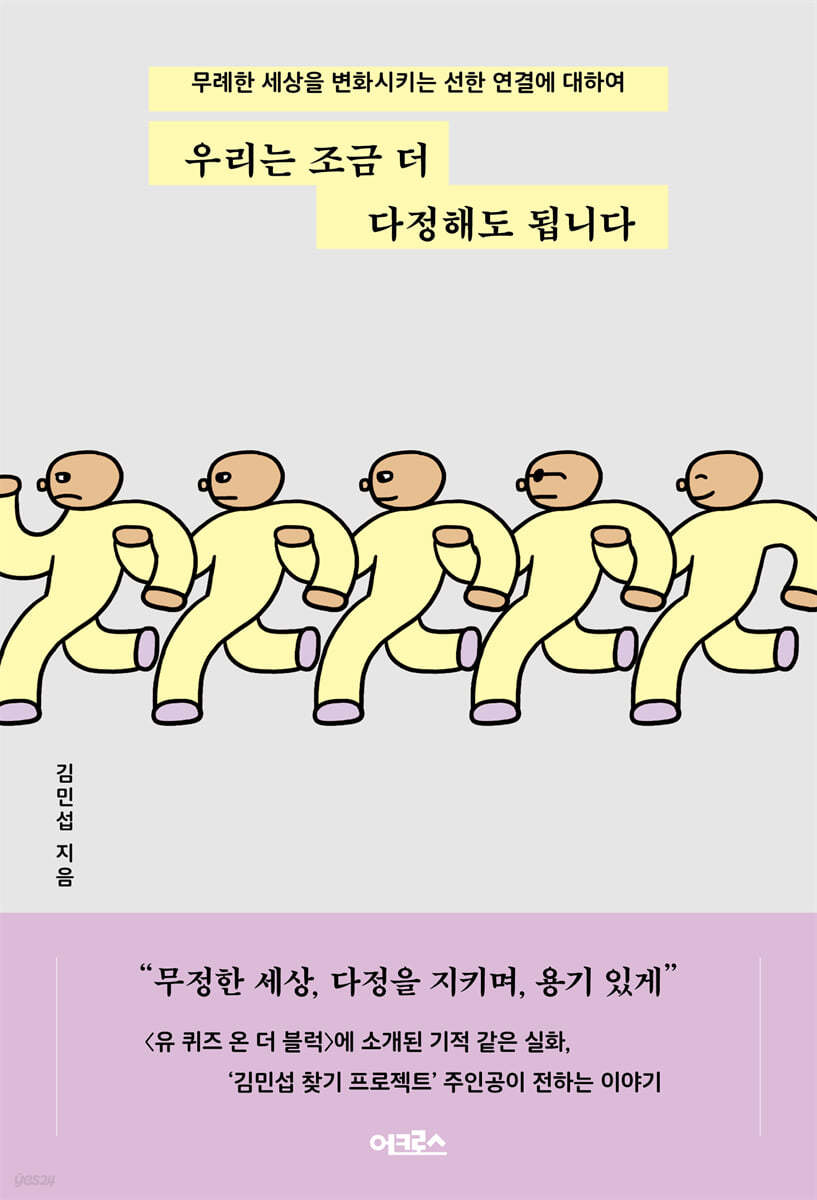
We can be a little more affectionate
 |
Description
Book Introduction
Kim Min-seop, author of “Surrogate Society” and “I Hope You Are Well,” has published a new book, “We Can Be A Little More Kind: On Good Connections That Change a Rude World,” which compiles Kim Min-seop’s writings from the past few years, a time of rapid change.
It contains stories of reflections on Korean society and the small miracles that occurred within it.
This book depicts realities that have already befallen us: universities that fire instructors through illegal means, young people grouped together under the label of MZ, businesses indifferent to the deaths of irregular workers, and people who find hope only in cryptocurrency. However, Kim Min-seop's perspective on these issues is by no means cold.
This is thanks to the author's hope that as human value declines, the unique human ability called 'affection' will become more important.
This book is for you, the kind person who connects with strangers you don't know and believes that their well-being is your own well-being.
It contains stories of reflections on Korean society and the small miracles that occurred within it.
This book depicts realities that have already befallen us: universities that fire instructors through illegal means, young people grouped together under the label of MZ, businesses indifferent to the deaths of irregular workers, and people who find hope only in cryptocurrency. However, Kim Min-seop's perspective on these issues is by no means cold.
This is thanks to the author's hope that as human value declines, the unique human ability called 'affection' will become more important.
This book is for you, the kind person who connects with strangers you don't know and believes that their well-being is your own well-being.
- You can preview some of the book's contents.
Preview
index
prolog
Part 1: A Fierce Battle of Affection
Affection, neither cruel nor kind
What is a good deed?
The advent of a friendly technological society may be possible.
We will give you a voucher for accommodation in Jeju Island.
Friendly competition is possible
If you dream, I will live that time
Let's run together secretly
The term "MZ generation" means "a collection of violence."
Just an old man who likes baseball
Deserves to be cheered on
Cheers to your journey
What is an apartment?
The reason for learning fades amidst the all-out battle to manage resumes.
I want to be a good person, like the writing.
We are beings who remember and draw the passage of time.
Don't you have a dream too?
On the violence that appropriate words can cause
Part 2: Standing in Your Place
The difference between sensitivity and affection
A child who hates studying
My wife doesn't listen to me.
A world where names have disappeared and only 'titles' remain.
Thinking about people and the world
What is the role of parents?
To my father-in-law
For young people who want to become writers
Don't you use YouTube?
Yumi, you're still doing what you want to do.
How to Design Your Child's Life
To become a university in Korea that knows shame
Large bookstores that have become book cafes
A miserable lament of capital
Supporting author Jeong Bo-ra
"Everyday Disasters" Found in Disaster Emergency Living Expenses Applications
The expression "strike using children as bait"
To the teachers who celebrated Teacher's Day
Part 3: How to Transform Memories into a Kinder Me
“How about that?”
Supporting Wonju Girls' High School students
Hoping for the preservation of the Wonju Academy Theater
May they rest in peace
Publisher's Account and Christmas
Reading a Book on the Beach in Normandy
The generation created by the Sewol ferry disaster
I bought Ethereum
I hope you all are still well.
One of the most delicious rice cakes
It's a book recommended by the Korean Language Teachers Association, but I can't read it during class.
Two writings and one speaking
I lost my bag on the subway.
A publishing method that doesn't leave anyone feeling lonely
Has anyone ever been to my bookstore?
Epilogue
Part 1: A Fierce Battle of Affection
Affection, neither cruel nor kind
What is a good deed?
The advent of a friendly technological society may be possible.
We will give you a voucher for accommodation in Jeju Island.
Friendly competition is possible
If you dream, I will live that time
Let's run together secretly
The term "MZ generation" means "a collection of violence."
Just an old man who likes baseball
Deserves to be cheered on
Cheers to your journey
What is an apartment?
The reason for learning fades amidst the all-out battle to manage resumes.
I want to be a good person, like the writing.
We are beings who remember and draw the passage of time.
Don't you have a dream too?
On the violence that appropriate words can cause
Part 2: Standing in Your Place
The difference between sensitivity and affection
A child who hates studying
My wife doesn't listen to me.
A world where names have disappeared and only 'titles' remain.
Thinking about people and the world
What is the role of parents?
To my father-in-law
For young people who want to become writers
Don't you use YouTube?
Yumi, you're still doing what you want to do.
How to Design Your Child's Life
To become a university in Korea that knows shame
Large bookstores that have become book cafes
A miserable lament of capital
Supporting author Jeong Bo-ra
"Everyday Disasters" Found in Disaster Emergency Living Expenses Applications
The expression "strike using children as bait"
To the teachers who celebrated Teacher's Day
Part 3: How to Transform Memories into a Kinder Me
“How about that?”
Supporting Wonju Girls' High School students
Hoping for the preservation of the Wonju Academy Theater
May they rest in peace
Publisher's Account and Christmas
Reading a Book on the Beach in Normandy
The generation created by the Sewol ferry disaster
I bought Ethereum
I hope you all are still well.
One of the most delicious rice cakes
It's a book recommended by the Korean Language Teachers Association, but I can't read it during class.
Two writings and one speaking
I lost my bag on the subway.
A publishing method that doesn't leave anyone feeling lonely
Has anyone ever been to my bookstore?
Epilogue
Detailed image
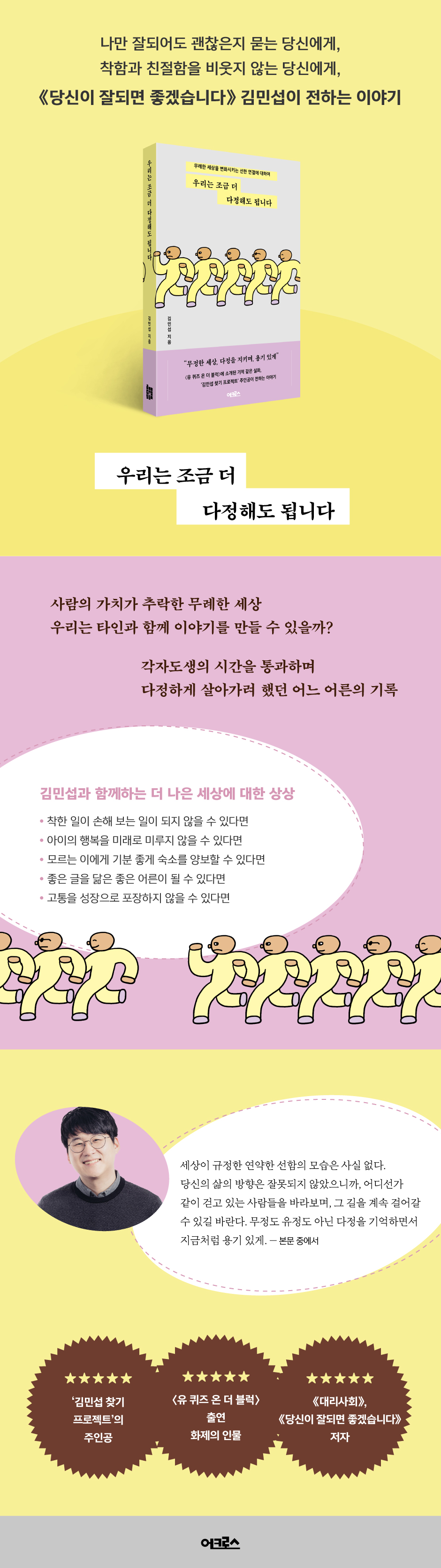
Into the book
There is no such thing as a fragile goodness as defined by the world.
I hope that you can continue on that path, looking at the people walking alongside you somewhere, because the direction of your life is not wrong.
Remembering the affection that is neither cruel nor kind, be as courageous as you are now.
---From "Affection, Neither Kindness nor Mercy"
From some point on, whenever I see athletes who have achieved good results in international competitions, I feel happy, but at the same time, I feel sad because I think about how much they must have struggled.
That is, how many times did it hit?
(…) Even if such a method is effective in achieving good results, we know that winning medals like that does not elevate the status of the country.
Whether they are eliminated in the preliminaries or win a gold medal, the sight of someone smiling happily after competing as an individual is truly a reflection of that country's national pride.
---From "Just an Old Man Who Likes Baseball"
There is no human being who can give up the present and be happy in the future.
A person who can be happy in the present can be happy at any time, and a person who can only be happy in the future cannot be happy in the future.
Like author Mo, who found what she loves after turning 30, I hope you can stay true to the present and dream of the future.
---From "Don't you have a dream too?"
Everyday language like “Please put in a little sugar” and “I’ll be there later.”
However, when it is circulated in the relationship between A and B, it makes the person in B's position feel uneasy.
When A says to B, “Let me think about it a little” or “I don’t like this a little,” the “little” in this sentence is not the little we know.
Words like 'moderately', 'a lot', and 'well' are all like that.
Ambiguous language spoken in the position of A and heard in the position of B becomes violence.
---From “On the Violence of Moderate Words”
This is usually how capital mourns people.
They hang up a phrase that looks sophisticated but degrades the viewer's dignity and shirk their responsibility.
It is a mean way of mourning for oneself rather than the victim, and it is the most effective way to avoid criticism.
Recently, the 4th anniversary of the Sewol ferry disaster passed.
I briefly imagined a sign posted that day on the sea that said, "We sincerely apologize for the inconvenience to your sightseeing/fishing," and then I stopped.
Just imagining it was breathtaking.
I hope that you can continue on that path, looking at the people walking alongside you somewhere, because the direction of your life is not wrong.
Remembering the affection that is neither cruel nor kind, be as courageous as you are now.
---From "Affection, Neither Kindness nor Mercy"
From some point on, whenever I see athletes who have achieved good results in international competitions, I feel happy, but at the same time, I feel sad because I think about how much they must have struggled.
That is, how many times did it hit?
(…) Even if such a method is effective in achieving good results, we know that winning medals like that does not elevate the status of the country.
Whether they are eliminated in the preliminaries or win a gold medal, the sight of someone smiling happily after competing as an individual is truly a reflection of that country's national pride.
---From "Just an Old Man Who Likes Baseball"
There is no human being who can give up the present and be happy in the future.
A person who can be happy in the present can be happy at any time, and a person who can only be happy in the future cannot be happy in the future.
Like author Mo, who found what she loves after turning 30, I hope you can stay true to the present and dream of the future.
---From "Don't you have a dream too?"
Everyday language like “Please put in a little sugar” and “I’ll be there later.”
However, when it is circulated in the relationship between A and B, it makes the person in B's position feel uneasy.
When A says to B, “Let me think about it a little” or “I don’t like this a little,” the “little” in this sentence is not the little we know.
Words like 'moderately', 'a lot', and 'well' are all like that.
Ambiguous language spoken in the position of A and heard in the position of B becomes violence.
---From “On the Violence of Moderate Words”
This is usually how capital mourns people.
They hang up a phrase that looks sophisticated but degrades the viewer's dignity and shirk their responsibility.
It is a mean way of mourning for oneself rather than the victim, and it is the most effective way to avoid criticism.
Recently, the 4th anniversary of the Sewol ferry disaster passed.
I briefly imagined a sign posted that day on the sea that said, "We sincerely apologize for the inconvenience to your sightseeing/fishing," and then I stopped.
Just imagining it was breathtaking.
---From "The Mourning of Capital"
Publisher's Review
To you who asks if it's okay if only I am doing well,
To all who do not scoff at goodness and kindness,
Author of 『Surrogate Society』 and 『I Hope You Are Well』,
Kim Min-seop's "Affection Recovery Project"
Author Kim Min-seop, who has delivered warm comfort to readers through works such as "Surrogate Society" and "I Hope You Are Well," has returned with a story about "affection."
"We Can Be a Little More Kind: On Good Connections That Change a Rude World" is a book about Kim Min-seop's reflections on living in a Korean society where everyone lives for themselves as a writer, a designated driver, a local bookstore owner, and a publisher, and the small miracles he created within them.
The scenes appearing in this book are not unfamiliar to us.
The film depicts realities that have already befallen us: universities that fire instructors through illegal means, young people grouped together under the name of MZ, businesses indifferent to the deaths of irregular workers, and people who find hope only in cryptocurrency.
However, Kim Min-seop's gaze upon this is by no means cold.
This is thanks to the author's hope that as human value declines, the unique human ability of 'affection' will become more important.
The author argues that affection will become the most important value of the next generation, and furthermore, that affection will become a realm of intelligence rather than a realm of values.
Because there will come a time when we will realize that we need affection to survive and that we need affection to write new stories with others.
This book is for you, the kind person who connects with strangers and believes that their well-being is your own well-being.
"Small, personal satisfactions accumulate to create miracles."
Imagining a Better World with Kim Min-seop
After paying at a restaurant and signing, a waiter asks Kim Min-seop a question.
“Is there any meaning to this signature?” Kim Min-seop hesitates, unable to answer easily.
A simple ribbon-shaped line that everyone knows.
It was in the shape of a ribbon commemorating the Sewol ferry disaster, and Kim Min-seop has been repeatedly signing such a signature as a sign of remembrance since the Sewol ferry disaster.
Repeating the signature thousands of times made it a habit that even the author himself had forgotten its meaning, but it was precisely because of this that the memory of the disaster was able to be engraved into the most familiar of daily routines.
The author's efforts to not separate personal life from positive influences create gentle ripples in a world that seems unchanging.
With the publication of "I am a Part-time Lecturer at a Local University," which documents the reality of a part-time university lecturer, the reality of young researchers in Korea is receiving attention.
We join Wonju Girls' High School students in calling for change by challenging the anachronistic motto, "Good daughter, good mother."
When we were informed that it was difficult to cancel a Jeju Island accommodation that had become unusable due to a typhoon, we transferred the accommodation free of charge to a couple who could not go on vacation.
As soon as I transferred, I received a call from the accommodation app customer service representative offering to cancel, but they refused to refund me, saying, “He was more than compensated for having a happy day there.”
The person in charge responds by saying that he will definitely find a good place to stay when we go on a family trip someday.
A perfect resolution where “no one fought, no one apologized, no one got hurt.”
The author acknowledges that he does good deeds for his own satisfaction, but at the same time realizes that such self-satisfaction accumulates to create a great social solidarity.
The 'Find Mr. Kim Min-seop Project', which was also introduced on 'You Quiz on the Block', surprised many people with its influence among the good deeds that Kim Min-seop participated in.
With the help of netizens, this project, which gave up the Fukuoka ticket to Kim Min-seop, born in 1993, who had the same English name as his passport, continued as the 'Send Kim Min-seop, born in 1993, to Fukuoka Project', and produced a miracle with 278 people donating approximately 2.54 million won.
It was a surprising event for artist Kim Min-seop, who wanted someone else to be happy instead of himself, who could not travel due to his child's surgery, and for Kim Min-seop, born in 1993, who was taking a leave of absence from school to earn money for his graduation exhibition.
"We Can Be A Little More Affectionate" also covers how the "Find Mr. Kim Min-seop Project" influenced the life of author Kim Min-seop, and how the life of Mr. Kim Min-seop, born in 1993, changed.
In the aftermath, we learn how small acts of kindness toward others can reverberate throughout the wider world.
Happiness postponed to the future, pain disguised as growth,
The reflections and concerns of adults who face this place we have created.
Kim Min-seop says there is a question he frequently gets asked whenever he gives lectures at middle and high schools.
Students ask, “What kind of dreams should we dream?”
However, in the current reality where students are forced to decide on their majors and send to cram schools to prepare for college entrance exams, and where some students are forced to work part-time or provide care due to financial difficulties, Kim Min-seop questions whether dreams can truly blossom.
This book contains a critique of our society, which creates a world where dreams are impossible and then forces children to dream, as well as the author's own reflections as an adult.
Adults telling children from other areas playing in the apartment playground, “If you play in someone else’s apartment, you’re stealing.”
The older generation ridicules individuals of various ages and personalities by lumping them together under the label of 'MZ'.
Parents criticize school cafeteria workers for using their children as bait to strike.
Although we say we are doing this for the sake of children, it actually reflects our own image of making the future they will live in a hell.
Kim Min-seop, who went through a time when becoming a professor was his sole goal in life, experienced the tragedy of the Sewol Ferry Disaster and became a parent of two children, and reflected on what he must do for the next generation.
I hope that her childhood, where violence disguised itself as growth, will not be repeated, and I support Ahn Se-young's courageous revelation.
He supports his children's emotional independence by calling them 'Mr. Kim Dae-heun' and 'Ms. Kim Rin' in his writing, and he also encourages his own emotional independence as a parent.
I think about the role of good adults who can support the different world that the next generation will create.
The last value left to humanity,
About the affectionate choice
College lecturer, writer, designated driver, publisher, bookstore owner, father of two.
This book contains the countless identities that Kim Min-seop has experienced, as well as the rapidly changing state of our society.
From the rise of neoliberalism to the contactless society, from the expansion of irregular employment to the replacement of labor by artificial intelligence, in a world where human values are endlessly declining and the logic of each person for themselves intensifies, what ultimately makes us human is a "kind choice," says Kim Min-seop.
The irrational choice of reaching out to the starving of an unknown person is something that cannot be done through economic rationality or artificial intelligence calculations, but it is precisely this irrational choice that creates the society we live in together.
The story of Kim Min-seop, who tried to maintain a warm attitude during the long, endless winter, shows us that there are still values in the world beyond the attitude of "I'm just going to live well."
After closing the book, you will naturally wonder if there is anything you can do for others, if there is a place where you can extend a helping hand and show solidarity.
Let's start a new time with this book, which is like a warm letter announcing the end of a long winter.
To all who do not scoff at goodness and kindness,
Author of 『Surrogate Society』 and 『I Hope You Are Well』,
Kim Min-seop's "Affection Recovery Project"
Author Kim Min-seop, who has delivered warm comfort to readers through works such as "Surrogate Society" and "I Hope You Are Well," has returned with a story about "affection."
"We Can Be a Little More Kind: On Good Connections That Change a Rude World" is a book about Kim Min-seop's reflections on living in a Korean society where everyone lives for themselves as a writer, a designated driver, a local bookstore owner, and a publisher, and the small miracles he created within them.
The scenes appearing in this book are not unfamiliar to us.
The film depicts realities that have already befallen us: universities that fire instructors through illegal means, young people grouped together under the name of MZ, businesses indifferent to the deaths of irregular workers, and people who find hope only in cryptocurrency.
However, Kim Min-seop's gaze upon this is by no means cold.
This is thanks to the author's hope that as human value declines, the unique human ability of 'affection' will become more important.
The author argues that affection will become the most important value of the next generation, and furthermore, that affection will become a realm of intelligence rather than a realm of values.
Because there will come a time when we will realize that we need affection to survive and that we need affection to write new stories with others.
This book is for you, the kind person who connects with strangers and believes that their well-being is your own well-being.
"Small, personal satisfactions accumulate to create miracles."
Imagining a Better World with Kim Min-seop
After paying at a restaurant and signing, a waiter asks Kim Min-seop a question.
“Is there any meaning to this signature?” Kim Min-seop hesitates, unable to answer easily.
A simple ribbon-shaped line that everyone knows.
It was in the shape of a ribbon commemorating the Sewol ferry disaster, and Kim Min-seop has been repeatedly signing such a signature as a sign of remembrance since the Sewol ferry disaster.
Repeating the signature thousands of times made it a habit that even the author himself had forgotten its meaning, but it was precisely because of this that the memory of the disaster was able to be engraved into the most familiar of daily routines.
The author's efforts to not separate personal life from positive influences create gentle ripples in a world that seems unchanging.
With the publication of "I am a Part-time Lecturer at a Local University," which documents the reality of a part-time university lecturer, the reality of young researchers in Korea is receiving attention.
We join Wonju Girls' High School students in calling for change by challenging the anachronistic motto, "Good daughter, good mother."
When we were informed that it was difficult to cancel a Jeju Island accommodation that had become unusable due to a typhoon, we transferred the accommodation free of charge to a couple who could not go on vacation.
As soon as I transferred, I received a call from the accommodation app customer service representative offering to cancel, but they refused to refund me, saying, “He was more than compensated for having a happy day there.”
The person in charge responds by saying that he will definitely find a good place to stay when we go on a family trip someday.
A perfect resolution where “no one fought, no one apologized, no one got hurt.”
The author acknowledges that he does good deeds for his own satisfaction, but at the same time realizes that such self-satisfaction accumulates to create a great social solidarity.
The 'Find Mr. Kim Min-seop Project', which was also introduced on 'You Quiz on the Block', surprised many people with its influence among the good deeds that Kim Min-seop participated in.
With the help of netizens, this project, which gave up the Fukuoka ticket to Kim Min-seop, born in 1993, who had the same English name as his passport, continued as the 'Send Kim Min-seop, born in 1993, to Fukuoka Project', and produced a miracle with 278 people donating approximately 2.54 million won.
It was a surprising event for artist Kim Min-seop, who wanted someone else to be happy instead of himself, who could not travel due to his child's surgery, and for Kim Min-seop, born in 1993, who was taking a leave of absence from school to earn money for his graduation exhibition.
"We Can Be A Little More Affectionate" also covers how the "Find Mr. Kim Min-seop Project" influenced the life of author Kim Min-seop, and how the life of Mr. Kim Min-seop, born in 1993, changed.
In the aftermath, we learn how small acts of kindness toward others can reverberate throughout the wider world.
Happiness postponed to the future, pain disguised as growth,
The reflections and concerns of adults who face this place we have created.
Kim Min-seop says there is a question he frequently gets asked whenever he gives lectures at middle and high schools.
Students ask, “What kind of dreams should we dream?”
However, in the current reality where students are forced to decide on their majors and send to cram schools to prepare for college entrance exams, and where some students are forced to work part-time or provide care due to financial difficulties, Kim Min-seop questions whether dreams can truly blossom.
This book contains a critique of our society, which creates a world where dreams are impossible and then forces children to dream, as well as the author's own reflections as an adult.
Adults telling children from other areas playing in the apartment playground, “If you play in someone else’s apartment, you’re stealing.”
The older generation ridicules individuals of various ages and personalities by lumping them together under the label of 'MZ'.
Parents criticize school cafeteria workers for using their children as bait to strike.
Although we say we are doing this for the sake of children, it actually reflects our own image of making the future they will live in a hell.
Kim Min-seop, who went through a time when becoming a professor was his sole goal in life, experienced the tragedy of the Sewol Ferry Disaster and became a parent of two children, and reflected on what he must do for the next generation.
I hope that her childhood, where violence disguised itself as growth, will not be repeated, and I support Ahn Se-young's courageous revelation.
He supports his children's emotional independence by calling them 'Mr. Kim Dae-heun' and 'Ms. Kim Rin' in his writing, and he also encourages his own emotional independence as a parent.
I think about the role of good adults who can support the different world that the next generation will create.
The last value left to humanity,
About the affectionate choice
College lecturer, writer, designated driver, publisher, bookstore owner, father of two.
This book contains the countless identities that Kim Min-seop has experienced, as well as the rapidly changing state of our society.
From the rise of neoliberalism to the contactless society, from the expansion of irregular employment to the replacement of labor by artificial intelligence, in a world where human values are endlessly declining and the logic of each person for themselves intensifies, what ultimately makes us human is a "kind choice," says Kim Min-seop.
The irrational choice of reaching out to the starving of an unknown person is something that cannot be done through economic rationality or artificial intelligence calculations, but it is precisely this irrational choice that creates the society we live in together.
The story of Kim Min-seop, who tried to maintain a warm attitude during the long, endless winter, shows us that there are still values in the world beyond the attitude of "I'm just going to live well."
After closing the book, you will naturally wonder if there is anything you can do for others, if there is a place where you can extend a helping hand and show solidarity.
Let's start a new time with this book, which is like a warm letter announcing the end of a long winter.
GOODS SPECIFICS
- Date of issue: January 6, 2025
- Page count, weight, size: 240 pages | 260g | 128*188*15mm
- ISBN13: 9791167741844
You may also like
카테고리
korean


korean

![GQ KOREA Mark (Monthly): December [2025]](http://librairie.coreenne.fr/cdn/shop/files/8ef265dbbfbf186523ed75ba7319009d.jpg?v=1765340328&width=3840)


