

Anne Frank's Diary
 |
Description
Book Introduction
The most compelling sentence documenting the Holocaust
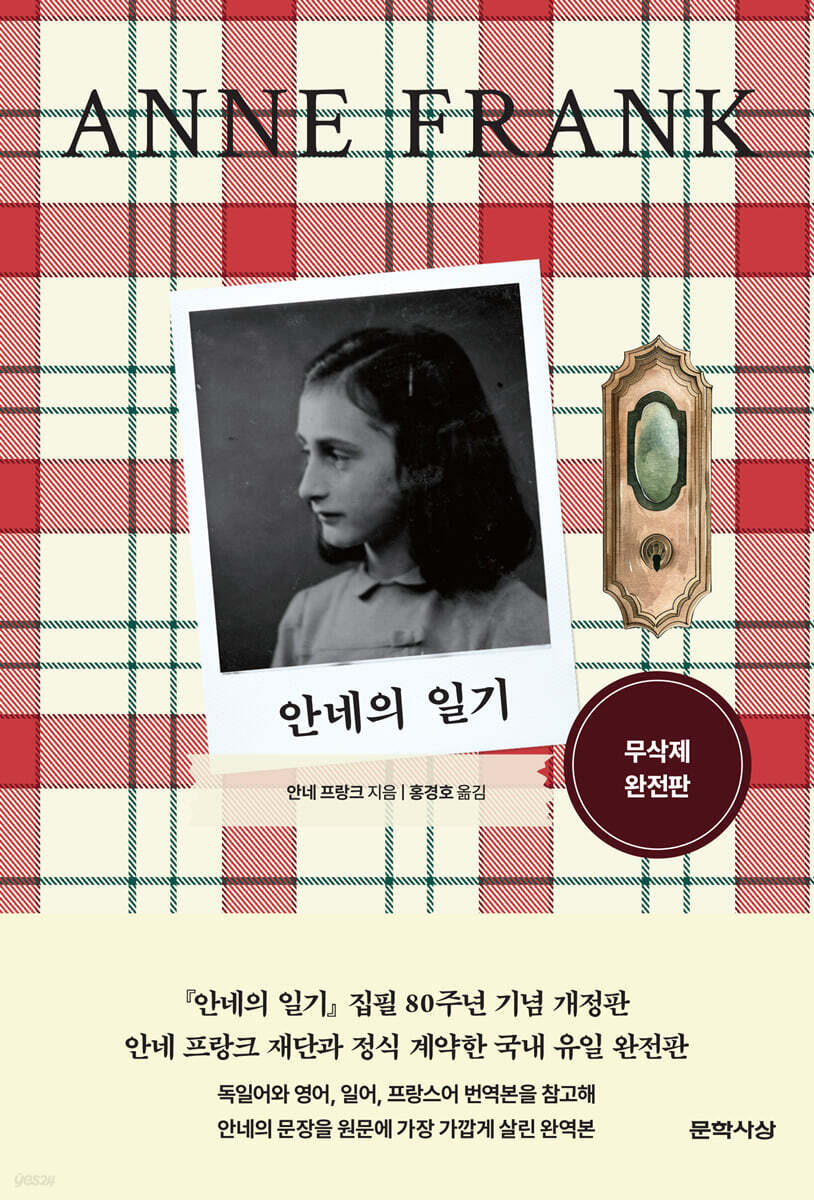
Revised edition commemorating the 80th anniversary of the writing of "Anne Frankl's Diary"
Total volume increased by approximately 25% compared to the existing shortened version
The only uncut complete version in Korea officially contracted with the Anne Frank Foundation
A complete translation that preserves Anne's original text by referencing translations in four languages.
Edit pages to reflect the most recent research
It has been 80 years since Anne Frank, who lost her life in Auschwitz during the Nazi Holocaust, wrote her final diary.
"Anne Frank's Diary" is said to be the most moving record since World War II and is still read around the world.
The first edition of "Anne Frank's Diary," written in Dutch, was translated into many languages, including German and French, and resonated with countless readers.
A play based on the 1955 diary was performed on stages around the world, including Broadway, and when it premiered in the Netherlands, Queen Juliana and Prince Bernhard came to see the performance in person.
A film made after the performance even won an Oscar.
"Anne Frank's Diary" is a personal account written by a young girl, but it is also a historical record that contains the brutal reality of racism perpetrated by those in power during World War II.
It was designated a UNESCO Memory of the World Register in 2009 in recognition of its value in combating the violence of war and violations of children's human rights.
『Anne Frank's Diary』 published by Munhaksasang is the only unedited version in Korea that has an official contract with the Anne Frank Foundation, and is the only Korean version sold at the Anne Frank House.
In the revised edition, some pages have been added and revised to reflect recent research findings.
"The Unwritten Story" contains information about what happened to the residents of the hiding place after August 1, 1944, when Anne wrote her last diary entry, as well as information about the helpers who helped them during their two years in hiding.
Revised edition commemorating the 80th anniversary of the writing of "Anne Frankl's Diary"
Total volume increased by approximately 25% compared to the existing shortened version
The only uncut complete version in Korea officially contracted with the Anne Frank Foundation
A complete translation that preserves Anne's original text by referencing translations in four languages.
Edit pages to reflect the most recent research
It has been 80 years since Anne Frank, who lost her life in Auschwitz during the Nazi Holocaust, wrote her final diary.
"Anne Frank's Diary" is said to be the most moving record since World War II and is still read around the world.
The first edition of "Anne Frank's Diary," written in Dutch, was translated into many languages, including German and French, and resonated with countless readers.
A play based on the 1955 diary was performed on stages around the world, including Broadway, and when it premiered in the Netherlands, Queen Juliana and Prince Bernhard came to see the performance in person.
A film made after the performance even won an Oscar.
"Anne Frank's Diary" is a personal account written by a young girl, but it is also a historical record that contains the brutal reality of racism perpetrated by those in power during World War II.
It was designated a UNESCO Memory of the World Register in 2009 in recognition of its value in combating the violence of war and violations of children's human rights.
『Anne Frank's Diary』 published by Munhaksasang is the only unedited version in Korea that has an official contract with the Anne Frank Foundation, and is the only Korean version sold at the Anne Frank House.
In the revised edition, some pages have been added and revised to reflect recent research findings.
"The Unwritten Story" contains information about what happened to the residents of the hiding place after August 1, 1944, when Anne wrote her last diary entry, as well as information about the helpers who helped them during their two years in hiding.
- You can preview some of the book's contents.
Preview
index
Introduction
To my dear Kitty
The Jewish Secret Hideout
The eighth refugee
In the midst of fear and despair
Hideout Life Schedule
first love
A past that is gone forever
My dreams, hopes, and writing
Why do we fight wars?
The landing operation finally begins!
Unwritten story
Recommendation · Moon Jeong-hee
Translator's Note · Hong Kyung-ho
Anne Frank Chronology
To my dear Kitty
The Jewish Secret Hideout
The eighth refugee
In the midst of fear and despair
Hideout Life Schedule
first love
A past that is gone forever
My dreams, hopes, and writing
Why do we fight wars?
The landing operation finally begins!
Unwritten story
Recommendation · Moon Jeong-hee
Translator's Note · Hong Kyung-ho
Anne Frank Chronology
Detailed image

Into the book
Jews should wear a yellow star.
Jews must surrender their bicycles to the authorities.
Jews are not allowed to ride in trams, and even if they have a car, they are not allowed to use it.
(…) In addition, there are a mountain of similar prohibitions, so the reality is that everything is prohibited, saying, “You can’t do this or that.”
But that doesn't mean we can stop living each day.
--- p.23
It's horrifying to think that my close friends are now in the clutches of the world's most brutal beasts.
And that's just because they're Jewish.
--- p.106
If you think about it, we are happy.
Much more than millions of people.
It's quiet and safe here.
Although we live now, squandering our past wealth, we forget our circumstances and talk about what happened after the war, or dream excitedly of new clothes or shoes.
Even if it's just a little money, we should try to save it to help those in need, and after the war, we should try to help those who barely survived.
--- p.119
My mother suggested to Mrs. Kleiman that we go to an ophthalmologist.
When I heard that, my body trembled without me knowing it.
Because this is not an ordinary thing.
(…) While the adults were discussing, I took a gray coat out of the closet and tried it on.
It was so small that I felt like I was borrowing my little sister's clothes.
The length of the jacket was as long as it could be, and the buttons couldn't be buttoned.
--- pp.153-154
Why on earth do humans build ever-larger planes and massive bombs on one side, while on the other, they build prefabricated houses to live in? Why do we spend millions of dollars every day on war, yet have none for medical facilities, artists, or the poor? Why is it that in some parts of the world, food is so abundant that it rots, while in others, people starve to death? Why are humans so foolish?
--- pp.380-381
I sometimes wonder, wouldn't it have been better not to hide out here? Of course, I would have died already, but I wouldn't have felt this misery, and I wouldn't have put others in danger.
We, who love life and cannot forget the sounds of nature, still cringe when we think of an uncertain future.
We still have hope in everything.
--- pp.415-416
What I'm criticizing are the men and the entire social structure who stubbornly try to deny the important, solid, and in the long run, beautiful role that women play in society.
Jews must surrender their bicycles to the authorities.
Jews are not allowed to ride in trams, and even if they have a car, they are not allowed to use it.
(…) In addition, there are a mountain of similar prohibitions, so the reality is that everything is prohibited, saying, “You can’t do this or that.”
But that doesn't mean we can stop living each day.
--- p.23
It's horrifying to think that my close friends are now in the clutches of the world's most brutal beasts.
And that's just because they're Jewish.
--- p.106
If you think about it, we are happy.
Much more than millions of people.
It's quiet and safe here.
Although we live now, squandering our past wealth, we forget our circumstances and talk about what happened after the war, or dream excitedly of new clothes or shoes.
Even if it's just a little money, we should try to save it to help those in need, and after the war, we should try to help those who barely survived.
--- p.119
My mother suggested to Mrs. Kleiman that we go to an ophthalmologist.
When I heard that, my body trembled without me knowing it.
Because this is not an ordinary thing.
(…) While the adults were discussing, I took a gray coat out of the closet and tried it on.
It was so small that I felt like I was borrowing my little sister's clothes.
The length of the jacket was as long as it could be, and the buttons couldn't be buttoned.
--- pp.153-154
Why on earth do humans build ever-larger planes and massive bombs on one side, while on the other, they build prefabricated houses to live in? Why do we spend millions of dollars every day on war, yet have none for medical facilities, artists, or the poor? Why is it that in some parts of the world, food is so abundant that it rots, while in others, people starve to death? Why are humans so foolish?
--- pp.380-381
I sometimes wonder, wouldn't it have been better not to hide out here? Of course, I would have died already, but I wouldn't have felt this misery, and I wouldn't have put others in danger.
We, who love life and cannot forget the sounds of nature, still cringe when we think of an uncertain future.
We still have hope in everything.
--- pp.415-416
What I'm criticizing are the men and the entire social structure who stubbornly try to deny the important, solid, and in the long run, beautiful role that women play in society.
--- pp.431-432
Publisher's Review
Anne's True Diary: Growing Up in Violence and Hatred
Anne Frank kept a diary in the form of letters from June 12, 1942, to August 1, 1944.
Otto Frank, the sole survivor of his family, edited and deleted many parts of his daughter Anne's diaries in the process of compiling them into a book.
He deleted any explicit depictions of sex, the shelter residents, or the negative aspects of his mother.
In the edited version, the accusatory nature of racism and war is more evident than Anne's feelings or thoughts.
Because of this, after its publication, it was attacked by some political groups and its authenticity was questioned.
The complete version of "Anne's Diary" contains the contradictory emotions Anne felt as she went through puberty, her rebelliousness toward adults, and her honest sexual desires.
While he is curious about the female body and ponders about its structure and changes, he also writes without reservation about his growing dislike for his mother, which may lead him to slap her one day, and even extreme content such as wishing that both his sister and mother would die.
During her two years in hiding, Anne continued to revise her diary and added new thoughts to her previous entries.
As Anne looks back with shame at the crude criticism and resentment she had poured out toward the adults in hiding, we see her growth as she writes her diary.
Despite the terrifying situation of bombings occurring every other day and neighbors and friends being taken to concentration camps, Anne never lost her wit.
It vividly portrays the reactions of adults preparing for the German army's flood operation, and even likens the condition of spoiled potatoes to a disease.
The humorous dramatization of the conversations between the people in the hideout brought life to the repetitive daily life and bleak reality.
Writing for 'My Own Life'
Traces of intense reflection on life as a woman can be seen in every corner of the diary.
Even though she was forbidden from looking out the window and had difficulty receiving a proper education, Anne consistently read and studied, setting goals for her life.
In her restricted life, the only adults Anne looked up to were her mother, Mrs. Pan Dan, and the employees of Opekta Trading Company, but Anne did not dream of a life like them.
Like many women, I wanted to continue doing something I enjoyed and was good at, rather than just being a housewife and someone's wife or mother.
My dream of becoming a journalist and writer was the driving force that kept me studying, drawing strength from the stifling and scary hiding place.
I have no intention of giving up writing.
It is unimaginable for me to spend my entire life doing nothing but housework like my mother and Mrs. Pandan, and like many other women, being forgotten.
I really want to get something.
Besides my husband and children, I'm talking about something I wouldn't regret giving my whole body to.
(Page 337)
Anne grew up accepting the changes and confusion she experienced during the war in her own way.
I learned more from books than from adults who always nag me.
He criticized the society that discriminates against women and does not accept the given environment, and argued that this structure and way of thinking must be changed.
Under pressure from many people, she hoped that her engaged best friend would give up on marriage for her true happiness.
For Anne, writing was not only a hobby, but also a process of self-formation.
In 1983, the Anne Frank Foundation published the first unedited edition, comparing the a-text and b-text.
The Diary of Anne Frank was finally completed in 1998 with the release of five additional pages of the missing diary.
Through the newly discovered diaries, we are able to fully encounter Anne Frank as a person, beyond the flat image of her as a girl who hid in an attic to escape the war.
When the hiding place was discovered, Otto Frank reportedly told the SS who arrested him that the two years he had spent in hiding had been happy, and pointed to the doorposts that marked Anne's growth as proof.
Anne's diary must have been something like that to her.
Even in the midst of endless horror, Anne never despaired and lived on.
There was a happiness in it that we cannot even imagine today.
Please refer to the German, English, Japanese, and French translations.
A complete translation that most closely matches Anne's original text
The Diary of a Young Girl was first published in the Netherlands on June 25, 1947, and was translated into German and French in 1950. It has since been translated into over 75 languages.
This book uses the complete German translation of 『Anne Frank Tagebuch』 as its central text, but for a more accurate and faithful translation, we also diligently consulted English, Japanese, and French translations, as well as academic materials published by the Anne Frank Foundation, with the help of experts, in an effort to prevent misreadings and mistranslations that could occur during the translation process.
Additionally, in order to preserve the sense of sentence structure that reflects Anne's development in expressive style and her talent, we avoided excessive paraphrasing and faithfully translated the original text.
I tried to accurately write the place names and personal names that appear in the diary according to the original pronunciation of the country to which the name belongs and the foreign language notation rules of the National Institute of the Korean Language.
For example, Peter van Daan and Peter Schip, who appear in the diary, are both spelled 'peter', but the former follows the German spelling and the latter follows the Dutch spelling.
In particular, we paid special attention to correcting Dutch place names and personal names that were misspelled in English, Japanese, and German in the previously published Korean versions of Anne Frank's Diary.
Recent research has moved the November 7, 1942 diary entry to October 30, 1943.
It was also revealed that Anne had pasted two pages of a-text into her diary entry for September 28, 1942.
To respect the author's intentions, this edition does not include any hidden pages.
Anne Frank kept a diary in the form of letters from June 12, 1942, to August 1, 1944.
Otto Frank, the sole survivor of his family, edited and deleted many parts of his daughter Anne's diaries in the process of compiling them into a book.
He deleted any explicit depictions of sex, the shelter residents, or the negative aspects of his mother.
In the edited version, the accusatory nature of racism and war is more evident than Anne's feelings or thoughts.
Because of this, after its publication, it was attacked by some political groups and its authenticity was questioned.
The complete version of "Anne's Diary" contains the contradictory emotions Anne felt as she went through puberty, her rebelliousness toward adults, and her honest sexual desires.
While he is curious about the female body and ponders about its structure and changes, he also writes without reservation about his growing dislike for his mother, which may lead him to slap her one day, and even extreme content such as wishing that both his sister and mother would die.
During her two years in hiding, Anne continued to revise her diary and added new thoughts to her previous entries.
As Anne looks back with shame at the crude criticism and resentment she had poured out toward the adults in hiding, we see her growth as she writes her diary.
Despite the terrifying situation of bombings occurring every other day and neighbors and friends being taken to concentration camps, Anne never lost her wit.
It vividly portrays the reactions of adults preparing for the German army's flood operation, and even likens the condition of spoiled potatoes to a disease.
The humorous dramatization of the conversations between the people in the hideout brought life to the repetitive daily life and bleak reality.
Writing for 'My Own Life'
Traces of intense reflection on life as a woman can be seen in every corner of the diary.
Even though she was forbidden from looking out the window and had difficulty receiving a proper education, Anne consistently read and studied, setting goals for her life.
In her restricted life, the only adults Anne looked up to were her mother, Mrs. Pan Dan, and the employees of Opekta Trading Company, but Anne did not dream of a life like them.
Like many women, I wanted to continue doing something I enjoyed and was good at, rather than just being a housewife and someone's wife or mother.
My dream of becoming a journalist and writer was the driving force that kept me studying, drawing strength from the stifling and scary hiding place.
I have no intention of giving up writing.
It is unimaginable for me to spend my entire life doing nothing but housework like my mother and Mrs. Pandan, and like many other women, being forgotten.
I really want to get something.
Besides my husband and children, I'm talking about something I wouldn't regret giving my whole body to.
(Page 337)
Anne grew up accepting the changes and confusion she experienced during the war in her own way.
I learned more from books than from adults who always nag me.
He criticized the society that discriminates against women and does not accept the given environment, and argued that this structure and way of thinking must be changed.
Under pressure from many people, she hoped that her engaged best friend would give up on marriage for her true happiness.
For Anne, writing was not only a hobby, but also a process of self-formation.
In 1983, the Anne Frank Foundation published the first unedited edition, comparing the a-text and b-text.
The Diary of Anne Frank was finally completed in 1998 with the release of five additional pages of the missing diary.
Through the newly discovered diaries, we are able to fully encounter Anne Frank as a person, beyond the flat image of her as a girl who hid in an attic to escape the war.
When the hiding place was discovered, Otto Frank reportedly told the SS who arrested him that the two years he had spent in hiding had been happy, and pointed to the doorposts that marked Anne's growth as proof.
Anne's diary must have been something like that to her.
Even in the midst of endless horror, Anne never despaired and lived on.
There was a happiness in it that we cannot even imagine today.
Please refer to the German, English, Japanese, and French translations.
A complete translation that most closely matches Anne's original text
The Diary of a Young Girl was first published in the Netherlands on June 25, 1947, and was translated into German and French in 1950. It has since been translated into over 75 languages.
This book uses the complete German translation of 『Anne Frank Tagebuch』 as its central text, but for a more accurate and faithful translation, we also diligently consulted English, Japanese, and French translations, as well as academic materials published by the Anne Frank Foundation, with the help of experts, in an effort to prevent misreadings and mistranslations that could occur during the translation process.
Additionally, in order to preserve the sense of sentence structure that reflects Anne's development in expressive style and her talent, we avoided excessive paraphrasing and faithfully translated the original text.
I tried to accurately write the place names and personal names that appear in the diary according to the original pronunciation of the country to which the name belongs and the foreign language notation rules of the National Institute of the Korean Language.
For example, Peter van Daan and Peter Schip, who appear in the diary, are both spelled 'peter', but the former follows the German spelling and the latter follows the Dutch spelling.
In particular, we paid special attention to correcting Dutch place names and personal names that were misspelled in English, Japanese, and German in the previously published Korean versions of Anne Frank's Diary.
Recent research has moved the November 7, 1942 diary entry to October 30, 1943.
It was also revealed that Anne had pasted two pages of a-text into her diary entry for September 28, 1942.
To respect the author's intentions, this edition does not include any hidden pages.
GOODS SPECIFICS
- Date of issue: October 22, 2024
- Format: Hardcover book binding method guide
- Page count, weight, size: 484 pages | 128*188*30mm
- ISBN13: 9788970121116
- ISBN10: 8970121110
You may also like
카테고리
korean


korean

![GQ KOREA Mark (Monthly): December [2025]](http://librairie.coreenne.fr/cdn/shop/files/8ef265dbbfbf186523ed75ba7319009d.jpg?v=1765340328&width=3840)


