

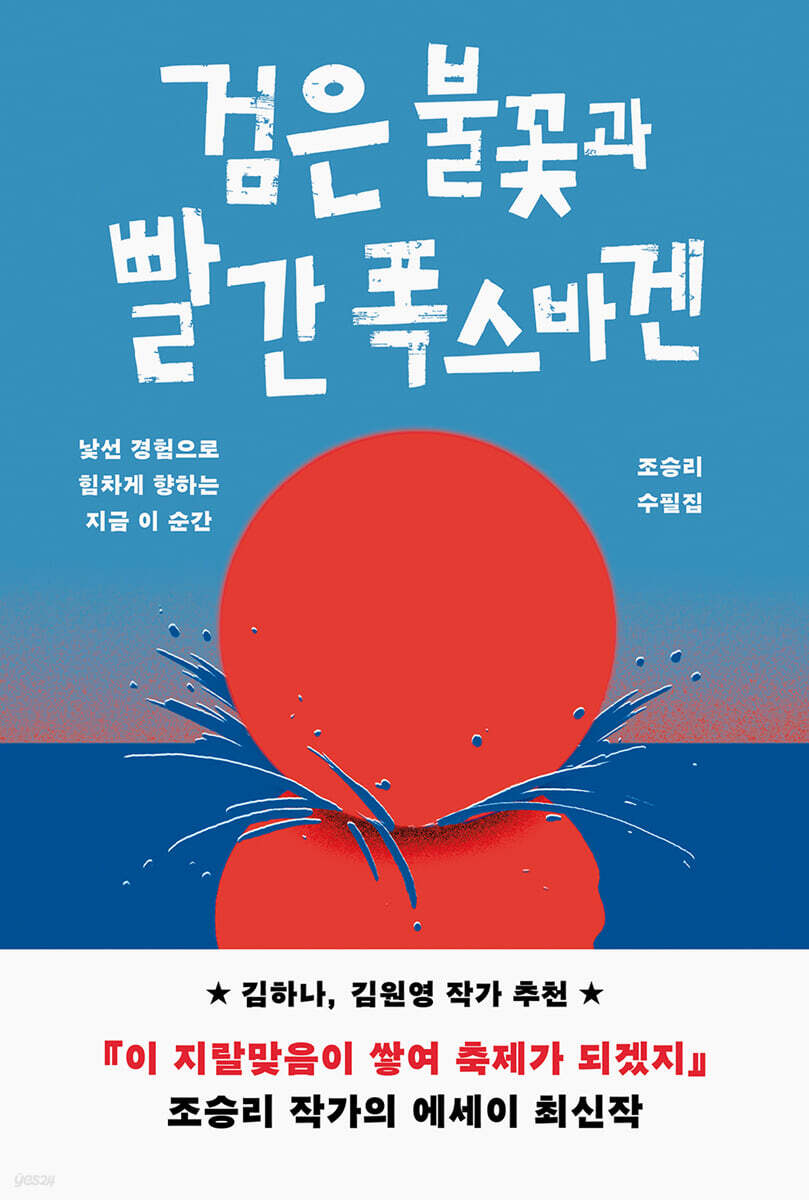
Black flames and red Volkswagen
 |
Description
Book Introduction
- A word from MD
-
The thoughts on life conveyed through an unfamiliar sense"This nonsense will pile up to become a festival" Jo Seung-ri's new essay collection.
The author, who has brought a spark to a life that had lost its light, tells a unique travel story through his keen senses.
It contains the experience of trying to survive in the world even if it is a mess due to reality.
It's time to experience his unique style of writing, which is both cynical and passionate.
April 11, 2025. Essay PD Lee Ju-eun
★『This nonsense will pile up to become a festival』 Jo Seung-ri's latest essay★
The bursting fireworks lose their color
Even though reality passes by so quickly, it's cruel
By seeing the world and meeting people,
The feeling of being alive felt to the fullest
Author Seungri Jo transformed a life that was expected to end in tragedy into a festival, giving readers a fresh shock and emotion.
After 『This nonsense will pile up to become a festival』, his second collection of essays 『Black Flames and Red Volkswagen』 is published by Semicolon.
This book contains his experiences abroad, as well as his close observations of life, along with his dense emotions.
Beginning with a journey full of twists and turns, the book cheerfully reveals the first experiences author Seungri Jo has had, including flamenco lessons, barrier-free exhibitions, barista certification exams, and plastic surgery consultations.
The author's appearance and emotional changes as he tries things out with curiosity in various ways are vivid.
The conversations with family, friends, colleagues, and massage parlor customers that appear during that experience are also unique.
Regardless of his disability, the author's inherently cynical nature and his refreshing personality of always saying what he wants to say create unique dialogues and scenes.
He says that melodrama is disgusting, and that humor and wit ultimately triumph even in the dark reality. Under his belief, the story is not heavy, but rather witty and cheerful.
His contradictory charm and temperament, negative yet optimistic, cynical yet affectionate, permeate the entire book and resonate particularly with readers.
The title, “Black Flames and Red Volkswagen,” comes from the eponymous subtitle at the very end of the book.
For him, who is blind due to visual impairment, the dazzling fireworks of the festival have lost their color.
When I recalled the story of my mother, exhausted from the hardships of making a living, I remembered a car that passed by loudly and quickly, as if teasing the mother and daughter.
The author metaphorically expressed his reality by comparing it to fire and tea.
However, paradoxically, the author's attempt to verbalize the world he perceives by metaphorically expressing even the sad reality through colors and images stands out.
In addition, the author's recollections of his mother and his attitude toward the life of mother and daughter stand out, creating a deep aftertaste in the book.
Living blind, he sometimes feels despair and sadness when faced with the realistic problems, but because he “want to see the world so much,” writer Seungri Jo puts his heart into what he can feel.
Although it can be beautiful at times and a mess at times.
The author's enthusiasm for experiencing the world and its curious aspects, even if it means going through a mess, is impressive, rather than a stable but numb life.
His courage and energy in facing and feeling the maximum of senses and emotions are fully conveyed to the reader.
The bursting fireworks lose their color
Even though reality passes by so quickly, it's cruel
By seeing the world and meeting people,
The feeling of being alive felt to the fullest
Author Seungri Jo transformed a life that was expected to end in tragedy into a festival, giving readers a fresh shock and emotion.
After 『This nonsense will pile up to become a festival』, his second collection of essays 『Black Flames and Red Volkswagen』 is published by Semicolon.
This book contains his experiences abroad, as well as his close observations of life, along with his dense emotions.
Beginning with a journey full of twists and turns, the book cheerfully reveals the first experiences author Seungri Jo has had, including flamenco lessons, barrier-free exhibitions, barista certification exams, and plastic surgery consultations.
The author's appearance and emotional changes as he tries things out with curiosity in various ways are vivid.
The conversations with family, friends, colleagues, and massage parlor customers that appear during that experience are also unique.
Regardless of his disability, the author's inherently cynical nature and his refreshing personality of always saying what he wants to say create unique dialogues and scenes.
He says that melodrama is disgusting, and that humor and wit ultimately triumph even in the dark reality. Under his belief, the story is not heavy, but rather witty and cheerful.
His contradictory charm and temperament, negative yet optimistic, cynical yet affectionate, permeate the entire book and resonate particularly with readers.
The title, “Black Flames and Red Volkswagen,” comes from the eponymous subtitle at the very end of the book.
For him, who is blind due to visual impairment, the dazzling fireworks of the festival have lost their color.
When I recalled the story of my mother, exhausted from the hardships of making a living, I remembered a car that passed by loudly and quickly, as if teasing the mother and daughter.
The author metaphorically expressed his reality by comparing it to fire and tea.
However, paradoxically, the author's attempt to verbalize the world he perceives by metaphorically expressing even the sad reality through colors and images stands out.
In addition, the author's recollections of his mother and his attitude toward the life of mother and daughter stand out, creating a deep aftertaste in the book.
Living blind, he sometimes feels despair and sadness when faced with the realistic problems, but because he “want to see the world so much,” writer Seungri Jo puts his heart into what he can feel.
Although it can be beautiful at times and a mess at times.
The author's enthusiasm for experiencing the world and its curious aspects, even if it means going through a mess, is impressive, rather than a stable but numb life.
His courage and energy in facing and feeling the maximum of senses and emotions are fully conveyed to the reader.
- You can preview some of the book's contents.
Preview
index
Recommendation
Prologue I see it this way
Chapter 1 I miss the world so much
Festival of Hungry Spirits
Endless plains
My warrior
In front of the Tuman River
1,442 stories
The real Clark
Love and gambling are just a hair's breadth apart
Jazz performance on a summer day
Vietnam, that bloody memory
Hot discrimination
Best sandwich
Chapter 2: Moments when you feel feverish even though it's not hot
1cc of filler to fill the void
Counting the Blind Barista
Dance with the Devil
Walking through Monet's garden
How to feel cherry blossoms
Spring Guest
The moment you become an adult
I have a fever even though it's not hot.
Still cowardly
Watermelon tastes like tears
A banknote that smelled like naphthalene
Chuno
Walk your path
Chapter 3 We will survive and survive somehow.
A mysterious incident
That kind of person
How to fight injustice
The moment when dreams bloom
Memories of the cheek stone
Fake wise men
I brought a flower pot into the house
Each person's compassion
I'll be your home
Black flames and red Volkswagen
Epilogue
Prologue I see it this way
Chapter 1 I miss the world so much
Festival of Hungry Spirits
Endless plains
My warrior
In front of the Tuman River
1,442 stories
The real Clark
Love and gambling are just a hair's breadth apart
Jazz performance on a summer day
Vietnam, that bloody memory
Hot discrimination
Best sandwich
Chapter 2: Moments when you feel feverish even though it's not hot
1cc of filler to fill the void
Counting the Blind Barista
Dance with the Devil
Walking through Monet's garden
How to feel cherry blossoms
Spring Guest
The moment you become an adult
I have a fever even though it's not hot.
Still cowardly
Watermelon tastes like tears
A banknote that smelled like naphthalene
Chuno
Walk your path
Chapter 3 We will survive and survive somehow.
A mysterious incident
That kind of person
How to fight injustice
The moment when dreams bloom
Memories of the cheek stone
Fake wise men
I brought a flower pot into the house
Each person's compassion
I'll be your home
Black flames and red Volkswagen
Epilogue
Detailed image

Into the book
“Do you know what you are eating right now?”
It was a cold question that left no room for emotion.
I swallowed the food in my mouth and tried to answer.
But I couldn't find the answer.
I couldn't figure out what the hell was in my mouth just now.
As I stared blankly at him, he gave instructions in a voice that was a bit warm but also strict.
“From now on, I’m going to eat slowly.
Chew and savor it for a long time.
“Tell me what kind of dish it is, talking about the texture.”
I asked why that should be.
He said that eating is not just about filling the stomach, but also about tasting and enjoying the flavors.
I didn't understand what he was saying.
I never thought that eating a meal needed any grand meaning.
Mr. Lee put some stir-fried vegetables on my plate.
I slowly picked it up, put it in my mouth, and chewed it.
I could feel the spicy and crunchy bean stems.
--- p.24 From “The Festival of Hungry Spirits”
The Arai couple decided to stop by the Braille library before heading to Tokyo Tower.
If it means anything to me, that is.
To be honest, I couldn't read Braille at that time.
I received Braille education when I was attending a school for the disabled, but because I had low vision, I read Braille with my eyes, not my hands.
Also, since I studied all my subjects in enlarged letters, there was no need to learn Braille.
So, I had no interest in places like the Braille library, but I didn't feel like I could refuse, so I just went along.
--- pp.39-40 From "My Warrior"
The doctor was the type of model student who would do well in school just by hearing his voice.
This time, I wanted to get a proper consultation, so I told them about the treatment I wanted.
But the doctor didn't seem to listen to me and asked about the cause of my blindness and the illness, then started talking about his mother.
His mother went blind two years ago due to retinal detachment.
He is currently staying at home, so I am worried about how to provide him with rehabilitation training.
The filial son, seemingly uninterested in his own work, kept asking about welfare centers and rehabilitation facilities suitable for a seventy-year-old.
He then consoled me by saying how difficult it must be to live with my eyes closed.
The hospital's department changed from plastic surgery to psychiatry.
I asked about the original purpose, plastic surgery and cosmetic procedures.
Then he said that I could go out and consult with the counselor and continued to ask what life was like for the blind and what kind of help the family should provide.
I ran out of the examination room, trying to avoid the barrage of questions.
The receptionist asked me to pay ten thousand won, saying it was a specialist's special treatment fee.
I grumbled that I deserved the special treatment fee and swiped my card as I left.
--- p.121 From “1cc of filler to fill the void”
I told the truth.
I was envious of people who were crazy about flamenco on stage.
I was jealous of their passion throughout the performance.
The instructor spoke in a bitter voice.
“In the end, the only people who remain are those who are crazy about that field.
“You have to be crazy to survive until the end.”
That day, the instructor told his story for the first time.
Conflict with parents who oppose art, insecurity about making a living, and yet, flamenco that he cannot give up.
Listening to the instructor's monologue, I learned that even if you love something so much, it doesn't necessarily mean you'll be happy.
The instructor started dancing in front of me.
I was the only one in the audience, blinded.
The sound of footsteps hitting the floor was dazzling.
He struck his body with his palm as if he was beating a drum.
Her gestures were sad.
I also tied my shoelaces tightly.
And went out onto the floor.
I stamp my feet next to the instructor.
Like a feeble consolation.
--- pp.136-137 from "Dances with the Devil"
It was the second day after my mother's funeral that I remembered what had happened that day.
I had completely forgotten about it, but my cousin, who had been there that day and heard the story with me, brought back the memory in a lost voice.
In an instant, goosebumps started to appear from the heels of my feet all the way to the back of my neck.
It was an exquisite reality for a coincidence.
I told that story to my friends.
However, I wanted to tell her that she had missed the point that I was blind, but my two friends, having heard only that my mother had passed away at the age of fifty-five, were excited about going back there.
My intention was not to confuse coincidence with fate.
I believe that I have an innate destiny.
But I don't think we live according to our predetermined fate.
What I learned from studying fortune telling was the lesson to never give in to fate, but to confront it.
I am advised by past records when to avoid and when to move forward.
I think that is true fortune telling.
--- p.248 From “The Fake Wise Men”
I kept hearing the sound of fireworks, but no light entered my sight.
It was obvious.
With my remaining vision, I could barely perceive day and night.
I gave strength to my eyes.
I looked up higher into the sky.
Suddenly, I wanted to see fireworks like crazy.
I climbed up, leaning on the windowsill with my feet.
I opened the screen and stuck my head out.
I scanned the sky to find the source of the sound.
There are times when I forget about my disability and suddenly realize it.
It was like that now.
I want to see the world so badly that I rub my eyes until they turn red.
Repeating meaningless actions knowing that they will not come to fruition.
I blame myself for being foolish, but at this moment, I want to believe in a miracle.
It was a cold question that left no room for emotion.
I swallowed the food in my mouth and tried to answer.
But I couldn't find the answer.
I couldn't figure out what the hell was in my mouth just now.
As I stared blankly at him, he gave instructions in a voice that was a bit warm but also strict.
“From now on, I’m going to eat slowly.
Chew and savor it for a long time.
“Tell me what kind of dish it is, talking about the texture.”
I asked why that should be.
He said that eating is not just about filling the stomach, but also about tasting and enjoying the flavors.
I didn't understand what he was saying.
I never thought that eating a meal needed any grand meaning.
Mr. Lee put some stir-fried vegetables on my plate.
I slowly picked it up, put it in my mouth, and chewed it.
I could feel the spicy and crunchy bean stems.
--- p.24 From “The Festival of Hungry Spirits”
The Arai couple decided to stop by the Braille library before heading to Tokyo Tower.
If it means anything to me, that is.
To be honest, I couldn't read Braille at that time.
I received Braille education when I was attending a school for the disabled, but because I had low vision, I read Braille with my eyes, not my hands.
Also, since I studied all my subjects in enlarged letters, there was no need to learn Braille.
So, I had no interest in places like the Braille library, but I didn't feel like I could refuse, so I just went along.
--- pp.39-40 From "My Warrior"
The doctor was the type of model student who would do well in school just by hearing his voice.
This time, I wanted to get a proper consultation, so I told them about the treatment I wanted.
But the doctor didn't seem to listen to me and asked about the cause of my blindness and the illness, then started talking about his mother.
His mother went blind two years ago due to retinal detachment.
He is currently staying at home, so I am worried about how to provide him with rehabilitation training.
The filial son, seemingly uninterested in his own work, kept asking about welfare centers and rehabilitation facilities suitable for a seventy-year-old.
He then consoled me by saying how difficult it must be to live with my eyes closed.
The hospital's department changed from plastic surgery to psychiatry.
I asked about the original purpose, plastic surgery and cosmetic procedures.
Then he said that I could go out and consult with the counselor and continued to ask what life was like for the blind and what kind of help the family should provide.
I ran out of the examination room, trying to avoid the barrage of questions.
The receptionist asked me to pay ten thousand won, saying it was a specialist's special treatment fee.
I grumbled that I deserved the special treatment fee and swiped my card as I left.
--- p.121 From “1cc of filler to fill the void”
I told the truth.
I was envious of people who were crazy about flamenco on stage.
I was jealous of their passion throughout the performance.
The instructor spoke in a bitter voice.
“In the end, the only people who remain are those who are crazy about that field.
“You have to be crazy to survive until the end.”
That day, the instructor told his story for the first time.
Conflict with parents who oppose art, insecurity about making a living, and yet, flamenco that he cannot give up.
Listening to the instructor's monologue, I learned that even if you love something so much, it doesn't necessarily mean you'll be happy.
The instructor started dancing in front of me.
I was the only one in the audience, blinded.
The sound of footsteps hitting the floor was dazzling.
He struck his body with his palm as if he was beating a drum.
Her gestures were sad.
I also tied my shoelaces tightly.
And went out onto the floor.
I stamp my feet next to the instructor.
Like a feeble consolation.
--- pp.136-137 from "Dances with the Devil"
It was the second day after my mother's funeral that I remembered what had happened that day.
I had completely forgotten about it, but my cousin, who had been there that day and heard the story with me, brought back the memory in a lost voice.
In an instant, goosebumps started to appear from the heels of my feet all the way to the back of my neck.
It was an exquisite reality for a coincidence.
I told that story to my friends.
However, I wanted to tell her that she had missed the point that I was blind, but my two friends, having heard only that my mother had passed away at the age of fifty-five, were excited about going back there.
My intention was not to confuse coincidence with fate.
I believe that I have an innate destiny.
But I don't think we live according to our predetermined fate.
What I learned from studying fortune telling was the lesson to never give in to fate, but to confront it.
I am advised by past records when to avoid and when to move forward.
I think that is true fortune telling.
--- p.248 From “The Fake Wise Men”
I kept hearing the sound of fireworks, but no light entered my sight.
It was obvious.
With my remaining vision, I could barely perceive day and night.
I gave strength to my eyes.
I looked up higher into the sky.
Suddenly, I wanted to see fireworks like crazy.
I climbed up, leaning on the windowsill with my feet.
I opened the screen and stuck my head out.
I scanned the sky to find the source of the sound.
There are times when I forget about my disability and suddenly realize it.
It was like that now.
I want to see the world so badly that I rub my eyes until they turn red.
Repeating meaningless actions knowing that they will not come to fruition.
I blame myself for being foolish, but at this moment, I want to believe in a miracle.
--- p.275 From “Black Flames and Red Volkswagen”
Publisher's Review
Rather than being empty while enjoying stability
Things I experienced because I wanted to be passionate even if it was a mess,
A unique travelogue that only author Jo Seung-ri can write.
The activity that allows us to experience the most unfamiliar experiences is traveling.
Writer Seungri Jo, whose hobby is traveling, takes time out of her busy daily life to go on a trip.
Nha Trang and Hanoi in Vietnam, Penang in Malaysia, Tokyo in Japan, Macau in Hong Kong, Clark in the Philippines, Baekdu Mountain, etc.
Although it was not easy to find a travel companion, author Seungri Jo eventually encounters and describes new scenery at the destination he traveled to.
Standing on the hot plains of Vietnam, briefly removed from the shopping spree of health food and latex, I recall Nguyen Ngoc Tu's novel "Endless Plains" and contemplate the hope of surviving a harsh life.
In Penang, Malaysia, which happens to be the Chung Yuan Festival, people are realizing the physical and mental emptiness caused by the hardships of life.
In this way, he imagines and draws in his mind everything he hears, smells, tastes, and touches, saying, “The invisible have their own way of appreciating scenery.”
His synesthetic expressions, such as predicting rain by the smell of water in the air and recalling warm memories of a trip to Vietnam by a pungent smell, provide readers with a new taste in writing.
His descriptions are so vivid that, as you read the book, the conventional wisdom that observation depends on sight is shattered.
This is also why the expression 'saw' he uses in his books feels natural.
A cool breeze blows, pushing a blue canvas before my eyes.
The cold sunlight breaks across the canvas, coloring it with particles of light.
I draw a blue sky and a lake shining with azure in my eyes.
That's how I vividly remember and appreciate time and space.
The smell of the sky and the earth, the sound of people chatting, the texture of the air touching my skin.
Unfamiliar sensations become new stimuli, leading me to broad thinking and deep contemplation.
I am grateful that there are so many senses that can replace sight.
_Page 10, from “Prologue”
It would be great if the journey he embarked on was smooth and beautiful, but the cruel reality does not leave him alone.
Because it is a type of travel where you have to be with someone, you end up with more people than other travelers.
At this time, writer Jo Seung-ri captures all kinds of human figures with his astute gaze.
A package tour guide who pressures you to buy things, a traveler who is rude to a local guide, a local driver who is more than kind, and a group of people who bring unexpected laughter and emotion.
With them, writer Jo Seung-ri's emotions fluctuate up and down.
A more three-dimensional feeling is created than when you just stay in daily life.
In particular, the author's change of heart, from being suspicious of the person who showed him kindness, saying, "I didn't believe in kindness without a price," to feeling embarrassed, sorry, and grateful after realizing his pure heart, is both amusing and touching.
This is something that everyone can relate to, not only when traveling abroad but also in life, as they receive help from others in big and small ways.
“I’m worried you might get scammed.
If you need a taxi, let me know.
“I’ll introduce you to an article that will give you peace of mind.”
My face felt hot.
I was ashamed of myself for doubting his good intentions.
I spent my last night in Vietnam with a warm heart.
_Page 102, from “Hot Discrimination”
In addition to travelogues, the book contains the sensory experiences of author Seungri Jo, who expands her world by trying various things that catch her fancy.
Readers who encounter him passionately feeling this world and facing fate are led to think that experience is the sum total of something that transcends sight.
And his will and passion give him the strength to live today.
It is the strength to shake off the expressions that confine oneself with words of helplessness and resignation such as ‘anyway’ and ‘whatever I do, it’s no use’.
And it comes to mind naturally.
What new experiences have you had recently? What are some things you just want to do without any sense of obligation? What are some feelings you've been suppressing and ignoring?
These questions will add vitality to your life.
The shape of emotions that are faced with courage
About the 'living temperature' that is sensitively detected
In particular, the expression of heat stands out in this book.
It is a kind of 'fever', a feeling brought on by emotions felt through unfamiliar experiences, and a feeling that comes from emotions that one had previously pretended not to know about.
The cowardice he felt towards himself during his school days when he pretended not to know his friend, whom others had badmouthed, because he was embarrassed to see him, the jealousy he felt towards his adoptive grandfather's granddaughter who was showing a lively side to her father, the anger that welled up when he heard the gossip of the women who tried to harass and take advantage of his disability...
The emotional intensity reaches its peak, especially at the end of the book, when the author reminisces about his father and mother.
The author calmly describes the moment when a fever rises even though it is not hot, and the 'living temperature' felt when one is acutely aware of one's own feelings, leaving a strong impression on the reader.
What is impressive is that even author Jo Seung-ri did not have such rich experiences and senses from the beginning.
There was a time when I worked so coldly that I was called a "Sujeonno" (a word meaning "hard worker").
At the time, I was so busy that I didn't have time to relax due to financial reasons such as the hardship of making a living and the responsibility I had for my family.
When I was only doing what I had to do, I had no time to reflect on myself, and I didn't even realize that I was becoming increasingly hungry inside.
The person who recommended the trip was my close friend A.
She cautiously told me that I was changing for the worse and advised me to distance myself from reality.
I dismissed it as empty talk.
He told me about my reality: I couldn't take a single day off to save up for the monthly savings I had to make and to send money to my family.
“You look so unhappy.
“I want you to love yourself the most.” _Page 20, from “The Festival of Hungry Spirits”
On the advice of a friend, I realized my misfortune and went on a trip.
Rather than just filling my stomach, I began to savor life by slowly tasting the various and subtle flavors.
It's not because I have more time and money than before, but because I realized the need to feel good about living.
In this way, we face and accept experiences and emotions one by one.
Author Jo Seung-ri honestly confesses and recalls emotions and memories that she did not want to admit, which were like a kind of shame.
I recall the memories I want to forget, organize them in writing, and embrace them as part of my emotions.
While writing the book, emotions like anger, sadness, jealousy, and betrayal sometimes burned like a strong flame, but at the same time, warm emotions like gratitude, emotion, and joy also bloomed passionately.
There are readers who only find author Jo Seung-ri's writing sad.
But ultimately, the power that attracted many readers with his first book was the universality of his writing, which resonated with many people regardless of disability or gender.
This collection of essays is also like that.
It reminds us of how important it is to react sensitively and not be insensitive to hurt or pain, and how precious the sensations we can feel because we are alive are.
In this way, author Jo Seung-ri's intimate emotions and three-dimensional depictions of sensations provide readers with an opportunity to deeply savor life.
“I dreamed of becoming an accountant, but I became visually impaired.
I used to be a masseuse, but I became a writer.
“Where will fate take me?”
Jo Seung-ri's Reason for Writing: His Declaration as a Writer
Writer Seungri Cho, who dreamed of becoming an accountant, became a visually impaired masseuse, and now has a new identity as a writer.
But after publishing my first book, I felt an inexplicable emptiness.
I felt relieved and happy to write, but at the same time, writing became burdensome.
But he didn't stop there and went out in search of unfamiliar experiences.
And finally, I regain the desire to write.
The book that recorded that process is 『Black Flame and Red Volkswagen』.
It was a day without much to gain, but for some reason, a feeling of excitement filled me.
That day, I started writing again, which I had stopped.
If I've been talking about the past so far, I want to write about the present and future from now on.
Page 123, "1cc of Filler to Fill the Void"
Reading this new book by Seungri Cho, who has found her voice as a writer, makes me think again about many things.
It makes you reconsider your vague and superficial perception of disability, starting with thoughts like, "How can a visually impaired person travel abroad?" and "They must read Braille because they're visually impaired." and "They must be kind because they're disabled."
And we begin to dream of a new vision for the society in which we live together.
However, rather than making a definitive claim, the author subtly tells the reader a story by confessing his own indifference.
Although the author had no particular interest in world peace, inter-Korean issues, or the history of democratization, the book reveals the author's transformation as he encountered these issues directly and indirectly and witnessed others putting their beliefs into practice.
He vows.
“I will become a conscience that takes courageous action.” Author Seungri Cho’s declaration, which appears throughout this book, makes clearer why this book deserves to be read widely and why it exists.
I have never been a parent before, so I don't fully understand that feeling.
But as a person with a disability, I know one thing.
The fact is that even if parental protection disappears, we will somehow survive and continue to survive.
My life is proof of that.
_Page 214, from “The Mysterious One”
I realized that the 'that kind of person' the landlady was talking about was me.
At that moment, I thought of F.
That strong attitude towards life.
He sat up straight with his shoulders back.
And then I slowly started eating.
It was unpleasant, but I didn't want to leave a scar.
But I made a promise.
'You should write more stories about the "people like that" you talk about.
We will make it known that we are living together.
That is my mission, which I have chosen.' _Pages 223-224, from "That Kind of Person"
I started to cry and then chuckled,
A humorous and witty piece by author Jo Seung-ri.
Author Jo Seung-ri's stories are serious and sad, but also funny and entertaining.
No matter how chaotic the story may be, it ends not with bitterness and disillusionment, but with affection, hope, and a smile, thanks to his writing skills.
It may also be because of the author's personality, which makes you laugh when it's funny, and laughs even louder when it's absurd and you're angry.
A funny yet sad story, a lighthearted yet heavy story.
This book reflects his contradictory and fascinating temperament.
As my mood and condition became worst, I suddenly felt like laughing.
That was my personality.
When I gave up, I laughed heartily.
Page 68, "The Real Clark"
His experiences, meticulously observed and written down, are not limited to personal stories.
What makes life worth living, what does it feel like to live like a human being, and furthermore, what does a society in which we can all live well look like?
Reading this book will make you aware of and think about situations and emotions you've never thought about before.
It is the joy of reading, a moment of empathy and sympathy that comes from transcending the specific conditions that externally define author Jo Seung-ri, such as being a woman, visually impaired, and Korean.
This book is recommended for readers who want to gain insight through the various senses he discovers in the process of trying and experiencing something that catches their eye, and for readers who want to read a collection of essays that boast a unique writing style.
“The fleeting moment of crossing the Han River in an electric train, the red light that fills my eyes, fills me with ecstasy.
Those brief, warm, and ecstatic moments give us the strength to endure misfortune.
(…) I believe that experience will give me the courage to face the dark future and my undying passion.” _Pages 285-286, from “Epilogue”
Things I experienced because I wanted to be passionate even if it was a mess,
A unique travelogue that only author Jo Seung-ri can write.
The activity that allows us to experience the most unfamiliar experiences is traveling.
Writer Seungri Jo, whose hobby is traveling, takes time out of her busy daily life to go on a trip.
Nha Trang and Hanoi in Vietnam, Penang in Malaysia, Tokyo in Japan, Macau in Hong Kong, Clark in the Philippines, Baekdu Mountain, etc.
Although it was not easy to find a travel companion, author Seungri Jo eventually encounters and describes new scenery at the destination he traveled to.
Standing on the hot plains of Vietnam, briefly removed from the shopping spree of health food and latex, I recall Nguyen Ngoc Tu's novel "Endless Plains" and contemplate the hope of surviving a harsh life.
In Penang, Malaysia, which happens to be the Chung Yuan Festival, people are realizing the physical and mental emptiness caused by the hardships of life.
In this way, he imagines and draws in his mind everything he hears, smells, tastes, and touches, saying, “The invisible have their own way of appreciating scenery.”
His synesthetic expressions, such as predicting rain by the smell of water in the air and recalling warm memories of a trip to Vietnam by a pungent smell, provide readers with a new taste in writing.
His descriptions are so vivid that, as you read the book, the conventional wisdom that observation depends on sight is shattered.
This is also why the expression 'saw' he uses in his books feels natural.
A cool breeze blows, pushing a blue canvas before my eyes.
The cold sunlight breaks across the canvas, coloring it with particles of light.
I draw a blue sky and a lake shining with azure in my eyes.
That's how I vividly remember and appreciate time and space.
The smell of the sky and the earth, the sound of people chatting, the texture of the air touching my skin.
Unfamiliar sensations become new stimuli, leading me to broad thinking and deep contemplation.
I am grateful that there are so many senses that can replace sight.
_Page 10, from “Prologue”
It would be great if the journey he embarked on was smooth and beautiful, but the cruel reality does not leave him alone.
Because it is a type of travel where you have to be with someone, you end up with more people than other travelers.
At this time, writer Jo Seung-ri captures all kinds of human figures with his astute gaze.
A package tour guide who pressures you to buy things, a traveler who is rude to a local guide, a local driver who is more than kind, and a group of people who bring unexpected laughter and emotion.
With them, writer Jo Seung-ri's emotions fluctuate up and down.
A more three-dimensional feeling is created than when you just stay in daily life.
In particular, the author's change of heart, from being suspicious of the person who showed him kindness, saying, "I didn't believe in kindness without a price," to feeling embarrassed, sorry, and grateful after realizing his pure heart, is both amusing and touching.
This is something that everyone can relate to, not only when traveling abroad but also in life, as they receive help from others in big and small ways.
“I’m worried you might get scammed.
If you need a taxi, let me know.
“I’ll introduce you to an article that will give you peace of mind.”
My face felt hot.
I was ashamed of myself for doubting his good intentions.
I spent my last night in Vietnam with a warm heart.
_Page 102, from “Hot Discrimination”
In addition to travelogues, the book contains the sensory experiences of author Seungri Jo, who expands her world by trying various things that catch her fancy.
Readers who encounter him passionately feeling this world and facing fate are led to think that experience is the sum total of something that transcends sight.
And his will and passion give him the strength to live today.
It is the strength to shake off the expressions that confine oneself with words of helplessness and resignation such as ‘anyway’ and ‘whatever I do, it’s no use’.
And it comes to mind naturally.
What new experiences have you had recently? What are some things you just want to do without any sense of obligation? What are some feelings you've been suppressing and ignoring?
These questions will add vitality to your life.
The shape of emotions that are faced with courage
About the 'living temperature' that is sensitively detected
In particular, the expression of heat stands out in this book.
It is a kind of 'fever', a feeling brought on by emotions felt through unfamiliar experiences, and a feeling that comes from emotions that one had previously pretended not to know about.
The cowardice he felt towards himself during his school days when he pretended not to know his friend, whom others had badmouthed, because he was embarrassed to see him, the jealousy he felt towards his adoptive grandfather's granddaughter who was showing a lively side to her father, the anger that welled up when he heard the gossip of the women who tried to harass and take advantage of his disability...
The emotional intensity reaches its peak, especially at the end of the book, when the author reminisces about his father and mother.
The author calmly describes the moment when a fever rises even though it is not hot, and the 'living temperature' felt when one is acutely aware of one's own feelings, leaving a strong impression on the reader.
What is impressive is that even author Jo Seung-ri did not have such rich experiences and senses from the beginning.
There was a time when I worked so coldly that I was called a "Sujeonno" (a word meaning "hard worker").
At the time, I was so busy that I didn't have time to relax due to financial reasons such as the hardship of making a living and the responsibility I had for my family.
When I was only doing what I had to do, I had no time to reflect on myself, and I didn't even realize that I was becoming increasingly hungry inside.
The person who recommended the trip was my close friend A.
She cautiously told me that I was changing for the worse and advised me to distance myself from reality.
I dismissed it as empty talk.
He told me about my reality: I couldn't take a single day off to save up for the monthly savings I had to make and to send money to my family.
“You look so unhappy.
“I want you to love yourself the most.” _Page 20, from “The Festival of Hungry Spirits”
On the advice of a friend, I realized my misfortune and went on a trip.
Rather than just filling my stomach, I began to savor life by slowly tasting the various and subtle flavors.
It's not because I have more time and money than before, but because I realized the need to feel good about living.
In this way, we face and accept experiences and emotions one by one.
Author Jo Seung-ri honestly confesses and recalls emotions and memories that she did not want to admit, which were like a kind of shame.
I recall the memories I want to forget, organize them in writing, and embrace them as part of my emotions.
While writing the book, emotions like anger, sadness, jealousy, and betrayal sometimes burned like a strong flame, but at the same time, warm emotions like gratitude, emotion, and joy also bloomed passionately.
There are readers who only find author Jo Seung-ri's writing sad.
But ultimately, the power that attracted many readers with his first book was the universality of his writing, which resonated with many people regardless of disability or gender.
This collection of essays is also like that.
It reminds us of how important it is to react sensitively and not be insensitive to hurt or pain, and how precious the sensations we can feel because we are alive are.
In this way, author Jo Seung-ri's intimate emotions and three-dimensional depictions of sensations provide readers with an opportunity to deeply savor life.
“I dreamed of becoming an accountant, but I became visually impaired.
I used to be a masseuse, but I became a writer.
“Where will fate take me?”
Jo Seung-ri's Reason for Writing: His Declaration as a Writer
Writer Seungri Cho, who dreamed of becoming an accountant, became a visually impaired masseuse, and now has a new identity as a writer.
But after publishing my first book, I felt an inexplicable emptiness.
I felt relieved and happy to write, but at the same time, writing became burdensome.
But he didn't stop there and went out in search of unfamiliar experiences.
And finally, I regain the desire to write.
The book that recorded that process is 『Black Flame and Red Volkswagen』.
It was a day without much to gain, but for some reason, a feeling of excitement filled me.
That day, I started writing again, which I had stopped.
If I've been talking about the past so far, I want to write about the present and future from now on.
Page 123, "1cc of Filler to Fill the Void"
Reading this new book by Seungri Cho, who has found her voice as a writer, makes me think again about many things.
It makes you reconsider your vague and superficial perception of disability, starting with thoughts like, "How can a visually impaired person travel abroad?" and "They must read Braille because they're visually impaired." and "They must be kind because they're disabled."
And we begin to dream of a new vision for the society in which we live together.
However, rather than making a definitive claim, the author subtly tells the reader a story by confessing his own indifference.
Although the author had no particular interest in world peace, inter-Korean issues, or the history of democratization, the book reveals the author's transformation as he encountered these issues directly and indirectly and witnessed others putting their beliefs into practice.
He vows.
“I will become a conscience that takes courageous action.” Author Seungri Cho’s declaration, which appears throughout this book, makes clearer why this book deserves to be read widely and why it exists.
I have never been a parent before, so I don't fully understand that feeling.
But as a person with a disability, I know one thing.
The fact is that even if parental protection disappears, we will somehow survive and continue to survive.
My life is proof of that.
_Page 214, from “The Mysterious One”
I realized that the 'that kind of person' the landlady was talking about was me.
At that moment, I thought of F.
That strong attitude towards life.
He sat up straight with his shoulders back.
And then I slowly started eating.
It was unpleasant, but I didn't want to leave a scar.
But I made a promise.
'You should write more stories about the "people like that" you talk about.
We will make it known that we are living together.
That is my mission, which I have chosen.' _Pages 223-224, from "That Kind of Person"
I started to cry and then chuckled,
A humorous and witty piece by author Jo Seung-ri.
Author Jo Seung-ri's stories are serious and sad, but also funny and entertaining.
No matter how chaotic the story may be, it ends not with bitterness and disillusionment, but with affection, hope, and a smile, thanks to his writing skills.
It may also be because of the author's personality, which makes you laugh when it's funny, and laughs even louder when it's absurd and you're angry.
A funny yet sad story, a lighthearted yet heavy story.
This book reflects his contradictory and fascinating temperament.
As my mood and condition became worst, I suddenly felt like laughing.
That was my personality.
When I gave up, I laughed heartily.
Page 68, "The Real Clark"
His experiences, meticulously observed and written down, are not limited to personal stories.
What makes life worth living, what does it feel like to live like a human being, and furthermore, what does a society in which we can all live well look like?
Reading this book will make you aware of and think about situations and emotions you've never thought about before.
It is the joy of reading, a moment of empathy and sympathy that comes from transcending the specific conditions that externally define author Jo Seung-ri, such as being a woman, visually impaired, and Korean.
This book is recommended for readers who want to gain insight through the various senses he discovers in the process of trying and experiencing something that catches their eye, and for readers who want to read a collection of essays that boast a unique writing style.
“The fleeting moment of crossing the Han River in an electric train, the red light that fills my eyes, fills me with ecstasy.
Those brief, warm, and ecstatic moments give us the strength to endure misfortune.
(…) I believe that experience will give me the courage to face the dark future and my undying passion.” _Pages 285-286, from “Epilogue”
GOODS SPECIFICS
- Date of issue: April 7, 2025
- Page count, weight, size: 288 pages | 358g | 135*200*17mm
- ISBN13: 9791194087663
- ISBN10: 1194087663
You may also like
카테고리
korean


korean

![GQ KOREA Mark (Monthly): December [2025]](http://librairie.coreenne.fr/cdn/shop/files/8ef265dbbfbf186523ed75ba7319009d.jpg?v=1765340328&width=3840)


