

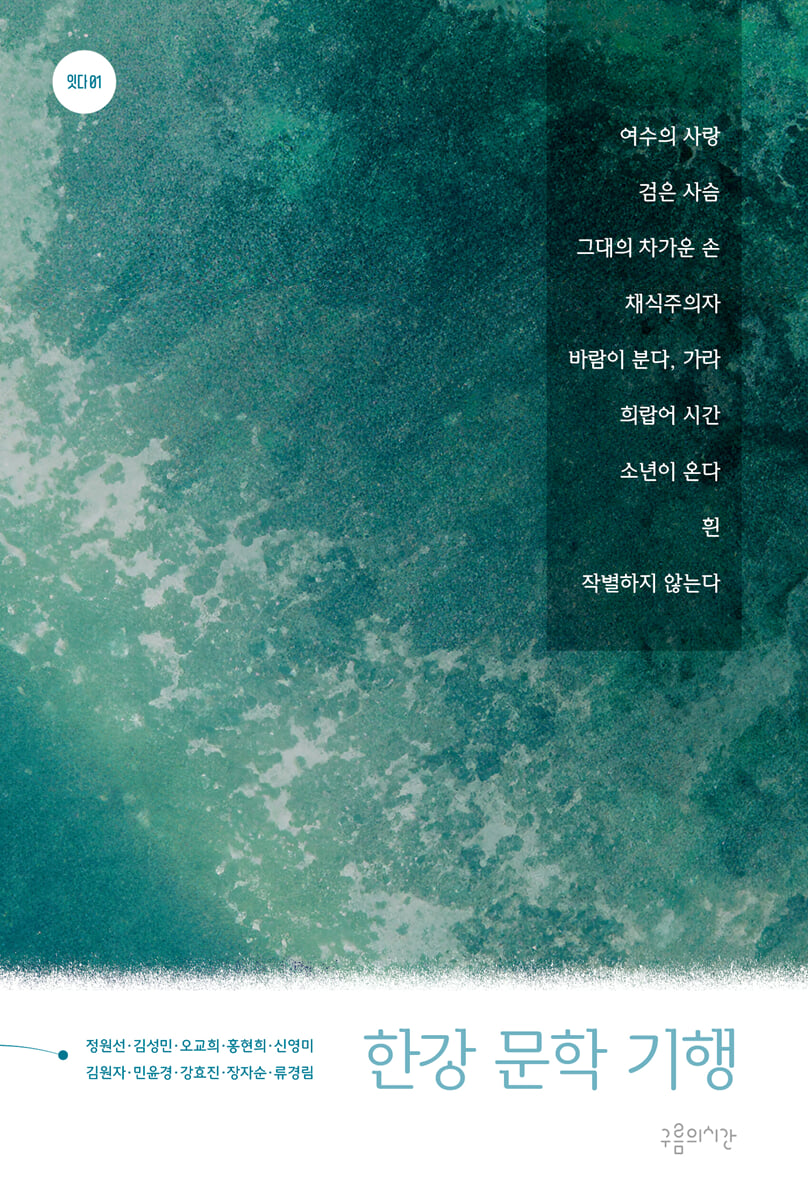
Han River Literary Tour
 |
Description
Book Introduction
A Year After the Nobel Prize in Literature, Continuing Han Kang's Literature
It's been a year since Han Kang won the Nobel Prize in Literature.
That fall, there were readers who wanted to read Han Kang's literature again.
They walked along the Han River, traveled to the sea of “Love in Yeosu,” Gwangju of “The Boy Comes,” the birch forest of “White,” and Jeju of “No Farewell.”
『Han River Literary Journey』 is a book that was born that way.
A record of ten people who read Han Kang's novels together, visited the places in person, and thought about literary questions through their bodies.
Reading becomes a journey, and travel becomes thinking.
Where does literature take us?
This book is one answer to that question.
A year spent with Han Kang's literature, and a testimony to the power of literature to connect life and the world.
We were readers from the future.
As if holding the answer key in one's hand, I already knew it when I opened the author's first novel.
The fact that this writer would later receive the Nobel Prize in Literature.
- From “A Year with the Han River”
It's been a year since Han Kang won the Nobel Prize in Literature.
That fall, there were readers who wanted to read Han Kang's literature again.
They walked along the Han River, traveled to the sea of “Love in Yeosu,” Gwangju of “The Boy Comes,” the birch forest of “White,” and Jeju of “No Farewell.”
『Han River Literary Journey』 is a book that was born that way.
A record of ten people who read Han Kang's novels together, visited the places in person, and thought about literary questions through their bodies.
Reading becomes a journey, and travel becomes thinking.
Where does literature take us?
This book is one answer to that question.
A year spent with Han Kang's literature, and a testimony to the power of literature to connect life and the world.
We were readers from the future.
As if holding the answer key in one's hand, I already knew it when I opened the author's first novel.
The fact that this writer would later receive the Nobel Prize in Literature.
- From “A Year with the Han River”
- You can preview some of the book's contents.
Preview
index
00
A letter to you
006 Jeongwonseon Recalling the “Forest Reading” to author Han Kang
01
Entering
023 Kim Seong-min: A Year with the Han River
02
Love in Yeosu
034 Introduction to Oh Kyo-hee's Works_The First Heart of the Han River
038 Oh Kyo-hee's Work Review_I Will Go to Yeosu Again
047 Oh Kyo-hee's Work Review_The Picnic I Couldn't Go
052 Yeosu, the path the Han River has traveled
03
Black Deer
058 Introduction to Kim Seong-min's Works_The Birth of a Young Master
063 Hong Hyun-hee's Work Review: What We Protect and What We Lost
074 Kim Seong-min's Work Review_Jeju Sea
080 Black Deer, the Path After That
084 Jeju Songaksan Mountain Trail
04
Your Cold Hands
090 Introduction to Shin Young-mi's Works_Mask and Truth
094 Shin Young-mi's Work Review_At the Ball Called Life
102 Your cold hands, in front of modern sculpture
05
The Vegetarian
110 Introduction to Kim Won-ja's Works_Between Violence and Beauty
113 Kim Won-ja's Work Review_ The Fourth Perspective
120 Becoming a Tree Like Yeong-hye from "The Vegetarian" in Jeju's Bijarim Forest
06
The Wind Blows, Go Away
126 Introduction to Min Yoon-kyung's Works: The Meaning of Life as We Stare at Death
130 Min Yoon-kyung's Work Review_The Wind Blows, That Way_The Road to Misiryeong
139 Kim Seong-min's Work Review_Mark Rothko and the Han River
144 Misiryeong Old Road
146 Suyuri and the Han River
07
Greek Lessons
152 Introduction to Kang Hyo-jin's Works_The Beauty of Fragile Beings
155 Kang Hyo-jin's work review_When it rains at Hwagyesa Temple
164 Greek Hours, Hwagyesa
08
The Boy Comes
170 Introduction to Jang Ja-sun's Works_Han Kang's Novel That Jumped Over the Han River
174 Jang Ja-sun's Work Review_The Bus Runs Today, Too
184 Ryu Kyung-rim's Work Review_I Was Completed
194 Boy and Writer's Road, Bus 518
09
"white"
202 Introduction to Kim Won-ja's Works_I'll Give You Something White
205 Kim Won-ja's Work Review_My White Things
208 Kim Won-ja's Work Review_On the Hill with White Magnolias
211 Kim Won-ja's work review_Like a white bird that covered my face
216 Won-dae-ri Birch Forest
218 Yonsei University Sinchon Campus and the Han River
220 'Bookstore Today' and the Han River
10
"I don't say goodbye"
226 Introduction to Kim Seong-min's Works_Questions That Drive Han Kang's Novels
230 Kim Seong-min's Work Review: A Song for the Sleepless Soul
240 Jeju 4.3 Peace Park
11
Going out
244 Oh Kyo-hee Our Garden
248 Han Kang's Chronology
A letter to you
006 Jeongwonseon Recalling the “Forest Reading” to author Han Kang
01
Entering
023 Kim Seong-min: A Year with the Han River
02
Love in Yeosu
034 Introduction to Oh Kyo-hee's Works_The First Heart of the Han River
038 Oh Kyo-hee's Work Review_I Will Go to Yeosu Again
047 Oh Kyo-hee's Work Review_The Picnic I Couldn't Go
052 Yeosu, the path the Han River has traveled
03
Black Deer
058 Introduction to Kim Seong-min's Works_The Birth of a Young Master
063 Hong Hyun-hee's Work Review: What We Protect and What We Lost
074 Kim Seong-min's Work Review_Jeju Sea
080 Black Deer, the Path After That
084 Jeju Songaksan Mountain Trail
04
Your Cold Hands
090 Introduction to Shin Young-mi's Works_Mask and Truth
094 Shin Young-mi's Work Review_At the Ball Called Life
102 Your cold hands, in front of modern sculpture
05
The Vegetarian
110 Introduction to Kim Won-ja's Works_Between Violence and Beauty
113 Kim Won-ja's Work Review_ The Fourth Perspective
120 Becoming a Tree Like Yeong-hye from "The Vegetarian" in Jeju's Bijarim Forest
06
The Wind Blows, Go Away
126 Introduction to Min Yoon-kyung's Works: The Meaning of Life as We Stare at Death
130 Min Yoon-kyung's Work Review_The Wind Blows, That Way_The Road to Misiryeong
139 Kim Seong-min's Work Review_Mark Rothko and the Han River
144 Misiryeong Old Road
146 Suyuri and the Han River
07
Greek Lessons
152 Introduction to Kang Hyo-jin's Works_The Beauty of Fragile Beings
155 Kang Hyo-jin's work review_When it rains at Hwagyesa Temple
164 Greek Hours, Hwagyesa
08
The Boy Comes
170 Introduction to Jang Ja-sun's Works_Han Kang's Novel That Jumped Over the Han River
174 Jang Ja-sun's Work Review_The Bus Runs Today, Too
184 Ryu Kyung-rim's Work Review_I Was Completed
194 Boy and Writer's Road, Bus 518
09
"white"
202 Introduction to Kim Won-ja's Works_I'll Give You Something White
205 Kim Won-ja's Work Review_My White Things
208 Kim Won-ja's Work Review_On the Hill with White Magnolias
211 Kim Won-ja's work review_Like a white bird that covered my face
216 Won-dae-ri Birch Forest
218 Yonsei University Sinchon Campus and the Han River
220 'Bookstore Today' and the Han River
10
"I don't say goodbye"
226 Introduction to Kim Seong-min's Works_Questions That Drive Han Kang's Novels
230 Kim Seong-min's Work Review: A Song for the Sleepless Soul
240 Jeju 4.3 Peace Park
11
Going out
244 Oh Kyo-hee Our Garden
248 Han Kang's Chronology
Into the book
I fell in love with the rich metaphors and sorrowful characters contained in “Love in Yeosu” because they were so captivating.
I felt aggrieved that I found out about the author so late.
--- p.7
The list of works by Han Kang, who is living in the same era, will continue to grow in the future.
His literature is a work in progress.
Here's a way to get a closer look at the author's work and visit the locations in his novels.
It is not necessarily limited to a physical location.
When I reinterpret and transform myself through Han Kang's novels, and thus time and space gain new meaning, the Han River becomes a place.
--- p.29
The time I spent in Yeosu was incredibly beautiful.
Yeosu, the city of Jeongseon and Jahun, the old city that was also a painful place for me, embraced me so affectionately.
Throughout my trip, kind people reached out to me everywhere, and I never felt lonely even though I was alone.
When life gets tough or I want to indulge in the traveler's charm, I will go back to Yeosu.
The sunset will be beautifully colored in Yeosu.
--- p.46
My father was a miner.
He worked as a rock driller in the mining department for 20 years.
For my father and the other adults there, it was a foreign land, but for our generation, who were born and raised there, it was home.
My father came there to live, but he always lived with the intention of leaving, and I, who left my hometown in my teens, have been living my life wandering the sky and mountains of my hometown.
I grew up with a handful of light that my father dug up from the depths of darkness.
As Father descended deeper into the earth, we were able to emerge into the world, little by little, following the afterglow of that light.
My father, who dug the ground in the dark, left me a legacy of how to live by digging for life.
--- pp.65-66
I see the crying sea in 『Black Deer』.
The sea depicted in the novel becomes even more meaningful as it is layered with various emotions.
We encounter that place deeply while fathoming the knots of meaning.
That's why we read literature.
To see things differently than before.
As stories are added to the Jeju sea, I remember the place differently than before.
As I walk through the sentences in the novel, I make the knots of my memories a little more colorful.
I look out at the Jeju sea and hear the sound of crying.
These are tears filled with light.
The waves of light cry.
.
--- p.82
As a child, Jang Woon-hyung encountered adults who wore masks and deceived themselves and others, and he began to ask himself, "Where did it all go wrong?"
Jang Woon-hyung, who grew up seeing his parents place importance on the gaze and attention of others, loses the boundary between truth and falsehood.
--- pp.103-104
The most valuable experience I had while reading “The Vegetarian” was the change that occurred in me as I read it over and over again.
It was a time when we could create a ‘fourth perspective.’
Unless you read the book, you won't know whether you will remain a bystander to the violence in the work, become aware of the traces of your own harm, choose to resist alongside Yeong-hye, or become a fourth-person perspective.
This is also why I would like to recommend it to those who haven't read it yet.
--- p.123
As I climbed to the top along the old Misiryeong road, it seemed to become as transparent as the wind.
Now I remember what I have to do.
He said that he would walk again and live with the help of the 15 needles in his numb ankle.
I will survive and embark on a new journey that will bring me down again.
If the wind blows again, go that way.
--- pp.142-143
The streets of New York at midday were blazing under the harsh sunlight.
I walked and walked, feeling the force of the setting sun.
The grid-like streets of New York were like a maze to travelers.
I needed my own travel map to avoid getting lost in the maze.
A map for the so-called 'journey following the author's footsteps'.
I searched for it as if I was collecting traces of writers who were active in New York.
Even when the writer leaves this world, the place remains.
As time passes, places also age.
Although his appearance has changed, when we imagine the writer who stayed there, he comes across not as a stuffed name but as a living, breathing person.
As I close the distance between myself and the author, capturing the landscapes he must have seen in his eyes in my heart, the work also seems to become a little closer.
--- pp.144-145
The gray clouds in the sky were clearing away, but Hwagyesa Temple in the photo was still hazy.
The moment I absentmindedly glanced at my phone, oh my gosh, there was a lot of fine moisture on the lens.
There was secret evidence left there that I had secretly visited the deep-sea forest from the Treasure Hall.
--- p.169
It would be difficult to conclude that the cause of my father's death was witnessing the scene of the airborne troops suppressing and massacring civilians.
But one scene where I encountered pain seeps into my subconscious without disappearing or being shaken off.
Through the years that I was unable to face because I was afraid, I approached my father using the power of memory.
Can the present save the past? As author Han Kang pondered,
I also find myself asking the question, “Can I save myself?”
--- p.178
Now I am a civilian, and there is no one to give me orders anymore.
That fact gives me a little bit of reassurance.
But that alone is not enough.
As long as we live, we must not forget Gwangju.
We must not forget the square where we gathered that day, and the fear that enveloped it.
Remembering is something that will protect me and at the same time be for everyone.
--- p.197
I wake up in the early morning dusk of midsummer when no one is awake and open 『White』.
Because I want to think about the white things that Han River wanted to give to 'you'.
Then, that winter, I wanted to go to the birch forest where it was snowing lightly.
A place in Won-dae-ri, Inje, Gangwon-do.
As far as I know, it's the place that best suits silence.
Because it's the best place to think about those white things.
--- p.211
The weather was dazzlingly beautiful during my stay in Jeju.
I took in the scenery while breathing in the fresh air carried by Jeju's wind.
In terms of the Han River connection method, the nature I encountered in Jeju is no different from the nature of 70 years ago.
The face of pain that Jeju wraps around with beauty is revealed.
The Jeju scenery I encountered after reading the novel is no longer the same as before.
It was a time to experience firsthand the Han River's question: why is the world so painful and violent, and at the same time, how is the world so beautiful?
How can pain and beauty coexist?
There is a love between them that does not give up.
If pain is proof of love, then love is the act of enduring that pain.
Love that endures is painful but beautiful.
Just like how beautiful is a love that doesn't say goodbye.
I felt aggrieved that I found out about the author so late.
--- p.7
The list of works by Han Kang, who is living in the same era, will continue to grow in the future.
His literature is a work in progress.
Here's a way to get a closer look at the author's work and visit the locations in his novels.
It is not necessarily limited to a physical location.
When I reinterpret and transform myself through Han Kang's novels, and thus time and space gain new meaning, the Han River becomes a place.
--- p.29
The time I spent in Yeosu was incredibly beautiful.
Yeosu, the city of Jeongseon and Jahun, the old city that was also a painful place for me, embraced me so affectionately.
Throughout my trip, kind people reached out to me everywhere, and I never felt lonely even though I was alone.
When life gets tough or I want to indulge in the traveler's charm, I will go back to Yeosu.
The sunset will be beautifully colored in Yeosu.
--- p.46
My father was a miner.
He worked as a rock driller in the mining department for 20 years.
For my father and the other adults there, it was a foreign land, but for our generation, who were born and raised there, it was home.
My father came there to live, but he always lived with the intention of leaving, and I, who left my hometown in my teens, have been living my life wandering the sky and mountains of my hometown.
I grew up with a handful of light that my father dug up from the depths of darkness.
As Father descended deeper into the earth, we were able to emerge into the world, little by little, following the afterglow of that light.
My father, who dug the ground in the dark, left me a legacy of how to live by digging for life.
--- pp.65-66
I see the crying sea in 『Black Deer』.
The sea depicted in the novel becomes even more meaningful as it is layered with various emotions.
We encounter that place deeply while fathoming the knots of meaning.
That's why we read literature.
To see things differently than before.
As stories are added to the Jeju sea, I remember the place differently than before.
As I walk through the sentences in the novel, I make the knots of my memories a little more colorful.
I look out at the Jeju sea and hear the sound of crying.
These are tears filled with light.
The waves of light cry.
.
--- p.82
As a child, Jang Woon-hyung encountered adults who wore masks and deceived themselves and others, and he began to ask himself, "Where did it all go wrong?"
Jang Woon-hyung, who grew up seeing his parents place importance on the gaze and attention of others, loses the boundary between truth and falsehood.
--- pp.103-104
The most valuable experience I had while reading “The Vegetarian” was the change that occurred in me as I read it over and over again.
It was a time when we could create a ‘fourth perspective.’
Unless you read the book, you won't know whether you will remain a bystander to the violence in the work, become aware of the traces of your own harm, choose to resist alongside Yeong-hye, or become a fourth-person perspective.
This is also why I would like to recommend it to those who haven't read it yet.
--- p.123
As I climbed to the top along the old Misiryeong road, it seemed to become as transparent as the wind.
Now I remember what I have to do.
He said that he would walk again and live with the help of the 15 needles in his numb ankle.
I will survive and embark on a new journey that will bring me down again.
If the wind blows again, go that way.
--- pp.142-143
The streets of New York at midday were blazing under the harsh sunlight.
I walked and walked, feeling the force of the setting sun.
The grid-like streets of New York were like a maze to travelers.
I needed my own travel map to avoid getting lost in the maze.
A map for the so-called 'journey following the author's footsteps'.
I searched for it as if I was collecting traces of writers who were active in New York.
Even when the writer leaves this world, the place remains.
As time passes, places also age.
Although his appearance has changed, when we imagine the writer who stayed there, he comes across not as a stuffed name but as a living, breathing person.
As I close the distance between myself and the author, capturing the landscapes he must have seen in his eyes in my heart, the work also seems to become a little closer.
--- pp.144-145
The gray clouds in the sky were clearing away, but Hwagyesa Temple in the photo was still hazy.
The moment I absentmindedly glanced at my phone, oh my gosh, there was a lot of fine moisture on the lens.
There was secret evidence left there that I had secretly visited the deep-sea forest from the Treasure Hall.
--- p.169
It would be difficult to conclude that the cause of my father's death was witnessing the scene of the airborne troops suppressing and massacring civilians.
But one scene where I encountered pain seeps into my subconscious without disappearing or being shaken off.
Through the years that I was unable to face because I was afraid, I approached my father using the power of memory.
Can the present save the past? As author Han Kang pondered,
I also find myself asking the question, “Can I save myself?”
--- p.178
Now I am a civilian, and there is no one to give me orders anymore.
That fact gives me a little bit of reassurance.
But that alone is not enough.
As long as we live, we must not forget Gwangju.
We must not forget the square where we gathered that day, and the fear that enveloped it.
Remembering is something that will protect me and at the same time be for everyone.
--- p.197
I wake up in the early morning dusk of midsummer when no one is awake and open 『White』.
Because I want to think about the white things that Han River wanted to give to 'you'.
Then, that winter, I wanted to go to the birch forest where it was snowing lightly.
A place in Won-dae-ri, Inje, Gangwon-do.
As far as I know, it's the place that best suits silence.
Because it's the best place to think about those white things.
--- p.211
The weather was dazzlingly beautiful during my stay in Jeju.
I took in the scenery while breathing in the fresh air carried by Jeju's wind.
In terms of the Han River connection method, the nature I encountered in Jeju is no different from the nature of 70 years ago.
The face of pain that Jeju wraps around with beauty is revealed.
The Jeju scenery I encountered after reading the novel is no longer the same as before.
It was a time to experience firsthand the Han River's question: why is the world so painful and violent, and at the same time, how is the world so beautiful?
How can pain and beauty coexist?
There is a love between them that does not give up.
If pain is proof of love, then love is the act of enduring that pain.
Love that endures is painful but beautiful.
Just like how beautiful is a love that doesn't say goodbye.
--- p.245
Publisher's Review
A record of the past year with the Han River
The moment of beginning
In October 2024, author Han Kang became the first Korean and first Asian woman to win the Nobel Prize in Literature.
That day felt like a festive time for us who love Korean literature.
Sharing our joy, we started ‘Reading the Han River’ again.
While reading her first collection of works, “Love in Yeosu,” and her novels together, we each read Han Kang’s poetry collections, prose collections, picture books, and other collections of criticism.
And I wrote a review and shared it.
We live all over the place, from Seoul to Jeju, and we meet via Zoom every other Friday and talk late into the night.
From reading to traveling
As my reading deepened, I began to visit the places that served as the background for the work.
Finally, after reading 『No Farewell』 together, we visited the site of the Jeju April 3 Incident.
Reading becomes a journey, and the journey becomes another writing.
As we walked together on a path I would never have reached alone, the meaning of reading expanded even further.
The path connecting literature and life
In the summer of 2025, ten authors embarked on individual literary journeys.
Yeosu and Soje Village in 『Love in Yeosu』, Dolsandaegyo Bridge, the Gangwon-do mountains in 『Black Deer』, the old Misiryeong road in 『The Wind Blows, Go Away』, Hwagyesa Temple in 『Greek Time』, Gwangju in 『The Boy Comes』, and even Jeju in 『No Farewell』.
I walked around and saw the scenery in the artwork and wrote sentences.
Any place, even a peripheral one, where I could tell my story became meaningful.
From 『Your Cold Hands』 encountered at an art exhibition, to 『White』 recalled in the birch forest of Inje, to the footsteps that led to the old house in Suyu-ri and the independent bookstore 'Bookstore Today', reading became another journey that connected people and space.
Read together, write together
The collected writings are an interpretation of Han Kang's works and an intimate record of the ten authors.
Starting with a letter to the author, it contains stories of how each person's life has changed and expanded.
In the questions posed by literature, we discover the power to stay, the power to see far, and the power to lead change.
To you
"Han River Literary Journey" is a story of all of us, sparked by the literature of the Han River.
Literature ultimately shows that it is open to life, and that when read together, we can go deeper and further.
Now we would like to hand this journey over to the readers.
Just as the literature of the Han River and our time are connected, I hope this book will become a bridge connecting you to the world.
The moment of beginning
We started 'Reading the Han River' again.
We live all over the place, from Seoul to Jeju, and we meet via Zoom every other Friday and talk late into the night.
From reading to traveling
As my reading deepened, I began to visit the places that served as the background for the work.
Reading becomes a journey, and the journey becomes another writing.
As we walked together on a path I would never have reached alone, the meaning of reading deepened and broadened.
To you
"Han River Literary Journey" is a story of all of us, sparked by the literature of the Han River.
Literature ultimately shows that it is open to life, and that when read together, we can go deeper and further.
Now we would like to hand this journey over to the readers.
Just as the literature of the Han River and our time are connected, I hope this book will become a bridge connecting you to the world.
The moment of beginning
In October 2024, author Han Kang became the first Korean and first Asian woman to win the Nobel Prize in Literature.
That day felt like a festive time for us who love Korean literature.
Sharing our joy, we started ‘Reading the Han River’ again.
While reading her first collection of works, “Love in Yeosu,” and her novels together, we each read Han Kang’s poetry collections, prose collections, picture books, and other collections of criticism.
And I wrote a review and shared it.
We live all over the place, from Seoul to Jeju, and we meet via Zoom every other Friday and talk late into the night.
From reading to traveling
As my reading deepened, I began to visit the places that served as the background for the work.
Finally, after reading 『No Farewell』 together, we visited the site of the Jeju April 3 Incident.
Reading becomes a journey, and the journey becomes another writing.
As we walked together on a path I would never have reached alone, the meaning of reading expanded even further.
The path connecting literature and life
In the summer of 2025, ten authors embarked on individual literary journeys.
Yeosu and Soje Village in 『Love in Yeosu』, Dolsandaegyo Bridge, the Gangwon-do mountains in 『Black Deer』, the old Misiryeong road in 『The Wind Blows, Go Away』, Hwagyesa Temple in 『Greek Time』, Gwangju in 『The Boy Comes』, and even Jeju in 『No Farewell』.
I walked around and saw the scenery in the artwork and wrote sentences.
Any place, even a peripheral one, where I could tell my story became meaningful.
From 『Your Cold Hands』 encountered at an art exhibition, to 『White』 recalled in the birch forest of Inje, to the footsteps that led to the old house in Suyu-ri and the independent bookstore 'Bookstore Today', reading became another journey that connected people and space.
Read together, write together
The collected writings are an interpretation of Han Kang's works and an intimate record of the ten authors.
Starting with a letter to the author, it contains stories of how each person's life has changed and expanded.
In the questions posed by literature, we discover the power to stay, the power to see far, and the power to lead change.
To you
"Han River Literary Journey" is a story of all of us, sparked by the literature of the Han River.
Literature ultimately shows that it is open to life, and that when read together, we can go deeper and further.
Now we would like to hand this journey over to the readers.
Just as the literature of the Han River and our time are connected, I hope this book will become a bridge connecting you to the world.
The moment of beginning
We started 'Reading the Han River' again.
We live all over the place, from Seoul to Jeju, and we meet via Zoom every other Friday and talk late into the night.
From reading to traveling
As my reading deepened, I began to visit the places that served as the background for the work.
Reading becomes a journey, and the journey becomes another writing.
As we walked together on a path I would never have reached alone, the meaning of reading deepened and broadened.
To you
"Han River Literary Journey" is a story of all of us, sparked by the literature of the Han River.
Literature ultimately shows that it is open to life, and that when read together, we can go deeper and further.
Now we would like to hand this journey over to the readers.
Just as the literature of the Han River and our time are connected, I hope this book will become a bridge connecting you to the world.
GOODS SPECIFICS
- Date of issue: October 25, 2025
- Page count, weight, size: 260 pages | 330g | 128*190*17mm
- ISBN13: 9791199500204
- ISBN10: 1199500208
You may also like
카테고리
korean


korean

![GQ KOREA Mark (Monthly): December [2025]](http://librairie.coreenne.fr/cdn/shop/files/8ef265dbbfbf186523ed75ba7319009d.jpg?v=1765340328&width=3840)


