

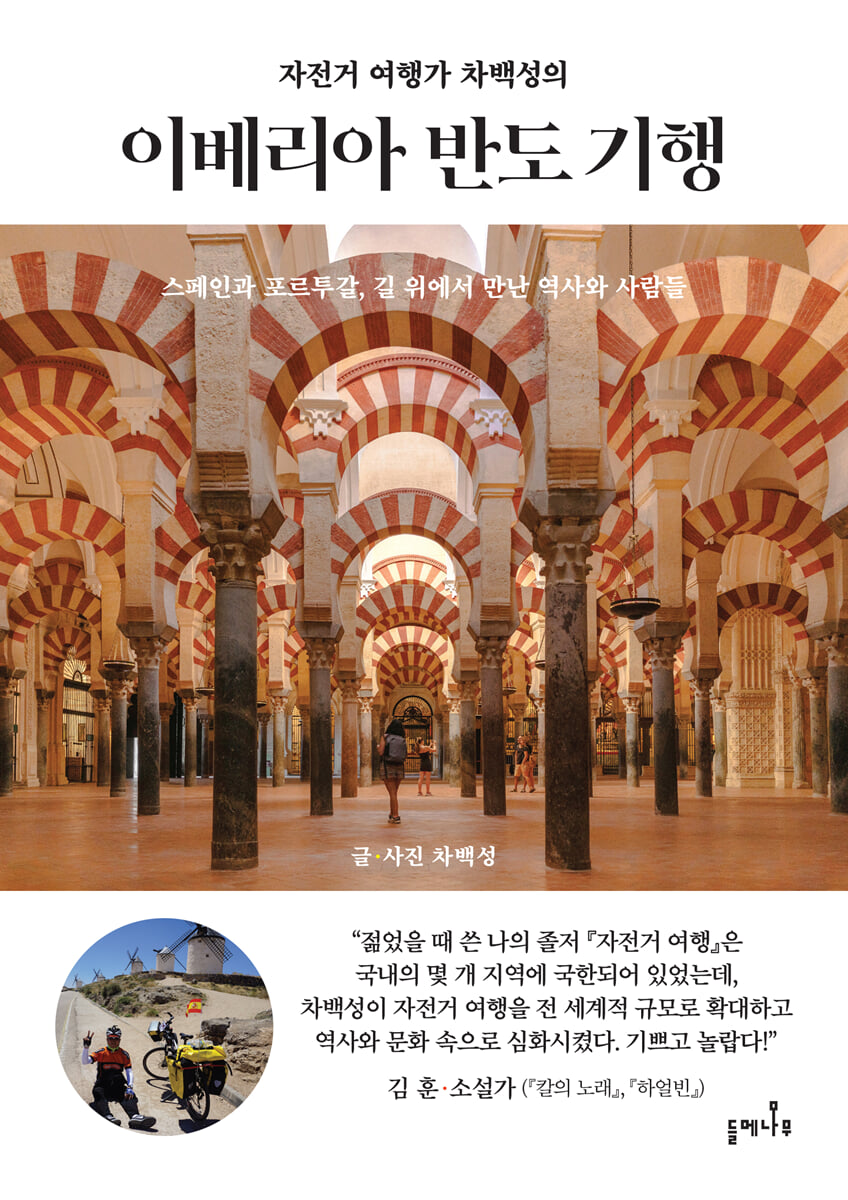
Bicycle traveler Cha Baek-seong's Iberian Peninsula journey
 |
Description
Book Introduction
Where art and revolution, faith and romance intersect
Humanities Travelogue of Spain and Portugal
This is a travelogue of humanities written by author Baekseong Cha, known as the “humanist on the road,” who traveled to around 20 cities in Spain and Portugal and recorded stories of art, history, faith, and humanity.
From the Prado Museum in Madrid, to the Mezquita in Cordoba, to the Camino de Santiago, to the traces of Lisbon's great voyages—we travel the land of hot sun and wind on two wheels, singing of life's passion and reflections on the road.
His gaze is not that of a simple traveler, but that of a humanist learning on the spot.
This book is the fifth journey in the "Themed Road Travel Series," following "American Road," "Japan Road," "European Road," and "Bicycle White Nights," and is a record of reflection that asks again about the meaning of the homeland and humanity in the history of the world.
Humanities Travelogue of Spain and Portugal
This is a travelogue of humanities written by author Baekseong Cha, known as the “humanist on the road,” who traveled to around 20 cities in Spain and Portugal and recorded stories of art, history, faith, and humanity.
From the Prado Museum in Madrid, to the Mezquita in Cordoba, to the Camino de Santiago, to the traces of Lisbon's great voyages—we travel the land of hot sun and wind on two wheels, singing of life's passion and reflections on the road.
His gaze is not that of a simple traveler, but that of a humanist learning on the spot.
This book is the fifth journey in the "Themed Road Travel Series," following "American Road," "Japan Road," "European Road," and "Bicycle White Nights," and is a record of reflection that asks again about the meaning of the homeland and humanity in the history of the world.
- You can preview some of the book's contents.
Preview
index
Spain
Chapter 1 [Madrid and the Central Plateau] The heart of Spain, where time and art intersect.
Stroll through Madrid, the capital of art and revolution.
The majesty of El Escorial and the shadow of Franco
Segovia, the Aqueduct and the Alcazar, and the Memories of Cochinillo
The Melodies of Aranjuez and the Thousand-Year-Old Capital of Toledo
Don Quixote's La Mancha, a field where madness and romance dance
Chapter 2 [Andalusia] A Crossroads of Civilizations Where Islam and Catholicism Meet
Al-Andalus, the Birth of Islamic Civilization
Cordoba, the city of Mezquita and Carmen
Flamenco, the fiery gypsy dance
Seville, meeting Columbus at the threshold of the ocean
Granada, the last city of the Islamic Empire
See blood and art in Ronda, the birthplace of bullfighting.
Chapter 3 [Southern Coast] At the border where the two seas, the Mediterranean and the Atlantic, meet
Remembering Yi Sun-sin at Trafalgar
Gibraltar: A Little England in Spain
The endless allure of the Costa del Sol, the beach of the sun
Chapter 4 [The Camino de Santiago and the North] On the Road That Calls the Soul
From the Altamira Murals to the Guggenheim Museum, a Northern Time Travel
'The Architect Given by God?' and Oviedo
The Camino de Santiago, a crossroads of life and faith
Portugal
Chapter 1 [Porto and the North] Gateway to the Atlantic, Where Memories of Navigation Remain
Chapter 2 [The Dawn of the Age of Discovery] The Door Opens to Uncharted Seas
Chapter 3 [Coimbra and the Central Region] The Eternal City Where Time and Learning Stay
Chapter 4 [Lisbon] Following the Great Earthquake and the Traces of Faded Glory
Chapter 5 [Near Lisbon] From Land's End to the Sea Again
Chapter 1 [Madrid and the Central Plateau] The heart of Spain, where time and art intersect.
Stroll through Madrid, the capital of art and revolution.
The majesty of El Escorial and the shadow of Franco
Segovia, the Aqueduct and the Alcazar, and the Memories of Cochinillo
The Melodies of Aranjuez and the Thousand-Year-Old Capital of Toledo
Don Quixote's La Mancha, a field where madness and romance dance
Chapter 2 [Andalusia] A Crossroads of Civilizations Where Islam and Catholicism Meet
Al-Andalus, the Birth of Islamic Civilization
Cordoba, the city of Mezquita and Carmen
Flamenco, the fiery gypsy dance
Seville, meeting Columbus at the threshold of the ocean
Granada, the last city of the Islamic Empire
See blood and art in Ronda, the birthplace of bullfighting.
Chapter 3 [Southern Coast] At the border where the two seas, the Mediterranean and the Atlantic, meet
Remembering Yi Sun-sin at Trafalgar
Gibraltar: A Little England in Spain
The endless allure of the Costa del Sol, the beach of the sun
Chapter 4 [The Camino de Santiago and the North] On the Road That Calls the Soul
From the Altamira Murals to the Guggenheim Museum, a Northern Time Travel
'The Architect Given by God?' and Oviedo
The Camino de Santiago, a crossroads of life and faith
Portugal
Chapter 1 [Porto and the North] Gateway to the Atlantic, Where Memories of Navigation Remain
Chapter 2 [The Dawn of the Age of Discovery] The Door Opens to Uncharted Seas
Chapter 3 [Coimbra and the Central Region] The Eternal City Where Time and Learning Stay
Chapter 4 [Lisbon] Following the Great Earthquake and the Traces of Faded Glory
Chapter 5 [Near Lisbon] From Land's End to the Sea Again
Detailed image

Into the book
I feel a special emotion when I come across a special structure or a beautiful bridge while traveling.
I walked slowly from the beginning to the end of the water bridge.
(……) I have seen aqueducts in Italy, France, Turkey, and other places while traveling around Europe, but this is the first time I have seen such a large and wonderful structure that has come down intact.
In Roman times, there likely weren't even civil engineering departments in engineering schools, yet they built structures that lasted a staggering 2,000 years! We salute the "engineers" of that time, who maintained a 1-degree slope and controlled the flow of water from afar using natural water pressure, without any construction equipment, or even surveying tools like transits or levels.
--- p.54 From “Amazing Structure, Aqueduct”
Traveling the world by bicycle may seem trivial and insignificant to others, but to me it was a major undertaking worth dedicating my life to.
I thought that enduring 'small humiliations' to achieve one's dreams was truly a way to preserve one's self-esteem.
Courage is overcoming fear.
In times of transition, it takes courage to be bullied.
It is a departure from the normal course of life that has been followed so far.
Realizing the dream I had as a child was the courage to have the confidence that I would not fall behind others on the long road of life.
The source of my courage was the inspiration I got from Don Quixote, which I read in my youth.
Don Quixote, who thought of the country woman Dulcinea as a princess and the windmills as threatening enemies, charged forward on his old horse Rocinante.
He shouted like this.
“I threw myself into whatever I attempted with passion and conviction.
If I thought I was right, I would take any risk and challenge myself.
“Even if I was broken, torn apart, and left with bruises, I dreamed the impossible dream, loved the impossible love, endured the unbearable pain, fought the unbeatable enemy, and ran to catch the unreachable star in the sky.”
--- pp.84-85 From “Inspiration from Don Quixote”
Tarrega loved his beautiful disciple Concha.
But it is a love that cannot be realized because she is married.
Nevertheless, Tarrega's love only deepened.
One day in 1896, he toured the Alhambra Palace with Concha.
As the sunset bathed the palace in red, he confessed his love to her, but was rejected.
Later, he wrote a song recalling that night they spent together in the moonlight.
That is 『Memories of the Alhambra (Recuerdos de la Alhambra)』.
Unfulfilled love seeped into a palace with a sad history, giving birth to the 'flower' of Spanish Romantic music.
I too felt a thrill of excitement when I first heard this song.
--- p.149 From “Impossible Love”
In one breath, I reached the top of Gibraltar, also known as the 'Upper Rock'.
My heart swelled with admiration and excitement.
A wind blowing from an unknown sea or land dug deep into my lungs.
The Mediterranean Sea, the Atlantic Ocean, and the European and African continents are all visible at a glance.
Is there anywhere else on Earth where you can stand on two feet and see two continents and two oceans at once?
I felt like I was standing on a giant globe, like a master using the magic of shrinking.
When I get back down, it will just be a memory, but at this moment, happiness fills my whole body.
Although it was a shame that my beloved horse, 'Rocinante', was not by my side, I turned another page on my 'bucket list', a dream I had long held.
--- p.188 From “The Excitement of Standing on a Giant Globe!”
When traveling alone, you have to endure extreme loneliness.
The weight of that loneliness is heavier than the seven bags on my bike.
But the reason I endure the pain and travel alone is because life is a long journey that I have to take alone anyway.
I prepare for the 'eternal journey' by continuing to pickle my soul through travel.
(……)
“Are you satisfied with your life now?
Should I just go with the flow and live without any clear plans or goals?
What are some priorities in my life that I can change?
If I change it, what will it mean to me?”
Constantly ask yourself questions and reflect on yourself.
This is the best moment of solo travel.
--- p.263 From "Let's go on a pilgrimage, alone!"
Portuguese slave traders simply had to dock their trading ships at the port of Lagos, pay the Yoruba appropriate price for the slaves who had completed their 'physical examination', tie them up like oysters, and 'load' them.
(……)
He showed me a mouth gag that looked like an old pair of scissors from a candy seller.
After hearing his explanation, I couldn't help but ask the curator this question.
“So what happened to the slaves who were eliminated? Did they send them back?”
“No.
“Useless ‘things’ were immediately disposed of.”
My face turned pale, without any further color.
My assistant, Odama, who was with me, asked me several times if I was okay.
I left the museum with a heavy heart, once again feeling the cruelty of Europeans in the past.
--- pp.316-317 From “Teeth Determine the Price of Things”
The ultimate form of travel, of departure, is death.
Life breathes the universe, but it is destined to have limitations that will force it to abandon everything and leave.
A journey away from everyday life is connected to death, which means leaving everything behind.
After a long and arduous journey, the world looks different and you begin to accept the reality that has been given to you.
It also develops a heart that cares for all beings, not just others.
The experience of leaving makes you take reality more seriously.
Ultimately, dying well means realizing that one day I too must embark on the path to eternity, and this becomes the way to live well in reality.
So, travel is a practice for death, but it is not a gloomy preview, but a process of self-awakening that affirms life.
I walked slowly from the beginning to the end of the water bridge.
(……) I have seen aqueducts in Italy, France, Turkey, and other places while traveling around Europe, but this is the first time I have seen such a large and wonderful structure that has come down intact.
In Roman times, there likely weren't even civil engineering departments in engineering schools, yet they built structures that lasted a staggering 2,000 years! We salute the "engineers" of that time, who maintained a 1-degree slope and controlled the flow of water from afar using natural water pressure, without any construction equipment, or even surveying tools like transits or levels.
--- p.54 From “Amazing Structure, Aqueduct”
Traveling the world by bicycle may seem trivial and insignificant to others, but to me it was a major undertaking worth dedicating my life to.
I thought that enduring 'small humiliations' to achieve one's dreams was truly a way to preserve one's self-esteem.
Courage is overcoming fear.
In times of transition, it takes courage to be bullied.
It is a departure from the normal course of life that has been followed so far.
Realizing the dream I had as a child was the courage to have the confidence that I would not fall behind others on the long road of life.
The source of my courage was the inspiration I got from Don Quixote, which I read in my youth.
Don Quixote, who thought of the country woman Dulcinea as a princess and the windmills as threatening enemies, charged forward on his old horse Rocinante.
He shouted like this.
“I threw myself into whatever I attempted with passion and conviction.
If I thought I was right, I would take any risk and challenge myself.
“Even if I was broken, torn apart, and left with bruises, I dreamed the impossible dream, loved the impossible love, endured the unbearable pain, fought the unbeatable enemy, and ran to catch the unreachable star in the sky.”
--- pp.84-85 From “Inspiration from Don Quixote”
Tarrega loved his beautiful disciple Concha.
But it is a love that cannot be realized because she is married.
Nevertheless, Tarrega's love only deepened.
One day in 1896, he toured the Alhambra Palace with Concha.
As the sunset bathed the palace in red, he confessed his love to her, but was rejected.
Later, he wrote a song recalling that night they spent together in the moonlight.
That is 『Memories of the Alhambra (Recuerdos de la Alhambra)』.
Unfulfilled love seeped into a palace with a sad history, giving birth to the 'flower' of Spanish Romantic music.
I too felt a thrill of excitement when I first heard this song.
--- p.149 From “Impossible Love”
In one breath, I reached the top of Gibraltar, also known as the 'Upper Rock'.
My heart swelled with admiration and excitement.
A wind blowing from an unknown sea or land dug deep into my lungs.
The Mediterranean Sea, the Atlantic Ocean, and the European and African continents are all visible at a glance.
Is there anywhere else on Earth where you can stand on two feet and see two continents and two oceans at once?
I felt like I was standing on a giant globe, like a master using the magic of shrinking.
When I get back down, it will just be a memory, but at this moment, happiness fills my whole body.
Although it was a shame that my beloved horse, 'Rocinante', was not by my side, I turned another page on my 'bucket list', a dream I had long held.
--- p.188 From “The Excitement of Standing on a Giant Globe!”
When traveling alone, you have to endure extreme loneliness.
The weight of that loneliness is heavier than the seven bags on my bike.
But the reason I endure the pain and travel alone is because life is a long journey that I have to take alone anyway.
I prepare for the 'eternal journey' by continuing to pickle my soul through travel.
(……)
“Are you satisfied with your life now?
Should I just go with the flow and live without any clear plans or goals?
What are some priorities in my life that I can change?
If I change it, what will it mean to me?”
Constantly ask yourself questions and reflect on yourself.
This is the best moment of solo travel.
--- p.263 From "Let's go on a pilgrimage, alone!"
Portuguese slave traders simply had to dock their trading ships at the port of Lagos, pay the Yoruba appropriate price for the slaves who had completed their 'physical examination', tie them up like oysters, and 'load' them.
(……)
He showed me a mouth gag that looked like an old pair of scissors from a candy seller.
After hearing his explanation, I couldn't help but ask the curator this question.
“So what happened to the slaves who were eliminated? Did they send them back?”
“No.
“Useless ‘things’ were immediately disposed of.”
My face turned pale, without any further color.
My assistant, Odama, who was with me, asked me several times if I was okay.
I left the museum with a heavy heart, once again feeling the cruelty of Europeans in the past.
--- pp.316-317 From “Teeth Determine the Price of Things”
The ultimate form of travel, of departure, is death.
Life breathes the universe, but it is destined to have limitations that will force it to abandon everything and leave.
A journey away from everyday life is connected to death, which means leaving everything behind.
After a long and arduous journey, the world looks different and you begin to accept the reality that has been given to you.
It also develops a heart that cares for all beings, not just others.
The experience of leaving makes you take reality more seriously.
Ultimately, dying well means realizing that one day I too must embark on the path to eternity, and this becomes the way to live well in reality.
So, travel is a practice for death, but it is not a gloomy preview, but a process of self-awakening that affirms life.
--- p.357 From “Humanistic Journey and Death”
Publisher's Review
“Travel is reading with your whole body.
“The scenery on the road is deeper than a book, and the encounter is warmer than thought.” - Cha Baek-seong
■ Spain and Portugal: The Moment Travel Becomes Humanities
『Bicycle Traveler Cha Baek-seong's Iberian Peninsula Journey』 is a humanities travelogue written by author Cha Baek-seong, known as a "humanist on the road," who traveled to around 20 cities in Spain and Portugal for 60 days and recorded stories of art, history, faith, and humanity.
From the Prado Museum in Madrid, to the Mezquita in Cordoba, to the Camino de Santiago, to traces of the Age of Exploration in Lisbon—he travels through the cities of both countries, interpreting the "landscapes on the road" through a humanistic lens.
This book is not just a travelogue.
It is a journey where humanities learned in the field, thoughts on art and civilization, and human passion and beliefs intersect.
The author says, “Travel is reading with your whole body,” and asks about philosophy on the road and discovers humanity in history.
■ Conversations with people I met on the road - Art, history, and life
Author Cha Baek-seong captures the meaning of life and humanity in various travel destinations.
In front of the 2,000-year-old Roman aqueduct in Segovia, we pay tribute to the wisdom of ancient engineers, and in front of the cochinillo asado, a dish of suckling pig, we offer a prayer of remembrance, saying, “In your next life, be reborn as a human.”
At night in Seville, I feel a passion deeper than that of youth in the flamenco of an old dancer, and at the Alhambra Palace, I listen to the music of Tárrega, created by unrequited love, and I mutter, “If love had come true, this song would not have existed.”
At the summit of Gibraltar, you will experience the “awesome moment of standing on a globe” in front of the sight of two continents and two oceans meeting.
In this way, 『Bicycle Traveler Cha Baek-seong's Iberian Peninsula Journey』 is a record that combines humanistic depth, vivid realism, and human humor.
The author's journey is filled with solitude, challenge, and contemplation, and ultimately leads to a reflection on life.
■ Seeing Myself in the World - A Humanities Journey Through Iberia Seen Through the Eyes of a Korean
The biggest difference of this book is its perspective of reading the world through the eyes of a Korean.
We visit Toledo, the hometown of Spanish priest Gregorio de Cespedes, who visited Joseon during the Imjin War, and read about the rise and fall of the Spanish Empire and Joseon's diplomatic history.
At the Palace of El Escorial, I look upon the fall of the empire and recall the Katsura-Taft Agreement, and in front of the Alcazar, the castle of Snow White, I recall the frustration of the Hague envoy.
He confesses, “How fortunate it is that my country is still alive at this very moment,” and looks at Joseon again in the world.
The author reflects on our own appearance through the history and culture of other countries.
His journey is not just a 'journey to see the world', but a 'mirror to look back on myself and our history'.
■ A Guide to Humanistic Journeys - "Learning About the World on the Road"
“Travel is reading with your whole body.
“The scenery on the road is deeper than a book, and the encounter is warmer than thought.”
― Cha Baek-seong
Artist Baekseong Cha uses bicycles as a metaphor for life and a tool for thought, exploring people and history on the road.
The fifth journey in the "Themed Road Travel Series" following "American Road," "Japan Road," "European Road," and "Bicycle White Night Travel," "Bicycle Traveler Cha Baek-seong's Iberian Peninsula Travels" is a humanities travel book that encompasses art and faith, empires and their downfall, and human courage and reflection.
We suggest a trip that goes deeper than going quickly, and a trip that feels properly rather than seeing a lot.
This book is a philosophy on the road that helps you adjust the pace of life and reorient your mind.
It will provide a unique experience that will allow you to explore Spain and Portugal in greater depth.
“The scenery on the road is deeper than a book, and the encounter is warmer than thought.” - Cha Baek-seong
■ Spain and Portugal: The Moment Travel Becomes Humanities
『Bicycle Traveler Cha Baek-seong's Iberian Peninsula Journey』 is a humanities travelogue written by author Cha Baek-seong, known as a "humanist on the road," who traveled to around 20 cities in Spain and Portugal for 60 days and recorded stories of art, history, faith, and humanity.
From the Prado Museum in Madrid, to the Mezquita in Cordoba, to the Camino de Santiago, to traces of the Age of Exploration in Lisbon—he travels through the cities of both countries, interpreting the "landscapes on the road" through a humanistic lens.
This book is not just a travelogue.
It is a journey where humanities learned in the field, thoughts on art and civilization, and human passion and beliefs intersect.
The author says, “Travel is reading with your whole body,” and asks about philosophy on the road and discovers humanity in history.
■ Conversations with people I met on the road - Art, history, and life
Author Cha Baek-seong captures the meaning of life and humanity in various travel destinations.
In front of the 2,000-year-old Roman aqueduct in Segovia, we pay tribute to the wisdom of ancient engineers, and in front of the cochinillo asado, a dish of suckling pig, we offer a prayer of remembrance, saying, “In your next life, be reborn as a human.”
At night in Seville, I feel a passion deeper than that of youth in the flamenco of an old dancer, and at the Alhambra Palace, I listen to the music of Tárrega, created by unrequited love, and I mutter, “If love had come true, this song would not have existed.”
At the summit of Gibraltar, you will experience the “awesome moment of standing on a globe” in front of the sight of two continents and two oceans meeting.
In this way, 『Bicycle Traveler Cha Baek-seong's Iberian Peninsula Journey』 is a record that combines humanistic depth, vivid realism, and human humor.
The author's journey is filled with solitude, challenge, and contemplation, and ultimately leads to a reflection on life.
■ Seeing Myself in the World - A Humanities Journey Through Iberia Seen Through the Eyes of a Korean
The biggest difference of this book is its perspective of reading the world through the eyes of a Korean.
We visit Toledo, the hometown of Spanish priest Gregorio de Cespedes, who visited Joseon during the Imjin War, and read about the rise and fall of the Spanish Empire and Joseon's diplomatic history.
At the Palace of El Escorial, I look upon the fall of the empire and recall the Katsura-Taft Agreement, and in front of the Alcazar, the castle of Snow White, I recall the frustration of the Hague envoy.
He confesses, “How fortunate it is that my country is still alive at this very moment,” and looks at Joseon again in the world.
The author reflects on our own appearance through the history and culture of other countries.
His journey is not just a 'journey to see the world', but a 'mirror to look back on myself and our history'.
■ A Guide to Humanistic Journeys - "Learning About the World on the Road"
“Travel is reading with your whole body.
“The scenery on the road is deeper than a book, and the encounter is warmer than thought.”
― Cha Baek-seong
Artist Baekseong Cha uses bicycles as a metaphor for life and a tool for thought, exploring people and history on the road.
The fifth journey in the "Themed Road Travel Series" following "American Road," "Japan Road," "European Road," and "Bicycle White Night Travel," "Bicycle Traveler Cha Baek-seong's Iberian Peninsula Travels" is a humanities travel book that encompasses art and faith, empires and their downfall, and human courage and reflection.
We suggest a trip that goes deeper than going quickly, and a trip that feels properly rather than seeing a lot.
This book is a philosophy on the road that helps you adjust the pace of life and reorient your mind.
It will provide a unique experience that will allow you to explore Spain and Portugal in greater depth.
GOODS SPECIFICS
- Date of issue: November 10, 2025
- Page count, weight, size: 420 pages | 148*210*30mm
- ISBN13: 9791186889367
- ISBN10: 1186889365
You may also like
카테고리
korean


korean

![GQ KOREA Mark (Monthly): December [2025]](http://librairie.coreenne.fr/cdn/shop/files/8ef265dbbfbf186523ed75ba7319009d.jpg?v=1765340328&width=3840)


