

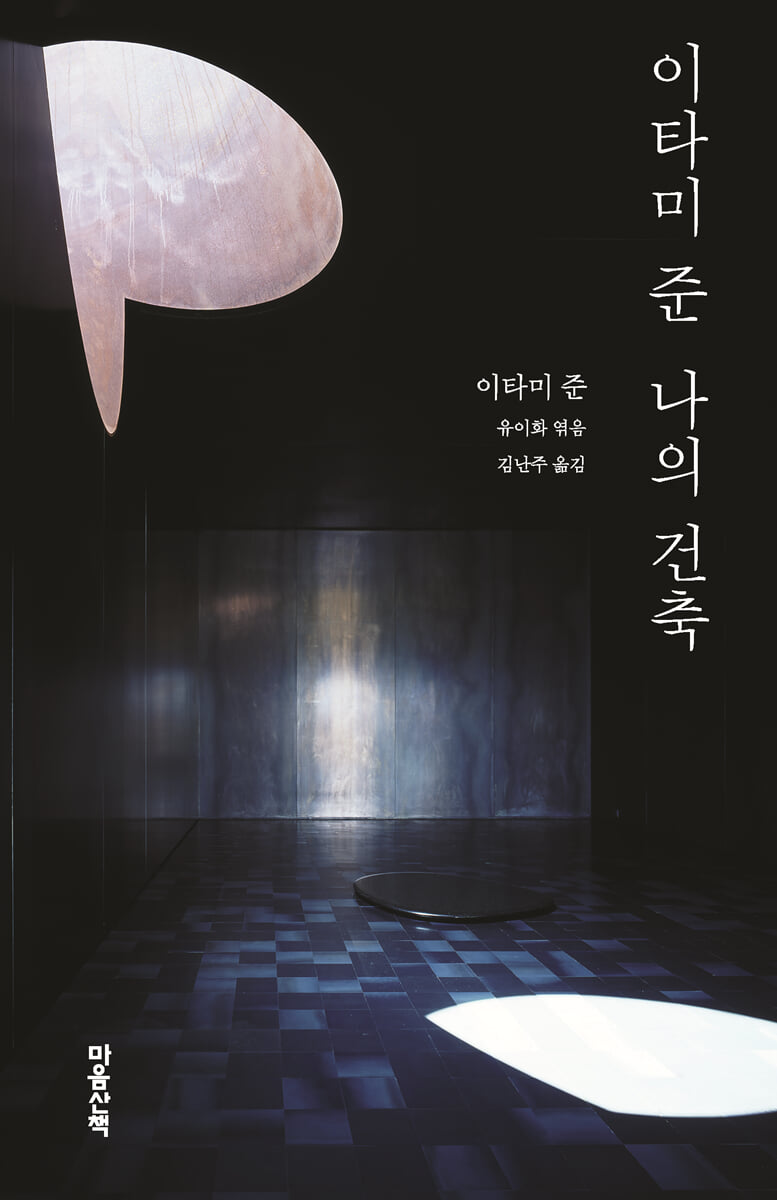
Jun Itami My Architecture
 |
Description
Book Introduction
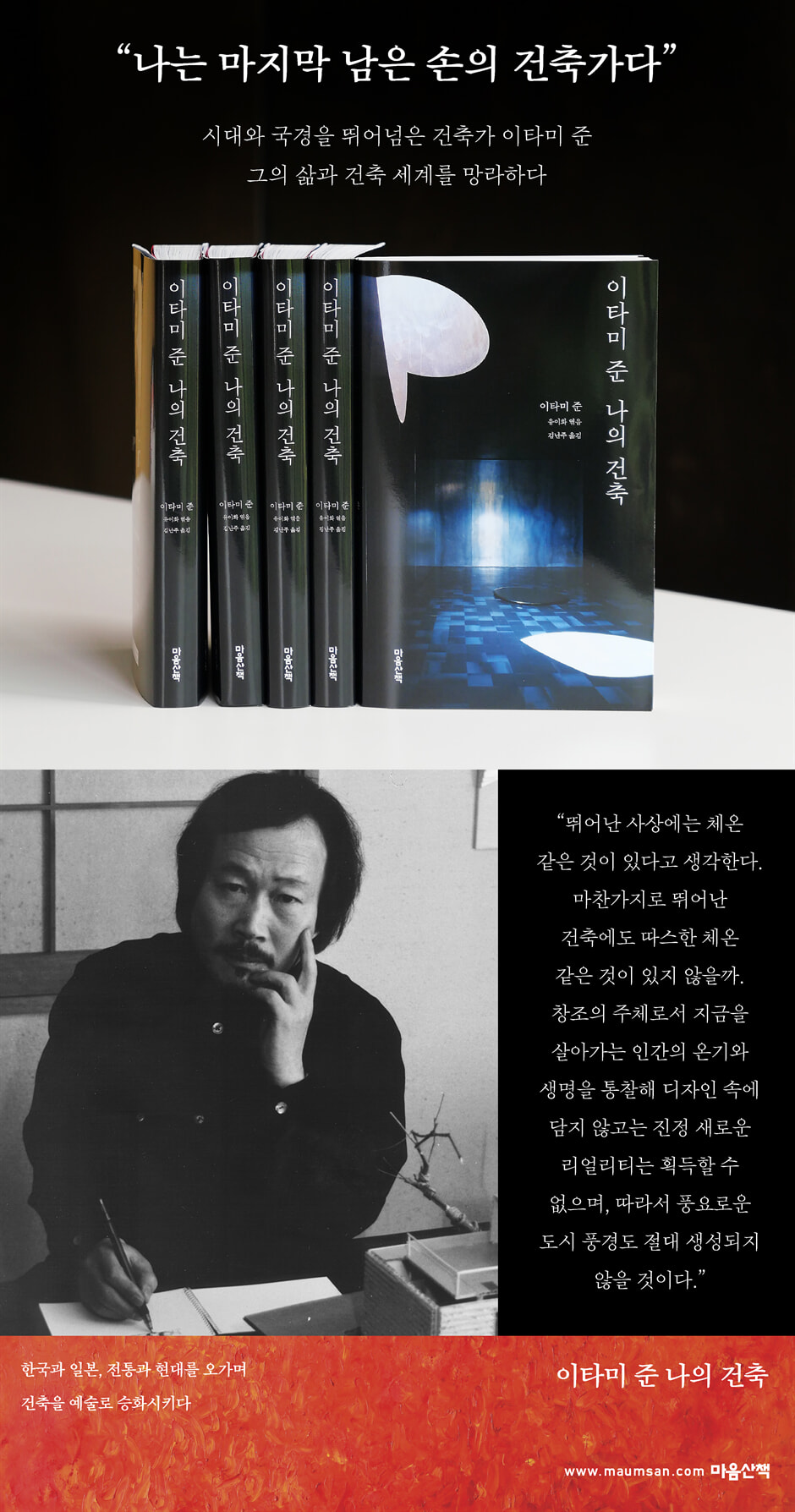
“I am the architect of the last remaining hand.”
Jun Itami, an architect who transcended time and borders
Covering his life and the world of architecture
He was the first Asian artist to hold a solo exhibition at the Guimet Museum of Asian Art in France, was awarded the Chevalier of France, and was the first Korean in Japan to receive the Murano Togo Award.
Architect Jun Itami achieved splendid fame in his later years, but the buildings he left behind over the years are quiet and simple.
Representative works such as Japan's 'House of Food', 'House of Margins', and 'Stone Church', and Korea's Jeju Island's 'Grape Hotel', 'Water, Wind, and Stone Art Museum', and 'Ark Church' are famous for their architecture that blends into nature and takes advantage of the local customs and characteristics.
"Jun Itami, My Architecture" is a book that provides a glimpse into the life and architectural world of architect Jun Itami.
As a second-generation Korean born in Japan, he embraced his identity as a border person and constantly questioned what architecture should contain.
Based on the questions that permeated his life, he built a unique architectural world that is not influenced by any trends or fads, and that shows the aesthetics of restraint and harmony.
After establishing an architectural firm in the late 1960s, he began to actively contribute articles on architecture.
This book contains writings he wrote until a few years before his death, along with a variety of photographs.
From childhood memories and everyday experiences to explorations of Joseon Dynasty architecture and art, exchanges with architects and artists who inspired and inspired him, and deep thoughts and design intentions behind his architecture, you can see it all at a glance.
This book is even more meaningful as it was compiled and compiled by architect Yuihwa Yu, the daughter of Jun Itami and an active member of the front lines who has inherited her father's philosophy.
My father stuck to analog drawing until the end.
He considers himself the 'architect of the last remaining hand', and he draws with his soul in every single line, excluding computer design.
I also believe that the power of hand architecture is ‘heart.’
The process of a sketch becoming a model, and the model becoming architecture, is ultimately a connection between the hand and the heart, and the soul being born as architecture.
─From "Seomun (Architect Yuihwa)"
Jun Itami, an architect who transcended time and borders
Covering his life and the world of architecture
He was the first Asian artist to hold a solo exhibition at the Guimet Museum of Asian Art in France, was awarded the Chevalier of France, and was the first Korean in Japan to receive the Murano Togo Award.
Architect Jun Itami achieved splendid fame in his later years, but the buildings he left behind over the years are quiet and simple.
Representative works such as Japan's 'House of Food', 'House of Margins', and 'Stone Church', and Korea's Jeju Island's 'Grape Hotel', 'Water, Wind, and Stone Art Museum', and 'Ark Church' are famous for their architecture that blends into nature and takes advantage of the local customs and characteristics.
"Jun Itami, My Architecture" is a book that provides a glimpse into the life and architectural world of architect Jun Itami.
As a second-generation Korean born in Japan, he embraced his identity as a border person and constantly questioned what architecture should contain.
Based on the questions that permeated his life, he built a unique architectural world that is not influenced by any trends or fads, and that shows the aesthetics of restraint and harmony.
After establishing an architectural firm in the late 1960s, he began to actively contribute articles on architecture.
This book contains writings he wrote until a few years before his death, along with a variety of photographs.
From childhood memories and everyday experiences to explorations of Joseon Dynasty architecture and art, exchanges with architects and artists who inspired and inspired him, and deep thoughts and design intentions behind his architecture, you can see it all at a glance.
This book is even more meaningful as it was compiled and compiled by architect Yuihwa Yu, the daughter of Jun Itami and an active member of the front lines who has inherited her father's philosophy.
My father stuck to analog drawing until the end.
He considers himself the 'architect of the last remaining hand', and he draws with his soul in every single line, excluding computer design.
I also believe that the power of hand architecture is ‘heart.’
The process of a sketch becoming a model, and the model becoming architecture, is ultimately a connection between the hand and the heart, and the soul being born as architecture.
─From "Seomun (Architect Yuihwa)"
- You can preview some of the book's contents.
Preview
index
Seomun Yuihwa
1 Itami Jun, Yoo Dong-ryong
A moment when the heart trembles / A landscape that never disappears / The taste of tofu / A box of wind and air / A store where warmth flows / Early in the morning, my beloved porridge / Black paper and white thread / In the corner of memory / The new face of Insa-dong / Water drop (poem)
2 Living in Joseon
From Earth to Earth / Jongmyo Shrine, Silent Architecture / The Color of Sun and Sorrow / The Beauty of Selflessness / The Paintings of the People / In Stone and Light / Fascinated by Furniture and Inkstones / Silla's Buddhist Statues / Sculptures of Love / Sculptures of Love / Warm Naturalness, White Porcelain / Crystal Clear Tea Bowls / Born Through the 'Eye of the Hand' / White and Transparent Beauty / Korean Folk Houses Following the Law of Nature / The Power of Typography (Bold Talk)
3 The Birth of Inspiration
Le Corbusier and Stirling's City / The Extraordinary Land, the Acropolis / When Encountering a Beautiful Chair / Drawing of the Soul / Photographer Osamu Murai / Sculptor Shiro Hayami / Architect Kim Chung-up / Towards Modern Korea / Painter Kwak In-sik / In Memory of Seiichi Shirai
4 My Architecture
Stones and Birds (Poetry) / The Language of Stone / The Story of a Black Box - House of Ink / Two Boxes - House of Blank Space / A Space Beyond Time - Trunk / An Architect Who Adapts to Nature (Dialogue) / Earthen Architecture and Its Self-Reliance - Onyang Art Museum / Essential Life Force - Sculptor's Studio / The Origin of Artificial Marble / Architecture of Imprints - Tower of Imprints / In the Sea and Wind - Manjisha / Into an Infinite Space - Church of Stone / Aesthetics of the Restroom / Pillar of the City - M Building / Dream Stories and Space of Ink / Renovation - Our House and Its Surroundings / Without Going Against the Topography - Grape Hotel / An Architect's Mind's Eye / Song of the Wind
1 Itami Jun, Yoo Dong-ryong
A moment when the heart trembles / A landscape that never disappears / The taste of tofu / A box of wind and air / A store where warmth flows / Early in the morning, my beloved porridge / Black paper and white thread / In the corner of memory / The new face of Insa-dong / Water drop (poem)
2 Living in Joseon
From Earth to Earth / Jongmyo Shrine, Silent Architecture / The Color of Sun and Sorrow / The Beauty of Selflessness / The Paintings of the People / In Stone and Light / Fascinated by Furniture and Inkstones / Silla's Buddhist Statues / Sculptures of Love / Sculptures of Love / Warm Naturalness, White Porcelain / Crystal Clear Tea Bowls / Born Through the 'Eye of the Hand' / White and Transparent Beauty / Korean Folk Houses Following the Law of Nature / The Power of Typography (Bold Talk)
3 The Birth of Inspiration
Le Corbusier and Stirling's City / The Extraordinary Land, the Acropolis / When Encountering a Beautiful Chair / Drawing of the Soul / Photographer Osamu Murai / Sculptor Shiro Hayami / Architect Kim Chung-up / Towards Modern Korea / Painter Kwak In-sik / In Memory of Seiichi Shirai
4 My Architecture
Stones and Birds (Poetry) / The Language of Stone / The Story of a Black Box - House of Ink / Two Boxes - House of Blank Space / A Space Beyond Time - Trunk / An Architect Who Adapts to Nature (Dialogue) / Earthen Architecture and Its Self-Reliance - Onyang Art Museum / Essential Life Force - Sculptor's Studio / The Origin of Artificial Marble / Architecture of Imprints - Tower of Imprints / In the Sea and Wind - Manjisha / Into an Infinite Space - Church of Stone / Aesthetics of the Restroom / Pillar of the City - M Building / Dream Stories and Space of Ink / Renovation - Our House and Its Surroundings / Without Going Against the Topography - Grape Hotel / An Architect's Mind's Eye / Song of the Wind
Detailed image
Into the book
In art, theory follows the work.
Works of art can be analyzed theoretically.
But art is not born from theory.
In that sense, art is something that is difficult to define and contains mystery.
--- p.51
In an age of anonymity, an unknown painter, wandering from place to place, working more freely and more creatively, would not have even consciously judged whether the picture he painted was beautiful.
They would have simply moved their brushes and traced the outlines of objects, without any ambition and with only an interest in the living spaces of common people.
There was a careless heart behind that act.
In this way, folk paintings were born from the lives of the people.
--- p.86
Although the process of making Joseon porcelain by shaping and firing clay can be said to be authentic, in terms of form and shape, it can only be said to be truly immature.
However, it is a so-called imperfect, unfinished vessel that has a human touch like human warmth and is free from any traces of artificiality.
Only when another element, tea, is added to it does it show its complete beauty and blend in with the surrounding objects.
Perhaps its simplicity and imperfection are what captivate people with its timeless beauty.
--- p.103-104
I do not mean to exclude function from architecture.
There is even less desire to pursue virtual architecture that entrusts the construction of space to digital and computer graphics.
I want to build a world that can be said to be my own unique modernism or genre, with traces of my hands and physicality still present.
--- p.191
A form appropriate to the local climate should not be forced.
Simply placing a sculpture in the landscape does not create a sculpture.
Only a shape derived from the local climate can become a mountain shape.
Therefore, it is necessary to find the essence in the local culture.
--- p.212-213
I think that great ideas have something like body temperature.
Likewise, wouldn't excellent architecture also have something like a warm body temperature?
Without incorporating the warmth and life of humans living in the present as the subjects of creation into design, a truly new reality cannot be achieved, and thus, a rich urban landscape will never be created.
--- p.286-288
For me, 'description' and 'drawing' are not only means of tracing the outline of architecture and objects, but also a tuning for my life and a rite of passage for the original experience and confirmation toward architecture.
In other words, it may be the structure of love that leads to architecture, the construction of softness.
--- p.301
What should be included at the foundation of architecture?
Unless it contains human life and strong aspirations, it is difficult to complete architecture that moves people.
It contains human warmth and life at its core.
How can we infuse the traditions, context, and essence of the region into the buildings we build in the future?
What is important is to listen to the local customs and the language that the 'sound of the wind' speaks.
Works of art can be analyzed theoretically.
But art is not born from theory.
In that sense, art is something that is difficult to define and contains mystery.
--- p.51
In an age of anonymity, an unknown painter, wandering from place to place, working more freely and more creatively, would not have even consciously judged whether the picture he painted was beautiful.
They would have simply moved their brushes and traced the outlines of objects, without any ambition and with only an interest in the living spaces of common people.
There was a careless heart behind that act.
In this way, folk paintings were born from the lives of the people.
--- p.86
Although the process of making Joseon porcelain by shaping and firing clay can be said to be authentic, in terms of form and shape, it can only be said to be truly immature.
However, it is a so-called imperfect, unfinished vessel that has a human touch like human warmth and is free from any traces of artificiality.
Only when another element, tea, is added to it does it show its complete beauty and blend in with the surrounding objects.
Perhaps its simplicity and imperfection are what captivate people with its timeless beauty.
--- p.103-104
I do not mean to exclude function from architecture.
There is even less desire to pursue virtual architecture that entrusts the construction of space to digital and computer graphics.
I want to build a world that can be said to be my own unique modernism or genre, with traces of my hands and physicality still present.
--- p.191
A form appropriate to the local climate should not be forced.
Simply placing a sculpture in the landscape does not create a sculpture.
Only a shape derived from the local climate can become a mountain shape.
Therefore, it is necessary to find the essence in the local culture.
--- p.212-213
I think that great ideas have something like body temperature.
Likewise, wouldn't excellent architecture also have something like a warm body temperature?
Without incorporating the warmth and life of humans living in the present as the subjects of creation into design, a truly new reality cannot be achieved, and thus, a rich urban landscape will never be created.
--- p.286-288
For me, 'description' and 'drawing' are not only means of tracing the outline of architecture and objects, but also a tuning for my life and a rite of passage for the original experience and confirmation toward architecture.
In other words, it may be the structure of love that leads to architecture, the construction of softness.
--- p.301
What should be included at the foundation of architecture?
Unless it contains human life and strong aspirations, it is difficult to complete architecture that moves people.
It contains human warmth and life at its core.
How can we infuse the traditions, context, and essence of the region into the buildings we build in the future?
What is important is to listen to the local customs and the language that the 'sound of the wind' speaks.
--- p.319
Publisher's Review
Korea and Japan, going back and forth between tradition and modernity
Elevating architecture into art
Jun Itami used the Korean name Yoo Dong-ryong until he graduated from university, but this restricted his work as an architect.
Then, during his first visit to Korea, he used the Itami Airport and created the stage name Itami Jun by taking the Chinese character 'Yun' from the name of the composer Gil Ok-yoon, with whom he was close.
Although he was discriminated against as an outsider in Japanese society and treated as a marginalized person in Korean society, he maintained his Korean roots and identity.
This soon led to a lifelong exploration of Korean traditions and Joseon Dynasty architecture and art.
Jun Itami presents expert-level analyses of the origins and production of white porcelain, its unadorned beauty, the resilient vitality of folk painting, the art of obscurity, and the indifferent and still structure of the ancestral shrine, which does not flaunt its existence.
It is no exaggeration to say that Itami Jun's philosophy, which views architecture not as a simple functional structure but as a space in harmony with natural elements such as earth, stone, wind, water, and light, originated here.
The characteristics of Joseon Dynasty housing can be found in its local character, influenced by feng shui and Confucianism.
Human life cannot be discussed without its relationship to the soil.
The soil is alive.
And the earth gives birth to all life, and that life returns to the earth again.
A worldview that rivaled the belief in reverence for the earth developed into a kind of ideology and had a great influence on the lives of the people.
─In the text
On the one hand, he expanded his architectural territory through extensive exchanges with contemporary architects and artists from Japan and Korea.
His encounters with architect Seiichi Shirai, who served as his mentor and spiritual leader and combined Japanese tradition with Western design; painter Insik Kwak, a master of Oriental minimalism who encouraged him to develop his aesthetic talent; and architect Chung-up Kim, a poet who “was not afraid of individuality and misunderstanding,” played a decisive role in Itami Jun’s elevating architecture to art.
An architect who pursued warmth and wildness
Encountering the landscapes of Itami Jun
In Itami Jun's space, his own spirituality, philosophy, and way of life are strongly revealed.
From his first atelier, ‘House of Food’, which vaguely attempted to explore “a state between the subtleties of light and darkness”, to the ‘Onyang Art Museum’, which completed a “wild building based on regional characteristics” using stones and soil from the region, to the ‘Stone Church’, which made use of “a form derived from the local climate”, to the ‘Grape Hotel’, which “has a roof that forms an irregular flow, as if forming a small village”, he has pursued architecture in which nature and humans coexist harmoniously.
It may be an auditory hallucination, but I feel an essential life force in the words of the stone itself, in the gravity that presses down on the earth.
The true purity of form can be achieved by utilizing materials familiar to humans, such as wood or stone, naturally extracted from the traditional context of the region, and containing the artist's strong desires.
─In the text
Jun Itami delved into the essence and use of materials such as stone and earth, while also not shying away from leaving the 'warmth of the hand'.
The statement, "What modern architecture lacks is warmth and wildness," encapsulates his philosophy.
Even as design and architectural planning shifted from pens to computers, we never lost sight of the belief that it was the hand that truly expressed human emotion.
Through this book, you will encounter the landscape of Jun Itami, who, as an architect and artist, has spent his life questing to create “living architecture.”
Elevating architecture into art
Jun Itami used the Korean name Yoo Dong-ryong until he graduated from university, but this restricted his work as an architect.
Then, during his first visit to Korea, he used the Itami Airport and created the stage name Itami Jun by taking the Chinese character 'Yun' from the name of the composer Gil Ok-yoon, with whom he was close.
Although he was discriminated against as an outsider in Japanese society and treated as a marginalized person in Korean society, he maintained his Korean roots and identity.
This soon led to a lifelong exploration of Korean traditions and Joseon Dynasty architecture and art.
Jun Itami presents expert-level analyses of the origins and production of white porcelain, its unadorned beauty, the resilient vitality of folk painting, the art of obscurity, and the indifferent and still structure of the ancestral shrine, which does not flaunt its existence.
It is no exaggeration to say that Itami Jun's philosophy, which views architecture not as a simple functional structure but as a space in harmony with natural elements such as earth, stone, wind, water, and light, originated here.
The characteristics of Joseon Dynasty housing can be found in its local character, influenced by feng shui and Confucianism.
Human life cannot be discussed without its relationship to the soil.
The soil is alive.
And the earth gives birth to all life, and that life returns to the earth again.
A worldview that rivaled the belief in reverence for the earth developed into a kind of ideology and had a great influence on the lives of the people.
─In the text
On the one hand, he expanded his architectural territory through extensive exchanges with contemporary architects and artists from Japan and Korea.
His encounters with architect Seiichi Shirai, who served as his mentor and spiritual leader and combined Japanese tradition with Western design; painter Insik Kwak, a master of Oriental minimalism who encouraged him to develop his aesthetic talent; and architect Chung-up Kim, a poet who “was not afraid of individuality and misunderstanding,” played a decisive role in Itami Jun’s elevating architecture to art.
An architect who pursued warmth and wildness
Encountering the landscapes of Itami Jun
In Itami Jun's space, his own spirituality, philosophy, and way of life are strongly revealed.
From his first atelier, ‘House of Food’, which vaguely attempted to explore “a state between the subtleties of light and darkness”, to the ‘Onyang Art Museum’, which completed a “wild building based on regional characteristics” using stones and soil from the region, to the ‘Stone Church’, which made use of “a form derived from the local climate”, to the ‘Grape Hotel’, which “has a roof that forms an irregular flow, as if forming a small village”, he has pursued architecture in which nature and humans coexist harmoniously.
It may be an auditory hallucination, but I feel an essential life force in the words of the stone itself, in the gravity that presses down on the earth.
The true purity of form can be achieved by utilizing materials familiar to humans, such as wood or stone, naturally extracted from the traditional context of the region, and containing the artist's strong desires.
─In the text
Jun Itami delved into the essence and use of materials such as stone and earth, while also not shying away from leaving the 'warmth of the hand'.
The statement, "What modern architecture lacks is warmth and wildness," encapsulates his philosophy.
Even as design and architectural planning shifted from pens to computers, we never lost sight of the belief that it was the hand that truly expressed human emotion.
Through this book, you will encounter the landscape of Jun Itami, who, as an architect and artist, has spent his life questing to create “living architecture.”
GOODS SPECIFICS
- Date of issue: September 20, 2025
- Page count, weight, size: 320 pages | 508g | 135*210*20mm
- ISBN13: 9788960909540
- ISBN10: 8960909548
You may also like
카테고리
korean


korean

![GQ KOREA Mark (Monthly): December [2025]](http://librairie.coreenne.fr/cdn/shop/files/8ef265dbbfbf186523ed75ba7319009d.jpg?v=1765340328&width=3840)


