

scary pictures
 |
Description
Book Introduction
- A word from MD
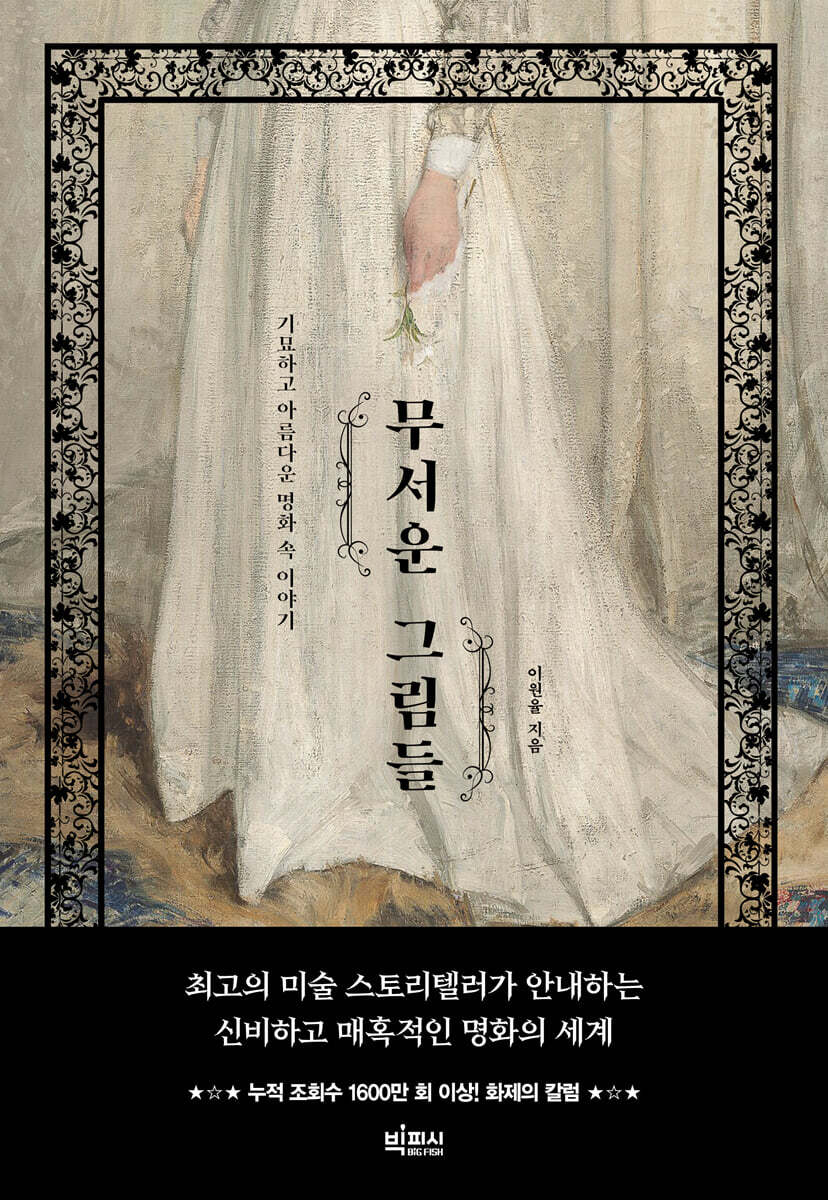
- [Scary Pictures Are Perfect] A collection of scary, chilling, yet captivating picture stories carefully selected by reporter Won-Yul Lee.
From eerie depictions of "epidemics" to tragic ones, we present paintings filled with mystery that will pique the curiosity of viewers.
The stories told by 100 famous paintings based on various themes will keep you glued to the book.
- Ahn Hyun-jae, art producer
Crossing the line between horror and beauty
The most fascinating story of a famous painting
The best art textbook, filled with cool masterpieces and rich cultural knowledge, has been published.
Reporter Won-Yul Lee, who captured the attention of many readers with his Herald Economy series "Huam-dong Art Museum," presents the fascinating stories behind beautiful yet strange masterpieces in "Scary Paintings."
The book features a colorful collection of 'scary pictures' that are beautiful, bizarre, and even mysterious.
Divided into four chapters dealing with life and death, fantasy and reality, cruelty and sorrow, mystery and secrets, this art book leads readers into the fascinating world of art.
The author's masterful storytelling weaves together paintings, artists, and history, creating an experience reminiscent of an art mystery documentary.
This book richly explores the diverse aspects of terrifying paintings through the stories hidden in over 100 famous paintings, including Monet's painting of his wife's corpse, Klimt's gorgeous yet sad work, Millais's paintings that are so beautiful they are tragic, and the decisive incident that turned an ordinary exhibit into a star overnight.
As you follow the captivating story told in this book, you will have the surprising experience of discovering that you have already acquired a deep understanding of history, religion, mythology, and the classics.
The most fascinating story of a famous painting
The best art textbook, filled with cool masterpieces and rich cultural knowledge, has been published.
Reporter Won-Yul Lee, who captured the attention of many readers with his Herald Economy series "Huam-dong Art Museum," presents the fascinating stories behind beautiful yet strange masterpieces in "Scary Paintings."
The book features a colorful collection of 'scary pictures' that are beautiful, bizarre, and even mysterious.
Divided into four chapters dealing with life and death, fantasy and reality, cruelty and sorrow, mystery and secrets, this art book leads readers into the fascinating world of art.
The author's masterful storytelling weaves together paintings, artists, and history, creating an experience reminiscent of an art mystery documentary.
This book richly explores the diverse aspects of terrifying paintings through the stories hidden in over 100 famous paintings, including Monet's painting of his wife's corpse, Klimt's gorgeous yet sad work, Millais's paintings that are so beautiful they are tragic, and the decisive incident that turned an ordinary exhibit into a star overnight.
As you follow the captivating story told in this book, you will have the surprising experience of discovering that you have already acquired a deep understanding of history, religion, mythology, and the classics.
- You can preview some of the book's contents.
Preview
index
Prologue: An invitation to a wondrous story within an unfamiliar masterpiece.
Chapter 1: Between Life and Death
Sorrow, Reborn as an Immortal Masterpiece: Arnold Böcklin, "The Plague"
Dangerous yet fascinating nonhumans: John Collier, "The Land Child"
The Truth About the Fatal Color That Killed the Master: James Whistler, Symphony No. 1 in White: The White Girl
Secrets of the Great Escape during World War II: Felix Nussbaum, Self-Portrait with Jewish Identity Card
Thirteen Days of Wandering in the Middle of the Sea: Théodore Géricault, The Raft of the Medusa
Chapter 2: Between Fantasy and Reality
The World's Most Unusual Emperor Portrait: Giuseppe Arcimboldo, "The Four Elements"
The Rise and Fall of Humanity as Seen by the Great Sphinx: Elihu Vedder, The Sphinx's Questioner
Six Bloody Portraits: Hans Holbein the Younger, Henry VIII
A Golden Legacy Reclaimed from the Worst of Looters: Gustav Klimt, Portrait of Adele Bloch-Bauer I
The surprising truth behind a masterpiece restored after 300 years: Rembrandt van Rijn, "The Night Watch."
Chapter 3: Between Cruelty and Sorrow
Why the Girl Needed His Neck: Gustave Moreau, "The Ghost"
The Identity of "It" Discovered Deep in the Forest: Gustave Doré, "The Dark Forest"
A painting so beautiful it's almost eerie: John Everett Millais, Ophelia
Reflection in the window of the Russian Grand Duchess: Ilya Repin, Grand Duchess Alekseyevna Sophia
Chapter 4: Between Mystery and Secret
The Dark Boy Who Created the World of Noir: Odilon Redon, "Cyclops"
The Most Unique Mythological Blockbuster: Joachim Wtevael's Perseus Saves Andromeda
Some thefts create masterpieces of the century: Leonardo da Vinci's Mona Lisa
A work of art that reeks of blood without a single drop of blood: Eugène Delacroix, The Death of Sardanapalus
A Mysterious Miracle on a Funeral Day: El Greco, The Burial of the Count of Orgaz
Chapter 1: Between Life and Death
Sorrow, Reborn as an Immortal Masterpiece: Arnold Böcklin, "The Plague"
Dangerous yet fascinating nonhumans: John Collier, "The Land Child"
The Truth About the Fatal Color That Killed the Master: James Whistler, Symphony No. 1 in White: The White Girl
Secrets of the Great Escape during World War II: Felix Nussbaum, Self-Portrait with Jewish Identity Card
Thirteen Days of Wandering in the Middle of the Sea: Théodore Géricault, The Raft of the Medusa
Chapter 2: Between Fantasy and Reality
The World's Most Unusual Emperor Portrait: Giuseppe Arcimboldo, "The Four Elements"
The Rise and Fall of Humanity as Seen by the Great Sphinx: Elihu Vedder, The Sphinx's Questioner
Six Bloody Portraits: Hans Holbein the Younger, Henry VIII
A Golden Legacy Reclaimed from the Worst of Looters: Gustav Klimt, Portrait of Adele Bloch-Bauer I
The surprising truth behind a masterpiece restored after 300 years: Rembrandt van Rijn, "The Night Watch."
Chapter 3: Between Cruelty and Sorrow
Why the Girl Needed His Neck: Gustave Moreau, "The Ghost"
The Identity of "It" Discovered Deep in the Forest: Gustave Doré, "The Dark Forest"
A painting so beautiful it's almost eerie: John Everett Millais, Ophelia
Reflection in the window of the Russian Grand Duchess: Ilya Repin, Grand Duchess Alekseyevna Sophia
Chapter 4: Between Mystery and Secret
The Dark Boy Who Created the World of Noir: Odilon Redon, "Cyclops"
The Most Unique Mythological Blockbuster: Joachim Wtevael's Perseus Saves Andromeda
Some thefts create masterpieces of the century: Leonardo da Vinci's Mona Lisa
A work of art that reeks of blood without a single drop of blood: Eugène Delacroix, The Death of Sardanapalus
A Mysterious Miracle on a Funeral Day: El Greco, The Burial of the Count of Orgaz
Detailed image

Into the book
In fact, most of the paintings left behind by the great masters are like that, which feels somewhat eerie.
When you peel back the layers of the paintings, an unexpected world opens up inside.
It contains stories of desperate moments of love and attitudes toward life, shocking myths and history that you will never forget once you know them, and outrageous imaginations and fantasies that make you wonder how they came to think of such things.
If you think about it, the textbook that can provide the most 'intense experience' in general knowledge such as philosophy, humanities, and history that can be applied to our lives right away is 'Scary Pictures'.
---From "Inviting you to a wondrous story in an unfamiliar masterpiece"
Böcklin's repainting of "Isle of the Dead" is imbued with the heartbreaking stories of both the artist and the commissioner.
Maybe that's why.
This painting, which has a devilish charm, left a deep impression on many people.
Commissions for paintings continued to pour in for Böcklin.
He painted three more “Island of the Dead” with the same title and composition.
In this way, all five “Island of Death” pieces were completed.
In Switzerland, Böcklin's home country, and Germany, where he stayed, this series was even praised as having a "Germanic soul."
Until then, Böcklin was a moderately well-known painter.
Thanks to these paintings, he was able to rise to the ranks of masters in one fell swoop.
In the end, it wasn't the beautiful landscapes or the mythical monsters and fairies that made him great.
Ironically, his numerous experiences and obsession with death led him to become an irreplaceable artist.
This was also the reason why Böcklin in his later years was obsessed with eerie paintings.
---From "Sorrow, Reborn as an Immortal Masterpiece: Arnold Böcklin, "The Plague"
Whistler inhaled lead fumes during the process of obtaining lead white pigment.
Is that all?
Even as he dabbed paint onto the canvas, lead dust flew around him like dust.
In this way, Whistler unknowingly filled his body with lead.
It was being piled up.
The white pigment was given literary nicknames such as 'silver white' because it shines like silver, and 'flake white' because it sparkles like small pieces of glass.
It also had good adhesive properties and was practical as it did not crack.
This pigment, which seemed so perfect, was actually a substance of death.
---From "The Truth About the Fatal Color That Killed the Master: James Whistler, "White Symphony No. 1: The White Girl"
Repin portrayed Sophia as a wounded tigress, having failed in both rebellions.
Still possessing her wildness, she appears to have not given up on the opportunity for a third rebellion.
That is why she still maintains her dignity as regent and her dignity as princess.
But everyone inside and outside the painting knows that Sophia is harboring vain hopes.
The servant, who has been far away from Sophia in the painting, already looks at her as if she were crazy.
Sophia's closest confidant, hanging dead outside the window, also seems to be telling us that there is now no other answer than death.
Only Sophia doesn't know her future.
That is why this picture is so powerful and yet so sad.
---From "What is reflected in the window of the Russian princess: Ilya Repin, "Princess Alexeyevna Sophia"
There was a more important reason why Delacroix's "The Death of Sardanapalus" was criticized.
It was in pictorial form.
His work, with its dizzying, writhing outlines, intense colors, and chaotic compositions, had a powerful impression unlike anything I had ever seen before.
The woman's body, bent and twisted like a bow, the jewels tumbling around, and the red cloth and ornaments that covered the entire screen like a river were incredibly provocative.
Although not a single drop of blood was depicted in this work, the smell of blood was clearly felt when one approached it.
At that time, neoclassical art, with its stable composition and restrained expression, was the trend in France.
Jacques-Louis David's "Oath of the Horatii" was a textbook.
In this context, Delacroix's paintings seemed to destroy the norms that had been painstakingly established.
“If this isn’t a picture of a fanatic, then what is?”
It was a critic's hateful lament.
When you peel back the layers of the paintings, an unexpected world opens up inside.
It contains stories of desperate moments of love and attitudes toward life, shocking myths and history that you will never forget once you know them, and outrageous imaginations and fantasies that make you wonder how they came to think of such things.
If you think about it, the textbook that can provide the most 'intense experience' in general knowledge such as philosophy, humanities, and history that can be applied to our lives right away is 'Scary Pictures'.
---From "Inviting you to a wondrous story in an unfamiliar masterpiece"
Böcklin's repainting of "Isle of the Dead" is imbued with the heartbreaking stories of both the artist and the commissioner.
Maybe that's why.
This painting, which has a devilish charm, left a deep impression on many people.
Commissions for paintings continued to pour in for Böcklin.
He painted three more “Island of the Dead” with the same title and composition.
In this way, all five “Island of Death” pieces were completed.
In Switzerland, Böcklin's home country, and Germany, where he stayed, this series was even praised as having a "Germanic soul."
Until then, Böcklin was a moderately well-known painter.
Thanks to these paintings, he was able to rise to the ranks of masters in one fell swoop.
In the end, it wasn't the beautiful landscapes or the mythical monsters and fairies that made him great.
Ironically, his numerous experiences and obsession with death led him to become an irreplaceable artist.
This was also the reason why Böcklin in his later years was obsessed with eerie paintings.
---From "Sorrow, Reborn as an Immortal Masterpiece: Arnold Böcklin, "The Plague"
Whistler inhaled lead fumes during the process of obtaining lead white pigment.
Is that all?
Even as he dabbed paint onto the canvas, lead dust flew around him like dust.
In this way, Whistler unknowingly filled his body with lead.
It was being piled up.
The white pigment was given literary nicknames such as 'silver white' because it shines like silver, and 'flake white' because it sparkles like small pieces of glass.
It also had good adhesive properties and was practical as it did not crack.
This pigment, which seemed so perfect, was actually a substance of death.
---From "The Truth About the Fatal Color That Killed the Master: James Whistler, "White Symphony No. 1: The White Girl"
Repin portrayed Sophia as a wounded tigress, having failed in both rebellions.
Still possessing her wildness, she appears to have not given up on the opportunity for a third rebellion.
That is why she still maintains her dignity as regent and her dignity as princess.
But everyone inside and outside the painting knows that Sophia is harboring vain hopes.
The servant, who has been far away from Sophia in the painting, already looks at her as if she were crazy.
Sophia's closest confidant, hanging dead outside the window, also seems to be telling us that there is now no other answer than death.
Only Sophia doesn't know her future.
That is why this picture is so powerful and yet so sad.
---From "What is reflected in the window of the Russian princess: Ilya Repin, "Princess Alexeyevna Sophia"
There was a more important reason why Delacroix's "The Death of Sardanapalus" was criticized.
It was in pictorial form.
His work, with its dizzying, writhing outlines, intense colors, and chaotic compositions, had a powerful impression unlike anything I had ever seen before.
The woman's body, bent and twisted like a bow, the jewels tumbling around, and the red cloth and ornaments that covered the entire screen like a river were incredibly provocative.
Although not a single drop of blood was depicted in this work, the smell of blood was clearly felt when one approached it.
At that time, neoclassical art, with its stable composition and restrained expression, was the trend in France.
Jacques-Louis David's "Oath of the Horatii" was a textbook.
In this context, Delacroix's paintings seemed to destroy the norms that had been painstakingly established.
“If this isn’t a picture of a fanatic, then what is?”
It was a critic's hateful lament.
---「A work that reeks of blood without a single drop of blood: Eugène Delacroix, The Death of Sardanapalus」
Publisher's Review
I can never take my eyes off it!
A thrilling art book that will have you immersed in it the moment you open it!
The art book "Scary Pictures" is published, offering the most fascinating educational experience along with famous paintings filled with strange yet captivating stories.
This book is an art book in which reporter Won-yul Lee, who serialized the popular art column 'Huam-dong Art Museum' in the Herald Economy that made culture and arts readers wait for Saturdays every week and recorded an unusually high number of 40,000 subscribers for a Naver reporter, carefully selected and introduced scary, chilling, yet fascinating paintings.
'Huam-dong Art Museum' is a popular column that has garnered such enthusiastic responses that it has even prompted other media outlets to compete with each other by launching feature-length weekend art content.
In "Scary Pictures," a variety of colorful "scary pictures" appear.
The work covers a wide range of subjects, from frightening paintings depicting realistic themes like 'epidemics' to works with fantastical themes like 'mythical curses'.
“Wow, there’s such a scary truth hidden in this picture!”
The best art storytellers tell us
A dangerous but beautiful picture story
Why are so many people so enthusiastic about the author's art stories?
Among the many charms, the one that stands out the most is ‘storytelling.’
With the tenacity I've built up while covering social and political issues, I conduct solid research and carefully weave between the facts to create a narrative.
These stories are not simply the author's imagination, but are inferences based on historical facts.
The author's storytelling, reminiscent of an art mystery documentary about paintings, artists, and sometimes even the people in them, doesn't simply tell the story of art, but rather, grounded in solid facts, unfolds in a vivid, present-day narrative that leaves everyone convinced and ultimately drawn in.
Finding the eerie aspects of paintings that would otherwise appear as just beautiful pictures and making you look at them again is something that only 'art storyteller' Wonyul Lee can do.
Now we can see why Collier painted "The Land Child" so bleakly.
The child's eyes are already out of focus.
The mermaid also doesn't seem to have any particular feelings for the child.
Come to think of it, the title itself is gloomy.
“Child of the Land” is a harsh expression that can only be given from the perspective of a mermaid.
Just as humans don't pay attention to the individual appearances of fish in a school, the mermaid doesn't care about the appearance of the targeted child.
Whether they are cute or lovable, they are all just little humans living on land.
It is a creature that will struggle without saying anything if you drag it into the water and throw it in.
_'Dangerous yet fascinating, non-human beings: John Collier, 'The Land Child'
From Lilith and sirens to mermaids and kelpies, it draws out mystical non-human beings from the legends and myths of each country and creates a passageway for reading famous paintings. It also introduces illustrations from Dante's Divine Comedy one by one and leads us into the world of classic masterpieces.
In addition, it helps readers read the pictures in a variety of ways, with various historical backgrounds, including Greek and Roman mythology, the Bible, World War II, the Reformation, and the birth of the Anglican Church.
In the midst of the whirlwind of history, the masters sublimated history, their lives, and their thoughts into art, satisfying readers' intellectual curiosity.
Just following a captivating "fun story", I soon found myself gaining knowledge about history, religion, mythology, and classics.
Such colorful and scary pictures!
Death, tragedy, and mystery beyond the painting become a source of education.
"The Scary Pictures" begins with Monet's painting of the corpse of his wife who has just died.
It may be surprising at first to think that this is a painting of a corpse, but if you look closely, you will see that it is filled with Monet's love, respect, and regret for his wife.
When you think of 'scary' pictures, you might think of them as provocative pictures that are filled with scary things, but that's not the case.
Examples include Klimt's "Portrait of Adele-Bloch-Bauer I," which is painted in gold and is gorgeous and beautiful, but contains a cruel and sad fate; John Everett Millais's "Ophelia," which maximizes the tragic scene through persistent description; and Arnold Böcklin's "The Plague," which is grotesque and terrifying but actually contains a deep sorrow for the loss of a child.
Through the scary pictures and stories of the artist in this book, you can truly feel how colorful, three-dimensional, and fascinating the emotion called 'fear' can be.
Also, by the time you reach the last page, you will find yourself filled with a wealth of knowledge about history, religion, mythology, and the classics.
A thrilling art book that will have you immersed in it the moment you open it!
The art book "Scary Pictures" is published, offering the most fascinating educational experience along with famous paintings filled with strange yet captivating stories.
This book is an art book in which reporter Won-yul Lee, who serialized the popular art column 'Huam-dong Art Museum' in the Herald Economy that made culture and arts readers wait for Saturdays every week and recorded an unusually high number of 40,000 subscribers for a Naver reporter, carefully selected and introduced scary, chilling, yet fascinating paintings.
'Huam-dong Art Museum' is a popular column that has garnered such enthusiastic responses that it has even prompted other media outlets to compete with each other by launching feature-length weekend art content.
In "Scary Pictures," a variety of colorful "scary pictures" appear.
The work covers a wide range of subjects, from frightening paintings depicting realistic themes like 'epidemics' to works with fantastical themes like 'mythical curses'.
“Wow, there’s such a scary truth hidden in this picture!”
The best art storytellers tell us
A dangerous but beautiful picture story
Why are so many people so enthusiastic about the author's art stories?
Among the many charms, the one that stands out the most is ‘storytelling.’
With the tenacity I've built up while covering social and political issues, I conduct solid research and carefully weave between the facts to create a narrative.
These stories are not simply the author's imagination, but are inferences based on historical facts.
The author's storytelling, reminiscent of an art mystery documentary about paintings, artists, and sometimes even the people in them, doesn't simply tell the story of art, but rather, grounded in solid facts, unfolds in a vivid, present-day narrative that leaves everyone convinced and ultimately drawn in.
Finding the eerie aspects of paintings that would otherwise appear as just beautiful pictures and making you look at them again is something that only 'art storyteller' Wonyul Lee can do.
Now we can see why Collier painted "The Land Child" so bleakly.
The child's eyes are already out of focus.
The mermaid also doesn't seem to have any particular feelings for the child.
Come to think of it, the title itself is gloomy.
“Child of the Land” is a harsh expression that can only be given from the perspective of a mermaid.
Just as humans don't pay attention to the individual appearances of fish in a school, the mermaid doesn't care about the appearance of the targeted child.
Whether they are cute or lovable, they are all just little humans living on land.
It is a creature that will struggle without saying anything if you drag it into the water and throw it in.
_'Dangerous yet fascinating, non-human beings: John Collier, 'The Land Child'
From Lilith and sirens to mermaids and kelpies, it draws out mystical non-human beings from the legends and myths of each country and creates a passageway for reading famous paintings. It also introduces illustrations from Dante's Divine Comedy one by one and leads us into the world of classic masterpieces.
In addition, it helps readers read the pictures in a variety of ways, with various historical backgrounds, including Greek and Roman mythology, the Bible, World War II, the Reformation, and the birth of the Anglican Church.
In the midst of the whirlwind of history, the masters sublimated history, their lives, and their thoughts into art, satisfying readers' intellectual curiosity.
Just following a captivating "fun story", I soon found myself gaining knowledge about history, religion, mythology, and classics.
Such colorful and scary pictures!
Death, tragedy, and mystery beyond the painting become a source of education.
"The Scary Pictures" begins with Monet's painting of the corpse of his wife who has just died.
It may be surprising at first to think that this is a painting of a corpse, but if you look closely, you will see that it is filled with Monet's love, respect, and regret for his wife.
When you think of 'scary' pictures, you might think of them as provocative pictures that are filled with scary things, but that's not the case.
Examples include Klimt's "Portrait of Adele-Bloch-Bauer I," which is painted in gold and is gorgeous and beautiful, but contains a cruel and sad fate; John Everett Millais's "Ophelia," which maximizes the tragic scene through persistent description; and Arnold Böcklin's "The Plague," which is grotesque and terrifying but actually contains a deep sorrow for the loss of a child.
Through the scary pictures and stories of the artist in this book, you can truly feel how colorful, three-dimensional, and fascinating the emotion called 'fear' can be.
Also, by the time you reach the last page, you will find yourself filled with a wealth of knowledge about history, religion, mythology, and the classics.
GOODS SPECIFICS
- Date of issue: July 10, 2024
- Page count, weight, size: 300 pages | 508g | 145*210*17mm
- ISBN13: 9791193128077
- ISBN10: 1193128072
You may also like
카테고리
korean


korean

![GQ KOREA Mark (Monthly): December [2025]](http://librairie.coreenne.fr/cdn/shop/files/8ef265dbbfbf186523ed75ba7319009d.jpg?v=1765340328&width=3840)


