

I want to know about the classics
 |
Description
Book Introduction
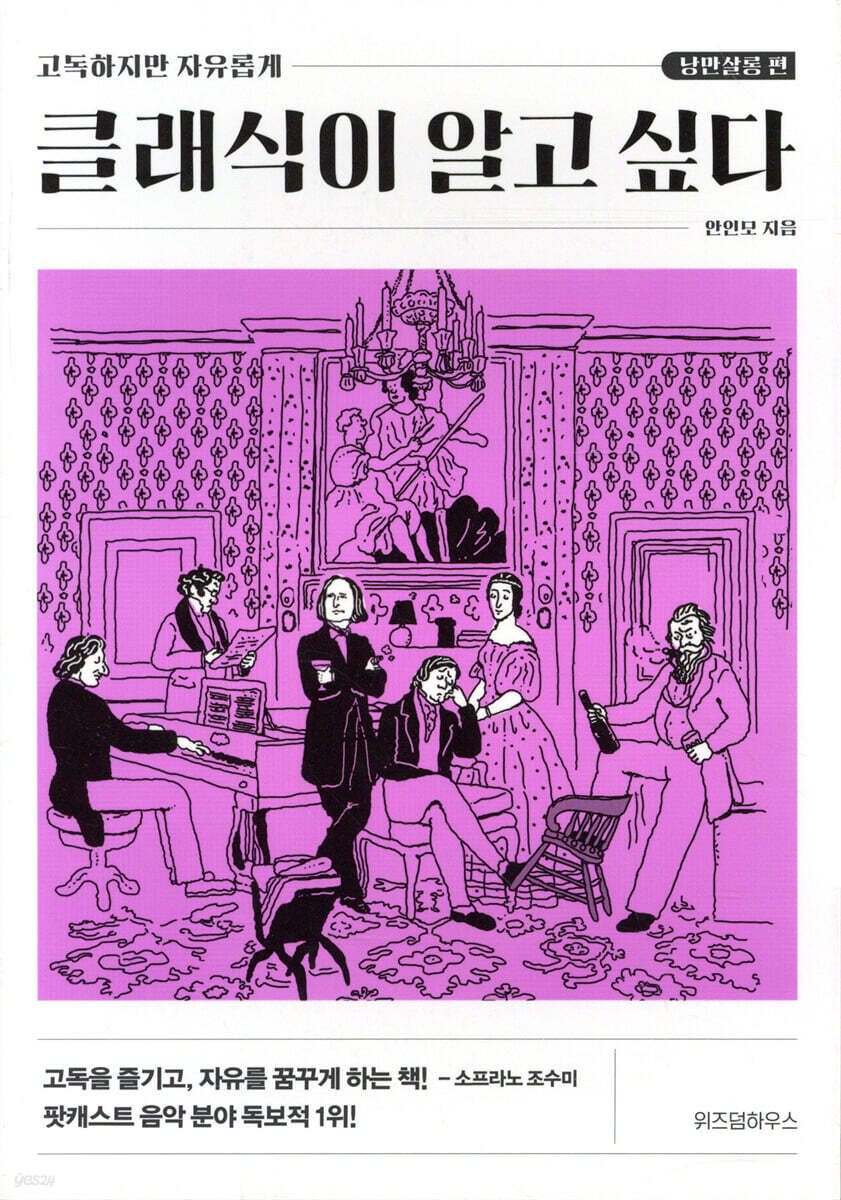
The best classic content in Korea, proven by 7.5 million cumulative hits! Since its first broadcast in September 2017, 'I Want to Know About Classical Music' has become the undisputed #1 podcast in the music industry. To celebrate the second anniversary of the broadcast, the first volume is being published. And the beginning is the story of the 'Romantic Era', which is most similar to our lives today and therefore the easiest to relate to. Let's follow the lives and music of the leading composers of the Romantic era, a time brimming with improvisation and fantasy, freely combining with literature, and filled with free-spirited dreaming, with pianist Ahn In-mo's easy and entertaining explanations. |
index
Beginning_ Romantic era, free dreams resonating through salons
How to get the most out of "I Want to Know Classics"
01 | Perfectly Unfinished, The Wandering Spring Bachelor by Schubert
02 | Chopin, the Piano Poet Who Sings of Parting
03 | List of Superstars Who Dream of Love
04 | Schumann, the dreaming poet of fantasy
05 | A Tearful Romance, Clara, the Keyboard Empress
06 | Eternal Love, Autumn Man Brahms
(Side Story) Something Lucky Young Master Mendelssohn
Going Out_ What do I dream of freedom from?
How to get the most out of "I Want to Know Classics"
01 | Perfectly Unfinished, The Wandering Spring Bachelor by Schubert
02 | Chopin, the Piano Poet Who Sings of Parting
03 | List of Superstars Who Dream of Love
04 | Schumann, the dreaming poet of fantasy
05 | A Tearful Romance, Clara, the Keyboard Empress
06 | Eternal Love, Autumn Man Brahms
(Side Story) Something Lucky Young Master Mendelssohn
Going Out_ What do I dream of freedom from?
Detailed image

Into the book
Romanticism is a genre that describes the extreme emotions of passionate love between knights in the Middle Ages.
The romanticism that enjoyed the 19th century is also present today, with fantastic stories of people who have separated in reality from the person they love, but still meet in their dreams.
Because we love you that much too.
Loving as long as you love, singing out that love, and struggling to get that love back.
Can this fever of love truly be explained by reason and intellect? Romanticism, which draws upon intuition, emotion, and imagination to freely unleash what lies within, is overflowing with passion, fantasy, and freedom.
In their works, and in their lives.
The previous era, Classicism, emphasized the balance of order and form.
I was truly not free.
Goethe said, “Classicism is health, romanticism is disease,” and literally, romanticism is a disease of freedom, overflowing with improvisation and fantasy.
Romantic music, freely combined with literature and filled with free-spirited dreams, is the most relatable and familiar classic music for us today.
--- p.
6
These days, there is a growing culture of gathering together to do things, such as reading groups or one-day classes.
It was the same in Schubert's time.
At that time, every household in Vienna had a piano, and home concerts were actively held, and the number of gatherings to share music was also increasing.
Thanks to this, the publishing industry that publishes sheet music was able to enjoy a boom.
Schubert practiced with a small ensemble of music lovers, and was able to present his latest chamber music in concerts given by these groups.
Schubert participated in a number of these small gatherings simultaneously, including reading groups, picnics, and sausage-eating groups.
Thanks to this, he was able to actively pursue music while also building a social network.
Ultimately, it was the trust and support shown by this network that played a major role in his ability to resign from his teaching position.
Among them, the gathering created by my friend Schober is called Schubertiade (Schubert Night).
--- p.33
Elegant and soft pieces by Chopin.
What did Chopin's hands look like when he played that piece? Of the many descriptions of Chopin's hands, the one that struck me most was the one that said they were "boneless, like rubber."
It is said that his hands were so flexible like rubber that they appeared to have no bones.
Here, Berlioz goes a step further, saying, “Chopin plays as if the tip of a brush strokes the keys rather than the hammers striking the strings, so you want to go up to the piano and put your ear to it.”
In this way, Chopin's performance shines even brighter when listened to closely, as if he were whispering his own story.
In fact, if you play in a large hall in front of many people at once, you can earn more money and become very popular overnight, but Chopin felt burdened by performing in public in such a large hall, and confessed to Liszt:
“I am not at all suited to performing.
I feel like I'm suffocating and paralyzed by the curious gazes from the audience.
“I feel dumb in front of those unfamiliar faces.”
Chopin, for example, disliked the suffocating atmosphere in which the audience held their breath and focused solely on him.
Instead, I enjoy playing more comfortably in small salons, in front of people I know.
He even played with the lights in the salon very dim.
--- p.84-85
The ability that Paganini lacked and Liszt had was the ability to steal women's hearts.
The list shakes the hearts of women with its statue-like faces.
At that time, the stage was set up with the piano facing away from the audience, so the audience could only see the back of the pianist's head and not see his facial expressions or gestures while he was playing.
Liszt wanted to show the audience the side profile of his face, including his sharp nose, and he ended up taking the unconventional step of turning the piano sideways.
Now, the list can show off both its attractive side profile and its nimble hands at the same time.
It seems obvious now, but no one had ever tried it before.
And also, the piano lid was opened towards the audience so that the sound could be transmitted to the audience better.
This list of groundbreaking attempts remains a tradition that continues to this day.
As a result, at the list's concert, there were many women who fainted because the list was so good.
Naturally, fan clubs are formed due to this list craze.
Shocked by Liszt's performance and the audience's enthusiastic response, Liszt's friend Heine gave the fan club its name.
Lisztomania.
Listomania, the ancestor of today's idol fan clubs, is starting to sweep across Europe.
--- p.129-130
Performing gave her not only money but also mental comfort.
Moreover, she was able to meet and love him through music, even if only for a moment while playing Schumann's works.
As soon as she got back into shape after giving birth to her youngest child, Felix, Clara embarked on a shockingly demanding schedule.
Before such tremendous stamina and passion could be unleashed, there were immediate problems at hand: the children and the immediate need to make a living.
And another thing was the very reason for Clara's existence.
From a childhood where she could only find her presence and be loved through music, she was able to find solace in her sadness through art.
Brahms thus returns Clara, who is destined to take over Clara's housework and go on stage, to the stage.
He knew what she truly wanted.
As he persuades her to hire more cooks, servants, and others, and even helps her with her household chores himself, a strong bond develops between Brahms and Clara, and her stage presence grows at an ever-increasing rate.
The romanticism that enjoyed the 19th century is also present today, with fantastic stories of people who have separated in reality from the person they love, but still meet in their dreams.
Because we love you that much too.
Loving as long as you love, singing out that love, and struggling to get that love back.
Can this fever of love truly be explained by reason and intellect? Romanticism, which draws upon intuition, emotion, and imagination to freely unleash what lies within, is overflowing with passion, fantasy, and freedom.
In their works, and in their lives.
The previous era, Classicism, emphasized the balance of order and form.
I was truly not free.
Goethe said, “Classicism is health, romanticism is disease,” and literally, romanticism is a disease of freedom, overflowing with improvisation and fantasy.
Romantic music, freely combined with literature and filled with free-spirited dreams, is the most relatable and familiar classic music for us today.
--- p.
6
These days, there is a growing culture of gathering together to do things, such as reading groups or one-day classes.
It was the same in Schubert's time.
At that time, every household in Vienna had a piano, and home concerts were actively held, and the number of gatherings to share music was also increasing.
Thanks to this, the publishing industry that publishes sheet music was able to enjoy a boom.
Schubert practiced with a small ensemble of music lovers, and was able to present his latest chamber music in concerts given by these groups.
Schubert participated in a number of these small gatherings simultaneously, including reading groups, picnics, and sausage-eating groups.
Thanks to this, he was able to actively pursue music while also building a social network.
Ultimately, it was the trust and support shown by this network that played a major role in his ability to resign from his teaching position.
Among them, the gathering created by my friend Schober is called Schubertiade (Schubert Night).
--- p.33
Elegant and soft pieces by Chopin.
What did Chopin's hands look like when he played that piece? Of the many descriptions of Chopin's hands, the one that struck me most was the one that said they were "boneless, like rubber."
It is said that his hands were so flexible like rubber that they appeared to have no bones.
Here, Berlioz goes a step further, saying, “Chopin plays as if the tip of a brush strokes the keys rather than the hammers striking the strings, so you want to go up to the piano and put your ear to it.”
In this way, Chopin's performance shines even brighter when listened to closely, as if he were whispering his own story.
In fact, if you play in a large hall in front of many people at once, you can earn more money and become very popular overnight, but Chopin felt burdened by performing in public in such a large hall, and confessed to Liszt:
“I am not at all suited to performing.
I feel like I'm suffocating and paralyzed by the curious gazes from the audience.
“I feel dumb in front of those unfamiliar faces.”
Chopin, for example, disliked the suffocating atmosphere in which the audience held their breath and focused solely on him.
Instead, I enjoy playing more comfortably in small salons, in front of people I know.
He even played with the lights in the salon very dim.
--- p.84-85
The ability that Paganini lacked and Liszt had was the ability to steal women's hearts.
The list shakes the hearts of women with its statue-like faces.
At that time, the stage was set up with the piano facing away from the audience, so the audience could only see the back of the pianist's head and not see his facial expressions or gestures while he was playing.
Liszt wanted to show the audience the side profile of his face, including his sharp nose, and he ended up taking the unconventional step of turning the piano sideways.
Now, the list can show off both its attractive side profile and its nimble hands at the same time.
It seems obvious now, but no one had ever tried it before.
And also, the piano lid was opened towards the audience so that the sound could be transmitted to the audience better.
This list of groundbreaking attempts remains a tradition that continues to this day.
As a result, at the list's concert, there were many women who fainted because the list was so good.
Naturally, fan clubs are formed due to this list craze.
Shocked by Liszt's performance and the audience's enthusiastic response, Liszt's friend Heine gave the fan club its name.
Lisztomania.
Listomania, the ancestor of today's idol fan clubs, is starting to sweep across Europe.
--- p.129-130
Performing gave her not only money but also mental comfort.
Moreover, she was able to meet and love him through music, even if only for a moment while playing Schumann's works.
As soon as she got back into shape after giving birth to her youngest child, Felix, Clara embarked on a shockingly demanding schedule.
Before such tremendous stamina and passion could be unleashed, there were immediate problems at hand: the children and the immediate need to make a living.
And another thing was the very reason for Clara's existence.
From a childhood where she could only find her presence and be loved through music, she was able to find solace in her sadness through art.
Brahms thus returns Clara, who is destined to take over Clara's housework and go on stage, to the stage.
He knew what she truly wanted.
As he persuades her to hire more cooks, servants, and others, and even helps her with her household chores himself, a strong bond develops between Brahms and Clara, and her stage presence grows at an ever-increasing rate.
--- p.227
Publisher's Review
★ The unrivaled #1 in podcast music!
★ 7.5 million cumulative hits!
“With this one book, you can have a conversation about classics!”
Even if you don't know what a symphony is, or what a sonata is,
A classic perfect textbook that will turn even the most ignorant into a fan of classics!
It's such a great classical music to listen to, but when I try to listen to it, I don't know what to listen to.
When asked, “Do you like classical music?”, if we say yes, we are afraid of being asked which composers or songs we like, so we just end up answering vaguely. Classical music has always been a subject too distant for us to approach.
Author Ahn In-mo, through various channels including the podcast "I Want to Know About Classics," conveys classical music, which often feels difficult and distant to us, in an easy and fun way, with emotional expressions and delivery skills, as if the older sister next door were telling us about it.
In particular, the podcast 'I Want to Know About Classical Music' has established itself as the best classical content in Korea, with 7.5 million hits and the unrivaled No. 1 position in the music category. This year, in celebration of its second anniversary, it is publishing its first book, 'Lonely but Free, Romantic Salon Edition.'
When we listen to rock music, we don't just pick out the songs we like and listen to them step by step, starting with Led Zeppelin.
But for some reason, when it comes to classical music, I feel like I have to start with Mozart and Beethoven, so I only listen to Mozart and Beethoven, but I soon get bored.
However, unlike existing classical education books that explained things based on orthodoxy and history, 『I Want to Know Classics』 (published by Wisdom House) begins its story from the ‘Romantic era’, which is most similar to our lives today and therefore most easily relatable.
The Romantic era was a time of overflowing improvisation and fantasy, freely combining with literature, and freely singing dreams in salons. As you follow the stories of the lives and music of the composers representing the Romantic era told in this book, you will go from being a classical idiot to a classical enthusiast, and even if you still don't know what a symphony is, you will discover your own taste in classical music.
Schubert, Chopin, Liszt, Schumann, Clara, Brahms,
The lives, music, and love of the genius composers who dominated the Romantic era!
Author Ahn In-mo reincarnated composers from 200 years ago into characters of our time, such as Schubert, the wandering spring bachelor, Chopin, the piano poet who sings of farewell, and Liszt, the superstar who dreams of love, to make their lives more approachable.
Also, Schubert, who displayed his talents to the fullest in the salon, Chopin and Liszt, who developed both humanly and musically through friendly competition, Schumann, who aspired to become the Paganini of the piano, and Chopin and Brahms, who became known to the world through his introduction, and even Clara, who Schumann and Brahms loved… The lives, music, and love stories of the composers who dominated the Romantic era were created in one omnibus volume through their relationships.
The text contains elements that even beginners of classical music can easily understand, but that will double the emotions, such as the 'Raealkkokal', a must-know classical terminology, and 'Raealkeal', which is full of useful information, as well as QR codes included in the text so that you can read while listening to music.
Also, as a bonus to commemorate the 2nd anniversary of the broadcast, this book includes 10 keywords for each composer that will enable a classical conversation right away, a playlist for each composer specially selected by the author for readers who are at a loss as to where to start listening to music, and a map of classical music festivals that will allow you to experience something special even if it is by chance while traveling. I hope that this book will fill you with culture and lost romance, and that it will be a time to “enjoy solitude and dream of freedom,” as soprano Sumi Jo recommends.
★ 7.5 million cumulative hits!
“With this one book, you can have a conversation about classics!”
Even if you don't know what a symphony is, or what a sonata is,
A classic perfect textbook that will turn even the most ignorant into a fan of classics!
It's such a great classical music to listen to, but when I try to listen to it, I don't know what to listen to.
When asked, “Do you like classical music?”, if we say yes, we are afraid of being asked which composers or songs we like, so we just end up answering vaguely. Classical music has always been a subject too distant for us to approach.
Author Ahn In-mo, through various channels including the podcast "I Want to Know About Classics," conveys classical music, which often feels difficult and distant to us, in an easy and fun way, with emotional expressions and delivery skills, as if the older sister next door were telling us about it.
In particular, the podcast 'I Want to Know About Classical Music' has established itself as the best classical content in Korea, with 7.5 million hits and the unrivaled No. 1 position in the music category. This year, in celebration of its second anniversary, it is publishing its first book, 'Lonely but Free, Romantic Salon Edition.'
When we listen to rock music, we don't just pick out the songs we like and listen to them step by step, starting with Led Zeppelin.
But for some reason, when it comes to classical music, I feel like I have to start with Mozart and Beethoven, so I only listen to Mozart and Beethoven, but I soon get bored.
However, unlike existing classical education books that explained things based on orthodoxy and history, 『I Want to Know Classics』 (published by Wisdom House) begins its story from the ‘Romantic era’, which is most similar to our lives today and therefore most easily relatable.
The Romantic era was a time of overflowing improvisation and fantasy, freely combining with literature, and freely singing dreams in salons. As you follow the stories of the lives and music of the composers representing the Romantic era told in this book, you will go from being a classical idiot to a classical enthusiast, and even if you still don't know what a symphony is, you will discover your own taste in classical music.
Schubert, Chopin, Liszt, Schumann, Clara, Brahms,
The lives, music, and love of the genius composers who dominated the Romantic era!
Author Ahn In-mo reincarnated composers from 200 years ago into characters of our time, such as Schubert, the wandering spring bachelor, Chopin, the piano poet who sings of farewell, and Liszt, the superstar who dreams of love, to make their lives more approachable.
Also, Schubert, who displayed his talents to the fullest in the salon, Chopin and Liszt, who developed both humanly and musically through friendly competition, Schumann, who aspired to become the Paganini of the piano, and Chopin and Brahms, who became known to the world through his introduction, and even Clara, who Schumann and Brahms loved… The lives, music, and love stories of the composers who dominated the Romantic era were created in one omnibus volume through their relationships.
The text contains elements that even beginners of classical music can easily understand, but that will double the emotions, such as the 'Raealkkokal', a must-know classical terminology, and 'Raealkeal', which is full of useful information, as well as QR codes included in the text so that you can read while listening to music.
Also, as a bonus to commemorate the 2nd anniversary of the broadcast, this book includes 10 keywords for each composer that will enable a classical conversation right away, a playlist for each composer specially selected by the author for readers who are at a loss as to where to start listening to music, and a map of classical music festivals that will allow you to experience something special even if it is by chance while traveling. I hope that this book will fill you with culture and lost romance, and that it will be a time to “enjoy solitude and dream of freedom,” as soprano Sumi Jo recommends.
GOODS SPECIFICS
- Publication date: October 23, 2019
- Page count, weight, size: 308 pages | 480g | 140*200*18mm
- ISBN13: 9791190305006
- ISBN10: 1190305003
You may also like
카테고리
korean


korean

![GQ KOREA Mark (Monthly): December [2025]](http://librairie.coreenne.fr/cdn/shop/files/8ef265dbbfbf186523ed75ba7319009d.jpg?v=1765340328&width=3840)


