

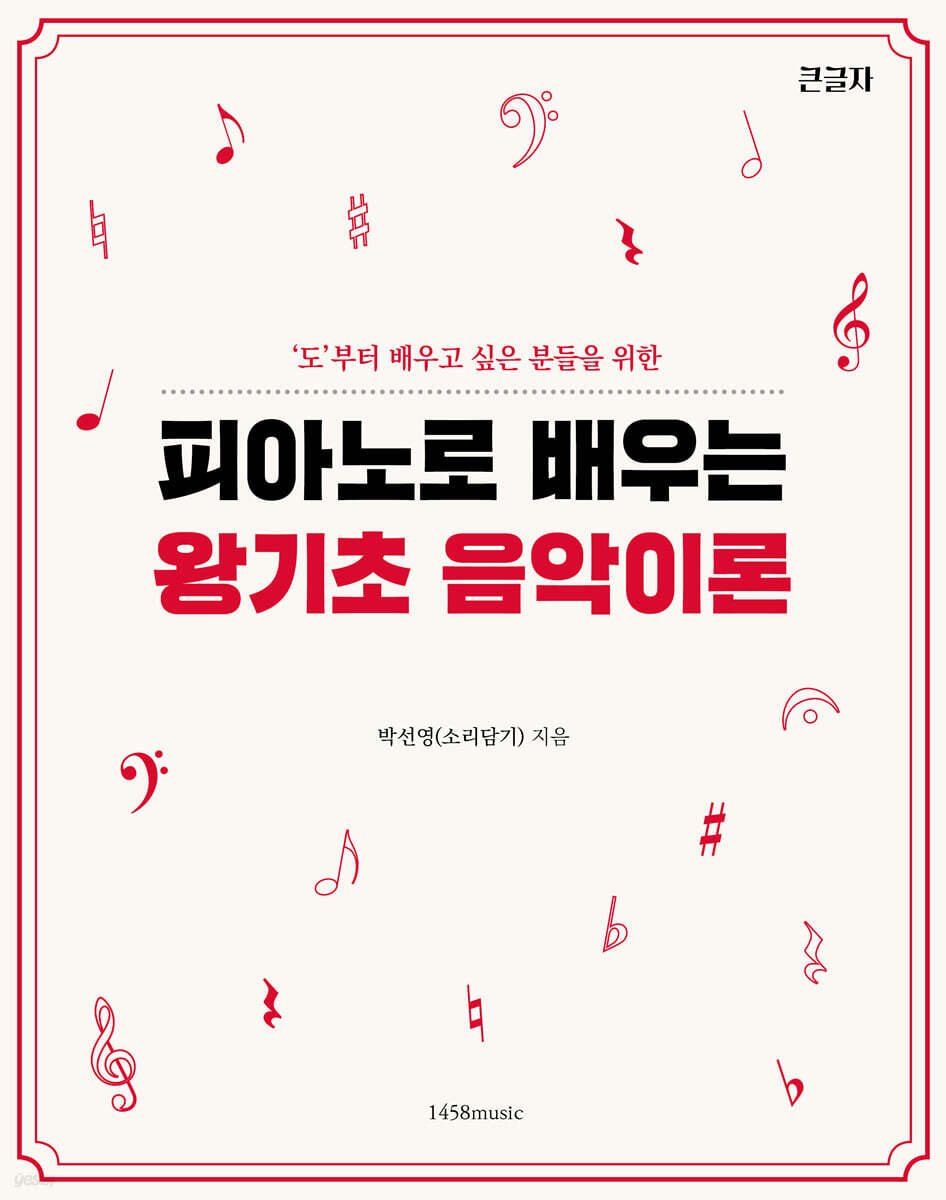
Basic Music Theory Learned with Piano
 |
Description
Book Introduction
The best introductory textbook for those just starting out in music!
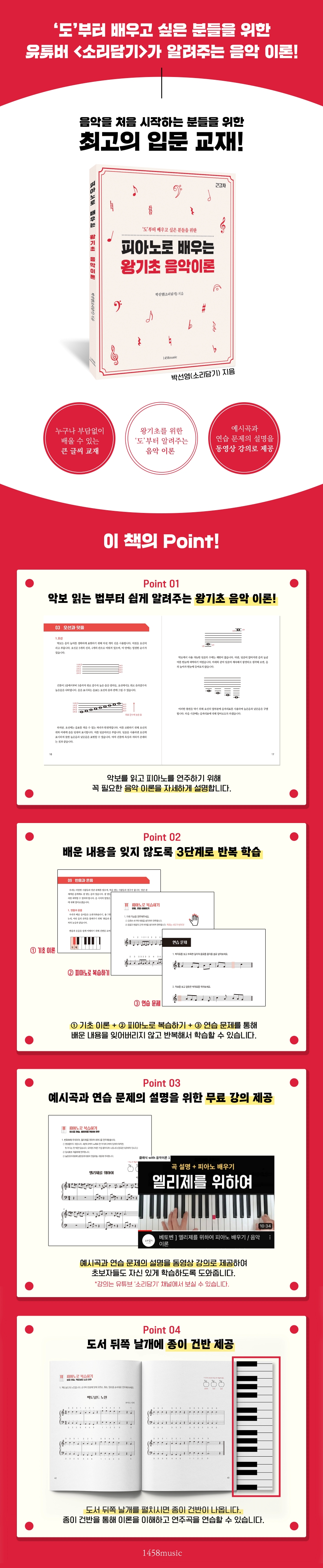
This book is a textbook for those who want to learn piano but are worried because they don't know how to read sheet music, or for those who are just starting to learn music. From sheet music and note names to notes, rests, beats, intervals, keys, and chords, it explains in detail the music theory essential for reading sheet music and playing the piano. ① Basic theory + ② Review with piano + ③ Practice problems are structured so that you can repeatedly check what you have learned without forgetting it. In particular, the author provides video lectures explaining example songs and practice problems through the YouTube channel Sound Damgi, helping even beginners learn with confidence. If you are just starting out with music or want to get a basic understanding of music theory, this is the perfect introductory textbook. |
- You can preview some of the book's contents.
Preview
index
Chapter 1.
How to read sheet music
01.
Types of sheet music
02.
Note names and keys
♬ Finding the rules for note names on the keyboard
03.
Staff and lead lines
♬ Location of Gaondo
04.
treble clef
05.
bass clef
♬ Note symbols and finger numbers
06.
note
♬ Little Star
07.
rest
♬ Old Man McDonald
08.
Measures and time signatures
♬ Edelweiss
Chapter 2.
Keys and major scales
09.
Semitones and whole tones
♬ Understanding semitones and whole tones
10.
Change table
♬ Happy Birthday Song
11.
Accidentals and table of contents
♬ For Elise
12.
Major scales and major keys
♬ Major scale practice
13.
Key signature and tonic
♬ Grandfather's old clock
Chapter 3.
Intervals and triads (chords)
14.
interval
♬ Pitch practice
15.
The nature of pitch
♬ Practice major thirds and minor thirds
16.
Chinese pronunciation
♬ Code practice
17.
Major and minor chords
♬ Major and minor chord practice
18.
Diatonic chord
♬ Amazing Grace
19.
Various musical symbols
♬ Practice the dot sign
20.
Comprehensive exercise
♬ Spring in my hometown
♬ Edelweiss
Answer sheet
How to read sheet music
01.
Types of sheet music
02.
Note names and keys
♬ Finding the rules for note names on the keyboard
03.
Staff and lead lines
♬ Location of Gaondo
04.
treble clef
05.
bass clef
♬ Note symbols and finger numbers
06.
note
♬ Little Star
07.
rest
♬ Old Man McDonald
08.
Measures and time signatures
♬ Edelweiss
Chapter 2.
Keys and major scales
09.
Semitones and whole tones
♬ Understanding semitones and whole tones
10.
Change table
♬ Happy Birthday Song
11.
Accidentals and table of contents
♬ For Elise
12.
Major scales and major keys
♬ Major scale practice
13.
Key signature and tonic
♬ Grandfather's old clock
Chapter 3.
Intervals and triads (chords)
14.
interval
♬ Pitch practice
15.
The nature of pitch
♬ Practice major thirds and minor thirds
16.
Chinese pronunciation
♬ Code practice
17.
Major and minor chords
♬ Major and minor chord practice
18.
Diatonic chord
♬ Amazing Grace
19.
Various musical symbols
♬ Practice the dot sign
20.
Comprehensive exercise
♬ Spring in my hometown
♬ Edelweiss
Answer sheet
Detailed image
Into the book
Understanding musical notation is a process of understanding the language of sound.
Learning an unfamiliar musical language can be challenging at first, but the more you get used to it, the more adept you will become at communicating through sound.
--- p.10
Fortunately, there is a certain order and rules for the names of sounds.
And there are only seven of them.
Just as a rainbow is made up of seven colors, the names of notes are also made up of seven.
Just as the colors of the rainbow, ‘red, orange, yellow, green, blue, indigo, violet’, have an order, the names of the notes also have an order, ‘do, re, mi, fa, sol, la, ti, do.’
However, the format for calling the name of a sound is different in each country.
For example, you need to remember the sound names of Italian, English, and Korean.
--- p.12
If you look at the piano keyboard, there are no black keys between the notes in the mi-fa and ti-do positions.
In this case, are mi~pa and si~do whole tones or semitones? If we define this distance as a whole tone, we can no longer measure the distance between other notes that require the black keys.
Therefore, the notes mi~fa and si~do right next to each other without a black key are semitones.
In the white keyboard do-re-mi-fa-sol-la-si-do, only the intervals between mi-fa and si-do are semitones.
--- p.53
If we say that a musical score is like a piece of writing, then each musical score has a main character.
Once the main character is decided, the rest of the characters can be decided.
The note corresponding to this main character is called the 'tonic note' in music.
--- p.68
This book is for those who are just starting out in music or learning an instrument but are having trouble with unfamiliar music theory.
For those who want to become familiar with music but have difficulty understanding unfamiliar terms and symbols, we have tried to provide explanations that are as easy as possible.
It explains the basic and fundamental concepts of music in an easy-to-understand way and includes various examples on the piano to show how they are applied in actual sheet music.
Learning an unfamiliar musical language can be challenging at first, but the more you get used to it, the more adept you will become at communicating through sound.
--- p.10
Fortunately, there is a certain order and rules for the names of sounds.
And there are only seven of them.
Just as a rainbow is made up of seven colors, the names of notes are also made up of seven.
Just as the colors of the rainbow, ‘red, orange, yellow, green, blue, indigo, violet’, have an order, the names of the notes also have an order, ‘do, re, mi, fa, sol, la, ti, do.’
However, the format for calling the name of a sound is different in each country.
For example, you need to remember the sound names of Italian, English, and Korean.
--- p.12
If you look at the piano keyboard, there are no black keys between the notes in the mi-fa and ti-do positions.
In this case, are mi~pa and si~do whole tones or semitones? If we define this distance as a whole tone, we can no longer measure the distance between other notes that require the black keys.
Therefore, the notes mi~fa and si~do right next to each other without a black key are semitones.
In the white keyboard do-re-mi-fa-sol-la-si-do, only the intervals between mi-fa and si-do are semitones.
--- p.53
If we say that a musical score is like a piece of writing, then each musical score has a main character.
Once the main character is decided, the rest of the characters can be decided.
The note corresponding to this main character is called the 'tonic note' in music.
--- p.68
This book is for those who are just starting out in music or learning an instrument but are having trouble with unfamiliar music theory.
For those who want to become familiar with music but have difficulty understanding unfamiliar terms and symbols, we have tried to provide explanations that are as easy as possible.
It explains the basic and fundamental concepts of music in an easy-to-understand way and includes various examples on the piano to show how they are applied in actual sheet music.
---From the author's note
Publisher's Review
The first book by teacher Seonyoung Park, who teaches music with easy explanations and examples through the YouTube channel Sound Damgi, has been published.
I have compiled the know-how I have gained from teaching students in elementary school and answering questions from various people through the Sound Damgi channel from the perspective of a beginner just starting out with music.
In particular, it is designed to allow you to confirm what you have learned rather than just providing a simple explanation by providing review through example songs and practice problems.
It was produced in large letters so that people over 40 can easily read it.
I have compiled the know-how I have gained from teaching students in elementary school and answering questions from various people through the Sound Damgi channel from the perspective of a beginner just starting out with music.
In particular, it is designed to allow you to confirm what you have learned rather than just providing a simple explanation by providing review through example songs and practice problems.
It was produced in large letters so that people over 40 can easily read it.
GOODS SPECIFICS
- Date of issue: April 14, 2023
- Page count, weight, size: 140 pages | 464g | 213*270*10mm
- ISBN13: 9791189598440
- ISBN10: 1189598442
You may also like
카테고리
korean


korean

![GQ KOREA Mark (Monthly): December [2025]](http://librairie.coreenne.fr/cdn/shop/files/8ef265dbbfbf186523ed75ba7319009d.jpg?v=1765340328&width=3840)


