

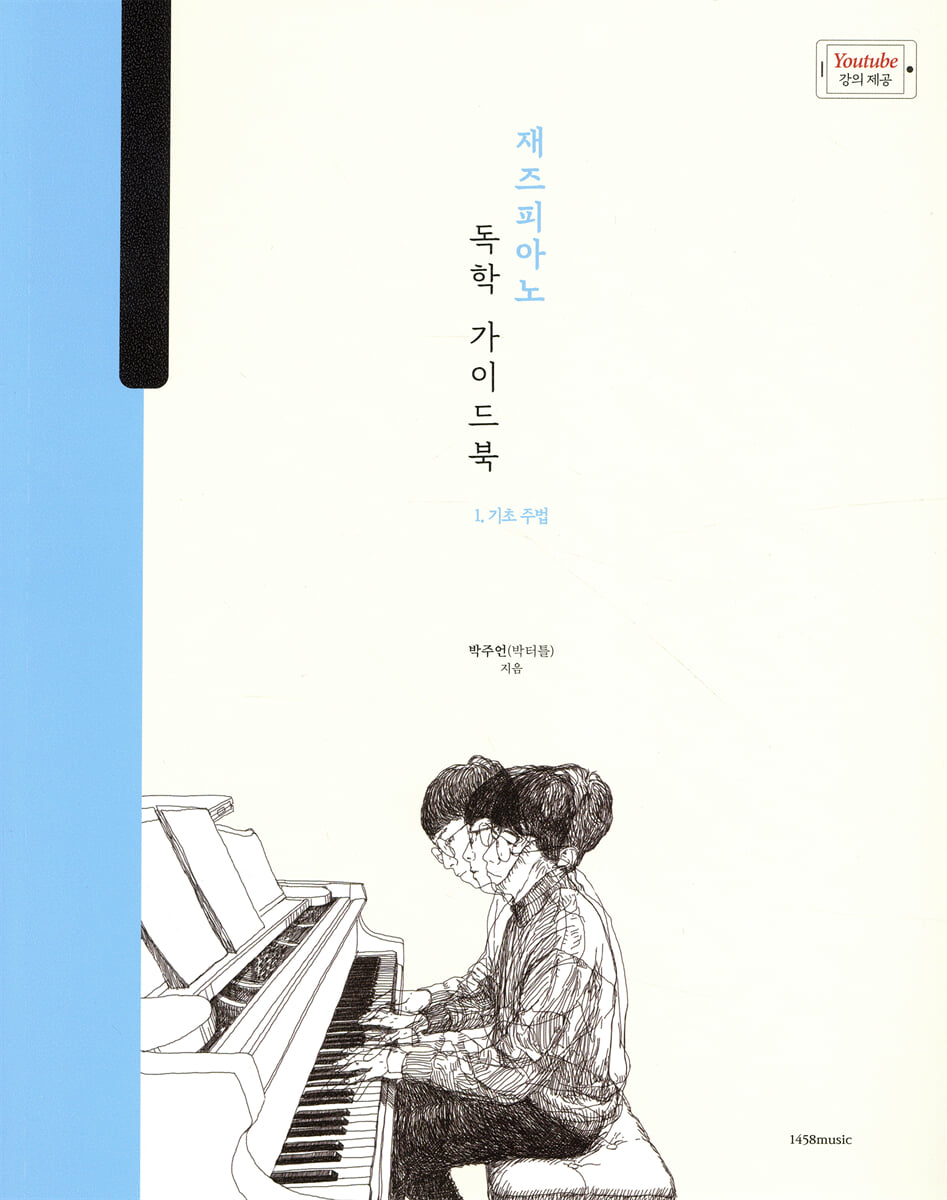
Park Turtle's Jazz Piano Self-Study Guidebook 1
 |
Description
Book Introduction
The best jazz piano introduction book! The Jazz Piano Self-Study Guidebook is a book that will help you learn the fundamentals of jazz piano. It contains the know-how of the author (Park Turtle), who is a YouTuber with 100,000 subscribers and is active as a music creator. It consists of the following order: walking, scale, comping, and stride (ragtime). This book will help you develop the ability to improvise on your own, rather than simply follow along with jazz performances. So the theory part and the 12 keys practice part are separated. It goes beyond theoretical explanations and provides a variety of resources to help with actual performance. We provide free YouTube lectures conducted by the author himself, so that even self-studying students and beginners can watch them without burden. |
- You can preview some of the book's contents.
Preview
index
PART01.
Prepare for practice
- Why jazz piano is difficult
- The three elements that make up jazz piano technique
- Understanding swing rhythm
- A story of rest: The music must keep flowing.
PART02.
Walking Bass
- The basics of a working base
- Walking bass using 1st and 5th notes
- Walking base with added approach notes
- Walking bass with added chord tones
- Walking bass with added decorative notes
- Walking base with added double approach notes
- If there are two codes in one word
- Working of the transpose code
- 12-bar blues progression
- A story about taking a break: Why you should practice walking first
PART03.
Melody & Scale
- Lead sheet and melody fake
- M2 walking + scale practice
- Practice chord tones
- Creating a melody with chord tones 1
- Creating a melody with chord tones 2
- Adding approach notes to a melody
- Pentatonic scale practice
- Blues scale practice
- Available note scale
- Stories to take a break from: Scale practice, you'll know when you try it, The crucial reason why my playing doesn't sound like jazz, Lick practice, what should I do?, Humming often
PART04.
Comping
- Understanding Comping
- Guide tone voicing
- Available tension tones
- 3 Notes Voicing
- 4 Notes Voicing
- Comping Rhythm Practice 1_Upbeat
- Comping Rhythm Practice 2_Basic Rhythm Patterns
- Comping Rhythm Practice 3_Syncopation
- A Story of Rest: The Pitfalls of Two-Handed Sheet Music_132, Why 2-5-1 Practice is Important
PART05.
Stride Style Accompaniment
- How to play jazz piano according to the situation
- What is stride style?
- Stride style left-hand technique
- Stride style two-handed practice
- A story of relaxation: The charm of stride style, if you are stressed because you have poor pitch
PART06.
Comprehensive exercise
- Cherry Blossom Ending (Walking + Melody)
- Little Star (Stride Style)
- Night Letter (3-step sheet music)
- Don't Cry (Walking + Melody)
- Autumn Leaves (Stride Style)
Prepare for practice
- Why jazz piano is difficult
- The three elements that make up jazz piano technique
- Understanding swing rhythm
- A story of rest: The music must keep flowing.
PART02.
Walking Bass
- The basics of a working base
- Walking bass using 1st and 5th notes
- Walking base with added approach notes
- Walking bass with added chord tones
- Walking bass with added decorative notes
- Walking base with added double approach notes
- If there are two codes in one word
- Working of the transpose code
- 12-bar blues progression
- A story about taking a break: Why you should practice walking first
PART03.
Melody & Scale
- Lead sheet and melody fake
- M2 walking + scale practice
- Practice chord tones
- Creating a melody with chord tones 1
- Creating a melody with chord tones 2
- Adding approach notes to a melody
- Pentatonic scale practice
- Blues scale practice
- Available note scale
- Stories to take a break from: Scale practice, you'll know when you try it, The crucial reason why my playing doesn't sound like jazz, Lick practice, what should I do?, Humming often
PART04.
Comping
- Understanding Comping
- Guide tone voicing
- Available tension tones
- 3 Notes Voicing
- 4 Notes Voicing
- Comping Rhythm Practice 1_Upbeat
- Comping Rhythm Practice 2_Basic Rhythm Patterns
- Comping Rhythm Practice 3_Syncopation
- A Story of Rest: The Pitfalls of Two-Handed Sheet Music_132, Why 2-5-1 Practice is Important
PART05.
Stride Style Accompaniment
- How to play jazz piano according to the situation
- What is stride style?
- Stride style left-hand technique
- Stride style two-handed practice
- A story of relaxation: The charm of stride style, if you are stressed because you have poor pitch
PART06.
Comprehensive exercise
- Cherry Blossom Ending (Walking + Melody)
- Little Star (Stride Style)
- Night Letter (3-step sheet music)
- Don't Cry (Walking + Melody)
- Autumn Leaves (Stride Style)
Detailed image
Into the book
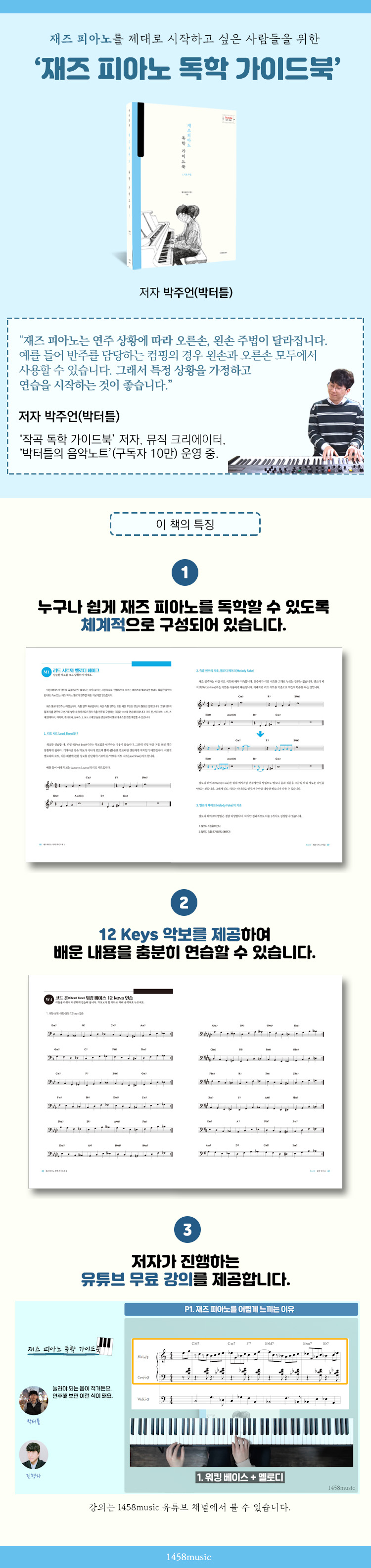
Jazz piano techniques vary between right-hand and left-hand players depending on the playing situation.
Especially for comping, which is responsible for accompaniment, it can be used with both the left and right hands.
So, it's a good idea to start practicing by assuming a specific situation.
You need to understand and practice the situation, whether it's playing a piano solo by yourself, playing a melody-centered performance with a stable bass, or playing an accompaniment that supports the melody.
This way you can use drum loops or ask a friend to sing along to you while you practice.
Practicing without understanding the performance situation will result in confusion in actual performance.
Especially for comping, which is responsible for accompaniment, it can be used with both the left and right hands.
So, it's a good idea to start practicing by assuming a specific situation.
You need to understand and practice the situation, whether it's playing a piano solo by yourself, playing a melody-centered performance with a stable bass, or playing an accompaniment that supports the melody.
This way you can use drum loops or ask a friend to sing along to you while you practice.
Practicing without understanding the performance situation will result in confusion in actual performance.
--- From the text
Publisher's Review
'Jazz Piano Self-Study Guidebook 1' is Park Turtle's second music guidebook following the composition self-study guidebook.
It provides a systematic practice method to help beginners in jazz piano reduce trial and error.
When playing jazz piano, you need to choose a technique that suits various situations, and this book helps you play appropriately for each situation.
We teach walking bass, scales, and comping in that order, and provide examples of how to practice combining these three techniques.
The author's lectures are provided especially through 1458music's YouTube channel.
You can supplement parts that you didn't understand from books alone and watch actual performance videos.
This is an ideal textbook for beginners or those who want to move from classical piano to jazz piano.
It provides a systematic practice method to help beginners in jazz piano reduce trial and error.
When playing jazz piano, you need to choose a technique that suits various situations, and this book helps you play appropriately for each situation.
We teach walking bass, scales, and comping in that order, and provide examples of how to practice combining these three techniques.
The author's lectures are provided especially through 1458music's YouTube channel.
You can supplement parts that you didn't understand from books alone and watch actual performance videos.
This is an ideal textbook for beginners or those who want to move from classical piano to jazz piano.
GOODS SPECIFICS
- Date of issue: April 10, 2020
- Page count, weight, size: 232 pages | 586g | 213*270*20mm
- ISBN13: 9791189598082
- ISBN10: 1189598086
You may also like
카테고리
korean


korean

![GQ KOREA Mark (Monthly): December [2025]](http://librairie.coreenne.fr/cdn/shop/files/8ef265dbbfbf186523ed75ba7319009d.jpg?v=1765340328&width=3840)


