

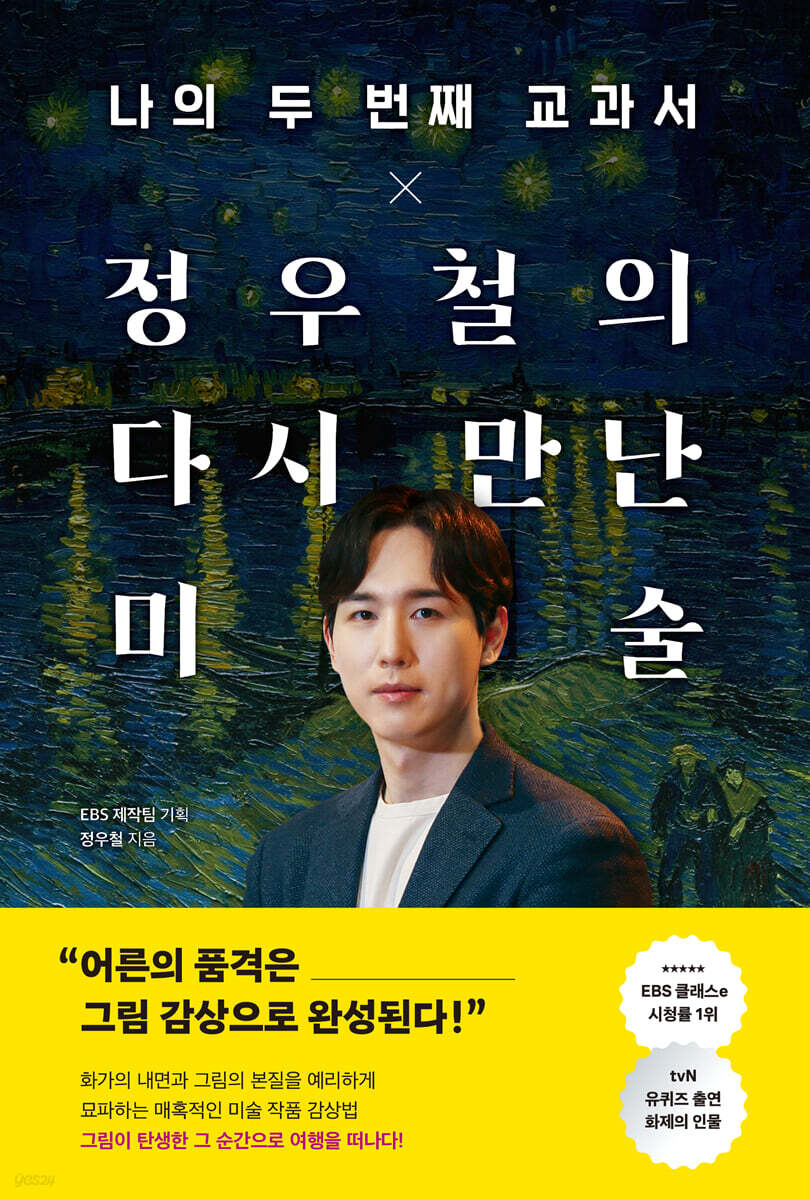
My Second Textbook x Jeong Woo-cheol's Art Reunited
 |
Description
Book Introduction
A hot topic appearing on tvN's "You Quiz on the Block"
Host of EBS Classe's #1 rated show, "Jung Woo-chul's Art Theater"
Exhibition commentator for Korea's most popular exhibitions, including the 'Henri Matisse Exhibition' and the 'Bernard Buffet Exhibition'
“I just read it for fun
“Culture grows naturally!”
Guided by docent Woo-cheol Jeong, the ‘affectionate storyteller’ of the art world
Art experience time for cultured adults
A new book has been published by docent Woo-cheol Jeong, who has appeared on tvN's "You Quiz on the Block" and JTBC's "Talk Pawon 25 Hours" and has been active as a commentator for Korea's most popular exhibitions, such as the "Henri Matisse Exhibition" and the "Bernard Buffet Exhibition."
This book is a retelling of the popular EBS educational program "My Second Textbook: Art," which reinterpreted "textbook knowledge" as "education for adults."
In this book, docent Jeong Woo-cheol takes a look back at the works of 21 of the best domestic and foreign painters that we saw in our textbooks during our school days, including representative Korean painters Lee Jung-seob and Park Soo-geun, and representative Western painters Vincent van Gogh and Claude Monet. He kindly introduces not only basic information about the works but also the lives of the painters hidden within the works.
As we listen to docent Jeong Woo-cheol's explanations, which feel like a journey back to the moment the artwork was created, the paintings enter our lives, and while we just read for fun, our artistic knowledge naturally grows.
When you learn about the life of Lee Jung-seob, who painted for his beloved family, you will feel the sorrow in his painting of [The Bull], and when you learn about the life of Monet, who tried to capture the beauty of light and color in his paintings even when he was blind, you will finally understand why his masterpiece [Water Lilies] deeply moves people.
“Studying art is not simply about accumulating knowledge of art, but rather, it is an opportunity to look back on one’s own life through the paintings and lives of artists.” As docent Jeong Woo-cheol said, if you read this book, art will no longer be simply “art that is difficult to be pretty and beautiful” that is separate from our lives.
You will feel the joy and emotion that familiar paintings add to our lives.
Host of EBS Classe's #1 rated show, "Jung Woo-chul's Art Theater"
Exhibition commentator for Korea's most popular exhibitions, including the 'Henri Matisse Exhibition' and the 'Bernard Buffet Exhibition'
“I just read it for fun
“Culture grows naturally!”
Guided by docent Woo-cheol Jeong, the ‘affectionate storyteller’ of the art world
Art experience time for cultured adults
A new book has been published by docent Woo-cheol Jeong, who has appeared on tvN's "You Quiz on the Block" and JTBC's "Talk Pawon 25 Hours" and has been active as a commentator for Korea's most popular exhibitions, such as the "Henri Matisse Exhibition" and the "Bernard Buffet Exhibition."
This book is a retelling of the popular EBS educational program "My Second Textbook: Art," which reinterpreted "textbook knowledge" as "education for adults."
In this book, docent Jeong Woo-cheol takes a look back at the works of 21 of the best domestic and foreign painters that we saw in our textbooks during our school days, including representative Korean painters Lee Jung-seob and Park Soo-geun, and representative Western painters Vincent van Gogh and Claude Monet. He kindly introduces not only basic information about the works but also the lives of the painters hidden within the works.
As we listen to docent Jeong Woo-cheol's explanations, which feel like a journey back to the moment the artwork was created, the paintings enter our lives, and while we just read for fun, our artistic knowledge naturally grows.
When you learn about the life of Lee Jung-seob, who painted for his beloved family, you will feel the sorrow in his painting of [The Bull], and when you learn about the life of Monet, who tried to capture the beauty of light and color in his paintings even when he was blind, you will finally understand why his masterpiece [Water Lilies] deeply moves people.
“Studying art is not simply about accumulating knowledge of art, but rather, it is an opportunity to look back on one’s own life through the paintings and lives of artists.” As docent Jeong Woo-cheol said, if you read this book, art will no longer be simply “art that is difficult to be pretty and beautiful” that is separate from our lives.
You will feel the joy and emotion that familiar paintings add to our lives.
- You can preview some of the book's contents.
Preview
index
Prologue - The life stories of artists who bring happiness and comfort to us living today.
Chapter 1.
Lee Jung-seob and Modigliani: Art, Love, and Life
Lee Jung-seob, a true Korean Fauvist with a powerful painting style
The encounter between the youngest son of a wealthy family and his elite mentor | Liberation, war, and love | A time of tumultuous joy and sorrow | Days of despair and the shadow of misery | Lee Jung-seob's final record
Amedeo Modigliani, the eternal love of a free-spirited bohemian
A painter's dream confessed while teetering on the brink of death | An artistic spirit born in a Parisian "beehive" | A signature style born from African art | The joy of a daughter's birth, and his last and first solo exhibition | A meeting 10 years after his death
Chapter 2.
Park Soo-keun and Van Gogh: Drawing the Purity of Life with Stars and Trees
Park Soo-geun, an artist who sought to portray human kindness and truth.
Soogeun's childhood and her encounter with Millet | "Would you like to be the wife of a great painter?" | Days when tears never stopped | The long, long road to heaven
Vincent van Gogh, a lifelong cat who embraced even failure.
Not a Painter, but a Seller | Van Gogh Awakens in Paris | Why He Cut Off His Ear | Lost on the Path of Life
Chapter 3.
Monet and Renoir: Capturing the Bright and Lively Life
Claude Monet: The Beginning of a New Style Created by Resistance from the Past
What is Impressionism? | Monet hated school, and he hated traditional painting techniques, too. | Forging his own path amid ridicule. | For Monet, there is no such thing as black.
Pierre-Auguste Renoir, the artist obsessed with happiness
“If it’s not fun, there’s no reason to draw.” | Lively men and women, a flood of colors | Even when I couldn’t hold a brush due to arthritis
Chapter 4.
Klimt and Schiele: Under the Two Names of 'Freedom' and 'Fear'
Gustav Klimt, the mysterious painter who kept himself hidden
A Successful Start as a Commercial Painter | Forging His Own Path Through the Vienna Secession | "An Incredibly Accomplished Artist"
Egon Schiele, whose works were as intense as his short life.
"Be My Teacher" | Art as a Deconstruction for the Truth | Schiele, the "Bad Man"
Chapter 5.
Moses and Rousseau: It's Never Too Late to Live
Anna Mary Moses, who had such a difficult life
Unattractive, yet all the more stunning paintings | Past struggles become memories | 88-year-old Young Woman of the Year
Henri Rousseau, The Future of Those Who Never Lose Their Dreams
The shock of seeing the charm of the tropical rainforest | A painter who is no longer ridiculed by anyone
Chapter 6.
Gentileschi, Suzanne Valadon, Frida Kahlo: Art Stories Painted by Hardships
Artemisia Gentileschi, a strong female painter who ushered in a new era
Childhood Experiences, Realizing the Intensity | Her Elegant Revenge | A Warrior with Caesar's Courage
Suzanne Valadon, an innovative female painter with a free and bold perspective
A woman who went from modeling to taking up a paintbrush herself | A shy man vs. a bold woman who breaks taboos
Frida Kahlo, her artistic achievements achieved through extreme physical pain
Polio at age 6 and a car accident during his school years | Extreme physical pain, death at age 47
Chapter 7.
Kandinsky and Klee: The more terrible the world becomes, the more abstract art becomes.
Wassily Kandinsky, in search of soul-stirring colors
A bewildering wonder | Feeling the harmony of lines and colors | Expressing the soul, that is art.
Paul Klee, the painter who became one with color
A detailed, vibrant painting skill | A time dominated by color | A lightheartedness that was never lost even in pain
Chapter 8.
Munch and Kirchner: Capturing Inner Feelings in Line and Color
Edvard Munch, a man who experienced all the world's suffering in his teens
The shadow of death, the agony of pain... but outstanding skill | Munch, who heard the cry of nature and sought refuge in a mental hospital | New hope found in Van Gogh
Ludwig Kirchner: The Life of a Painter Traumatized by His Times
Emotions bursting through color and line | The Last in a small Swiss village
Chapter 9.
Rodin and Claudel: Sculpting Love and Parting
Auguste Rodin, a master who carved human emotions into sculptures
A Talent Discovered Late, Controversial Works | Rodin's Mastery: Meeting Camille Claudel | His Later Years: Developing His Own Style
Camille Claudel, the ill-fated sculptor trapped in a passionate genius
The Unlucky Unloved by Her Mother | Abandoned Camille, Desperate for Love | Thirty Years in a Mental Hospital
Chapter 10.
Da Vinci and Michelangelo: Masterpieces by Two Geniuses Who Shined in the Renaissance
Da Vinci, the man who created the masterpieces “The Last Supper” and “Mona Lisa”
An illegitimate child who displayed extraordinary talent | Da Vinci, who had many unfinished works | The French king who watched over Da Vinci during his death
Michelangelo, a hard-working genius who transcended painting and sculpture
Extraordinary sculpting skills proven since his 20s | Fascinating stories hidden in [The Creation of Heaven and Earth] | A master who burned with passion until his death
Chapter 1.
Lee Jung-seob and Modigliani: Art, Love, and Life
Lee Jung-seob, a true Korean Fauvist with a powerful painting style
The encounter between the youngest son of a wealthy family and his elite mentor | Liberation, war, and love | A time of tumultuous joy and sorrow | Days of despair and the shadow of misery | Lee Jung-seob's final record
Amedeo Modigliani, the eternal love of a free-spirited bohemian
A painter's dream confessed while teetering on the brink of death | An artistic spirit born in a Parisian "beehive" | A signature style born from African art | The joy of a daughter's birth, and his last and first solo exhibition | A meeting 10 years after his death
Chapter 2.
Park Soo-keun and Van Gogh: Drawing the Purity of Life with Stars and Trees
Park Soo-geun, an artist who sought to portray human kindness and truth.
Soogeun's childhood and her encounter with Millet | "Would you like to be the wife of a great painter?" | Days when tears never stopped | The long, long road to heaven
Vincent van Gogh, a lifelong cat who embraced even failure.
Not a Painter, but a Seller | Van Gogh Awakens in Paris | Why He Cut Off His Ear | Lost on the Path of Life
Chapter 3.
Monet and Renoir: Capturing the Bright and Lively Life
Claude Monet: The Beginning of a New Style Created by Resistance from the Past
What is Impressionism? | Monet hated school, and he hated traditional painting techniques, too. | Forging his own path amid ridicule. | For Monet, there is no such thing as black.
Pierre-Auguste Renoir, the artist obsessed with happiness
“If it’s not fun, there’s no reason to draw.” | Lively men and women, a flood of colors | Even when I couldn’t hold a brush due to arthritis
Chapter 4.
Klimt and Schiele: Under the Two Names of 'Freedom' and 'Fear'
Gustav Klimt, the mysterious painter who kept himself hidden
A Successful Start as a Commercial Painter | Forging His Own Path Through the Vienna Secession | "An Incredibly Accomplished Artist"
Egon Schiele, whose works were as intense as his short life.
"Be My Teacher" | Art as a Deconstruction for the Truth | Schiele, the "Bad Man"
Chapter 5.
Moses and Rousseau: It's Never Too Late to Live
Anna Mary Moses, who had such a difficult life
Unattractive, yet all the more stunning paintings | Past struggles become memories | 88-year-old Young Woman of the Year
Henri Rousseau, The Future of Those Who Never Lose Their Dreams
The shock of seeing the charm of the tropical rainforest | A painter who is no longer ridiculed by anyone
Chapter 6.
Gentileschi, Suzanne Valadon, Frida Kahlo: Art Stories Painted by Hardships
Artemisia Gentileschi, a strong female painter who ushered in a new era
Childhood Experiences, Realizing the Intensity | Her Elegant Revenge | A Warrior with Caesar's Courage
Suzanne Valadon, an innovative female painter with a free and bold perspective
A woman who went from modeling to taking up a paintbrush herself | A shy man vs. a bold woman who breaks taboos
Frida Kahlo, her artistic achievements achieved through extreme physical pain
Polio at age 6 and a car accident during his school years | Extreme physical pain, death at age 47
Chapter 7.
Kandinsky and Klee: The more terrible the world becomes, the more abstract art becomes.
Wassily Kandinsky, in search of soul-stirring colors
A bewildering wonder | Feeling the harmony of lines and colors | Expressing the soul, that is art.
Paul Klee, the painter who became one with color
A detailed, vibrant painting skill | A time dominated by color | A lightheartedness that was never lost even in pain
Chapter 8.
Munch and Kirchner: Capturing Inner Feelings in Line and Color
Edvard Munch, a man who experienced all the world's suffering in his teens
The shadow of death, the agony of pain... but outstanding skill | Munch, who heard the cry of nature and sought refuge in a mental hospital | New hope found in Van Gogh
Ludwig Kirchner: The Life of a Painter Traumatized by His Times
Emotions bursting through color and line | The Last in a small Swiss village
Chapter 9.
Rodin and Claudel: Sculpting Love and Parting
Auguste Rodin, a master who carved human emotions into sculptures
A Talent Discovered Late, Controversial Works | Rodin's Mastery: Meeting Camille Claudel | His Later Years: Developing His Own Style
Camille Claudel, the ill-fated sculptor trapped in a passionate genius
The Unlucky Unloved by Her Mother | Abandoned Camille, Desperate for Love | Thirty Years in a Mental Hospital
Chapter 10.
Da Vinci and Michelangelo: Masterpieces by Two Geniuses Who Shined in the Renaissance
Da Vinci, the man who created the masterpieces “The Last Supper” and “Mona Lisa”
An illegitimate child who displayed extraordinary talent | Da Vinci, who had many unfinished works | The French king who watched over Da Vinci during his death
Michelangelo, a hard-working genius who transcended painting and sculpture
Extraordinary sculpting skills proven since his 20s | Fascinating stories hidden in [The Creation of Heaven and Earth] | A master who burned with passion until his death
Detailed image

Into the book
Love and War.
This is probably the most concise statement about the lives of Lee Jung-seob and Amedeo Modigliani.
Lee Jung-seob worked on his art during the Korean War, and Modigliani worked on his art during the First World War. As the madness of the war intensified, they fled to Jeju Island and Nice, southern France, respectively, and continued their work.
Although I felt a brief sense of relief in the remote place, I also felt wounds that bordered on trauma.
But even in the midst of war, what made their souls happy was life with the woman they loved.
Lee Jung-seob fell in love with Lee Nam-deok, a Japanese painter, and Modigliani fell in love with Jeanne Hebuterne, a painter and lover 14 years his junior.
They all fell in love with each other at first sight, loved each other fiercely, and experienced a sad and hazy separation.
So their lives were both happy times filled with love and painful times filled with war.
The circumstances that led to the end of their lives are also very similar.
Both ambitiously prepared for their first solo exhibitions, but suffered great disappointment and frustration.
And a deep sigh extinguished their young artistic spirit forever.
---「Chapter 1.
From "Lee Jung-seob and Modigliani: Art, Love, and Life"
Park Soo-keun and Vincent van Gogh both captured the 'ordinary lives of common people' on canvas.
I wanted to capture the image of a rural area where farmers just work hard without any special events, living each day diligently without anything special to do.
What they noticed in that appearance was 'sublimity'.
This is because I felt an utmost nobility in the very sight of ordinary people faithfully carrying out their roles.
The world of these two works has in common the origins of the French painter Jean-Francois Millet.
Millet, a realist painter who depicted the lives of 19th-century farmers, captured the lives of rural areas and farmers in his works, [The Gleaners] and [The Angelus], which depicted them warmly and earnestly.
---「Chapter 2.
From "Park Soo-keun and Van Gogh: Drawing the Purity of Life with Stars and Trees"
Monet's bright and vibrant painting style is now slowly beginning to resemble watercolors.
I used a specific color frequently, and with repeated brushstrokes, I began to create paintings that looked as if paint had been poured onto the canvas.
His right eye was virtually blind, and he painted with only his left eye.
For Monet, this situation was nothing but fear and dread.
As a result, he often got angry, and at times he would tear up and destroy his own work.
It is said that when his eyesight was at its worst, he destroyed as many as 500 pieces of art.
But Monet did not completely collapse.
He completed a work called [Training], which can be called his masterpiece.
He had been drawing meditations all his life, giving comfort to others, but now his last work was giving comfort to himself.
December 5, 1926, the day this work was completed.
Monet died at the age of 86.
His death made headlines, and his funeral was held quietly, without any religious ceremonies or speeches, as he had requested.
His coffin was covered with a black cloth, but his friends said, 'There is no black for Monet.'
This is because impressionist painters usually believed that 'there is no black as long as there is light.'
Eventually, his coffin was covered with the bright, floral fabric he so loved.
---「Chapter 3.
Monet and Renoir: Capturing the Bright and Lively Life
At that time, painters always drew Baladong as pretty and beautiful.
The same goes for Renoir's painting of Suzanne Valadon. A calm and beautiful woman without any worries.
This is exactly what Baladong looked like on canvas.
But was Baladong really a woman of that appearance? In fact, it's not easy to see that as the case.
It is not easy for a woman who has lived in the lowest class to have such a peaceful demeanor while doing laundry since her teens.
It is highly likely that he was a person filled with the hardships of life that he had to constantly endure.
Perhaps Baladong was very dissatisfied with the way he looked on canvas.
So, haven't you ever thought about drawing a picture of your true self?
Eventually, she began to nurture her dream of becoming an artist and of painting herself.
Of course, all conditions were poor.
I couldn't go to art school, nor could I learn painting from a painter.
In the end, I had no choice but to learn how artists paint by watching them as I worked as a model.
And during break time, I would secretly go to a corner and practice by imitating other artists' paintings.
---「Chapter 6.
From "Gentileschi, Suzanne Valadon, Frida Kahlo"
Munch learned about Van Gogh's work and his life.
In the process, he realized that Vincent van Gogh was the one who had it harder than he was.
But although he always complained about wanting to die, Van Gogh put hope into his paintings.
And he wondered.
How did Van Gogh capture hope in his paintings? From then on, Munch began to change little by little.
One time, the University of Oslo hired an artist to paint a mural.
And the changed Munch applied for this and painted a work called [The Sun].
For Norwegians, the sun is very different from what we usually think of it as.
From November to February, the sun appears to rise but then disappears immediately, never rising at all.
From our perspective, such an environment itself would be extremely painful.
For these Norwegians, the sun is a symbol of joy, signaling the end of the harsh winter and the arrival of spring.
Now, Munch has found "hope," not "the scream."
This is probably the most concise statement about the lives of Lee Jung-seob and Amedeo Modigliani.
Lee Jung-seob worked on his art during the Korean War, and Modigliani worked on his art during the First World War. As the madness of the war intensified, they fled to Jeju Island and Nice, southern France, respectively, and continued their work.
Although I felt a brief sense of relief in the remote place, I also felt wounds that bordered on trauma.
But even in the midst of war, what made their souls happy was life with the woman they loved.
Lee Jung-seob fell in love with Lee Nam-deok, a Japanese painter, and Modigliani fell in love with Jeanne Hebuterne, a painter and lover 14 years his junior.
They all fell in love with each other at first sight, loved each other fiercely, and experienced a sad and hazy separation.
So their lives were both happy times filled with love and painful times filled with war.
The circumstances that led to the end of their lives are also very similar.
Both ambitiously prepared for their first solo exhibitions, but suffered great disappointment and frustration.
And a deep sigh extinguished their young artistic spirit forever.
---「Chapter 1.
From "Lee Jung-seob and Modigliani: Art, Love, and Life"
Park Soo-keun and Vincent van Gogh both captured the 'ordinary lives of common people' on canvas.
I wanted to capture the image of a rural area where farmers just work hard without any special events, living each day diligently without anything special to do.
What they noticed in that appearance was 'sublimity'.
This is because I felt an utmost nobility in the very sight of ordinary people faithfully carrying out their roles.
The world of these two works has in common the origins of the French painter Jean-Francois Millet.
Millet, a realist painter who depicted the lives of 19th-century farmers, captured the lives of rural areas and farmers in his works, [The Gleaners] and [The Angelus], which depicted them warmly and earnestly.
---「Chapter 2.
From "Park Soo-keun and Van Gogh: Drawing the Purity of Life with Stars and Trees"
Monet's bright and vibrant painting style is now slowly beginning to resemble watercolors.
I used a specific color frequently, and with repeated brushstrokes, I began to create paintings that looked as if paint had been poured onto the canvas.
His right eye was virtually blind, and he painted with only his left eye.
For Monet, this situation was nothing but fear and dread.
As a result, he often got angry, and at times he would tear up and destroy his own work.
It is said that when his eyesight was at its worst, he destroyed as many as 500 pieces of art.
But Monet did not completely collapse.
He completed a work called [Training], which can be called his masterpiece.
He had been drawing meditations all his life, giving comfort to others, but now his last work was giving comfort to himself.
December 5, 1926, the day this work was completed.
Monet died at the age of 86.
His death made headlines, and his funeral was held quietly, without any religious ceremonies or speeches, as he had requested.
His coffin was covered with a black cloth, but his friends said, 'There is no black for Monet.'
This is because impressionist painters usually believed that 'there is no black as long as there is light.'
Eventually, his coffin was covered with the bright, floral fabric he so loved.
---「Chapter 3.
Monet and Renoir: Capturing the Bright and Lively Life
At that time, painters always drew Baladong as pretty and beautiful.
The same goes for Renoir's painting of Suzanne Valadon. A calm and beautiful woman without any worries.
This is exactly what Baladong looked like on canvas.
But was Baladong really a woman of that appearance? In fact, it's not easy to see that as the case.
It is not easy for a woman who has lived in the lowest class to have such a peaceful demeanor while doing laundry since her teens.
It is highly likely that he was a person filled with the hardships of life that he had to constantly endure.
Perhaps Baladong was very dissatisfied with the way he looked on canvas.
So, haven't you ever thought about drawing a picture of your true self?
Eventually, she began to nurture her dream of becoming an artist and of painting herself.
Of course, all conditions were poor.
I couldn't go to art school, nor could I learn painting from a painter.
In the end, I had no choice but to learn how artists paint by watching them as I worked as a model.
And during break time, I would secretly go to a corner and practice by imitating other artists' paintings.
---「Chapter 6.
From "Gentileschi, Suzanne Valadon, Frida Kahlo"
Munch learned about Van Gogh's work and his life.
In the process, he realized that Vincent van Gogh was the one who had it harder than he was.
But although he always complained about wanting to die, Van Gogh put hope into his paintings.
And he wondered.
How did Van Gogh capture hope in his paintings? From then on, Munch began to change little by little.
One time, the University of Oslo hired an artist to paint a mural.
And the changed Munch applied for this and painted a work called [The Sun].
For Norwegians, the sun is very different from what we usually think of it as.
From November to February, the sun appears to rise but then disappears immediately, never rising at all.
From our perspective, such an environment itself would be extremely painful.
For these Norwegians, the sun is a symbol of joy, signaling the end of the harsh winter and the arrival of spring.
Now, Munch has found "hope," not "the scream."
---「Chapter 8.
From "Munch and Kirchner, Expressing Inner Feelings in Lines and Colors"
From "Munch and Kirchner, Expressing Inner Feelings in Lines and Colors"
Publisher's Review
“Every artist has his own way
“It contains one’s own ‘life’”
Why Paintings Give Us Comfort and Emotion
The author of this book, docent Woo-cheol Jeong, who is a top broadcaster and exhibition lecturer and is known as an exhibition commentator for the most popular exhibitions in Korea, conveys the meaning of looking at paintings through the lives of artists and their works.
Although it is a famous work by a familiar artist and one we have seen many times somewhere, docent Jeong Woo-cheol lovingly explains how art appreciation adds comfort and emotion to our daily lives through the 'artist's narrative' hidden within the work.
Twenty-one painters appear in 『My Second Textbook x Jeong Woo-cheol's Art We Met Again』.
Representative Korean painters Lee Jung-seob and Park Soo-keun, Vincent van Gogh and Claude Monet whose exhibitions sell out every time they open, Gustav Klimt and Edvard Munch, artists whose beauty and melancholy coexist, Da Vinci and Michelangelo, the two geniuses of the Renaissance, Gentileschi, Suzanne Valadon, and Frida Kahlo, who overcame prejudice and broke through the glass ceiling of being a woman.
The artists that Docent Jeong Woo-cheol carefully selected have one thing in common: they are artists who have persevered and worked hard to paint “beautiful things,” even if life is not beautiful.
The only difference is that the painter also lived the life of an artist, but ultimately, his life is no different from ours.
If you follow the explanations of docent Jeong Woo-cheol and read about their lives and paintings as if you were looking at a painting, you will find an opportunity to look back on your life while looking at the paintings.
“I saw Van Gogh’s painting
“I found new hope”_Edvard Munch
The Usefulness of Art: Bringing New Inspiration to Your Life
Sometimes, a painting you see by chance can give you strength in life.
In his book, docent Jeong Woo-cheol explains this ‘usefulness of art’ through Munch’s life.
Munch suffered from severe depression from his teenage years due to the death of his family during his childhood, and depicted his own psychology in his work, [The Scream].
But one day, Munch was deeply impressed by Van Gogh's work.
After learning more about Van Gogh's life, Munch began to paint pictures with hope 'influenced by Van Gogh', free from the fear, anxiety, and depression that had followed him, and left behind masterpieces such as [The Scream] and [The Haymaker], which were completely different from [The Scream].
And he left these words.
“I try to explain life and its meaning through art.
So I hope my drawings will help others see their lives a little more clearly.”
As we can see from Munch's life, the closer I get to art, the more I can gain new energy for life.
Let's enjoy a light and comfortable time reading about paintings with docent Jeong Woo-cheol's art class, which tells the story of the artist's life rather than a boring class.
Even the paintings you have seen so far will enter your life in a new way.
“It contains one’s own ‘life’”
Why Paintings Give Us Comfort and Emotion
The author of this book, docent Woo-cheol Jeong, who is a top broadcaster and exhibition lecturer and is known as an exhibition commentator for the most popular exhibitions in Korea, conveys the meaning of looking at paintings through the lives of artists and their works.
Although it is a famous work by a familiar artist and one we have seen many times somewhere, docent Jeong Woo-cheol lovingly explains how art appreciation adds comfort and emotion to our daily lives through the 'artist's narrative' hidden within the work.
Twenty-one painters appear in 『My Second Textbook x Jeong Woo-cheol's Art We Met Again』.
Representative Korean painters Lee Jung-seob and Park Soo-keun, Vincent van Gogh and Claude Monet whose exhibitions sell out every time they open, Gustav Klimt and Edvard Munch, artists whose beauty and melancholy coexist, Da Vinci and Michelangelo, the two geniuses of the Renaissance, Gentileschi, Suzanne Valadon, and Frida Kahlo, who overcame prejudice and broke through the glass ceiling of being a woman.
The artists that Docent Jeong Woo-cheol carefully selected have one thing in common: they are artists who have persevered and worked hard to paint “beautiful things,” even if life is not beautiful.
The only difference is that the painter also lived the life of an artist, but ultimately, his life is no different from ours.
If you follow the explanations of docent Jeong Woo-cheol and read about their lives and paintings as if you were looking at a painting, you will find an opportunity to look back on your life while looking at the paintings.
“I saw Van Gogh’s painting
“I found new hope”_Edvard Munch
The Usefulness of Art: Bringing New Inspiration to Your Life
Sometimes, a painting you see by chance can give you strength in life.
In his book, docent Jeong Woo-cheol explains this ‘usefulness of art’ through Munch’s life.
Munch suffered from severe depression from his teenage years due to the death of his family during his childhood, and depicted his own psychology in his work, [The Scream].
But one day, Munch was deeply impressed by Van Gogh's work.
After learning more about Van Gogh's life, Munch began to paint pictures with hope 'influenced by Van Gogh', free from the fear, anxiety, and depression that had followed him, and left behind masterpieces such as [The Scream] and [The Haymaker], which were completely different from [The Scream].
And he left these words.
“I try to explain life and its meaning through art.
So I hope my drawings will help others see their lives a little more clearly.”
As we can see from Munch's life, the closer I get to art, the more I can gain new energy for life.
Let's enjoy a light and comfortable time reading about paintings with docent Jeong Woo-cheol's art class, which tells the story of the artist's life rather than a boring class.
Even the paintings you have seen so far will enter your life in a new way.
GOODS SPECIFICS
- Date of issue: December 4, 2024
- Page count, weight, size: 296 pages | 552g | 152*225*18mm
- ISBN13: 9791169851152
- ISBN10: 1169851150
You may also like
카테고리
korean


korean

![GQ KOREA Mark (Monthly): December [2025]](http://librairie.coreenne.fr/cdn/shop/files/8ef265dbbfbf186523ed75ba7319009d.jpg?v=1765340328&width=3840)


