

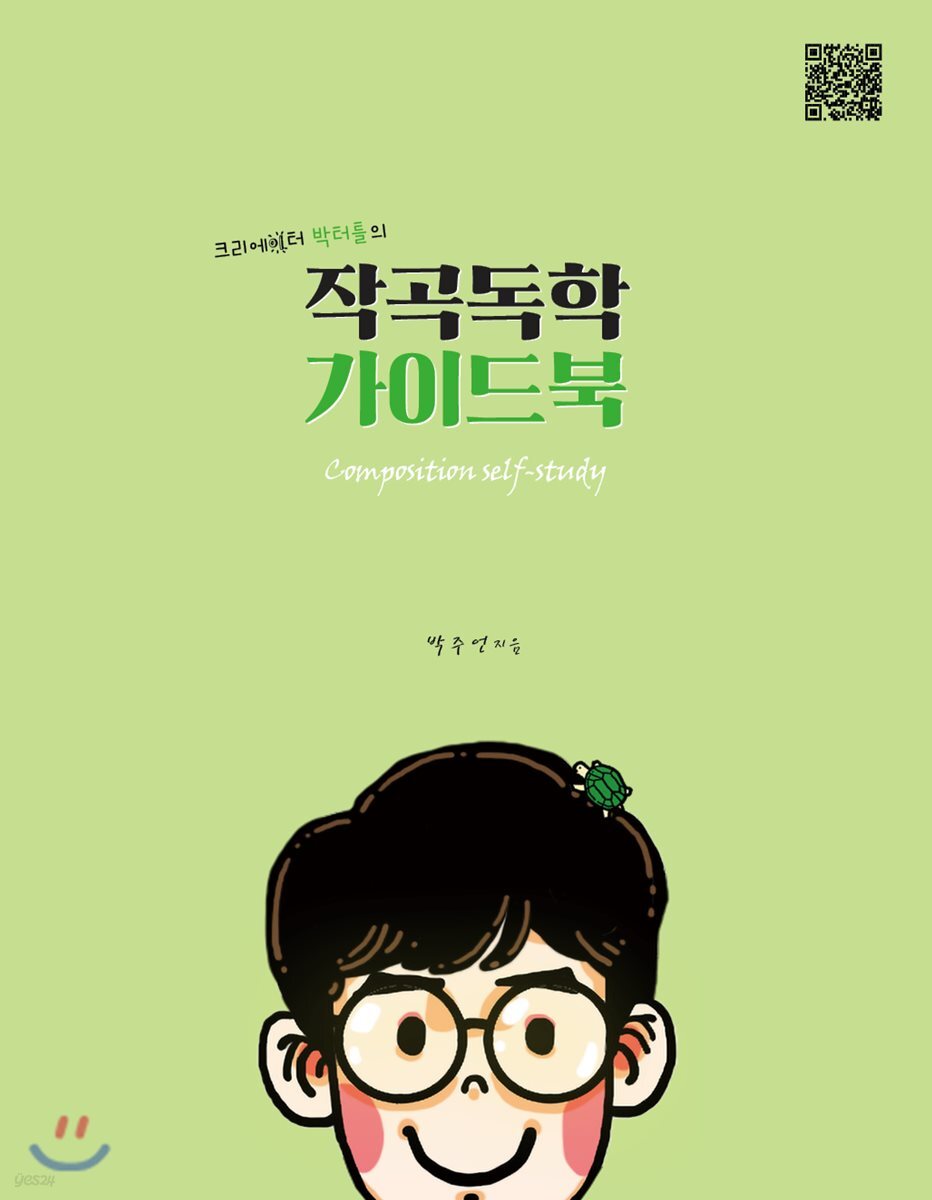
Self-study composition guidebook
 |
Description
Book Introduction
A friendly guide for beginners in composition, from creator Park Turtle.
Park Turtle's 'Self-Study Songwriting Guidebook' is a book that helps you create your own songs, as the title suggests. It explains the basics of songwriting, divided into chord progression, melody, lyrics, and rhythm parts. It includes detailed explanations, tracks to listen to sounds, illustrations, and checklist questions so that even beginners in composition or those who want to compose as a hobby can easily understand. In particular, the explanation is presented using four songs written and composed by the author himself as examples, helping to enable concrete practice. You can already see another talent of author Park Joo-eon, who is already teaching music theory in an easy-to-understand way through YouTube's 'Park Turtle's Music Notes'. Park Turtle's 'Self-Study Composition Guidebook' is a book that breaks the prejudice that studying composition is difficult. The author's know-how in easily explaining complex music theory through YouTube is now available in a composition book. In particular, it explains in detail what ideas were used to plan the author's self-composed songs that were released as sound sources and what composition techniques were used to complete them. We explain unfamiliar music theory as simply as possible, and provide tracks so that even beginners can listen to the sounds without feeling burdened. Anyone who wants to create their own songs can look forward to it. |
- You can preview some of the book's contents.
Preview
index
Author's Note_4
Must Do it!_8
PART00.
4 Ways to Start Composing and SONG FORM
4 Ways to Start Composing_13 / Song Form_19 / Representative Song Forms_26 / [Good to Read] The 30-Second Rule_30
PART01.
Start composing from a chord progression
Diatonic chords_36 / Frequently used major progressions_40 / Harmonies and melodies_47 / Creating Verse 1 using harmonics_49 / How to create Verse 2_54 / Creating Verse 2 using harmonics_56 / Creating non-harmonic melodies_61 / Passing notes and departure notes_63 / Preceding notes and suspension notes_67 / Auxiliary notes and pre-notes_71 / Creating choruses using non-harmonic notes_76 / Understanding minor progressions_81 / Finding parallel keys_82 / Harmonic minor scale_83 / Frequently used minor progressions_85 / Creating pre-choruses in minor keys_88
PART02.
Start composing with a synchronizing melody
Motive Melody_98 / 6 Ways to Develop Motive_101 / Repetition_101 / Isomorphic Progression_102 / Inversion_106 / Variation_108 / Addition and Omission_112 / Expansion and Reduction_114 / Developing Motives to Complete Verse and Chorus_118 / Attaching Chord Progression to Melody_125 / Function of Chord_127 / Substitute Chord_130 / Strong and Weak Progression_136 / Harmonic Rhythm_137 / Strong and Weak Beat_138 / Inversion Chord_140 / Attaching Chord to Verse_144
PART03.
Starting to compose from rhythm
Beat, Tempo, and Rhythm_156 / Straight Rhythm and Bounce Rhythm_159 / Unfinished Measures_161 / Creating a Chorus with Shuffle Rhythm_164 / Creating a Verse with Shuffle Rhythm_176 / Creating a Shuffle Song Bridge_185 / [Good to Read] Tension_181
PART04.
Starting a song composition with lyrics
Essays and Lyrics_193 / Analyzing Syllables in Established Songs_195 / Using Inversion_200 / Finding Progression that Fits Lyrics_204 / Writing Melodies that Match Lyrics and Progression_208 / Writing Bridge Lyrics_216 / [Good to Read] Writing Lyrics Using the Six W's and One W's_222
PART05.
Make it stylish with reharmony
What is Reharmonization?_229 / Secondary Dominant_230 / Related IIm7_237 / Augmented 4th Substitute Chords_240 / How to Read Chords_245 / Modal Interchange_247
PART06.
Understanding Computer Music
What are MIDI, DAWs, and Sequencers?_269 / Representative DAWs_270 / What you need for computer music_274 / Computer music arrangement methods_277 / Computer music arrangement process_280 / Useful tips to know when starting to arrange_287 / [Good to read] What are mixing and mastering?_291
Must Do it!_8
PART00.
4 Ways to Start Composing and SONG FORM
4 Ways to Start Composing_13 / Song Form_19 / Representative Song Forms_26 / [Good to Read] The 30-Second Rule_30
PART01.
Start composing from a chord progression
Diatonic chords_36 / Frequently used major progressions_40 / Harmonies and melodies_47 / Creating Verse 1 using harmonics_49 / How to create Verse 2_54 / Creating Verse 2 using harmonics_56 / Creating non-harmonic melodies_61 / Passing notes and departure notes_63 / Preceding notes and suspension notes_67 / Auxiliary notes and pre-notes_71 / Creating choruses using non-harmonic notes_76 / Understanding minor progressions_81 / Finding parallel keys_82 / Harmonic minor scale_83 / Frequently used minor progressions_85 / Creating pre-choruses in minor keys_88
PART02.
Start composing with a synchronizing melody
Motive Melody_98 / 6 Ways to Develop Motive_101 / Repetition_101 / Isomorphic Progression_102 / Inversion_106 / Variation_108 / Addition and Omission_112 / Expansion and Reduction_114 / Developing Motives to Complete Verse and Chorus_118 / Attaching Chord Progression to Melody_125 / Function of Chord_127 / Substitute Chord_130 / Strong and Weak Progression_136 / Harmonic Rhythm_137 / Strong and Weak Beat_138 / Inversion Chord_140 / Attaching Chord to Verse_144
PART03.
Starting to compose from rhythm
Beat, Tempo, and Rhythm_156 / Straight Rhythm and Bounce Rhythm_159 / Unfinished Measures_161 / Creating a Chorus with Shuffle Rhythm_164 / Creating a Verse with Shuffle Rhythm_176 / Creating a Shuffle Song Bridge_185 / [Good to Read] Tension_181
PART04.
Starting a song composition with lyrics
Essays and Lyrics_193 / Analyzing Syllables in Established Songs_195 / Using Inversion_200 / Finding Progression that Fits Lyrics_204 / Writing Melodies that Match Lyrics and Progression_208 / Writing Bridge Lyrics_216 / [Good to Read] Writing Lyrics Using the Six W's and One W's_222
PART05.
Make it stylish with reharmony
What is Reharmonization?_229 / Secondary Dominant_230 / Related IIm7_237 / Augmented 4th Substitute Chords_240 / How to Read Chords_245 / Modal Interchange_247
PART06.
Understanding Computer Music
What are MIDI, DAWs, and Sequencers?_269 / Representative DAWs_270 / What you need for computer music_274 / Computer music arrangement methods_277 / Computer music arrangement process_280 / Useful tips to know when starting to arrange_287 / [Good to read] What are mixing and mastering?_291
Detailed image

Publisher's Review
Park Turtle's 'Self-Study Composition Guidebook' is a book that breaks the prejudice that studying composition is difficult.
The author's know-how in easily explaining complex music theory through YouTube is now available in a composition book.
In particular, it explains in detail what ideas were used to plan the author's self-composed songs that were released as sound sources and what composition techniques were used to complete them.
We explain unfamiliar music theory as simply as possible, and provide tracks so that even beginners can listen to the sounds without feeling burdened.
Anyone who wants to create their own songs can look forward to it.
The author's know-how in easily explaining complex music theory through YouTube is now available in a composition book.
In particular, it explains in detail what ideas were used to plan the author's self-composed songs that were released as sound sources and what composition techniques were used to complete them.
We explain unfamiliar music theory as simply as possible, and provide tracks so that even beginners can listen to the sounds without feeling burdened.
Anyone who wants to create their own songs can look forward to it.
GOODS SPECIFICS
- Date of issue: July 2, 2019
- Page count, weight, size: 292 pages | 614g | 177*255*18mm
- ISBN13: 9791189598068
- ISBN10: 118959806X
You may also like
카테고리
korean


korean

![GQ KOREA Mark (Monthly): December [2025]](http://librairie.coreenne.fr/cdn/shop/files/8ef265dbbfbf186523ed75ba7319009d.jpg?v=1765340328&width=3840)


