

Embarrassing Art Stories 5
 |
Description
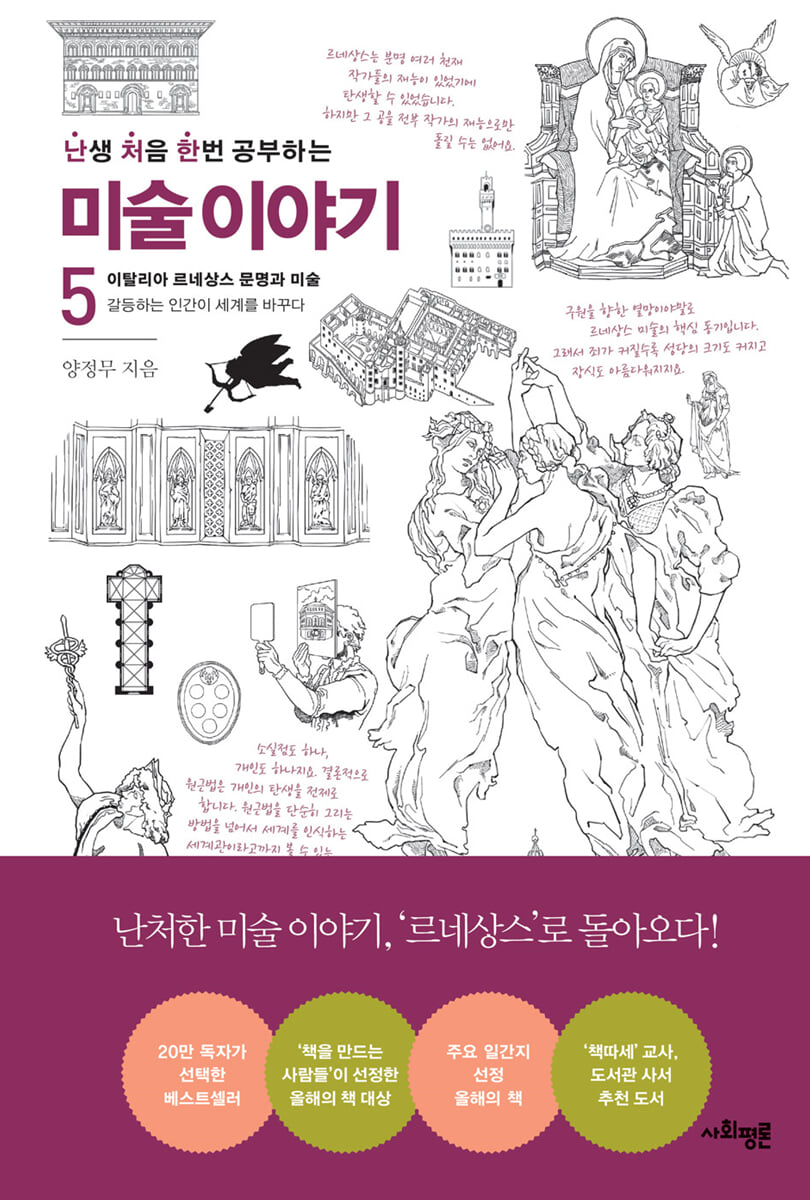
Book Introduction
Art history, the 'flower of humanities'!
One-on-one art lectures that are as easy to read as listening!
The Renaissance, a time of great chaos, a new beginning!
The fifth volume of the "Embarrassing Art Stories" series covers not only how to properly appreciate art, but also the history, politics, economics, and artistic trends contained within it, in an easy, fun, and profound way.
It is a comfortable, colloquial, one-on-one lecture format, and the questions and answers that appear at appropriate times will help to clear up any questions that may arise in your mind.
Because the images appear according to the flow of the story, you don't have to go through the trouble of turning the pages to read.
The collection's value has been enhanced with carefully selected high-quality photos and illustrations.
Although it is an easy book to understand, it is not a low-level book.
Professor Yang Jeong-mu, the author, is an authority in the field of art history and introduces as diverse a range of knowledge and perspectives as possible to understand art.
In other words, it provides the basic art knowledge that a person studying art for the first time must know, as well as the latest theories leading the academic world and Korean art that can be seen around us.
The author, who is also a popular public lecturer, guides readers into the world of art with a friendly attitude, much like a knowledgeable tour guide.
"The Difficult Story of Art," which covered the art of the primitive era, Greece, Rome, and the Middle Ages in Volumes 1-4, finally covers the Italian Renaissance civilization and its art in Volume 5.
During this period, we can see not only the tremendous growth of art in Italy, but also the human beings who overcame crises and stood at the center of the world.
One-on-one art lectures that are as easy to read as listening!
The Renaissance, a time of great chaos, a new beginning!
The fifth volume of the "Embarrassing Art Stories" series covers not only how to properly appreciate art, but also the history, politics, economics, and artistic trends contained within it, in an easy, fun, and profound way.
It is a comfortable, colloquial, one-on-one lecture format, and the questions and answers that appear at appropriate times will help to clear up any questions that may arise in your mind.
Because the images appear according to the flow of the story, you don't have to go through the trouble of turning the pages to read.
The collection's value has been enhanced with carefully selected high-quality photos and illustrations.
Although it is an easy book to understand, it is not a low-level book.
Professor Yang Jeong-mu, the author, is an authority in the field of art history and introduces as diverse a range of knowledge and perspectives as possible to understand art.
In other words, it provides the basic art knowledge that a person studying art for the first time must know, as well as the latest theories leading the academic world and Korean art that can be seen around us.
The author, who is also a popular public lecturer, guides readers into the world of art with a friendly attitude, much like a knowledgeable tour guide.
"The Difficult Story of Art," which covered the art of the primitive era, Greece, Rome, and the Middle Ages in Volumes 1-4, finally covers the Italian Renaissance civilization and its art in Volume 5.
During this period, we can see not only the tremendous growth of art in Italy, but also the human beings who overcame crises and stood at the center of the world.
- You can preview some of the book's contents.
Preview
index
The Story of Studying Art for the First Time in My Life 5
Italian Renaissance Civilization and Art: How Conflicted Humans Changed the World
I Italian City-States and Renaissance Art
- Between heaven and hell
01 Chaos Grows Art
02 Dreaming of salvation through art
03 Mural painted for the poor
04 Siena, embodying ideals grounded in reality
05 The Great Crisis Arrives
II The Renaissance Begins to Bloom
- The glory of Rome is revived in Florence.
01 Architectural Projects in a Vibrant Young City
02 The Gates of Glory Open, and an Era of Competition Begins
03 The Revolution Caused by Brunelleschi's Dome
04 Organizing the method of drawing the world
III The Designers of Renaissance Art
- Who is the protagonist of art?
01 Who bought that art?
02 From the mercenary captain to the genius of the century
Italian Renaissance Civilization and Art: How Conflicted Humans Changed the World
I Italian City-States and Renaissance Art
- Between heaven and hell
01 Chaos Grows Art
02 Dreaming of salvation through art
03 Mural painted for the poor
04 Siena, embodying ideals grounded in reality
05 The Great Crisis Arrives
II The Renaissance Begins to Bloom
- The glory of Rome is revived in Florence.
01 Architectural Projects in a Vibrant Young City
02 The Gates of Glory Open, and an Era of Competition Begins
03 The Revolution Caused by Brunelleschi's Dome
04 Organizing the method of drawing the world
III The Designers of Renaissance Art
- Who is the protagonist of art?
01 Who bought that art?
02 From the mercenary captain to the genius of the century
Detailed image

Into the book
This book deals with the art of the Renaissance period.
Starting with Giotto, who marked a new beginning in the history of Western painting, you will encounter the brilliant masters of Renaissance art, including Brunelleschi, Masaccio, and Leonardo da Vinci.
--- 「… ) The fascinating art of the Renaissance ultimately belongs to those who understand and enjoy it.
With this in mind, let us embark on our art journey to Italy.
--- From "'Dedicated to Volume 5 - A Story of Art Journeying to the Renaissance'"
Europe wasn't exactly a place to see from the start.
Something changed around 1300.
There was an explosion of art creation, and at the same time the quality of the work improved beyond recognition.
At this point, European art, which had previously been no different from the art of other parts of the world, rose to a numerically unrivaled position.
--- From "Part 1: Italian City-States and Renaissance Art, Chapter 1: 'Chaos Nurtures Art'"
If you think about it, people at that time seemed very honest about salvation.
Because he was so willing to create such a beautiful and gigantic work of art for his own salvation.
--- 「… ) The fact that there are many works of art in Europe also tells us that there were many people who thought they had committed a sin.
--- From "Part 1 Italian City-States and Renaissance Art, Chapter 2, 'Dreaming of Salvation through Art'"
Among those who saw Masaccio's Holy Trinity in Florence were, of course, painters.
They, more than anyone else, would have been amazed by this virtual reality created by Masaccio's perspective.
From this time on, painters began to make every effort to learn perspective.
This brought about an era where one could not draw without knowing perspective.
--- From "Part 2, The Renaissance Begins to Bloom, Chapter 4, 'Organizing Methods of Drawing the World'"
The Renaissance was certainly possible because of the talents of many genius writers.
But we can't give all the credit to the author.
The Renaissance would not have been possible without people who recognized the talent of writers and created an environment where they could develop their talents.
Starting with Giotto, who marked a new beginning in the history of Western painting, you will encounter the brilliant masters of Renaissance art, including Brunelleschi, Masaccio, and Leonardo da Vinci.
--- 「… ) The fascinating art of the Renaissance ultimately belongs to those who understand and enjoy it.
With this in mind, let us embark on our art journey to Italy.
--- From "'Dedicated to Volume 5 - A Story of Art Journeying to the Renaissance'"
Europe wasn't exactly a place to see from the start.
Something changed around 1300.
There was an explosion of art creation, and at the same time the quality of the work improved beyond recognition.
At this point, European art, which had previously been no different from the art of other parts of the world, rose to a numerically unrivaled position.
--- From "Part 1: Italian City-States and Renaissance Art, Chapter 1: 'Chaos Nurtures Art'"
If you think about it, people at that time seemed very honest about salvation.
Because he was so willing to create such a beautiful and gigantic work of art for his own salvation.
--- 「… ) The fact that there are many works of art in Europe also tells us that there were many people who thought they had committed a sin.
--- From "Part 1 Italian City-States and Renaissance Art, Chapter 2, 'Dreaming of Salvation through Art'"
Among those who saw Masaccio's Holy Trinity in Florence were, of course, painters.
They, more than anyone else, would have been amazed by this virtual reality created by Masaccio's perspective.
From this time on, painters began to make every effort to learn perspective.
This brought about an era where one could not draw without knowing perspective.
--- From "Part 2, The Renaissance Begins to Bloom, Chapter 4, 'Organizing Methods of Drawing the World'"
The Renaissance was certainly possible because of the talents of many genius writers.
But we can't give all the credit to the author.
The Renaissance would not have been possible without people who recognized the talent of writers and created an environment where they could develop their talents.
--- From "Part 3: The Designers of Renaissance Art, Chapter 1: 'Who Bought the Art?'"
Publisher's Review
· Art history, the 'flower of humanities'!
Read the history of politics, religion, economics, and art through contemporary paintings, sculptures, and architecture.
· One-on-one art lectures that are as easy to read as listening!
It delivers the fun, knowledge, and emotion of art through sharp questions and answers, vivid photos, and rich illustrations.
· The true face of the Renaissance as seen through art!
The Renaissance was by no means a time full of light.
Through the art of this era, we dispel vague illusions about the Renaissance and take a closer look at its true face.
One-on-one tutoring for those who feel awkward when it comes to art!
'I'm busy just trying to make a living, so why should I read art history?'
In our country, the number of people enjoying art is increasing.
Large-scale art exhibitions and invitational exhibitions by famous foreign artists are frequently held, and the response from visitors is also enthusiastic.
Artworks often appear at domestic art auctions and are sold for prices exceeding hundreds of millions of won.
For a meaningful trip, for healing, or for investment… .
The reasons why people become interested in art vary.
However, despite this growing interest, many people still complain that they have no idea where to start or how to approach studying art.
Many people give up on studying art because they think it is a pastime enjoyed only by those with free time.
The series of stories about art that I am studying for the first time in my life, or 'Awkward Art Stories' for short, is a series that covers not only how to properly appreciate works of art, but also the history, politics, economy, and artistic flow contained within them in an easy, fun, and profound way for such people.
Why do Britain, France, and the United States invest in art?
When we visit so-called developed countries, we make it a must to visit the country's representative museums and art galleries, such as the British Museum in England, the Louvre in France, and the Metropolitan Museum of Art in the United States.
Countries that have played a pivotal role in world history are full of art galleries and museums, and the social elite are passionate about art.
Why do they invest in art galleries, support artists, and collect art? Why are simple stones, bowls, or even a child's scribbles labeled "art" and commanded astronomical prices?
This book answers this by saying that art is a window that shows the past and contains the ‘answers that lead the future.’
Art critic John Ruskin said, “A great nation writes its autobiography in three volumes.
One volume is about action, one volume is about writing, and the other volume is about art.
“Neither of the books can be understood without first reading the other two, but of them, Art is the most reliable.”
To truly appreciate art is to confront the era that gave birth to it head-on, and it is the path to gaining insight that will lead the future.
That is why art is called the 'flower of the humanities', which is the essence of all academic disciplines such as history, politics, economics, and art.
Everything about art history, easy to read and learn properly!
Art, as fascinating as it is, is actually not easy to study properly.
First of all, because art has a very long history.
Even the most trendy contemporary art pieces have 40,000 years of history embedded in them, so it's often difficult to understand them without knowing art history.
Moreover, the barriers to entry are high.
For many people, 'art books = difficult books'.
Because of the unfamiliar terminology and unfriendly explanations, I often gave up on reading the book before I could even get past ten pages.
In comparison, the 'Awkward Art Story' series is easy to read.
First of all, it is written in a colloquial, one-on-one lecture format, so it flows smoothly and comfortably.
Moreover, the questions and answers that appear at appropriate times will help to clear up any doubts that may arise in your mind.
Since the images appear according to the flow of the story, there is no need to go through the trouble of turning the pages to read.
However, just because it was easy to solve doesn't mean the book is of a low standard.
Professor Yang Jeong-mu, the author of the book and an authority in the field of art history, has packed a vast amount of information and diverse perspectives into one book.
It covers the most basic art knowledge you need to know, as well as the latest theories leading the academic world, and includes as much information and theories as possible, from famous works of art to Korean art that we can easily see around us.
Carefully selected high-quality photographs and illustrations enhance the collection's value.
As you follow the author's lectures, who is also a popular public speaker, you will find that his vast knowledge is naturally integrated and understood through art.
At some point, readers will find themselves traveling through the world of art with a friendly and knowledgeable guide.
The 'Embarrassing Art Story' series, which has covered art from the primitive era to Greece, Rome, and the Middle Ages in the previous volumes 1-4, finally covers Italian Renaissance art, which brought about innovation in art, in this volume 5.
Afterwards, the Northern European Renaissance art, Baroque art, and modern and contemporary art will be published in succession, completing the book in eight volumes.
Volume 5: Conflicted Humans Change the World
Volume 5 of 『Studying Art for the First Time in My Life』 deals with Italian Renaissance art.
Italy in the 1300s, when Renaissance art began, was a turbulent and dynamic place.
City-states that had amassed enormous wealth through Mediterranean trade competed with each other, while the Black Death raged, taking countless lives.
Members of the Italian city-states actively responded to all these situations and tried to view the world accurately.
And overcoming the crisis led to confidence, which brought about innovation in the quantity and quality of art works and various techniques.
Part 1, 'Italian City-States and Renaissance Art,' examines the formation of Italian city-states and the art of the 1300s.
Artworks from Italian city-states such as Padua, Assisi, and Siena reflect the aspirations of various classes of people, including merchants, the poor, and politicians, who lived during the Renaissance.
In the early stages of the Black Death, art tended to decline, but after the chaos was resolved, its quality and quantity improved rapidly.
Part 2, 'The Renaissance Begins to Bloom', introduces artworks from Florence, the birthplace of the Renaissance.
The Florentines were proud of their republic, which guaranteed equal opportunities for its members, and of having survived the crises of floods and the Black Death.
The Florence Cathedral, a product of such pride, brings together the scientific endeavors of Florentine artists.
Additionally, the newly invented perspective at the time gave the impression of seeing the three-dimensional real world through a flat picture, and it became an opportunity for Renaissance people to become aware of themselves perceiving the world outside of the picture.
Part 3, 'Designers of Renaissance Art', features people who supported Renaissance art.
Although less well-known than the genius artists Leonardo da Vinci and Michelangelo, the Medici and other Florentine merchant families had a tremendous influence not only in purchasing art but also in selecting works and artists, and even in shaping trends in popular art.
Meanwhile, artists who received support from lords who were former mercenary captains mainly painted elegant works in the style of ancient Greece and Rome, while also presenting attempts to relieve the monotony of court life.
Read the history of politics, religion, economics, and art through contemporary paintings, sculptures, and architecture.
· One-on-one art lectures that are as easy to read as listening!
It delivers the fun, knowledge, and emotion of art through sharp questions and answers, vivid photos, and rich illustrations.
· The true face of the Renaissance as seen through art!
The Renaissance was by no means a time full of light.
Through the art of this era, we dispel vague illusions about the Renaissance and take a closer look at its true face.
One-on-one tutoring for those who feel awkward when it comes to art!
'I'm busy just trying to make a living, so why should I read art history?'
In our country, the number of people enjoying art is increasing.
Large-scale art exhibitions and invitational exhibitions by famous foreign artists are frequently held, and the response from visitors is also enthusiastic.
Artworks often appear at domestic art auctions and are sold for prices exceeding hundreds of millions of won.
For a meaningful trip, for healing, or for investment… .
The reasons why people become interested in art vary.
However, despite this growing interest, many people still complain that they have no idea where to start or how to approach studying art.
Many people give up on studying art because they think it is a pastime enjoyed only by those with free time.
The series of stories about art that I am studying for the first time in my life, or 'Awkward Art Stories' for short, is a series that covers not only how to properly appreciate works of art, but also the history, politics, economy, and artistic flow contained within them in an easy, fun, and profound way for such people.
Why do Britain, France, and the United States invest in art?
When we visit so-called developed countries, we make it a must to visit the country's representative museums and art galleries, such as the British Museum in England, the Louvre in France, and the Metropolitan Museum of Art in the United States.
Countries that have played a pivotal role in world history are full of art galleries and museums, and the social elite are passionate about art.
Why do they invest in art galleries, support artists, and collect art? Why are simple stones, bowls, or even a child's scribbles labeled "art" and commanded astronomical prices?
This book answers this by saying that art is a window that shows the past and contains the ‘answers that lead the future.’
Art critic John Ruskin said, “A great nation writes its autobiography in three volumes.
One volume is about action, one volume is about writing, and the other volume is about art.
“Neither of the books can be understood without first reading the other two, but of them, Art is the most reliable.”
To truly appreciate art is to confront the era that gave birth to it head-on, and it is the path to gaining insight that will lead the future.
That is why art is called the 'flower of the humanities', which is the essence of all academic disciplines such as history, politics, economics, and art.
Everything about art history, easy to read and learn properly!
Art, as fascinating as it is, is actually not easy to study properly.
First of all, because art has a very long history.
Even the most trendy contemporary art pieces have 40,000 years of history embedded in them, so it's often difficult to understand them without knowing art history.
Moreover, the barriers to entry are high.
For many people, 'art books = difficult books'.
Because of the unfamiliar terminology and unfriendly explanations, I often gave up on reading the book before I could even get past ten pages.
In comparison, the 'Awkward Art Story' series is easy to read.
First of all, it is written in a colloquial, one-on-one lecture format, so it flows smoothly and comfortably.
Moreover, the questions and answers that appear at appropriate times will help to clear up any doubts that may arise in your mind.
Since the images appear according to the flow of the story, there is no need to go through the trouble of turning the pages to read.
However, just because it was easy to solve doesn't mean the book is of a low standard.
Professor Yang Jeong-mu, the author of the book and an authority in the field of art history, has packed a vast amount of information and diverse perspectives into one book.
It covers the most basic art knowledge you need to know, as well as the latest theories leading the academic world, and includes as much information and theories as possible, from famous works of art to Korean art that we can easily see around us.
Carefully selected high-quality photographs and illustrations enhance the collection's value.
As you follow the author's lectures, who is also a popular public speaker, you will find that his vast knowledge is naturally integrated and understood through art.
At some point, readers will find themselves traveling through the world of art with a friendly and knowledgeable guide.
The 'Embarrassing Art Story' series, which has covered art from the primitive era to Greece, Rome, and the Middle Ages in the previous volumes 1-4, finally covers Italian Renaissance art, which brought about innovation in art, in this volume 5.
Afterwards, the Northern European Renaissance art, Baroque art, and modern and contemporary art will be published in succession, completing the book in eight volumes.
Volume 5: Conflicted Humans Change the World
Volume 5 of 『Studying Art for the First Time in My Life』 deals with Italian Renaissance art.
Italy in the 1300s, when Renaissance art began, was a turbulent and dynamic place.
City-states that had amassed enormous wealth through Mediterranean trade competed with each other, while the Black Death raged, taking countless lives.
Members of the Italian city-states actively responded to all these situations and tried to view the world accurately.
And overcoming the crisis led to confidence, which brought about innovation in the quantity and quality of art works and various techniques.
Part 1, 'Italian City-States and Renaissance Art,' examines the formation of Italian city-states and the art of the 1300s.
Artworks from Italian city-states such as Padua, Assisi, and Siena reflect the aspirations of various classes of people, including merchants, the poor, and politicians, who lived during the Renaissance.
In the early stages of the Black Death, art tended to decline, but after the chaos was resolved, its quality and quantity improved rapidly.
Part 2, 'The Renaissance Begins to Bloom', introduces artworks from Florence, the birthplace of the Renaissance.
The Florentines were proud of their republic, which guaranteed equal opportunities for its members, and of having survived the crises of floods and the Black Death.
The Florence Cathedral, a product of such pride, brings together the scientific endeavors of Florentine artists.
Additionally, the newly invented perspective at the time gave the impression of seeing the three-dimensional real world through a flat picture, and it became an opportunity for Renaissance people to become aware of themselves perceiving the world outside of the picture.
Part 3, 'Designers of Renaissance Art', features people who supported Renaissance art.
Although less well-known than the genius artists Leonardo da Vinci and Michelangelo, the Medici and other Florentine merchant families had a tremendous influence not only in purchasing art but also in selecting works and artists, and even in shaping trends in popular art.
Meanwhile, artists who received support from lords who were former mercenary captains mainly painted elegant works in the style of ancient Greece and Rome, while also presenting attempts to relieve the monotony of court life.
GOODS SPECIFICS
- Publication date: December 19, 2018
- Page count, weight, size: 468 pages | 710g | 153*224*30mm
- ISBN13: 9791162730249
- ISBN10: 1162730242
You may also like
카테고리
korean


korean

![GQ KOREA Mark (Monthly): December [2025]](http://librairie.coreenne.fr/cdn/shop/files/8ef265dbbfbf186523ed75ba7319009d.jpg?v=1765340328&width=3840)


