

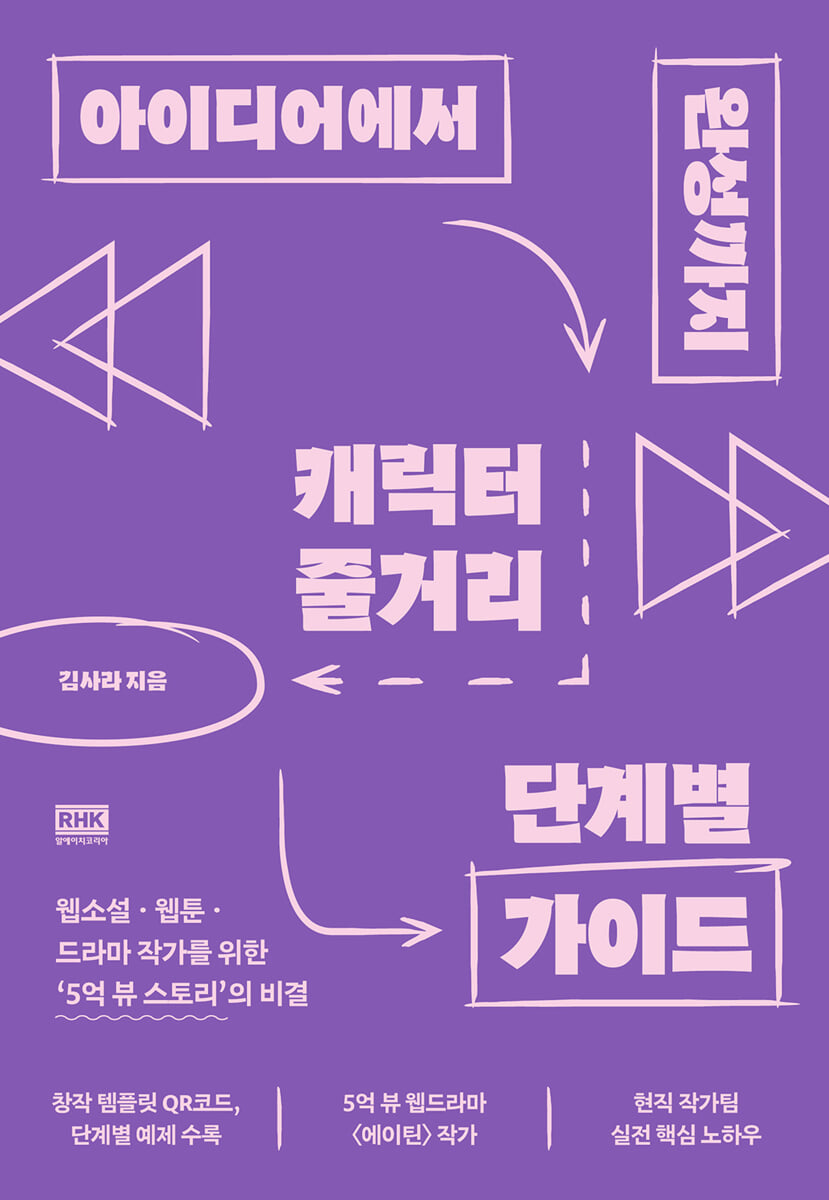
A step-by-step guide to character plot development, from idea to completion.
 |
Description
Book Introduction
"Just follow along and you'll create your own story."
From a draft in your head to a selling plan!
The writer of the web drama [A-Teen] with 500 million cumulative views
Practical story creation techniques you can't learn anywhere else
* Creative template QR code provided
* Highly recommended by current web novel/drama writers and drama directors
Many people dream of becoming writers.
But there are so many aspiring writers who only dream without ever completing a single story.
If you're an aspiring or beginning writer, you've probably had the experience of reading a writing guide, sitting at your desk with your head full of theories, and then your mind goes blank.
For these people, a very friendly and practical guidebook, “A Step-by-Step Guide to Character Plots from Idea to Completion,” has been published.
This is the first writing guide that will help you create your own characters and plots by following along step by step.
It is designed to correct common mistakes and misunderstandings made by beginner writers and, above all, to be immediately applicable to real-world situations.
The author of this book, Kim Sara, the writer of the web drama [A-Teen], which has accumulated 500 million views, generously shares her expertise in the text.
This book is full of creative tips from real-world writing experiences, as only the author, who runs a team of writers and works as a current writer and story director, can provide.
If you've ever wondered, "So what should I write about?" after reading a traditional writing guide, if you dream of becoming a web novel, webtoon, or drama writer without a creative writing major, or if you're a story creator in a slump who needs a fresh approach, try this innovative writing guide.
It will be an opportunity to leap forward as a creator.
From a draft in your head to a selling plan!
The writer of the web drama [A-Teen] with 500 million cumulative views
Practical story creation techniques you can't learn anywhere else
* Creative template QR code provided
* Highly recommended by current web novel/drama writers and drama directors
Many people dream of becoming writers.
But there are so many aspiring writers who only dream without ever completing a single story.
If you're an aspiring or beginning writer, you've probably had the experience of reading a writing guide, sitting at your desk with your head full of theories, and then your mind goes blank.
For these people, a very friendly and practical guidebook, “A Step-by-Step Guide to Character Plots from Idea to Completion,” has been published.
This is the first writing guide that will help you create your own characters and plots by following along step by step.
It is designed to correct common mistakes and misunderstandings made by beginner writers and, above all, to be immediately applicable to real-world situations.
The author of this book, Kim Sara, the writer of the web drama [A-Teen], which has accumulated 500 million views, generously shares her expertise in the text.
This book is full of creative tips from real-world writing experiences, as only the author, who runs a team of writers and works as a current writer and story director, can provide.
If you've ever wondered, "So what should I write about?" after reading a traditional writing guide, if you dream of becoming a web novel, webtoon, or drama writer without a creative writing major, or if you're a story creator in a slump who needs a fresh approach, try this innovative writing guide.
It will be an opportunity to leap forward as a creator.
- You can preview some of the book's contents.
Preview
index
Introduction
Spoiler alert
Step 1.
Get ready
1-1 Overview of the Plot - Misconceptions about the Plot
1-2 Character Capture Overview - What Characters Are Needed?
1-3 Characters First or Plot First - Don't Forget Your Goal
Practice: Cheolsu and Yeonghee
Step 2.
What story do you want to tell?
2-1 A-Line - A Recipe for Story Creation
2-2 Friends Who Talk Well - There's 'This' in an Interesting Story
2-3 Writing Planning Intentions - 4 Steps to Practice
Distinguishing between 2-4 A-lines - A-lines must have a question mark
Why the 2-5 A-Line is Important - The Weapon That Will Survive Until the End
Practice: Writing Your Planning Intent
Step 3.
A-line formula and motif character
3-1 A-Line Formula - Missions and Obstacles
3-2 Deciding on a Motif Character - Hints Are All Around You
3-3 How to Use Motif Characters - Extraction, Exaggeration, Deletion, and Change
Practice: Creating Characters and A-Lines
Step 4.
Is my story strong?
4-1 The Strength of the A-Line - How to Create a Powerful Story
4-2 Analyzing a Famous Work - There's a Reason for the Allure of Your Favorite Character
Practice: Checking the A-line and Setting Up the People Around You
Step 5.
The beginning of full-scale writing
5-1. Implementing the A-Line with Planning Intentions - Hide or Reveal?
5-2 Character Embodying the A-Line - When There Are Two Characters and When There Is One
Throwing it into the 5-3 incident - Character 'Self-Deep Learning'
Practice: A-Line and Character Development
Step 6.
Sub-line configuration
6-1 Creating the B-Line - The Story's Key Points
6-2 Creating a C-Line - Rest Time is an Important Device
6-3 Examples of Lines A, B, and C - From Analysis to Utilization
6-4 How to Modify Characters - Separate, Combine, and Change
Practice: Creating a B-Line
Step 7.
Detailed work
7-1 Establishing Details - What's Visible Even When It's Not
7-2 Trying to erase names - Characters don't speak the same way
7-3 Deleting Characters - Discarding is More Important Than Creating
Block 7-4 - Write a synopsis for each part and episode.
7-5 Writing a 'Clever' Logline - We Already Know the Answer
Frequently Asked Questions
Going out words
supplement
Spoiler alert
Step 1.
Get ready
1-1 Overview of the Plot - Misconceptions about the Plot
1-2 Character Capture Overview - What Characters Are Needed?
1-3 Characters First or Plot First - Don't Forget Your Goal
Practice: Cheolsu and Yeonghee
Step 2.
What story do you want to tell?
2-1 A-Line - A Recipe for Story Creation
2-2 Friends Who Talk Well - There's 'This' in an Interesting Story
2-3 Writing Planning Intentions - 4 Steps to Practice
Distinguishing between 2-4 A-lines - A-lines must have a question mark
Why the 2-5 A-Line is Important - The Weapon That Will Survive Until the End
Practice: Writing Your Planning Intent
Step 3.
A-line formula and motif character
3-1 A-Line Formula - Missions and Obstacles
3-2 Deciding on a Motif Character - Hints Are All Around You
3-3 How to Use Motif Characters - Extraction, Exaggeration, Deletion, and Change
Practice: Creating Characters and A-Lines
Step 4.
Is my story strong?
4-1 The Strength of the A-Line - How to Create a Powerful Story
4-2 Analyzing a Famous Work - There's a Reason for the Allure of Your Favorite Character
Practice: Checking the A-line and Setting Up the People Around You
Step 5.
The beginning of full-scale writing
5-1. Implementing the A-Line with Planning Intentions - Hide or Reveal?
5-2 Character Embodying the A-Line - When There Are Two Characters and When There Is One
Throwing it into the 5-3 incident - Character 'Self-Deep Learning'
Practice: A-Line and Character Development
Step 6.
Sub-line configuration
6-1 Creating the B-Line - The Story's Key Points
6-2 Creating a C-Line - Rest Time is an Important Device
6-3 Examples of Lines A, B, and C - From Analysis to Utilization
6-4 How to Modify Characters - Separate, Combine, and Change
Practice: Creating a B-Line
Step 7.
Detailed work
7-1 Establishing Details - What's Visible Even When It's Not
7-2 Trying to erase names - Characters don't speak the same way
7-3 Deleting Characters - Discarding is More Important Than Creating
Block 7-4 - Write a synopsis for each part and episode.
7-5 Writing a 'Clever' Logline - We Already Know the Answer
Frequently Asked Questions
Going out words
supplement
Detailed image

Into the book
This book is structured to be easier to follow and put into practice than other writing books.
I've seen a lot of guidebooks that tell you to fill out a character profile or follow the plot structure.
And I tried to follow it a lot.
But the biggest obstacle to putting these methods into practice was the question, "So what should I write?"
(…) This book is not like that.
It explains why the plot structure is structured this way step by step, and how to fill in each part of the plot, with detailed examples so you can create it yourself.
By clearly distinguishing between the technical and creative aspects of creation, you can determine which parts should be approached technically and which parts should be left to creativity.
--- p.9
What kind of planning intention should we, as non-geniuses, have? Planning intention shouldn't strive to convey some grandiose social message.
The planning intent is literally the 'intention' of writing this article.
Smartphones were created to provide convenient use by adding various smart functions to mobile phones, and water glasses were created to hold water and drink it.
(…) So, the planning intention is just the planning ‘intention.’
That is, ‘the reason the author writes this.’
--- p.40
The story never progresses based on the concept, theme, or planning intention.
For example, 'The Story of the Wicked Private Tutor' could be a story about a wicked private tutor reforming, and 'The Story of the Goblin with a Knife in His Chest' could be a story about a goblin going wild.
A young wizard takes a train to a magical world where he may become a dark wizard, a scholar, or an inventor of magical toys.
But the plot must be a single, unchanging flow.
--- p.47
A line requires a mission and obstacles to get in the way.
Obstacles can be characters (villains) or worldviews.
Or anything else is possible! As long as it can stop the protagonist's mission.
If we express this in a formula, it is as follows.
The protagonist's mission + obstacle = ? (I wonder what will happen!)
--- p.60
As we build up the story through the characters, we want the characters to move as we want them to.
Or, I think the author is the one who can make the character move as he wants.
But my thoughts are a little different.
A writer is someone who throws well-crafted, consistent characters into an event or A-line and guesses what kind of reaction will occur.
It is the writer's job to write down what he has guessed.
--- p.71
As I said at the beginning, our goal is to create strong characters that stick in people's memories right away.
To do that, we need to simplify the character.
(…) It does not mean to reduce the details, but to classify those details.
If you look at the character's 'keywords', you can classify them in detail.
For example, in the case of Cheolsu in practice, keywords like '#professional #chic #scheming male lead...' will come to mind.
And then you have to think about whether the details you've created can fit into this category.
--- p.165
Every writer creates something called a 'plan'.
Here the writers face a difficulty.
"How do you use a plan?" First, let's think about the purpose of a "plan."
The plan is not for the viewers and readers to see.
The 'plan' is the material that people who are involved in this work or who will invest a large amount of money in this work will see.
What that means is that a proposal isn't something you write saying, "Look how fun my work is."
A proposal is a document that says, "Look how much money my work can bring in."
--- p.212
Q.
How do I know if my story is interesting? A.
Are you enjoying it now? (…) Is your story entertaining right now? Do you want to continue writing it quickly? Do you want to finish it and show it to the world? Are you excited to see what it will be like when it comes out? If you answered "no" to these questions, there's a good chance your story isn't engaging.
I've seen a lot of guidebooks that tell you to fill out a character profile or follow the plot structure.
And I tried to follow it a lot.
But the biggest obstacle to putting these methods into practice was the question, "So what should I write?"
(…) This book is not like that.
It explains why the plot structure is structured this way step by step, and how to fill in each part of the plot, with detailed examples so you can create it yourself.
By clearly distinguishing between the technical and creative aspects of creation, you can determine which parts should be approached technically and which parts should be left to creativity.
--- p.9
What kind of planning intention should we, as non-geniuses, have? Planning intention shouldn't strive to convey some grandiose social message.
The planning intent is literally the 'intention' of writing this article.
Smartphones were created to provide convenient use by adding various smart functions to mobile phones, and water glasses were created to hold water and drink it.
(…) So, the planning intention is just the planning ‘intention.’
That is, ‘the reason the author writes this.’
--- p.40
The story never progresses based on the concept, theme, or planning intention.
For example, 'The Story of the Wicked Private Tutor' could be a story about a wicked private tutor reforming, and 'The Story of the Goblin with a Knife in His Chest' could be a story about a goblin going wild.
A young wizard takes a train to a magical world where he may become a dark wizard, a scholar, or an inventor of magical toys.
But the plot must be a single, unchanging flow.
--- p.47
A line requires a mission and obstacles to get in the way.
Obstacles can be characters (villains) or worldviews.
Or anything else is possible! As long as it can stop the protagonist's mission.
If we express this in a formula, it is as follows.
The protagonist's mission + obstacle = ? (I wonder what will happen!)
--- p.60
As we build up the story through the characters, we want the characters to move as we want them to.
Or, I think the author is the one who can make the character move as he wants.
But my thoughts are a little different.
A writer is someone who throws well-crafted, consistent characters into an event or A-line and guesses what kind of reaction will occur.
It is the writer's job to write down what he has guessed.
--- p.71
As I said at the beginning, our goal is to create strong characters that stick in people's memories right away.
To do that, we need to simplify the character.
(…) It does not mean to reduce the details, but to classify those details.
If you look at the character's 'keywords', you can classify them in detail.
For example, in the case of Cheolsu in practice, keywords like '#professional #chic #scheming male lead...' will come to mind.
And then you have to think about whether the details you've created can fit into this category.
--- p.165
Every writer creates something called a 'plan'.
Here the writers face a difficulty.
"How do you use a plan?" First, let's think about the purpose of a "plan."
The plan is not for the viewers and readers to see.
The 'plan' is the material that people who are involved in this work or who will invest a large amount of money in this work will see.
What that means is that a proposal isn't something you write saying, "Look how fun my work is."
A proposal is a document that says, "Look how much money my work can bring in."
--- p.212
Q.
How do I know if my story is interesting? A.
Are you enjoying it now? (…) Is your story entertaining right now? Do you want to continue writing it quickly? Do you want to finish it and show it to the world? Are you excited to see what it will be like when it comes out? If you answered "no" to these questions, there's a good chance your story isn't engaging.
--- p.224
Publisher's Review
“The most practical composition” not found in existing composition books
Follow the creative know-how that generated 500 million views in one book.
Whether it's a web novel, webtoon, or drama, there's an unchanging secret to a successful story.
These are ‘attractive characters’ and ‘a plot that makes you wonder about the ending.’
To captivate readers (viewers), the characters and plot must be solid.
This book explains step-by-step the process of establishing and specifically refining the two main lines: character and plot.
Learn concepts in a friendly manner, as if you were being tutored right next to you, without any difficult terminology, and guide yourself to apply the author's creative skills.
At the end of each chapter, in the 'Practice' section, you can create your own characters and plots by referring to examples provided by the author.
Even if you're new to writing, reading carefully will help you get the feel for it, and if you have experience creating stories, you'll quickly learn what you were missing.
Anyone can get closer to creating their own work by following the four steps: how to write a plan, how to create the core "A-line" of the story, how to create the main character and supporting characters, and how to bring the details of the story to life and make them concrete.
E-book funding goal reached 2600%!
10 years of creative tips revealed,
Completely resolving common mistakes and misunderstandings that beginning writers often make.
"This book saved me from having frozen fingers whenever I sat in front of my laptop," "It gave me a concrete understanding of vague concepts," "I read it all in one day and put it into practice," "It only contains the essentials," "It was the most satisfying funding I've ever participated in."
These are actual reader reviews at the time of e-book funding.
Having already proven the necessity of a “practical writing guide” by achieving over 2600% of its target amount, it has also received a great response in terms of its practical content.
This newly reorganized and published paperback edition combines 'Character Creation' and 'Plot Creation', which were previously divided into two volumes in the previously funded e-book version, into one volume, supplementing and reorganizing the manuscript to enable simultaneous creation of characters and plots.
This book provides concrete examples of how the author actually planned and fleshed out the characters and plot of the drama [A-TEEN], how to analyze other famous works, and helps readers understand where beginner writers often make mistakes and how to overcome them based on data accumulated while running a team of writers.
As you apply the creative methods the author has collected over a long period of time, you will soon find yourself at the end of the book as a writer with solid fundamentals.
“What is the difference between the planning intent, the plot, and the A-line (or logline)?”
If you find it difficult to answer the above questions, then you only have a vague understanding of story creation.
Let's find the answer right in this book.
Follow the creative know-how that generated 500 million views in one book.
Whether it's a web novel, webtoon, or drama, there's an unchanging secret to a successful story.
These are ‘attractive characters’ and ‘a plot that makes you wonder about the ending.’
To captivate readers (viewers), the characters and plot must be solid.
This book explains step-by-step the process of establishing and specifically refining the two main lines: character and plot.
Learn concepts in a friendly manner, as if you were being tutored right next to you, without any difficult terminology, and guide yourself to apply the author's creative skills.
At the end of each chapter, in the 'Practice' section, you can create your own characters and plots by referring to examples provided by the author.
Even if you're new to writing, reading carefully will help you get the feel for it, and if you have experience creating stories, you'll quickly learn what you were missing.
Anyone can get closer to creating their own work by following the four steps: how to write a plan, how to create the core "A-line" of the story, how to create the main character and supporting characters, and how to bring the details of the story to life and make them concrete.
E-book funding goal reached 2600%!
10 years of creative tips revealed,
Completely resolving common mistakes and misunderstandings that beginning writers often make.
"This book saved me from having frozen fingers whenever I sat in front of my laptop," "It gave me a concrete understanding of vague concepts," "I read it all in one day and put it into practice," "It only contains the essentials," "It was the most satisfying funding I've ever participated in."
These are actual reader reviews at the time of e-book funding.
Having already proven the necessity of a “practical writing guide” by achieving over 2600% of its target amount, it has also received a great response in terms of its practical content.
This newly reorganized and published paperback edition combines 'Character Creation' and 'Plot Creation', which were previously divided into two volumes in the previously funded e-book version, into one volume, supplementing and reorganizing the manuscript to enable simultaneous creation of characters and plots.
This book provides concrete examples of how the author actually planned and fleshed out the characters and plot of the drama [A-TEEN], how to analyze other famous works, and helps readers understand where beginner writers often make mistakes and how to overcome them based on data accumulated while running a team of writers.
As you apply the creative methods the author has collected over a long period of time, you will soon find yourself at the end of the book as a writer with solid fundamentals.
“What is the difference between the planning intent, the plot, and the A-line (or logline)?”
If you find it difficult to answer the above questions, then you only have a vague understanding of story creation.
Let's find the answer right in this book.
GOODS SPECIFICS
- Date of issue: July 3, 2024
- Page count, weight, size: 236 pages | 468g | 145*210*18mm
- ISBN13: 9788925574851
- ISBN10: 8925574853
You may also like
카테고리
korean


korean

![GQ KOREA Mark (Monthly): December [2025]](http://librairie.coreenne.fr/cdn/shop/files/8ef265dbbfbf186523ed75ba7319009d.jpg?v=1765340328&width=3840)


