

Embarrassing Art Stories 7
 |
Description
Book Introduction
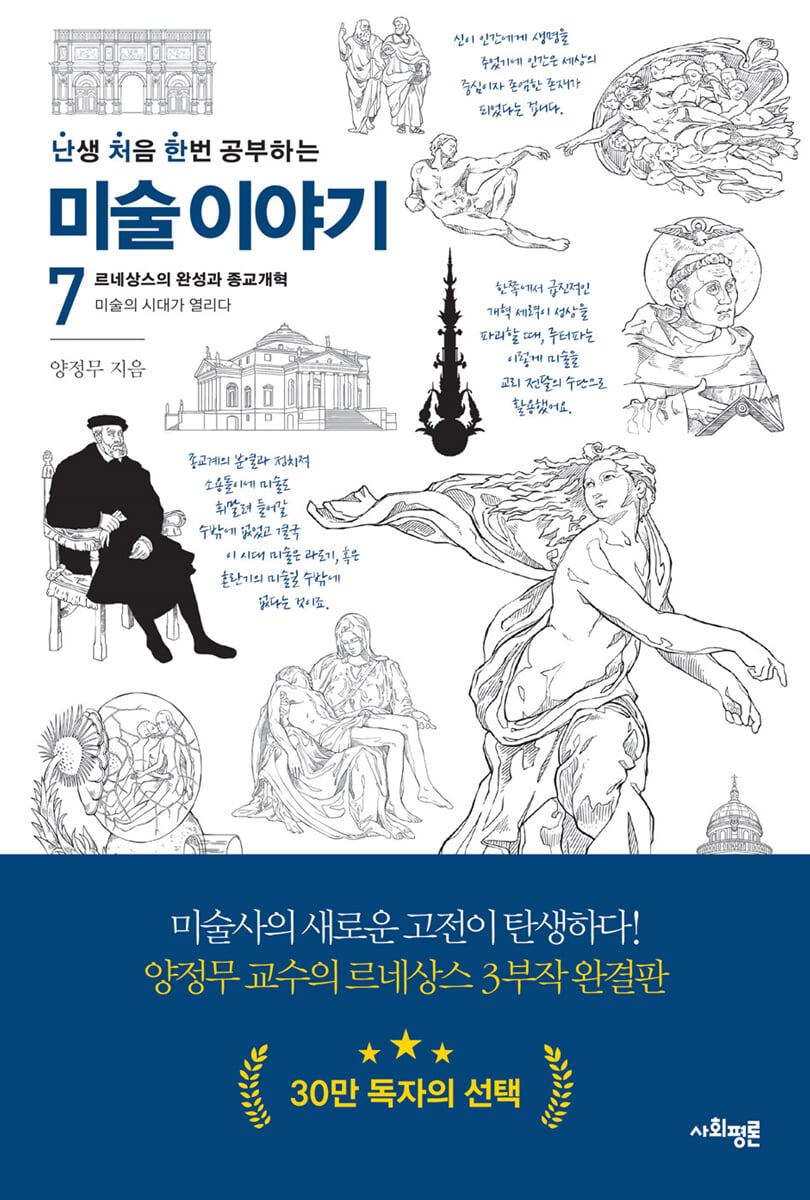
『The Story of Studying Art for the First Time in My Life』 7 The series "Studying Art for the First Time in My Life" (hereafter "Awkward Art Story"), which debuted with the publication of Volumes 1 and 2 in 2016, created an unprecedentedly large issue as a general-purpose book on art. The Dong-A Ilbo and Munhwa Ilbo selected this book as their 'Book of the Year,' and the Kyunghyang Shinmun and Chosun Ilbo selected the author, Professor Yang Jeong-mu, as their 'Author of the Year.' Amidst the continued interest and response of readers, volumes 5 and 6, which cover ancient and medieval art and Renaissance art in depth, were published in succession. The seventh volume, published after two years of preparation, is the final edition of the Renaissance trilogy. Volume 7 examines the impact on art of the Renaissance, which flourished in 16th-century Rome, and the Reformation, which began north of the Alps. We also examine in detail how the regional art of Rome, Florence, and Venice changed amidst the turmoil brought about by the Reformation. From the masterpieces of the Roman Renaissance heyday, which flourished under the leadership of Michelangelo and Raphael, to Northern European art that still retained a medieval worldview, to Protestant art used as a tool for spreading doctrine during the Reformation, to Mannerist art that emerged after the crisis of the Catholic Church, if we examine 16th-century art, we can see that it developed diversely through fierce challenges and exploration, becoming a bridgehead toward a new era. |
- You can preview some of the book's contents.
Preview
index
Starting the series
Dedicated to Volume 7 - When the Myth of Art Was Created
I. The Roman Renaissance - Dreaming of a City of Glory
01 A city with two spaceships
02 The Pope and the Emperor
03 Man of God, Michelangelo
04 The Perfection of the Elegant Renaissance, Raphael
05 The return of glory, the Romanization of Rome!
II The Reformation and Art - A Change in Faith Transforms Art
01 Northern Europe, a world of imagination and symbolism
02 The Reformation Changes the Role of Art
Ⅲ Mannerism and the Late Renaissance - A Time of Brilliant Chaos
01 Rome's Crisis and Michelangelo
02 Florence and the Renaissance in Crisis
03 16th Century Venetian Renaissance
Dedicated to Volume 7 - When the Myth of Art Was Created
I. The Roman Renaissance - Dreaming of a City of Glory
01 A city with two spaceships
02 The Pope and the Emperor
03 Man of God, Michelangelo
04 The Perfection of the Elegant Renaissance, Raphael
05 The return of glory, the Romanization of Rome!
II The Reformation and Art - A Change in Faith Transforms Art
01 Northern Europe, a world of imagination and symbolism
02 The Reformation Changes the Role of Art
Ⅲ Mannerism and the Late Renaissance - A Time of Brilliant Chaos
01 Rome's Crisis and Michelangelo
02 Florence and the Renaissance in Crisis
03 16th Century Venetian Renaissance
Detailed image

Into the book
Humanism is easy to talk about, but it is actually quite difficult to define.
Around the 15th and 16th centuries, as early as the 14th century, a movement to revive ancient culture began.
At a time when the existing Christian worldview, which was centered on theology and God, was dominant, a movement began to place greater emphasis on human individuality, freedom, and honest emotions.
In other words, it can be seen as a movement that dreamed of a humane world and the restoration of humanity.
So, if the Middle Ages were a world of gods and religion, the Renaissance could be said to have dreamed of a realistic world that restored humanity and humanity.
---From "Part 1, Chapter 2, 'The Pope and the Emperor'"
The Creation of Adam reflects Michelangelo's ideas about God and humanity.
The painting condenses the human-centered philosophy that God created humans in his own image, and that discovering human beauty is the same as embodying God's divinity.
The innocent, pure, and sinless appearance of human beings when they were created.
Through the praise of humans born in the image of God.
In the end, it is about praising God and praising humanity at the same time.
---From "Part 1, Chapter 3, 'Michelangelo, the Man Given by God'"
There is a saying, “Good writers copy, great writers steal.”
If you accurately identify what is good in the work of a master, study it, and develop it, your own originality will be born.
In this way, Raphael learned the composition of figures from da Vinci and the dynamic poses from Michelangelo, developing his own style.
---From "Part 1, Chapter 4, 'Raphael, the Perfection of the Elegant Renaissance'"
What I want to emphasize here is that the writers of this period did not simply follow ancient examples.
They thoroughly digested the ancient examples, analyzed them, and gradually found flaws, even adopting a critical perspective.
Ultimately, it was an attempt to find their own, more superior expression.
If you ask what the Renaissance is, you can say the following:
It is not just an attempt to discover ancient values, but an attempt to surpass them.
Ultimately, I would like to emphasize that this generous attitude is precisely the atmosphere of the 16th century High Renaissance.
---From "Part 1, Chapter 5, 'Rebirth of Glory, Romanization of Rome!'"
Doctrines that are organized in writing have that much greater impact.
One could say that Luther played the role in 16th-century Germany that St. Jerome played in the early church.
Thanks to Luther's translation of the German Bible, the Bible, which had been monopolized by only a few clergy, became available to intellectuals and the common people.
As the monopoly structure of religious knowledge gradually collapsed, the influence of the Catholic Church was bound to diminish.
Now the region north of the Alps is no longer the periphery of the Christian world, but is emerging as a center of the Reformation and a center of a new civic culture.
---From "Part 2, Chapter 2, 'The Reformation, Changing the Role of Art'"
The High Renaissance that had previously unfolded in Rome also flourished in a form that combined faith and belief in reason based on humanism, although art served the goals of the papacy.
In contrast, Mannerist art in 16th-century Florence was a product of rapidly changing political circumstances and shifting power dynamics.
As a result, it is necessary to remember that a unique aesthetic sense, aristocratic playfulness, and even seemingly bizarre tastes developed.
This is not to discuss the superiority of art, but to understand how art was influenced and developed according to the changing times and the nature of power.
---From "Part 3, Chapter 2, 'Florence and the Renaissance in Crisis'"
When talking about the 16th century Renaissance, we look at Palladio's architecture last because Palladio is the 'Renaissance' that came directly to us.
That means that Palladian architecture is a Renaissance heritage that can be encountered in everyday life.
Palladio is called the father of classical architecture because he not only developed his own architectural style based on classical architecture, but also organized it in a systematic manner as explained above.
Architecture based on this kind of modernity and rationality is the true face of the Renaissance.
---From "Part 3, Chapter 3, 'The 16th Century Venetian Renaissance'"
When a new architectural style emerges, competes with other architectural styles, and becomes established as the mainstream of a society, it is not only aesthetic value or function that is at play, but also social and historical context.
So, if we look at who influenced whom in the history of Western art, and which styles competed and were adopted, we will eventually arrive at where we stand.
Isn't the greatest charm of art that a story that begins by looking at others eventually leads us to look at ourselves?
Around the 15th and 16th centuries, as early as the 14th century, a movement to revive ancient culture began.
At a time when the existing Christian worldview, which was centered on theology and God, was dominant, a movement began to place greater emphasis on human individuality, freedom, and honest emotions.
In other words, it can be seen as a movement that dreamed of a humane world and the restoration of humanity.
So, if the Middle Ages were a world of gods and religion, the Renaissance could be said to have dreamed of a realistic world that restored humanity and humanity.
---From "Part 1, Chapter 2, 'The Pope and the Emperor'"
The Creation of Adam reflects Michelangelo's ideas about God and humanity.
The painting condenses the human-centered philosophy that God created humans in his own image, and that discovering human beauty is the same as embodying God's divinity.
The innocent, pure, and sinless appearance of human beings when they were created.
Through the praise of humans born in the image of God.
In the end, it is about praising God and praising humanity at the same time.
---From "Part 1, Chapter 3, 'Michelangelo, the Man Given by God'"
There is a saying, “Good writers copy, great writers steal.”
If you accurately identify what is good in the work of a master, study it, and develop it, your own originality will be born.
In this way, Raphael learned the composition of figures from da Vinci and the dynamic poses from Michelangelo, developing his own style.
---From "Part 1, Chapter 4, 'Raphael, the Perfection of the Elegant Renaissance'"
What I want to emphasize here is that the writers of this period did not simply follow ancient examples.
They thoroughly digested the ancient examples, analyzed them, and gradually found flaws, even adopting a critical perspective.
Ultimately, it was an attempt to find their own, more superior expression.
If you ask what the Renaissance is, you can say the following:
It is not just an attempt to discover ancient values, but an attempt to surpass them.
Ultimately, I would like to emphasize that this generous attitude is precisely the atmosphere of the 16th century High Renaissance.
---From "Part 1, Chapter 5, 'Rebirth of Glory, Romanization of Rome!'"
Doctrines that are organized in writing have that much greater impact.
One could say that Luther played the role in 16th-century Germany that St. Jerome played in the early church.
Thanks to Luther's translation of the German Bible, the Bible, which had been monopolized by only a few clergy, became available to intellectuals and the common people.
As the monopoly structure of religious knowledge gradually collapsed, the influence of the Catholic Church was bound to diminish.
Now the region north of the Alps is no longer the periphery of the Christian world, but is emerging as a center of the Reformation and a center of a new civic culture.
---From "Part 2, Chapter 2, 'The Reformation, Changing the Role of Art'"
The High Renaissance that had previously unfolded in Rome also flourished in a form that combined faith and belief in reason based on humanism, although art served the goals of the papacy.
In contrast, Mannerist art in 16th-century Florence was a product of rapidly changing political circumstances and shifting power dynamics.
As a result, it is necessary to remember that a unique aesthetic sense, aristocratic playfulness, and even seemingly bizarre tastes developed.
This is not to discuss the superiority of art, but to understand how art was influenced and developed according to the changing times and the nature of power.
---From "Part 3, Chapter 2, 'Florence and the Renaissance in Crisis'"
When talking about the 16th century Renaissance, we look at Palladio's architecture last because Palladio is the 'Renaissance' that came directly to us.
That means that Palladian architecture is a Renaissance heritage that can be encountered in everyday life.
Palladio is called the father of classical architecture because he not only developed his own architectural style based on classical architecture, but also organized it in a systematic manner as explained above.
Architecture based on this kind of modernity and rationality is the true face of the Renaissance.
---From "Part 3, Chapter 3, 'The 16th Century Venetian Renaissance'"
When a new architectural style emerges, competes with other architectural styles, and becomes established as the mainstream of a society, it is not only aesthetic value or function that is at play, but also social and historical context.
So, if we look at who influenced whom in the history of Western art, and which styles competed and were adopted, we will eventually arrive at where we stand.
Isn't the greatest charm of art that a story that begins by looking at others eventually leads us to look at ourselves?
---From "Part 3, Chapter 3, 'The 16th Century Venetian Renaissance'"
Publisher's Review
★ Art history, the 'flower of humanities' that you can read easily!
As you follow the art lectures that are as easy to read as listening, the flow of history, politics, economics, and art will magically enter your head.
★ The complete edition of the 'Renaissance Trilogy', a story about art that I studied for the first time in my life, has been published!
The 'Renaissance Trilogy', which began with Volume 5, 'Italian Renaissance Civilization and Art', and continued with Volume 6, 'Early Capitalism and the Spread of the Renaissance', finally concludes with Volume 7, 'The Completion of the Renaissance and the Reformation'.
Volume 7 examines how the Renaissance, which began in Florence, Italy, blossomed magnificently in 16th-century Rome.
★ Renaissance? The birth of a new classic!
The Renaissance began with the rediscovery of the Greek and Roman classics that had been neglected during the Middle Ages, but now it goes beyond those classics.
The works created during the Renaissance era became the 'new classics' of Western art history and became a powerful example that dominated Western art history for the next 500 years.
Through the works of 16th-century Renaissance masters, we look back on how the greatest golden age in Western art history was born.
★ A masterpiece created over two years, including a field trip to Rome!
Professor Yang Jeong-mu personally visited Rome to write the seventh volume, conducted on-site research, and gained new inspiration to prepare the final edition of the Renaissance.
The author, a Renaissance expert, witnesses the fierce conflicts and challenges that led to the birth of a new classic in Rome, and discovers that these challenges still impact us today.
Professor Yang Jeong-mu appeared on programs such as “China Class,” “The Hall of Art,” and “Bookstores These Days: Reading Books,” leading countless people into the world of art history with his friendly explanations and extensive knowledge.
As we listen to the author's sometimes humorous and sometimes sharp stories, the landscape of the 16th-century Renaissance comes to life vividly before our eyes.
Art history organized by our authors from our perspective.
_Korea Daily
Rather than simply listing artworks, it tells the story of ‘us here and now.’
_Chosun Ilbo
It's easy to read, yet has depth that goes beyond an introductory book.
_Dong-A Ilbo
World history and art history are densely intertwined like warp and weft, giving the content a weighty quality.
_PD Journal
One-on-one tutoring for those who feel awkward when it comes to art!
We're busy just trying to make a living, so why should we read art history?
In our country, the number of people who enjoy art is increasing.
Large-scale art exhibitions and invitational exhibitions by famous foreign artists are frequently held, and the response from visitors is also enthusiastic.
At domestic art auctions, artworks are often sold for prices exceeding hundreds of millions of won.
For a more meaningful trip, for healing, or for investment… .
There are many different reasons why people become interested in art.
However, despite this growing interest, there are still many people who complain that they have no idea where to start or how to approach studying art.
There are many cases where people give up on studying art because they think it is a pastime that only those with money can enjoy.
For these people, the 7-volume "Art Stories for the First Time in Your Life" series has been published, which covers not only how to properly appreciate art, but also the history, politics, economy, and socio-cultural trends contained in art in an easy, fun, and profound way.
Why do Britain, France, and the United States invest in art?
When we visit so-called developed countries, we make it a point to visit the country's representative museums and art galleries, such as the British Museum in England, the Louvre in France, and the Metropolitan Museum of Art in the United States.
Countries that have played a leading role in world history are full of art galleries and museums, and the social elite are passionate about art.
Why do they invest in art galleries, support artists, and collect art? Why are simple stones, bowls, or even a child's scribbles labeled "art" and commanded astronomical prices?
This book answers these questions by saying that art is a window to the past and contains answers that lead to the future.
Art critic John Ruskin said, “A great nation writes its autobiography in three volumes.
One volume is about action, one volume is about writing, and the other volume is about art.
“Neither of the books can be understood without first reading the other two, but of them, Art is the most reliable,” he said.
To truly appreciate art is to confront the era that gave birth to it head-on, and it is the path to gaining insight that will lead the future.
That is why art is called the 'flower of the humanities', containing the essence of all academic disciplines, including history, politics, economics, and philosophy.
Everything about art history, easy to read and learn properly!
Such fascinating art is not easy to study properly.
First of all, because art has a very long history.
Even the most trendy contemporary art pieces contain 40,000 years of history, making it often difficult to understand them without a knowledge of art history.
Moreover, the barriers to entry are high.
For many people, 'art books = difficult books'.
Because of the unfamiliar terminology and unfriendly explanations, I often gave up on reading the book before I could even get past ten pages.
However, the 'Awkward Art Story' series can be enjoyed comfortably as if listening to an interesting story in a one-on-one lecture format.
Considering the reader's convenience, the illustrations were arranged to follow the natural flow of the reader's gaze, without the need to turn the pages to find the illustrations.
Carefully selected photos and illustrations of works of art worthy of collection, along with appropriate questions that will help you resolve any questions that arise in your mind, add to the pleasure of reading.
That doesn't mean the book is of low quality.
Professor Yang Jeong-mu, the author of the book and an authority in the field of art history, encompasses a vast amount of information and diverse perspectives in one book.
It covers essential basic art knowledge, as well as the latest theories leading the academic world, and is packed with rich information and theory, from famous works of art to Korean art that we can easily see around us.
All this information and knowledge will become readily apparent as you follow the author's lectures, who is also a popular public speaker.
As you read this series, you'll find yourself traveling through the vast world of art, transcending time and space, with a friendly and knowledgeable guide.
The Renaissance that Professor Yang Jeong-mu tells us is different!
The final edition of Renaissance, completed after two years of hard work!
The 'Difficult Art Stories' series, which began with primitive, Egyptian, and Mesopotamian civilizations and art, moved on to Greco-Roman civilization and art, early Christian civilization and art, medieval civilization and art, and finally Renaissance civilization and art.
Renaissance art is so important that it is covered across three volumes in this ten-volume series.
This is because the Renaissance was the period when the concepts and ideals of Western art history, which we now consider art, were established.
Professor Yang Jeong-mu, who majored in the Renaissance, shows the various aspects of Renaissance art more easily and interestingly than anyone else, and even interprets the social aspects behind it.
In Volume 5, the first volume of the 'Renaissance Trilogy', we looked at how the Renaissance was born, focusing on various Italian city-states such as Padua, Assisi, and Siena, as well as Florence. In Volume 6, we looked at how early capitalism and Renaissance art influenced and developed each other through the Renaissance beyond Northern Europe and Venetian Renaissance art.
The seventh and final volume of the Renaissance trilogy covers the glorious moment when the Renaissance, which began in Florence, reached its peak in 16th-century Rome.
In the 15th century, Rome was a backward city, but paradoxically, the 16th century Renaissance blossomed most brilliantly in Rome.
At that time, the Pope dreamed of rebuilding Rome to greatness in order to establish his authority.
Under the Pope's support, Rome was splendidly revived as the center of the Renaissance through the hands of masters such as Michelangelo and Raphael.
However, the influence of the Reformation that began in Northern Europe brought an end to the heyday of the Renaissance in Rome, and in the chaos that followed, new styles of art were born in Rome, Florence, and Venice.
In Volume 7, we examine the political and social interests behind the splendid works of the Renaissance era, and read the changes of the times reflected in the works of masters such as Michelangelo and Raphael.
Furthermore, by covering the Mannerist art that emerged during the chaotic period after the Renaissance and the changes in Northern European art influenced by the Reformation, we rediscover that there were new attempts and explorations in the art of this period, which is often overlooked as a period of transition.
Even behind the splendid Renaissance, fierce conflicts of the times arose. By examining how art explored new roles through the great transformation of the Reformation, we can vividly discover how the artworks and the eras behind them influenced and communicated with each other.
From Volume 8 onwards, the new era of Baroque art will be covered, followed by Rococo art, modern art, and contemporary art.
『The Story of Studying Art for the First Time in My Life』 Volume 7
The Completion of the Renaissance and the Reformation - The Dawn of an Era of Art
The Renaissance has finally reached its peak!
This book presents the different artistic landscapes of 16th-century Italy and Northern Europe beyond the Alps, covering the period of the Renaissance and the Reformation.
The Renaissance, which began in Florence in the 15th century, reached its splendid peak in Rome in the 16th century, ushering in a true "age of art" in which art and artists gained independent authority.
The heyday of the Renaissance in Rome, which lasted for about 20 to 30 years, ended with Rome being engulfed in war due to the conflict between the Holy Roman Emperor and the Pope over hegemony over Italy.
On the other hand, the flames of the Reformation that began in Northern Europe beyond the Alps brought about changes in art by denying and destroying the religious art of the existing Catholic Church.
Protestants rejected traditional Catholic art, but instead actively used art to clearly convey Protestant doctrine.
From the late 16th century, art of different characters emerged in Rome, Florence, and Venice.
In Rome, which was completely destroyed by the sack of Rome, a new reconstruction through art began, centered around Michelangelo.
In Florence, Mannerist art emerged amidst the chaos of the collapse of the Republic and the transition to a duchy.
Meanwhile, in Venice, the late Renaissance developed independently, based on the wealth accumulated through maritime trade.
In particular, Palladio's architecture, which reinterpreted Greek and Roman classics, had a great influence not only in Venice but also on modern Western society.
Part 1: The Roman Renaissance - Dreaming of a City of Glory
The Pope Who Dreamed of the Resurrection of the Ancient Roman Empire
Part 1 examines the works of some of the greatest masters in Western art history, focusing on the reconstruction projects of 16th-century Rome.
Rome, which had been neglected since the departure of the Pope in the 15th century, once again became the center of ecclesiastical power with the return of the Pope.
The Pope dreamed of reviving the glory of ancient Rome through art and architecture, and commissioned a series of great works from masters such as Michelangelo and Raphael that would demonstrate the authority of Rome and the Catholic Church.
Through this, Rome became the center of the Renaissance in the 16th century.
Michelangelo and Raphael introduced classical Greek and Roman art and completed Renaissance art with balanced and harmonious works.
Now, art has acquired its own authority, separate from technology, and the artist's name has become more well-known than the person who commissioned the work, reflecting the artist's philosophy and spiritual world.
Only then did the true 'age of art' begin.
Contemporaries who observed the work of these masters gained confidence that they, too, could create works that surpassed the classics by studying and analyzing the ancient Roman classics.
This attempt is particularly prominent in the field of architecture, where architecture that reinterprets and develops the classics of ancient Rome appears.
Part 2: The Reformation and Art - How Changes in Faith Transform Art
Art that challenges authority
Part 2 focuses on the art being produced in Northern Europe north of the Alps, with a completely different atmosphere from that of Rome.
Unlike the Renaissance in the Italian peninsula, which reflected the rediscovery of classics and humanism, Northern Europe was dominated by religious fervor and fear of the end times.
In particular, the grotesque imaginary world seen in Hieronymus Bosch's The Garden of Earthly Delights well reflects the medieval atmosphere of Northern Europe at the time.
The Catholic Church in Rome tried to take advantage of the religious fervor of the Northern Europeans by selling indulgences, but Martin Luther caused a stir by publishing the 95 Theses, which completely denied and criticized the authority of the Pope.
The flame of religious reform ignited by Luther spread throughout Northern Europe and had a great influence on art.
Some Protestants destroyed icons of the Catholic Church, claiming that its religious art was idolatry, and the demand for traditional religious art also decreased.
Luther did not completely reject religious art, but rather used art as a tool to clearly convey new doctrines.
The role of art in Northern Europe changed under the influence of the Reformation, and works produced during this period also reveal the self-awareness of Northern Europeans who were newly awakening to their place at the center of the world, free from the influence of the Catholic Church.
Part 3: Mannerism and the Late Renaissance - A Time of Brilliant Chaos
Another glory of Renaissance art
In Part 3, we return to the Italian peninsula and examine how the late Renaissance unfolded in Rome, Florence, and Venice in the late 16th century.
Rome, which faced a crisis due to the Reformation and the Sack of Rome, once again dreamed of revival through art.
In particular, Michelangelo's Last Judgment reveals the Vatican's intention to re-establish the authority of the Catholic Church by warning Protestants.
The Vatican also works to restore Rome's ruins, including resuming construction on St. Peter's Basilica and rebuilding the Capitoline Hill.
Florence's political system changes from a republic of citizens to a duchy ruled by the Medici family.
Changes in power are reflected in art, with sculptures and paintings produced that emphasize the authority and power of the ruler, and the architectural style of large palaces and gardens, the private spaces of the powerful, also changing.
On the one hand, Mannerist art, characterized by unrealistic and unstable compositions and proportions that reflect the unstable reality, also appears.
In Venice, late Renaissance art developed independently in the free-spirited atmosphere characteristic of a maritime nation.
In particular, the paintings of Giorgione and Titian are evaluated to have raised Venetian painting to a new level with their rich and poetic expressions.
Palladio established an architectural style that creatively applied ancient architecture by reinterpreting it, and Palladian architecture became a new classic that influenced us through Europe and even in modern times.
Through this, we can realize that the Renaissance is not a Western history distant from us, but rather an entity that continues to be reinterpreted and influential even today.
As you follow the art lectures that are as easy to read as listening, the flow of history, politics, economics, and art will magically enter your head.
★ The complete edition of the 'Renaissance Trilogy', a story about art that I studied for the first time in my life, has been published!
The 'Renaissance Trilogy', which began with Volume 5, 'Italian Renaissance Civilization and Art', and continued with Volume 6, 'Early Capitalism and the Spread of the Renaissance', finally concludes with Volume 7, 'The Completion of the Renaissance and the Reformation'.
Volume 7 examines how the Renaissance, which began in Florence, Italy, blossomed magnificently in 16th-century Rome.
★ Renaissance? The birth of a new classic!
The Renaissance began with the rediscovery of the Greek and Roman classics that had been neglected during the Middle Ages, but now it goes beyond those classics.
The works created during the Renaissance era became the 'new classics' of Western art history and became a powerful example that dominated Western art history for the next 500 years.
Through the works of 16th-century Renaissance masters, we look back on how the greatest golden age in Western art history was born.
★ A masterpiece created over two years, including a field trip to Rome!
Professor Yang Jeong-mu personally visited Rome to write the seventh volume, conducted on-site research, and gained new inspiration to prepare the final edition of the Renaissance.
The author, a Renaissance expert, witnesses the fierce conflicts and challenges that led to the birth of a new classic in Rome, and discovers that these challenges still impact us today.
Professor Yang Jeong-mu appeared on programs such as “China Class,” “The Hall of Art,” and “Bookstores These Days: Reading Books,” leading countless people into the world of art history with his friendly explanations and extensive knowledge.
As we listen to the author's sometimes humorous and sometimes sharp stories, the landscape of the 16th-century Renaissance comes to life vividly before our eyes.
Art history organized by our authors from our perspective.
_Korea Daily
Rather than simply listing artworks, it tells the story of ‘us here and now.’
_Chosun Ilbo
It's easy to read, yet has depth that goes beyond an introductory book.
_Dong-A Ilbo
World history and art history are densely intertwined like warp and weft, giving the content a weighty quality.
_PD Journal
One-on-one tutoring for those who feel awkward when it comes to art!
We're busy just trying to make a living, so why should we read art history?
In our country, the number of people who enjoy art is increasing.
Large-scale art exhibitions and invitational exhibitions by famous foreign artists are frequently held, and the response from visitors is also enthusiastic.
At domestic art auctions, artworks are often sold for prices exceeding hundreds of millions of won.
For a more meaningful trip, for healing, or for investment… .
There are many different reasons why people become interested in art.
However, despite this growing interest, there are still many people who complain that they have no idea where to start or how to approach studying art.
There are many cases where people give up on studying art because they think it is a pastime that only those with money can enjoy.
For these people, the 7-volume "Art Stories for the First Time in Your Life" series has been published, which covers not only how to properly appreciate art, but also the history, politics, economy, and socio-cultural trends contained in art in an easy, fun, and profound way.
Why do Britain, France, and the United States invest in art?
When we visit so-called developed countries, we make it a point to visit the country's representative museums and art galleries, such as the British Museum in England, the Louvre in France, and the Metropolitan Museum of Art in the United States.
Countries that have played a leading role in world history are full of art galleries and museums, and the social elite are passionate about art.
Why do they invest in art galleries, support artists, and collect art? Why are simple stones, bowls, or even a child's scribbles labeled "art" and commanded astronomical prices?
This book answers these questions by saying that art is a window to the past and contains answers that lead to the future.
Art critic John Ruskin said, “A great nation writes its autobiography in three volumes.
One volume is about action, one volume is about writing, and the other volume is about art.
“Neither of the books can be understood without first reading the other two, but of them, Art is the most reliable,” he said.
To truly appreciate art is to confront the era that gave birth to it head-on, and it is the path to gaining insight that will lead the future.
That is why art is called the 'flower of the humanities', containing the essence of all academic disciplines, including history, politics, economics, and philosophy.
Everything about art history, easy to read and learn properly!
Such fascinating art is not easy to study properly.
First of all, because art has a very long history.
Even the most trendy contemporary art pieces contain 40,000 years of history, making it often difficult to understand them without a knowledge of art history.
Moreover, the barriers to entry are high.
For many people, 'art books = difficult books'.
Because of the unfamiliar terminology and unfriendly explanations, I often gave up on reading the book before I could even get past ten pages.
However, the 'Awkward Art Story' series can be enjoyed comfortably as if listening to an interesting story in a one-on-one lecture format.
Considering the reader's convenience, the illustrations were arranged to follow the natural flow of the reader's gaze, without the need to turn the pages to find the illustrations.
Carefully selected photos and illustrations of works of art worthy of collection, along with appropriate questions that will help you resolve any questions that arise in your mind, add to the pleasure of reading.
That doesn't mean the book is of low quality.
Professor Yang Jeong-mu, the author of the book and an authority in the field of art history, encompasses a vast amount of information and diverse perspectives in one book.
It covers essential basic art knowledge, as well as the latest theories leading the academic world, and is packed with rich information and theory, from famous works of art to Korean art that we can easily see around us.
All this information and knowledge will become readily apparent as you follow the author's lectures, who is also a popular public speaker.
As you read this series, you'll find yourself traveling through the vast world of art, transcending time and space, with a friendly and knowledgeable guide.
The Renaissance that Professor Yang Jeong-mu tells us is different!
The final edition of Renaissance, completed after two years of hard work!
The 'Difficult Art Stories' series, which began with primitive, Egyptian, and Mesopotamian civilizations and art, moved on to Greco-Roman civilization and art, early Christian civilization and art, medieval civilization and art, and finally Renaissance civilization and art.
Renaissance art is so important that it is covered across three volumes in this ten-volume series.
This is because the Renaissance was the period when the concepts and ideals of Western art history, which we now consider art, were established.
Professor Yang Jeong-mu, who majored in the Renaissance, shows the various aspects of Renaissance art more easily and interestingly than anyone else, and even interprets the social aspects behind it.
In Volume 5, the first volume of the 'Renaissance Trilogy', we looked at how the Renaissance was born, focusing on various Italian city-states such as Padua, Assisi, and Siena, as well as Florence. In Volume 6, we looked at how early capitalism and Renaissance art influenced and developed each other through the Renaissance beyond Northern Europe and Venetian Renaissance art.
The seventh and final volume of the Renaissance trilogy covers the glorious moment when the Renaissance, which began in Florence, reached its peak in 16th-century Rome.
In the 15th century, Rome was a backward city, but paradoxically, the 16th century Renaissance blossomed most brilliantly in Rome.
At that time, the Pope dreamed of rebuilding Rome to greatness in order to establish his authority.
Under the Pope's support, Rome was splendidly revived as the center of the Renaissance through the hands of masters such as Michelangelo and Raphael.
However, the influence of the Reformation that began in Northern Europe brought an end to the heyday of the Renaissance in Rome, and in the chaos that followed, new styles of art were born in Rome, Florence, and Venice.
In Volume 7, we examine the political and social interests behind the splendid works of the Renaissance era, and read the changes of the times reflected in the works of masters such as Michelangelo and Raphael.
Furthermore, by covering the Mannerist art that emerged during the chaotic period after the Renaissance and the changes in Northern European art influenced by the Reformation, we rediscover that there were new attempts and explorations in the art of this period, which is often overlooked as a period of transition.
Even behind the splendid Renaissance, fierce conflicts of the times arose. By examining how art explored new roles through the great transformation of the Reformation, we can vividly discover how the artworks and the eras behind them influenced and communicated with each other.
From Volume 8 onwards, the new era of Baroque art will be covered, followed by Rococo art, modern art, and contemporary art.
『The Story of Studying Art for the First Time in My Life』 Volume 7
The Completion of the Renaissance and the Reformation - The Dawn of an Era of Art
The Renaissance has finally reached its peak!
This book presents the different artistic landscapes of 16th-century Italy and Northern Europe beyond the Alps, covering the period of the Renaissance and the Reformation.
The Renaissance, which began in Florence in the 15th century, reached its splendid peak in Rome in the 16th century, ushering in a true "age of art" in which art and artists gained independent authority.
The heyday of the Renaissance in Rome, which lasted for about 20 to 30 years, ended with Rome being engulfed in war due to the conflict between the Holy Roman Emperor and the Pope over hegemony over Italy.
On the other hand, the flames of the Reformation that began in Northern Europe beyond the Alps brought about changes in art by denying and destroying the religious art of the existing Catholic Church.
Protestants rejected traditional Catholic art, but instead actively used art to clearly convey Protestant doctrine.
From the late 16th century, art of different characters emerged in Rome, Florence, and Venice.
In Rome, which was completely destroyed by the sack of Rome, a new reconstruction through art began, centered around Michelangelo.
In Florence, Mannerist art emerged amidst the chaos of the collapse of the Republic and the transition to a duchy.
Meanwhile, in Venice, the late Renaissance developed independently, based on the wealth accumulated through maritime trade.
In particular, Palladio's architecture, which reinterpreted Greek and Roman classics, had a great influence not only in Venice but also on modern Western society.
Part 1: The Roman Renaissance - Dreaming of a City of Glory
The Pope Who Dreamed of the Resurrection of the Ancient Roman Empire
Part 1 examines the works of some of the greatest masters in Western art history, focusing on the reconstruction projects of 16th-century Rome.
Rome, which had been neglected since the departure of the Pope in the 15th century, once again became the center of ecclesiastical power with the return of the Pope.
The Pope dreamed of reviving the glory of ancient Rome through art and architecture, and commissioned a series of great works from masters such as Michelangelo and Raphael that would demonstrate the authority of Rome and the Catholic Church.
Through this, Rome became the center of the Renaissance in the 16th century.
Michelangelo and Raphael introduced classical Greek and Roman art and completed Renaissance art with balanced and harmonious works.
Now, art has acquired its own authority, separate from technology, and the artist's name has become more well-known than the person who commissioned the work, reflecting the artist's philosophy and spiritual world.
Only then did the true 'age of art' begin.
Contemporaries who observed the work of these masters gained confidence that they, too, could create works that surpassed the classics by studying and analyzing the ancient Roman classics.
This attempt is particularly prominent in the field of architecture, where architecture that reinterprets and develops the classics of ancient Rome appears.
Part 2: The Reformation and Art - How Changes in Faith Transform Art
Art that challenges authority
Part 2 focuses on the art being produced in Northern Europe north of the Alps, with a completely different atmosphere from that of Rome.
Unlike the Renaissance in the Italian peninsula, which reflected the rediscovery of classics and humanism, Northern Europe was dominated by religious fervor and fear of the end times.
In particular, the grotesque imaginary world seen in Hieronymus Bosch's The Garden of Earthly Delights well reflects the medieval atmosphere of Northern Europe at the time.
The Catholic Church in Rome tried to take advantage of the religious fervor of the Northern Europeans by selling indulgences, but Martin Luther caused a stir by publishing the 95 Theses, which completely denied and criticized the authority of the Pope.
The flame of religious reform ignited by Luther spread throughout Northern Europe and had a great influence on art.
Some Protestants destroyed icons of the Catholic Church, claiming that its religious art was idolatry, and the demand for traditional religious art also decreased.
Luther did not completely reject religious art, but rather used art as a tool to clearly convey new doctrines.
The role of art in Northern Europe changed under the influence of the Reformation, and works produced during this period also reveal the self-awareness of Northern Europeans who were newly awakening to their place at the center of the world, free from the influence of the Catholic Church.
Part 3: Mannerism and the Late Renaissance - A Time of Brilliant Chaos
Another glory of Renaissance art
In Part 3, we return to the Italian peninsula and examine how the late Renaissance unfolded in Rome, Florence, and Venice in the late 16th century.
Rome, which faced a crisis due to the Reformation and the Sack of Rome, once again dreamed of revival through art.
In particular, Michelangelo's Last Judgment reveals the Vatican's intention to re-establish the authority of the Catholic Church by warning Protestants.
The Vatican also works to restore Rome's ruins, including resuming construction on St. Peter's Basilica and rebuilding the Capitoline Hill.
Florence's political system changes from a republic of citizens to a duchy ruled by the Medici family.
Changes in power are reflected in art, with sculptures and paintings produced that emphasize the authority and power of the ruler, and the architectural style of large palaces and gardens, the private spaces of the powerful, also changing.
On the one hand, Mannerist art, characterized by unrealistic and unstable compositions and proportions that reflect the unstable reality, also appears.
In Venice, late Renaissance art developed independently in the free-spirited atmosphere characteristic of a maritime nation.
In particular, the paintings of Giorgione and Titian are evaluated to have raised Venetian painting to a new level with their rich and poetic expressions.
Palladio established an architectural style that creatively applied ancient architecture by reinterpreting it, and Palladian architecture became a new classic that influenced us through Europe and even in modern times.
Through this, we can realize that the Renaissance is not a Western history distant from us, but rather an entity that continues to be reinterpreted and influential even today.
GOODS SPECIFICS
- Publication date: May 25, 2022
- Page count, weight, size: 556 pages | 874g | 152*225*35mm
- ISBN13: 9791162732274
- ISBN10: 116273227X
You may also like
카테고리
korean


korean

![GQ KOREA Mark (Monthly): December [2025]](http://librairie.coreenne.fr/cdn/shop/files/8ef265dbbfbf186523ed75ba7319009d.jpg?v=1765340328&width=3840)


