

Click, Korean Art History
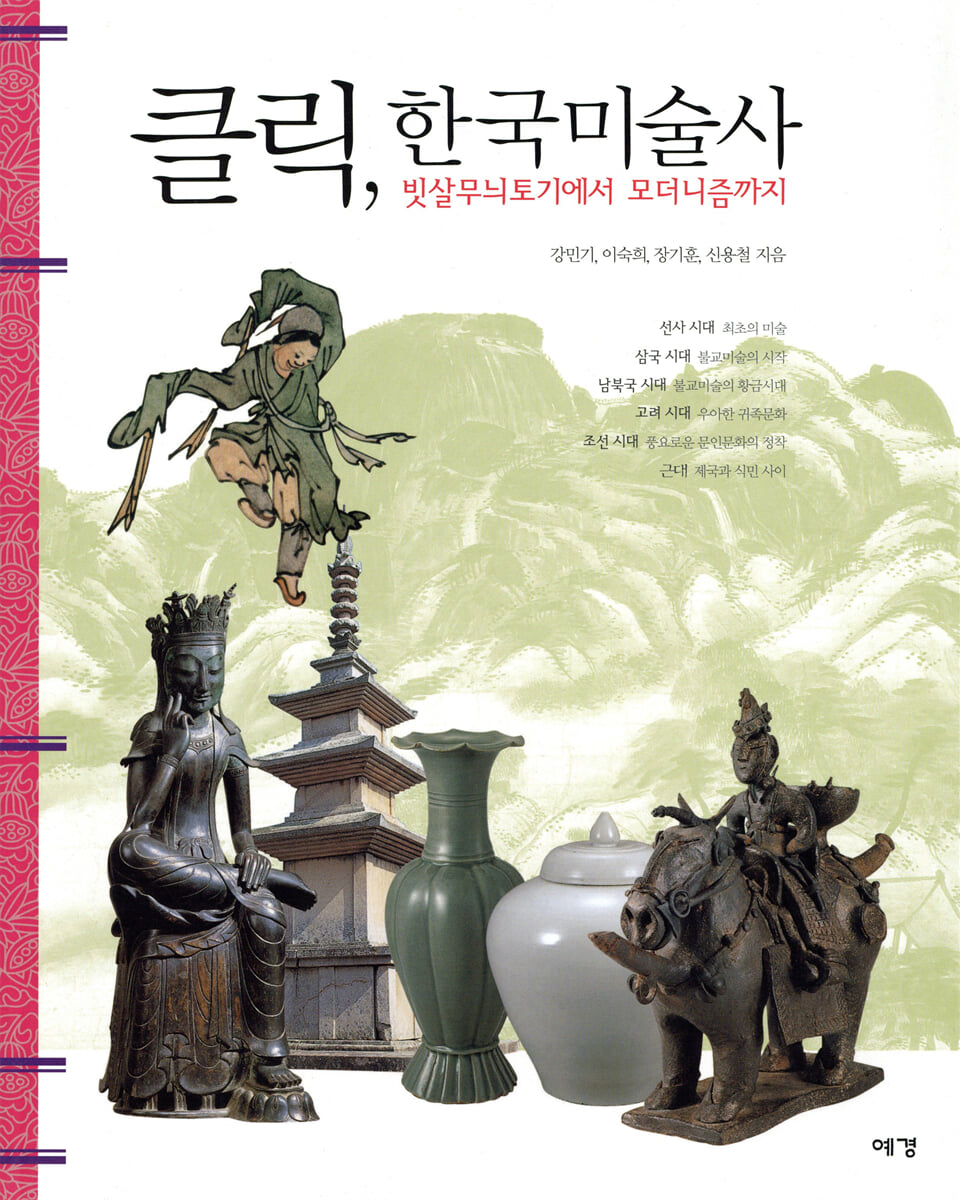 |
Description
Book Introduction
Pure and selfless innocence, created in harmony with beautiful nature
The history of art in our country spanning half a millennium!
This book provides a broad and in-depth explanation of Korean art history, first dividing it into periods and then into six categories: painting, sculpture, ceramics, crafts, architecture, and stonework, for a clear overview.
Additionally, experts in each field have unraveled themes and issues that readers need to know when understanding traditional art through major works, allowing readers to naturally understand our art history.
The conversation section covers general painting, Buddhist painting, and modern Western and Eastern painting by period, and explains the artists and their works together in a natural way.
The sculpture section also explains the meaning, flow, materials, and production techniques of works from each period, focusing on Buddhist statues.
It also carefully examines individual subjects such as tow, the twelve zodiac signs, tomb sculptures, and jangseung.
The history of art in our country spanning half a millennium!
This book provides a broad and in-depth explanation of Korean art history, first dividing it into periods and then into six categories: painting, sculpture, ceramics, crafts, architecture, and stonework, for a clear overview.
Additionally, experts in each field have unraveled themes and issues that readers need to know when understanding traditional art through major works, allowing readers to naturally understand our art history.
The conversation section covers general painting, Buddhist painting, and modern Western and Eastern painting by period, and explains the artists and their works together in a natural way.
The sculpture section also explains the meaning, flow, materials, and production techniques of works from each period, focusing on Buddhist statues.
It also carefully examines individual subjects such as tow, the twelve zodiac signs, tomb sculptures, and jangseung.
- You can preview some of the book's contents.
Preview
index
Ⅰ.
First Art (Prehistoric)
Painting - Ancient people's wishes contained in petroglyphs
Ceramics - The Origin and Spread of Prehistoric Pottery
The First Abstract Art: Neolithic Pottery
Various types of Bronze Age plain pottery
The development of pottery and the emergence of hard pottery
A Look Inside Korean Art - Dolmen
Crafts - Delicate aesthetics, bronzeware
A Look Inside Korean Art - Bronze Mirror with Patterns
Ⅱ.
The Beginning of Buddhist Art (Three Kingdoms Period)
Painting - Murals for the Dead
Records of a Cinematic Life: 4th to early 5th centuries
Buddhist and customary scenes: mid-5th century–6th century
Gods and Trees: Late 6th century - Early 7th century
A Look Inside Korean Art - Four Guardian Gods
Painters who crossed the sea
Sculpture - The Spread of Buddhism and Early Buddhist Statues
The appearance of a high school graduate and a Buddhist statue
A Look Inside Korean Art - Tou
The future incarnation, the Maitreya Buddha statue
A Look Inside Korean Art - Bangasayusang
A Look Inside Korean Art - The Life and Times of Buddha
The Buddha's World Open to All Directions: The Origin and Meaning of the Four Directions of Buddha
Ceramics - The development of diverse pottery cultures
The Succession of Proto-Three Kingdoms Pottery and the Influence of Chinese Ceramics: Goguryeo and Baekje
The development of hard pottery: Silla and Gaya
A Look Inside Korean Art - Pottery Equestrian Figure-Style Cup with a Stem
Crafts - Ornate gold crown discovered in tomb
A Look Inside Korean Art - Baekje Gilt-Bronze Incense Burner
Architecture - The construction of the temple and the initial layout of the temple complex
1 tower, 3 golden halls, and octagonal wooden pagoda: Goguryeo
The spread of Buddhist architecture to Japan through the one-tower, one-golden-hall layout of the Garam Temple: Baekje
The Transmission of Goguryeo and Baekje Architecture to Silla
Stone - Masonry towers and joint towers
From wooden pagoda to stone pagoda
The development of Silla stone pagodas
Ⅲ.
The Golden Age of Buddhist Art (North and South States Period)
Painting - Painting of the Cinematic Age
Place a preface in Seogyeong
Buddhist Paintings: Byun Sang-do and Seung Sang
Balhae's paintings that unified Northeast Asia
Sculpture - The Golden Age of Buddhist Sculpture
Acceptance and development of the Silla four-sided Buddha form
Buddha statue wishing for good health and longevity: Medicine Buddha statue
The Ultimate Compassion: The Transfiguration of Avalokitesvara in the Esoteric Buddhist World
A Look Inside Korean Art - Seokguram Grotto
A Look Inside Korean Art - Is the Principal Buddha Sakyamuni Buddha or Amitabha Buddha?
A Look Inside Korean Art - Eleven-Faced Avalokitesvara Statue
The emergence and popularity of international Buddhist statue styles
The Buddha's true body and Dharmakaya: Vairochana Buddha
Buddhist sculptures of Balhae, the successor to Goguryeo
A Look Inside Korean Art - Types of Buddhist Statues by Material
Ceramics - the pinnacle of ancient pottery culture
The heyday of blue-gray hard pottery
Yuzu pottery: condensed and ash glaze
A Look Inside Korean Art - Anapji Pond
Crafts - Buddhist ritual implements
What is a Buddhist temple?
Architecture - The Golden Age of Buddhist Architecture
Plain land and mountain land
A Look Inside Korean Art - Bulguksa Temple
Stone - The origin of the three-story stone pagoda
The evolution of Silla stone pagodas during the North-South States Period
A Look Inside Korean Art - The Transmission and Popularity of Jotapgyeong
A Look Inside Korean Art - Sarira Reliquary
The golden age of stone art
Balhae's stone art
Ⅳ.
Elegant aristocratic culture (Goryeo Dynasty)
Conversation - The Golden Age of Buddhist Painting
The Essence of Buddhist Painting: Wishing for Comfort in This World and the Hereafter
A Look Inside Korean Art - Yesterday's Bijangjeon Prints
Development of general conversation
Paint a portrait and enshrine it
The emergence of literati painters
Sculpture - The changing appearance of the Buddha statue
The temporary fad of iron Buddha statues
The creation of a large Buddha based on the idea that 'the king is Buddha'
A neat and gentle stone statue of a bodhisattva
A splendid gilt-bronze Buddha statue of the Lama family in the style of the royal court
Ceramics - The Age of Celadon
The Birth of Goryeo Celadon: Woljuyaki Celadon and Early Celadon
A Look Inside Korean Art - Distribution of Goryeo Celadon Kiln Sites
A Look Inside Korean Art - Types of Celadon
The spread of celadon culture and the peak of pure celadon
The trend of inlaid celadon and various decorative techniques
The decline of celadon and inlaid celadon with Chinese characters
Crafts - Offerings to the Buddha
Architecture - Aristocratic and elegant Zen Buddhist architecture
The expansion of temples and the increase in mountain temples
A Look Inside Korean Art - Traditional Korean Wooden Architecture
Stone - The emergence and development of stone pagodas with regional characteristics
Regionally differentiated pagoda styles
The birth of various stone art
Changes in the shape of the pagoda
V.
Establishment of a rich literary culture (Joseon Dynasty)
Conversation - Beyond Religion, to Humanity and Nature
The First Half of the Joseon Dynasty: Political Turmoil and Painting
A Look Inside Korean Art - How to Appreciate Dream Journey to the Peach Blossom Land
The aesthetics of nature in harmony with humans
A Look Inside Korean Art - The Eight Views of Xiaoxiang and Gyehoedo
Portraits that pursue spiritual idealism
A painting of a bird of paradise filled with innocence and nobility
Late Joseon Dynasty: Formation of National Self-Consciousness and the Renaissance
A Look Inside Korean Art - True Landscape Painters
Capturing Contemporary Life on Canvas: Genre Painting
A Look Inside Korean Art - Kim Hong-do and Shin Yun-bok
A Look Inside Korean Art - Do Seok-hwa
A Look Inside Korean Art - Tongsinsa Procession
The world of bird, flower, and animal paintings
The emergence of the middle class and the art world of the late Joseon Dynasty
A Look into Korean Art - Kim Jeong-hui's Disciples
Sculpture - Buddhist sculptures in the context of the policy of suppressing Buddhism and promoting Confucianism
Buddhist sculptures sponsored by the royal family and concubines
The popularity of clay and wooden Buddha statues
The three-dimensional world of Buddha: wooden carvings
A Look Inside Korean Art - Tomb Sculptures from the Tomb of the Noble Aristocrats
A Look Inside Korean Art - Tomb Sculptures from Joseon Royal Tombs
Ceramics - From Buncheong to Baekja
A New Look at Goryeo Inlaid Celadon: Buncheong Sagi
Installation of official kilns and production of white porcelain
A Look Inside Korean Art - Types of Joseon White Porcelain
The iron-painted white porcelain style spread throughout the country
A Look Inside Korean Art - Four White Porcelain Pieces
A Look Inside Korean Art - Distribution of Joseon Dynasty Kiln Sites
The revival of Bunwon Baekja
A Look Inside Korean Art - Types of Auspicious Designs on Late Joseon Dynasty White Porcelain
Crafts - Ornaments used to decorate Buddhist temples
Architecture - Diverse and Complex Buildings
Royal patronage and restrained temple architecture
The golden age of temple architecture
Castle architecture, a culmination of science and practical architecture
The palace and Jongmyo Shrine, the royal symbol and ceremonial space
Architecture of a formalized area, Hyanggyo
Seowon, where nature and Confucian architecture meet
Stonework - The Declining Art of Stonework
Succession of traditional forms and decline in the construction of stone pagodas
The pagodas that adorned the last of the central style of the early Joseon Dynasty
The simple, local beauty reflected in the late Joseon Dynasty's pagodas
Ⅵ.
Between Empire and Subject (Modern Times)
Conversation - Loss of National Sovereignty and the Influx of Western Art
Calligrapher and painter of turbulent times
Art and Culture in the Westernization Policy
They in the New Culture Movement
Reflections on traditional flower gardens and the search for modernity
Dreaming of a modern boy
A Look Inside Korean Art - Landscape Painting Exhibition by 10 Artists
Reflections on Japanese painting and overcoming colonial history
Sculpture - Modern Transformation of Traditional Sculpture
Buddhist sculptures inheriting tradition
Changes in the world of sculpture due to the introduction of Western sculpting techniques
Ceramics - Ceramic Craft as Industry and Art
Infiltration of Japanese industrial ceramics
The Decline of Joseon's Handicraft Industry and the Rise of Ceramics
supplement
References
Search
First Art (Prehistoric)
Painting - Ancient people's wishes contained in petroglyphs
Ceramics - The Origin and Spread of Prehistoric Pottery
The First Abstract Art: Neolithic Pottery
Various types of Bronze Age plain pottery
The development of pottery and the emergence of hard pottery
A Look Inside Korean Art - Dolmen
Crafts - Delicate aesthetics, bronzeware
A Look Inside Korean Art - Bronze Mirror with Patterns
Ⅱ.
The Beginning of Buddhist Art (Three Kingdoms Period)
Painting - Murals for the Dead
Records of a Cinematic Life: 4th to early 5th centuries
Buddhist and customary scenes: mid-5th century–6th century
Gods and Trees: Late 6th century - Early 7th century
A Look Inside Korean Art - Four Guardian Gods
Painters who crossed the sea
Sculpture - The Spread of Buddhism and Early Buddhist Statues
The appearance of a high school graduate and a Buddhist statue
A Look Inside Korean Art - Tou
The future incarnation, the Maitreya Buddha statue
A Look Inside Korean Art - Bangasayusang
A Look Inside Korean Art - The Life and Times of Buddha
The Buddha's World Open to All Directions: The Origin and Meaning of the Four Directions of Buddha
Ceramics - The development of diverse pottery cultures
The Succession of Proto-Three Kingdoms Pottery and the Influence of Chinese Ceramics: Goguryeo and Baekje
The development of hard pottery: Silla and Gaya
A Look Inside Korean Art - Pottery Equestrian Figure-Style Cup with a Stem
Crafts - Ornate gold crown discovered in tomb
A Look Inside Korean Art - Baekje Gilt-Bronze Incense Burner
Architecture - The construction of the temple and the initial layout of the temple complex
1 tower, 3 golden halls, and octagonal wooden pagoda: Goguryeo
The spread of Buddhist architecture to Japan through the one-tower, one-golden-hall layout of the Garam Temple: Baekje
The Transmission of Goguryeo and Baekje Architecture to Silla
Stone - Masonry towers and joint towers
From wooden pagoda to stone pagoda
The development of Silla stone pagodas
Ⅲ.
The Golden Age of Buddhist Art (North and South States Period)
Painting - Painting of the Cinematic Age
Place a preface in Seogyeong
Buddhist Paintings: Byun Sang-do and Seung Sang
Balhae's paintings that unified Northeast Asia
Sculpture - The Golden Age of Buddhist Sculpture
Acceptance and development of the Silla four-sided Buddha form
Buddha statue wishing for good health and longevity: Medicine Buddha statue
The Ultimate Compassion: The Transfiguration of Avalokitesvara in the Esoteric Buddhist World
A Look Inside Korean Art - Seokguram Grotto
A Look Inside Korean Art - Is the Principal Buddha Sakyamuni Buddha or Amitabha Buddha?
A Look Inside Korean Art - Eleven-Faced Avalokitesvara Statue
The emergence and popularity of international Buddhist statue styles
The Buddha's true body and Dharmakaya: Vairochana Buddha
Buddhist sculptures of Balhae, the successor to Goguryeo
A Look Inside Korean Art - Types of Buddhist Statues by Material
Ceramics - the pinnacle of ancient pottery culture
The heyday of blue-gray hard pottery
Yuzu pottery: condensed and ash glaze
A Look Inside Korean Art - Anapji Pond
Crafts - Buddhist ritual implements
What is a Buddhist temple?
Architecture - The Golden Age of Buddhist Architecture
Plain land and mountain land
A Look Inside Korean Art - Bulguksa Temple
Stone - The origin of the three-story stone pagoda
The evolution of Silla stone pagodas during the North-South States Period
A Look Inside Korean Art - The Transmission and Popularity of Jotapgyeong
A Look Inside Korean Art - Sarira Reliquary
The golden age of stone art
Balhae's stone art
Ⅳ.
Elegant aristocratic culture (Goryeo Dynasty)
Conversation - The Golden Age of Buddhist Painting
The Essence of Buddhist Painting: Wishing for Comfort in This World and the Hereafter
A Look Inside Korean Art - Yesterday's Bijangjeon Prints
Development of general conversation
Paint a portrait and enshrine it
The emergence of literati painters
Sculpture - The changing appearance of the Buddha statue
The temporary fad of iron Buddha statues
The creation of a large Buddha based on the idea that 'the king is Buddha'
A neat and gentle stone statue of a bodhisattva
A splendid gilt-bronze Buddha statue of the Lama family in the style of the royal court
Ceramics - The Age of Celadon
The Birth of Goryeo Celadon: Woljuyaki Celadon and Early Celadon
A Look Inside Korean Art - Distribution of Goryeo Celadon Kiln Sites
A Look Inside Korean Art - Types of Celadon
The spread of celadon culture and the peak of pure celadon
The trend of inlaid celadon and various decorative techniques
The decline of celadon and inlaid celadon with Chinese characters
Crafts - Offerings to the Buddha
Architecture - Aristocratic and elegant Zen Buddhist architecture
The expansion of temples and the increase in mountain temples
A Look Inside Korean Art - Traditional Korean Wooden Architecture
Stone - The emergence and development of stone pagodas with regional characteristics
Regionally differentiated pagoda styles
The birth of various stone art
Changes in the shape of the pagoda
V.
Establishment of a rich literary culture (Joseon Dynasty)
Conversation - Beyond Religion, to Humanity and Nature
The First Half of the Joseon Dynasty: Political Turmoil and Painting
A Look Inside Korean Art - How to Appreciate Dream Journey to the Peach Blossom Land
The aesthetics of nature in harmony with humans
A Look Inside Korean Art - The Eight Views of Xiaoxiang and Gyehoedo
Portraits that pursue spiritual idealism
A painting of a bird of paradise filled with innocence and nobility
Late Joseon Dynasty: Formation of National Self-Consciousness and the Renaissance
A Look Inside Korean Art - True Landscape Painters
Capturing Contemporary Life on Canvas: Genre Painting
A Look Inside Korean Art - Kim Hong-do and Shin Yun-bok
A Look Inside Korean Art - Do Seok-hwa
A Look Inside Korean Art - Tongsinsa Procession
The world of bird, flower, and animal paintings
The emergence of the middle class and the art world of the late Joseon Dynasty
A Look into Korean Art - Kim Jeong-hui's Disciples
Sculpture - Buddhist sculptures in the context of the policy of suppressing Buddhism and promoting Confucianism
Buddhist sculptures sponsored by the royal family and concubines
The popularity of clay and wooden Buddha statues
The three-dimensional world of Buddha: wooden carvings
A Look Inside Korean Art - Tomb Sculptures from the Tomb of the Noble Aristocrats
A Look Inside Korean Art - Tomb Sculptures from Joseon Royal Tombs
Ceramics - From Buncheong to Baekja
A New Look at Goryeo Inlaid Celadon: Buncheong Sagi
Installation of official kilns and production of white porcelain
A Look Inside Korean Art - Types of Joseon White Porcelain
The iron-painted white porcelain style spread throughout the country
A Look Inside Korean Art - Four White Porcelain Pieces
A Look Inside Korean Art - Distribution of Joseon Dynasty Kiln Sites
The revival of Bunwon Baekja
A Look Inside Korean Art - Types of Auspicious Designs on Late Joseon Dynasty White Porcelain
Crafts - Ornaments used to decorate Buddhist temples
Architecture - Diverse and Complex Buildings
Royal patronage and restrained temple architecture
The golden age of temple architecture
Castle architecture, a culmination of science and practical architecture
The palace and Jongmyo Shrine, the royal symbol and ceremonial space
Architecture of a formalized area, Hyanggyo
Seowon, where nature and Confucian architecture meet
Stonework - The Declining Art of Stonework
Succession of traditional forms and decline in the construction of stone pagodas
The pagodas that adorned the last of the central style of the early Joseon Dynasty
The simple, local beauty reflected in the late Joseon Dynasty's pagodas
Ⅵ.
Between Empire and Subject (Modern Times)
Conversation - Loss of National Sovereignty and the Influx of Western Art
Calligrapher and painter of turbulent times
Art and Culture in the Westernization Policy
They in the New Culture Movement
Reflections on traditional flower gardens and the search for modernity
Dreaming of a modern boy
A Look Inside Korean Art - Landscape Painting Exhibition by 10 Artists
Reflections on Japanese painting and overcoming colonial history
Sculpture - Modern Transformation of Traditional Sculpture
Buddhist sculptures inheriting tradition
Changes in the world of sculpture due to the introduction of Western sculpting techniques
Ceramics - Ceramic Craft as Industry and Art
Infiltration of Japanese industrial ceramics
The Decline of Joseon's Handicraft Industry and the Rise of Ceramics
supplement
References
Search
Detailed image

Publisher's Review
A pure and selfless mind with no obstacles and talents from heaven
Discover the history of art spanning half a millennium, woven in harmony with beautiful nature.
An easy and fun history of Korean art with beautiful illustrations
More than ten years have passed since the publication of “Click, Western Art History.”
Among Western art history books that were often seen as difficult to understand due to their thickness and dense text, Click, Western Art History was loved by readers who were just beginning to study Western art history by providing clear explanations that could be read at a glance, abundant illustrations, and comparison tables that summarize each feature.
Amidst this unexpected interest and love, we could sense readers' thirst for an "easy and fun" art history book, and thus planned a Korean art history book that explains the flow of traditional Korean art in a friendly and fun way.
The book that was born this way is “Click, Korean Art History.”
《Click, Korean Art History》 describes Korean art history concisely and clearly, explaining difficult terms in simple terms and providing encyclopedic explanations for essential concepts.
Additionally, it includes over 1,000 diverse and beautiful illustrations to help readers gain a more in-depth and familiar understanding of Korean art history.
Understanding the flow of Korean art by era, field, and subject
《Click, Korean Art History》 divides the five thousand years of Korean art history into prehistoric times, the Three Kingdoms, North and South States, Goryeo, Joseon, and modern times, and organizes it so that readers can naturally understand the flow of art over each era. In addition, within each era, it divides into fields such as painting, sculpture, ceramics, crafts, architecture, and stonework, and describes topics that experts in each field must know when understanding Korea's traditional art, focusing on cultural heritage.
In particular, this book provides a concise introduction to Balhae paintings, Buddhist sculptures, and stone art, which have not been covered well in existing Korean art history books, and also covers modern art of the early 20th century, which has been excluded from the category of traditional art until now, in relatively detail, thereby attempting to view the entire history of Korean art from a balanced perspective.
Three-dimensional editing that helps readers understand in depth
What stands out most about this book is its three-dimensional editing, which helps readers gain a deeper understanding.
First, at the beginning of each era, there is an overview page that briefly looks back on the history of that era and examines its connection to art culture. Next to that is a chronological table that organizes Korean history and the history of art according to the flow of time.
This allows us to see at a glance how the history of art develops and influences the social and cultural circumstances of the time.
In addition, before going into each era and each field, a heading summarizing only the core content of the text was included so that the characteristics of each field of the corresponding era can be clearly understood without having to read the entire text. Next to the abundant illustrations, a brief explanation of the work or matters not covered in the text are included.
Throughout the text, tables clearly outline the work's characteristics and changes in style, helping readers easily remember essential information.
Particularly important artifacts can be examined in more detail on the pictorial pages titled “A Look Inside Korean Art,” and explanations of difficult art terms that appear in the text are added at the end of each period.
By following the history of Korean art with "Click, Korean Art History," which contains such rich content, we will be able to feel the breath and emotions of our people, as well as the true aesthetic sense of Koreans.
Discover the history of art spanning half a millennium, woven in harmony with beautiful nature.
An easy and fun history of Korean art with beautiful illustrations
More than ten years have passed since the publication of “Click, Western Art History.”
Among Western art history books that were often seen as difficult to understand due to their thickness and dense text, Click, Western Art History was loved by readers who were just beginning to study Western art history by providing clear explanations that could be read at a glance, abundant illustrations, and comparison tables that summarize each feature.
Amidst this unexpected interest and love, we could sense readers' thirst for an "easy and fun" art history book, and thus planned a Korean art history book that explains the flow of traditional Korean art in a friendly and fun way.
The book that was born this way is “Click, Korean Art History.”
《Click, Korean Art History》 describes Korean art history concisely and clearly, explaining difficult terms in simple terms and providing encyclopedic explanations for essential concepts.
Additionally, it includes over 1,000 diverse and beautiful illustrations to help readers gain a more in-depth and familiar understanding of Korean art history.
Understanding the flow of Korean art by era, field, and subject
《Click, Korean Art History》 divides the five thousand years of Korean art history into prehistoric times, the Three Kingdoms, North and South States, Goryeo, Joseon, and modern times, and organizes it so that readers can naturally understand the flow of art over each era. In addition, within each era, it divides into fields such as painting, sculpture, ceramics, crafts, architecture, and stonework, and describes topics that experts in each field must know when understanding Korea's traditional art, focusing on cultural heritage.
In particular, this book provides a concise introduction to Balhae paintings, Buddhist sculptures, and stone art, which have not been covered well in existing Korean art history books, and also covers modern art of the early 20th century, which has been excluded from the category of traditional art until now, in relatively detail, thereby attempting to view the entire history of Korean art from a balanced perspective.
Three-dimensional editing that helps readers understand in depth
What stands out most about this book is its three-dimensional editing, which helps readers gain a deeper understanding.
First, at the beginning of each era, there is an overview page that briefly looks back on the history of that era and examines its connection to art culture. Next to that is a chronological table that organizes Korean history and the history of art according to the flow of time.
This allows us to see at a glance how the history of art develops and influences the social and cultural circumstances of the time.
In addition, before going into each era and each field, a heading summarizing only the core content of the text was included so that the characteristics of each field of the corresponding era can be clearly understood without having to read the entire text. Next to the abundant illustrations, a brief explanation of the work or matters not covered in the text are included.
Throughout the text, tables clearly outline the work's characteristics and changes in style, helping readers easily remember essential information.
Particularly important artifacts can be examined in more detail on the pictorial pages titled “A Look Inside Korean Art,” and explanations of difficult art terms that appear in the text are added at the end of each period.
By following the history of Korean art with "Click, Korean Art History," which contains such rich content, we will be able to feel the breath and emotions of our people, as well as the true aesthetic sense of Koreans.
GOODS SPECIFICS
- Date of issue: June 1, 2011
- Page count, weight, size: 416 pages | 1,270g | 220*270*30mm
- ISBN13: 9788970844541
- ISBN10: 8970844546
You may also like
카테고리
korean


korean

![GQ KOREA Mark (Monthly): December [2025]](http://librairie.coreenne.fr/cdn/shop/files/8ef265dbbfbf186523ed75ba7319009d.jpg?v=1765340328&width=3840)


