

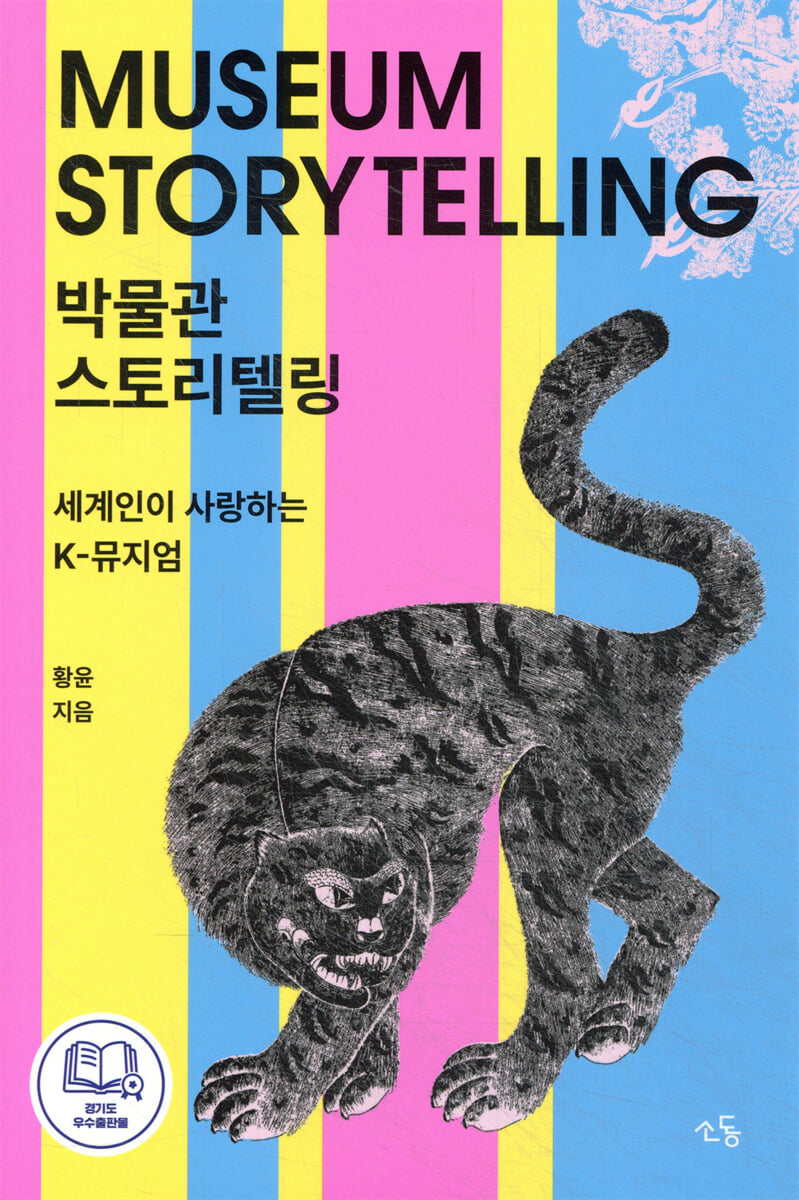
Museum Storytelling
 |
Description
Book Introduction
“Museums are a stage for stories that connect the past and present, the region and the world.”
Each piece of artifact, each piece of art, contains layers of the breath of the times and human imagination.
The true power of a museum comes when a single artifact is connected to artifacts from other times and regions and comes to life as a single 'story.'
As the influence of K-culture spreads across the globe, the world is paying attention to Korea's traditional arts, fine arts, crafts, and design.
But the true power of culture comes not from 'fashion' but from the depth of understanding of roots and context.
This is where this book shines.
This book explores how our culture and art are born, transformed, and reinterpreted within the grand flow of world history through the stage of the museum.
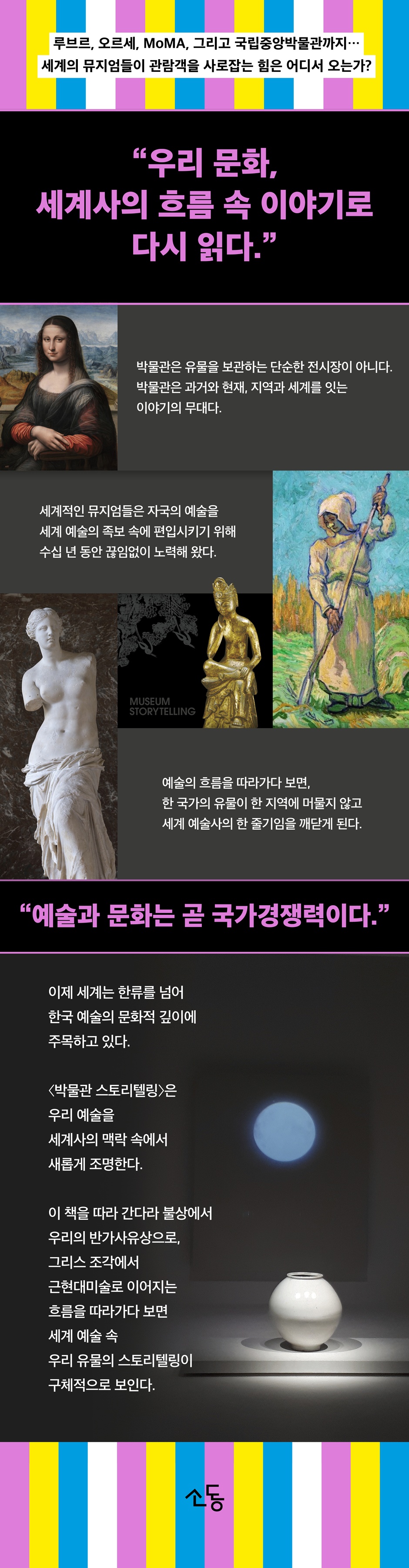
The author traces the path of artistic movement from India's Gandhara Buddhist statues to China, the Korean Peninsula, and Japan, and even examines how the formative sensibility derived from Greek sculpture influenced Asian art history beyond Europe.
In the process, the author presents a unique perspective called ‘genealogical storytelling.’
For him, a museum is not a place with stuffed relics, but a living being where various cultures influence each other and create new stories.
He compares the exhibition styles of major museums around the world, including the Louvre, the Musée d'Orsay, the Centre Pompidou, and the National Museum of Korea, and shows how they weave art into a single thread of world history through 'context and story.'
This is not a simple exhibition technique, but a methodology of insight that leads us to read our art and history deeply within the genealogy of world history.
Therefore, through this, readers gain a new understanding of the world historical significance of each relic.
"Museum Storytelling" questions the place of Korean art in the world and offers answers to the questions of where and how it can be positioned in the future.
In other words, this is a book that suggests 'how to tell the story of our culture in the world's languages.'
Therefore, general readers who love museums will be able to enjoy discovering the 'stories hidden behind artifacts,' while exhibition planners and art historians will be able to gain inspiration for 'contextual exhibition' techniques.
Each piece of artifact, each piece of art, contains layers of the breath of the times and human imagination.
The true power of a museum comes when a single artifact is connected to artifacts from other times and regions and comes to life as a single 'story.'
As the influence of K-culture spreads across the globe, the world is paying attention to Korea's traditional arts, fine arts, crafts, and design.
But the true power of culture comes not from 'fashion' but from the depth of understanding of roots and context.
This is where this book shines.
This book explores how our culture and art are born, transformed, and reinterpreted within the grand flow of world history through the stage of the museum.
The author traces the path of artistic movement from India's Gandhara Buddhist statues to China, the Korean Peninsula, and Japan, and even examines how the formative sensibility derived from Greek sculpture influenced Asian art history beyond Europe.
In the process, the author presents a unique perspective called ‘genealogical storytelling.’
For him, a museum is not a place with stuffed relics, but a living being where various cultures influence each other and create new stories.
He compares the exhibition styles of major museums around the world, including the Louvre, the Musée d'Orsay, the Centre Pompidou, and the National Museum of Korea, and shows how they weave art into a single thread of world history through 'context and story.'
This is not a simple exhibition technique, but a methodology of insight that leads us to read our art and history deeply within the genealogy of world history.
Therefore, through this, readers gain a new understanding of the world historical significance of each relic.
"Museum Storytelling" questions the place of Korean art in the world and offers answers to the questions of where and how it can be positioned in the future.
In other words, this is a book that suggests 'how to tell the story of our culture in the world's languages.'
Therefore, general readers who love museums will be able to enjoy discovering the 'stories hidden behind artifacts,' while exhibition planners and art historians will be able to gain inspiration for 'contextual exhibition' techniques.
- You can preview some of the book's contents.
Preview
index
Prologue 4
Museum's Genealogy
What is a genealogy? 13
From Gandhara Buddhist statues to Chinese, Korean, and Japanese Buddhist statues, 17
Appearance of the National Museum of Korea 26
A broader worldview
The Eastward Advance of Greek Culture 39
If there is a Greek statue 44
Egypt and Greece 48
Louvre Museum
Mona Lisa 59
Renaissance 68
The Louvre Museum's Structure 72
The Globalization of Genealogy Storytelling 80
Genealogy of Modern and Contemporary Art
Impressionism's position in the genealogy is 95.
Impressionism Exhibition 101
A Look at Korean Art Exhibitions 114
Cultivating Star Artists through Exhibition Spaces 119
Millet and Park Soo-geun 123
Museum's Genealogy
What is a genealogy? 13
From Gandhara Buddhist statues to Chinese, Korean, and Japanese Buddhist statues, 17
Appearance of the National Museum of Korea 26
A broader worldview
The Eastward Advance of Greek Culture 39
If there is a Greek statue 44
Egypt and Greece 48
Louvre Museum
Mona Lisa 59
Renaissance 68
The Louvre Museum's Structure 72
The Globalization of Genealogy Storytelling 80
Genealogy of Modern and Contemporary Art
Impressionism's position in the genealogy is 95.
Impressionism Exhibition 101
A Look at Korean Art Exhibitions 114
Cultivating Star Artists through Exhibition Spaces 119
Millet and Park Soo-geun 123
Detailed image
Into the book
A genealogy is a book that records the lineage and bloodline of a family.
Surprisingly, such a genealogy exists in art history as well.
If you look closely, you'll see that even artistic trends that emerged in one country did not suddenly appear alone.
The roots and the flow of the lineage clearly exist separately, and if you follow those roots deeply, you will inevitably encounter the genealogy of art history, that is, the flow of art in world history.
--- p.8~9
The Louvre Museum in France is also famous as a museum that has had tangible and intangible influence on many countries.
Above all, the storytelling structure that connects the country's story in world history as 'Mesopotamia → Egypt → Greece → Italian Renaissance → France' is truly superb.
… Only when our story within world history is established to a certain degree, like the Louvre Museum, will we have the competitive edge to more easily explain our history to people around the world.
--- p.80
The Metropolitan Museum of Art is a place that shows American storytelling while adding its own unique color, while being influenced by the storytelling of the Louvre Museum.
If so, shouldn't we also seriously study the Louvre and the Metropolitan Museum of Art and consider the future of the National Museum of Korea, which represents Korea?
As Korea has become a developed country in the 21st century and is increasingly visited by people from abroad, it is time to create an exhibition that is not only shared among Koreans, but also understandable to overseas visitors through genealogy.
--- p.90~91
Foreign visitors to the National Museum of Modern and Contemporary Art in Korea account for only 5 percent.
This is even more shocking because it was achieved at a representative art museum located right next to Gyeongbokgung Palace, the premier tourist destination in South Korea.
--- p.102
The United States has long been a national effort to clearly present the roots of its art through genealogical storytelling, and has also introduced the unique growth of American art since then.
Thanks to such efforts, American art, which had long been ignored as a peripheral art form in Europe, is now recognized as a proper world art form.
This is the result of a long-standing, strategic effort by American museums to consistently explain American art within the context of world art history.
--- p.127
A star writer is never created without the active support of the country and society in question, in addition to his or her own efforts.
Furthermore, it is even more difficult to develop a world-class writer based in one region.
--- p.133
Although moon jars have been receiving special attention for their aesthetic appeal since 2000, in fact, during the Joseon Dynasty, they were merely practical items used to store soy sauce and other condiments.
Moreover, until the early 17th to 18th centuries, the technology to make large white porcelain was lacking, so the top and bottom were made separately and then attached to each other. However, they were unable to withstand the weight and became distorted or rough in shape rather than smooth.
Looking at it objectively, it was a result of Joseon's clear technological limitations at the time.
However, as this began to be reinterpreted with a modern and contemporary aesthetic rather than the standards of the past, it became clear that this was the very expression of the value of randomness, and the moon jar came to be evaluated as the pinnacle of Korean beauty.
--- p.288~230
In Europe, Chinese culture has been receiving positive responses to the extent that it can be said that it has advanced into Europe in the 17th and 18th centuries, Japanese culture in the 19th and 20th centuries, and Korean culture in the 21st century.
Therefore, it is cautiously predicted that the 21st century will be the golden age of Korean culture, following the Chinoiserie of the 17th and 18th centuries and Japonism of the 19th and 20th centuries.
--- p.246
The process of incorporating one's own art into the world's art history is thus difficult and arduous.
But the fruits of overcoming the difficult process and gaining recognition are sweet.
This is because the power of art and culture can create a positive and attractive image of a country in the eyes of the world.
And this soon leads to another competitiveness of the country.
This is why developed countries invest heavily in cultural and artistic projects.
Surprisingly, such a genealogy exists in art history as well.
If you look closely, you'll see that even artistic trends that emerged in one country did not suddenly appear alone.
The roots and the flow of the lineage clearly exist separately, and if you follow those roots deeply, you will inevitably encounter the genealogy of art history, that is, the flow of art in world history.
--- p.8~9
The Louvre Museum in France is also famous as a museum that has had tangible and intangible influence on many countries.
Above all, the storytelling structure that connects the country's story in world history as 'Mesopotamia → Egypt → Greece → Italian Renaissance → France' is truly superb.
… Only when our story within world history is established to a certain degree, like the Louvre Museum, will we have the competitive edge to more easily explain our history to people around the world.
--- p.80
The Metropolitan Museum of Art is a place that shows American storytelling while adding its own unique color, while being influenced by the storytelling of the Louvre Museum.
If so, shouldn't we also seriously study the Louvre and the Metropolitan Museum of Art and consider the future of the National Museum of Korea, which represents Korea?
As Korea has become a developed country in the 21st century and is increasingly visited by people from abroad, it is time to create an exhibition that is not only shared among Koreans, but also understandable to overseas visitors through genealogy.
--- p.90~91
Foreign visitors to the National Museum of Modern and Contemporary Art in Korea account for only 5 percent.
This is even more shocking because it was achieved at a representative art museum located right next to Gyeongbokgung Palace, the premier tourist destination in South Korea.
--- p.102
The United States has long been a national effort to clearly present the roots of its art through genealogical storytelling, and has also introduced the unique growth of American art since then.
Thanks to such efforts, American art, which had long been ignored as a peripheral art form in Europe, is now recognized as a proper world art form.
This is the result of a long-standing, strategic effort by American museums to consistently explain American art within the context of world art history.
--- p.127
A star writer is never created without the active support of the country and society in question, in addition to his or her own efforts.
Furthermore, it is even more difficult to develop a world-class writer based in one region.
--- p.133
Although moon jars have been receiving special attention for their aesthetic appeal since 2000, in fact, during the Joseon Dynasty, they were merely practical items used to store soy sauce and other condiments.
Moreover, until the early 17th to 18th centuries, the technology to make large white porcelain was lacking, so the top and bottom were made separately and then attached to each other. However, they were unable to withstand the weight and became distorted or rough in shape rather than smooth.
Looking at it objectively, it was a result of Joseon's clear technological limitations at the time.
However, as this began to be reinterpreted with a modern and contemporary aesthetic rather than the standards of the past, it became clear that this was the very expression of the value of randomness, and the moon jar came to be evaluated as the pinnacle of Korean beauty.
--- p.288~230
In Europe, Chinese culture has been receiving positive responses to the extent that it can be said that it has advanced into Europe in the 17th and 18th centuries, Japanese culture in the 19th and 20th centuries, and Korean culture in the 21st century.
Therefore, it is cautiously predicted that the 21st century will be the golden age of Korean culture, following the Chinoiserie of the 17th and 18th centuries and Japonism of the 19th and 20th centuries.
--- p.246
The process of incorporating one's own art into the world's art history is thus difficult and arduous.
But the fruits of overcoming the difficult process and gaining recognition are sweet.
This is because the power of art and culture can create a positive and attractive image of a country in the eyes of the world.
And this soon leads to another competitiveness of the country.
This is why developed countries invest heavily in cultural and artistic projects.
--- p.250
Publisher's Review
K-culture expands its territory into museums
With the global spread of the Korean Wave and heightened interest in Korean culture, we must ask ourselves, "Where did our culture come from?" and contemplate, "How will our culture position itself in the world in the future?"
Now is the time to present a way for international audiences to understand the context of our culture and art, rather than just a story shared among us.
This is because the power of art and culture can make the image of Korea that people around the world see more positive and attractive.
So, what efforts are we making now to ensure that our writers and art become 'writers and art in the world'?
This book is the most sophisticated answer to this question.
The author analyzes the artistic movement from Gandhara Buddhist statues to the pensive Bodhisattva statues of the Korean Peninsula, the expansion of Greek sculpture into Europe and Asia, and how world-class museums such as the Louvre, the Musée d'Orsay, and the Centre Pompidou have positioned their own art within the larger flow of world history.
This is unraveled through a unique perspective called 'genealogical storytelling', and through various exhibition examples, it vividly demonstrates how 'contextual narrative' expands our understanding of art.
A genealogical storytelling exhibition that helps you understand the context of art history.
‘Genealogy storytelling’ is not simply an exhibition technique.
It is a framework of thought that allows us to understand culture and history more deeply and gain new insights.
As we follow the lineage of art, we naturally come to realize what significance our culture holds in world history.
For that reason, the author emphasizes that Korean museums must now move toward storytelling-centered exhibitions that resonate with people around the world.
In addition, this book presents the direction and method in detail.
Indeed, world-renowned museums have long devoted considerable effort to incorporating their country's art into the genealogy of world history.
So now we too must ask ourselves, ‘How should we talk about our art in the world?’ and find the answer.
That is why Museum Storytelling is not simply a commentary on art history.
It serves as a thought tool that allows for a deeper understanding and appreciation of culture and history, and offers new coordinates and insights into Korean art in the global context to not only general museum-loving readers but also cultural planners, art historians, and content creators.
Only when we convey our art in the world's languages will the true era of K-Museums begin.
With the global spread of the Korean Wave and heightened interest in Korean culture, we must ask ourselves, "Where did our culture come from?" and contemplate, "How will our culture position itself in the world in the future?"
Now is the time to present a way for international audiences to understand the context of our culture and art, rather than just a story shared among us.
This is because the power of art and culture can make the image of Korea that people around the world see more positive and attractive.
So, what efforts are we making now to ensure that our writers and art become 'writers and art in the world'?
This book is the most sophisticated answer to this question.
The author analyzes the artistic movement from Gandhara Buddhist statues to the pensive Bodhisattva statues of the Korean Peninsula, the expansion of Greek sculpture into Europe and Asia, and how world-class museums such as the Louvre, the Musée d'Orsay, and the Centre Pompidou have positioned their own art within the larger flow of world history.
This is unraveled through a unique perspective called 'genealogical storytelling', and through various exhibition examples, it vividly demonstrates how 'contextual narrative' expands our understanding of art.
A genealogical storytelling exhibition that helps you understand the context of art history.
‘Genealogy storytelling’ is not simply an exhibition technique.
It is a framework of thought that allows us to understand culture and history more deeply and gain new insights.
As we follow the lineage of art, we naturally come to realize what significance our culture holds in world history.
For that reason, the author emphasizes that Korean museums must now move toward storytelling-centered exhibitions that resonate with people around the world.
In addition, this book presents the direction and method in detail.
Indeed, world-renowned museums have long devoted considerable effort to incorporating their country's art into the genealogy of world history.
So now we too must ask ourselves, ‘How should we talk about our art in the world?’ and find the answer.
That is why Museum Storytelling is not simply a commentary on art history.
It serves as a thought tool that allows for a deeper understanding and appreciation of culture and history, and offers new coordinates and insights into Korean art in the global context to not only general museum-loving readers but also cultural planners, art historians, and content creators.
Only when we convey our art in the world's languages will the true era of K-Museums begin.
GOODS SPECIFICS
- Date of issue: October 26, 2025
- Page count, weight, size: 264 pages | 140*210*20mm
- ISBN13: 9791193193174
- ISBN10: 1193193176
You may also like
카테고리
korean


korean

![GQ KOREA Mark (Monthly): December [2025]](http://librairie.coreenne.fr/cdn/shop/files/8ef265dbbfbf186523ed75ba7319009d.jpg?v=1765340328&width=3840)


