

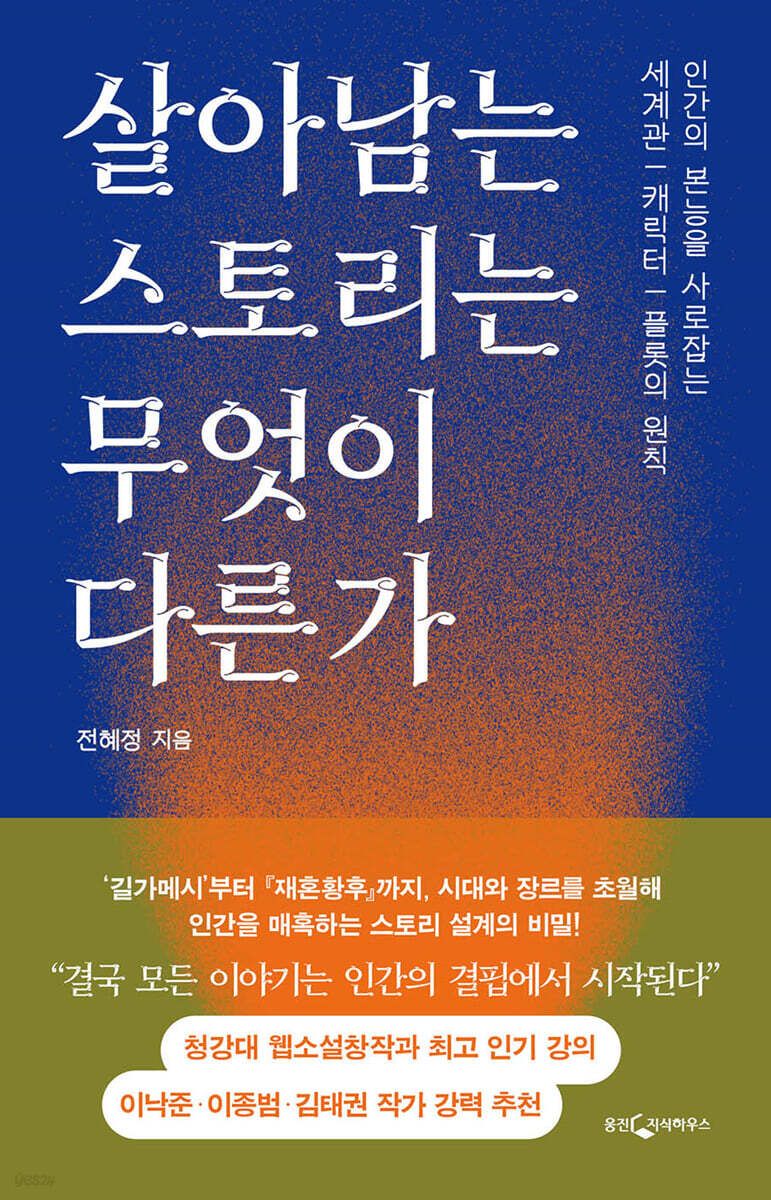
What makes a survival story different?
 |
Description
Book Introduction
△ Cheonggang University's Web Novel Creation Department's most popular lecture
△ Strongly recommended by Lee Nak-jun, Lee Jong-beom, and Kim Tae-kwon
From "The Epic of Gilgamesh" to "The Remarried Empress," transcending time and genre
The secret to designing a story that captivates people!
“Ultimately, all stories begin with human deficiency.”
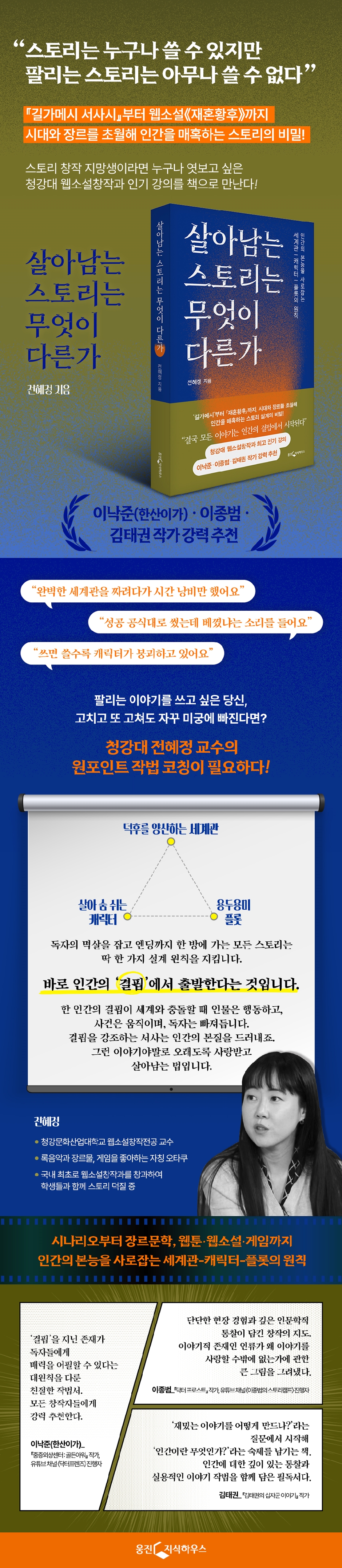
Anyone can write a story, but not everyone can finish it! What if you've wasted time trying to perfect the worldview? What if you followed a formula for success but the plot went awry and the characters fell apart? What if, no matter how much you revise, you can't find a way to the ending? These are the questions we need to consider.
“Why do humans fall for stories?” From primordial myths, legends, and folktales to movies, dramas, literature, web novels, and webtoons, all beloved stories across time and genre have one thing in common.
It starts from human ‘deficiency’.
When one human's shortcomings collide with the world, characters act, events move, and readers are drawn in.
A narrative that emphasizes deficiency never becomes stale, no matter how many years it is repeated. Rather, it reveals the essence of humanity.
"What Makes a Survival Story Different" is a book that faithfully transcribes the popular lecture "Storytelling Writing Lecture" by Professor Jeon Hye-jeong of the Web Novel Creation Department at Cheonggang Cultural Industry University.
The author guides creators beyond the obvious formula for success to the fundamental question, "What kind of stories are instinctively appealing to humans?"
With this book, even those who have been stuck in a writing labyrinth will be able to complete a story that sells.
It will be a ray of light for aspiring creative writers who want to be loved and survive with just one story.
△ Strongly recommended by Lee Nak-jun, Lee Jong-beom, and Kim Tae-kwon
From "The Epic of Gilgamesh" to "The Remarried Empress," transcending time and genre
The secret to designing a story that captivates people!
“Ultimately, all stories begin with human deficiency.”
Anyone can write a story, but not everyone can finish it! What if you've wasted time trying to perfect the worldview? What if you followed a formula for success but the plot went awry and the characters fell apart? What if, no matter how much you revise, you can't find a way to the ending? These are the questions we need to consider.
“Why do humans fall for stories?” From primordial myths, legends, and folktales to movies, dramas, literature, web novels, and webtoons, all beloved stories across time and genre have one thing in common.
It starts from human ‘deficiency’.
When one human's shortcomings collide with the world, characters act, events move, and readers are drawn in.
A narrative that emphasizes deficiency never becomes stale, no matter how many years it is repeated. Rather, it reveals the essence of humanity.
"What Makes a Survival Story Different" is a book that faithfully transcribes the popular lecture "Storytelling Writing Lecture" by Professor Jeon Hye-jeong of the Web Novel Creation Department at Cheonggang Cultural Industry University.
The author guides creators beyond the obvious formula for success to the fundamental question, "What kind of stories are instinctively appealing to humans?"
With this book, even those who have been stuck in a writing labyrinth will be able to complete a story that sells.
It will be a ray of light for aspiring creative writers who want to be loved and survive with just one story.
- You can preview some of the book's contents.
Preview
index
Entering
Part 1: Why Do Humans Write Such Stories?
Lesson 1: Why Your Story Isn't Interesting
Prejudices and myths floating around the content industry | What kind of stories sell? | What stories are good and what not to write | Why do you want to write that story?
Lecture 2: Humans crave probability and legitimacy.
Without the law of cause and effect, humans cannot think | Myths, legends, religions, and conspiracy theories | How humans endure absurdity | The human instinct for storytelling, serving the need for legitimacy
The Three Powers Worldview: A Window Through Which Homopictus Accepts Reality
We also need stories that crack windows. | Reality has no planned worldview. | How Homopictus confronts an uncomfortable reality. | In the worldview of genre fiction, events connect like dominoes.
The worldview, characters, and plot structure of the story of surviving the quarterfinals_
The Worldview-Plot-Character Triangle | The Pirate Captain's Treasure Hunt Game and the World of Storytelling | Deficiency: The Essence of the Story That Runs Through the Triangle
Part 2: Every story begins with a lack.
The story of the fifth lecture is about a character who lacks a worldview and solves problems.
Chapter 6: The Main Character: The Blank Spaces of the Characters Elicit Empathy
A character lacking in worldview order | Lack of knowledge + unknown choices = curiosity about the character | A mechanism for eliciting empathy | Why the protagonist keeps making difficult choices
7th Character: Press the Deficiency button to begin the story.
The result of an effort to cover up the wound
8-part plot: The more dramatic the change, the more captivating it is.
A choice I never could have guessed | The plot is the character's trajectory | The asteroid impact and the protagonist's birth
| A character's growth story that amplifies emotion
Lesson 9: Famous Lines: Don't Fall for the Living Lines
Between realistic lines and clichés | A character with a deficiency delivers memorable lines | The power of lines that make even villains sympathize | Lines that usurp status | A character with a deficiency lies | A character who knows metaphor has depth | The art of nitpicking to avoid seriousness
Lesson 10 Message: The author speaks in terms of the order of the worldview.
The author's message that determines the order of the worldview | Aphorisms that contain the order of the worldview | Anything can be a message | What genre readers want
Lesson 11: Trial: Create a Custom Gateway for Your Protagonist
In Search of the Master of Worldview and Plot | Regular Gates in Romance Novels | Trials Are Tailored Gates for the Protagonist | Why Trials in Web Novels Are New
Episode 12: Make a promise in the first episode and keep it until the end.
The order of the worldview is initially promised | A world that could exist somewhere
Read more How to Establish Your Protagonist's Deficiency
Part 3: Principles of Plot Design That Stimulates Instinct
Lesson 13: How to grab your readers by the scruff of the neck and get them to the end in one fell swoop
Aristotle's Poetics and the Three-Act Structure | The Story Structure That Ends with a "Come to Yourself" | Paving the Way for Your Protagonist
Lecture 14: A 6-Step Structure for Designing Worldview, Characters, and Plots
Step 1: The protagonist in a certain world makes a decision the moment he realizes his deficiency and crosses the river of no return. | Step 2: The protagonist's chosen action triggers a chain of events. | Step 3: The protagonist's heart breaks after falling into the trap of a problem and choosing the wrong answer. | Step 4: Realizing that the wrong answer was also a necessary process, the protagonist devotes himself to solving the problem again. | Step 5: Solves the problem using the right method. | Step 6: The protagonist finally reaches the ending, restoring the order of the worldview and resolving the deficiency.
Lesson 15: Six Archetypes of a Loved and Survived Plot
Round of 16, Round 1: Journey to Deprivation
Order Restored After Adventure | A Plot of Pursuit and Adventure, A Journey in Pursuit of Lack
Round 17, Round 2: Showdown with the Doppelganger
Doppelganger: A showdown between the "real" and "fake" self | A fateful clash between the protagonist and his nemesis | A chase plot: A story of chase and being chased | A revenge plot: Chasing a monster while gazing into the abyss | A rival plot: A battle for the legitimacy of the worldview
Round of 18, Round 3: Dramatic Growth
The most immature grow the most | Maturity plot: The worldview shatters and the person becomes an adult | Transformation plot: The most extreme form of growth
Lesson 19: The Love Trap
My Savior Who Came to Ruin My Life | Love Plot: When Life's Greatest Ordeal Is with One Person | Sacrifice Plot: Filling the Void and Becoming a Victor
20th Round, Round 5: A Fateful Choice
My Choices Determine My Destiny | A Plot of Temptation and Downfall, Wrong Choices Lead to Ruin | Isolated Success, When Victory Isn't Victory
Lesson 21: Archetype 6: Restoring or Destructing Order
Mystery plot, restoration of rational order | Horror plot, defeat of rational order
Going out
Recommendation
Part 1: Why Do Humans Write Such Stories?
Lesson 1: Why Your Story Isn't Interesting
Prejudices and myths floating around the content industry | What kind of stories sell? | What stories are good and what not to write | Why do you want to write that story?
Lecture 2: Humans crave probability and legitimacy.
Without the law of cause and effect, humans cannot think | Myths, legends, religions, and conspiracy theories | How humans endure absurdity | The human instinct for storytelling, serving the need for legitimacy
The Three Powers Worldview: A Window Through Which Homopictus Accepts Reality
We also need stories that crack windows. | Reality has no planned worldview. | How Homopictus confronts an uncomfortable reality. | In the worldview of genre fiction, events connect like dominoes.
The worldview, characters, and plot structure of the story of surviving the quarterfinals_
The Worldview-Plot-Character Triangle | The Pirate Captain's Treasure Hunt Game and the World of Storytelling | Deficiency: The Essence of the Story That Runs Through the Triangle
Part 2: Every story begins with a lack.
The story of the fifth lecture is about a character who lacks a worldview and solves problems.
Chapter 6: The Main Character: The Blank Spaces of the Characters Elicit Empathy
A character lacking in worldview order | Lack of knowledge + unknown choices = curiosity about the character | A mechanism for eliciting empathy | Why the protagonist keeps making difficult choices
7th Character: Press the Deficiency button to begin the story.
The result of an effort to cover up the wound
8-part plot: The more dramatic the change, the more captivating it is.
A choice I never could have guessed | The plot is the character's trajectory | The asteroid impact and the protagonist's birth
| A character's growth story that amplifies emotion
Lesson 9: Famous Lines: Don't Fall for the Living Lines
Between realistic lines and clichés | A character with a deficiency delivers memorable lines | The power of lines that make even villains sympathize | Lines that usurp status | A character with a deficiency lies | A character who knows metaphor has depth | The art of nitpicking to avoid seriousness
Lesson 10 Message: The author speaks in terms of the order of the worldview.
The author's message that determines the order of the worldview | Aphorisms that contain the order of the worldview | Anything can be a message | What genre readers want
Lesson 11: Trial: Create a Custom Gateway for Your Protagonist
In Search of the Master of Worldview and Plot | Regular Gates in Romance Novels | Trials Are Tailored Gates for the Protagonist | Why Trials in Web Novels Are New
Episode 12: Make a promise in the first episode and keep it until the end.
The order of the worldview is initially promised | A world that could exist somewhere
Read more How to Establish Your Protagonist's Deficiency
Part 3: Principles of Plot Design That Stimulates Instinct
Lesson 13: How to grab your readers by the scruff of the neck and get them to the end in one fell swoop
Aristotle's Poetics and the Three-Act Structure | The Story Structure That Ends with a "Come to Yourself" | Paving the Way for Your Protagonist
Lecture 14: A 6-Step Structure for Designing Worldview, Characters, and Plots
Step 1: The protagonist in a certain world makes a decision the moment he realizes his deficiency and crosses the river of no return. | Step 2: The protagonist's chosen action triggers a chain of events. | Step 3: The protagonist's heart breaks after falling into the trap of a problem and choosing the wrong answer. | Step 4: Realizing that the wrong answer was also a necessary process, the protagonist devotes himself to solving the problem again. | Step 5: Solves the problem using the right method. | Step 6: The protagonist finally reaches the ending, restoring the order of the worldview and resolving the deficiency.
Lesson 15: Six Archetypes of a Loved and Survived Plot
Round of 16, Round 1: Journey to Deprivation
Order Restored After Adventure | A Plot of Pursuit and Adventure, A Journey in Pursuit of Lack
Round 17, Round 2: Showdown with the Doppelganger
Doppelganger: A showdown between the "real" and "fake" self | A fateful clash between the protagonist and his nemesis | A chase plot: A story of chase and being chased | A revenge plot: Chasing a monster while gazing into the abyss | A rival plot: A battle for the legitimacy of the worldview
Round of 18, Round 3: Dramatic Growth
The most immature grow the most | Maturity plot: The worldview shatters and the person becomes an adult | Transformation plot: The most extreme form of growth
Lesson 19: The Love Trap
My Savior Who Came to Ruin My Life | Love Plot: When Life's Greatest Ordeal Is with One Person | Sacrifice Plot: Filling the Void and Becoming a Victor
20th Round, Round 5: A Fateful Choice
My Choices Determine My Destiny | A Plot of Temptation and Downfall, Wrong Choices Lead to Ruin | Isolated Success, When Victory Isn't Victory
Lesson 21: Archetype 6: Restoring or Destructing Order
Mystery plot, restoration of rational order | Horror plot, defeat of rational order
Going out
Recommendation
Detailed image
Into the book
From the very beginning of the conception of this book, I didn't intend to introduce 'how to write an interesting story.'
Rather, it was something I started to do to explain 'what kind of story is not interesting?'
As I was looking closely at the structure of 'not fun', at some point the question 'what is fun?' arose.
With this question in mind, I learned the true meaning of the word "fun" through the questions I accumulated while creating and pondering together with students in class and in the field.
Furthermore, we have reached the fundamental questions of 'What is a story?' and 'Why have humans created stories?'
This book is the result of a slow but persistent pursuit of questions like, "Why do humans become immersed in stories?", "Why do humans need legitimacy and plausibility?", and "How do humans overcome their deficiencies through stories?"
--- From "Entering"
You can "deal" with a specific genre or subject matter, but can you answer "why" you want to write that story? If you can only answer with, "I just enjoy mysteries," or "I like gore." If you can only answer with, "I just enjoy mysteries," or "I like gore," then your writing will end up circling around genre and subject matter.
If I, and humanity, don't know 'why' we chose that genre, we're still stuck in a maze.
It's a labyrinth called 'personal taste' that can explain everything but in fact can't explain anything.
Just as if you can't answer why you want to write a story, it's still not a story you want to write, and if you don't understand why people like stories, you can't write a story that's loved or properly appreciate it.
So, putting aside the complicated discussions here and there, I would like to start with a ‘story about stories.’
--- From "Why Your Story Is Boring"
Feeling that a fictional causal relationship is plausible is how humans perceive 'probability'.
Humans have sincerely believed in this 'fictional causality' that is difficult to prove.
It's enough to spend a lot of money to paint a magnificent picture in a cave that's difficult to even enter.
Humanity, eager to understand how the world works, has tried to infer the causes and effects of events happening around it.
And in the process, stories like myths, religions, folk tales and legends are invented.
(Omitted) We are all daughters of 'Evelyn', thrown into a world rife with absurdity, such as war, disease, discrimination, hatred, injustice, disaster, and separation from loved ones.
To avoid walking into a black hole like Joy, with all of her emotions and personality worn out, she must find meaning and value in life.
Only then can we overcome the absurdity of life.
--- From "Humans long for probability and legitimacy"
The stories that humanity has loved have a normative worldview and the corresponding plausibility of events.
These are stories in which the author creates the rules of the world and sets the stage to convey his mythical intentions.
In a word, it is 'fiction'.
(Omitted) In narrative literature, the flow and probability of events are taken into consideration, but genre literature, among them, follows this even more technically and thoroughly.
The flow and probability of events become the 'plot' in genre literature.
The reason the last domino fell is because the first domino fell.
If a pistol appears in Act 1 of a play, it will be fired at least in Act 3.
The author designs the dominoes to fall so beautifully and spectacularly that they take the reader's mind off things, and as a result, the reader feels catharsis when the last domino falls.
--- From "Worldview, the Window through which Homopictus Accepts Reality"
As I explained earlier, 'The worldview is the expansion of characters in time and space, and the plot is the expansion of actions.'
Here, the character's 'deficiency' is the key.
The character tries to travel across wider space and time and take more actions in order to find what he lacks.
What is lacking is outside the character, so he must move and expand his world of experience.
The scope of the stage created in the process is the world view, and the events arranged according to the rules of the game are the plot.
Ultimately, as the character grows and the gaps are filled, the extent of that growth becomes the scope of the worldview and the trajectory of the plot.
As a result, what the character lacked was the order of the worldview, and the events that occurred to fill that lack could be said to be the process of solving the problem to get to the right answer.
Humans have always loved stories about recovering something that should have been given to them but was taken away due to the absurdity of reality.
--- From "The Worldview-Character-Plot Structure of the Survival Story"
Readers want to feel vicariously satisfied with the characters in the story, so they try to determine whether their actions and choices have at least some justification.
I want to know why the character made that choice.
As your curiosity about a character grows, you will try to understand and empathize with his actions more actively.
At this point, a paradoxical phenomenon occurs.
The more difficult it is to understand a character at first, or even to feel antipathy towards them, the more curious you become, which ultimately leads to a deeper understanding and empathy for that character.
Moreover, I feel even greater affection for the character I have found so difficult to empathize with.
(Omitted) If the mechanism that induces empathy is misunderstood, the opposite story can emerge.
The protagonist, whose shortcomings are unknown, makes choices that anyone would make.
Not only do we not feel curious about the protagonist, we also do not empathize with his struggles.
As a result, I can't find any fun in the story.
--- From "The Main Character: The Blank Space of the Character Arouses Empathy"
As the deficiency is stimulated, the protagonist's story begins in earnest.
He becomes the protagonist only when devices that ignite revenge, anger, resentment, obsession, and desire come flying from the outside world and crash into him.
"The button is pressed." "The switch is flipped." "It's scratched." We use these expressions in real life, don't we? These aren't just situations that make you angry or hurt; they trigger an inner need, igniting deep shame or a burning desire, and fueling persistent resentment.
--- From "Character: The story begins when you press the deficiency button"
Genre works are created based on the premise of ‘people who clearly want something.’
Readers who know clearly what kind of story fills their needs most are the ones who choose it.
Readers of genre fiction find vicariously satisfying in watching the protagonist overcome his or her own shortcomings by finding the author's message through hard work.
Therefore, through the values and worldview pursued by the protagonist, and the author's message, we can also learn what our own deficiencies are.
--- From "Message: The writer speaks in the order of the worldview"
In the world of storytelling, everything—characters, events, settings, rules—must follow a single message.
Of course, that is what ‘order’ is.
In a romantic world, you can't be upset when you find love after going through all kinds of hardships, only to suddenly see the other person as a squid.
A competent detective shouldn't solve all the mysteries and then end up being played by the criminal.
After going through all kinds of trials and tribulations, you can't just say, 'Oh, it was a dream.'
--- From "Worldview: Make a promise in the first episode and keep it till the end"
Just as readers can categorize the deficiencies they find universally relatable, so can universally beloved plots be categorized into several branches.
There is a plot that runs through the heart of countless stories in the world.
The analysis of these 'archetypes' of plots is plot theory and writing.
Developing the ability to analyze and understand the structure of long-loved stories not only trains us to create engaging narratives, but also connects us to understanding "storytelling humanity" like ourselves.
Rather, it was something I started to do to explain 'what kind of story is not interesting?'
As I was looking closely at the structure of 'not fun', at some point the question 'what is fun?' arose.
With this question in mind, I learned the true meaning of the word "fun" through the questions I accumulated while creating and pondering together with students in class and in the field.
Furthermore, we have reached the fundamental questions of 'What is a story?' and 'Why have humans created stories?'
This book is the result of a slow but persistent pursuit of questions like, "Why do humans become immersed in stories?", "Why do humans need legitimacy and plausibility?", and "How do humans overcome their deficiencies through stories?"
--- From "Entering"
You can "deal" with a specific genre or subject matter, but can you answer "why" you want to write that story? If you can only answer with, "I just enjoy mysteries," or "I like gore." If you can only answer with, "I just enjoy mysteries," or "I like gore," then your writing will end up circling around genre and subject matter.
If I, and humanity, don't know 'why' we chose that genre, we're still stuck in a maze.
It's a labyrinth called 'personal taste' that can explain everything but in fact can't explain anything.
Just as if you can't answer why you want to write a story, it's still not a story you want to write, and if you don't understand why people like stories, you can't write a story that's loved or properly appreciate it.
So, putting aside the complicated discussions here and there, I would like to start with a ‘story about stories.’
--- From "Why Your Story Is Boring"
Feeling that a fictional causal relationship is plausible is how humans perceive 'probability'.
Humans have sincerely believed in this 'fictional causality' that is difficult to prove.
It's enough to spend a lot of money to paint a magnificent picture in a cave that's difficult to even enter.
Humanity, eager to understand how the world works, has tried to infer the causes and effects of events happening around it.
And in the process, stories like myths, religions, folk tales and legends are invented.
(Omitted) We are all daughters of 'Evelyn', thrown into a world rife with absurdity, such as war, disease, discrimination, hatred, injustice, disaster, and separation from loved ones.
To avoid walking into a black hole like Joy, with all of her emotions and personality worn out, she must find meaning and value in life.
Only then can we overcome the absurdity of life.
--- From "Humans long for probability and legitimacy"
The stories that humanity has loved have a normative worldview and the corresponding plausibility of events.
These are stories in which the author creates the rules of the world and sets the stage to convey his mythical intentions.
In a word, it is 'fiction'.
(Omitted) In narrative literature, the flow and probability of events are taken into consideration, but genre literature, among them, follows this even more technically and thoroughly.
The flow and probability of events become the 'plot' in genre literature.
The reason the last domino fell is because the first domino fell.
If a pistol appears in Act 1 of a play, it will be fired at least in Act 3.
The author designs the dominoes to fall so beautifully and spectacularly that they take the reader's mind off things, and as a result, the reader feels catharsis when the last domino falls.
--- From "Worldview, the Window through which Homopictus Accepts Reality"
As I explained earlier, 'The worldview is the expansion of characters in time and space, and the plot is the expansion of actions.'
Here, the character's 'deficiency' is the key.
The character tries to travel across wider space and time and take more actions in order to find what he lacks.
What is lacking is outside the character, so he must move and expand his world of experience.
The scope of the stage created in the process is the world view, and the events arranged according to the rules of the game are the plot.
Ultimately, as the character grows and the gaps are filled, the extent of that growth becomes the scope of the worldview and the trajectory of the plot.
As a result, what the character lacked was the order of the worldview, and the events that occurred to fill that lack could be said to be the process of solving the problem to get to the right answer.
Humans have always loved stories about recovering something that should have been given to them but was taken away due to the absurdity of reality.
--- From "The Worldview-Character-Plot Structure of the Survival Story"
Readers want to feel vicariously satisfied with the characters in the story, so they try to determine whether their actions and choices have at least some justification.
I want to know why the character made that choice.
As your curiosity about a character grows, you will try to understand and empathize with his actions more actively.
At this point, a paradoxical phenomenon occurs.
The more difficult it is to understand a character at first, or even to feel antipathy towards them, the more curious you become, which ultimately leads to a deeper understanding and empathy for that character.
Moreover, I feel even greater affection for the character I have found so difficult to empathize with.
(Omitted) If the mechanism that induces empathy is misunderstood, the opposite story can emerge.
The protagonist, whose shortcomings are unknown, makes choices that anyone would make.
Not only do we not feel curious about the protagonist, we also do not empathize with his struggles.
As a result, I can't find any fun in the story.
--- From "The Main Character: The Blank Space of the Character Arouses Empathy"
As the deficiency is stimulated, the protagonist's story begins in earnest.
He becomes the protagonist only when devices that ignite revenge, anger, resentment, obsession, and desire come flying from the outside world and crash into him.
"The button is pressed." "The switch is flipped." "It's scratched." We use these expressions in real life, don't we? These aren't just situations that make you angry or hurt; they trigger an inner need, igniting deep shame or a burning desire, and fueling persistent resentment.
--- From "Character: The story begins when you press the deficiency button"
Genre works are created based on the premise of ‘people who clearly want something.’
Readers who know clearly what kind of story fills their needs most are the ones who choose it.
Readers of genre fiction find vicariously satisfying in watching the protagonist overcome his or her own shortcomings by finding the author's message through hard work.
Therefore, through the values and worldview pursued by the protagonist, and the author's message, we can also learn what our own deficiencies are.
--- From "Message: The writer speaks in the order of the worldview"
In the world of storytelling, everything—characters, events, settings, rules—must follow a single message.
Of course, that is what ‘order’ is.
In a romantic world, you can't be upset when you find love after going through all kinds of hardships, only to suddenly see the other person as a squid.
A competent detective shouldn't solve all the mysteries and then end up being played by the criminal.
After going through all kinds of trials and tribulations, you can't just say, 'Oh, it was a dream.'
--- From "Worldview: Make a promise in the first episode and keep it till the end"
Just as readers can categorize the deficiencies they find universally relatable, so can universally beloved plots be categorized into several branches.
There is a plot that runs through the heart of countless stories in the world.
The analysis of these 'archetypes' of plots is plot theory and writing.
Developing the ability to analyze and understand the structure of long-loved stories not only trains us to create engaging narratives, but also connects us to understanding "storytelling humanity" like ourselves.
--- From "6 Archetypes of Plots That Are Loved and Survived"
Publisher's Review
A lecture on story writing at Cheonggang University for creators who keep getting stuck in a labyrinth no matter how many times they revise.
"Grab the reader by the scruff of the neck and take them to the end in one fell swoop."
In an era where web novels earn a billion won annually, universities and other educational institutions are rapidly expanding their curriculums aimed at nurturing commercial writers to respond to the rapidly growing story industry driven by the influence of global OTT.
Cheonggang Cultural Industry College, the first university in Korea to offer a web novel writing major, also sees a high competition rate for admission every year due to the influx of aspiring writers.
But despite the high hopes of aspiring writers, in a content market saturated with competition, only a few writers are actually writing stories that make money.
So, what can you write to create engaging stories and sell? Professor Jeon Hye-jeong, a web novel writer at Cheonggang Cultural Industry College, says the question she hears most frequently from students in her story writing classes is, "Why isn't my story interesting?"
Most beginning writers start by learning the formulas of genre grammar and writing style and then writing similar pieces.
While following a set structure can be helpful in understanding how a story works, focusing solely on the formula for a successful story can easily lead to the trap of continuing to write "similar but boring stories."
At the very moment when you feel like the story is no longer interesting no matter how many times you revise it, Professor Jeon Hye-jeong recommends that you think about this question.
“Why do people get lost in stories?” “What kind of stories do people find interesting?”
"What Makes a Survival Story Different" is the result of Professor Jeon Hye-jeong's insights gained through her diverse experiences as a creator and long conversations with students in the classroom regarding these very questions.
Professor Jeon Hye-jeong's "Storytelling Writing Lecture" is greatly loved by students at Chung-Ang University for its insightful understanding of the essence of storytelling and its unique humor.
This book is Professor Jeon Hye-jeong's first solo book, a compilation of her popular lectures, which any aspiring creative writer would want to eavesdrop on at least once.
Homopictus, seeking the legitimacy of fiction, asks the world "why" through storytelling.
What is a story that captures human instinct?
There are clearly trends driving the industry, such as the expansion of the SF genre market, the decline in the popularity of romantic fantasy, and the rise of mystery thrillers due to the popularization of global OTT.
However, you can't write an 'interesting story' just by following the ever-changing industry trends or readers' reactions.
Professor Jeon Hye-jeong points out that if you start writing stories without fundamental insight into what kind of stories people like, you will get lost in online criticism and self-censorship.
So how do you write a compelling story that grabs the reader by the throat and, like a runaway train, drives them to the end? To uncover the secret, the author, rather than dissecting a popular story today, takes readers into a cave dating back to the Paleolithic era.
Since the time when people left murals in dark caves to pray for a successful hunt, 'storytelling' has not been a simple form of entertainment for humans, but a fundamental tool for understanding existence and the world, and an instinct in itself.
Humanity has evolved by inferring the workings of the world, such as the providence of nature, war and disease, discrimination and hatred, loss and death, as cause and effect, and in the process, fictional stories such as myths, religious folktales, and legends were born.
Part 1, “Why Do Humans Write Such Stories,” relentlessly explores the types and structures of stories that have fascinated Homo Fictus, humanity who cannot live without stories.
Faced with harsh reality, humans wander around the 'why triangle' of 'why?' (worldview), 'why me?' (character), and 'why are you giving me this ordeal?' (plot).
The goal is to overcome reality by finding the 'causal relationship' and 'justification' of the incident.
Perhaps this is why, when life becomes unhappy, it's easy to fall prey to conspiracy theories woven into storytelling.
To get a plausible answer to all these questions, a sense of 'this is how it should be', the story must have a 'solid structure'.
The creator's story design must begin from the very essence of the story.
Based on the belief that writing a story is an attempt to understand human existence, the author reinterprets the organic structure of worldview, characters, and plot through the keyword of human instinct.
The easiest and fastest way than any story design formula was through ‘human understanding.’
From The Epic of Gilgamesh to The Remarried Empress: The Fundamental Principles of Worldview, Character, and Plot Design
“Ultimately, all stories begin with human deficiency.”
Most story genres that have been loved for a long time have a solid triangular structure of worldview, characters, and plot.
The problem is that if you set these three things separately during the creative process and then try to combine them, the story is likely to become uneven.
How do we design an immersive story without a grand worldview or a unique portrayal of character psychology? The answer lies in the character's "deficiency."
Humans have always loved stories about wanting to recover something that should have been given to them but was taken away by the absurd reality.
Because we all have a need, we want to know the rules of conduct to fill it, and we want to live in an orderly world where living by the rules brings rewards.
This instinct makes humans fall into storytelling that is justifiable and plausible, and live in comfort and vicarious satisfaction.
In Part 2, “All Stories Begin with Deficiency,” the author examines beloved stories that transcend time and genre, from the Epic of Gilgamesh, the first epic poem in human history, to masterpieces like “The Graduate,” “The Princess and the Matchmaker,” and “La La Land,” to dramas like “Game of Thrones” and “Breaking Bad,” to the webtoon “My Daughter Who Turned into a Zombie,” and web novels “The Remarried Empress” and “The Youngest Son of a Chaebol Family,” and brings up the immutable principle of story design called “deficiency.”
Furthermore, through 'Read More', Jeffrey E.
By introducing the schema theory of the spirit, it helps creators design stories more elaborately.
When human deficiencies collide with the world (worldview), characters move through time and space and act (characters), events move accordingly (plot), and readers become immersed.
In other words, a story is a series of events that a character who lacks order in the world view causes to fill it, and can be defined as a process of solving problems that lead to the correct answer called the world view.
Among all narrative literature that follows the flow and probability of events, genre literature follows this especially skillfully.
In an anxious world where only uncertain reality and existence remain, it is a beautiful design built with a worldview, characters, and plot that provides comfort to humans.
A worldview that creates nerds, a plot that's all over the place, and "tips" for creating living, breathing characters.
"Show the worldview in the first episode, and unfold a domino-like pattern of trials tailored to the protagonist."
In the world of stories, readers 'empathize' with the protagonist as they follow the process of a character lacking a worldview solving a problem.
The more difficult the problems or trials the protagonist faces, and the more tailored they are to the protagonist, the more interesting the story becomes.
This principle applies without fail even in the world of web novels.
However, unlike traditional writing styles where the protagonist goes through a particularly difficult and unfair process of resolution, the world of web novels that follow the 'myth of meritocracy' is different in that the protagonist solves problems with outstanding abilities as if he were dealing with a leaked exam question.
One thing to keep in mind is that in web novels, the worldview promised in the first episode must be maintained until the very end.
The reason why the drama "The Youngest Son" ended up being a bust, unlike the well-received web novel "The Youngest Son" that maintained the worldview of "Money is everything" from beginning to end, ended up being a bust, is because it did not adhere to this principle.
This book presents the fundamental principle of worldview-character-plot design: "deficiency," while also thoroughly presenting various writing techniques that bring dramatic fun and empathy to the story.
"Create a customized gateway for the protagonist." "Deficient characters argue and lie." "Promise your worldview in the first episode and keep it until the end." "Events don't explode like landmines, but connect like dominoes." These are some of the "honey tips" that creators often miss when designing stories of various genres, and they are explained in simple and clear language.
Six Plot Archetypes that Apply Traditional Principles to Modern K-Content
“A story is the face of humanity, ultimately the process of understanding humanity.”
From Aristotle's theory of three-act structure to Ronald Tobias's "Twenty Plots to Capture the Heart," there are many books on plot theory and how to deal with them.
However, most of them deal with authors or classic films or plays that are unfamiliar to Korea, and they focus on plots from old folk tales or myths, making it difficult to apply them to modern narratives.
In Part 3 of this book, "Principles of Plot Design that Stimulates Instinct," the author reinterprets universal writing theories in a modern way and analyzes works well known to Korean readers today using examples to derive "six archetypes of beloved plots."
These are 'Journey to Deficiency', 'Confrontation with the Doppelganger', 'Dramatic Growth', 'Love Trap', 'Fateful Choice', and 'Restoration or Destruction of Order'.
From the movies "Decision to Leave," "Mad Max," and "Gravity," to the comics "Galaxy Express 999" and "Naruto," and the controversial novels "Lolita" and classic detective stories like "Sherlock Holmes," readers naturally come to understand the structure and principles of plots in a feast of stories that transcend time and genre.
"What Makes a Survival Story Different" covers practical writing theory, but it also serves as a comprehensive textbook, highlighting the author's profound insight into how humans have understood and endured reality through storytelling.
Just as readers of genre fiction can vicariously experience the protagonist's journey of overcoming his or her own deficiencies, the story can also help us understand what our own deficiencies are.
The author conveys the message that developing the ability to analyze and understand the structure of stories that are loved and survived is not only training for creating interesting stories, but also a path to understanding "storytelling humanity" like us.
I also hope that through this book, you will one day be able to start a new story with your own questions.
"Grab the reader by the scruff of the neck and take them to the end in one fell swoop."
In an era where web novels earn a billion won annually, universities and other educational institutions are rapidly expanding their curriculums aimed at nurturing commercial writers to respond to the rapidly growing story industry driven by the influence of global OTT.
Cheonggang Cultural Industry College, the first university in Korea to offer a web novel writing major, also sees a high competition rate for admission every year due to the influx of aspiring writers.
But despite the high hopes of aspiring writers, in a content market saturated with competition, only a few writers are actually writing stories that make money.
So, what can you write to create engaging stories and sell? Professor Jeon Hye-jeong, a web novel writer at Cheonggang Cultural Industry College, says the question she hears most frequently from students in her story writing classes is, "Why isn't my story interesting?"
Most beginning writers start by learning the formulas of genre grammar and writing style and then writing similar pieces.
While following a set structure can be helpful in understanding how a story works, focusing solely on the formula for a successful story can easily lead to the trap of continuing to write "similar but boring stories."
At the very moment when you feel like the story is no longer interesting no matter how many times you revise it, Professor Jeon Hye-jeong recommends that you think about this question.
“Why do people get lost in stories?” “What kind of stories do people find interesting?”
"What Makes a Survival Story Different" is the result of Professor Jeon Hye-jeong's insights gained through her diverse experiences as a creator and long conversations with students in the classroom regarding these very questions.
Professor Jeon Hye-jeong's "Storytelling Writing Lecture" is greatly loved by students at Chung-Ang University for its insightful understanding of the essence of storytelling and its unique humor.
This book is Professor Jeon Hye-jeong's first solo book, a compilation of her popular lectures, which any aspiring creative writer would want to eavesdrop on at least once.
Homopictus, seeking the legitimacy of fiction, asks the world "why" through storytelling.
What is a story that captures human instinct?
There are clearly trends driving the industry, such as the expansion of the SF genre market, the decline in the popularity of romantic fantasy, and the rise of mystery thrillers due to the popularization of global OTT.
However, you can't write an 'interesting story' just by following the ever-changing industry trends or readers' reactions.
Professor Jeon Hye-jeong points out that if you start writing stories without fundamental insight into what kind of stories people like, you will get lost in online criticism and self-censorship.
So how do you write a compelling story that grabs the reader by the throat and, like a runaway train, drives them to the end? To uncover the secret, the author, rather than dissecting a popular story today, takes readers into a cave dating back to the Paleolithic era.
Since the time when people left murals in dark caves to pray for a successful hunt, 'storytelling' has not been a simple form of entertainment for humans, but a fundamental tool for understanding existence and the world, and an instinct in itself.
Humanity has evolved by inferring the workings of the world, such as the providence of nature, war and disease, discrimination and hatred, loss and death, as cause and effect, and in the process, fictional stories such as myths, religious folktales, and legends were born.
Part 1, “Why Do Humans Write Such Stories,” relentlessly explores the types and structures of stories that have fascinated Homo Fictus, humanity who cannot live without stories.
Faced with harsh reality, humans wander around the 'why triangle' of 'why?' (worldview), 'why me?' (character), and 'why are you giving me this ordeal?' (plot).
The goal is to overcome reality by finding the 'causal relationship' and 'justification' of the incident.
Perhaps this is why, when life becomes unhappy, it's easy to fall prey to conspiracy theories woven into storytelling.
To get a plausible answer to all these questions, a sense of 'this is how it should be', the story must have a 'solid structure'.
The creator's story design must begin from the very essence of the story.
Based on the belief that writing a story is an attempt to understand human existence, the author reinterprets the organic structure of worldview, characters, and plot through the keyword of human instinct.
The easiest and fastest way than any story design formula was through ‘human understanding.’
From The Epic of Gilgamesh to The Remarried Empress: The Fundamental Principles of Worldview, Character, and Plot Design
“Ultimately, all stories begin with human deficiency.”
Most story genres that have been loved for a long time have a solid triangular structure of worldview, characters, and plot.
The problem is that if you set these three things separately during the creative process and then try to combine them, the story is likely to become uneven.
How do we design an immersive story without a grand worldview or a unique portrayal of character psychology? The answer lies in the character's "deficiency."
Humans have always loved stories about wanting to recover something that should have been given to them but was taken away by the absurd reality.
Because we all have a need, we want to know the rules of conduct to fill it, and we want to live in an orderly world where living by the rules brings rewards.
This instinct makes humans fall into storytelling that is justifiable and plausible, and live in comfort and vicarious satisfaction.
In Part 2, “All Stories Begin with Deficiency,” the author examines beloved stories that transcend time and genre, from the Epic of Gilgamesh, the first epic poem in human history, to masterpieces like “The Graduate,” “The Princess and the Matchmaker,” and “La La Land,” to dramas like “Game of Thrones” and “Breaking Bad,” to the webtoon “My Daughter Who Turned into a Zombie,” and web novels “The Remarried Empress” and “The Youngest Son of a Chaebol Family,” and brings up the immutable principle of story design called “deficiency.”
Furthermore, through 'Read More', Jeffrey E.
By introducing the schema theory of the spirit, it helps creators design stories more elaborately.
When human deficiencies collide with the world (worldview), characters move through time and space and act (characters), events move accordingly (plot), and readers become immersed.
In other words, a story is a series of events that a character who lacks order in the world view causes to fill it, and can be defined as a process of solving problems that lead to the correct answer called the world view.
Among all narrative literature that follows the flow and probability of events, genre literature follows this especially skillfully.
In an anxious world where only uncertain reality and existence remain, it is a beautiful design built with a worldview, characters, and plot that provides comfort to humans.
A worldview that creates nerds, a plot that's all over the place, and "tips" for creating living, breathing characters.
"Show the worldview in the first episode, and unfold a domino-like pattern of trials tailored to the protagonist."
In the world of stories, readers 'empathize' with the protagonist as they follow the process of a character lacking a worldview solving a problem.
The more difficult the problems or trials the protagonist faces, and the more tailored they are to the protagonist, the more interesting the story becomes.
This principle applies without fail even in the world of web novels.
However, unlike traditional writing styles where the protagonist goes through a particularly difficult and unfair process of resolution, the world of web novels that follow the 'myth of meritocracy' is different in that the protagonist solves problems with outstanding abilities as if he were dealing with a leaked exam question.
One thing to keep in mind is that in web novels, the worldview promised in the first episode must be maintained until the very end.
The reason why the drama "The Youngest Son" ended up being a bust, unlike the well-received web novel "The Youngest Son" that maintained the worldview of "Money is everything" from beginning to end, ended up being a bust, is because it did not adhere to this principle.
This book presents the fundamental principle of worldview-character-plot design: "deficiency," while also thoroughly presenting various writing techniques that bring dramatic fun and empathy to the story.
"Create a customized gateway for the protagonist." "Deficient characters argue and lie." "Promise your worldview in the first episode and keep it until the end." "Events don't explode like landmines, but connect like dominoes." These are some of the "honey tips" that creators often miss when designing stories of various genres, and they are explained in simple and clear language.
Six Plot Archetypes that Apply Traditional Principles to Modern K-Content
“A story is the face of humanity, ultimately the process of understanding humanity.”
From Aristotle's theory of three-act structure to Ronald Tobias's "Twenty Plots to Capture the Heart," there are many books on plot theory and how to deal with them.
However, most of them deal with authors or classic films or plays that are unfamiliar to Korea, and they focus on plots from old folk tales or myths, making it difficult to apply them to modern narratives.
In Part 3 of this book, "Principles of Plot Design that Stimulates Instinct," the author reinterprets universal writing theories in a modern way and analyzes works well known to Korean readers today using examples to derive "six archetypes of beloved plots."
These are 'Journey to Deficiency', 'Confrontation with the Doppelganger', 'Dramatic Growth', 'Love Trap', 'Fateful Choice', and 'Restoration or Destruction of Order'.
From the movies "Decision to Leave," "Mad Max," and "Gravity," to the comics "Galaxy Express 999" and "Naruto," and the controversial novels "Lolita" and classic detective stories like "Sherlock Holmes," readers naturally come to understand the structure and principles of plots in a feast of stories that transcend time and genre.
"What Makes a Survival Story Different" covers practical writing theory, but it also serves as a comprehensive textbook, highlighting the author's profound insight into how humans have understood and endured reality through storytelling.
Just as readers of genre fiction can vicariously experience the protagonist's journey of overcoming his or her own deficiencies, the story can also help us understand what our own deficiencies are.
The author conveys the message that developing the ability to analyze and understand the structure of stories that are loved and survived is not only training for creating interesting stories, but also a path to understanding "storytelling humanity" like us.
I also hope that through this book, you will one day be able to start a new story with your own questions.
GOODS SPECIFICS
- Date of issue: May 7, 2025
- Page count, weight, size: 320 pages | 408g | 135*210*20mm
- ISBN13: 9788901294803
- ISBN10: 890129480X
You may also like
카테고리
korean


korean

![GQ KOREA Mark (Monthly): December [2025]](http://librairie.coreenne.fr/cdn/shop/files/8ef265dbbfbf186523ed75ba7319009d.jpg?v=1765340328&width=3840)


